Specs are compiled from manufacturer listings and verified buyer reviews and can change over time — please confirm the key details on the product page before buying.
Most people buy a shredder that quits after ten minutes of work, then spend the next hour waiting for it to cool down with a stack of bank statements still sitting on the desk. The fix is a shredder with a real duty cycle — a published run time in minutes before the motor needs a cooldown. That run-time figure matters more than sheets-per-pass, and it is the first spec this guide compares.
This guide is built by comparing the manufacturers’ published specifications and the patterns across verified customer reviews, so you get each pick’s real strengths and trade-offs instead of marketing spin.
You’ll see continuous-run times side by side, security levels explained in plain words, and the jam-proofing details that separate a smooth office machine from a frustrating one. That way you can match a best heavy duty paper shredder to your run time, security level and bin size.
Top Picks


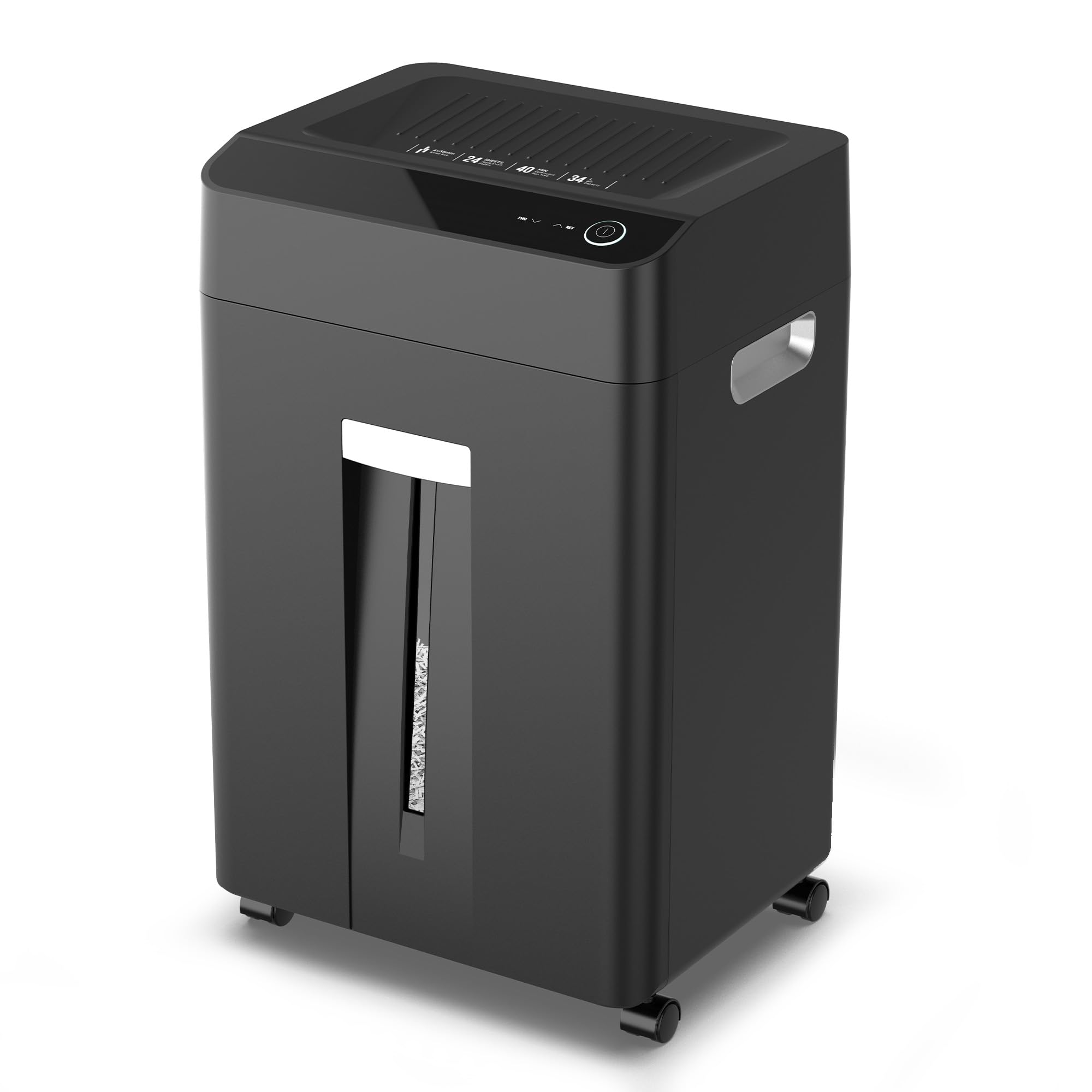
How To Choose The Best Heavy Duty Paper Shredder
A heavy duty shredder is defined less by sheets per pass than by continuous run time before cooldown. A machine that eats 24 sheets but stops after 10 minutes leaves you with a half-finished pile and a cooling-down timer. Start with run time, then narrow by security level and bin capacity.
Run time before sheet count
The run-time figure tells you how many minutes the motor works before it needs a cooldown. Heavy-duty models here range from 30 minutes up to 60 minutes of continuous shredding. If you empty a filing cabinet at tax time, a 60-minute unit finishes the job in one sitting. A 30-minute unit means a break halfway through.
Security level: cross-cut versus micro-cut
Security level describes how small the pieces get. A P-4 rated cross-cut turns a page into particles measured in fractions of an inch. A P-5 rated micro-cut slices it far smaller — one model here cuts a letter-size page into roughly 2,592 particles. Micro-cut is the safer choice for documents carrying account numbers or medical details.
Auto-feed versus manual feed
An auto-feed tray lets you drop a whole stack in and walk away — models here hold anywhere from 120 to 300 sheets that way. The manual slot handles staples, credit cards and paper clips, and usually takes a smaller number of sheets at once. Most offices want both: the tray for stacks, the slot for staples and cards.
Bin size and machine weight
Bin capacity in gallons sets how often you stop to empty. A 9-gallon bin holds far more than a 5-gallon one, so a busy office empties less often. Weight matters too: a 55.1-pound machine is a permanent fixture, while a 23.1-pound unit on casters rolls where you need it.
Noise and jam-proofing
Noise is measured in decibels (dB), and the closer to 58 dB, the less your office notices it running. Jam-proofing comes in two forms: an auto-reverse that backs paper out when it senses a blockage, and a dedicated jam-proof system that stops the feed before it clogs. Both save you from picking shredded paper out of the blades.
Side-by-Side Comparison
| Model | Best For | Run Time | Sheet Capacity | Bin Size | Amazon |
|---|---|---|---|---|---|
| Fellowes Powershred 99Ci★ Best Overall | Shared offices that want near-silent running | 30 minutes | 18 sheets | 9 gallons | Amazon |
| Bonsaii 18-Sheet Cross-CutLongest Run | Long shredding sessions on a tighter budget | 60 minutes | 18 sheets | 6 gallons | Amazon |
| Locksworth 24-Sheet Cross CutBest Security | High-security paperwork in a small footprint | 40 minutes | 24 sheets | 9 gallons | Amazon |
| Aurora AU1680MA Micro-Cut | Tiny particles with a full hour of running | 60 minutes | 16 sheets | 7 gallons | Amazon |
| Amazon Basics 200-Sheet Auto Feed | Large auto-feed loads without a premium layout | 60 minutes auto | 200 sheets auto | 8.5 gallons | Amazon |
| BONSEN 300-Sheet Auto Feed | Bulk confidential files in a quiet workspace | 60 minutes auto | 300 sheets auto | 8.1 gallons | Amazon |
| Aurora AU200MA Commercial | High-volume P-5 security in a busy office | 60 minutes | 200 sheets auto | 8.5 gallons | Amazon |
| Fellowes Powershred 125Ci | Big-bin continuous work with a jam-proof system | 45 minutes | 20 sheets | 14 gallons | Amazon |
Detailed Reviews
1. Fellowes Powershred 99Ci 18-Sheet Crosscut Shredder
Our pick — 4.5+★ from 11,000+ verified ratings; the strongest balance of quality and price.
The office shredder that swallows 18 sheets and barely raises its voice.
If your shredder sits in a shared room, noise is the first thing you notice. This machine runs at 62.1 dB, which is close to normal conversation — you can keep talking while it chews through a stack. The 18-sheet pass handles most everyday batches without you counting pages, and it also takes staples, credit cards, paper clips and CDs.
The security comes from 397 cross-cut particles per page at Level P-4 — small confetti pieces rather than long readable strips, so account numbers don’t survive the bin. The 9-gallon pull-out bin holds a serious volume before the LED bin-full light asks you to empty it. Run time is 30 minutes before a cooldown, and the jam-proof system backs paper out automatically when a feed goes wrong.
Fellowes also builds in SafeSense, a sensor that shuts the machine off the moment a hand touches the paper opening — worth knowing if kids or pets share the room. What wins offices over is the build quality; this is the machine people describe as the best they’ve owned. The honest trade-off is heft: at 36.4 pounds it stays put, and at 62.1 dB versus the Bonsaii’s 62 dB the two are effectively tied on noise. Fewer total ratings sit behind it than some budget picks, but the score holds at 4.5+ stars across 11,000+ ratings.
Where it earns the top slot
- 18-sheet pass at Level P-4 with 397 particles per page
- SafeSense stops the blades when a hand nears the opening
- 9-gallon bin keeps emptying trips rare
- Runs at 62.1 dB — quiet enough for a shared office
What to weigh first
- 30-minute run time means a mid-job cooldown on huge purges
- 36.4 pounds is a permanent placement, not a roll-away unit
The call: Buy this if your shredder lives in a shared space and you want jam-proofing plus a big bin.
Think twice: A 30-minute duty cycle will interrupt anyone clearing an entire filing cabinet in one go.
2. Bonsaii 18-Sheet Cross-Cut Paper Shredder
Double the run time of the Fellowes, at roughly half its weight on wheels.
A 60-minute continuous run is the number that changes a workday. You load the office’s whole backlog, and the machine keeps cutting for an hour before it needs a rest — twice the 30 minutes the Fellowes 99Ci manages. It handles 18 sheets per pass, shreds down to P-4 at 13/64 x 63/64 inches, and takes credit cards and staples without complaint.
At 23.1 pounds it is the lighter office machine here, and four casters let you roll it between desks. The 6-gallon pull-out basket holds more than 400 sheets of A4 before it needs emptying, with a transparent window so you can see the level. Noise sits at 62 dB, and the auto reverse plus overload protection keep a stray thick envelope from stalling the job.
The catch sits in the long-haul record. Durability and reliability come out mixed in owner feedback — some machines run for years, others quit within months, and the wheels have been known to snap. Buy it for the run time and the price-to-capability balance, and treat it as a machine that earns its keep rather than a lifer.
Why the hour matters: If your shredding days are batch days — tax season, an office move, a clear-out — a machine that runs twice as long as the Fellowes finish in one pass instead of two.
Keep in mind: The 6-gallon bin is smaller than the 9-gallon bins on several rivals here, so long sessions mean more emptying.
Reach for this if: You want the longest run time per dollar and need to roll the unit around.
Look elsewhere if: You need a machine with a spotless long-term reliability record above all else.
3. Locksworth 24-Sheet Cross Cut Paper Shredder, 9 Gallon
P-5 security and a 9-gallon bin in a body that tucks under a desk.
This is the pick for anyone shredding documents they truly cannot lose. It cuts to P-5, the higher security tier, turning paper into 5/32 x 1-12/32 inch particles — far smaller than a standard cross-cut strip. It takes 24 sheets per pass, plus credit cards, staples, clips and CDs.
Run time is 40 minutes, enough to process a large batch before the 60-minute cooldown, and the REV function clears jams and sweeps dust from the blades. The 9-gallon pull-out bin holds around 650 sheets, and it stops the moment you pull the bin out so nothing flies. Four casters make it easy to shift.
Owners describe it as compact enough to fit almost anywhere and fast enough to clear several months of paperwork in well under half an hour. One thing worth knowing: the bin capacity here is 9 gallons against the Aurora AU125MA’s 5 gallons, so you empty far less often. This is a newer listing with a smaller review base than the veterans, but the feedback lands positive on performance and ease of use.
The security argument: P-5 particles are the smallest cut on this list, and for tax files or client records that difference is the whole point.
The fit note: At 24 sheets per pass it is not the bulk-feeder the auto-feed machines are — you still load by hand.
Pick it for: Sensitive documents that need the smallest particle size and a bin you rarely empty.
Skip it for: Hands-free processing of 200-page stacks — that is auto-feed territory.
4. Aurora AU125MA Micro-Cut Shredder

The auto-feed tray that takes 160 sheets — nearly nine times the Fellowes’ 18-sheet pass.
The number here is 160: drop that many sheets into the auto tray and the machine feeds them itself. For comparison, the Fellowes 99Ci handles 18 sheets in a manual pass — a 8.9x gap in one-load capacity. The manual slot takes 12 sheets and handles the mixed stuff — mail, cards, staples — that the auto tray cannot.
In auto mode you get 60 minutes of continuous shredding before a cooldown, and 10 minutes in manual mode with the same cooldown. Security is P-4 micro-cut at 5/32″ x 15/32″ (4 x 12 mm) particles. The 6-gallon pullout bin trims emptying, and 360° casters let you roll it around the workspace.
What buyers like most is the build and the quiet — it runs without announcing itself. The fair warning is reliability: some units run great, others stall early, so it pays to feed within its rated counts and keep the tray clean. Treat the auto feed as a convenience, not a licence to overstuff.
The capacity play: 160 sheets per auto load means a whole in-tray goes in at once, versus hand-feeding 18 at a time on a conventional cross-cut machine.
Mind the manual limit: Manual mode runs only 10 minutes before cooldown, so mixed-material jobs are best spread out.
Suits you if: A big auto tray and quiet running are your priorities over long-term track record.
Second thoughts if: You want the most proven reliability on the list — this one is a newer model with a smaller history.
5. Aurora AU1680MA Micro-Cut Shredder

A full hour of cutting, and the pieces are small enough to lose in a bin.
Micro-cut is the headline: this machine shreds to 5/32 by 15/32 inches at P-4, and it destroys CDs, DVDs, credit cards and small paper clips too. Sixteen sheets per pass is the manual load. The 60-minute continuous run time is the equal of any machine on this list and double the 30 minutes the Fellowes 99Ci allows.
Auto-reverse clears paper jams, the 7-gallon pullout bin has the same LED status readouts as the rest of the Aurora line (standby, overheat, bin-full, overload, door open), and it runs quietly. Buyers find it performs better than expected, empty easily and cut into very small bits, though value opinions split toward overpriced for some.
It’s a heavier machine at 36.2 pounds, so plan a permanent spot. If security and run time top your list and you don’t need a big auto tray, this hits both.
The security cut: Micro-cut at 5/32 by 15/32 inches leaves far less on the page than a standard cross-cut — a real privacy upgrade.
Be aware: 16 sheets per pass is modest, so heavy stacks go through in several batches.
Worth it for: Anyone prioritizing micro-cut security and a full hour of run time without an auto tray.
Not for: Offices that process stacks of 100+ pages — the 16-sheet manual pass will slow you down.
6. Amazon Basics 200-Sheet Auto Feed Cross-Cut Paper Shredder

The 200-sheet auto tray plus the largest bin of the auto-feeders: 8.5 gallons.
Load 200 sheets into the auto tray and it handles them without you removing staples — that is the pitch, and it is a strong one for monthly clear-outs. The manual slot takes 10 sheets for single pages. Cross-cut is P-4 at 5/32 x 25/32 inches. Run time is 60 minutes in auto mode and 10 minutes in manual, with a 45-minute cooldown between long sessions.
The 8.5-gallon pullout bin tops the auto-feed group on capacity, with LED indicators for feed error, bin-full, door-open, overload and overheat, plus an energy-saving sleep mode and automatic motor shut-off. A 4-mode switch (Auto, Off, Forward, Reverse) gives you manual jam control.
Owners call it reliable and good value, but durability is the split: some run for years, others quit within a month. The bin fills quickly for some, and the size feels smaller than expected to others. It is a strong value play if you accept it as a workhorse rather than an heirloom.
What makes the case
- 200-sheet auto feed and an 8.5-gallon bin
- Shreds staples without removal
- Sleep mode and auto motor shut-off
- 4-mode switch for manual jam control
What to go in expecting
- Durability splits in owner reports — some units quit early
- Manual mode runs only 10 minutes before cooldown
The value read: Big auto-feed capacity and a deep bin without a premium layout.
Give it a pass if: You want the longest proven lifespan — the track record here is mixed.
7. BONSEN 300-Sheet Micro Cut Paper Shredder
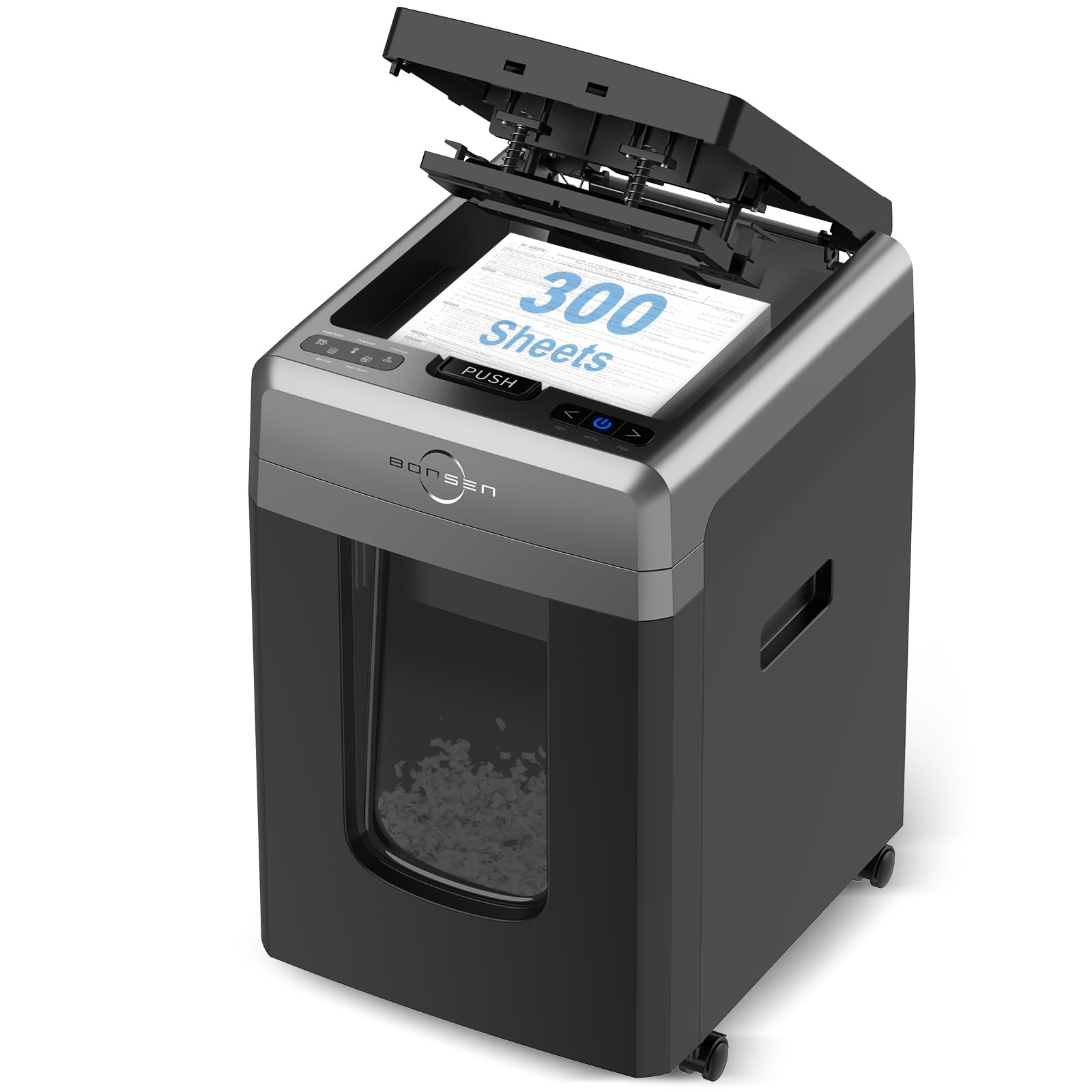
300 sheets in the tray, and a 58 dB whisper while it eats them.
Load up to 300 letter-size sheets in the auto tray — the largest single-load capacity in this guide — and it runs hands-free for 60 minutes in auto mode. The manual slot takes 12 sheets, plus credit cards, staples and clips. Cutting is P-4 micro-cut (a security level that turns paper into tiny particles) at 5/32″ x 15/32″ particles, so sensitive documents are hard to reconstruct.
Noise is where this separates itself: 58 dB, the lowest figure on the list, and well below the 62 dB the Bonsaii and Fellowes 99Ci sit at. It also goes into auto-sleep after 10 minutes idle, which saves power. The 8.1-gallon pullout bin with casters cuts emptying trips, and 1-year customer support backs the purchase.
The honest catch is dust: fine particles gather on the top and around the machine during long auto-feed runs. Speed opinions split, too — some call it a time saver, others slow. Neither undercuts the core appeal: a huge tray, quiet cutting, and heavy-duty volume in one machine.
The quiet argument: At 58 dB this is the least intrusive machine here — the difference matters in a shared or open-plan office.
Where it needs checking: Dust builds up on long runs, so plan to wipe the housing and around the blades.
Choose this if: A 300-sheet auto tray and the quietest motor here match how you work.
Look past it if: You want the fastest cut available and can’t live with a steady dust wipe-down.
8. Aurora AU200MA Micro-Cut Shredder

200 sheets auto-fed at P-5 security, with an 8.5-gallon bin underneath.
This is where security and volume converge: a 200-sheet auto-feed tray, a 10-sheet manual slot, and P-5 micro-cut that turns each letter-size page into about 2,592 particles at 5/64 by 15/32 inches. Run time is a full 60 minutes continuous, with auto-reverse for jams and an auto power-sleep to save energy.
The 8.5-gallon pullout bin has LED readouts for standby, overheat, bin-full, overload, door open — the same diagnostic set the rest of the Aurora line carries. It runs quietly, which matters when it’s chewing a 200-page stack beside a desk. The machine draws on 120 volts at 60 Hz.
Performance earns its praise here — this is a quality machine owners recommend. The caveats are realistic: the bin fills faster than the 200-sheet tray suggests, and a few units fail early. Feed within the rated counts and it holds up.
Why the combo sells: P-5 security plus a 200-sheet auto tray is the closest thing here to a set-and-leave confidential shredder.
The trade-off to accept: An 8.5-gallon bin still needs frequent emptying when you are feeding 200 sheets at a time.
Built for: Offices that handle high volumes of confidential paper and want hands-free feeding.
Less ideal if: Emptying often bothers you — the bin is the bottleneck on big loads.
9. Fellowes Powershred 125Ci 20-Sheet Crosscut Shredder

The 14-gallon bin that turns emptying into a weekly chore, not a daily one.
Empty the bin less often: 14 gallons is the largest bin in this guide, and the reason a busy office might choose it over the more compact auto-feeders. It takes 20 sheets per pass and cuts to 397 P-4 cross-cut particles (small pieces that meet a security level), shredding staples, credit cards, paper clips, CDs and junk mail. Run time is 45 minutes before a cooldown.
The 100% Jam Proof System is Fellowes’ dedicated anti-jam build, and SafeSense stops the blades the moment a hand touches the paper opening. At 55.1 pounds it is the heaviest machine here — a permanent fixture that stays where you put it. It runs at 63 dB, a touch louder than the 99Ci’s 62.1 dB.
Buyers report it handles large batches and suits offices. Feedback splits on durability and value: some report long, sturdy service, others see it fail after extended use. If you want a big-bin crosscut with a proven anti-jam system, this is the senior option.
Why offices pick it
- 14-gallon bin — empty far less often
- 100% Jam Proof System plus SafeSense hand sensor
- 20-sheet pass at P-4 cross-cut
- Shreds staples, cards, CDs and junk mail
The honest caveats
- 55.1 pounds is not a machine you move around
- Durability and value split in owner experience
The verdict: The big-bin, anti-jam senior pick for a permanent office spot.
Consider the alternative if: You need portability or an auto-feed tray — this is fixed and manual.
Know the Specs
Continuous run time and cooldown
Run time is the number of minutes the motor works before it must cool. A 30-minute unit suits moderate daily batches; a 60-minute unit clears a filing cabinet in one sitting. Cooldown is the wait afterward — often equal to the run time — so longer runs mean fewer interruptions across the day.
Security levels P-4 and P-5
P-4 and P-5 describe how small the cut particles are. P-5 micro-cut produces smaller pieces than standard P-4 cross-cut, which makes reconstruction much harder. Particle size is given in fractions of an inch or millimetres — smaller is more secure, at the cost of faster bin fill.
Auto feed versus manual feed
An auto-feed tray takes a whole stack and feeds it hands-free — capacities here run from 120 to 300 sheets. The manual slot handles odd pages, staples and cards, usually up to around 12 sheets. Most offices benefit from both because the auto tray cannot take mixed material.
Bin capacity and weight
Bin capacity in gallons sets how often you stop to empty. A 9-gallon bin holds far more paper than a 5-gallon one. Weight, meanwhile, decides placement: a 23-pound unit on casters rolls around; a 55-pound unit is parked for good.
Common Questions
How long can a heavy duty shredder run before it needs to cool down?
What is the difference between P-4 and P-5 security on a shredder?
Can an auto-feed shredder handle staples and credit cards?
How often will I have to empty the bin on a heavy duty shredder?
Do I need an auto-feed tray or is manual enough?
Are heavy duty shredders noisy enough to disturb an office?
Can these shredders destroy CDs and DVDs?
How heavy is a heavy duty shredder and can I move it?
Will a micro-cut shredder fill its bin faster than a cross-cut one?
Do heavy duty shredders need special maintenance?
The Bottom Line
For the safest single bet, the Fellowes Powershred 99Ci combines a 9-gallon bin, 100% jam-proofing, SafeSense hand protection (a sensor that stops the blades when your hand gets close) and 62.1 dB quiet running (about as loud as a normal conversation). It holds the top overall position for that balance of quiet, secure, big-bin shredding. If a full hour of continuous running matters more to you than bin size, grab the Bonsaii 18-Sheet Cross-Cut and accept the smaller 6-gallon bin. And if you are clearing confidential filing cabinets hands-free, the BONSEN 300-Sheet Auto Feed gives you the biggest tray on the list at 300 sheets and the quietest motor here at 58 dB — the combination that makes bulk shredding feel almost invisible.
One nudge: the Fellowes 99Ci has built a genuinely large owner base for its quality and quiet build, and that depth of real-world feedback is exactly what you want behind a machine you will run for years. Pick the tier that matches your workload — auto-feed for bulk piles, micro-cut for the most sensitive paper — and every pick here will outwork the ten-minute home unit that started this hunt.
How we choose
We do not accept paid placement. Every pick is matched to a real buyer and a real use-case; we do not hands-on test units.
Sources
Specifications: manufacturer listings and product documentation. Review insights: verified customer reviews, as of November 2026. Pricing: not shown on this page (it changes often); check the current price via the retailer link.
As an Amazon Associate, Tactical Gear Guy earns from qualifying purchases. This does not affect which products we feature.