Specs are compiled from manufacturer listings and verified buyer reviews and can change over time — please confirm the key details on the product page before buying.
What do you need to keep running, and for how long? A camping weekend and a three-day blackout are two different jobs. The picks below split along that line. Small, quiet inverters (units that convert engine power to clean electricity for electronics) charge phones and run a fridge. Larger units carry a whole house on a transfer switch (a switch that connects your generator to home wiring). Start with the wattage you truly need, not the biggest number on the box.
This guide is built by comparing the manufacturers’ published specifications and the patterns across verified customer reviews, so you get each pick’s real strengths and trade-offs instead of marketing spin.
Every inverter here lists its running watts versus its peak watts, so you can quickly tell which models cover a refrigerator with room to spare. That gap between starting and running power is where most first-time buyers get tripped up, and it is the number to verify before you commit to any one of these top ranked generators.
Top Picks
How To Choose The Top Ranked Generators
The single biggest mistake is buying by peak wattage alone. Peak watts are a brief surge — the short burst a fridge compressor needs on startup. Running watts are what the unit sustains hour after hour, and that is the figure you add up across everything you plan to plug in. Match your real load to the running watts first, then confirm the peak figure covers whatever surges.
Running Watts Versus Peak Watts
Write down each appliance you need and its running watts, then total them. A generator rated at 4000 running watts with a 5000 peak handles a modest household load with headroom for startup surges. If your total lands close to the running number, you have no room for a motor kicking on. Leave a margin so a refrigerator or air conditioner can surge without tripping the overload protection.
Inverter Versus Open Frame
Inverter generators convert engine power to clean, stable electricity — often listed as total harmonic distortion (THD) under 3%. That cleanliness is what protects laptops, phones, and anything with a circuit board. Open frame units tend to be louder and heavier but push more raw wattage for the same engine size. For sensitive electronics, an inverter is the safer route.
Noise in Decibels at 23 Feet
Noise is quoted as decibels (dB) measured from 23 feet away, and the range across these units is wide. A model around 48 to 58 dB is conversation-level and campground-friendly. One near 70 dB is noticeably louder and better suited to a worksite or a backyard where nobody minds. If you camp near other people, that low dB figure is worth more than extra wattage.
Fuel Type and Runtime
Gasoline is the common fuel and gives the longest runtimes per tank. Dual fuel models also run on propane (LPG), which stores far longer without going stale and is handy for emergency backup. Runtime is usually quoted at 25% load, so a unit claiming many hours at light load will run far fewer hours when you load it heavily.
Side-by-Side Comparison
| Model | Best For | Running / Peak Watts | Fuel | Weight | Amazon |
|---|---|---|---|---|---|
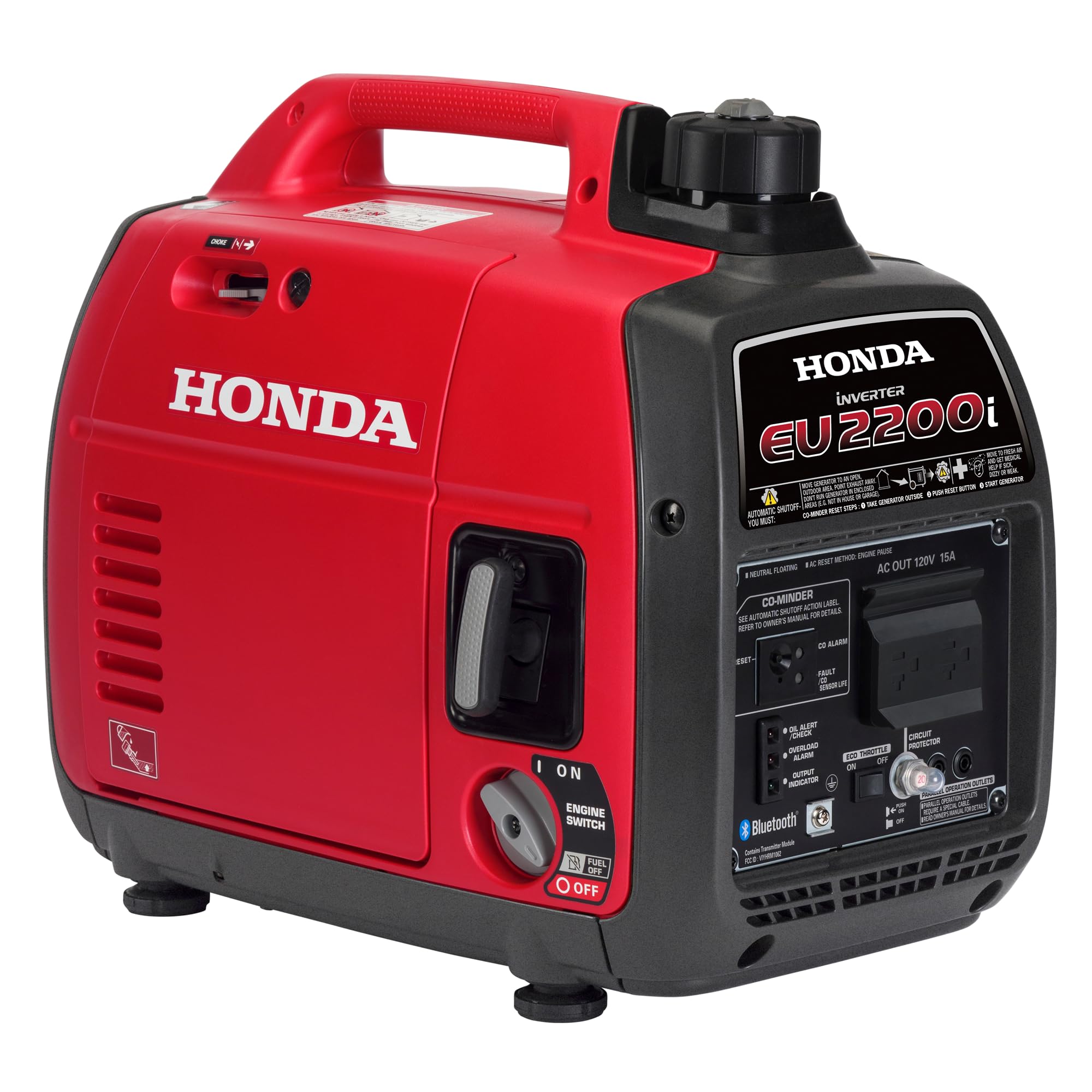
| Honda EU2200i★ Best Overall | Quiet camping and RV power | 2200 peak watts | Gasoline | 51 pounds | Amazon |
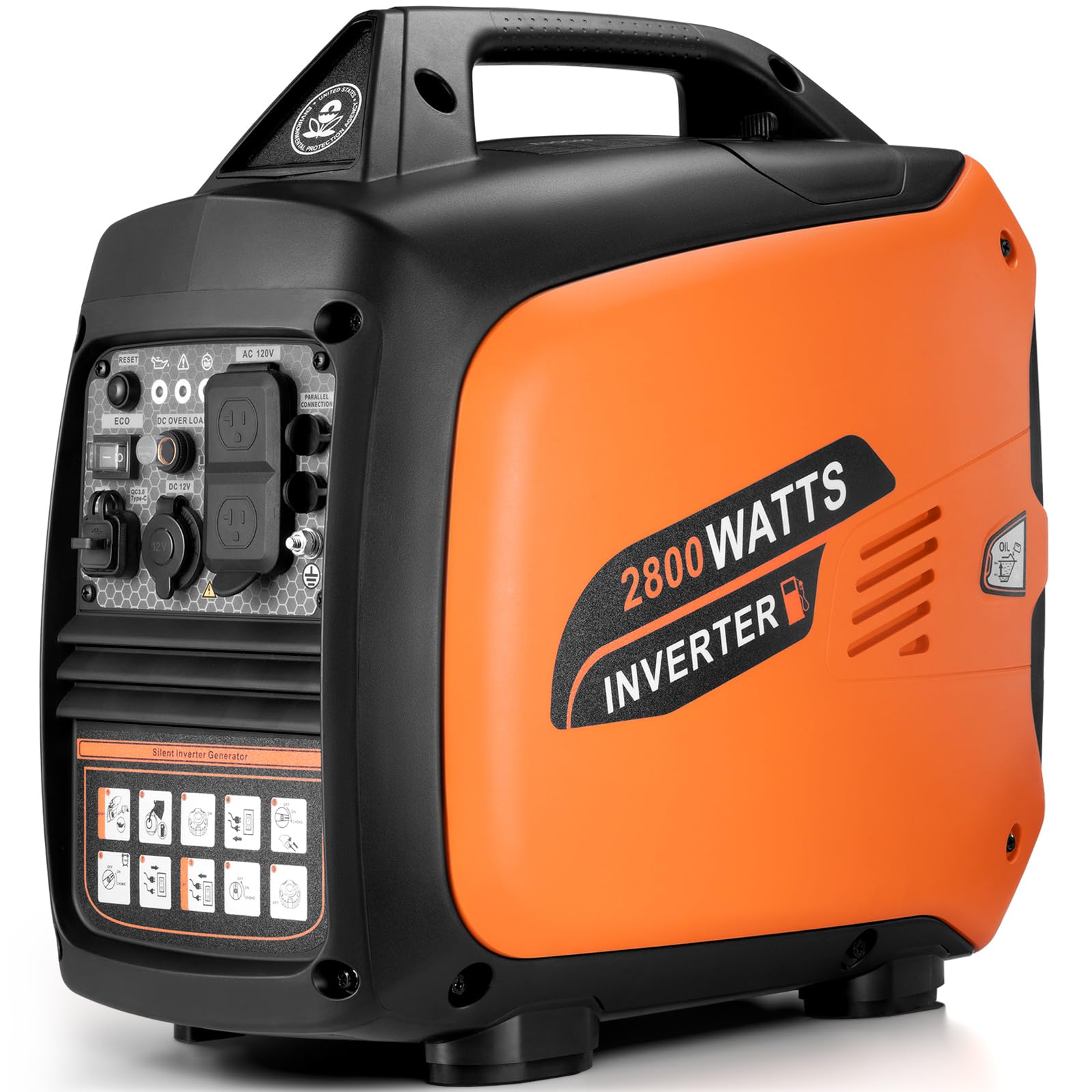
| 2800-Watt Oxseryn InverterBest Value | Budget-friendly home backup | 2000 running / 2800 peak watts | Gasoline | 40 pounds | Amazon |
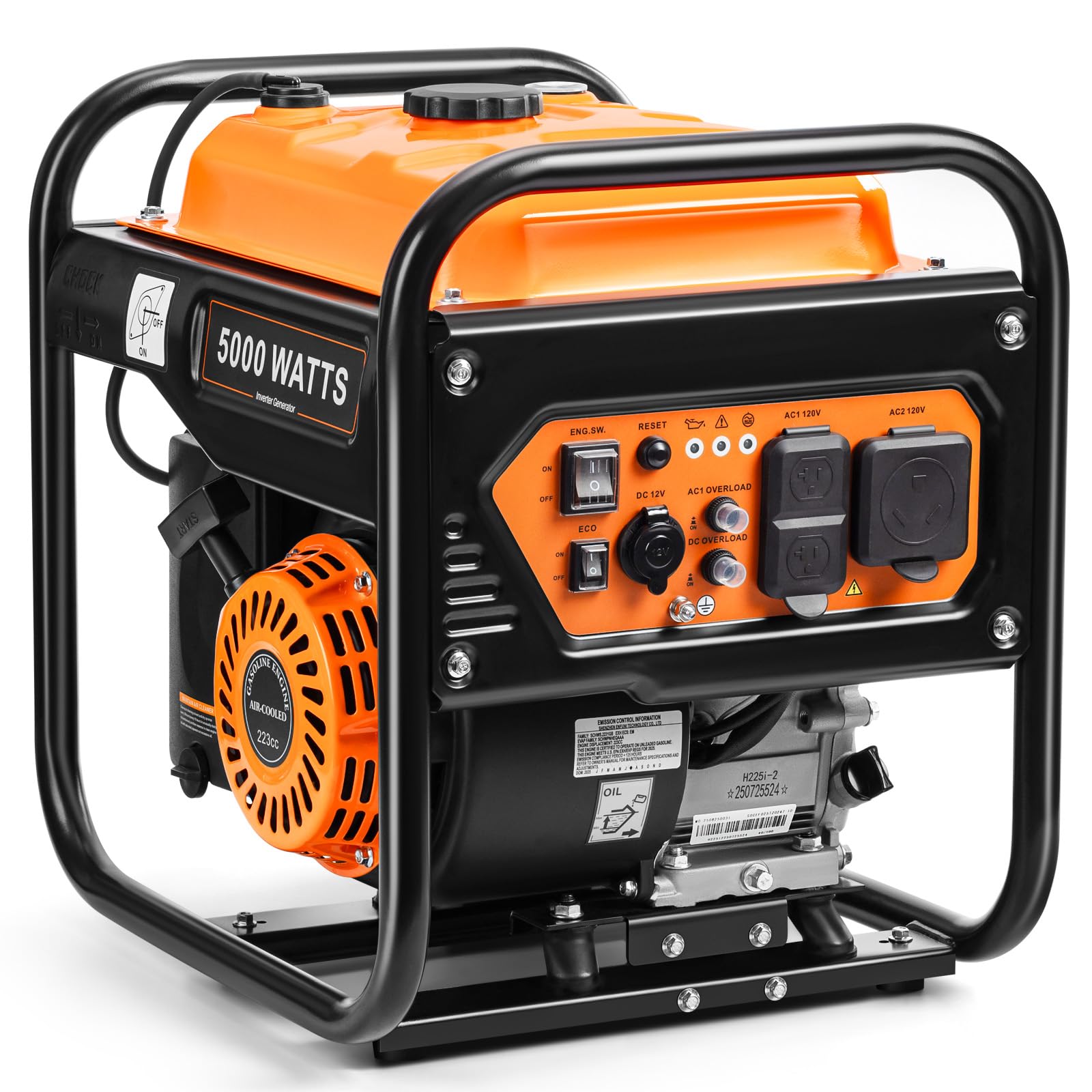
| 5000W Oxseryn Open FrameTop Performer | Power tools and RV campers | 4000 running / 5000 peak watts | Gasoline | 59 pounds | Amazon |
| Champion 4000-Watt | Light RV and tailgating | 3000 running / 4000 peak watts | Gasoline | 48.1 pounds | Amazon |
| WEN 56477i | RV-ready power and value | 4000 rated / 4800 surge watts | Gasoline | 72.7 pounds | Amazon |
| ERAYAK 4500W | RV air conditioning on a budget | 3500 running / 4500 peak watts | Gasoline | 55.12 pounds | Amazon |
| WEN DF480iX Dual Fuel | Propane backup flexibility | 4000 rated / 4800 surge watts (gas) | Gasoline or Propane | 78.5 pounds | Amazon |
| Westinghouse 4000 Peak Watt Dual Fuel | Remote start and portability | 3300 running / 4000 peak watts | Gasoline or Propane | 62.8 pounds | Amazon |
| PECRON F3000LFP | Indoor-safe battery backup | 3600 watts output | Battery / Solar | 63.3 pounds | Amazon |
| Westinghouse 12500 Peak Watt | Whole-home transfer switch backup | 9500 running / 12500 peak watts (gas) | Gasoline or Propane | 212.1 pounds | Amazon |
| SIOKIUU 2500W | Light camping and light backup | 1900 running / 2500 peak watts | Gasoline | 39.46 pounds | Amazon |
Detailed Reviews
1. Honda EU2200i 2200 Watt Inverter Generator (EU2200ITAN)
Our pick — 4.5+★ from 3,000+ verified ratings; the strongest balance of quality and price.
Quiet enough to hear a conversation over, small enough to carry at 51 pounds.
The number owners keep coming back to is quality, and it shows in how this unit holds up. Its 4.5+ star rating across a deep pool of camper and RV owner reviews is the highest on this list. You get a 2200-watt engine with a 121 cubic centimeter displacement (the size of the engine’s cylinders, which sets its power ceiling). For a small camping or RV setup, that is plenty to run a fridge, some lights, and a laptop.
What wins people over is the sound. Honda rates it at 48 to 57 dB(A), which is quieter than a normal conversation, so you can chat right beside it at a campground. If you have ever been the person whose generator drew a glare from the next site over, that figure alone is worth the consideration. The CO-MINDER carbon monoxide detection system is the other quiet hero — it shut the unit down automatically before CO levels climb too high, which is the safety feature you want overnight.
Controls live in the My Generator phone app over Bluetooth, so you can monitor and stop it remotely, and there is a 3-year residential warranty behind it. The trade-off is straight wattage: at 2200 peak, this is not the unit to run central air or a bank of power tools. Think of it as the weekend and small-backup pick for when quiet, clean power matters more than raw output.
Where It Shines
- 48 to 57 dB(A) operation is quieter than a normal conversation, so it suits close campgrounds
- CO-MINDER system shuts it down automatically if carbon monoxide rises
- Bluetooth app adds remote stop and monitoring plus service reminders
- 3-year residential warranty covers the unit end to end
Where It Tapers Off
- 2200 peak watts leaves no room for big motor loads or whole-home backup
- Not available in California, so residents need the listed alternate models
- The remote and app features are conveniences, not a substitute for the wattage it lacks
Settle on this if: You camp, travel by RV, or want a very quiet backup for a few essentials and prize low noise over big output.
Look elsewhere if: You need to start a large air conditioner or carry a whole house — the 2200 peak watts will not cover it.
2. 2800-Watts Portable Inverter Generator
The entry-friendly inverter that still protects your laptop with clean sine power.
For a first generator, the smartest place to start is clean power at a light weight — and this unit delivers both. Its inverter keeps total harmonic distortion under 3% so a laptop, phone, or drone charges safely. Peak output is 2800 watts with 2000 running watts from a 79.8 cubic centimeter engine, which is a real step up in capability over the small 2200-watt class.
The specs line up fairly against the 5000W open frame above: this one has a 79.8 cubic centimeter engine versus that model’s 223 cubic centimeters, and a 1.1 gallon tank versus the 2 gallon tank. Those gaps mean less raw muscle but a far easier unit to lift and store. It runs up to 9 hours at 25% load, and the fuel shutoff and ECO mode stretch a tank further. Ports include two 120V AC, one 12V DC, one USB, and one USB-C, so phones, cameras, and small tools all have a home.
The honest catch is altitude. If you regularly run above 4000 feet, the maker says you need a high-altitude kit (not included), or it may run rough and burn more fuel. At 40 pounds with a built-in handle, one adult can carry it to a campsite or a driveway without help. At 40 pounds, it is easy to haul out for occasional backup use.
The clean-power edge: Under 3% THD means sensitive electronics run without the jitter that damages boards over time, which matters if your backup is protecting a work laptop.
Know before you buy: The 2000 running watts suits a fridge and a few lights, but not one at a time with a big motor on top — budget the load carefully.
Reach for this if: You want a genuinely portable inverter that keeps electronics safe on camping trips or short outages.
Step up if: Your loads run heavy and constant, in which case more running watts than 2000 will serve you better.
3. 5000W Inverter Generator
A 223cc engine that throws clean sine wave power straight into an RV’s 30-amp port.
If your needs lean toward power tools and a serious camper, this open frame model earns its spot on raw capability. It puts out 4000 running watts and 5000 peak from a 223 cubic centimeter engine — a much larger displacement than the 2800-watt unit’s 79.8 cubic centimeters, and much more muscle to draw from. There is a genuine 30A RV outlet (the round plug many travel trailers use), so you can feed an RV directly instead of running adapters.
The 2 gallon tank with a built-in fuel gauge keeps you from guessing how much juice is left, and it runs up to 10 hours at 25% load. Performance is the aspect that carries this one — it does the work without drama, starting reliably on the first pull. It also feeds sensitive gear cleanly, since the inverter output is low in distortion, though the maker does not print a specific THD figure here.
What you trade is quiet. The advertised noise is 70 dBA at 23 feet, so this is not the unit for a quiet campground next to strangers — it belongs at a worksite or a backyard. At 59 pounds it is heavier than the small inverters too. And like the 2800-watt unit, it wants a high-altitude kit above 4000 feet. The built-in fuel gauge lets you check the tank without shutting down mid-job.
Why Owners Keep It
- 4000 running / 5000 peak watts handles multiple tools and appliances at once
- Dedicated 30A RV outlet feeds a travel trailer without adapters
- Built-in fuel gauge and 2 gallon tank support up to 10 hours at 25% load
Signature Hiccups
- 70 dBA at 23 feet is loud — fine for a worksite, tough next to campers
- 59 pounds means you will want help lifting it
- Needs a high-altitude kit above 4000 feet
Built for: People who want one generator to run power tools, a camper, and a few home essentials without stepping into heavy whole-home territory.
Not the ticket if: Quiet is high on your list, since it is the loudest pick here.
4. Champion 4000-Watt RV Ready Portable Inverter Generator

One of the lightest 4000-watt inverters around, at just under 49 pounds.
At 48.1 pounds, this is one of the lightest 4000-watt inverters in the industry, so one person can move it without much fuss. It gives you 3000 running watts (the power it delivers continuously) and 4000 starting watts (the extra surge to start motors) from a 149 cubic centimeter engine (about 9 cubic inches). That is enough to back up a few home essentials or run a tailgate, and light enough to lift into a truck bed.
Champion pitches the 64 dBA at 23 feet as ideal for camping and tailgating, and it is a fair middle ground between the whisper-quiet Honda and the loud open frame option. The CO Shield system shuts it down if carbon monoxide climbs, and there is a TT-30R RV outlet plus a household duplex outlet delivering clean power under 3% THD. Run time reaches up to 10 hours at 25% load.
The optional parallel kit lets two of these Champion units connect to double output. That makes it a sensible first buy: add a second unit later instead of replacing this one. Consider this the weekend-warrior pick that keeps a friendly weight for one person.
Light-footed power: 3000 running watts at under 49 pounds is a rare pairing, and it keeps the tailgate and small-backup jobs within reach for a solo owner.
the balance for: Campers, tailgaters, and anyone who would rather carry their generator than wheel it.
Consider a bigger unit if: You need to run a large compressor or a full house — 3000 running watts has its limits.
5. WEN 4800-Watt Portable Inverter Generator (56477i)

The camper’s favorite: wheels, a pull handle, and enough juice for AC and a fridge.
This one is built to move with a camper, and it shows — onboard wheels and a telescoping pull handle mean you roll it rather than carry it. A 224 cubic centimeter engine produces 4800 surge watts and 4000 rated watts, which is enough to run a 50-amp camper without complaint and keep the AC, lights, fridge, and microwave going.
Power delivery is where it earns its fans. It runs an RV air conditioner alongside a fridge and still has room for smaller loads, and it starts right up with the first pull. The WEN Watchdog CO sensor shuts it off automatically if carbon monoxide rises, and the fuel shutoff drains the carburetor before storage to help the engine last. An onboard RV receptacle, four 120V outlets, a 12V DC, and two USB ports cover just about everything you would plug in.
Reliability and quiet operation both rate highly, alongside the performance itself. The reality check is the 72.7 pounds on the spec sheet — the wheels do the lifting, but you still need to get it in and out of a vehicle. For someone who camps regularly and wants a single unit that carries the load, this is a serious contender.
The camper fit: 4800 surge watts, a TT-30R RV port, and wheels make this a one-unit RV solution that runs AC and fridge together.
Hassle to plan for: At 72.7 pounds it is at the heavy end for a portable — rolling helps, but lifting is a two-hand job.
Go here for: RV owners who want to run real campers off one generator without upgrading to a heavy open frame unit.
Pass it by if: You need to lug it up stairs often — the weight makes carrying less pleasant than rolling.
6. ERAYAK 4500W Portable Quiet Inverter Generator

Quiet, compact, and genuinely up for an RV air conditioner and fridge at once.
At 60.5 dB(A) from a short distance, this one sits comfortably in the quiet crowd — the sort of level that will not clear a campground. It delivers 4500 peak watts and 3500 running watts from a 208 cubic centimeter engine, and its inverter keeps power clean enough for laptops, CPAP machines, and phones. That is a serious load for a unit that weighs 55.12 pounds.
The standout feature is 50A parallel capability. Connect two units with the separately sold kit and you get a rated 7,000 watts and peak 9,000 watts with a 50A output — so one unit covers most campers, and two cover a serious rig. Ports are generous: a 30A TT-30R for RV service, two 120V AC outlets, a 12V cigarette port, and USB-A and USB-C, all protected by 20A and 30A breakers.
If you want to keep an eye on the trade-off, the engine is a modest 208 cubic centimeters, so it leans on its inverter design rather than sheer displacement. It handles an RV AC and fridge simultaneously well, but if you plan to run air conditioning at full bore for hours, two units in parallel is the realistic play. A wheel kit and telescoping handle boost mobility.
Worth it for: RV households that want quiet output now and a clear path to doubling power later via parallel kits.
Think twice if: You want a single unit to run a big air conditioner all day — the 3500 running watts work better with a second unit alongside.
7. WEN 4800-Watt Dual Fuel Portable Inverter Generator (DF480iX)

Runs on gasoline or propane, and starts with a button instead of a yank.
The dual-fuel angle is the reason to look here: a 224 cubic centimeter engine runs on gasoline for 4800 surge and 4000 rated watts, or on propane for 4320 surge and 4000 rated watts. Propane stores for the long haul without getting stale, which is exactly what you want for an emergency unit that sits in the garage. The electric start makes it a one-button job rather than a pull-start ritual.
WEN turns the noise claim into a reference point — the maker says the operation is comparable to a normal conversation, per the US Department of Health and Human Services, and users back up the description. A tool-free LPG quick-connector lets you hook up a propane tank without tools, and the WEN Watchdog CO sensor shuts it off automatically if carbon monoxide spikes. It ships with four 120V outlets, one TT-30R RV port, a 12V DC, and two USB ports.
The check here is weight — 78.5 pounds on the spec sheet, plus onboard wheels and a telescoping pull handle to help you move it. If you want propane backup without giving up gasoline convenience, this covers both without a separate purchase. Think of it as outage insurance that does not hinge on a single fuel supply.
The Dual-Fuel Argument
- Runs on gasoline or propane, so backup is not tied to one fuel
- Electric start plus CO Watchdog shutdown and fuel shut-off
- Four 120V outlets, a TT-30R RV port, and a tool-free LPG quick-connector
The Practical Catch
- 78.5 pounds makes it genuinely heavy to lift between uses
- Propane output runs slightly below the gasoline surge figure
- You supply your own propane tank for the dual-fuel setup
The right call for: Preppers and home-backup owners who value a second fuel type, plus the convenience of electric start.
Look past it if: Portability tops your list — the weight points to a wheeled spot near the house.
8. Westinghouse 4000 Peak Watt Dual Fuel Portable Inverter Generator

Push a key fob and it fires up from across the campsite — gas or propane, your choice.
The remote start is the head-turner here: a key fob starts the unit from a distance, with electric and recoil backup right on the machine. It runs 4000 peak watts and 3300 rated watts at less than 3% THD, so your electronics stay safe. It works from either gasoline or propane, and a five-part digital data center rotates through fuel level, power output, remaining run time, voltage, and lifetime hours.
The spec that stands out is the noise — as low as 52 dBA, which is a genuinely quiet camping number. Combined with up to 7 hours of run time on a 1.69 gallon gas tank and an Economy Mode, it stretches fuel while keeping things civil. There is an RV-ready TT-30R 30 amp outlet, a duplex household outlet, and two USB outlets, and it will run a 15K RV air conditioner, per owner reports.
The tell is that this is a compact, mid-weight 62.8-pound unit rather than a high-capacity whole-home machine — 3300 running watts covers a camper’s essentials and a few home items, not everything you own. Dual fuel flexibility plus the remote start is a rare pairing in a rig this size. Auto low-oil and CO shutdown round out the safety side.
The campsite convenience: Remote key-fob start plus 52 dBA noise and an RV-ready 30 amp outlet is a combo built for trailer life.
Balance the load: 3300 running watts covers a camper and a few household items, but a full house will strain it.
Best matched to: Travel-trailer owners who want one-button start and a quiet engine at the site.
Hop past it if: You need to back up a large home through a transfer switch — this unit is sized for travel trailers, not whole houses.
9. PECRON F3000LFP Portable Power Station

No fuel, no fumes — a 3072Wh battery that can run a fridge indoors without a CO worry.
This is the one that changes the rules of the category. There is no gas engine and no exhaust, just a 3072Wh LiFePO4 battery (a lithium-iron-phosphate chemistry known for a long service life) feeding 3600 watts of pure sine wave output. That capacity is enough to back up home essentials for 2-3 days, and you can power 13 devices at once — six AC outlets, two 100W USB-C PD ports, two 18W USB-A, a carport, and two DC outputs.
Charging is quick for a battery this size: 0% to 100% in about 2 hours on AC (1800W max), or by solar (1600W max) or car, and you can combine AC, solar, and car charging. The UPS mode switches in 8-20ms, which keeps a computer or medical device from blinking out during a power cut — something a gas generator simply cannot do without being already running. A companion app lets you watch real-time power use.
The honest limits: 63.3 pounds makes this a stationary backup rather than a carry-around unit, and the fan runs loud under heavy load. The battery life and durability aspect draws mixed feedback, and weight is the one true letdown for people who expected to haul it easily. Compared with the gas options above, you trade endless runtime for silent, indoor-safe operation and instant UPS switching.
The No-Fume Advantage
- 3600W pure sine wave output with 3072Wh capacity for 2-3 days of essentials
- 8-20ms UPS switching protects computers during a cut
- Fast 0-100% AC recharge in about 2 hours
The Real-World Limits
- 63.3 pounds makes it hard to move
- Fan noise can get loud under heavy draw
- Run time is finite — a gas unit can refill and keep going
The winner for: Indoors and apartments where fumes and noise from a gas unit would be a problem, or as UPS insurance for work equipment.
Not for: Multi-day off-grid power or long heavy runs where a gas generator’s refillable runtime matters more.
10. Westinghouse 12500 Peak Watt Dual Fuel Portable Generator

A 457cc dual-fuel monster built to carry an entire house through an outage.
This is the whole-home unit, and its numbers are in a different league from the portables above. It pushes 9500 running and 12500 peak watts on gasoline, or 8500 running and 11200 peak on propane, from a heavy-duty 457 cubic centimeter Westinghouse OHV engine with a cast iron sleeve. That is enough to run an entire house and a 41-foot trailer, and the transfer switch-ready L14-30R makes connecting to a home setup straightforward.
Setup is a strong point — attaching the wheels is simple, and the control panel is intuitive enough to figure out without the manual. The engine has automatic low-oil and CO shutdown, and a digital hour meter tracks use. Remote start with an included key fob and electric plus recoil start means you are not pulling a cord in the rain. Up to 12 hours of run time on a 6.6 gallon fuel tank with a gauge keeps you through an extended outage.
The catch is unmistakable at 212.1 pounds — this is a wheeled, garage-resident machine, not something you toss in a truck bed for a weekend. It also wants the proper transfer switch wiring to feed a house, which is an install job. Plan for a permanent home for it, and it will handle the big storm season when you need it most.
Raw capacity: 9500 running watts on gasoline and a 457cc cast-iron-sleeved engine make this the one unit here that can genuinely run a whole house.
The layout reality: 212.1 pounds and transfer-switch wiring mean you store it remotely and treat it as fixed equipment, not a portable.
Made for: Homeowners preparing for extended outages who will wire a transfer switch and keep it on wheels in the garage.
Wrong tool if: You camp or need something you can lift — this belongs in the driveway.
11. SIOKIUU 2500W Portable Inverter Generator

The lightest of the bunch — 39.46 pounds and up to 17 hours on a fill.
This one wins on weight and runtime. At 39.46 pounds it is the lightest unit here, light enough to carry to a treestand blind or a campsite with one hand on the grip. Its 1.06 gallon tank runs up to 17 hours at 25% load, or 8.6 hours at 50% — the longest light-load runtime on this list. An 80 cubic centimeter 4-stroke engine makes 2500 peak watts and 1900 running watts of clean power under 3% THD.
For sensitive electronics, that clean output is the selling point: it handles laptops, phones, drones, and cameras safely, and the ECO mode and parallel function stretch a tank further. Quiet operation under 59 dBA from 23 feet keeps it polite, and the CO sensor shuts it down automatically if carbon monoxide climbs. A 3-year warranty with lifetime technical support sits behind it.
The fair caution is reliability. Reports run mixed — plenty perform flawlessly, but the durability record has not been as consistent as the bigger names. The reviewer note here is fair to repeat: buyers report it ran for 4+ hours without issues and praise its clean power and portability. Reserve it for light camping and light backup where its featherweight nature matters more than long-term certainty.
The Featherweight Case
- 39.46 pounds — the lightest unit here, easy to carry solo
- Up to 17 hours at 25% load on a 1.06 gallon tank
- Clean sub-3% THD output with CO sensor and 3-year warranty
The Trade-offs
- Reliability experience is mixed, so treat it as light-duty gear
- 1900 running watts is modest, best for phones and small tools
- Small 80cc engine limits what it can run at once
A match for: Campers and hunters who need something genuinely light to carry and only light loads to run.
Skip it for: Heavy, frequent use or big appliances where reliability and higher running watts matter more.
Know the Specs
Running vs Peak Watts
Peak watts are the brief surge a motor needs at startup; running watts are the constant load the unit sustains. Add up what you plug in to find your running figure, then confirm the peak number covers startup surges. A 4000 running / 5000 peak unit handles a fridge and a few lights comfortably; a 2000 running inverter suits lighter loads. Sizing to running watts prevents overload trips.
THD and Clean Power
Total harmonic distortion (THD) measures how clean the electricity is. A figure under 3% is what protects laptops, phones, and anything with a circuit board. Inverter generators are built to keep that low; open frame units tend to be louder and coarser. If electronics are your load, prioritize a low THD rating over extra raw wattage.
Energy Density and Battery Backup
A battery power station like the F3000LFP is measured in watt-hours (Wh). Its 3072Wh LiFePO4 capacity runs essentials for 2-3 days and can be recharged quickly. That makes it ideal for indoor, fume-free backup and UPS switching, but it cannot match a gas unit’s refillable, near-endless runtime for extended outages.
Fuel, Runtime, and Decibels
Runtime at 25% load is a light-load guideline; heavier loads use fuel faster. Gasoline gives the longest runtimes per tank, while propane (LPG) stores far longer without going stale and suits emergency backup. Noise is measured in decibels at 23 feet — roughly 48 to 58 dB is quiet and campground-friendly, while 70 dB suits a worksite.
Common Questions
Can the Honda EU2200i really run a small RV air conditioner?
Do I need a high-altitude kit for generators above 4000 feet?
What is the difference between an inverter generator and an open frame generator?
Can I run two generators together to double my power?
Is a dual fuel generator better than a gasoline-only one for emergency backup?
Can I use a battery power station instead of a gas generator?
How quiet is quiet enough for a campground?
What outlets do I need to plug in an RV?
How much runtime should I expect at full load?
Are these generators safe to run near a home or camper?
The Bottom Line
Start with your real load, not the biggest number. For quiet weekend power, the Honda EU2200i is the one to beat. It runs a small camper and sensitive electronics at 48 to 57 dB(A) (a noise level about as loud as a normal conversation), and its CO-MINDER shutdown (a sensor that turns off the generator if carbon monoxide builds up) adds confidence for overnight use. For a camper that needs AC and a fridge from one unit, the WEN 56477i rolls where you point it. For whole-house backup through a transfer switch, the Westinghouse 12500 Peak Watt is the heavyweight that can carry the load on gasoline or propane.
There is one more smart angle: if you want silence indoors and UPS switching to protect work equipment with no fuel at all, the PECRON F3000LFP battery station is the odd one out here in the best way. Its strong rating rests on a deep pool of owner reviews. Whichever way you go, match running watts first, then let the noise and fuel type settle the rest.
How we choose
We do not accept paid placement. Every pick is matched to a real buyer and a real use-case; we do not hands-on test units.
Sources
Specifications: manufacturer listings and product documentation. Review insights: verified customer reviews, as of November 2026. Pricing: not shown on this page (it changes often); check the current price via the retailer link.
As an Amazon Associate, Tactical Gear Guy earns from qualifying purchases. This does not affect which products we feature.