Specs are compiled from manufacturer listings and verified buyer reviews and can change over time — please confirm the key details on the product page before buying.
You want a built-in vacuum that pulls dust out of a hallway carpet from a unit bolted in the garage, and you want to know which power unit actually earns its wall brackets. The biggest confusion in this category is the gap between airwatts and water lift — one measures cleaning force, the other measures how high the suction can pull a column of water, and listings mix them freely. Below you get the honest read on eight systems, from a compact RV unit you can mount in a closet to a canister built for homes up to 9,000 square feet.
This guide is built by comparing the manufacturers’ published specifications and the patterns across verified customer reviews, so you get each pick’s real strengths and trade-offs instead of marketing spin.
Installation kits are where most first-time buyers get tripped up, since several of these power units arrive without the flex hose or intake fittings your walls need. What follows is a plain-English breakdown of the best Top Central Vacuum Systems, sorted by what each one is genuinely built to handle.
Top Picks


How To Choose The Best Top Central Vacuum Systems
Match the power unit to the space you need to cover first. A unit rated for up to 9,000 square feet (a large whole-house job) carries a different motor and canister than one built for a 30-foot RV. Buy too small and the suction fades the moment you attach a long hose.
Match the unit to your square footage and inlet count
The OVO 750 Airwatts model lists coverage up to 9,000 square feet and 8 inlets or more. The Imperium CV300 recommends itself for homes up to 7,500 square feet, and the Prolux CV12000 is rated for up to 8 outlets or 8,000 square feet. Pick by the outer edge of your home, not the average, because a unit that is maxed out on every run loses pull at the far inlet.
Understand what arrives in the box
A “system” in this category does not always mean a complete install. Some listings are power units only, and you supply the low-voltage hose, inlet valves, and pipe fittings yourself. Others include the hose and accessory kit. Read the included-components line before you assume you can mount it and start cleaning the same weekend.
Decide between bagged and bagless filtration
Pick your dirt-emptying style next. Disposable-bag units like the Broan-NuTone keep emptying clean, because you toss the bag and never touch the dust. Hybrid systems let you choose a bag or a washable filter. Cyclonic and cartridge designs skip bags entirely but ask you to clean filters and pails. The choice depends on whether you’d rather buy bags or handle dust directly.
Side-by-Side Comparison
| Model | Best For | Capacity | Motor / Airflow | Form Factor | Amazon |
|---|---|---|---|---|---|
| HP Products 9880 Dirt Devil★ Best Overall | RVs and tight mounts | 1 gallon | 100 CFM | Cannister | Amazon |
| RoadVac InterVac CS-RMMost Complete Kit | Boats, tiny homes, compact spaces | 4 pints | 11 A | Wall Mount | Amazon |
| OVO 700 Airwatts 25LBiggest Canister | Large homes on a budget | 25 liters | 700 airwatts / 140.2 CFM | Cannister | Amazon |
| Imperium CV300 | Quiet operation in big houses | 23.65 liters | 740 airwatts / 58 dB | Cannister | Amazon |
| Prolux CV12000 | Replacing an aging system | 14.2 liters | 142 CFM / 116″ water lift | Wall Mount | Amazon |
| Broan-NuTone PP5501 | Low-maintenance emptying | 6 gallons | 550 airwatts / 120′ suction | Upright | Amazon |
| OVO 750 Airwatts 35L | Very large homes with a full kit | 35 liters | 750 airwatts / 140.2 CFM | Cannister | Amazon |
| VacuMaid P125p | Big homes and cyclonic filtration | 6.75 gallons | 525 airwatts / 116 CFM | Cannister | Amazon |
Detailed Reviews
1. HP Products 9880 Dirt Devil Central Vacuum System
Our pick — 4.5+★ from 300+ verified ratings; the strongest balance of quality and price.
The compact power unit that turns a dinette cleanup into a back-bedroom sweep.
The HP Products 9880 lands first because it does the one thing a small-space vacuum must do: it reaches. The included hose runs from 7 feet to 35 feet, so you stretch it from the dinette to the back bedroom without unclipping a thing. Flow rate is 100 cubic feet per minute, which is the volume of air it moves each minute — enough on a rug to lift tracked-in grit, and the customers-say consensus backs that up.
Capacity is 1 gallon, which is the number to weigh against everything else here. That’s a fifth of the Broan-NuTone’s 6 gallons, so you empty this one far more often. For an RV, a boat, or a garage bay, that small pail is the point — it mounts in a tight cabinet and weighs 21 pounds. The 21.5″L x 14″W x 11.13″H body fits spaces where bigger canisters will not.
The ownership story is the interesting part. People who buy it for a travel trailer keep repeating the same note — they can’t get over the power coming out of a unit this small, especially in a rig with two heavy-shedding dogs. Setup is short and simple, though one thing catches nearly everyone: the listing doesn’t include the hose that runs from the unit to the intake port, so buy that fitting up front. Reach is the reason it wins — a 35-foot hose from a 1-gallon canister is a trade a lot of small-space owners happily make.
What makes it worth the wall bracket
- Hose stretches from 7 feet to 35 feet, so one reach covers a whole RV interior
- 21-pound body is easy to lift into an overhead cabinet or dinette bay
- 100 CFM airflow handles sand and pet hair on a compact build
Measure before you commit
- 1-gallon pail means frequent empties compared with a 6-gallon canister
- The hose from unit to intake port is not included — budget for it
Reach for this if: you’re outfitting an RV, travel trailer, or boat where a compact mount and a long stretch hose matter more than a huge pail.
Look elsewhere if: your home has several floors and you want to go weeks between empties — the small canister will have you back at it sooner.
2. RoadVac InterVac Design CS-RM RV Central Vacuum System
Wall-mounted, ready to run, and small enough to disappear into a closet corner.
Some out there come as a naked power unit and leave you hunting fittings. The RoadVac CS-RM is the opposite: the box carries the power unit, the stretch hose, and a full accessory kit, so it is a built-in vacuum solution you can run shortly after it is on the wall. The 35-foot stretch hose reaches the whole interior of a boat or trailer without moving the unit.
Space is the real selling point. The composite housing measures 11.75″L x 6″W x 6.75″H — compare that with the Imperium CV300 at 25.38″L x 12.88″W x 25.38″H and you get a sense of how much cabinet the smaller unit frees up. That footprint is why it suits tiny homes, kitchens in compact rigs, and anything without a dedicated mechanical bay.
Filtration runs through a cloth filter, and capacity sits at 4 pints, so this is a small-space machine first and a whole-house machine second. It draws 11 amps, which is the electrical load the unit pulls while running. The controller is manual and the mount is a straightforward wall fix, which is what you want in a tight, awkward spot. This one is for the buyer who values a complete box and a tiny footprint over raw airwatts.
Where the money goes: into completeness and compactness — the hose, accessory kit, and small composite body all ship together, and the 35-foot stretch hose is the kind of reach that saves you moving a mounted unit.
The trade to accept: 4 pints of capacity is the smallest bucket here except for the Dirt Devil, and a cloth filter means periodic cleaning rather than bag swaps. If you need to cover 8,000 square feet, look further down this page.
Built for: a boat owner, tiny-home dweller, or someone outfitting a kitchen nook who wants a full kit in one box and no floor clutter.
Not the one for: a full-size house with multiple inlets — the small capacity is a mismatch for heavy-weekly cleaning.
3. OVO Large Central Vacuum System
A 25-liter steel canister that treats a big house like a small job.
Here’s the number that decides it: 25 liters of capacity. Compare that with the Prolux CV12000 at 14.2 liters and the OVO holds noticeably more before you touch it. For a home with several inlets, that difference is fewer trips to the garage. The 5.7″ two-stage motor produces 700 airwatts and 140.2 CFM of airflow, and the unit is rated to cover up to 7,000 square feet across up to 7 inlets.
What wins people over is performance under load. The reports that keep surfacing are about suction that holds its pull — dog hair and sand disappearing off the floor, the motor still strong after swapping out an older system. Suction is the second-strongest theme in the feedback, right behind general performance, and the pattern is consistent: this thing cleans hard and keeps cleaning.
Hybrid filtration is the other draw. You can run a disposable triple-layer bag, which is included and recommended, or go bagless with the permanent washable filter. OVO claims the soft start-stop circuit adds 20% to motor life, and the integrated muffler with noise-blocking foam quiets the unit itself. One thing to plan for: the flexible connection hose isn’t included, so you may wait on a fitting before the install is done. Bottom-load steel canister, 7,000 square feet of reach, and a bag-or-bagless choice — that’s a LOT of vacuum for a mid-range outlay.
Standout spec: 700 airwatts with 140.2 CFM through a 6.6-gallon rolled-steel bottom-load canister rated for up to 7,000 square feet.
Budget a fitting: the flex hose from unit to intake is not part of the package, and the bag-or-bagless choice means deciding how you want to handle dust before the first empty.
Right call for: a large single-family home with several inlets where you’d rather empty a big steel pail than a small plastic one.
Skip if: your home runs past 7,000 square feet or more than 7 inlets — the spec caps out there, and the OVO 750 below is the bigger build.
4. Imperium CV300 Central Vacuum Power Unit
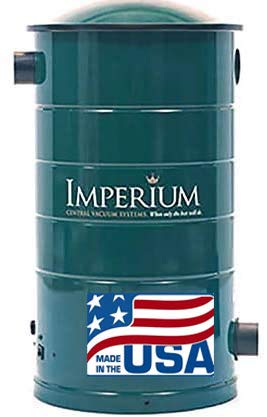
740 airwatts that somehow stays near a whisper while it works.
The CV300 earns its spot on raw cleaning force at a quiet 58 dB (decibels, a sound-level measure — roughly a normal conversation). It produces 740 airwatts (the cleaning force on carpet) and is recommended for homes up to 7,500 square feet. Made in the USA with all-steel construction and a 10-year motor warranty, it includes a utility inlet so you can clean right at the power unit. You also get the paper bag (dirt capacity is 6.25 gallons) and all mounting hardware.
Owners who’ve replaced older units are the ones driving that story. They describe half the size of an older Beam unit but twice the suction and far less noise — the kind of upgrade that makes you wonder why you waited. Build quality is the strongest theme across the feedback, and the specific mentions of quiet operation back it up. The bag sits on top for easy access, which keeps maintenance simple.
The honest snag is hose noise. The canister itself is quiet, but the sound coming out of the end of the hose can be loud while vacuuming, and the all-steel body at 25.38″L x 12.88″W x 25.38″H is a sizable piece of wall. This is a canister-first unit — you’ll supply the inlets and hose — but the quiet, heavy-duty core is exactly what a big house with a shared wall needs.
The quiet argument: 58 dB operation with 740 airwatts and a 10-year motor warranty, assembled in steel with a top-access bag for quick changes.
One fair warning: the unit is quiet, but the airflow noise at the end of the hose is not — ears will notice it in a small room.
For the noise-sensitive: a two-story home that shares walls with a home office or a nursery, where a howling motor is a real problem.
Think twice if: you need everything in the box — this is a canister and bag setup, and the hose and inlets are on you.
5. Prolux CV12000 Central Vacuum
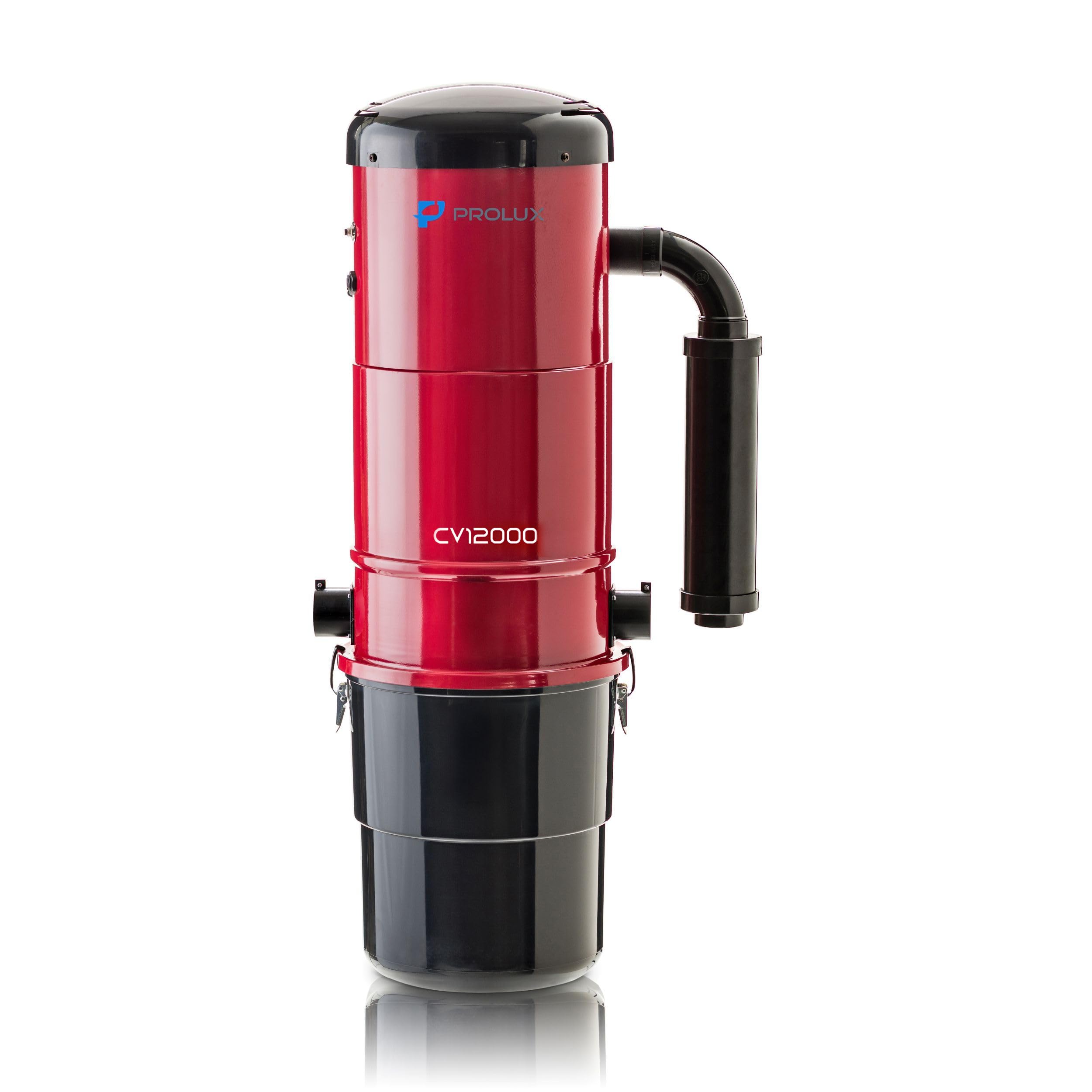
Built to drop onto the pipe stub of the system you already have.
If the system in your garage is on its last legs, the CV12000 is the one designed to slot in. Dual intake ports on either side let it connect directly to an existing standard U.S. system, and the easy-mount bracket means fewer trips up the wall. It’s rated for up to 8 outlets or 8,000 square feet, pulls 142 CFM with 116″ of water lift, and runs a 2-stage bypass motor where dirty air never passes through the motor itself.
The “no suction loss” pitch is the differentiator. Dust-resistant filtration keeps performance consistent instead of fading as the system clogs, and the body is powder-coated steel to resist rust. You get a 25-year body and 10-year motor service promise, plus U.S.-based support. The 6.8-gallon bag capacity or 3.75-gallon bagless capacity gives you a choice, and a spare bag and muffler are included.
Installation draws the warmest comments — people who ran the swap themselves talk about a job measured in a couple of hours. A few note that fitting it to an older house may call for an extra connection hose, and durability feedback is mixed at the margins, with a stray cracked outlet pipe mentioned. At 12.5 amps and 22 pounds it leans heavier than the Dirt Devil’s 21 pounds, but that heft is a steel body built for a long service life.
Why the swap crowd picks it
- Dual intake ports fit a standard U.S. system, so replacement is direct
- 2-stage bypass motor keeps dirty air out of the motor itself
- 142 CFM and 116″ water lift serve up to 8 outlets or 8,000 square feet
Plan around these
- An older house may need an extra connection hose for the fit
- 22-pound steel body is heavier than some compact rivals
Choose this when: your existing central vac has died and you want a direct-fit replacement with a long body and motor service promise.
Keep looking if: you’re starting from bare walls in a new build — the dual-port design shines most when there’s a system to match it to.
6. Broan-NuTone Residential Central Vacuum System Power Unit

The emptier you’ll forget about — a big bag and wide latches do the work.
Broan-NuTone goes after the chore nobody likes: emptying the can. The 6 U.S. gallon disposable bag takes NuTone model 391 bags and, per the maker, needs emptying only every 6 months on average. Compare that to the HP Products’ 1 gallon and you see the gap — six times the capacity, which is exactly the point for a main-floor install. Large ergonomic latches flip open the debris pail so the bag slides out without a fight.
Power sits at 550 air watts with 120 feet of maximum suction, and the thru-flow motor is paired with sound-absorbing material to keep operation quiet — no muffler required, per the listing. A multi-direction vacuum connection makes the install work even in tight utility spaces, and Broan includes a six-foot power cord for reach.
The catch is that this is a power unit, not a full kit. You’re supplying your own hose and inlets, and the upright form factor at 29.75″L x 15.63″W x 29.75″H takes real wall or floor space. Its 22-pound body is heavier than the Dirt Devil. For a homeowner who wants to set the unit and go six months between bag changes, that trade is easy to accept.
Maintenance math: a 6-gallon disposable bag the maker rates at about 6 months on average, with flip-open latches for one-handle removal.
Space trade: the upright body is one of the larger footprints on this page, and the hose is not in the box.
Best for: a full-time home where emptying the vacuum is the chore you dread, and a half-year bag swap sounds like relief.
Pass if: you’re outfitting a compact cabin or RV — the upright size will crowd the space a small canister would not.
7. OVO 750 Airwatts Central Vacuum System
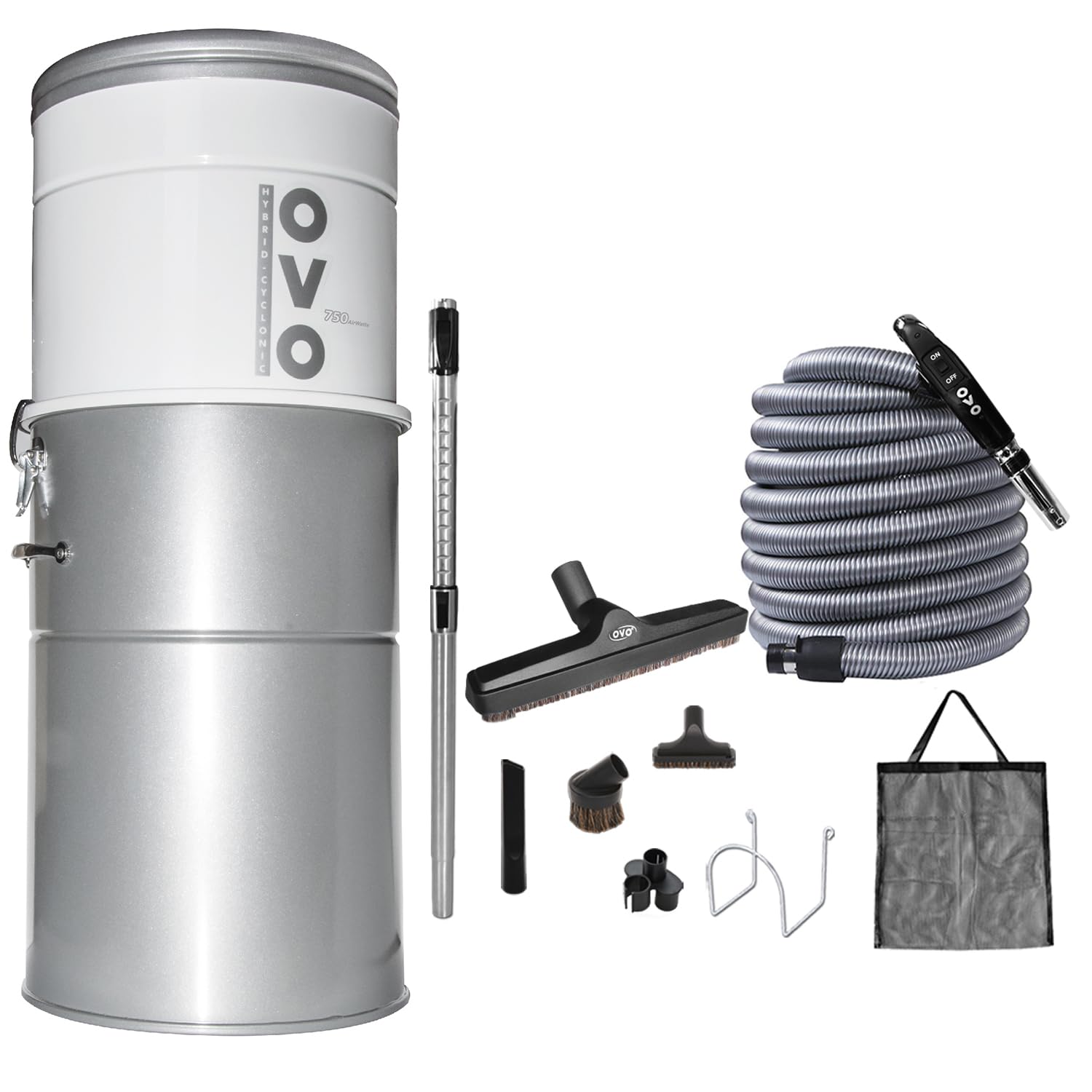
A 35-liter canister sold with the hose and floor brush already in the box.
Most of these units leave you shopping for a hose separately. This OVO doesn’t — a 40-foot low-voltage hose and a deluxe floor brush accessory kit ship with it. That matters because low-voltage hose is the piece people most often forget. The unit itself pushes 750 airwatts through a 5.7″ two-stage Ametek USA motor with 140.2 CFM of airflow, and the 9.25-gallon (35-liter) rolled-steel bottom-load canister covers up to 9,000 square feet across 8 inlets or more.
OVO claims the soft start-stop circuit adds 20% to motor life expectancy. The integrated muffler and noise-blocking foam in the motor compartment keep the unit’s own sound down. Installation is the theme the feedback keeps returning to — it goes up without fuss, and the suction is a clear jump over older units it replaces.
Here’s the honest part: performance feedback is genuinely split, and the maker notes an 8% performance drop at high altitude. This OVO belongs in a buyer who wants the largest canister and the full kit in one order. If a single big purchase with everything included is what you need, it delivers that.
One-order solution: a large home with many inlets where you’d rather get the canister, 40-foot hose, and floor brush together.
Where it slips: high-altitude homes will feel the manufacturer’s stated 8% suction drop, and the mixed performance feedback is worth reading first.
8. VacuMaid P125p Cyclonic Central Vacuum Power Unit

A 40-pound tank built to cycle dust for years without a bag.
VacuMaid is the cyclonic option here, which means no disposable bags — a plastic can liner handles mess-free debris disposal instead. It runs an Ametek Lamb 7.2″ tangential bypass motor at 525 max airwatts with 116 CFM airflow and 125 sealed vacuum inches of waterlift. The canister holds 6.75 gallons and is rated for homes up to 9,000 square feet. Manufactured in the USA by Lindsay Manufacturing, it’s made to replace an old system, and parts to fit your existing setup are in the box.
This is the setup for someone tired of buying bags. The cyclonic chamber spins debris out of the airflow, so the filter stays cleaner and you’re not ordering replacement bags every season. At 40 pounds it’s the heaviest unit on this page and wants a solid mount. The 13.5-amp draw is the most electrical load here, so check what your outlet can feed before you buy.
The bag-free pitch: a cyclonic chamber and plastic can liner mean no disposable bags for the life of the unit, backed by a 6.75-gallon steel canister.
Weigh the install: 40 pounds and 13.5 amps demand a sturdy mount and a dedicated-enough circuit — check both before ordering.
Made for: a large home where you want to stop buying bags and handle a 6.75-gallon pail instead of a plastic bag.
Check first if: your wall mount is flimsy or the circuit is shared — the weight and 13.5-amp draw need better support than a lightweight unit does.
Know the Specs
Airwatts versus water lift
Two suction numbers tell you different things. Airwatts measure the cleaning force on carpet, while water lift measures how high the suction can pull a column of water — that’s why you’ll see 550 air watts on one unit and 116″ of water lift on another. Neither number alone decides a buy: a high-lift unit grabs deep dirt, a high-airwatt unit moves a lot of air. Read the CFM (cubic feet per minute, the airflow volume passing through the motor each minute) alongside them.
Capacity and empty frequency
Canister size tells you how often you’ll be at the unit. A 1-gallon pail and a 6-gallon bag are very different lifestyles — the small one suits a cabin or a car’s footwells, the big one suits a whole house where you’d rather empty every so often. Bottom-load pails slide out below the motor, top-load pails require you to reach over, and disposable-bag systems let you lift the bag out cleanly. Match capacity to the dirt your home actually makes.
Bypass versus thru-flow motors
Motor design decides how much grime reaches the moving parts. A bypass motor keeps the dirty airstream away from the motor itself, so less grime cakes the moving parts — that’s the design Prolux and VacuMaid use. A thru-flow motor pulls the airstream through the motor housing, which Broan-NuTone combines with sound-absorbing material for quieter operation. Bypass designs tend to be associated with longer service life, while thru-flow builds can be quieter. Both work; the choice depends on how much maintenance you want.
Hose, inlets, and what’s actually included
The hose length and kit contents are the most overlooked specs on the page. A 7′ to 35′ expandable hose covers a travel-trailer interior; a 40-foot low-voltage hose covers a large house but needs the wiring to match. Some units ship with a full accessory kit, others give you a bag and hardware only, and the flex hose between unit and intake is frequently missing. Read the included-components list before you assume a weekend install.
Common Questions
Will a central vacuum power unit fit my existing pipe system?
What is the difference between airwatts and water lift?
Do I need a low-voltage hose for a central vacuum system?
Can a central vacuum system be installed in an RV or tiny home?
How often do I need to empty a central vacuum canister?
What does hybrid filtration mean on a central vacuum?
How much square footage can a central vacuum cover?
What does a bypass motor do differently from a thru-flow motor?
Do these units come with a hose and accessory kit?
The Bottom Line
For most people, the top central vacuum systems winner is the HP Products 9880 Dirt Devil. A 35-foot stretch hose from a 21-pound cabinet-mount unit reaches a whole RV or small home, and that reach is what makes a built-in vacuum worth having. If you want a full accessory kit in one box for a tiny home or boat, grab the RoadVac InterVac CS-RM. For a large house where the biggest canister and a complete 40-foot kit matter most, reach for the OVO 750 Airwatts 35L. And with a mid-4s star rating across a solid pool of owners, the OVO 700 Airwatts 25L is the dependable value pick for a whole-house install.
How we choose
We do not accept paid placement. Every pick is matched to a real buyer and a real use-case; we do not hands-on test units.
Sources
Specifications: manufacturer listings and product documentation. Review insights: verified customer reviews, as of November 2026. Pricing: not shown on this page (it changes often); check the current price via the retailer link.
As an Amazon Associate, Tactical Gear Guy earns from qualifying purchases. This does not affect which products we feature.