Specs are compiled from manufacturer listings and verified buyer reviews and can change over time — please confirm the key details on the product page before buying.
The quick answer: if you want one thick gym mat that covers almost every home workout — shoes on, weights down, jump rope spinning — the GymCope Large Exercise Mat is the safest pick on this list. It is a 7mm mat (roughly a quarter-inch of high-density PVC) that comes in six sizes, and it ships with a bag, three straps, and a towel. Below that top spot you will find oversized TPE mats, a half-inch yoga mat, interlocking foam tiles, and a couple of genuinely heavy-duty training surfaces. Each one solves a different problem, and the trick is matching the mat to what your floor and your knees actually need.
This guide is built by comparing the manufacturers’ published specifications and the patterns across verified customer reviews, so you get each pick’s real strengths and trade-offs instead of marketing spin.
Thickness is the number everyone fixates on, but density and grip decide whether a mat survives a year of training. Here is how to pick the right one in five minutes of reading.
Thick padding helps most underfoot, but a mat that slides or sheds will ruin your session regardless of depth — the right thick gym mats balance cushioning, grip, and a footprint that fits your room.
Top Picks


How To Choose The Best Thick Gym Mats
Buying a thick gym mat is really three decisions stacked together: how thick, what material, and how much floor you need to cover. Get those three right and almost any well-reviewed mat will do the job. Get them wrong and you will be rolling up a mat that slides, stinks, or leaves you feeling every floorboard.
Thickness is not the same as cushioning
A 7mm mat made from high-density PVC (7mm is about a quarter-inch) can support a dumbbell press better than a soft 15mm mat that squashes flat. Density is the real cushioning. Thin but dense protects your joints without letting your feet sink, which matters for balance work like lunges and single-leg moves. Soft and thick feels great under a knee but can make standing balance drills wobbly.
Match the footprint to the workout
Jump rope, dance cardio, and Zumba need room to swing a rope and step sideways — a 6’x4′ mat is the common starting point, while a 9’x6′ layout suits two people training side by side. A yoga-and-stretch routine is comfortable on a narrower mat. Interlocking foam tiles are the alternative when your room is an odd shape, because you cut and clip tiles to fit rather than rolling out a fixed rectangle.
Floor type decides your grip design
On hardwood, tile, or concrete you want a textured or suction-cup base that grabs and stays. On thick carpet, a mat with a flat base can slide, and some oversized yoga mats are explicitly not recommended for deep carpet. If your home gym lives on a carpeted bedroom floor, look for wording about carpet compatibility before you commit.
Material and smell
PVC mats are the tough, shoe-friendly option built for weights and cardio. TPE (a rubbery plastic blend) is lighter and often lower-odor, which suits yoga and stretching. EVA foam tiles are the softest underfoot and the easiest to vacuum, but they are the least forgiving under heavy iron. Any new mat may have a factory smell for the first few days — air it out flat before you roll it into a corner.
Side-by-Side Comparison
| Model | Best For | Thickness | Footprint | Material | Amazon |
|---|---|---|---|---|---|
| GymCope Large Exercise Mat★ Best Overall | All-round home gym | 0.27″ (7mm) | 72″ x 48″ | PVC | Amazon |
| GymCope Extra Large Yoga MatBest for Yoga | Yoga and stretching | 0.24″ (6mm) | 72″ x 48″ | TPE | Amazon |
| Gogokiwi Extra Large Yoga MatMost Versatile | Two-person cardio | 0.25″ | 72″ x 48″ | RecFoam | Amazon |
| nuveti Large Exercise Mat | Joint protection | 0.59″ (15mm) | 72.05″ x 31.5″ | TPE | Amazon |
| HAPBEAR Large Exercise Mat | HIIT and cardio | 0.32″ (8mm) | 84″ x 60″ | PVC | Amazon |
| Hatha Yoga Large TPE Mat | Floor comfort | 0.5″ | 72″ x 48″ | TPE | Amazon |
| AIRHOP Interlocking Foam Tiles | Odd-shaped rooms | 0.79″ | 12 tiles, 24″ x 24″ | EVA foam | Amazon |
| VEVOR Large Exercise Mat | Multi-person space | 0.28″ (7mm) | 108″ x 72″ | PVC | Amazon |
| GXMMAT Large Exercise Mat | Shoe-on training | 0.28″ (7mm) | 72″ x 72″ | PVC | Amazon |
Detailed Reviews
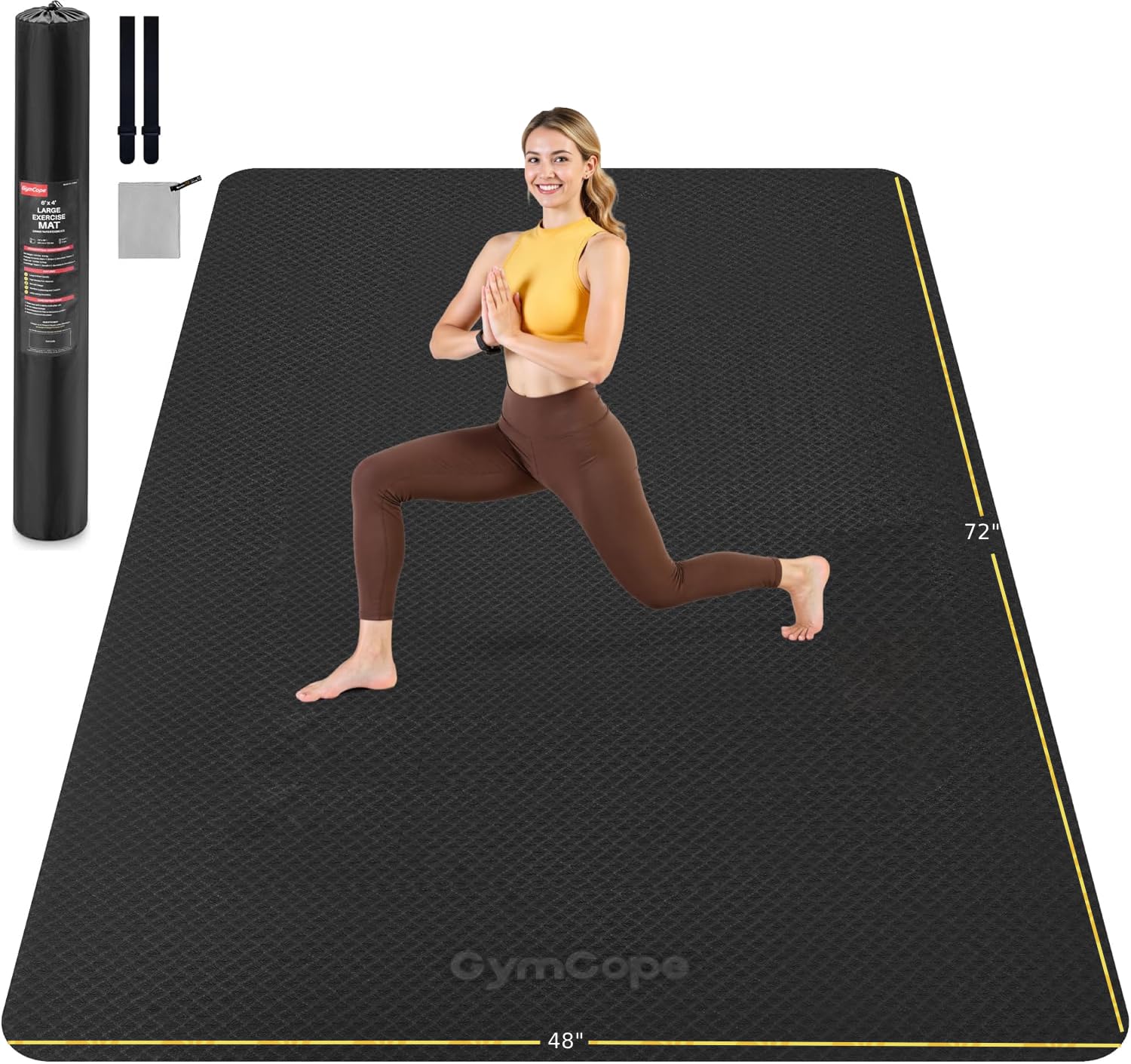
1. GymCope Large Exercise Mat for Home Workouts
Our pick — 4.5+★ from 800+ verified ratings; the strongest balance of quality and price.
A 13.2-pound, 7mm high-density PVC mat that holds up to shoes, dumbbells, and jump rope in one session.
The GymCope is the one to buy if you want a single mat that handles cardio, dance, lifting, and stretching without you thinking about it again. The 72″ x 48″ version gives you a 6-foot by 4-foot patch of floor at 0.27″ thick — that is 7mm of high-density PVC, which the brand labels shoe-friendly. High-density here means the mat resists abrasion and scratches instead of shedding foam, so a shoe sole does not chew through it the way it will on softer foam.
What wins people over is the build quality, and it shows up in the way the mat holds its place. The double-sided anti-slip surfaces grip tile, carpet, concrete, and hardwood, and the mat stays put through jump rope and lateral drills. You get six sizes from 6’x4′ up to 12’x6′, which lets you cover a couple-training footprint or a family play area with the same product. The 13.2-pound weight is the trade-off of that density — this is a mat you roll up with the included bag and three hook-and-loop straps rather than sling over a shoulder one-handed.
One number to weigh: the GymCope runs 13.2 pounds where the Gogokiwi below sits at 4 pounds, and that gap is exactly why the GymCope feels planted under a barbell while the lighter mat does not. The bundle is unusually complete for this category — a carrying bag, three straps, and a 27″x16″ microfiber towel — and the waterproof surface wipes clean of sweat with a damp cloth. The honest caveat is thickness: 7mm is protective, but buyers expecting a plush pillow under their knees will notice it is on the firmer side of cushioning. Treat it as a training surface, not a nap mat.
Where it earns the top spot
- High-density PVC shrugs off shoes, dumbbells, and abrasion
- Double-sided anti-slip surface holds on tile, carpet, concrete, and hardwood
- Six sizes from 6’x4′ to 12’x6′ cover solo, couple, or family use
- Ships with bag, 3 straps, and a microfiber towel
- Waterproof surface wipes clean in seconds
What you should know going in
- At 13.2 pounds it is a two-hand roll-and-carry job
- 7mm is firm support, not plush padding under the knees
- The tightest size is a single-person footprint
Buy this one if: you want one tough mat for shoes-on cardio, weights, and stretching in a normal-sized room.
Think twice if: you specifically want a soft, deep cushion under your knees or a mat you can toss in a tote.
2. GymCope Extra Large Yoga Mat, 72″x48″ or 78″x57″
A wide, grippy TPE mat built for stretching, Pilates, and floor work rather than dropped weights.
Start with the size, because that is the whole point. The 72″ x 48″ deck gives you nearly twice the space of a standard yoga mat, and there is a 78″ x 57″ version for tall users or partner stretching. Four thickness choices — 6mm, 8mm, 10mm, and 12mm — let you dial support to your joints. The 6mm base version is listed at 0.24″ thick and 1.34 kg, which is light enough to roll and move to another room without a fuss.
High-density TPE (a rubbery, PVC-free and latex-free plastic blend) keeps the mat low-odor and resilient, and the dual-sided grip uses a textured leaf pattern on top and a wave pattern underneath. That combination holds on hardwood, tile, and cement — but the maker is clear that it is not recommended for thick carpet, so a plush bedroom rug is the wrong home for this one. A strap set, a microfiber towel, and a bag come in the box.
The comparison worth knowing: this GymCope is 0.24″ thick while the nuveti pick below is 0.59″, and the nuveti is 1.9 times heavier at 2.61 kg versus 1.34 kg. Read that as a weight-versus-cushion trade: the GymCope stays portable, the nuveti goes deep on padding. The recurring gripe on this one is thickness — several buyers expected a meatier mat and found it thinner than the photos suggested. That is a fit issue, not a defect: pick the 12mm option if cushion is your priority.
Who it clicks with: anyone who wants a generous, low-odor surface for yoga, Pilates, HIIT, or meditation and does not plan to wear shoes on it.
The fine print: the textured base wants hard flooring under it, and the thinner options will not satisfy a buyer chasing a deep knee cushion.
Reach for this if: your routine is bodyweight, barefoot, and you want room to spread out on a hard floor.
Look elsewhere if: your workout space is thick carpet or you plan to train in shoes with weights.
3. Gogokiwi Extra Large Yoga Mat 6’x4′
Four pounds of recyclable foam that unfolds into a 6-foot by 4-foot training zone.
The Gogokiwi sells itself on space and portability at the same time, which is a rare combination. Its 72 x 48 inches is billed as 112% more exercise space than a traditional mat, and the high-rebound RecFoam (the brand’s own foam blend, which it says is 100% recyclable) bounces back instead of packing down. At 4 pounds and 0.25″ thick, it is the mat you actually carry to the park or the garage without needing both arms.
The reversible design gives you two colors and two patterns, and the point is function as much as looks — flipping the mat changes which grip face meets your hands and feet. The closed-cell surface blocks sweat from soaking in, so a damp towel or sponge handles cleanup and it air-dries before you roll it back up with the included hook-and-loop straps. Cushioning is decent on hard wood floors, and it holds steady through jumping and general floor work.
Here is the honest limit. This is 4 pounds against the GymCope’s 13.2 pounds, and the review pages split on durability — the surface is reported to break down on some units over time. For yoga, stretching, and bodyweight circuits that split is rarely a problem. If you are dropping kettlebells or training in shoes five days a week, the denser mats on this list are the better long-term bet.
Good match for: renters and multi-room trainers who want a big surface that is genuinely easy to move and store.
The trade-off to accept: lighter foam is friendlier to your back and less forgiving under heavy equipment.
4. nuveti Large Exercise Mat, 15mm/20mm/30mm

The padding-first pick for anyone who feels every floorboard in their knees and hips.
If a standard 6mm mat leaves you sore, this is the jump. The nuveti comes in 15mm, 20mm, and 30mm versions, and the 0.59″ model reviewed here is the middle option — roughly two and a half times the depth of the 0.24″ GymCope yoga mat. That thickness is what the whole product hangs on: it puts a real layer between you and a hard floor for ankle, knee, and hip comfort during mat work, Pilates, and stretching.
The construction is high-density foaming TPE, PVC-free and non-toxic, with a textured non-slip surface for balance work. The 72.05″ x 31.5″ footprint is long and narrow rather than square, so it suits a single person stretching lengthwise but not a pair training side by side. It is 2.61 kg, so it stays manageable to move. The softer surface does exactly what buyers want it for — kneeling and floor poses stop being a negotiation with your joints.
Two real catches come with all that foam. First, the mat is thick enough that it can feel soft to some and too hard to others — there is no universal firmness setting, so pick your millimeter count deliberately. Second, rolling it up for storage takes effort; it is stiffer than a thin mat and does not coil neatly without pressure. If you want a mat that lives out in one spot, neither point matters much.
Why buyers pick it: the depth is the product — 15mm or 30mm options give you a genuinely different feel underfoot than any 6mm yoga mat.
Storage reality: expect to work at rolling it up, and expect a narrow footprint that suits one person.
Choose it when: joint comfort outranks portability and you train mostly barefoot or in socks on a hard floor.
Pass on it when: you need a square mat for two people or a mat you can roll and stow in seconds.
5. HAPBEAR Large Exercise Mat, 6’x4′ to 12’x6′

Six size options and an 8mm deck tuned for jumping, spinning, and sweating hard.
This is the mat for the person whose workout leaves a puddle. The high-density PVC foam runs up to 8mm (a little over 1/3 inch), which is soft enough for knees and elbows during aerobic work and dense enough to hold up to repeated impact. HAPBEAR offers six footprints — 6’x4′, 7’x5′, 8’x6′, 9’x6′, 10’x6′, and 12’x6′ — so you can match the mat to the room rather than the other way around. The 84″ x 60″ version reviewed here is 15.6 pounds.
Grip is the standout feature. The corrugated top surface and suction-cup base work together to lock the mat down, so lateral moves and fast footwork do not shift it under you. The material resists deforming even at high temperature, the surface is waterproof and sweat-proof, and the maker points out it resists curling — a common complaint with cheaper roll-up mats. The bundle adds a set of resistance bands and a storage bag, which rounds out a home-gym starter kit.
Durability is where the reviews wobble. The mat is built tough, but a share of buyers report the surface wearing faster than they expected under hard daily use. Weigh that against how well it performs: when you want space, grip, and shock absorption for HIIT, it delivers all three. The trade-off is that this is a training mat you will replace sooner than a top-tier PVC slab if you hammer it every day.
What sells it
- Up to 8mm of high-density PVC cushions knees and elbows through impact work
- Corrugated top plus suction-cup base holds steady during fast footwork
- Six footprints from 6’x4′ to 12’x6′
- Waterproof, sweat-proof surface wipes clean
- Resistance bands and storage bag included
Where it can let you down
- Surface wear shows up sooner for some buyers under hard daily use
- 15.6 pounds at the 7’x5′ size makes it a stay-put mat
- The biggest sizes need serious floor space
Fits you if: HIIT, spin, or dance cardio is your main routine and grip under fast feet is the priority.
Look elsewhere if: you want a mat that looks untouched after years of daily abuse.
6. Hatha Yoga Large TPE Yoga Mat 6’x4’x1/2″

A full half-inch of TPE that turns a hard floor into something your knees can live with.
Half an inch is the headline, and it is a lot of mat. The Hatha measures 72″ x 48″ at 0.5″ thick, which lands between a standard yoga mat and the deep nuveti padding. The high-density TPE is phthalate-free, gentle on the skin, and fully recyclable — the brand pushes the sustainability angle hard — and the 8.8-pound weight keeps it from being a wrestling match to move. Two bundling ribbons are included for storage in a corner.
Grip comes from a special non-slip texture on both sides, and the high-density build is meant to resist tearing across yoga, Pilates, stretching, jump rope, and squats. The comfort is the thing people come back for: the cushion supports knees and elbows during floor work, and stability holds so the mat does not slide out from under you mid-pose. The 72″ x 48″ deck is roughly twice the width of a standard mat, which means you can reach and roll without running out of surface.
Two honest notes. A mat this thick can carry a factory odor at first, so give it air and time before you judge it. And at 8.8 pounds it is heavier than a thin yoga mat, though far lighter than the dense PVC training slabs. The comparison that matters: this is 0.5″ of soft TPE while the GymCope is 0.27″ of firm PVC — same room, very different feel under a knee.
Why thickness matters: half an inch of TPE (a dense, rubber-like foam) cushions bony knees and elbows, so long floor sessions stay comfortable.
Give it a week: expect some initial smell and a heftier roll-up than a travel mat.
Best suited to: yoga, Pilates, and stretching where comfort under joints is worth a heavier mat.
Not the one for: anyone who wants a compact mat to carry to class every day.
7. AIRHOP Upgraded 0.79″ Interlocking Foam Tiles
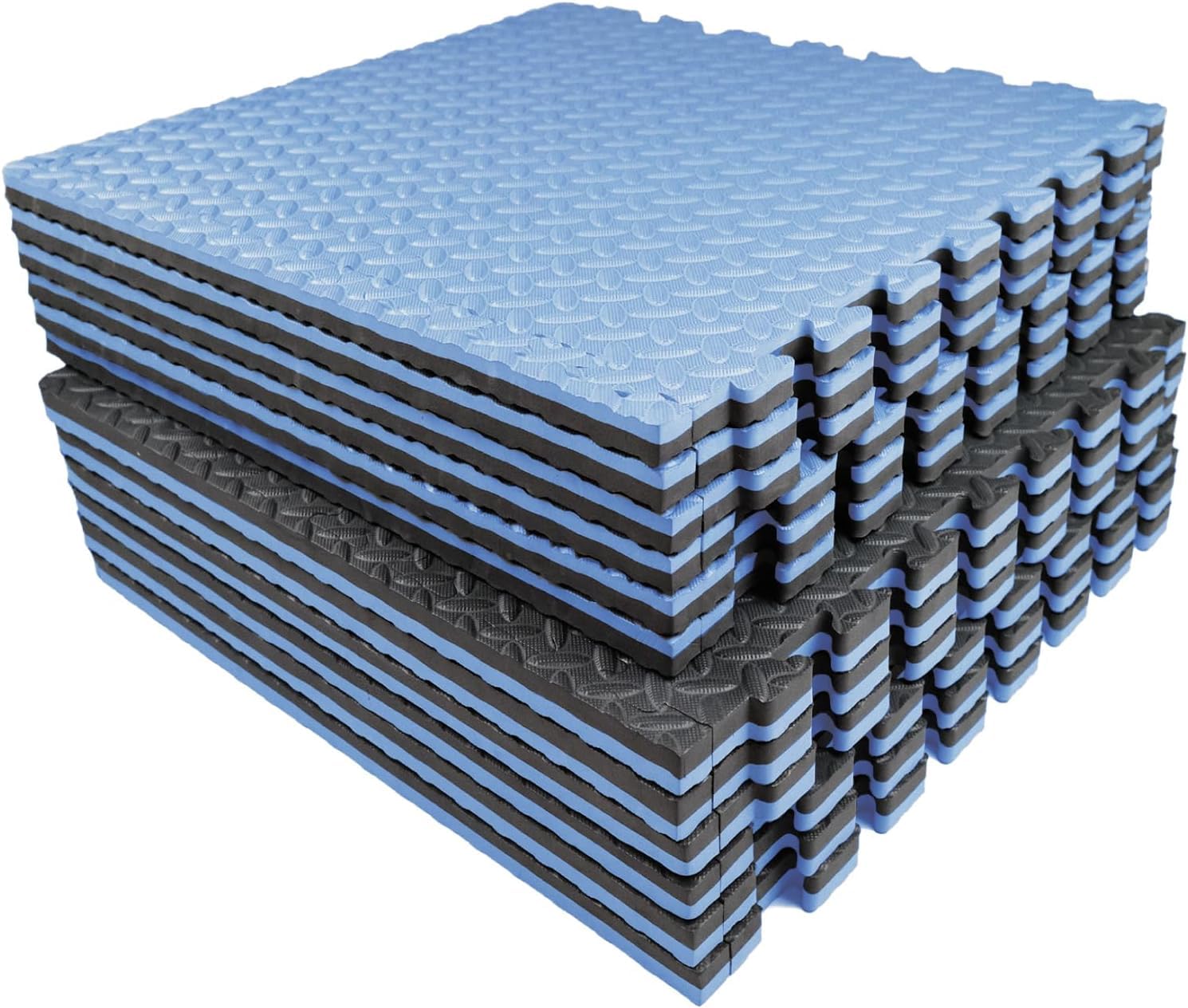
Twelve clip-together tiles that solve the awkward-room problem a rolled mat cannot.
When your gym is an L-shaped basement or a garage corner, a fixed 6’x4′ rectangle is the wrong tool. This set is 12 interlocking tiles at 24″ x 24″ each, covering 4.5 m² in whatever shape you build. The upgraded thickness lands at 0.79″ (2 centimeters) of high-density EVA foam, which is the deepest cushioning on this list — soft, springy, and quiet underfoot. Assembly is push-and-click simple, and the tiles pull apart just as easily when you move.
The foam does double duty. It absorbs shock and reduces noise, so a set of dumbbells or a treadmill no longer thumps through the floor, and the maker notes it can support benches, treadmills, and weights as a protective layer. The double-sided steel-pattern surface is non-slip and waterproof, and it vacuums clean — pet hair, dust, and crumbs come up without a scrub. The foam is BPA-free, non-toxic, and phthalate-free, and the tiles work in garages, basements, patios, offices, and trade show rooms.
Cushioning is the star, and it earns the most praise in the reviews. The trade-off is that foam tiles are the least stable surface here under heavy iron — a loaded barbell set down hard will compress them. They are also not a mat you roll up and carry. This is a floor you install and leave in place.
Why the tiles win
- 0.79″ EVA foam is the deepest, springiest cushion on the list
- 12 tiles cover 4.5 m² in any shape you need
- Build and take apart by hand, no tools
- Waterproof, non-slip, and easy to vacuum
- Quiets dumbbells and equipment on the floor below
Where tiles fall short
- Soft foam compresses under very heavy weights
- Installed floor, not a portable mat
- Seams between tiles can collect dust
Pick this for: garages, basements, and odd-shaped rooms where you want a soft, quiet floor built to fit.
Look past it if: you need a mat to move between rooms or drop heavy barbells on.
8. VEVOR Large Exercise Mat, 9’x6′ and More
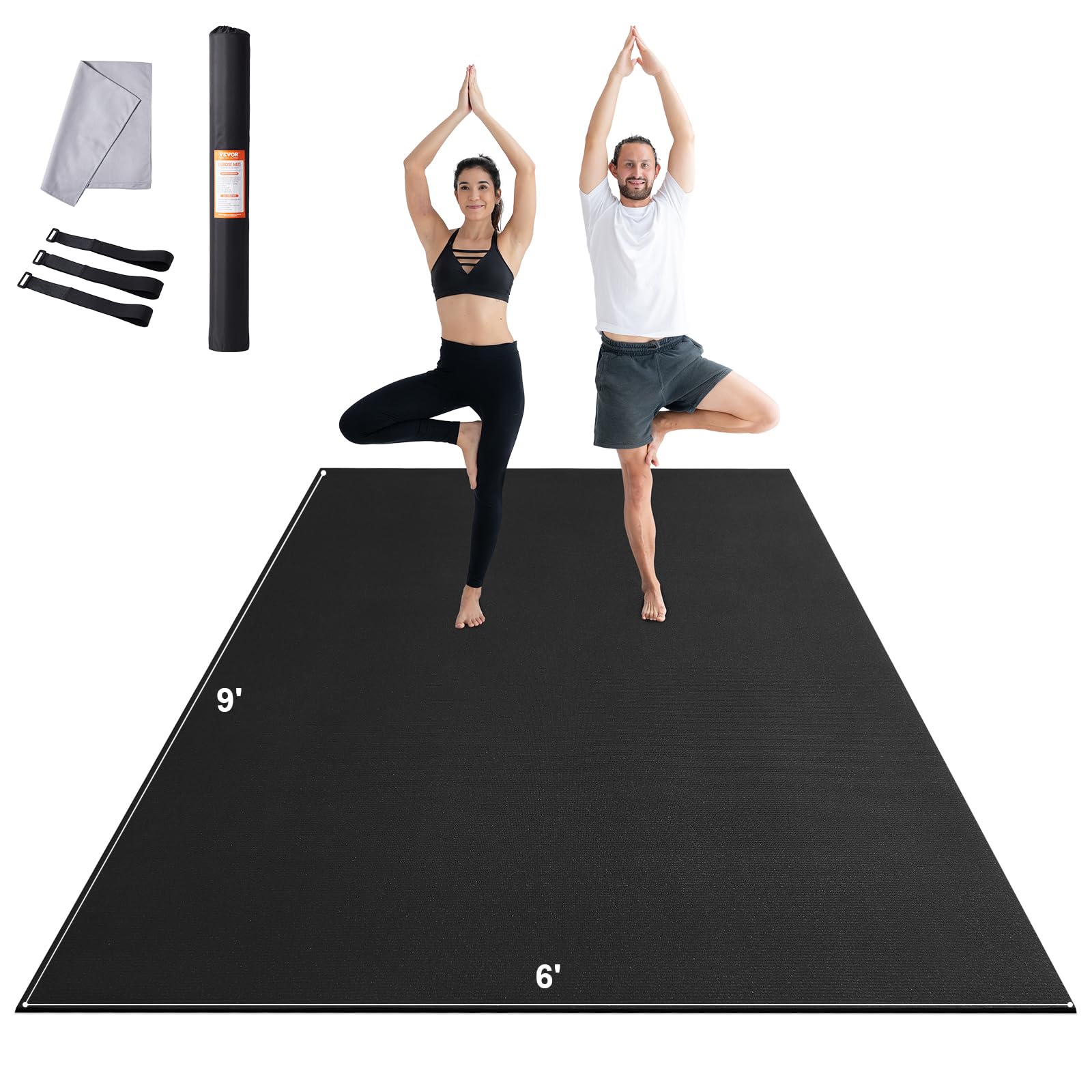
A 9-by-6-foot training floor sized for two or three people at once.
This is the mat for a shared workout room. The 9’x6′ version reviewed here is 108″ x 72″ — big enough for two or three people to train together, which is why it turns a spare bedroom into a proper home gym. Seven sizes run from 12’x6′ down to 6’x4′. The PVC is high-density, weighing 2800g/m², and the 0.28″/7mm thickness protects carpet and hardwood from scratches while cushioning your joints.
Grip is engineered for stability. The surface is anti-slip and wear-resistant, and the dense circular texture on the underside delivers strong grip so the mat does not wander during jumps or lateral moves. It rolls out flat and stays put, so you can lay it down once and leave it. The kit is generous: a soft, absorbent fiber towel, a storage bag, and three straps for rolling and carrying. It handles yoga, HIIT, aerobics, dance, P90x, Insanity, T25, Zumba, TRX, kettlebell swings, and jump rope.
On thickness, reviews split — some describe it as thick, others as not very thick, even though everyone lands on good value. At 7mm it is a firm, supportive mat, not a plush pillow. If deep cushion is your goal, the nuveti or the Hatha mats fit better. If you need a large, grippy training floor for multiple bodies, this is the one.
The size argument: 108″ x 72″ is room for two or three, and the circular base texture keeps that big surface from sliding.
Set your expectation: 7mm reads firm underfoot; adjust your size and your mindset to a training mat, not a cushioned nap pad.
Made for: couples and families training in one room who want a big, planted surface with grip to spare.
Not ideal for: a single person in a small space, or anyone chasing deep joint cushioning.
9. GXMMAT Large Exercise Mat for Home Gym

The premium build that takes shoes, gloves, and years of daily abuse without flinching.
This is the top of the ladder for a reason — it is built for the person who trains hard in shoes and wants the mat to survive it. The 72″ x 72″ version reviewed here is a full 6-foot square at 0.28″ (7mm) thick, made from high-density micro-foam over a PVC body. The brand pushes its double-sided non-skid surfaces hard: a grooved, matrix-circle underside stops the mat from sliding, and the subtly textured top keeps hands and feet planted.
The comfort pitch is stability plus cushioning. At 7mm of high-density memory foam, it aims for the middle ground where a knee feels supported but your balance work does not get wobbly. The material resists abrasion, scratches, tears, and impact, and the no-latex, no-phthalate, no-silicone construction is a real selling point if you are sensitive to smell. It lands at 9 kg, which is heavier than most mats here — a sign of dense material rather than bulk foam.
What owners mention is that this one lasts. The durability reputation is the strongest on the list, with the review pages describing the mat holding up over long stretches of hard use. It also holds a 4.5+ rating, and a 4.5+ across this many owners is the kind of track record you pay a premium for. The accessories are unusually thoughtful: a pair of gloves, three Velcro storage straps, and a carry bag. The one catch is the roll-up — 9 kg of dense foam takes real effort to store, so plan a spot where it can stay flat.
The case for the premium: dense micro-foam, double-sided grip, and a construction that shrugs off shoes and weights make this the long-haul pick.
Plan around it: 9 kg of foam is a two-hand roll, and the square 72″ x 72″ footprint needs a dedicated floor.
It suits: serious home trainers who wear shoes, use weights, and want a mat that outlasts the trend.
Go smaller if: you lack a permanent floor spot or you move your mat between rooms.
Know the Specs
Thickness versus density
A thick mat is not automatically a soft mat. Thickness is the number in millimeters or inches, while density is how firm the foam is packed. A dense 7mm PVC mat like the GymCope protects your joints and stays stable under a weight, while a soft 15mm mat spreads under pressure and feels plush but firm up. For balance work and lifting, density wins. For kneeling and long floor sessions, thickness wins.
Material and what it means for your routine
PVC mats are tough, waterproof, and shoe-friendly — the right pick for weights and cardio. TPE is lighter and often lower-odor, which suits yoga, Pilates, and stretching. EVA foam tiles are the softest and the noisiest under heavy iron. Match the material to how hard you plan to use the mat, not just how thick it looks.
Footprint and floor type
Most mats here are 72″ x 48″, which fits a single person comfortably. Bigger sizes — 9’x6′ or 12’x6′ — cover two or three people. On hardwood, tile, or concrete, a textured or suction-cup base holds best. On thick carpet, a flat-backed mat can slide, so look for carpet compatibility or choose interlocking tiles that grip the pile.
Shipping, storage, and care
Dense mats weigh between roughly 4 and 15.6 pounds, so consider whether you will roll it daily or leave it down. A storage bag and straps come with several picks here and make transport easier. Wipe PVC mats with a damp cloth, air-dry before rolling, and store them flat or loosely rolled to avoid permanent creases.
Common Questions
Will a thick gym mat work on carpet?
Is 7mm thick enough for lifting weights?
What is the difference between PVC and TPE mats?
How do I size a mat for my room?
Why does my new mat smell?
Can I use a thick mat for jump rope and HIIT?
How do I clean a gym mat?
Are interlocking foam tiles better than a rolled mat?
How long should a thick gym mat last?
Do I need a mat if I already have carpet?
The Bottom Line
For most people, the best thick gym mats pick is the GymCope Large Exercise Mat. It gives you a dense 7mm PVC build (a tough plastic layer that resists wear), double-sided grip, six sizes, and a complete bag-and-strap kit. That makes it the safest single buy for shoes-on cardio, weights, and stretching. Want deep joint cushioning instead? The nuveti Large Exercise Mat packs 15mm to 30mm of padding, so your knees and hips sink into a softer landing. If your gym lives in a garage or an odd-shaped room, the AIRHOP interlocking tiles let you build the floor to fit your space. One honest nudge: the GXMMAT carries a 4.5+ rating for a reason — if you want the mat most likely to outlast everything else here, it is the one to grab.
How we choose
We do not accept paid placement. Every pick is matched to a real buyer and a real use-case; we do not hands-on test units.
Sources
Specifications: manufacturer listings and product documentation. Review insights: verified customer reviews, as of November 2026. Pricing: not shown on this page (it changes often); check the current price via the retailer link.
As an Amazon Associate, Tactical Gear Guy earns from qualifying purchases. This does not affect which products we feature.