Specs are compiled from manufacturer listings and verified buyer reviews and can change over time — please confirm the key details on the product page before buying.
If you keep cranking the volume to hear dialogue, then grab the remote when an explosion hits, a soundbar with Bluetooth and a real center channel fixes that — not a bigger TV. Every pick below streams music from your phone over Bluetooth and clears up muddy TV speech. For most living rooms, the Polk Audio Signa S2 is the safest first buy: it includes a wireless subwoofer you can drop behind the couch, and buyers report years of daily use with the drivers still sounding clean.
This guide is built by comparing the manufacturers’ published specifications and the patterns across verified customer reviews, so you get each pick’s real strengths and trade-offs instead of marketing spin.
Some bars here are slim all-in-ones that tuck under the screen, while others add a separate bass box or rear speakers for surround. The list below separates the ones that genuinely fix dialogue from the ones that just add volume, so you can pick the right television Bluetooth speakers for your room in one pass.
Top Picks


How To Choose The Best Television Bluetooth Speakers
You judge a TV speaker by whether you can hear a whispered line without cranking the volume until the next car chase is unbearable — not by how loud it gets. Each pick below solves that problem differently. Your room, your TV’s ports, and if you want a separate bass box on the floor decide which one fits.
Match the connection to your TV’s ports first
The cleanest handshake between TV and bar is HDMI eARC (Enhanced Audio Return Channel — one cable that carries sound both ways and lets your TV remote control the bar’s volume). If your TV is older, an optical cable does the same job for standard surround formats. Bluetooth is the fallback and the bonus: it is how you stream a podcast from your phone to the bar when the TV is off. A bar with only Bluetooth and no HDMI or optical will leave you juggling two remotes and often fighting a slight audio delay on video.
Understand what channel count buys you
A “2.0” bar means two speaker channels and no separate bass driver. “2.1” adds a subwoofer for the low rumble. “4.1” and “5.0” spread sound wider with more drivers angled to bounce audio around the room. More channels can mean more convincing surround, but in a small bedroom a well-tuned 2.0 bar frequently sounds cleaner than a busy multi-speaker setup crammed against a wall.
Give dialogue tech real weight
Look for a named dialogue or voice feature — Polk’s VoiceAdjust, Bose’s Dialogue Mode, Yamaha’s Clear Voice, Samsung’s Active Voice Analyzer all do the same core job: lift the vocal range above background effects. This is the single most useful button on any TV bar for everyday shows, news, and sports, because it fixes the exact problem that pushes people to buy one in the first place.
Side-by-Side Comparison
| Model | Best For | Power / Channels | Bass Solution | Key Connections | Amazon |
|---|---|---|---|---|---|
| Polk Audio Signa S2★ Best Overall | Most living rooms | 5 drivers, 2.1 | Included wireless subwoofer | HDMI, ARC, Optical, AUX, Bluetooth | Amazon |
| MZEIBO Sound BarBest Value | Tight spaces and dorm rooms | 80 W, 4 full-range drivers | Built-in cavity | ARC, Optical, AUX, Bluetooth | Amazon |
| TCL S45HAtmos On A Slim Bar | Atmos on a slim bar | Up to 100 W, 2.0 | Built-in drivers | HDMI eARC/ARC, Optical, Bluetooth, AUX | Amazon |
| ULTIMEA Sound Bar | App tweakers on a budget | 240 W peak, 2.1 | Included wireless subwoofer | HDMI ARC, Optical, Bluetooth 6.0 | Amazon |
| TCL S55H | Bedroom home theater | Up to 220 W, 2.1 | Included wireless subwoofer | HDMI eARC/ARC, Optical, Bluetooth, AUX | Amazon |
| LG S40TR | True surround on a budget | 4.1 channels | Wireless subwoofer + rear speakers | Bluetooth, Optical, Wireless | Amazon |
| Bose TV Speaker (2nd Gen) | Small rooms and speech clarity | Center tweeter + angled drivers | Built-in, bass boost button | HDMI-ARC, Optical (cable sold separately), Bluetooth | Amazon |
| Samsung S60D | Samsung TV owners | 5 channels, all-in-one | Built-in subwoofers | Wireless Dolby Atmos, Bluetooth, Wi-Fi | Amazon |
| Yamaha SR-B30A | Music and movies together | Dolby Atmos, 2 built-in subwoofers | Two built-in subwoofers | HDMI eARC/ARC, Optical, AUX, Bluetooth multipoint | Amazon |
Detailed Reviews
1. Polk Audio Signa S2 Sound Bar
Our pick — 4.0+★ from 21,500+ verified ratings; the strongest balance of quality and price.
Five drivers and a free-standing bass box for a room that needs both punch and clear speech
What you actually buy here is bass without giving up shelf space. Polk fits five full-range drivers into a bar just over 2″ tall, then hands you a wireless subwoofer that plugs into any wall outlet and finds the bar on its own. The slim profile clears your TV’s bottom edge and its IR sensor, so your remote still sees the screen. That combination — a wireless sub for deep low end plus a bar just over 2″ tall — is why this is the pick for a normal living room with a soundbar-shaped slot already carved out.
VoiceAdjust is the feature that earns it the top spot. That is Polk’s dialogue tool: it boosts the vocal track independently of everything else, so a quiet courtroom scene stays legible while the score sits behind it. Owners consistently rate the sound quality as the standout, and they are right on the detail — dialogue gets sharper, not just louder. Connectivity is generous: HDMI, ARC, optical, and AUX all work, plus Bluetooth for streaming from your phone at a stated range of 10 meters. Music from Spotify or Pandora plays straight from the handset.
Two honest limits. The remote is the weak link — it wants you close to the bar and the on-screen volume readout is missing, so you tune by ear rather than by a number. And the wireless subwoofer link is the one connection that occasionally drops for some setups, which is worth knowing before you bury the sub behind furniture. Neither spoils the core job, but if you like a tidy remote-first setup, the LG and Samsung picks below lean harder into single-remote control.
What earns the top slot
- Five full-range drivers in a bar just over 2″ tall, with a wireless subwoofer boxed in
- VoiceAdjust lifts dialogue without pumping the overall volume
- 10-meter Bluetooth range for streaming from a phone or tablet
- HDMI, ARC, optical, and AUX mean it fits old and new TVs alike
Where it asks patience
- The remote wants you close and there is no on-screen volume number
- The wireless sub link can drop on some setups — keep the sub reachable
- Needs an HDMI ARC or digital port; very old TVs will not cooperate
Buy this when: you want one box that adds real bass to a normal-sized living room and fixes muddy dialogue the same evening.
Know before you click: the bundled remote is the least polished piece of the package.
2. MZEIBO Sound Bar
The bar that splits in two so it can sit where no long soundbar fits
Most soundbars need a wide, flat console; the MZEIBO bar does not. It splits into two halves, and owners have stood the pieces upright as tower speakers when the shelf was too shallow for a full bar. That modular design is the whole point, and it makes a cramped dorm room or a bedroom with a wall-mounted TV workable. It runs 80 watts through four full-range drivers with a large internal cavity. That is modest next to the Polk’s separate subwoofer setup — the ULTIMEA below pushes 240 W, a stated 3.0x gap — but it is the easiest fit for a tight corner.
Three EQ presets — Movie, Music, News — give you a quick tilt toward speech or bass without digging through menus. The News mode is the useful one for a bar this size, since the main complaint owners share is that maximum volume feels low. If you sit close to the TV and mostly watch shows and news, that ceiling rarely bites. If you want cinema rumble, it will. Connectivity covers Bluetooth, AUX, optical, and ARC, and the matte black finish blends into the TV’s shadow line so it stops looking like an add-on.
Worth knowing: owners describe a five-minute setup and a clean fix for the room echo that built-in TV speakers leave behind. The recurring note is pairing trouble with some Sony televisions over Bluetooth, so confirm your model pairs before you commit to it as a Bluetooth music source.
Reach for this if: your console is too narrow for a long bar and you want the separation-it-in-two option.
Look elsewhere if: you need headroom above normal listening volume for action films.
3. TCL S45H 2.0 Sound Bar for Smart TV with Dolby Atmos
Height effects and auto room tuning packed into a single bar with no sub to hide
Dolby Atmos on a 2.0 bar sounds like a contradiction until you hear it: instead of a floor-rattling sub, this TCL simulates height and surround with its drivers and up to 100 watts of total output. For an apartment or a bedroom where a separate bass box has nowhere to live, that is the whole appeal. The S45H skips the subwoofer entirely and spends its budget on spatial processing and a low-profile metal-feeling chassis, so the TV can sit flat and the bar slides underneath without a shadow.
The standout feature is AI Sonic Auto Room Calibration: a one-time pass through the TCL app measures your layout and listening position, then rebalances the sound to fit. Room calibration like that usually costs more. Voices come through distinctly, and music holds up for a 2.0 design. The trade-off: bass stays solid rather than couch-shaking, and the app-driven calibration does much of the work.
Where it shines: buy-in consensus is that voices and music both come through clearer than the TV alone ever managed, and setup leans on auto-connect over HDMI so there is no menu safari. As owners put it, the product is “easy to set up, taking only 1-2 minutes to download and install, and connects easily to LG Smart TVs.”
Pick it for: Atmos-style spatial sound and auto calibration without giving up floor space to a sub.
skip it if: you want a dedicated bass driver for movies — the S55H below adds one.
4. ULTIMEA Sound Bar with Wireless Subwoofer, App Control
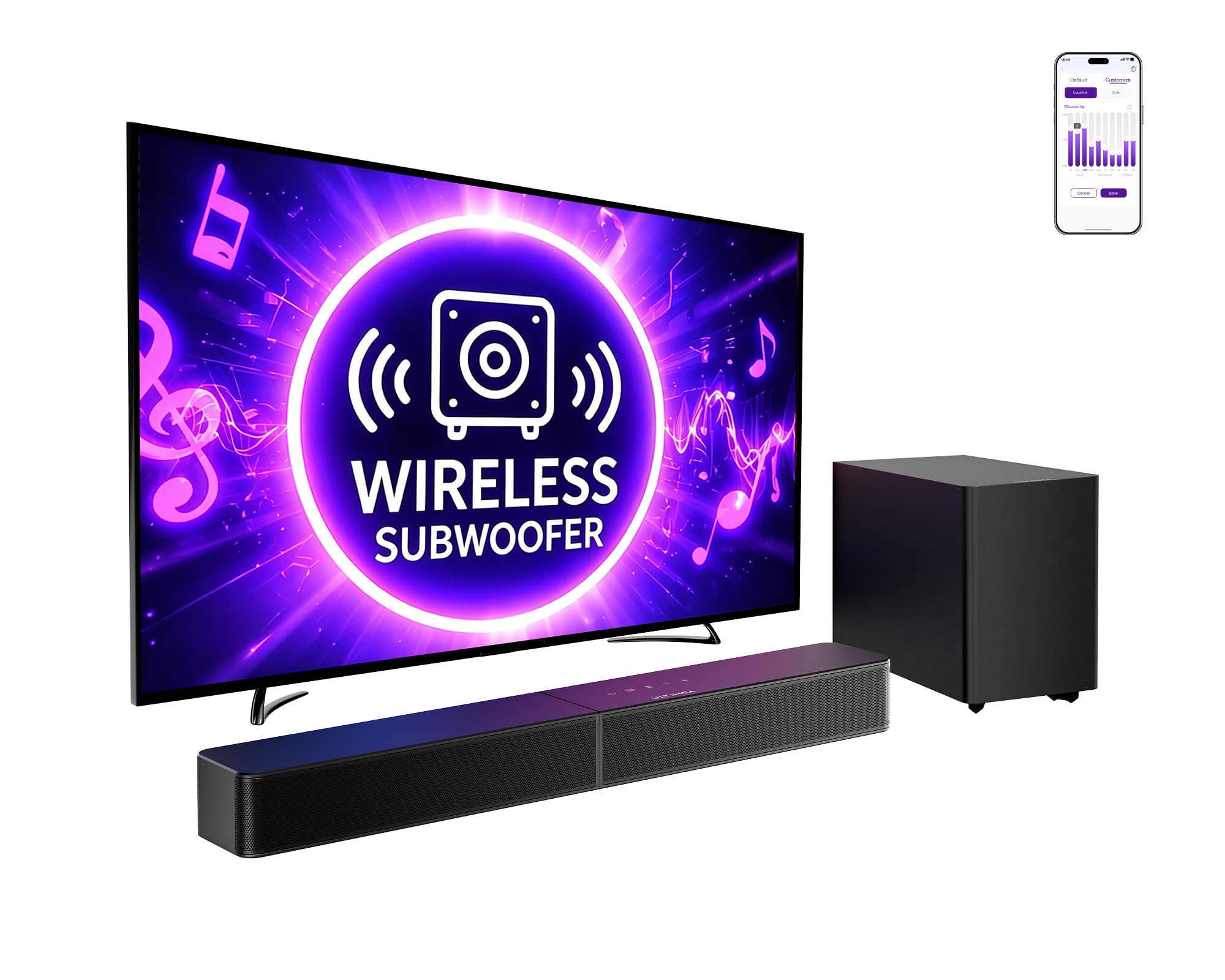
240 watts, a sub you can park anywhere, and an equalizer deep enough to tune by ear
The amp sets this ULTIMEA apart from the other budget bars: 240 watts of peak output across a 2.1-channel system, with the wireless subwoofer rated down to a 45 Hz low end and a maximum SPL (sound pressure level, or how loud it can play) of 95 dB. At 95 dB, that is real headroom for a mid-size living room. The bass box pairs over its own wireless link, so you can tuck it behind a chair instead of running a cable across the rug. BassMX drives an 18 mm high-excursion driver inside a 6.5 L tuned cabinet to keep low end tight rather than boomy.
The app is the other half of the pitch. You get a 10-band equalizer and 121 preset EQ matrices through the Ultimea App, with over-the-air updates so the tuning can change without a hardware swap. Bluetooth 6.0 handles the phone side with lower latency than the older standard, which matters if you stream video from a tablet and don’t want the mouths out of sync. VoiceMX bumps the 120 Hz–6 kHz vocal range, so whisper-quiet scenes stay readable without a manual tweak. Mica-reinforced drivers raise cone stiffness to reduce the resonance that makes cheap bars sound harsh.
The honest caveat is bulk. At roughly 23.62″ deep by 2.76″ wide by 3.54″ high, this is a deeper bar than the slimmest models here, so check the console depth before you assume it tucks under the screen.
The case for it: you want more grunt than a base soundbar and you actually enjoy tuning an equalizer.
The catch to weigh: the deeper chassis and occasional wireless drop mean it fits a console, not a whisper-thin wall mount.
5. TCL S55H 2.1 Sound Bar with Wireless Subwoofer

The S45H’s spatial tricks with a real subwoofer bolted on for bedroom bass
Take the TCL S45H formula — Dolby Atmos, DTS:X, AI Sonic calibration — and add the one thing a 2.0 bar can’t fake: a dedicated wireless subwoofer. The S55H runs up to 220 watts across a 2.1 system, with a 5.5-inch driver in the bar and a separate bass box on the floor. The wireless link means the sub goes wherever the low end sounds fullest, no receiver required. The subwoofer itself measures 7.68″ wide by 12.60″ high by 7.68″ deep, so it is compact enough to tuck into a corner next to a bedroom dresser.
This is the pick for a small-to-medium room where one sub is enough. The sound quality win is broad — owners describe it as a huge upgrade over internal TV speakers, with dialogue legible and bass present without swamping the midrange. HD channels, game consoles, and a projector all feed in cleanly through HDMI eARC/ARC, optical, or Bluetooth, and the bar sizes up well against 65-inch screens. It also loses points with a small slice of owners on volume-control quirks, so plan on tuning the levels once and leaving them.
The reason to buy: it is the honest middle between the sub-less S45H and a full surround kit, and it wins the price-to-punch contest for a bedroom wall. The subwoofer is the star of the show and the bar exists to keep voices crisp above it.
Best matched to: a bedroom or modest living room where a real sub changes the movie experience.
Second-guess it if: you want rear-channel surround — that is the LG pick below.
6. LG S40TR Soundbar

Four channels and two rear speakers put sound behind your head without a receiver
If you have the wall space, nothing here beats the feeling of a speaker behind your ear. The LG S40TR is a 4.1 system: the bar handles the front, a wireless subwoofer adds the rumble, and two wireless rear speakers handle the surround without a separate receiver cluttering the floor. WOW Orchestra is the extra worth knowing about if you own an LG TV — it uses the TV’s speakers and the soundbar together, so the whole room becomes the stage. Clear Voice Plus leans on a center speaker to sharpen dialogue, and the Smart Up-Mixer widens a plain two-channel broadcast into a fuller surround field.
One Caveat is cable-related: the rear speakers still need to be plugged in for power and a physical cable, and depending on the package the connecting wire is not always included. If your rear speakers live across the room from a wall outlet, plan for that wire run. Bluetooth is here and works well for phone streaming, but the bar really shows off when you feed it the TV’s surround signal.
What the reviews say: the sound quality is the recurring praise — sports commentary and movie dialogue come through clearly, and setup is reported as easy. The friction sits in connectivity: some buyers hit subwoofer dropouts or find their LG TV needs an extra optical cable to talk to the bar.
Great fit when: you have space for rear speakers and want real surround on a tighter budget.
Rethink it if: your TV is an older LG and you would rather not add an optical cable to the setup.
7. Bose TV Speaker
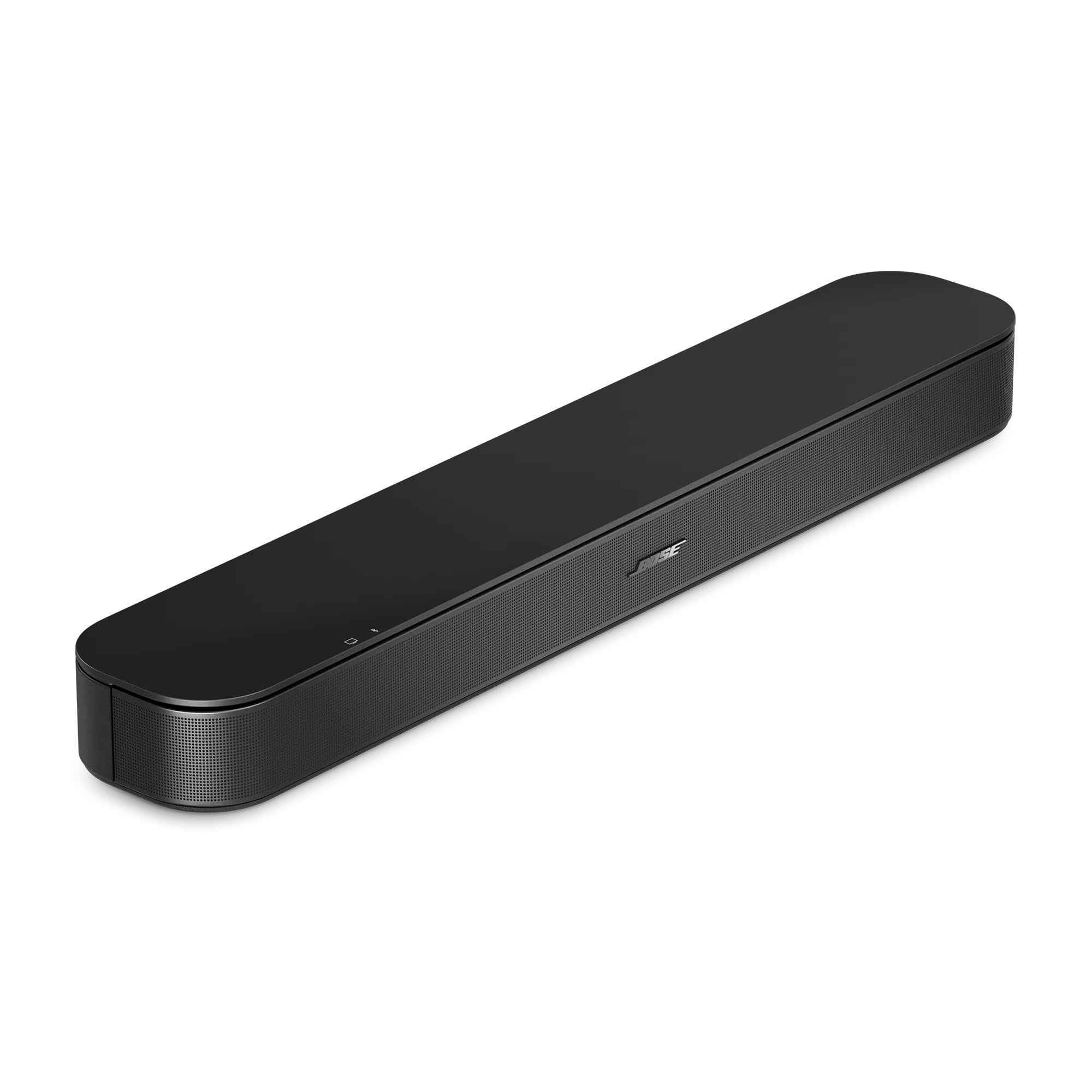
A single bar that fits in front of anything and turns speech into something you stop fighting
The spec that matters on the Bose is height: it stands just over 2″ tall and sits in front of the TV without throwing a shadow on the panel or blocking the screen. In a small room or on a furniture piece that cannot swallow a deep bar, that footprint is the whole reason to pick it. Under the hood the center tweeter does the voices, while left and right drivers are angled outward to create a wider stage than the box suggests. A Bass Boost button adds warmth on demand rather than leaving a subwoofer on the floor year-round.
Dialogue Mode is the headline for anyone who has ever ridden the volume up and down: it lifts speech over background sound so action scenes and whispered lines both stay intelligible. That is the same job the Polk’s VoiceAdjust does, but Bose does it from a bar just over 2″ tall. Pairing is quick over HDMI-ARC or Bluetooth, and the Bluetooth range is listed at 30 feet, which is longer than several bars here — enough to carry a podcast from across the room. The one real cost is bass depth: with no dedicated subwoofer, the bar tops out at full-bodied rather than rumbling. The upside is that you can add the Bose Bass Module 700 or the Bose Lifestyle Ultra Subwoofer later if you want it.
Why people keep it
- Just over 2″ tall and rounded, so it fits where deep bars cannot
- Dialogue Mode cleans up speech-heavy shows and films
- 30-foot Bluetooth range for phone and podcast streaming
- HDMI-ARC or Bluetooth setup in seconds with a simple remote
What you trade away
- No subwoofer in the box — bass stays moderate unless you add a module
- The optical cable is sold separately if you skip HDMI
- A small room tool; a large living room will want the Polk or TCL S55H
The right call for: a bedroom, apartment, or any TV with only a couple of inches of clearance.
The honest miss: if your movie nights live on explosions and bass drops, this bar leaves depth on the table.
8. SAMSUNG S60D 5.0ch Soundbar with Wireless Dolby Atmos

Five channels, built-in bass, and no speaker box to hide anywhere in the room
This is the all-in-one argument done properly. The Samsung S60D packs five channels and built-in subwoofers into a single bar — no floor-standing bass box, no rear speakers, no extra wires. For a minimalist living room or a shelf where a subwoofer would look wrong, that is the deciding spec. It also handles Dolby Atmos wirelessly, so the height and surround effects arrive without an HDMI cable running from the TV to the bar. If you own a Samsung TV, Q-Symphony pairs the TV speakers and the bar so the whole audio chain works as one system.
The smart layer is thicker here than on any other pick. Alexa is built in, along with AirPlay 2 and Chromecast, and SpaceFit Sound Pro analyzes the room and rebalances the audio to it — a nice match for an all-in-one design that can’t be repositioned on the fly. Adaptive Sound follows the type of content in real time and pulls the voices forward, and Active Voice Analyzer filters out room noise around dialogue. When the bass is built into the bar, you accept a modest low end in exchange for a clean room, and that is exactly the trade the S60D makes.
Reviewer read: the sound quality lands as the biggest win, with owners noting voices stay clear even at low volume, and setup is reported as quick — seconds to pair. The value is that the whole smart ecosystem comes with it. The honest gap is bass: without a separate subwoofer, it is adequate rather than room-shaking, so an action fan will notice the ceiling.
The smart bet when: you run a Samsung TV and want wireless Atmos, Alexa, and AirPlay in one clean box.
Measure twice if: deep bass is your priority — this bar trades rumble for a wire-free room.
9. Yamaha SR-B30A Sound Bar with Built-in Subwoofers
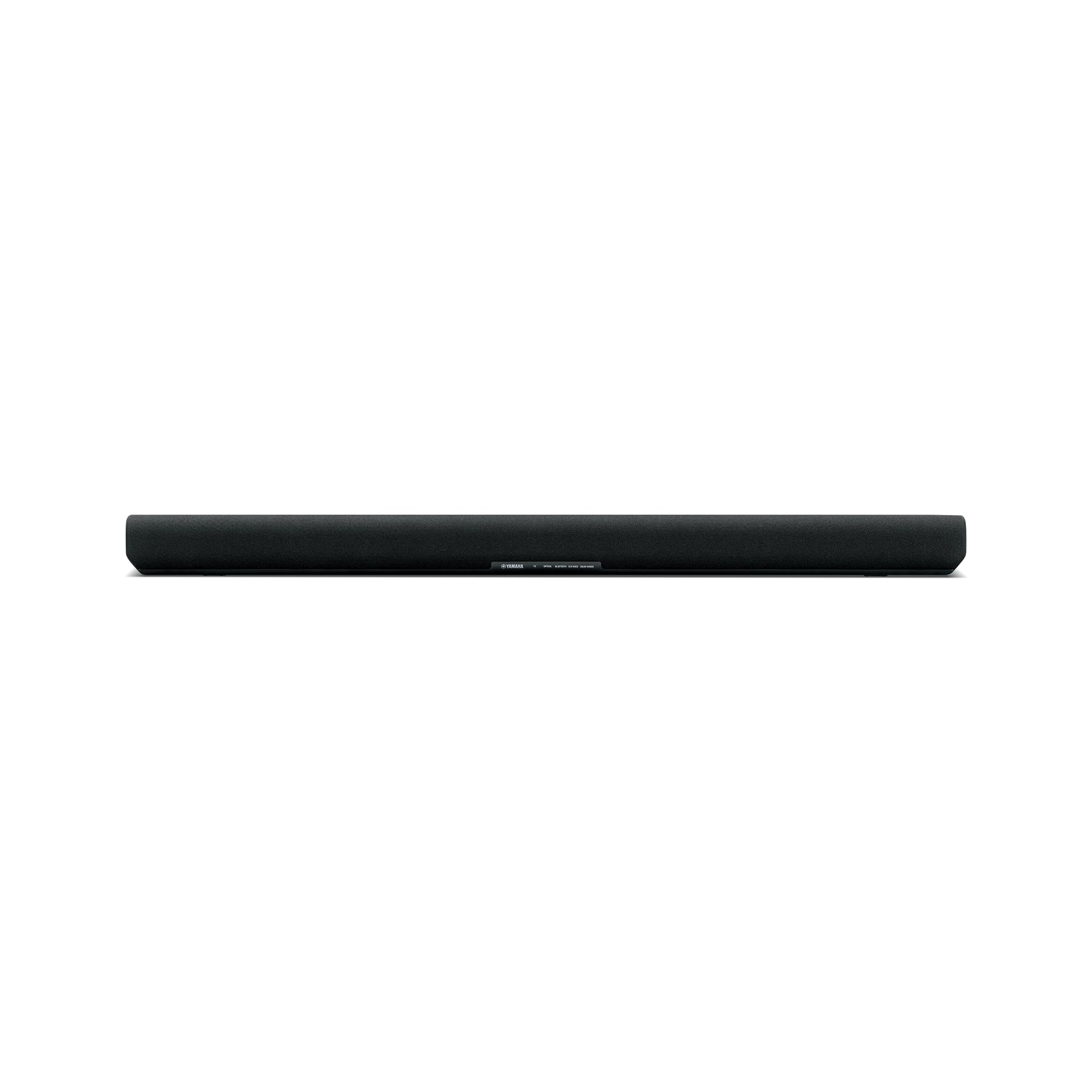
Two subwoofers live inside this slim bar, so the bass comes without the box
Yamaha takes the same space-saving approach as the Samsung but leans harder into music. Two built-in subwoofers fill the low end from inside the bar, so there is nothing on the floor and nothing to wire. Dolby Atmos handles the spatial side, and the whole thing is tuned for sound across movies, music, and dialogue rather than a single use case. Clear Voice is the dialogue tool here — it pulls speech forward when music or effects would normally bury it — and four presets (Movie, Stereo, Standard, Game) let you shift the character in a tap.
The connection set is unusually generous for a compact bar: HDMI eARC/ARC for uncompressed high-bitrate audio, plus optical, AUX, and Bluetooth with multipoint. That multipoint support is the underrated piece — it lets two devices stay paired at once, so you can move from phone to laptop without re-pairing each time. If you want to go further, there is an optional input for adding a self-powered external subwoofer later, which is the upgrade path a built-in design normally closes off.
The trade-off with dual built-in subs is placement: they need a little room to breathe, and Clear Voice is reported to work best in full-on mode rather than as a subtle lift. On the plus side, the app gives you room to tweak, and the low profile fits between typical TV legs. Owners describe it as a great fit for a TV on a stand with limited clearance, and the volume ladder moves in small, lag-free steps.
Best for: a music fan who wants bass in the bar, with an open door to add an external sub later.
Keep in mind: the built-in subwoofers want a little clearance, so a jammed-in slot blunts their effect.
Know the Specs
Peak Wattage and What It Really Means
Wattage is how much power the amplifier can push, and it sets the loudness ceiling for a room. A 240-watt peak system like the ULTIMEA has breathing room for a mid-size living room, while an 80-watt bar like the MZEIBO is tuned for a close-up setup. More watts does not automatically mean cleaner sound — a well-tuned 2.0 bar can beat a loud budget bar on clarity — but it does set how much headroom you get before distortion creeps in during a loud scene.
Channels and Subwoofer Layout
The channel number tells you how the sound is split around the room. A “2.0” bar sends two channels from one box; “2.1” adds a subwoofer for low frequencies; “4.1” and “5.0” add more drivers, and sometimes rear speakers, for a surround field. A dedicated subwoofer gives you low end a bar’s small cabinet cannot match, while built-in subwoofer designs trade that depth for a cleaner room with no box on the floor. The right call depends on whether you can give up the floor space.
Connections: HDMI eARC, Optical, and Bluetooth
HDMI eARC is the cleanest TV link because it carries high-bitrate audio and lets your TV remote control the bar’s volume. Optical does the same job for standard formats and suits older TVs. Bluetooth is the wireless extra that lets you stream music from a phone, and its range (often around 10 meters, with one model here at 30 feet) decides how far you can wander. Buyers who want one remote should prioritize HDMI eARC; buyers who want a music source should check Bluetooth version and multipoint support.
Dialogue and Room-Calibration Features
A named dialogue feature — VoiceAdjust, Dialogue Mode, Clear Voice, Active Voice Analyzer — boosts the vocal range so speech stays legible over music and effects. Room calibration does the surrounding job: it measures your walls and listening position and rebalances the sound to fit. Dialogue mode and room calibration are what separate a bar that fixes your TV from a bar that is simply louder, so weight them above a bigger driver when your priority is understanding what people are saying.
Common Questions
Do television Bluetooth speakers work with any TV brand?
Will a soundbar make dialogue clearer if I have hearing trouble?
Can I stream music from my phone to a TV soundbar over Bluetooth?
Is a soundbar with a separate subwoofer worth the extra floor space?
How do I connect a soundbar to an older TV that has no HDMI ARC port?
What does Dolby Atmos add to a television Bluetooth speaker?
Is a full surround setup with rear speakers hard to install?
Can I add a better subwoofer later instead of buying one up front?
Will a soundbar block my TV remote’s sensor?
Do I need a dedicated app to get the best audio from these bars?
The Bottom Line
For most rooms, the television bluetooth speakers winner is the Polk Audio Signa S2 because it hands you a wireless subwoofer, five drivers, and VoiceAdjust dialogue cleanup in one slim bar that fits under almost any TV. If you want the same dialogue focus in the smallest possible footprint, take the Bose TV Speaker. And if surround sound behind your head is the goal, the LG S40TR is the one to reach for. One clear signal: the Polk holds the highest owner satisfaction among the full-size bars here while bundling the subwoofer that most rivals charge extra for.
How we choose
We do not accept paid placement. Every pick is matched to a real buyer and a real use-case; we do not hands-on test units.
Sources
Specifications: manufacturer listings and product documentation. Review insights: verified customer reviews, as of November 2026. Pricing: not shown on this page (it changes often); check the current price via the retailer link.
As an Amazon Associate, Tactical Gear Guy earns from qualifying purchases. This does not affect which products we feature.