Specs are compiled from manufacturer listings and verified buyer reviews and can change over time — please confirm the key details on the product page before buying.
You need a work space warm enough to actually work in, and you need it warm in minutes, not hours. That is the whole job of a propane forced air furnace. Everything else — the hose length, the ignition type, how loud the fan runs — only matters once you know the unit can push enough heat to beat the cold coming in. This guide breaks down eleven real machines by how they heat, how fast they start, and the trade-offs you will actually feel in a garage or on a jobsite.
This guide is built by comparing the manufacturers’ published specifications and the patterns across verified customer reviews, so you get each pick’s real strengths and trade-offs instead of marketing spin.
Start by matching the heat output to your square footage, then check the ignition and safety hardware. The right machine warms your shop without draining a 20 lb. tank before lunch, and every pick here pairs fast heat-up with a thermoelectric safety valve and overheat shut-off.
Top Picks
How To Choose The Best Propane Forced Air Furnace
The wrong unit for your space is either too small to keep up or too big to run comfortably. Getting this right starts with two numbers: the BTU output and the square footage the maker rates it for. Everything after that is about how you want to run it.
Match BTU output to the space, then add headroom
A British thermal unit (BTU) is a measure of heat energy, and on these machines it tells you how much warmth the burner produces each hour. A 125,000 BTU unit, like the InoKraft or the GASLAND, is rated for spaces up to 3,200 and 3,100 square feet respectively. An 80,000 BTU ceiling unit, like the Mr. Heater unit heater, is rated for up to 2,667 square feet. A 400,000 BTU machine, like the big Mr. Heater portable, is rated for up to 10,000 square feet. If your shop is uninsulated or your doors open constantly, size up rather than down.
Portable torpedo versus ceiling-mounted unit heater
A portable forced air heater — often called a torpedo or salamander — sits on the floor, aims heat where you point it, and connects to a propane tank with a hose. A ceiling-mounted unit heater hangs overhead and plumbs into a gas line, which is why the Mr. Heater 80,000 BTU and 125,000 BTU unit heaters specify a minimum ceiling height. Portable units are for jobsites and garages you heat only when you are out there. Ceiling units are for spaces you want warmed permanently.
Ignition, safety valves, and ventilation
Continuous electronic ignition means the unit sparks itself rather than relying on you to hold a match to a pilot. A thermoelectric safety valve cuts gas flow if the flame goes out, and an overheat shut-off kills the burner if things get too hot. These matter because a propane burner in a closed space is a real hazard. Every unit here is designed for well-ventilated areas, and you should never run one in a sealed room.
Tank size and how long you can actually run
Most portable units connect to a standard 20 lb. propane tank with the included hose and regulator. Bigger output drains a tank faster — the GASLAND lists roughly 5 hours of run time on low with a 20 lb. tank, while the Mr. Heater 85,000 BTU lists up to 8.5 hours of continuous operation on a single tank, and the Dura Heat runs 17–30 hours on a 100 lb. cylinder. Match expected run time to how long your workday lasts.
Side-by-Side Comparison
| Model | Best For | Heat Output | Rated Coverage | Weight | Amazon |
|---|---|---|---|---|---|
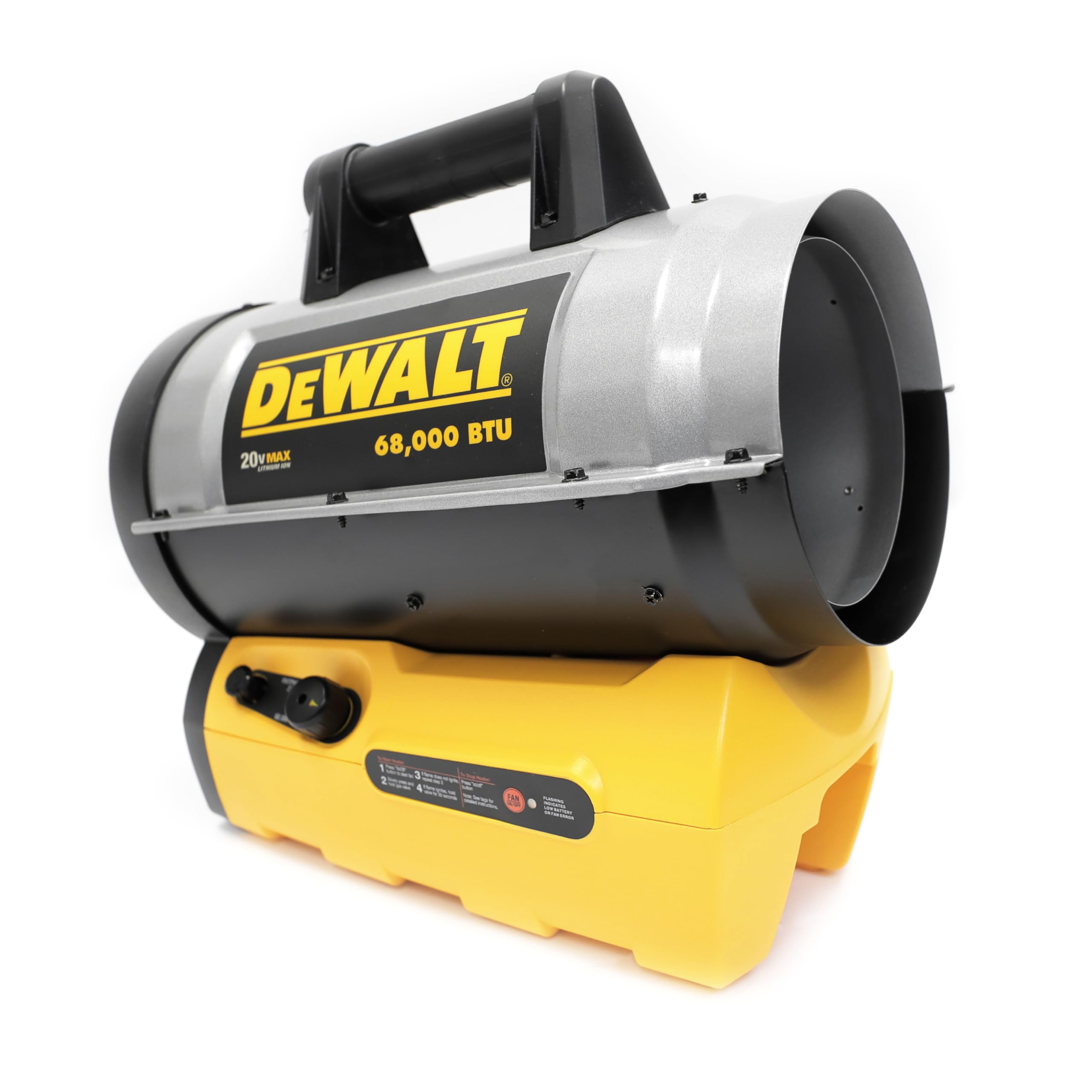
| DEWALT 68,000 BTU Propane Heater | Cordless jobsite flexibility | 27,000–68,000 BTU | 1,700 sq. ft. | 15.1 lb. | Amazon |
| SPECRAFT 150,000 BTU Forced Air Propane Heater | Big-area jobsite heat | 150,000 BTU | 4,000 sq. ft. | 24.3 lb. | Amazon |
| InoKraft MAXHEAT MH125 | Set-and-forget thermostat | 125,000 BTU | 3,200 sq. ft. | — | Amazon |
| Mr. Heater 85,000 BTU Quiet Burner | Long tank run time | 85,000 BTU | 2,125 sq. ft. | 14.2 lb. | Amazon |
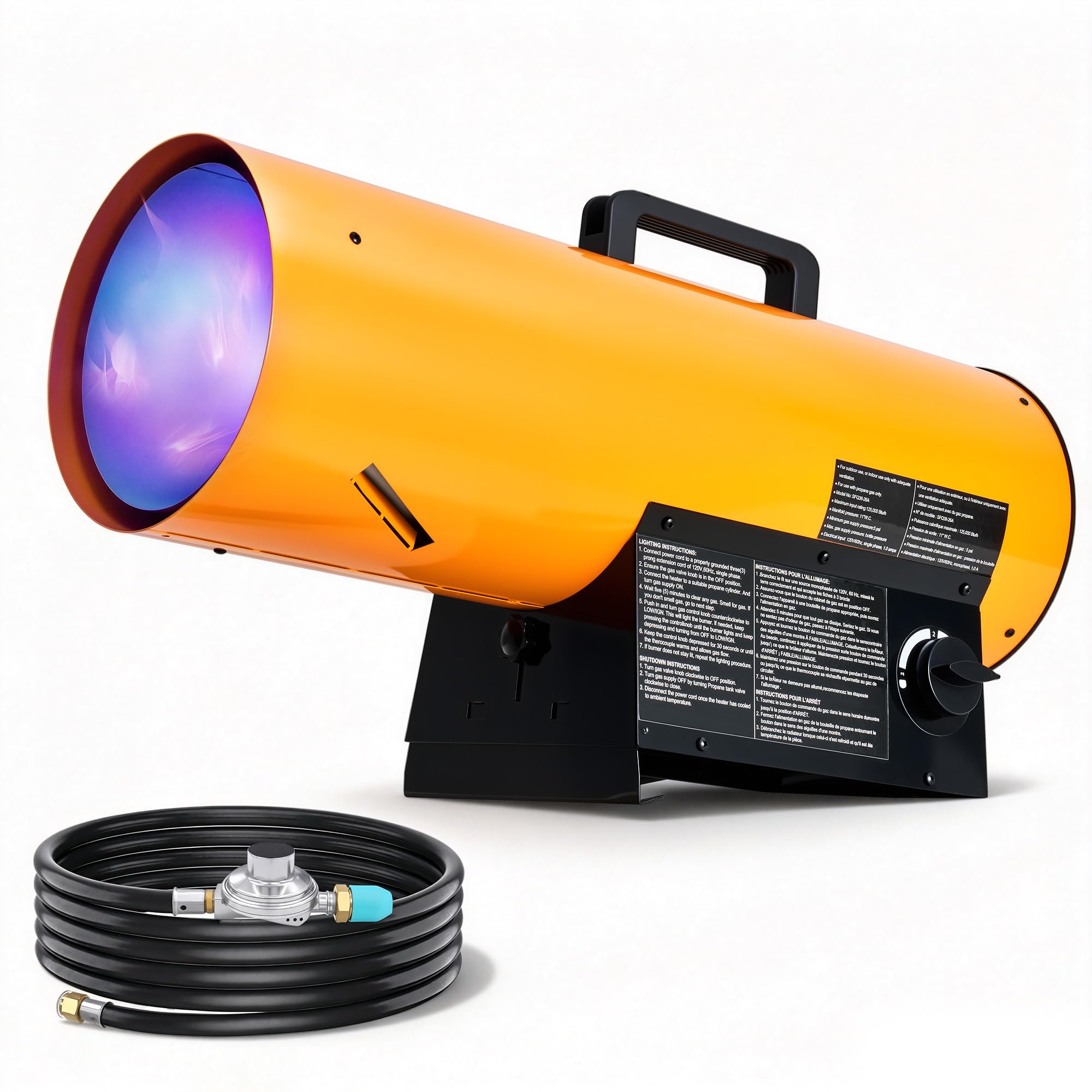
| GASLAND 125,000 BTU Force Air Heater | Popular garage workhorse | 75,000–125,000 BTU | 3,100 sq. ft. | 13 lb. | Amazon |
| Dura Heat GFA125A | Long 100 lb. tank runs | 70,000–125,000 BTU | 3,200 sq. ft. | — | Amazon |
| Master MH-150V-GFA-A | Torpedo output with variable dial | 150,000 BTU | — | 18 lb. | Amazon |
| Dyna-Glo RMC-FA150DGD | Large garage coverage | 120,000–150,000 BTU | 3,500 sq. ft. | 20.1 lb. | Amazon |
| Mr. Heater 80,000 BTU Unit Heater | Permanent ceiling mount | 80,000 BTU | 2,667 sq. ft. | — | Amazon |
Detailed Reviews
1. DEWALT 68,000 BTU Propane Heater
A jobsite heater that runs on battery or cord, so an outlet never limits where you set it.
What sets this one apart is the power source. It runs on a 20 Volt MAX battery or a 120 Volt cord, so you can carry it to a spot with no outlet and still get heat. That hybrid setup is the reason it took the top spot here, and the 4.5+ stars across 280+ owners back up that it works in practice. The burner puts out a variable 27,000 to 68,000 BTU and is rated for spaces up to 1,700 square feet.
Warm-up speed is the thing owners talk about most. A 24 x 35 shop going from 58 to 75 degrees in under 30 minutes, and a three-car garage climbing to 60 degrees after 30 minutes in single-digit outside temperatures — that is the pattern. A 24 x 12 uninsulated garage shop warms up quickly too. The Quiet Burner Technology is rated at 50% less noise than standard units of similar size, and the factory-matched 10 ft hose and regulator come in the box.
The catch is the output ceiling. At 68,000 BTU this is the lightest hitter in the DEWALT line, and the 1,700 square foot rating reflects it — a large or drafty barn will feel the limit. One buyer called it good for outdoor daytime and night use with a 30 lb. tank, but noted it leans on high output. The safety side is covered with factory-installed high-limit switches and a thermoelectric safety valve, and it weighs 15.1 pounds.
Where the DEWALT Wins
- Battery or cord power means no outlet needed for jobsite placement
- Quiet Burner Technology rated at 50% less noise than similar-size units
- Factory-matched 10 ft hose and regulator included
- High-limit switches and thermoelectric safety valve built in
Where It Tops Out
- 68,000 BTU max is the lowest ceiling on this list
- Only rated for 1,700 square feet, so big barns need more
- One buyer had a unit fail within weeks and struggled to return it
Best fit for: garage owners and contractors who work where the outlet is not, and who value quiet over maximum output.
Pass it by if: your space runs much past 1,700 square feet and you need the bigger gas that the Dura Heat or Dyna-Glo brings.
2. SPECRAFT 150,000 BTU Propane Heater
A jobsite torpedo that throws big heat across a 4,000 square foot work area from one unit.
If raw output is your priority, this is the number to beat: 150,000 BTU, rated for work areas up to 4,000 square feet. The forced-air fan drives it across the space, and an adjustable tilt lets you aim the airflow at the work zone. That tilt is the practical feature — you point heat at the bay you are standing in rather than heating empty air. The max temperature setting is 176 °F, the highest figure in this lineup, and it weighs 24.3 pounds.
The ignition is continuous spark, which is a simpler system than the electronic ignition on some rivals but still starts without a match. A 10 ft hose and regulator come in the box, and the ETL certification and 80°C overheat auto shut-off cover the safety side. The manual gas valve lets you dial fuel flow and heat intensity down for smaller areas. The valve at OFF/0 stops gas flow but keeps the fan and igniter running while plugged in, so you follow the cooldown steps before unplugging.
Power trade: The 176 °F max temp is a standout on paper, but it comes with a manual valve rather than a thermostat, so you hold and adjust heat by hand instead of setting a target. And at 24.3 pounds it is the heaviest portable here, versus 13 pounds for the GASLAND — plan on a wheeled cart or a spot you do not move often.
The call: Buy this when you have a genuinely large, open, ventilated jobsite and you want the most BTU per move. skip it if you want to set a temperature and walk away, or if you move your heater around all day.
3. InoKraft MAXHEAT MH125 Propane Heater
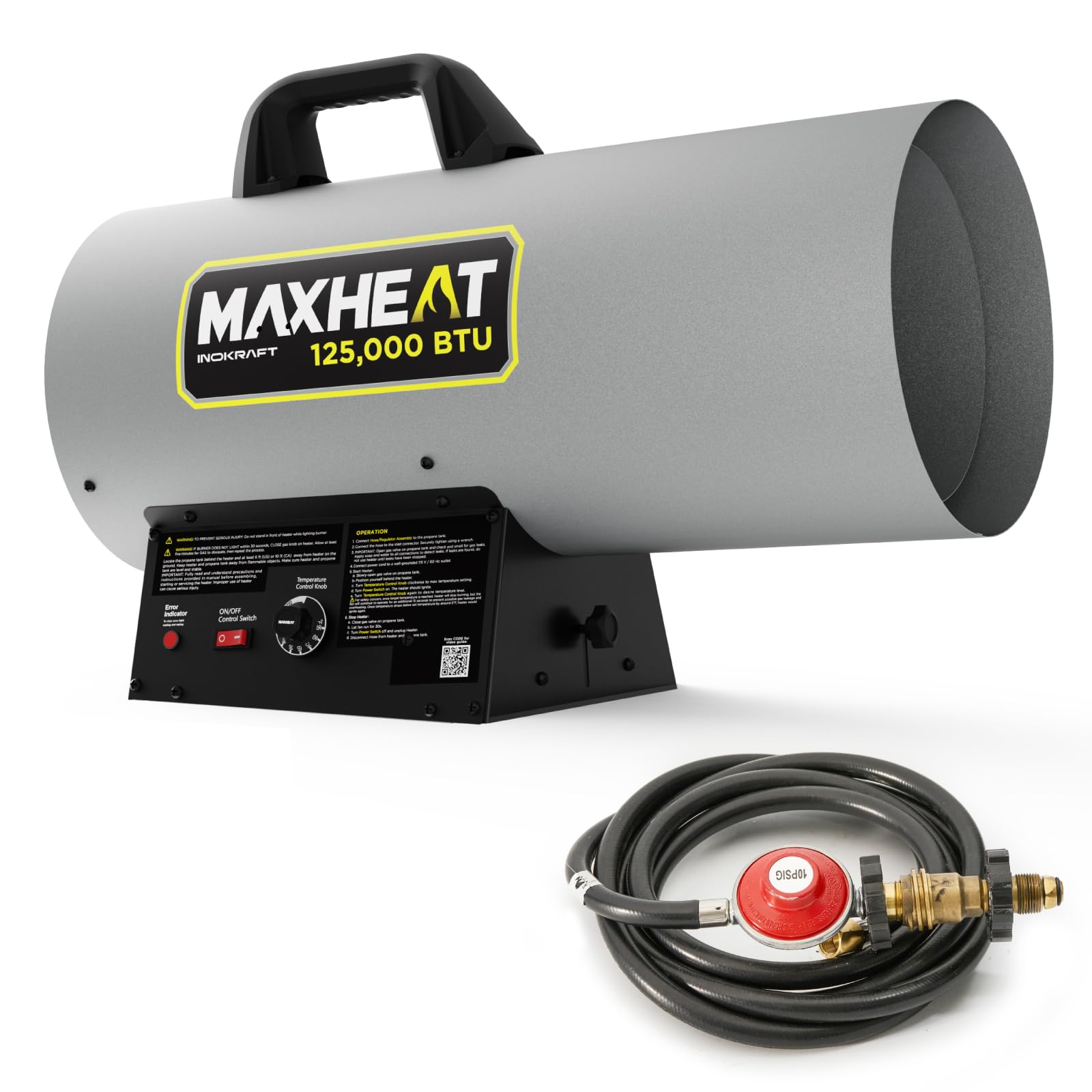
The heater that turns itself off when the shop hits temp and restarts when it drops.
Most portable propane heaters make you babysit the dial. This one takes a target temperature from 25 to 95 °F and cycles the burner on and off to hold it. The burner shuts off at your setting and automatically restarts when the space cools below it. That means no walking over to the dial with glue on your gloves, and the burner idles instead of running full-tilt once the shop hits temp.
The output is 125,000 BTU, rated for large, well-ventilated spaces up to 3,200 square feet. A heavy-duty forced-air fan pushes heat out fast, and the maker rates temperature rise in as little as 5 minutes. The adjustable heat angle lets you aim warmth at your workbench. A 4.9 ft power cord gives placement reach so you lean on an extension cord less. The 4.5+ stars across 70+ owners suggest it does the job.
Here is the honest limit: a thermostat-controlled propane burner still needs a ventilated space, and the savings only show up if you were previously running flat-out all day. Safety is solid — overheat auto-shutoff, gas shutoff protection, and CSA certification. Setup is simple: plug into a 115V outlet, connect the included 10 ft hose and regulator to a 20 lb. tank or larger, and go. It carries a 1-year manufacturer warranty and a built-in handle for moving.
Why it lands here: This delivers the thermostat control that the cheaper portables lack, at a mid-range position. If your garage projects run long and you want the space to hold heat without you adjusting a valve every 20 minutes, this is the pick.
The honest catch: The 95 °F max temp is lower than the SPECRAFT’s 176 °F, so this is a comfort-heating machine, not a scorched-earth thawing tool.
Reach for this: if you want your garage to hold a steady temperature on its own while you work.
Look past it: if you need the highest possible heat for thawing frozen ground or a cavernous, leaky barn.
4. Mr. Heater 85,000 BTU Propane
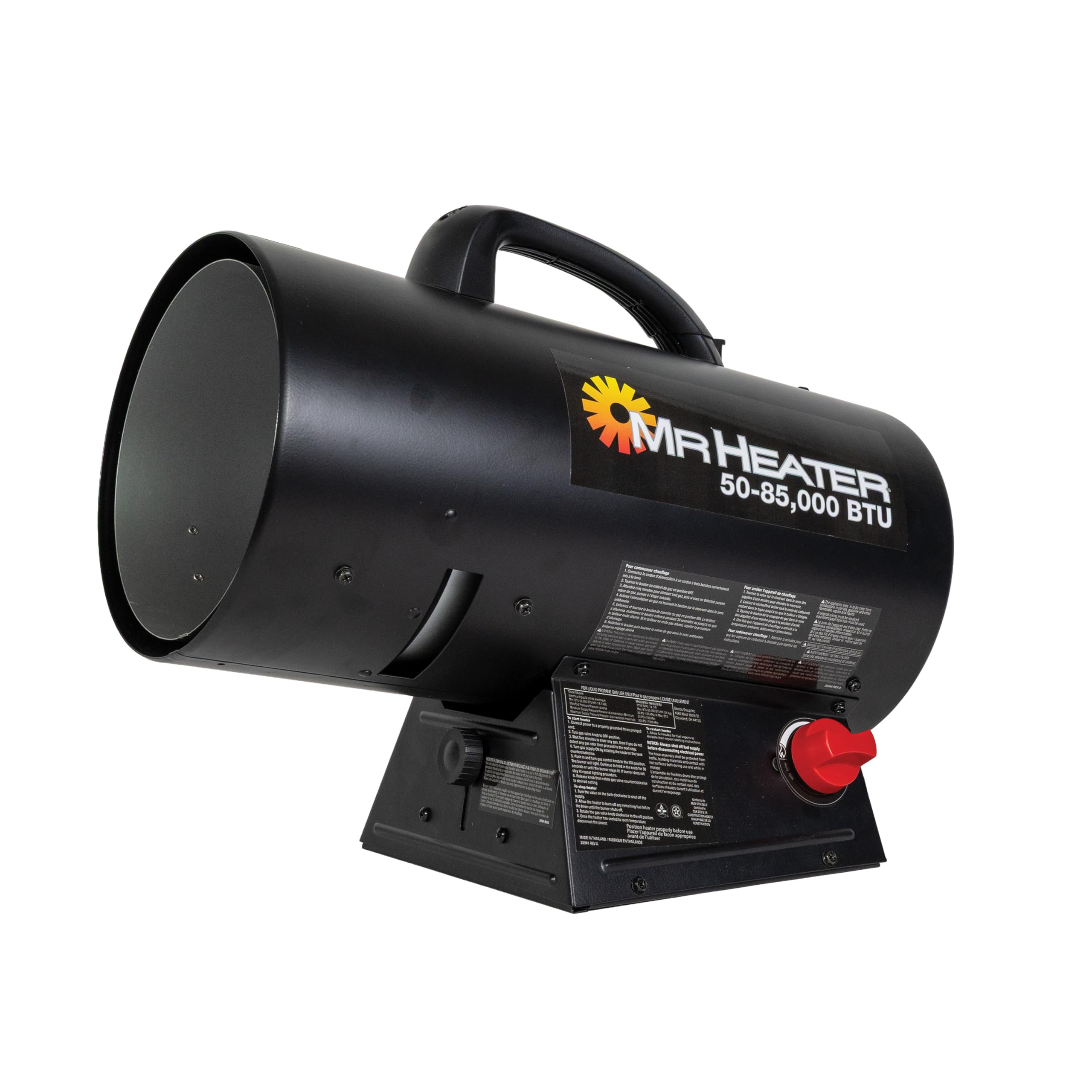
A compact 85,000 BTU heater built to sip a 20 lb. tank for most of a workday.
The number that matters here is run time: up to 8.5 hours of continuous operation on a single tank. That covers a full winter workday in a two-car garage without swapping a 20 lb. tank mid-project. It is rated for spaces up to 2,125 square feet and takes standard 20 lb. propane tanks at minimum. At 14.2 pounds it moves easily between jobs.
What buyers praise most is raw heat performance, and the speed is real. A 24 x 24 garage heats in a hurry, and a shop reaches 50 degrees in 15 minutes before dropping the unit to low to hold temperature. A four-bay RV shop is warm across all bays in about 20 minutes. Assembly is quick, and the adjustable height lets you point the airflow. The Quiet Burner Technology keeps fan noise down, though noise is the one point buyers split on.
The honest caveat is fuel appetite at full output. On high this pulls a 20 lb. tank fast, so plan for a spare tank or a bigger cylinder if you run it flat-out for hours. The 4.0+ stars across 200+ ratings reflect strong satisfaction. It is listed as an outdoor unit, so treat it as a well-ventilated space heater and never a sealed-room one. Includes the L.P. gas hose and regulator.
The Heavy Hitters
- Up to 8.5 hours of continuous operation on one tank
- Quiet Burner Technology for reduced noise
- Small 14.2 lb. footprint that moves between garages
- Variable output dials down to hold a space warm
The Fuel Bill
- Can drain a 20 lb. tank quickly at high output
- Output tops out at 85,000 BTU, below the bigger portables
- Noise is the one thing buyers disagree on
Buy it if: you want a two-car-garage heater that runs most of a shift on one tank and moves easily. Look elsewhere if: you need 125,000 BTU or more and plan to run high all day.
5. GASLAND 125,000 BTU Propane Force Air Heater for Garage
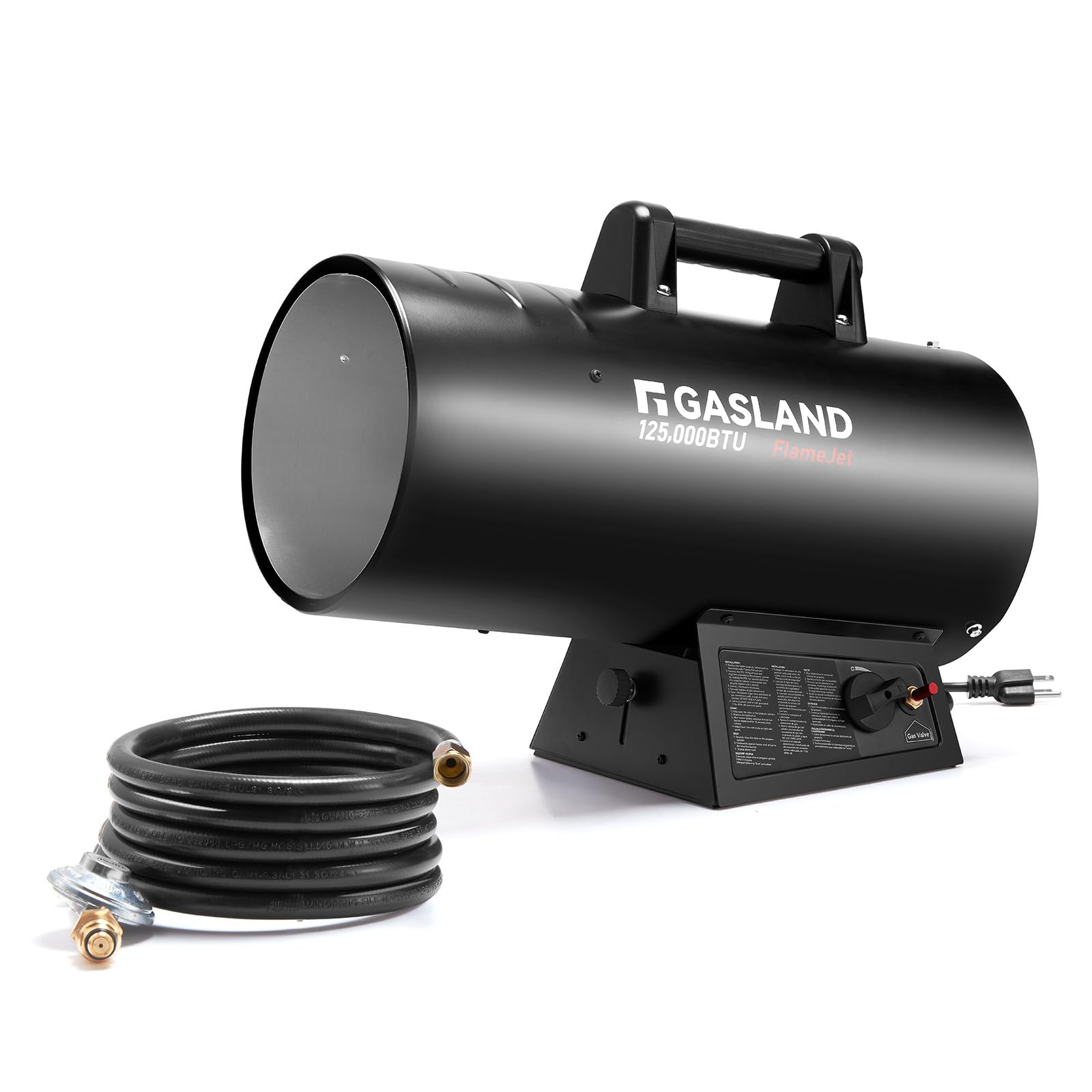
The garage heater with the most owner experience behind it, and a variable dial from 75,000 to 125,000 BTU.
This is the crowd favorite — 4.0+ stars across 1,500+ owners — and that volume of feedback tells you it earns its place in real garages. The output runs from 75,000 to 125,000 BTU, so you dial it down for a small shop or up for a 3,100 square foot space. It is one of the lightest portables here at 13 pounds. That is 11.3 pounds lighter than the SPECRAFT, which matters if you carry it between buildings.
What wins people over is the heat actually reaching them. Buyers describe it pushing warmth to their legs, a feature the forced-air design makes possible. A 12’x12′ space gets a good amount of heat, and owners use it on patios, porches, driveways, and in tiny houses. It also runs roughly 5 hours on low with a standard 20 lb. tank. The continuous electronic ignition starts it fast, and CSA certification, overheat detection, and a thermoelectric safety valve cover the safety side.
The catch is that a small slice of owners hit a rough start, with ignition needing a purge and an occasional unit that will not stay lit. Sized against the huge review base, that is a minority experience, but it is worth knowing. The adjustable heat angle gives you control over where the air goes, and the 1-year warranty and lifetime customer support back it up.
The data read: The huge owner base is the strongest argument here — this is the heater people actually buy for garage work, and the feedback holds up.
The honest note: Ignition can need a purge on some units, so give it a clean start and follow the lighting steps.
The verdict: The best value for a garage or workshop in the 3,000 square foot range, and the lightest of the high-output portables. Not the pick for: someone who wants zero fiddling at startup or needs coverage past 3,100 square feet.
6. Dura Heat GFA125A 70K-125K BTU Propane Forced Air Heater
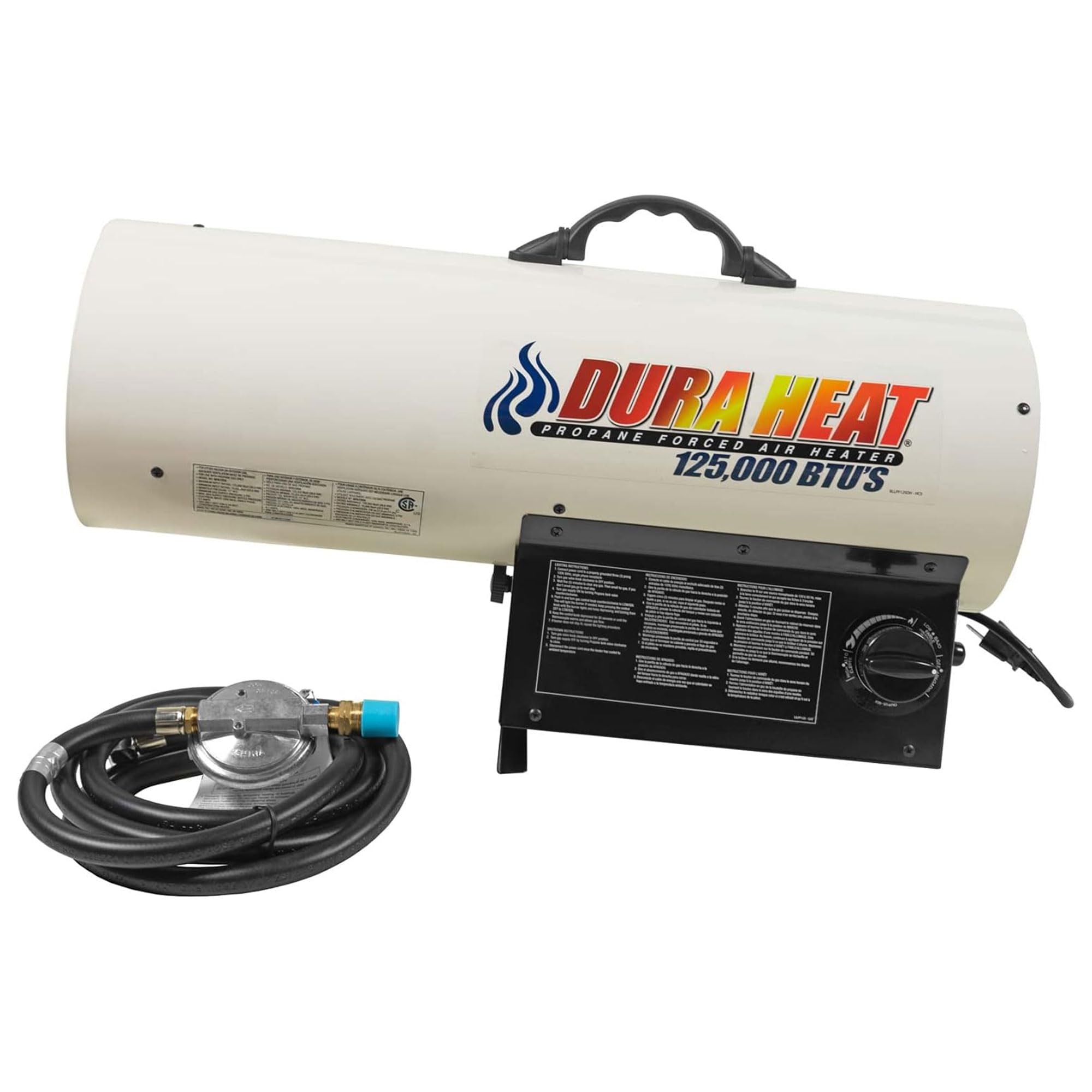
Built to run off a 100 lb. cylinder for 17 to 30 hours straight at variable output.
The endurance figure defines this one: 17 to 30 hours on a 100 lb. propane cylinder, with variable output from 70,000 to 125,000 BTU. That is the pick for a shop running all day on a 100 lb. cylinder instead of a 20 lb. tank. Its efficiency is visible in the electrical draw, too — just 0.65 amps, versus 2 amps on the GASLAND. It is rated for spaces up to 3,200 square feet, and the fan forces hot air where you aim it.
The operation is simple by design — no thermostat to set, just a dial you turn and a straightforward fan. The 10 ft hose and regulator come included. It holds a 4.5+ star rating across 20+ ratings, the highest star score on this list, and it is propane-only. That lean design is why it has fewer owners behind it than the bigger brands: the higher score comes with a smaller crowd, but it is consistent.
Here is your sizing check. A 100 lb. cylinder is not a 20 lb. tank, so if you planned to run this off a standard backyard tank, know it wants the bigger vessel. The unit is rated for outdoor use, so keep it in a ventilated space. It weighs 0 pounds in the listed spec, so do not lean on shipping weight here; the cabinet design is built around a 100 lb. cylinder setup.
Choose this if: you have a 100 lb. tank and want long, uninterrupted heat for a big shop. Steer clear if: you only have 20 lb. tanks or need thermostat control and portable grab-and-go size.
7. Master MH-150V-GFA-A 150,000 BTU LP Forced Air Heater
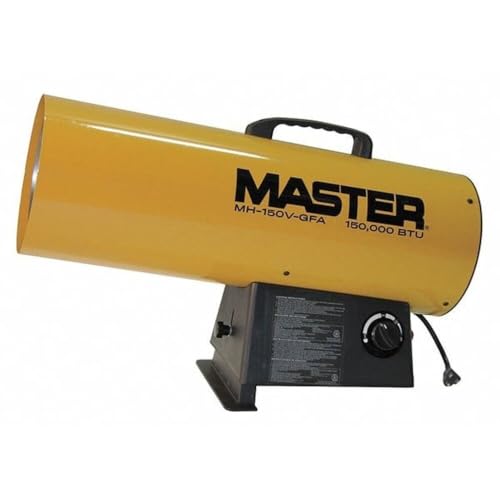
A 150,000 BTU torpedo that sips a 20 lb. tank for up to 23 hours of continuous heat.
This one balances two things that usually fight each other: high output and long run time. You get 150,000 BTU with variable heat settings, and the maker rates up to 23 hours of continuous heating on a full 20 lb. propane tank. That is a full day of heat on one 20 lb. tank, which is why contractors keep this torpedo in their trailer. It is built as a torpedo salamander heater for warehouses, barns, and construction sites.
The variable settings let you dial output to match the space, and an over-heat shut-off stops operation automatically if things get too hot. It weighs 18 pounds, which sits between the lighter GASLAND at 13 pounds and the SPECRAFT at 24.3 pounds — manageable for one person to carry and set. The 4.0+ stars across 10+ ratings come from a small owner base, so treat the sample as limited.
The honest catch is the ignition and indoor use. Some owners note it does not light automatically and is not meant for strictly indoor use, so this is a tool for ventilated workspaces and manual starts. Heat output itself gets solid marks — it warms quickly and runs quieter than some older models. If you want push-button lighting and a sealed-room guarantee, this is not that machine.
The standout: 23 hours of continuous heat on a 20 lb. tank with 150,000 BTU of variable output is the combination that makes this a pro-grade jobsite workhorse.
The thing to know: Expect to light it yourself and keep it outdoors or in a ventilated space — some buyers flag the manual ignition as a friction point.
The fit: contractors heating barns and construction sites who value output and tank endurance over push-button convenience. Wrong pick for: enclosed residential rooms or anyone expecting automatic ignition.
8. Dyna-Glo RMC-FA150DGD Propane Heater

A 3,500 square foot heater with continuous electronic ignition that prevents delayed lighting.
Where this one earns its spot is coverage. It runs 120,000 to 150,000 BTU continuously variable and is rated for up to 3,500 square feet, one of the biggest spaces on this list. The ignition is the safety story: continuous electronic ignition that prevents dangerous delayed ignition, so gas lights at the moment it flows instead of pooling. The adjustable heat angle aims output at the work zone, and it includes a 10 ft hose and regulator.
It heats fast: buyers report a two-car garage climbing from the mid-40s to the 60s within 30 minutes, and a 1,600 square foot shop warming in about 20 minutes. It also skips the kerosene smell that bothers some owners of other heaters. Its 4.0+ stars across 77 owners point to steady performance, and an overheat auto-shut-off (it cuts the burner if the unit gets too hot) adds a safety layer.
One trade-off to plan around: a few owners find the propane smell noticeable in a tight space, so ventilation matters. Noise is also a split point — some call it a little loud, others find it quiet. And at 20.1 pounds it is a bit of a lift from spot to spot. This is an indoor-rated forced air heater in a freestanding form, so it can live near your bay, but run it where air moves.
Why Buyers Keep It
- Continuous electronic ignition prevents dangerous delayed light-up
- Rated for 3,500 square feet of coverage
- Heats a two-car garage to the 60s within 30 minutes
- Inside versus the kerosene machines — no kerosene odor
What To Weigh
- Propane smell can build in tight, poorly ventilated spaces
- 20.1 pounds makes it a bit heavy to reposition
- Noise is a matter of taste, not consensus
Your machine if: you have a large garage or shop in the 3,500 square foot range and want ignition safety built in. Think twice if: you heat a small, sealed room where odor concentration would build.
9. Mr. Heater 80,000 BTU Unit Heater
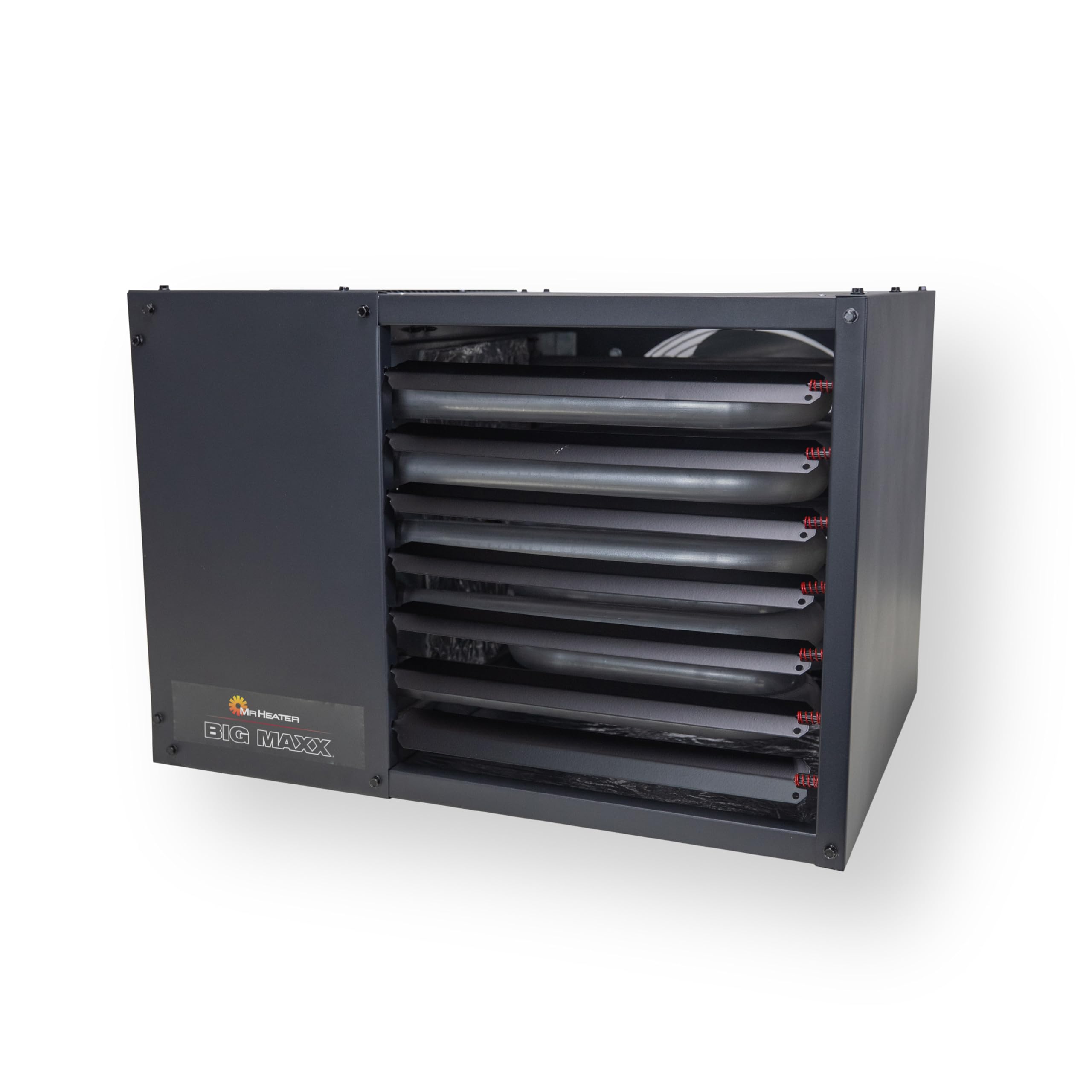
Hang it from the ceiling and stop thinking about garage heat all winter.
This is a different animal from the portables. It is a ceiling-mounted unit heater that turns a garage, barn, or workshop into a permanently heated workspace. At 80,000 BTU it is rated for up to 2,667 square feet. It hangs low-profile overhead on the included angle brackets, and it works with a standard 24-volt or Wi-Fi enabled thermostat (sold separately) so you control it from a wall or your phone. The 4.0+ stars across 850+ owners reflect how many people run one.
Performance is what owners talk about most — it heats fast and installs straightforwardly. An insulated three-car detached garage warms easily, and one shop keeps warm enough that coats come off. It is also efficient with airflow and sized well for a shop. The fuel side is flexible: it ships as natural gas with an NG to LP conversion kit so it can run propane, and it includes high-temperature and gas safety shut-off sensors.
Install planning is the honest gate. It needs a 10 ft minimum ceiling height and 8 ft of clearance from the base of the heater to the floor — not every residential garage clears that. The 2.3 amp draw is reasonable, and reliable operation is the norm, though a small number hit electrical issues over time. It does require a proper gas line and thermostat, so budget for that setup, not just the unit.
top-tier for: permanent garage heat with thermostat control. A large owner base and strong performance marks back the confidence of hanging it once and forgetting it.
The install catch: the 10 ft ceiling and 8 ft clearance requirements mean you need to measure before you buy — a low-ceiling garage will not clear it.
Go this route if: you want a permanently mounted propane or natural gas heater with thermostat control in a garage that has the ceiling height. Stay with a portable if: your ceiling is low or you want something you can pick up and move.
10. Mr. Heater 400,000 BTU Portable Forced Air Propane Heater
Forced Air Versus Radiant
Forced air means a fan pushes the warmed air out, so the heat moves across the room instead of radiating only from the unit itself. That is why these heaters can warm a 3,500 square foot space rather than just the spot in front of them. Radiant heat is direct line-of-sight warmth; forced air is whole-room circulation. For a garage or jobsite you want the fan.
Tank Size and Run Time
A standard 20 lb. tank is the usual fuel for portable units, while bigger outputs or long run times call for a 100 lb. cylinder or a pair. Run time is directly tied to tank size and output setting — a unit on low lasts longer than one onhigh. Plan your refills around your longest workday, and keep a spare tank on hand if you run near the top of the dial.
Ignition and Safety Valves
Continuous electronic ignition sparks the gas at the moment it flows, which prevents dangerous delayed ignition. A thermoelectric safety valve cuts gas flow if the flame goes out, and overheat shut-off kills the burner if it gets too hot. These are the features that separate a safe heater from a risky one. Every unit here is designed for well-ventilated spaces, so never run one in a sealed room.
Amperage and Power Draw
Amperage tells you how much electrical current the fan and ignition pull, which matters if you run it off a small circuit. The Dura Heat draws 0.65 amps, while the GASLAND draws 2 amps. A lower draw is easier on a shared garage circuit. Corded units plug into a standard outlet, and the DEWALT can run on a 20 Volt MAX battery when no outlet is nearby.
Thermostat Control Versus Manual Valve
A thermostat takes your target temperature and cycles the burner on and off to hold it, like the InoKraft with its 25–95 °F range. A manual valve means you set the flow and adjust by hand as the space warms. A thermostat holds your set temperature on its own, so you stop adjusting a manual valve every 20 minutes and stop burning propane past the target. Manual control is simpler and often cheaper to build, but you stay in the loop.
Portable Versus Ceiling Mounted
Portable units sit on the floor, connect to a tank, and move where you need them. Ceiling-mounted unit heaters hang overhead, plumb into a gas line, and heat a fixed space permanently. The Mr. Heater unit heaters need a minimum ceiling height and clearance from the floor to the heater base. Choose portable for jobsites and grab-and-go heating, ceiling mount for a shop you want warmed every winter without setup.
Common Questions
How many BTUs do I need to heat my garage with a propane forced air furnace?
Can I run a propane forced air heater in a closed garage?
How long will a 20 lb. propane tank last with a forced air heater?
What is the difference between a torpedo heater and a unit heater?
Do I need a thermostat to run a forced air propane heater?
What does continuous electronic ignition do on a propane heater?
How heavy is a propane forced air heater, and can I carry it alone?
Can I use a forced air propane heater with a small 20 lb. tank on a high BTU unit?
Why does my propane heater smell like propane when it runs?
How much ceiling height does a ceiling-mounted propane unit heater need?
The Bottom Line
For most buyers, the propane forced air furnace winner is the DEWALT 68,000 BTU Cordless Portable Forced Air Propane Heater. It runs on battery or cord, so no outlet limits where you set it, and Quiet Burner Technology keeps the noise down. If you want the biggest garage coverage with a thermostat that runs itself, grab the InoKraft MAXHEAT MH125. And for a permanent, ceiling-mounted setup in a big shop, the Mr. Heater 80,000 BTU Unit Heater is the one to reach for. The GASLAND has the most owner experience behind it, but the DEWALT takes the higher star score, and that combination is where the smart money goes.
How we choose
We do not accept paid placement. Every pick is matched to a real buyer and a real use-case; we do not hands-on test units.
Sources
Specifications: manufacturer listings and product documentation. Review insights: verified customer reviews, as of November 2026. Pricing: not shown on this page (it changes often); check the current price via the retailer link.
As an Amazon Associate, Tactical Gear Guy earns from qualifying purchases. This does not affect which products we feature.