Specs are compiled from manufacturer listings and verified buyer reviews and can change over time — please confirm the key details on the product page before buying.
If you are shopping for a terabyte microSD card, the first thing to know is that a huge number of cards sold online are counterfeit — they report a terabyte but overwrite or corrupt your files once you pass a much smaller real limit. That single risk matters more than any speed figure on the box. This guide covers nine genuine 1TB-and-up cards, explains what each one is honestly good at, and helps you match one to your console, camera, phone or dash cam. One quick note before we go further: this list uses flexible, human-like matching for terabyte-class microSD cards (1TB capacity or higher), so not every pick is the exact model number you typed into the search bar — the nearest same-type card that does the same job is included, and you will always be told which is which.
This guide is built by comparing the manufacturers’ published specifications and the patterns across verified customer reviews, so you get each pick’s real strengths and trade-offs instead of marketing spin.
We start with what capacity really means once a device formats the card, then walk through read speeds, the A2 and V30 ratings, and which cards actually fit a Switch, Steam Deck or drone before you commit. Everything below is built to help you land on the right tb microsd card on the first try.
Top Picks


How To Choose The Best TB microSD Card
A terabyte microSD card is not a luxury purchase anymore — it is the standard way to expand a console, a phone or a camera without carrying spares. The problem is that the card’s label tells you almost nothing about whether it will work in your specific device. Here is how to read the shelf without getting burned.
Start with the capacity your device will actually read
Every card’s printed capacity is the raw storage before formatting, so a card labelled 1TB will show less usable space once your device sets up its file system. On the Amazon Basics card, the maker explicitly states the available storage is higher than 908GB — that is normal, not a defect. More important is the device ceiling: if your phone or camera officially supports a 64GB maximum, it may not recognise a full 1TB card at all. Check the device’s maximum supported capacity before you buy.
Then match the speed rating to the job
Read speed is how fast files come off the card — it governs how quickly game levels load or how fast you can pull photos onto a laptop. Write speed is how fast the card saves data, and it matters most for recording video. The V30 label (Video Speed Class 30) is the one to look for if you shoot 4K footage, because it guarantees a minimum sustained write rate for video. The A2 label (App Performance Class) is the gaming and phone equivalent — it means apps and games can run directly from the card with faster launch times.
Check the connector type before anything else
The newest Nintendo Switch 2 uses a different, faster card format called microSD Express, and it is not backwards compatible with the standard microSD cards on this list. Nearly every card here states clearly that it is not compatible with Switch 2. If you own the original Switch, a Steam Deck, an Android phone, a drone or a security camera, standard microSD remains the correct choice.
Side-by-Side Comparison
| Model | Best For | Stated Capacity | Read Speed | Video / App Rating | Amazon |
|---|---|---|---|---|---|
| SANDISK 1TB Ultra + Adapter★ Best Overall | Everyday phones, tablets and original Switch | 1 TB | Up to 150 MB/s | C10, U1, A1 | Amazon |
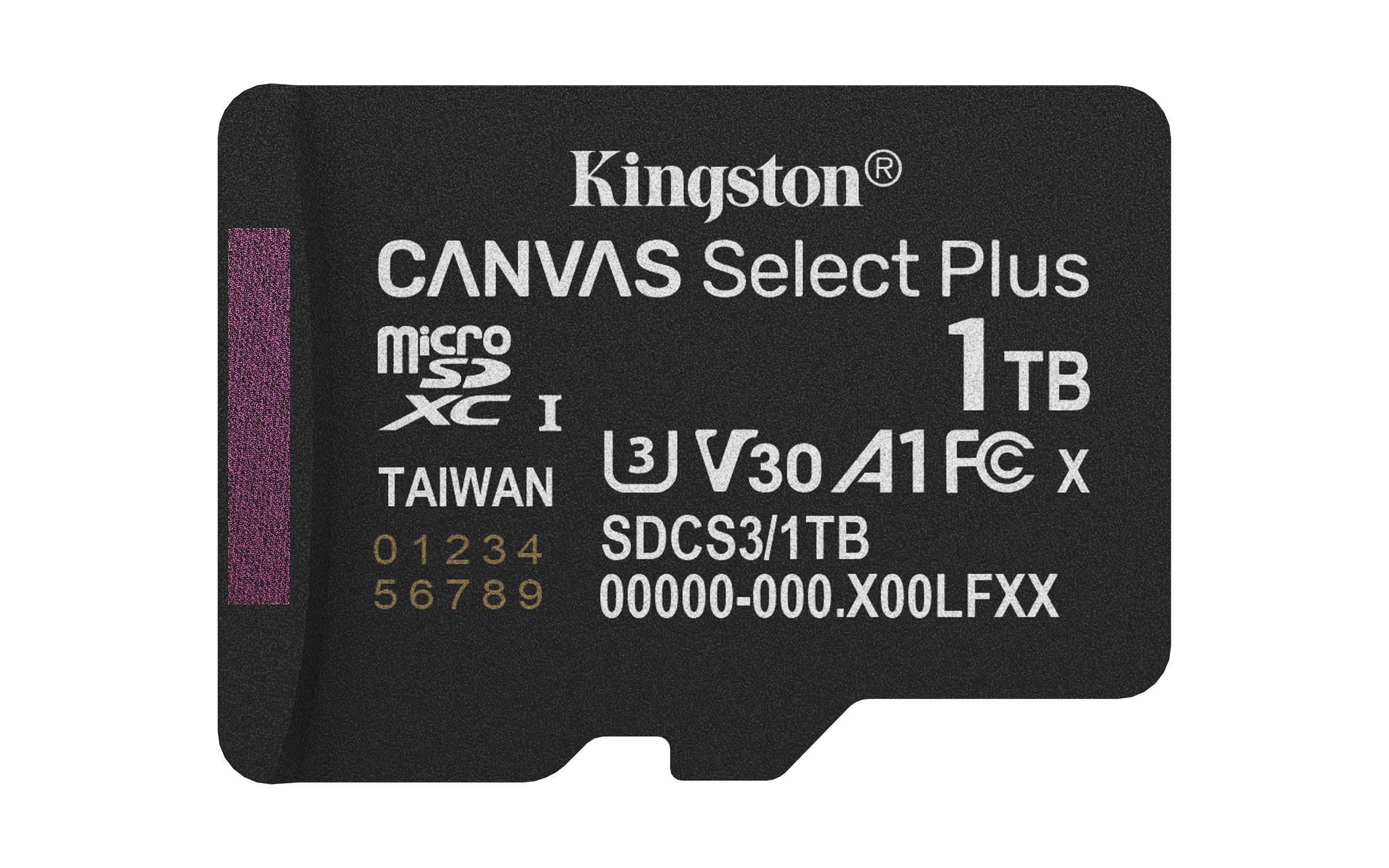
| Kingston Canvas Select Plus 1TBBudget Champion | Android phones and cameras on a tighter budget | 1024 GB | Up to 150 MB/s | A1 | Amazon |
| Silicon Power 1TB GamingCompact Pick | Portable gaming consoles and tablets | 1 TB | 80 MB/s | V30 | Amazon |
| PNY PRO Elite Prime 1TB | Drones, action cameras and surveillance | 1000 GB | Up to 200 MB/s | U3, V30, A2 | Amazon |
| Lexar Play Blue 1TB | Original Switch and Steam Deck gaming | 1 TB | 160 MB/s | V30, A2 | Amazon |
| Lexar Silver Plus 1TB | Drone and 4K video work | 1024 GB | 205 MB/s max | V30 | Amazon |
| Amazon Basics 1TB microSDXC | Full HD and 4K capture across mixed devices | 1 TB | Up to 200 MB/s | U3, C10, A2 | Amazon |
| Samsung PRO Plus 1TB | 4K phones, drones and consoles | 1 TB | Up to 180 MB/s | U3, V30, A2 | Amazon |
| SanDisk Extreme PRO 2TB | Heavy 5K/4K recording and big libraries | 2000 GB | Up to 250 MB/s | U3, V30, A2 | Amazon |
Detailed Reviews
1. SANDISK 1TB Ultra microSD Card
Our pick — 4.5+★ from 155,000+ verified ratings; the strongest balance of quality and price.
The card that ends your storage panic across phones, tablets and the original Switch.
This is the card to buy if you want one terabyte of storage that simply works everywhere without a compatibility scavenger hunt. The SanDisk Ultra carries a 1TB capacity and a read speed of up to 150MB/s, which is the number that decides how fast your photos and game levels come back off the card. It also carries an A1 rating (App Performance Class 1, the lower of the two app ratings), so apps load faster than on a plain card — helpful on an Android phone but not the fastest option for heavy game installs.
The plain-English read: 150MB/s read speed is what lets SanDisk claim you can move up to 1000 photos per minute, and in real life that means a full camera roll transfers to your laptop in one short sitting rather than a coffee break. At 4.54 g the card itself weighs next to nothing, so it adds no bulk to a phone or tablet. Its compatibility sheet is genuinely broad — Android smartphones and tablets, the original Nintendo Switch, Raspberry Pi retro handhelds, and WiFi security cameras all appear in what buyers report. If you want the best overall balance of broad device fit and a known brand, this is the sane pick — 4.5+ stars across 155,000+ ratings backs that up.
What wins people over most is plain reliability — the card keeps working, month after month, without drama. The honest catch sits in durability, where the record is genuinely split: a few units fail after a couple of years, and an occasional one arrives dead. That is a normal risk with any flash card, but it is worth keeping your most precious files backed up regardless. Note too that SanDisk’s camera claim assumes a compatible host device; a slow reader will pull files slower than 150MB/s.
What earns the top spot
- 1TB capacity with up to 150MB/s read — fast enough to move up to 1000 photos per minute to a laptop
- Rated for Android phones and tablets plus the original Nintendo Switch, Raspberry Pi handhelds and WiFi cameras
- A1 app rating so apps and games launch quicker than on a basic card
- 1,600-plus owners single out reliability, which is why it sits at the top of this list
Where it asks you to be careful
- Durability feedback is split — a few cards fail within a couple of years, so back up what matters
- Not compatible with Nintendo Switch 2
- Full 150MB/s needs a compatible reader and host device
Plain verdict: The right card if you want one terabyte that fits phones, tablets and the original Switch without a compatibility check.
Think twice if: you are outfitting a Nintendo Switch 2, which needs a microSD Express card instead.
2. Kingston Canvas Select Plus 1TB
The least expensive way onto a genuine terabyte without dropping down a speed class.
If you want the cheapest honest terabyte here, this is it. Kingston states the card at 1024 GB — a touch more labelled space than the PNY PRO Elite Prime’s 1000 GB — and pairs it with an up-to-150MB/s read speed for everyday transfers. The A1 app rating means phones and tablets will launch apps from it faster than from an unrated card, which matters on an Android phone that is already filling up.
Where do you feel that read rating in daily use? Pulling a couple of hours of phone video onto a laptop walks along at a comfortable pace rather than dragging, and camera photo dumps clear in a few minutes. The card fits Android devices and cameras, and it carries water, temperature and X-ray resistance in its spec sheet, so an accidental splash on a camera bag is not an instant disaster.
One honest limitation: Kingston lists 60MB/s as its media speed in the specifications, which is a slower figure than its headline read number — so treat the “up to 150MB/s” as the best-case read and expect real-world transfer speeds to settle lower depending on your reader. That is the trade-off for the lower price, and it is a fair one for backups and media storage rather than constant high-speed video work. The card is smaller in the hand than a fingernail, so it slips easily into a pocket card wallet.
Price-to-value read: You get the full 1024 GB, A1 app performance and a known brand for the least money in this lineup — the clearest budget pick on the shelf.
The trade-off to know: older or slower readers will cap your real transfer speed well below the headline read rating, so this suits storage and everyday file moves more than high-frame-rate video recording.
Reach for this if: your priority is pure capacity per dollar and your needs are photos, media and app storage.
Look elsewhere if: you need guaranteed high sustained write speed for 4K video capture.
3. Silicon Power 1TB SDXC Micro SD Card
Built for the original Switch and Steam Deck, with a five-year warranty and a smaller price tag than most of this list.
The Silicon Power gaming card is aimed squarely at handheld consoles — it is designed for dependable storage on portable gaming devices, and it carries the V30 video rating (a guaranteed minimum sustained write rate for 4K video) so game installs and video saves stay smooth. It also has an automatic error correction code feature, which quietly fixes tiny read errors so a single glitch does not corrupt a save file.
In practice that is a difference you will never feel in a console, but it is worth knowing that the two spec figures are not identical. The 1TB space is generous for a Switch or tablet library, and the maker backs it with a five-year limited manufacturer warranty — the longest written coverage on this list.
The one compatibility line you must read: this is a standard microSD card and is explicitly not compatible with the Nintendo Switch 2. Inside a Switch 2 it may handle only limited tasks like storing screenshots, with no game installs or save data. For the original Switch, a Steam Deck, or a Samsung tablet, it does the job — and the broad Samsung phone and tablet list on the box means most Android owners will find their model named.
Why console gamers shortlist it
- 1TB space with V30 video rating for smooth game and video saves
- Automatic error correction code helps protect saves from tiny read glitches
- Five-year limited manufacturer warranty — the longest stated coverage here
- Designed for portable gaming consoles including the original Switch and Steam Deck
Fine print on the box
- Explicitly not compatible with the Nintendo Switch 2
- 80 MB/s media speed is slower than the higher-priced cards here
- Steam Deck users are directed to a Gen4x4 2230 SSD for best gaming performance
Console-first call: A sensible match for an original Switch or a tablet where the five-year warranty matters more than raw benchmark speed.
Where it falls short: if you own a Switch 2, this card is the wrong format entirely.
4. PNY 1TB PRO Elite Prime microSDXC
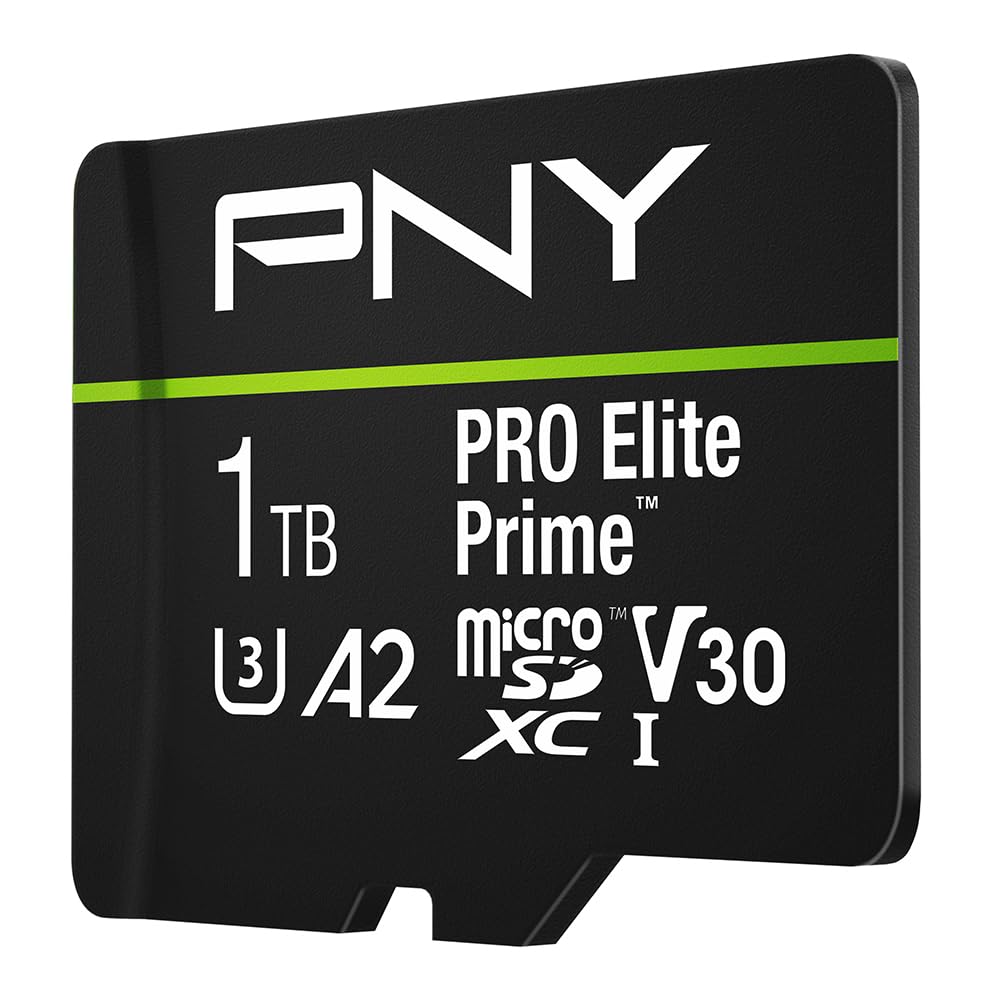
A drone-and-action-camera card with an A2 app rating and 200MB/s read that beats most of the mid-pack.
Start with the A2 rating, because it is the firepower here. A2 (App Performance Class 2) is the higher app rating, and PNY states it delivers at least 4000 IOPS reads and 2000 IOPS writes — meaning games and apps launch noticeably quicker from the card than they would on an A1 card. Add read speeds up to 200MB/s and write speeds up to 150MB/s, and this card clears transfers faster than the 150MB/s SanDisk Ultra and the 160MB/s Lexar Play Blue in this list.
For real-world use, that speed matters when you are offloading drone footage or action-cam clips onto a laptop — 200MB/s read pulls a big card’s worth of files in a burst rather than a slow crawl. The card ships with an SD adapter so it drops into a DSLR, a laptop reader or a desktop slot, and it carries drop, temperature and water resistance in its spec sheet. It is built for drones, action cameras, surveillance cameras, phones and tablets — a genuinely versatile fit.
Be honest about two things. First, the 200MB/s read figure requires PNY’s Performance Prime card reader; with a plain reader, expect lower real-world speed. Second, the record shows speed and compatibility are the split topics — some owners mention performance that does not match expectations, and the card is explicitly not compatible with the Nintendo Switch 2. For most people doing action-cam or drone work with the right reader, it performs well; if you want the widest compatibility guarantee, a card with more universal praise may suit you better.
Where it leads: A2 app performance plus up to 200MB/s read gives this the strongest gaming-and-apps fit of the mid-pack cards, and the included SD adapter makes device swaps painless.
The honest limit: the headline speed depends on PNY’s own reader, and the Switch 2 incompatibility is worth checking before you buy.
Good match for: drone and action-camera shooters who want fast offloads and quick app launches.
Not the one for: a Nintendo Switch 2 owner, or anyone without a compatible fast reader expecting full speed.
5. Lexar 1TB Play Blue Micro SD Card

Game-first read speed for a Switch, a Steam Deck or a phone that needs instant app launches.
The Play Blue is Lexar’s gaming-badged card, and the numbers explain why. It reads at up to 160MB/s — faster than the 150MB/s SanDisk Ultra and the 150MB/s Kingston, and a touch behind the PNY’s 200MB/s — which is the figure that shrinks game-level load times. On top of that it carries A2 app performance, meaning apps and games run straight from the card with quick access and no buffering lag.
That read speed shows up in use: pulling a large game library onto a laptop or dragging a batch of photos off the card feels brisk, and the A2 rating keeps a Steam Deck or phone feeling responsive when apps live on the card rather than internal storage. The card is built for the original Nintendo Switch, smartphones, tablets, the Steam Deck and the ASUS ROG Ally, and it carries temperature, water, vibration, X-ray and magnetic resistance in its spec sheet. A 1TB card that tolerates a drop in an action bag is a card you stop worrying about.
Be realistic about durability, because the record here is split — some cards stay rock-solid while a few users report file corruption. That is worth balancing by keeping a backup of precious files, and by buying from a trusted seller to avoid counterfeit units. The Switch 2 incompatibility applies here as well; this is standard microSD, not microSD Express.
What makes it a gaming pick
- Up to 160MB/s read — snappy game loads and fast photo transfers
- A2 app rating so games and apps launch quickly from the card
- Fits the original Switch, Steam Deck, ROG Ally, phones and tablets
- Carries temperature, water, vibration, X-ray and magnetic resistance
What to watch
- Durability is split — a small number report file corruption over time
- Not compatible with the Nintendo Switch 2
- Speed ratings assume a compatible host device
Best served: handheld gamers who want quick load times on an original Switch, a Steam Deck or an ROG Ally without stepping up to the priciest card.
Reconsider if: your console is a Switch 2, which takes a different card format.
6. Lexar 1TB Silver Plus Micro SD Card
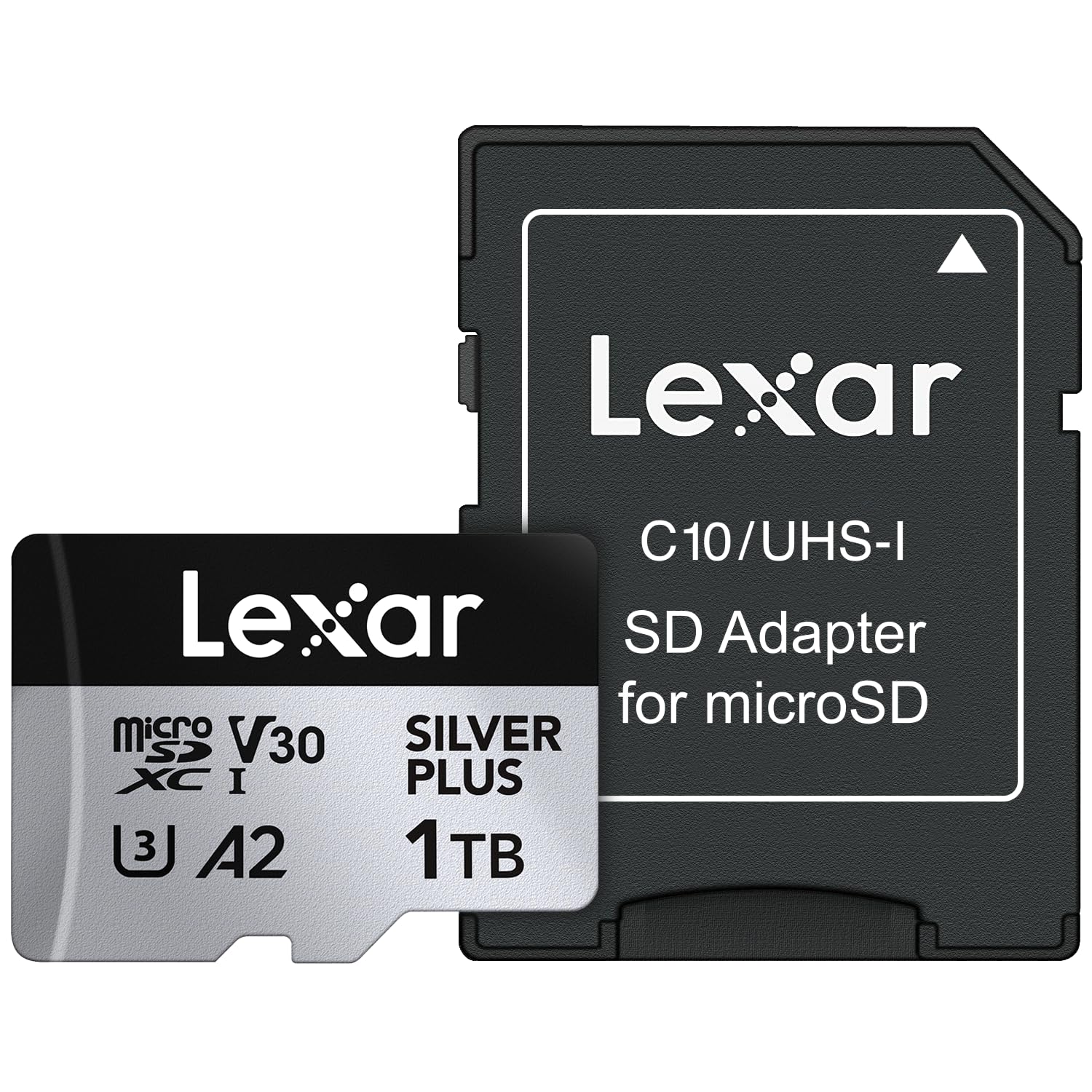
Drone footage offloads at a 205MB/s clip, which is the fastest read figure on this list.
This card is built around one number: a 205MB/s max read speed. That is the highest read figure on this list — above the PNY’s 200MB/s, the Samsung PRO Plus’s 180MB/s, and the SanDisk Ultra’s 150MB/s — and it is the reason a photojournalist or drone pilot shortlists it. Add a 150MB/s max write speed for smoother saves and V30 video support up to 4K 60FPS, and it handles fast-action footage without dropping frames.
Where do you notice the read speed? Pulling a big batch of drone clips or 4K footage onto a laptop stops being a chore — a large card’s worth of files clears in a fraction of the time a slower card would take. The 1024 GB capacity gives you room for long recording sessions, and the card carries full-bore toughness: IPX7 waterproofing, plus wear, drop, temperature, X-ray, shock, magnetic and vibration resistance. Lexar also includes recovery software and a lifetime limited warranty on the card, which is unusually long coverage for a card this small.
The honest note is durability, where the feedback is genuinely mixed — most cards run fine and handle 4K recording without issue, but a few report early failure. That is the reality of any flash media; a backup and Lexar’s included recovery software are your safety net. The one compatibility check: this is standard microSD, not Switch 2 ready, so buy a microSD Express card if you are outfitting the new console.
Spec mic-drop: A 205MB/s read speed and IPX7 waterproofing make this the fast-and-tough pick for videographers who offload clips in bulk.
Worth a look at the trade-off: the 205MB/s figure is a maximum, not a guaranteed constant, and durability has a few reported failures over time.
Best fit for: drone pilots and videographers who move big 4K files regularly and want the quickest offloads plus waterproofing.
Better to skip if: your main device is a Nintendo Switch 2, which needs microSD Express.
7. Amazon Basics 1TB microSDXC Card
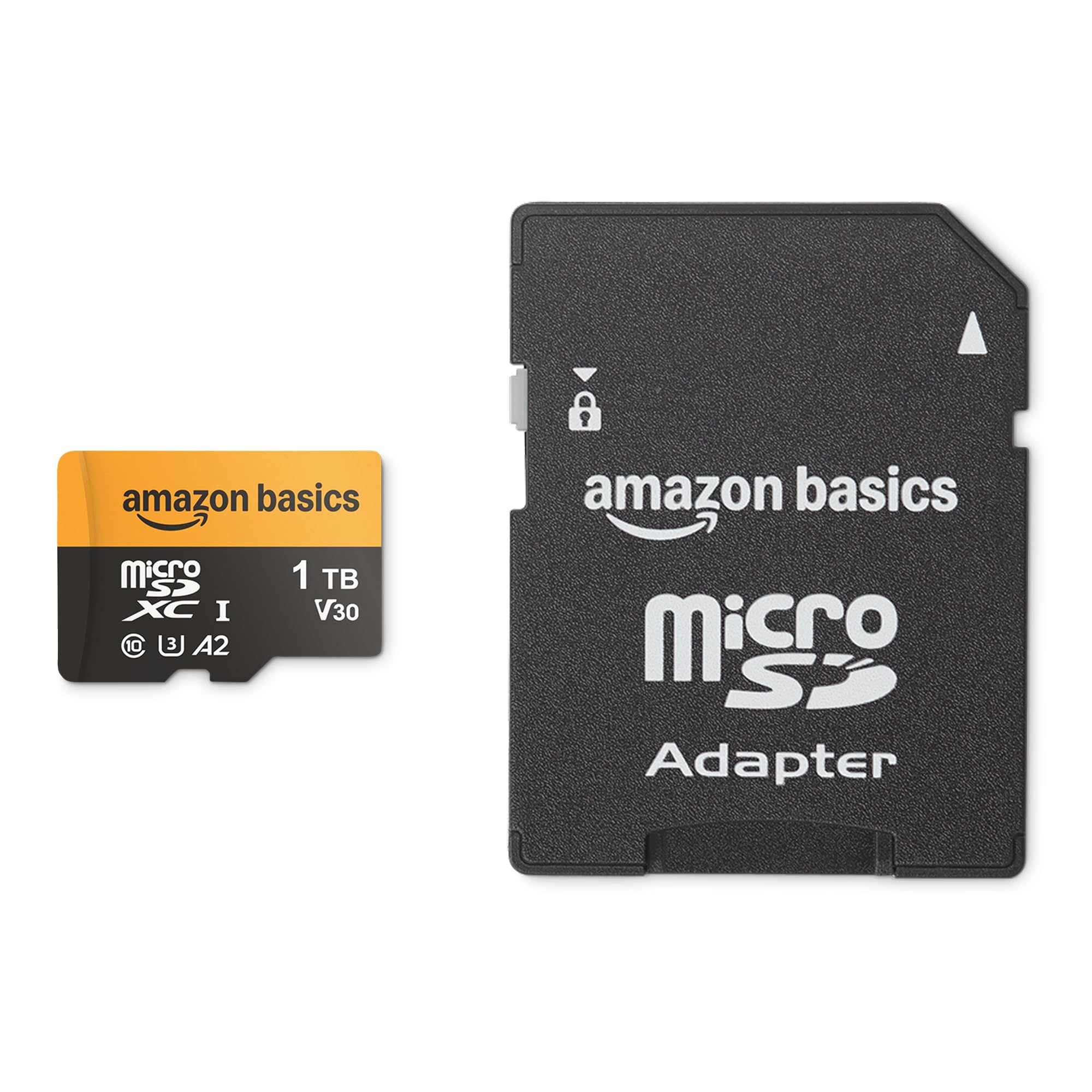
An all-rounder that handles Full HD, 4K and 5K capture across phones, tablets, cameras, drones and consoles.
If you want one card that fits everything from a phone to a DSLR to a drone, this is the generalist of the group. It carries a 1TB capacity, read speeds up to 200MB/s and write speeds up to 150MB/s, and it grades out with UHS-I, U3, Class 10 and A2 — which means it clears 4K and 5K video recording and runs apps quickly, all in one card. The A2 rating here puts it on par with the pricier PNY and Lexar cards for app launches.
Here is the plain version of the capacity question, because it trips up a lot of buyers. Amazon states the card’s usable space is higher than 908GB — the printed 1TB is the raw figure before the file system takes its overhead — and it warns that a device with a lower maximum capacity may not recognise the full 1TB. So on a phone that only supports smaller cards, this card’s extra space is wasted. That is a device limit, not a card fault, and the card is fair value for its capacity across compatible devices.
One real gotcha: to actually reach the 200MB/s read speed, you need Amazon Basics’ own USB-C 3.0 card reader, sold separately — the adapter in the box does not do it. The card also carries shockproof, IPX6 waterproof (resists powerful water jets), temperature-proof, X-ray-proof and magnetic-proof ratings, so it survives a bag full of gear. It is a fine all-rounder for Full HD and 4K work on a phone or action camera.
Why it earns a spot
- 1TB with up to 200MB/s read and 150MB/s write, plus U3, Class 10 and A2 ratings
- Handles Full HD, 4K and 5K video and high-resolution photos
- Shockproof, IPX6 waterproof, temperature, X-ray and magnetic resistant
- Fits phones, tablets, cameras, GoPros, drones, laptops and gaming consoles
The honest caveats
- The 200MB/s read speed needs Amazon Basics’ own USB-C reader, sold separately
- Usable space runs higher than 908GB, not the full printed terabyte
- Not compatible with the Nintendo Switch 2
Solid choice for: a mixed bag of devices — a phone, an action cam and a laptop — where one card has to do everything.
Bear in mind: without the matching Amazon Basics reader, you will not touch the top read speed.
8. Samsung PRO Plus 1TB microSDXC

The brand-name terabyte for Samsung phones and 4K drones, tuned for 4K capture and quick app launches.
Samsung builds this card around speed and reputation. It carries up to 180MB/s read and 130MB/s write when used with Samsung’s USB readers, plus U3, V30 and A2 ratings — so it clears 4K UHD video from a phone or drone and keeps app launches quick. The A2 rating matters if you install games or apps onto the card: they open promptly rather than stalling. A slim list of connectivity and a tough build round it out.
The real-world payoff is capture reliability when it counts: a single burst shot or a 4K clip saves without a hiccup, and offloading a day’s footage onto a laptop moves briskly at 180MB/s. The card also comes with a Samsung adapter that slots into a laptop, camera or tablet, and Samsung backs it with resistance to water and extreme temperatures — useful for a phone that leaves the house daily. It is a strong fit for a GoPro, a DJI drone, a Samsung phone or a tablet.
Where the record gets realistic: data reliability and product accuracy both come in mixed, with a small share reporting lost photos or a card that did not match the listing. As with any flash card, that is the reason to buy from a trusted seller and keep backups — a genuine Samsung card from a reputable source is not the risk. Note the Switch 2 incompatibility applies here as well.
What you pay for: A respected brand, up to 180MB/s read and 130MB/s write, and the full U3/V30/A2 rating set for 4K capture and fast apps.
Straight talk on the risk: a small number report data loss or a mismatched card, so sourcing and backups are the safety net.
Strongest for: a Samsung phone or a 4K drone shooter who wants a brand-name card with the full speed-and-app ratings.
Second thoughts if: you want a Switch 2 card or are uneasy paying a premium without seeing the card from a reputable seller first.
9. SanDisk Extreme PRO 2TB microSDXC
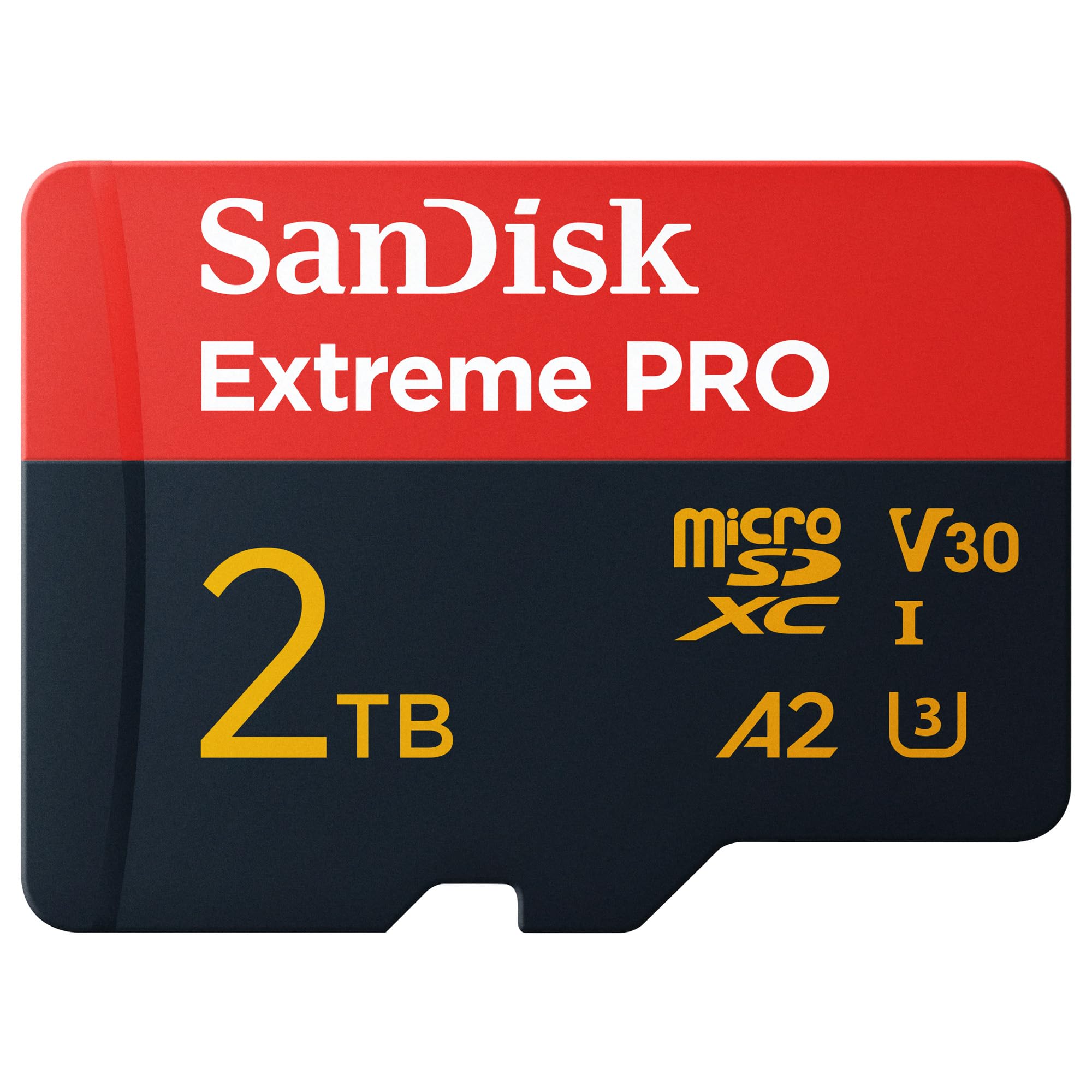
Twice the terabyte of most of this list, for drone and action-cam shooters who never want to swap a card again.
This is the only card here that steps past a terabyte into 2000 GB, and it pairs that with up to 250MB/s read and 150MB/s write speeds when used with SanDisk’s QuickFlow USB-A reader. That read speed is the top figure on the list, and it means a huge recording session offloads in one long pull rather than several. U3 and V30 ratings keep 5K and 4K UHD point-of-view footage recording without dropped frames.
The capacity gets concrete in SanDisk’s own terms: 2TB holds up to 2808 minutes of 4K UHD video recorded at 30fps. For a drone pilot or action cam user that means recording trip after trip without pulling the card to make room. The card is designed to keep working under extreme conditions, rough handling and continuous use, and it comes with RescuePRO Deluxe data recovery software, free for two years, plus an SD adapter for a DSLR or laptop slot. Its storage capacity is what wins people over — the satisfaction rate on capacity is essentially unanimous.
The obvious trade-off is cost, and buyers are split on whether the extra terabyte is worth the premium — this is the priciest card on the list by a wide margin. It is a fair call only if you genuinely shoot enough to use the space. Also, the top read speed assumes SanDisk’s QuickFlow reader, sold separately. For a Steam Deck or a heavy 4K camera workload, though, it is a serious one-card solution.
The case for the 2TB
- 2000 GB — double the capacity of most cards here, so fewer card swaps
- Up to 250MB/s read and 150MB/s write for fast offloads of big sessions
- Holds up to 2808 minutes of 4K UHD video at 30fps
- Includes RescuePRO Deluxe recovery software free for two years, plus SD adapter
What it costs you
- The most expensive card on this list by a wide margin
- Top read speed depends on SanDisk’s QuickFlow reader, sold separately
- Overkill if you rarely record long 4K sessions
The big-league option: a genuine two-terabyte card for drone, action-cam and Steam Deck users who record continuously and hate swapping cards.
The reality check: if your sessions are short, you are paying for capacity you will not use.
Know the Specs
Read speed and write speed (MB/s)
Read speed is how fast the card hands data back to your device — it sets how quickly games load and photos transfer to a laptop. Write speed is how fast the card saves data, and it is the one that matters for recording video. Both are usually quoted as an “up to” maximum that assumes a compatible reader and host device. A card rated at 250MB/s read will not hit that number through a slow, older reader — the reader is the ceiling. For 4K video, watch the write side and the V30 rating more than the headline read figure.
A2 and V30 — what the ratings actually mean
The V30 rating (Video Speed Class 30) guarantees a minimum sustained write speed for video, so the card can record 4K footage without frame drops. The A1 and A2 ratings are about apps: A2 is the higher tier, letting games and apps run directly from the card with faster launch times than A1. If you install games on the card, prefer A2. If you mostly store photos and back up files, the app rating matters far less than capacity and device compatibility.
Common Questions
Why does my 1TB card show less than a terabyte of free space?
Will a 1TB microSD card work in my Nintendo Switch?
Do I need an A2-rated card for a Steam Deck or gaming handheld?
What is the difference between the V30 and A2 ratings?
Can a fake 1TB microSD card damage my device or lose my files?
Will a 1TB card work in an older phone or camera?
Do I need a special reader to reach the top read speeds?
How much 4K video can a 2TB microSD card hold?
Which card is best for a GoPro or DJI drone?
Are these cards waterproof and shockproof?
The Bottom Line
For most buyers, the tb microsd card winner is the SanDisk 1TB Ultra because it pairs a full 1TB capacity and up to 150MB/s read with the broadest device fit on the list — phones, tablets, the original Switch, Raspberry Pi handhelds and WiFi cameras — and reliability is the single trait its owners single out most. If you shoot drone or action-cam footage and want the quickest offloads, grab the Lexar Silver Plus for its 205MB/s read and IPX7 waterproofing. And for recording that never stops, the SanDisk Extreme PRO 2TB is the one to reach for, with 2000 GB and up to 250MB/s read. Whichever you pick, buy from a trusted seller — that alone is the best defence against a counterfeit card that quietly eats your files.
How we choose
We do not accept paid placement. Every pick is matched to a real buyer and a real use-case; we do not hands-on test units.
Sources
Specifications: manufacturer listings and product documentation. Review insights: verified customer reviews, as of November 2026. Pricing: not shown on this page (it changes often); check the current price via the retailer link.
As an Amazon Associate, Tactical Gear Guy earns from qualifying purchases. This does not affect which products we feature.