Specs are compiled from manufacturer listings and verified buyer reviews and can change over time — please confirm the key details on the product page before buying.
Orange tennis balls solve one very specific problem: you need a ball you can actually see against grass, snow, clay and a busy court. The catch is that not every orange ball is built the same. Some bounce like a real tennis ball, some go flat after a dozen serves, and some are really just colourful dog toys. This guide separates the balls that hold their bounce from the ones that only hold their colour.
This guide is built by comparing the manufacturers’ published specifications and the patterns across verified customer reviews, so you get each pick’s real strengths and trade-offs instead of marketing spin.
You will learn which packs bounce like real tennis balls, which ones are built for dogs and practice, and which low-compression options suit kids. The trick to choosing the orange tennis balls is matching the ball’s compression and felt duty rating to how hard you actually hit.
Top Picks

How To Choose The Best Orange Tennis Balls
Buying orange tennis balls is really two decisions stacked on top of each other. First, who is hitting the ball — you, a coach, a kid, or a dog. Second, how much bounce you need from it. Get those two right and the orange colour is just a visibility bonus.
Match the compression to the player
Compression describes how much the ball squashes on impact. A standard ball is stiff, which is right for experienced players who swing fast. A low-compression ball feels softer and travels slower, which is why it suits kids and first-time learners. A full-compression ball hit by a seven-year-old will simply fly past them.
Pressurised versus pressureless — know the difference
A standard pressurised ball has gas sealed inside. It plays lively at first but slowly leaks over weeks. A pressureless ball has no gas to lose, so it keeps its bounce over a much longer stretch, which is why coaches buy it in boxes. The trade-off is that a pressureless ball can feel firmer off the strings on day one.
Check the felt duty rating
“Extra duty” felt is the thickest, most abrasion-resistant version. It is what you want on hard courts, where a thinner ball gets scuffed bald quickly. If you play mostly on clay or soft courts, a standard felt is fine. If you are buying for a ball machine, durability matters even more because the machine rubs the felt on every feed.
Think about pack size and what’s included
You can pick a pack size from 12 balls up to 60. A 12-pack suits a family or a single player best. A 40 or 60 pack makes more sense for a coach, a club, or a dog owner whose balls keep vanishing under hedges. Check whether a carry bag comes included — it is not always in the box. A proper bag with a drawstring stops balls from rolling around your car.
Side-by-Side Comparison
| Model | Best For | Pack Size | Diameter | Construction | Amazon |
|---|---|---|---|---|---|
| Tennis Balls Bulk, High Bounce for Practice and Dog Play★ Best Overall | All-round practice and fetch | 12 | 2.5 in | Stitched rubber core | Amazon |
| GKK Tennis Balls 12 PackBest Felt Durability | Machine practice and lessons | 12 | — | Rubber with extra duty felt | Amazon |
| GAMMA Sports Pressureless Tennis BallsBest Long-Term Bounce | Long-life training and coaching | 12 | — | Pressureless | Amazon |
| Tennis Balls for Practice, Pet Dog Playing Balls | Big 18-ball practice load | 18 | 2.58 in | Felt-covered rubber core | Amazon |
| Kids Tennis Balls, Low-Compression Training Balls | Beginners and juniors | 40 | 2.58 in | Molded rubber, low compression | Amazon |
| Magicorange Tennis Ball for Training & Pet Playing | Bulk dog-play supply | 60 | 2.58 in | Stitched felt on rubber core | Amazon |
| Wilson Starter Tennis Balls | Kids learning on short courts | 12 | 7.5 cm | Stitched felt, low bounce | Amazon |
Detailed Reviews
1. Tennis Balls Bulk, High Bounce for Practice and Dog Play
Our pick — 4.5+★ from 750+ verified ratings; the strongest balance of quality and price.
A 12-ball starter set that quietly does the job of two products at once.
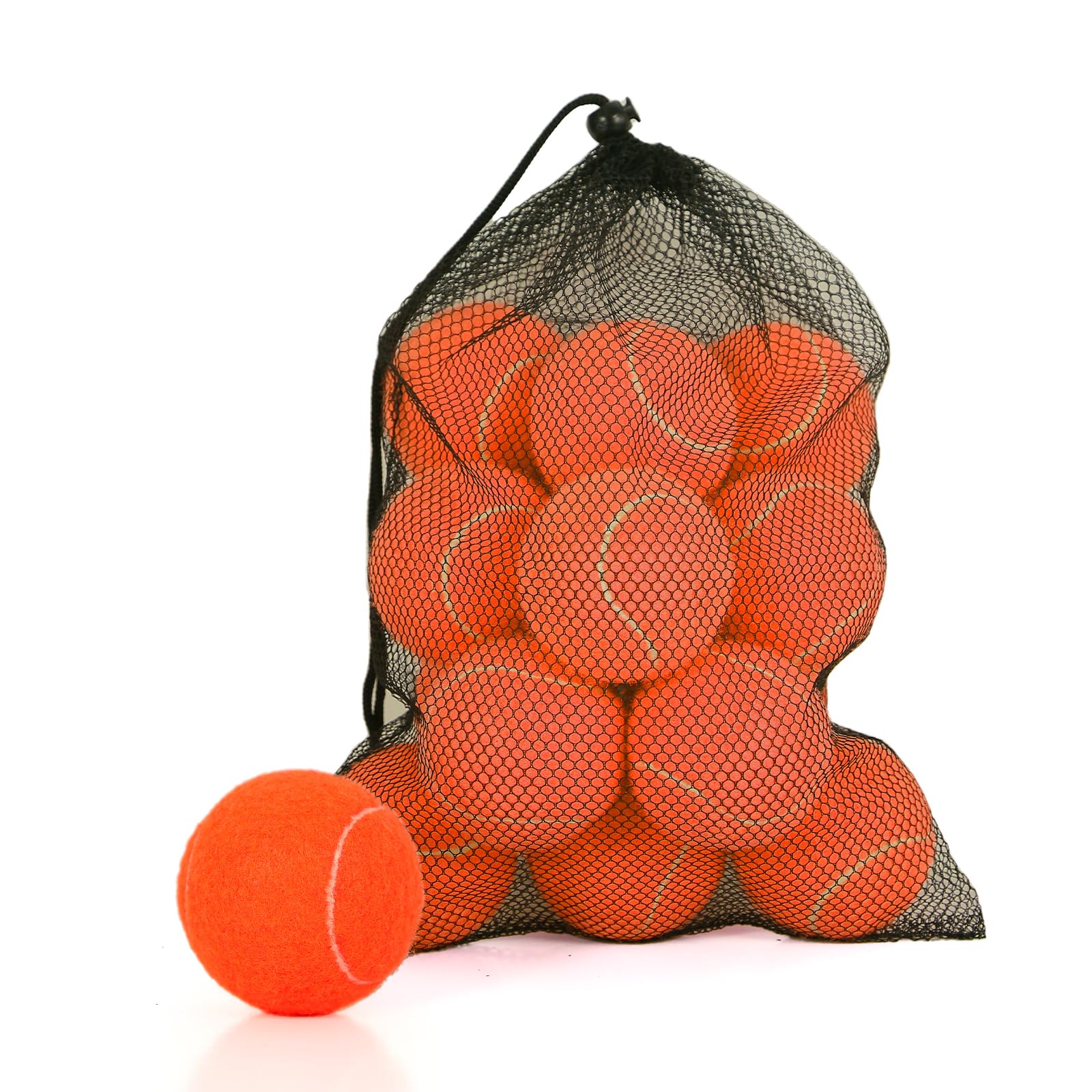
Two things sell this pack. The first is the 2.5-inch diameter — a genuine standard-size tennis ball that works for real drills, not a mini toy ball. The second is the stitched natural rubber core wrapped in a soft felt cover, which gives you a comfortable, dependable hit for serving drills, rally practice, PE classes and ball machines.
Overall quality is the most-praised thing about this pack. It arrives with 12 balls and a drawstring mesh bag, which sounds small until you have driven home with tennis balls rolling under the seats. This box also pulls double duty as a fetch supply, so the same pack covers your practice session and your dog’s afternoon.
The honest catch is how the felt (the fuzzy outer cloth) wears over time. Durability and bounce are genuinely mixed here: plenty of owners find them tough and lively, while a fair number say they go soft or dead sooner than expected. Treat this as a solid recreational and fetch ball, not a match ball for a league player. At 4.5+ out of 5, the overwhelming majority get what they expected. It holds up best for practice, coaching and supervised fetch, not league matches.
What earns its place first
- True standard 2.5-inch ball that behaves like a tennis ball in drills and machines
- 12 balls plus a drawstring mesh bag for tidy transport and storage
- Soft felt gives a comfortable hit for lessons, beginner training and long rallies
Where it asks for patience
- Bounce and felt life are mixed — expect a recreational lifespan, not a match-grade one
- Orange dye stays bright, so it is a smart pick for grass and dog walks
The call: Buy this one if you want one pack for lessons, coaching and fetch without juggling two orders.
Think twice if: you play competitive matches and need a ball that holds its liveliness through a full session.
2. GKK Tennis Balls 12 Pack Durable Pressurized Tennis Balls
Extra duty felt on a pressurised ball — the durability-first pick for hard courts.
This is the only ball in the lineup that spells out an “extra duty” felt rating, and that matters. Extra duty felt is the thicker, more abrasion-resistant grade, built for the scuffing of hard courts and repeated ball-machine feeds. The natural rubber core is there to give a lively, consistent bounce without a jarring feel on the arm.
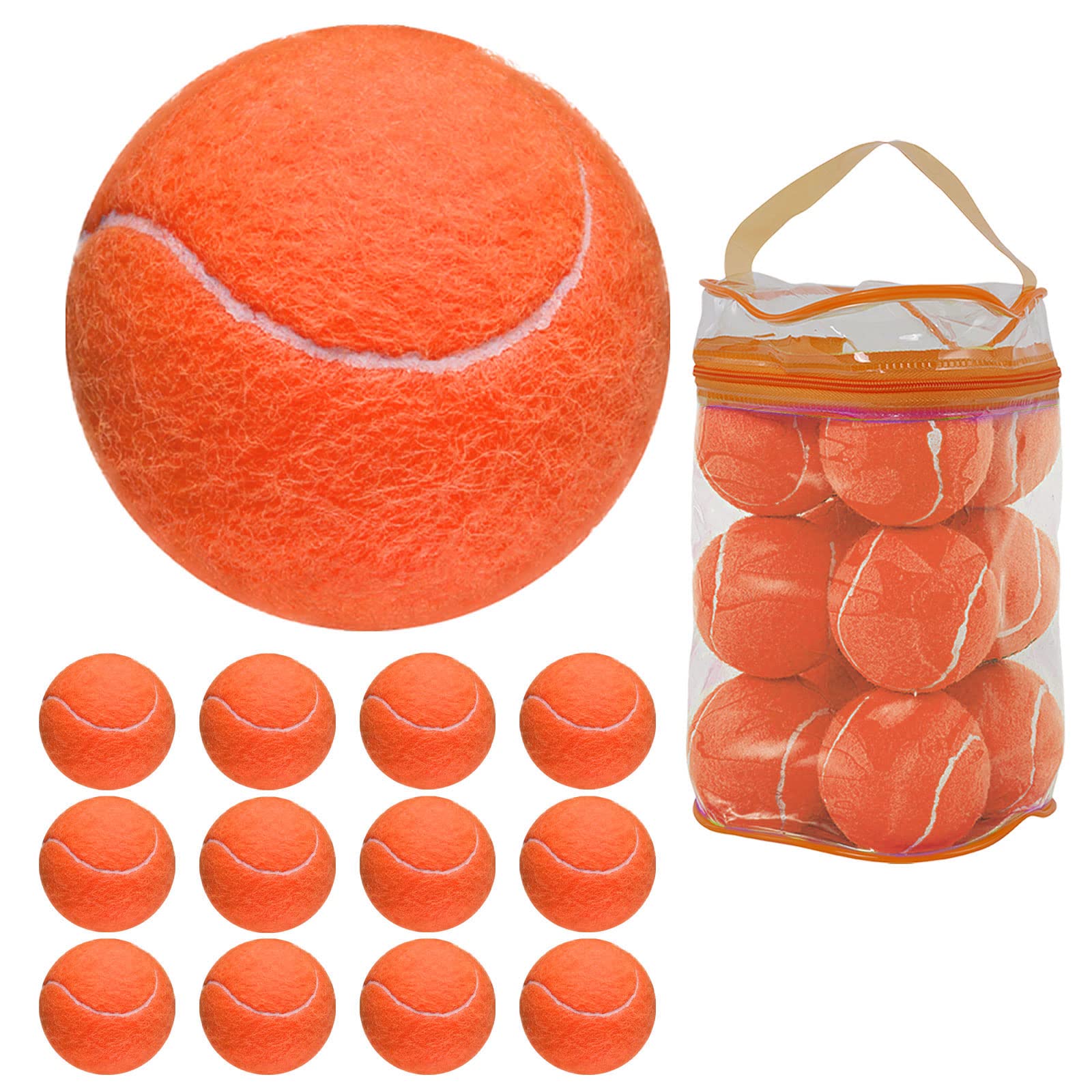
Where it diverges from the two packs above is that storage bag. Instead of a mesh bag you get a transparent PVC bag, which is sturdier and keeps shape better in a tennis bag. It is a small detail, but one that survives a car boot better than thin mesh.
The catch to know about is that this is a pressurised ball, which means the gas inside slowly escapes over time. It will feel lively in week one and gradually soften over months of storage. Use it and it stays honest; leave it in a hot garage for a season and it will lose some spring. For the price tier, it is a sensible upgrade over a basic ball if you keep your gear in a bag and play often.
Where it looks strong: extra duty felt is the thickest grade, so this is the one to buy if your courts are hard and your ball machine runs hot.
The trade-off: pressurised construction means bounce slowly fades with storage, so play it regularly rather than hoarding it.
Good match for: hard-court practice and machine work where felt wear is the enemy.
Not for: a kid starting out who needs a slower, softer ball.
3. GAMMA Sports Pressureless Tennis Balls
No gas inside, so the bounce does not leak away while the balls sit in the basket.
The headline here is pressureless construction. Because there is no pressurised gas to escape, these balls do not lose pressure over time the way a standard ball does, which is why coaches buy them for lessons and machine work. The durable coloured felt is designed to wear longer on hard courts, and it stays visible against most backgrounds.
They are built to travel too. You can use them on hard, soft, clay or cement courts, and the pressureless design makes them a natural fit for a ball machine during solo serving sessions. If you have ever opened a hopper of ball-machine balls and found half of them dead, this is the design that fixes that.
Set your expectations honestly, though. Quality and bounce are genuinely split down the middle here: some balls in a batch play great, others come out flat, and durability is the weaker part of the build. This is a practice and training ball — it is not the one to pull out for a competitive match. Buy it as a big practice supply you can cycle through, and the price tier starts to make sense.
What the design delivers
- Pressureless core keeps bounce alive over long storage, unlike a gas-pressurised ball
- Works on hard, soft, clay and cement, so one bag travels anywhere
- Machine-compatible for solo serving drills
The reality of the batch
- Consistency varies ball to ball — some come out flat from the bag
- Felt and internal wear show up sooner than on a match ball
Sharpest fit: coaches and anyone feeding a ball machine who wants balls that survive a season in a basket.
Wrong tool if: you want a hand-picked twelve for a weekend match.
4. Tennis Balls for Practice, Pet Dog Playing Balls
Eighteen balls where most packs give twelve — the supply that actually lasts a session.
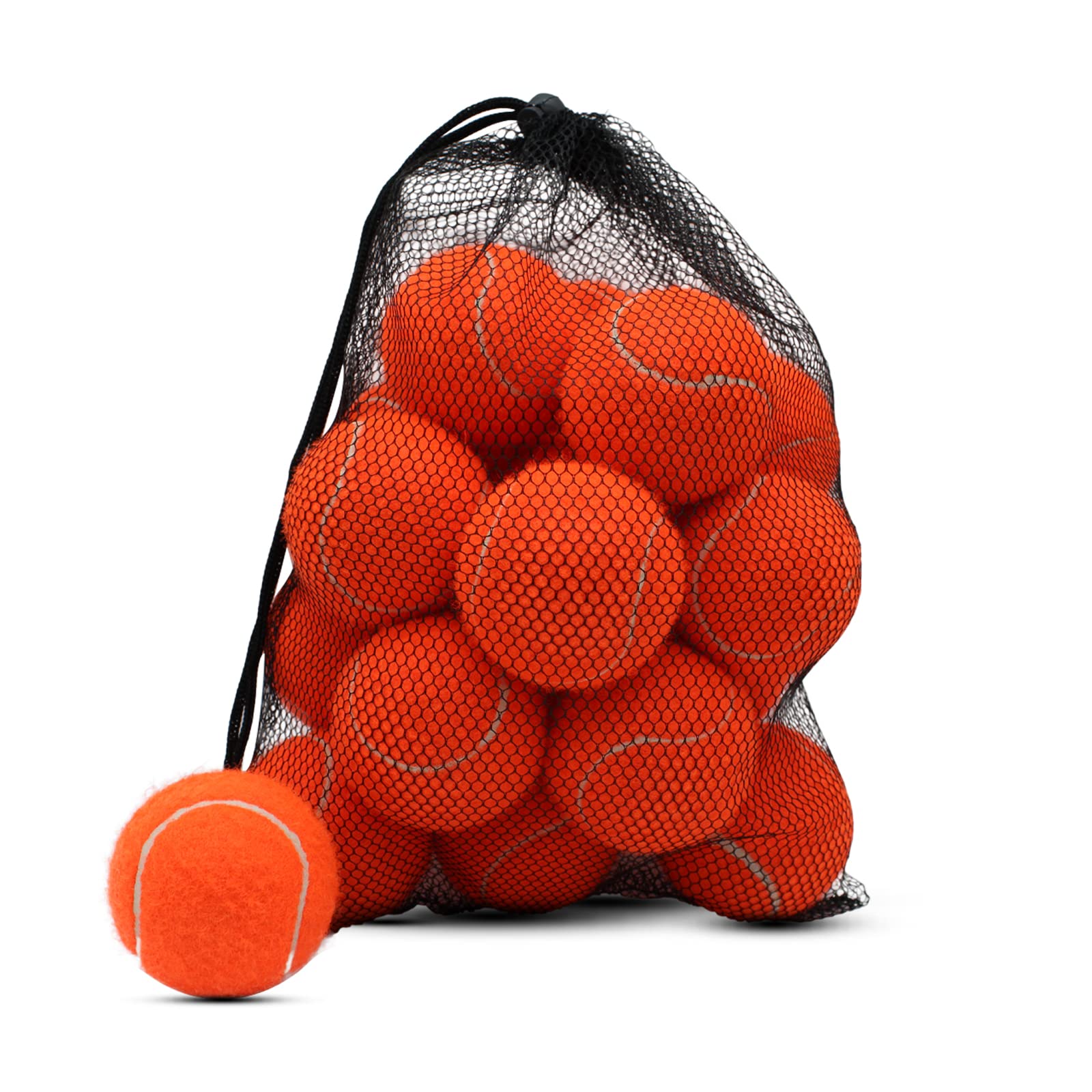
Count is the story with this one. Fewer walks to the fence, fewer interruptions, more swings. Each ball measures 2.58 inches across with a bounce height of about 135cm, which is real tennis-ball territory rather than a toy spec.
The feel is a natural rubber core under durable felt — consistent off the strings and easier on the arm than a hard ball. A reusable mesh bag with a sliding drawstring closes it up, so eighteen balls drop into one tidy bundle instead of rattling around your boot.
Dogs seem to approve, which is why this pack keeps turning up in parks. The bright orange felt is easy to follow in flight and easy to recover. Note the recurring caveat: some reports mention a noticeable smell out of the bag, and the felt can break down under heavy chewing. Air them out and treat them as a practice supply rather than a long-term match set, and this is a lot of usable balls for the tier.
Why the bigger pack wins: 18 versus 12 means a coaching or family session keeps going without constant retrieval breaks.
One thing to expect: a few owners notice an odour when the bag first opens — a short air-out solves it.
Pick it when: you are feeding a group, a class or an energetic dog and want to stop chasing strays.
Leave it if: you only ever need a couple of balls and want them to stay perfect for months.
5. Kids Tennis Balls
A slower, softer ball that gives a young beginner time to line up the swing.
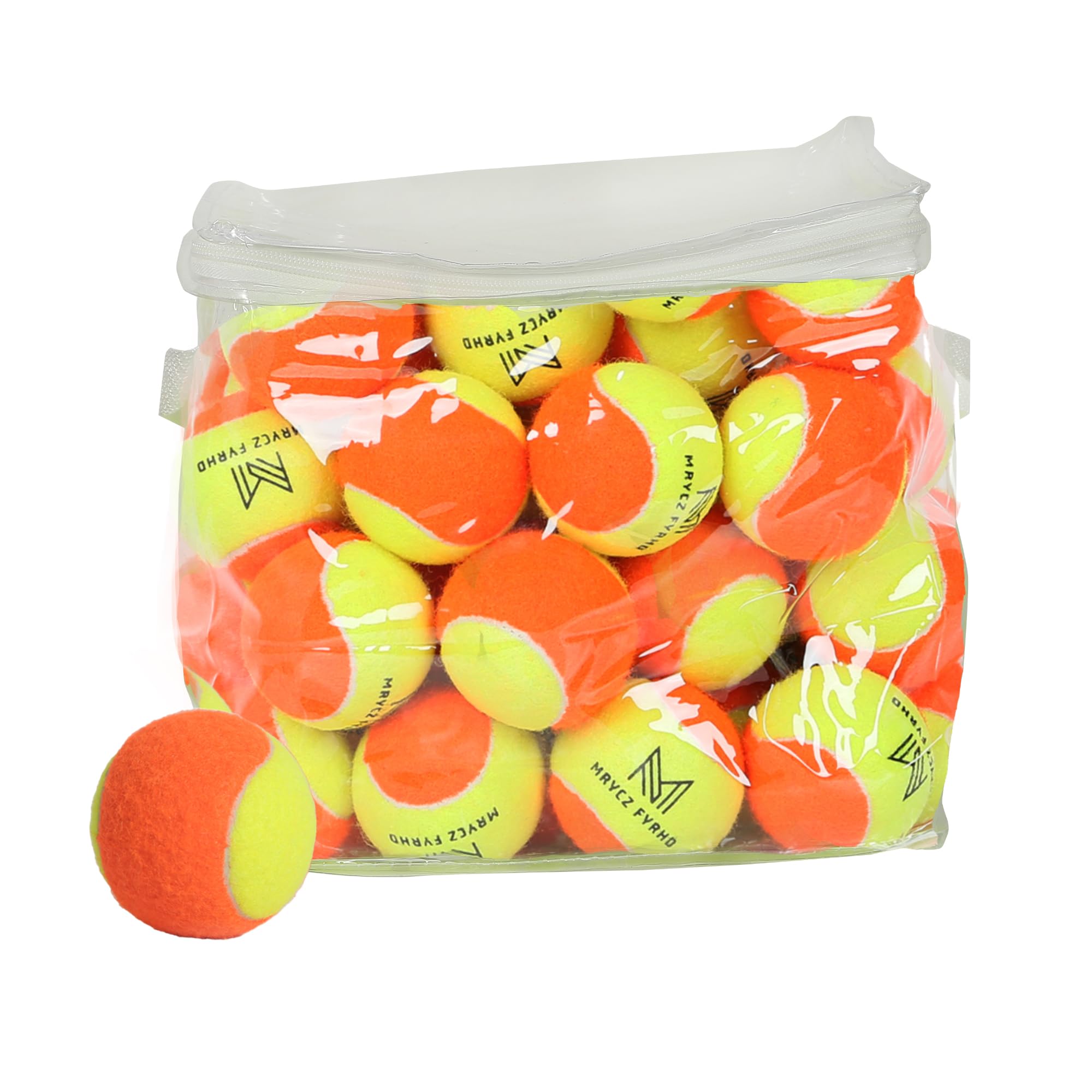
This is the pack built for the kid who has never held a racket. It uses low compression — 25% or 50% lower than a standard ball, which softens the rebound so the ball sits in the air longer and arrives at a speed a beginner can actually track. At 2.58 inches it matches a standard-diameter tennis ball, with a bounce height up to 3.28ft.
You get 40 balls and a reusable mesh bag, plus two smiley-face shock absorbers with sliding drawstring locks. Forty is a coaching-session quantity: enough for a whole junior class to have a ball each without a queue forming. The natural rubber and durable felt give a consistent, comfortable hit that softens the shock on small hands.
It is the highest-rated pick of the eight, and owners say the low-compression softness suits young beginners exactly as intended. Bounce consistency is the one wobble worth naming: within a big 40-ball bag, you may find a few that sit flatter than the rest. Set those aside and the rest of the bag does the job it was built for.
Why coaches reach for the 40-pack
- Low-compression ball slows the game down to a beginner’s timing
- 40 balls means a whole class can share without waiting
- Soft natural rubber and felt reduce the sting on small wrists
What to watch for
- Bounce varies a little ball to ball across the big pack
- Built for training, not for full-swing competitive play
Right answer for: parents and coaches teaching juniors their first strokes.
Step away if: the player is already swinging hard and wants a full-compression ball.
6. Magicorange Tennis Ball 60 Bulk Pack
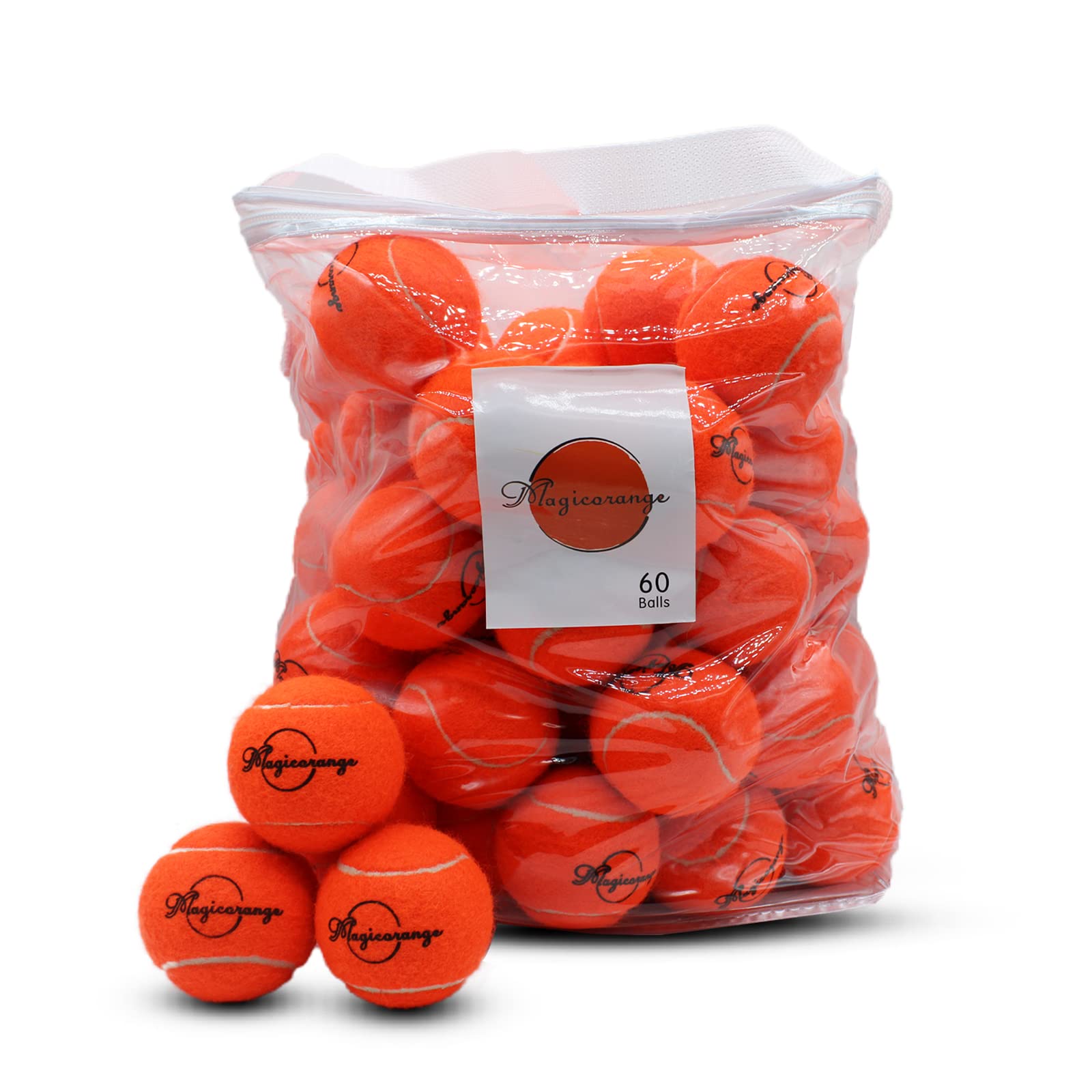
Sixty balls in one bag — the supply that turns a dog toy shortage into a non-issue.
Sixty. That is the entire pitch, and it earns its keep. Each ball is 2.58 inches with a bounce height of about 135cm, stitched felt over a natural rubber core. The maker rates the felt weather-resistant and UV-protected, so sun, rain and grass wear it down slower than a plain felt ball. The bright orange is easy to spot, and a reusable mesh bag keeps all sixty contained.
Where it shines is volume for mundane uses — backyard fetch, filling a ball pit, replacing the balls your dog keeps destroying. Owners using it for backyard fetch and ball pits call it excellent value for the sheer number of balls per bag.
Do not buy this expecting a match ball. Bounce is the weak point: a fair share of owners mention these balls barely bounce at all, and the felt breaks apart on heavy chewers faster than you would like. This is a bulk utility supply, not a training ball for serious stroke work. If you want a hopper full of balls for the dog and the backyard, the maths works; if you want a ball that toes the baseline, it will disappoint.
Where the value sits: sixty 2.58-inch balls and a mesh bag is an enormous amount of utility for backyard play, ball pits and dog retrieval.
The honest limit: many owners find the bounce poor, so treat this as a throw-and-fetch supply rather than a practice ball.
Buy it if: you need a mountain of orange balls for a dog, a yard, or a ball pit.
Skip the bulk tier if: you are drilling your serve and need a ball with real spring.
7. Wilson Starter Tennis Balls
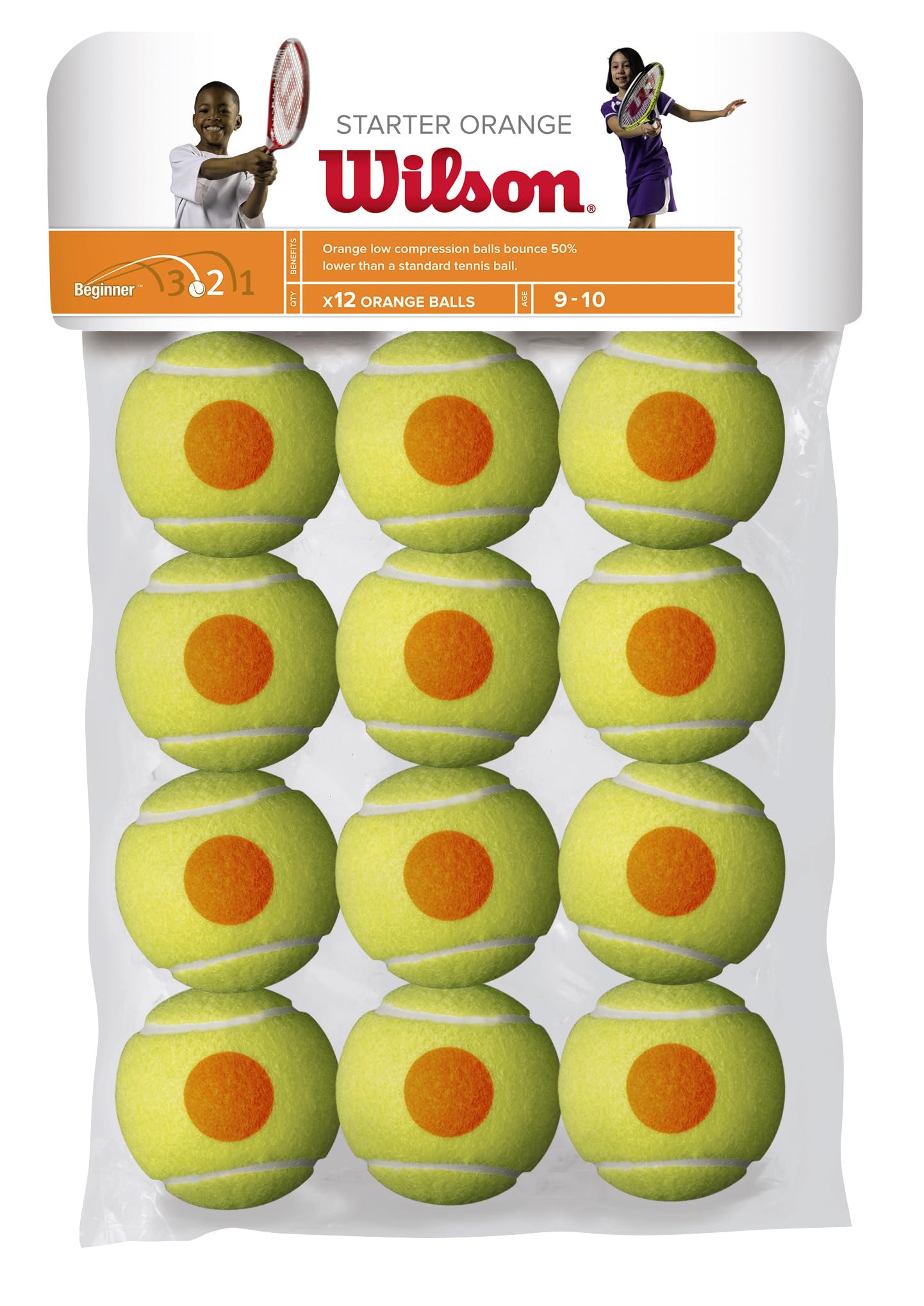
A starter ball with half the bounce, built to keep the ball on a mid-size court.
Wilson engineered this ball for one job: keeping a young beginner’s game under control. It has 50 percent less bounce than a normal ball, so it stays low and does not rocket over the fence on a big swing. It is suited to children up to 10 years old on mid-size courts, which is exactly the court a junior coach would set up.
The build is stitched felt around a soft core, and it is made to work on all surfaces — hard, clay or grass alike. Each ball measures 7.5 centimeters across, a slightly reduced size that suits small hands and small rackets. The mixed yellow-and-orange colouring keeps it visible without being a full fluorescent toy.
Be clear on the trade-off: this is a teaching aid, not a competition ball. It is deliberately slow and low, so an adult player will find it frustratingly soft on a full court. If your player is past the learning stage, spend that budget on a standard ball instead.
Why it earns a premium tier: 50 percent less bounce and a size suited to under-10s make this a purpose-built teaching ball, not a generic orange ball.
Honest caveat: the reduced bounce is the point, so it is the wrong ball the moment a beginner wants real full-court play.
Very well matched to: a junior program or a parent teaching a child under ten on a small court.
Not worth it for: older kids or adults who already rally with a standard ball.
Know the Specs
Compression and bounce height
Compression is how much the ball squashes when struck. Low-compression balls, labelled 25% or 50% lower than standard, rebound slower and stay in the air longer — ideal for a beginner who needs time to set up the swing. Standard balls are livelier for full-swing play.
Pressurised versus pressureless
A pressurised ball holds gas inside that escapes slowly, so it plays fresh at first and fades with time. A pressureless ball has no gas to lose, so it keeps its bounce over long storage — a coach’s favourite for machine work, though it can feel firmer on day one.
Felt duty rating
Felt is the fuzzy outer layer, and its duty rating describes thickness. “Extra duty” is the toughest grade, built for the abrasion of hard courts and ball machines. A standard felt is fine on soft or clay courts, where a hard-wearing surface would just be spare weight.
Diameter and pack size
Standard tennis balls sit around 2.5 to 2.6 inches, while starter balls are often smaller. A slightly larger ball is easier for a dog or a beginner to connect with. Pack size then sets how long you go between retrieval walks — 12 for a family, 40 or 60 for a coach or dog owner.
Common Questions
Are orange tennis balls the same as yellow ones?
Will a low-compression ball work on a standard full-size court?
How long do pressureless tennis balls keep their bounce?
Are orange tennis balls safe for a dog to fetch?
What does “extra duty” felt actually mean?
Can I use these orange balls in a ball machine?
Is a 2.5-inch ball or a 2.58-inch ball better for practice?
How many balls should I buy for coaching a junior class?
Do orange tennis balls lose their colour over time?
Can I use starter balls for adult beginners?
The Bottom Line
For most people buying orange tennis balls, the winner is the Tennis Balls Bulk, High Bounce for Practice and Dog Play. One pack gives you 12 true 2.5-inch balls with a stitched rubber core, plus a mesh bag. It balances practice and pet play better than anything else here. If hard-court durability is your priority, the GKK 12 Pack brings extra duty felt to the table. And for teaching a young beginner, the Kids Low-Compression 40-Pack is the strongest fit: 40 balls, a mesh bag, and a slower bounce that finally gives a child time to learn the stroke.
How we choose
We do not accept paid placement. Every pick is matched to a real buyer and a real use-case; we do not hands-on test units.
Sources
Specifications: manufacturer listings and product documentation. Review insights: verified customer reviews, as of November 2026. Pricing: not shown on this page (it changes often); check the current price via the retailer link.
As an Amazon Associate, Tactical Gear Guy earns from qualifying purchases. This does not affect which products we feature.