Specs are compiled from manufacturer listings and verified buyer reviews and can change over time — please confirm the key details on the product page before buying.
You want a Swedish motorcycle jacket that blocks cold morning wind, keeps its armor in place when you need it, and fits right the first time. Miss them and you get a jacket that flaps at highway speed or armor that drifts off your shoulder in a slide. The picks below sort that out for you.
This guide is built by comparing the manufacturers’ published specifications and the patterns across verified customer reviews, so you get each pick’s real strengths and trade-offs instead of marketing spin.
Swedish riding means short summers, long shoulder seasons, and a lot of wet asphalt in between. That shapes what matters most in a jacket: a waterproof shell you can trust, a liner you can pull out when the sun finally shows, and vents that actually move air when it does. Below you’ll find the best Swedish motorcycle jacket picks, sorted by who they genuinely fit.
Top Picks


How To Choose The Best Swedish Motorcycle Jacket
A Swedish riding season has two hard edges: the cold, wet weeks at each end and the short burst of warm weather in the middle. A jacket that only handles one of those is a jacket you stop wearing. The picks that work here all share a detachable liner and a shell that blocks wind — everything else is a matter of how you ride and how much you want to spend.
Start with the shell fabric, not the logo
The outer shell is what meets the road, so it is the first thing to check. A 600D Cordura shell (a dense, tightly woven nylon rated by denier, the weight of the yarn) resists abrasion far better than a thin fashion textile. Higher numbers mean a heavier weave — 1300D nylon, for example, is a notably thicker, tougher fabric than 600D. A leather shell behaves differently again: it flexes, ages, and takes a patch panel well, but it holds water differently than a coated textile.
Decide if you want a liner you can remove
A detachable thermal liner is the single feature that turns one jacket into a cold-weather jacket and a warm-weather jacket. With the liner in, you are covered for near-freezing mornings and late-evening rides home. Pull it out and open the vents, and the same shell works through summer. Jackets without a removable liner are effectively locked to one narrow temperature band.
Check that the armor sits where your body bends
CE armor at the shoulders, elbows, and back is the core protection, but padding that shifts out of position protects nothing. Look for adjustable cuffs, waist straps, and arm adjusters that cinch the armor against your body. A snug, aerodynamic fit keeps the pads in place at speed; a loose jacket lets them rotate away from the joint.
Measure your chest, not your shirt size
This is where most first-time buyers get it wrong. Riding jackets are cut close to the body and sized off chest measurement, not the size printed on your everyday shirt. If you plan to wear a hoodie or a base layer underneath, or you sit between two sizes, go up one. When a listing tells you to contact the seller before ordering, that offer is usually worth taking.
Side-by-Side Comparison
| Model | Best For | Shell Fabric | Armor | Liner | Amazon |
|---|---|---|---|---|---|
| HWK Adventure★ Best Overall | All-season everyday riding | 600D Cordura | CE shoulders, elbows, back | Detachable thermal | Amazon |
| ILM JRL3 AdventureBest Value | Wet-weather urban commuting | 600D Oxford | Slow-rebound CE pads | Removable | Amazon |
| ILM B02 ArmoredNight Rider Pick | Night riders on a budget | 600D Oxford | CE shoulder, elbow, back + chest pads | Detachable thermal | Amazon |
| Milwaukee Leather MPM1730 | Style-first textile riding | 1300D Nylon | — | Full-sleeve zip-out | Amazon |
| COMMUTER Buffalo Leather | Year-round leather wearers | 1.2–1.3 mm buffalo leather | 5-piece CE | Removable thermal quilted | Amazon |
| Walker and Hawkes Wax Grafton | Classic waxed-cotton look | 100% waxed cotton | — | 100% cotton tartan lining | Amazon |
| First Mfg Co Vendetta | Leather with armor pockets | Leather | Armor pockets | Removable thermal | Amazon |
| Alpinestars T SPS Air V2 | Hot-weather urban rides | Mesh panels | Nucleon Flex Plus shoulders, elbows | — | Amazon |
| Milwaukee Leather MLM1550 | Distressed leather character | Distressed leather | — | — | Amazon |
Detailed Reviews
1. HWK Adventure Motorcycle Jacket with CE Armor, 600D Cordura
Our pick — 4.5+★ from 8,000+ verified ratings; the strongest balance of quality and price.
The four-season workhorse that earns its place through sheer consistency.
Start with what the shell has to survive. This jacket uses a 600D Cordura outer — a heavy, tightly woven nylon measured in denier, the weight of the yarn — which is the abrasion-resistant stuff you want between you and the road. CE armor sits at the shoulders, elbows, and back, and every seam carries double-safety stitching. Reflective logos and design elements run across the jacket so you stay visible when the light drops.
Weather handling is where it separates itself from the cheaper end of this list. A Reissa water-resistant breathable membrane blocks wind and light rain without sealing heat in, and a detachable insulated thermal liner lets you run it through autumn and winter and strip it out for spring. The long-cut design adds coverage at the waist and lower back, which is exactly where cold air finds its way in on a Swedish morning. Buyers report it comfortable down to 40°F, and the thermal liner zips out once the day warms up.
Ventilation is a five-zone system: two shoulder vents, two arm vents, and one at the back, working alongside integrated mesh panels. Open all five with the liner out and you get real airflow. Storage is handled by five external Velcro pockets and two internal zippered pockets, and an internal attachment zipper connects straight to HWK motorcycle pants so the jacket stays put through a turn. Sizing runs S through 4XL, and the maker’s own guidance is to size up if you plan to layer or sit between sizes — it fits close to true size with a snug, aerodynamic cut.
What wins people over here is the build itself: construction is the single most-praised attribute in owner reviews. The fit note is the honest caveat: the cut is roomy to some riders and large to others, so chest measurement beats guesswork.
Why riders keep it in rotation
- 600D Cordura shell with CE armor at shoulders, elbows, and back
- Five vents plus mesh panels handle warm rides once the liner is out
- Reissa membrane blocks wind and light rain without trapping heat
- Seven pockets, including two internal zippered ones
- Zips directly into HWK motorcycle pants
Where it asks for your attention
- Sizing feedback splits between roomy and running large — measure your chest
- Water resistance is rated for light rain, not a sustained downpour
- The snug cut leaves little room for a thick hoodie unless you size up
The one to buy: this is the jacket for a rider who wants one shell to cover a Swedish spring, summer, and autumn without thinking about it.
Measure first: the close aerodynamic fit is the point, but it is also why you should order by chest measurement rather than shirt size.
2. ILM Adventure Motorcycle Jacket CE Armored JRL3
Built for the commute that starts dry and finishes in a downpour.
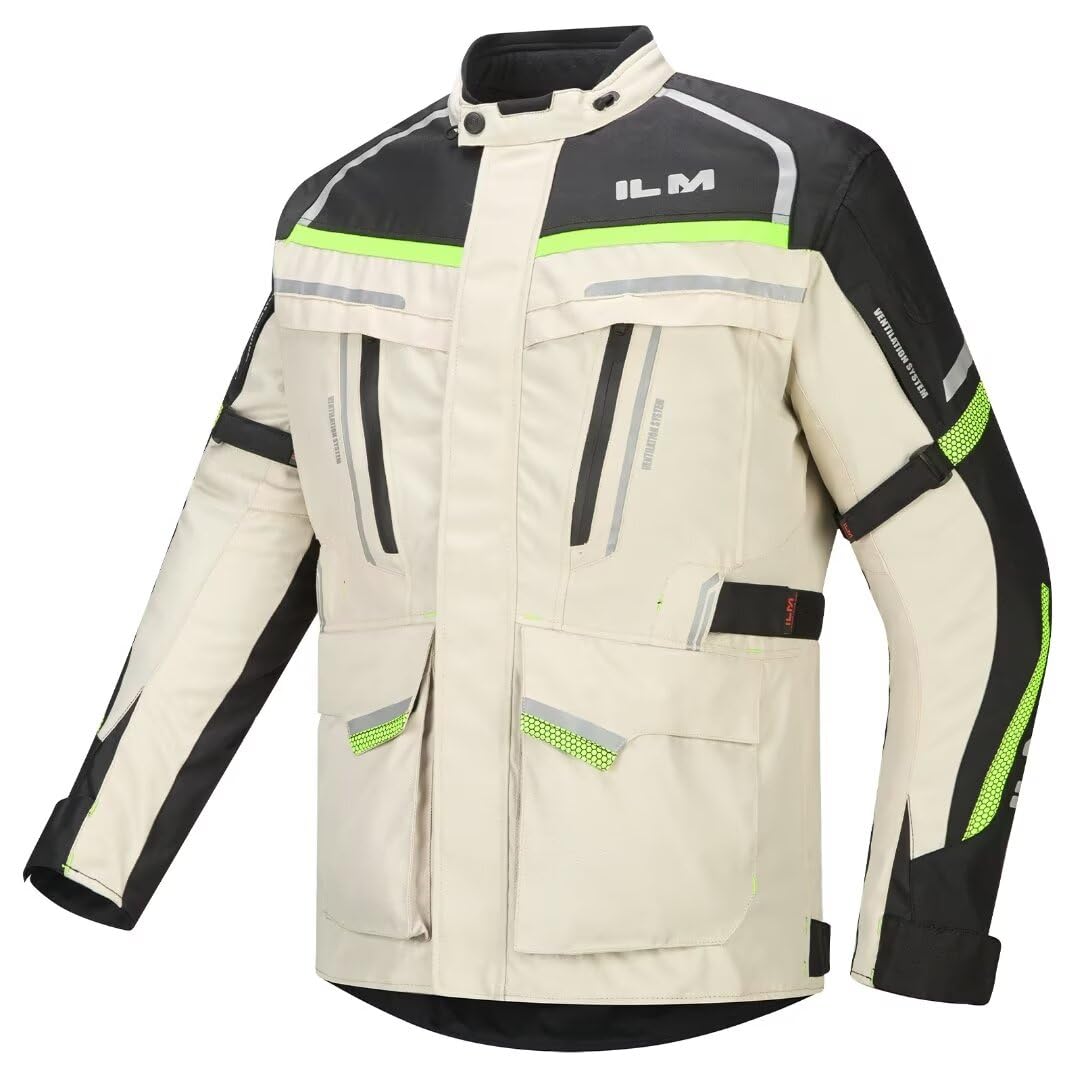
The spec that matters here is the built-in waterproof layer sitting behind a 600D Oxford shell — Oxford being a basket-weave nylon that resists scuffing and wear. ILM pairs that with upgraded wet-weather performance, so the jacket is aimed squarely at riders who cannot skip the bike because the forecast turned. The 600D Oxford outer is the same denier class as the HWK shell above, but here the waterproofing is the headline rather than a secondary feature.
Ventilation spreads across the chest, full back, and shoulders, using a zipper vent construction plus a wide mesh panel. That is a more generous airflow layout than a chest-only vent setup, and it means the jacket stays usable when the rain stops and the sun comes out. The removable lining adds warmth for cold weather. Owners mention riding comfortably in 70–80 degree temperatures with the vents open.
Protection comes from slow-rebound CE pads, which are designed to absorb impact rather than spring back immediately. Adjustable cuffs tighten to keep gravel out, and the collar slides to dial in fit and comfort. What riders praise most is the overall quality of the build relative to what it costs — this is a lot of jacket for the entry end of the mid-range. Fit earns consistent approval too, with the waistline and biceps able to cinch tight, and it moves with you rather than fighting you.
Where it earns the nod: a genuine waterproof layer plus wide mesh venting is an unusual pairing at this point in the range, and it is the reason this one suits a wet-climate commuter over a fair-weather rider.
The honest caveat: the collarless-adjacent urban styling is more understated than the high-vis designs elsewhere on this list, so if being seen at night is your priority, look at the reflective-heavy options instead.
Wet-road commuter: pick this if your ride happens in the rain more often than not and you want the waterproofing built in rather than sprayed on.
Fair-weather rider: you would be paying for rain protection you rarely use.
3. ILM Motorcycle Jacket with CE Armor, Water Resistant B02
The one that leans hardest into being seen after dark.
Most jackets on this list put armor at shoulders, elbows, and back and stop there. This one adds protective pads on the chest as well, which is a meaningful difference in a low-speed fall where your chest meets the tank. The shell is a 600D Oxford fabric treated with a Reissa waterproof and windproof layer, so rain beads off rather than soaking through. Reflective strips run across the jacket for night visibility.
Climate control comes from five air vents — chest, arms, and back — that move sweat out on a long ride. Button snaps along the arms let you cinch the sleeves tight, which cuts the flapping that makes a loose jacket tiring at speed. A detachable thermal lining covers the cold end of the season, and the maker positions one jacket as enough for winter and summer both. Zippered secure pockets hold glasses, wallet, phone, and keys.
Quality is what earns the most approval from owners, and it is priced among the most accessible armored options here. The recurring gripe is the zipper, which some find flimsy-looking — treat it with care and it will do the job. Fit runs a touch tight for some riders, so the same chest-measurement rule applies.
The chest-pad difference: extra padding across the front plus reflective strips make this the strongest pick for anyone riding home in the dark on a regular basis.
What to watch: the zipper is the weakest part of an otherwise solid package, and the cut runs slightly tight for some builds.
Late-shift riders: if your commute happens after sunset, the reflective strips and chest pads justify this one over a plainer jacket.
Size-up candidate: order a size up if you layer, because the fit runs slightly tight.
4. Milwaukee Leather MPM1730 Reflective Skulls Textile Jacket

Heavier fabric than almost anything here, wrapped around a look you either want or don’t.
Where the HWK and both ILM jackets above build on a 600D shell, this one steps up to 1300D nylon textile — and a noticeably denser, tougher hand-feel as a result. That heavier fabric is the reason it holds its shape and resists scuffing over seasons of use. Genuine YKK zippers run throughout, which is the brand riders associate with long-term durability in zipper hardware.
The design is the conversation piece. Reflective skull embroidery runs across the chest, arms, and back, with reflective piping crossing the same zones. That is not just decoration — it puts reflective material across the areas drivers actually see. A collarless design and action back shoulder panel keep it comfortable in the riding position, and side hip zipper openings add give when you are folded forward on the bars.
Ventilation comes in the form of two chest vents, arm vents, and back vents, all zipper-closed. A full-sleeve zip-out liner handles the cold end, and dual inside left and right pockets are sized to work as concealed carry storage or plain large pockets if you do not carry. Two outside lower zippered pockets and two chest zippered pockets round out storage. Riders note it works well as spring and fall riding gear.
Built around the fabric: 1300D nylon and YKK hardware put this above the lighter textiles for sheer longevity, and the reflective skull work makes it visible at night in a way plain black jackets are not.
The sizing question: feedback splits between true to size and running small enough that a size bigger still feels tight — check the size chart against your chest before ordering.
Go here for: a rider who wants a heavy textile shell with a distinctive look and reflective coverage built into the design.
Look elsewhere if: you want a plain, understated jacket or need CE armor — this one is built around the fabric and the artwork.
5. COMMUTER Men’s Premium Buffalo Leather CE Armor Jacket
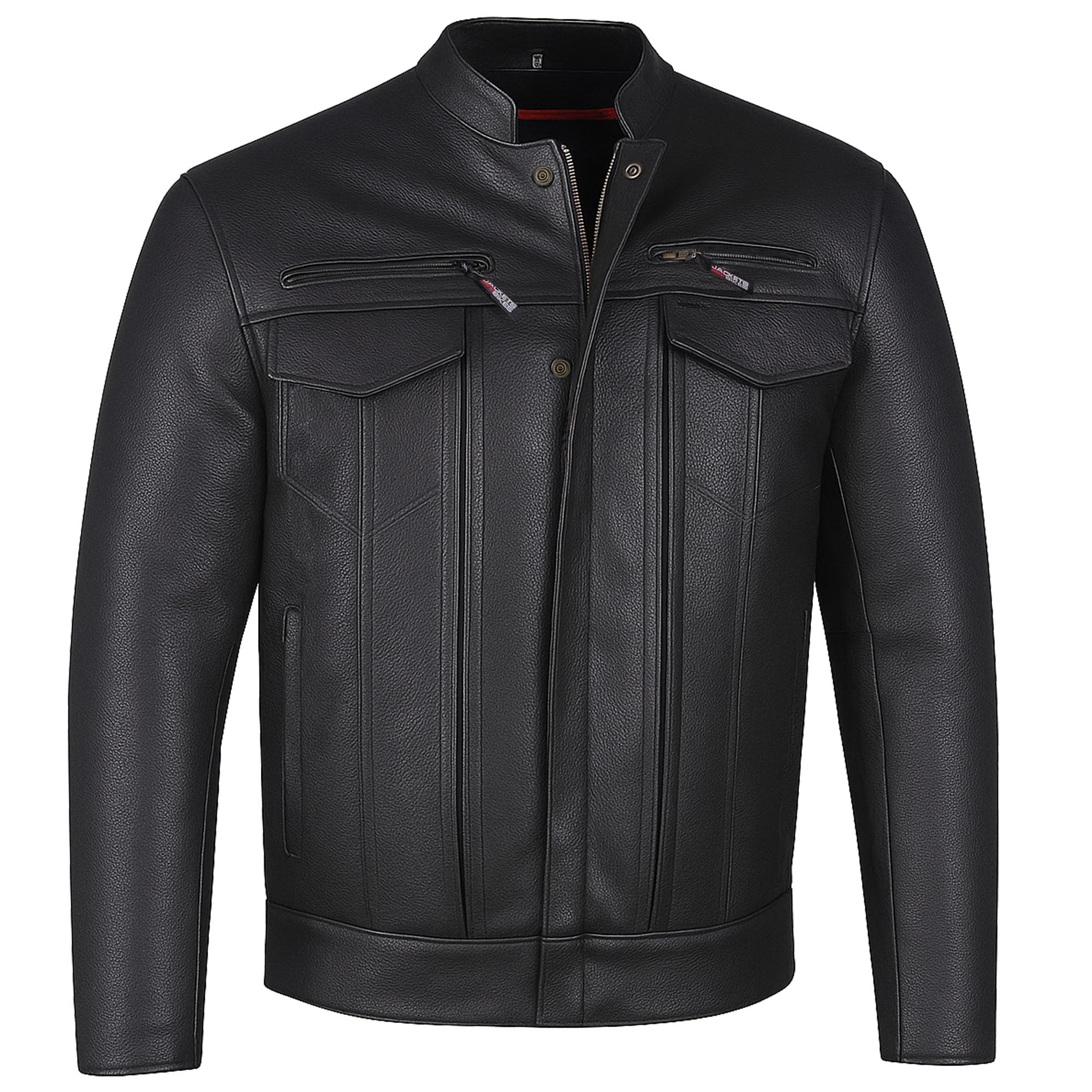
Supple buffalo hide with the armor already installed.
This jacket breaks in fast and shrugs off everyday scuffs, thanks to 1.2 to 1.3 mm of natural buffalo hide — soft enough to wear in quickly, thick enough to resist the wear that marks thinner leathers. Buffalo leather is picked for durability and flexibility together, and the maker builds this one to last. Five pieces of CE armor (European-certified impact protection) come pre-installed, so you are not fitting them later from a box.
Storage is unusually generous — eight utility pockets in total, split four exterior and four interior, plus two spacious secure pockets and an interior cell phone pocket. A large leather back panel is left clear for patches and customization if you want to add your own. The all-season layout pairs a removable thermal quilted liner for low temperatures with ventilation zippers at the chest and back for summer airflow.
Elsewhere the hardware is Original YKK metal zippers, with a full-sleeve zip-out liner, action back, zippered cuffs, grommets under each arm, a mandarin collar, and what the maker calls a true American cut. What stands out in the feedback is the leather itself — riders describe a thick hide that does not have the plastic sheen of cheaper jackets. Concealed carry pockets serve both left- and right-handed use, and it fits with space to layer underneath.
The leather case
- 1.2–1.3 mm buffalo hide that is soft, supple, and wear-resistant
- 5-piece CE armor pre-installed, not left for you to fit
- Eight utility pockets plus two secure pockets and a phone pocket
- Removable quilted thermal liner plus chest and back vents
- Original YKK metal zippers and full-sleeve zip-out liner
The break-in reality
- Leather this thick takes time to soften to your shape
- Heavier on the shoulders than a textile shell
- The clear back panel is a patch area first and foremost, not a vent
For the leather-first rider: this is the pick if you want genuine hide, armor already in place, and pockets for everything you carry.
For the weight-conscious: a thick buffalo shell sits heavier than any textile on this list, so try before committing to a long tour.
6. Walker and Hawkes Men’s Wax Grafton Motorcycle Jacket
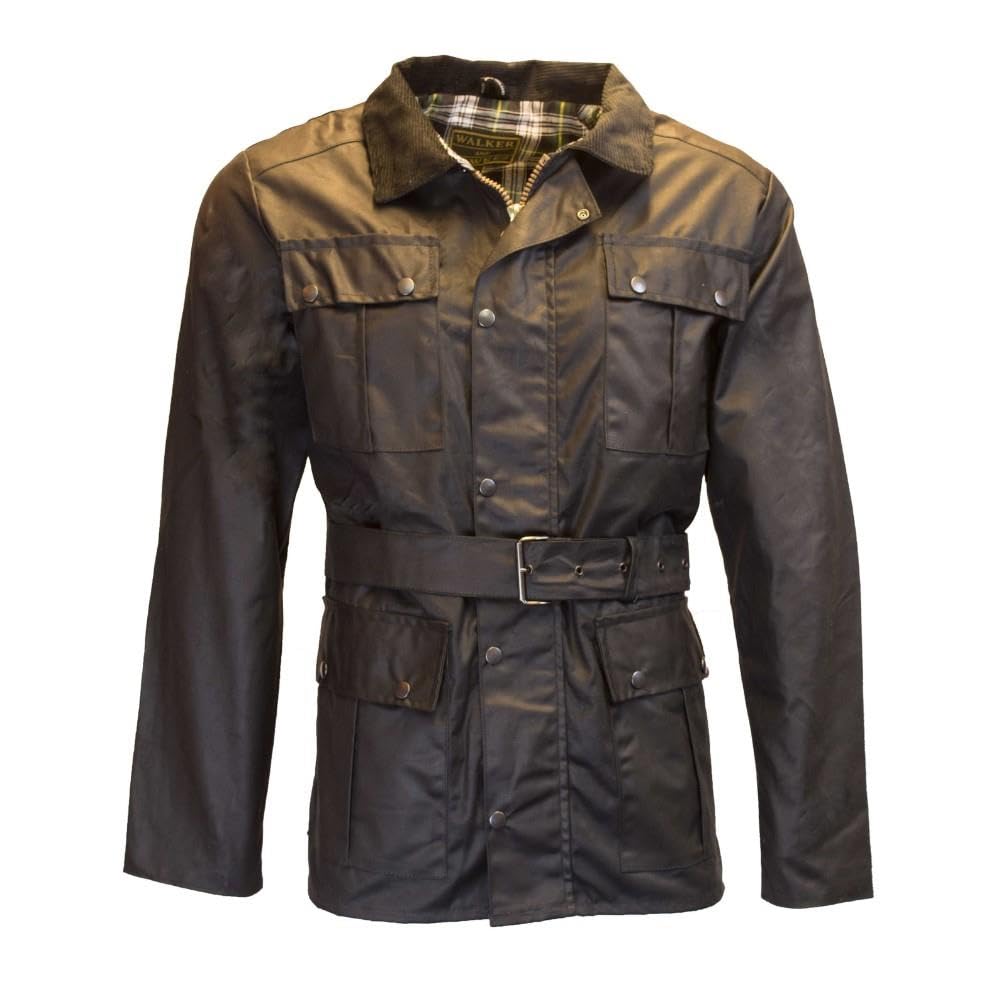
Waxed cotton with a corduroy collar and a look nothing else on this list shares.
The shell is 100% waxed cotton, which is waterproof by construction — the wax treatment makes the fabric shed rain rather than absorb it. That is a fundamentally different approach from the coated nylon and Oxford textiles further up this list, and it gives the jacket a broken-in, heritage character that ages into its own look. The lining is 100% cotton in a checked tartan pattern.
Details are built for a riding jacket rather than a fashion piece. Four front pockets close with stud fastenings, and the main closure is a heavy-duty zip under a studded flap. There is a colour corduroy collar, one inside pocket, and a stud-fastening storm flap that adds a second barrier against weather at the front. A belt strap lets you adjust the fit at the waist.
It is the styling that draws people in — riders describe it as great-looking and are surprised by how good it is for what it costs. The one thing to plan around is the fit: feedback leans toward running a little snug, so check the size guide against the jacket you intend to buy rather than assuming your usual size will work.
Why it stands out: 100% waxed cotton with a corduroy collar and tartan lining is a genuinely different proposition from the technical textiles here, and it weathers into something better looking than it started.
The trade-off: waxed cotton needs re-waxing over time to keep its water resistance, and the fit runs snug, so size carefully.
For the traditionalist: choose this if you want a jacket that looks like it came from a country outfitter and improves with age.
For the technical rider: there is no CE armor here and no venting system, so it is a style choice more than a track-day one.
7. First Mfg Co Vendetta Leather Motorcycle Jacket

Heavy leather with armor pockets built in and a liner you can pull when it thaws.
This is a leather jacket built for riders who want hide but also want the option to run armor. Armor pockets are sewn in ready to take pads, and a removable thermal liner means you are not locked to one temperature band the way a fixed-lining leather jacket would leave you. That combination — leather shell, armor pockets, removable liner — is the practical core of this pick.
Warmth is the thing riders keep coming back to. Customers note it workable down to around 30 degrees with the thermal liner in. The build quality earns the most praise of anything about it, and the fit follows close behind, which says a lot for a leather jacket where pattern-cutting matters as much as the hide. It also looks the part, with riders rating the appearance and value highly.
One honest wrinkle: the material draws split opinions, with some describing it as genuine leather and others finding it of lower quality than expected. That is worth knowing going in, because leather jackets live or die on the hide. Treat it as a question to settle by reading the current listing details carefully before you commit.
The cold-weather case: a removable thermal liner inside a leather shell with armor pockets gives you a jacket that works from freezing mornings to milder afternoons.
Worth checking: material feedback splits, so confirm the leather spec on the current listing rather than assuming.
Cold-morning leather rider: this is for you if you want hide, armor pockets, and a liner that comes out when the day warms.
Detail-checker: verify the material description on the live listing before you order, because opinions on the hide are divided.
8. Alpinestars T SPS Air V2 Mesh Motorcycle Jacket
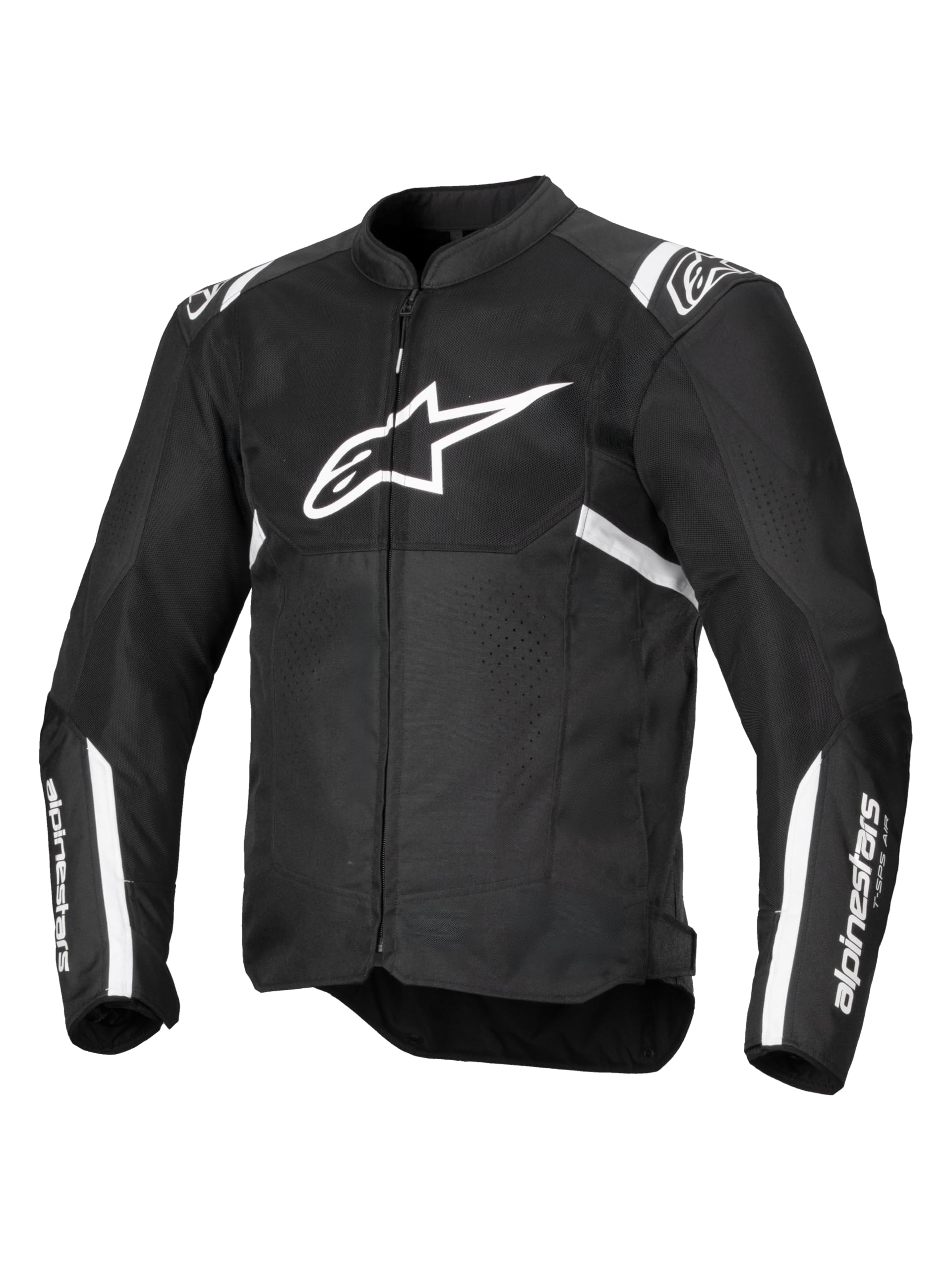
The jacket that treats airflow as the whole point, not an afterthought.
Every other jacket here is built to keep weather out. This one is built to let it through. Large mesh panels sit on the chest, back, and arms, with strategically placed air vents working alongside them, so moving air passes straight through the shell. Riders describe it as very breathable with lots of air flow, and the fit as feeling like a loose-fitting shirt rather than armor.
Protection is Alpinestars’ own Nucleon Flex Plus padding at the shoulders and elbows, and the jacket is cut with a performance-oriented fit aimed at urban riding. That is a different design brief from the touring jackets above — where the HWK is long-cut for waist coverage, this is cut for movement and a sportier riding position.
Two things to weigh before you buy. First, there is no thermal liner and no waterproof layer, so this is a warm-weather jacket by design — it is not the one you reach for in a Swedish November. Second, sizing feedback splits, with a notable share finding it runs small. The maker specifies an International Fit, so go by the size chart rather than your usual letter. Warmth is the other split topic, which is another way of saying it is not built for cold.
The hot-day answer: chest, back, and arm mesh panels with Nucleon Flex Plus shoulder and elbow protection make this the coolest-running option on the list by construction.
Not for the cold half of the year: no liner and no waterproof membrane means it sits in the closet once temperatures drop and rain sets in.
Summer-only riders: this is the one if your riding is confined to warm, dry months and you value airflow over everything.
Three-season riders: you need a liner and a weatherproof shell, which this deliberately does not have.
9. Milwaukee Leather MLM1550 Distressed Leather Scooter Jacket

Heavy real leather with a deliberately worn-in finish.
The two 5.5-pound-scale details here are weight and hide. Riders describe it as heavy, real leather construction, and that weight is the tell on this one — thick leather that hangs with substance rather than draping like a fashion jacket. The black-beige distressed finish is a factory treatment that divides opinion: some see it as character, and one description compares it to smeared gold paint, so look at the photos closely if the finish matters to you.
Comfort comes through softness rather than suppleness-by-thickness. Owners rate the softness highly, and the fit is described as perfect, with one comparison to an old-school bomber jacket in the way it sits on the body. The vents give it some breathing room in warmer weather. It is a scooter-cut jacket, which means a shorter, more upright-oriented fit than a touring shell.
Value holds up well against the construction — quality is clearly the strongest impression this jacket leaves, followed by fit. There is no armor listed and no removable liner, so treat this as a leather jacket for fairer days rather than a three-season technical piece.
The leather speaks for itself: heavy real hide, soft to the touch, with a distressed finish that gives it an old-school bomber character.
What it is not: there is no CE armor and no thermal liner, so it is a fair-weather leather jacket rather than a protective all-season one.
For the leather purist: pick this if you want heavy hide, a worn-in look, and a soft feel from the first wear.
For the armored rider: look at the COMMUTER buffalo leather instead, which puts CE armor in at a similar leather weight.
Know the Specs
Denier (D) — the number in 600D and 1300D
Denier is a measure of how heavy a yarn is, so a higher number means a denser, tougher fabric. A 600D Cordura or Oxford shell is the standard for abrasion-resistant riding textiles, while 1300D nylon is noticeably heavier and thicker. Neither number tells you how waterproof a jacket is — that comes from the membrane or coating, not the denier. Think of denier as the fabric’s raw toughness rating, and the membrane as its rain layer.
CE armor and slow-rebound padding
CE armor is impact padding rated to a published standard, and it sits at the shoulders, elbows, and back in the jackets here that carry it. Placement is only half the job; the fit is the other half. Armor needs to be held tight against your body by adjustable cuffs, waist straps, and arm snaps, otherwise it rotates away from the joint in a fall. Slow-rebound padding is a design where the material absorbs the hit rather than bouncing back immediately.
Detachable thermal liners and venting
A detachable thermal liner (an insulated inner layer you can zip or button out) lets one jacket cover cold and warm rides. Leave it in for cold weather; pull it and open the vents, and the same shell suits warm rides. Ventilation depends on vent count and placement — two chest vents, arm vents, and back vents move more air than a single pair, because air needs an entry and an exit to flow through the jacket as you ride.
Waxed cotton and leather shells
Waxed cotton is a fabric treated with wax so rain beads off rather than soaking in, and it needs re-waxing periodically to keep that property. Leather shells are measured in thickness — 1.2 to 1.3 mm buffalo hide is thick enough to resist everyday scuffing and soft enough to break in. Both approaches behave differently from coated nylon: leather flexes and ages with you, waxed cotton weathers into a patina, and neither uses the mesh-and-membrane construction that dominates synthetic riding textiles.
Common Questions
How do I size a Swedish motorcycle jacket if I wear a hoodie underneath?
Is a 600D Cordura shell strong enough for a highway slide?
Can I wear a mesh motorcycle jacket through a Swedish winter?
How often does waxed cotton need re-waxing?
Do I need CE armor at the back as well as shoulders and elbows?
What is the difference between 600D Cordura and 600D Oxford fabric?
Can a leather motorcycle jacket work in both summer and winter?
Which jacket suits riding mostly in the rain?
What does an international fit mean on a motorcycle jacket?
Should I buy a jacket with armor included or armor pockets only?
The Bottom Line
For most riders, the swedish motorcycle jacket answer is the HWK Adventure, because a 600D Cordura shell (a tough, abrasion-resistant nylon), CE armor in all three key zones, a detachable thermal liner, and five vents cover a Swedish riding year without gaps. If rain is your constant companion, the ILM JRL3 puts a built-in waterproof layer behind a 600D Oxford shell (a woven fabric with a water-repellent finish). And for fair-weather airflow, the Alpinestars T SPS Air V2 moves the most air through its chest, back, and arm mesh.
One last note on the top pick: the HWK does not carry the highest rating on this page — the Milwaukee MLM1550 edges it — but it holds 4.5+ stars across 8,000+ reviews. That volume of feedback, against a leather jacket’s smaller pool, makes it the steadier bet for a first all-season jacket. Buy by chest measurement and size up if you layer.
How we choose
We do not accept paid placement. Every pick is matched to a real buyer and a real use-case; we do not hands-on test units.
Sources
Specifications: manufacturer listings and product documentation. Review insights: verified customer reviews, as of November 2026. Pricing: not shown on this page (it changes often); check the current price via the retailer link.
As an Amazon Associate, Tactical Gear Guy earns from qualifying purchases. This does not affect which products we feature.