Specs are compiled from manufacturer listings and verified buyer reviews and can change over time — please confirm the key details on the product page before buying.
An on-demand water heater heats water the moment you open a tap, so you never sit through a cold start and never run the tank dry mid-shower. Flow rate, measured in GPM (gallons per minute), is the number that decides how many showers and appliances can run at once. Below is the honest breakdown of ten real units, sorted by what they actually do well and who they fit.
This guide is built by comparing the manufacturers’ published specifications and the patterns across verified customer reviews, so you get each pick’s real strengths and trade-offs instead of marketing spin.
Tankless units come in electric and gas flavors, and the fuel you have at home usually narrows the list before anything else does. Flow rate and fuel type matter more than brand, so this guide ranks ten real units against your house, wiring, and shower count. Buying an on-demand water heater gets dramatically easier once you know your flow rate target.
Top Picks


How To Choose The Best On-Demand Water Heater
Start with the fuel you already have. Electric units need dedicated breakers and heavy wiring but no venting, so they slip into closets and utility nooks. Gas units burn propane or natural gas and need a vent, but they deliver far more heat per minute for whole-house demand.
Match Flow Rate To Your Fixtures
Flow rate tells you how much hot water the unit pushes per minute. A single shower typically runs around 2 GPM, and a kitchen tap adds roughly 1.5 GPM, so add up what you run together. A unit rated at 5.3 GPM handles several fixtures at once; one rated 1.56 GPM suits a single point of use like a garage sink.
Know What Your Panel Can Handle
Electric tankless heaters pull serious current. The Rheem RTEX-24 calls for 240V single-phase power, three 40-amp double-pole breakers, and a recommended minimum 200-amp household panel. Check your panel and your wire gauge before you commit, because an undersized service means an electrician visit first.
Check Temperature Rise And Venting
Temperature rise means how much the unit can warm incoming water at a given flow, and cold climate water needs a bigger rise. Gas units need venting — some indoor models use a direct vent system, while outdoor models are built to vent naturally. RV owners should add freeze protection and an altitude rating to the shortlist.
Side-by-Side Comparison
| Model | Best For | Flow Rate | Fuel / Heat Output | Weight | Amazon |
|---|---|---|---|---|---|
| Rinnai V53DeP★ Best Overall | Whole-house budget gas | 5.3 GPM | Propane / 81 KW | 33 lb | Amazon |
| ThermoMate 8kWBest For Small Spaces | Point-of-use electric | 1.56 GPM at 35°F rise | Electric / 8,000 W | 9.9 lb | Amazon |
| EcoSmart ECO 8Budget Champion | Compact electric value | 2 GPM | Electric / 8 KW | 4.8 lb | Amazon |
| CAMPLUX BW264 | Outdoor camping showers | 2.64 GPM | Propane / 68,000 BTU | — | Amazon |
| FOGATTI InstaShower 7 | RV drop-in replacement | 2.5 GPM | Propane / 48,000 BTU | — | Amazon |
| Rheem RTEX-24 | Whole-home electric | 5.9 GPM | Electric / 24 KW | 17.8 lb | Amazon |
| Ranein 8.5 GPM | Large household propane | 8.5 GPM | Propane / 190,000 BTU | 42 lb | Amazon |
| Stiebel Eltron Tempra 29 Plus | Tight-space electric | 3 GPM | Electric / 28,800 W | 19 lb | Amazon |
| Rheem RTG-95DVLN-3 | Multi-bathroom gas | 9.5 GPM | Natural gas / 199,900 BTU | 46.5 lb | Amazon |
| Rinnai RX199iN | Big-home premium gas | 11 GPM | Propane or natural gas / 199,000 BTU | 55 lb | Amazon |
Detailed Reviews
1. Rinnai V53DeP Propane Tankless Water Heater
Our pick — 4.5+★ from 450+ verified ratings; the strongest balance of quality and price.
The propane workhorse that runs a shower, a dishwasher, and a washing machine without blinking.
This is the unit to buy if you have propane at home and want one heater to serve the whole busy household. It flows at 5.3 GPM (gallons of hot water per minute), which is enough to keep several appliances fed at the same time. The heat output reads 81 KW versus the EcoSmart ECO 8’s 8 KW. The crowd agrees it delivers — 4.5+ stars across 470+ owners, and the practical bits of running it are what people talk about most.
Owners praise its simple reliability: it handles two showers, a dishwasher, and a washing machine running at once without complaint. Installation landed smoothly too, and buyers point to the energy savings of heating only when a tap is open. Improved scale detection is part of the design, which helps the unit hold its efficiency over time. At 33 pounds and built for an outdoor install, it fits the side of a house or a utility recess where a tank simply would not go.
The honest catch is temperature control. The unit leans toward a 120°F default, and a handful of owners find the finer adjustments less precise than they would like, so plan your settings rather than expecting to nudge them constantly. Professional installation is recommended by the maker, and the residential warranty runs a limited 15 years on the heat exchanger with 5 years on parts and labor — provided you register within 90 days, or the labor coverage drops to 1 year. Register it. That single step protects the biggest part of what you are buying.
Where It Earns Its Keep
- 5.3 GPM feeds several fixtures at once, so nobody waits their turn
- 81 KW heat output is the strongest raw power in this lineup
- Heats on demand only, so you are not paying to keep a tank warm
- Compact outdoor design frees up floor space
What To Plan Around
- Defaults to 120°F, and fine temperature tweaks take some fiddling
- Propane only — no natural gas option here
- Warranty labor drops to 1 year unless you register within 90 days
Buy it for: propane households with more than one bathroom running at once.
Think twice if: you want dial-in precision on temperature or you run natural gas.
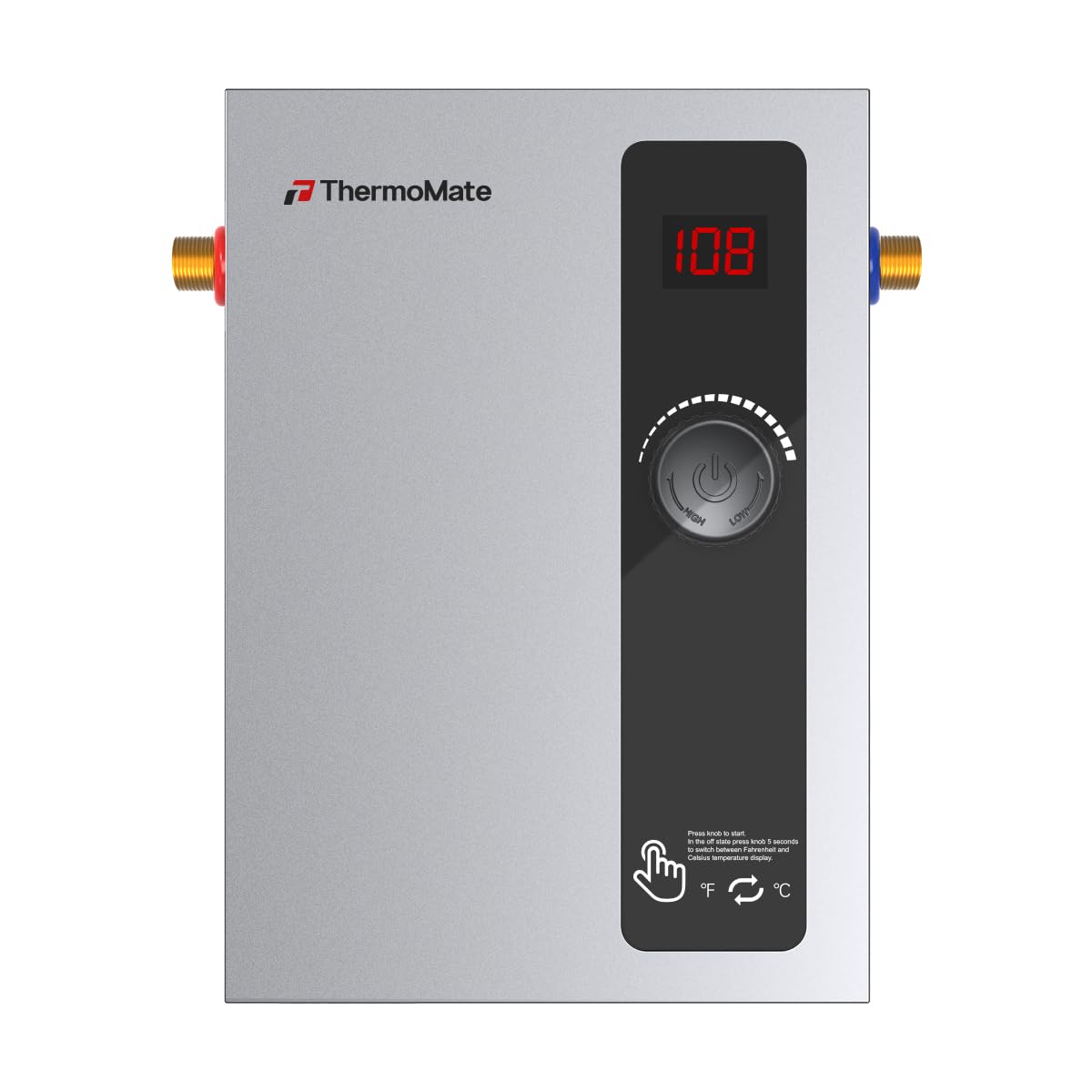
2. ThermoMate Tankless Water Heater Electric, 8kW 240 Volt
A single-tap specialist that slips under a counter and heats water in seconds.
If your problem is one cold sink — a garage utility tub, a workshop, a small cabin — this 8kW electric unit is built for exactly that. At 35°F temperature rise it flows 1.56 GPM, so it is not a whole-house heater, but it will serve up to two faucets. The maximum temperature tops out at 131°F. The build uses a cast aluminum heating chamber that keeps the heating element separated from the water lines, which is meant to guard against leaks and scale.
The self-modulating control is the quiet hero here. It continuously reads water temperature and flow rate, then adjusts how much energy it uses, with the maker publishing 99% heating efficiency and up to 60% savings on water heating cost versus a traditional tank. The scale runs 24 hours standby for instant hot water whenever the tap opens. Mounted on a wall, it measures just 8.58″W x 12.2″H, so it tucks into tight spots that a tank unit could never claim.
Before you buy, look at your breaker panel. This model requires a double-pole 40-amp breaker, and the electrics are rated 240V at 33.3A nominal current with 8AWG wire. It carries ETL certification with overheating protection and an auto-stop when no water is detected, plus 1/2 NPT side connections. The catch is that this is a point-of-use heater by design — if you are expecting it to feed a whole house, its 1.56 GPM at a 35°F rise will feel thin, so match it to one or two fixtures and it does its job well.
Best fit: a garage sink, workshop, or cabin where one or two taps are all you need and the panel already has a 40-amp double-pole breaker free.
Worth knowing: the separated heating chamber is the maintenance story — keeping scale off the element is what protects the efficiency over the long run.
Reach for this if: you want instant hot water at a single fixture without opening a wall for venting.
Look elsewhere if: you need more than two faucets fed at once.
3. EcoSmart ECO 8 Tankless Water Heater, Electric, 8-kW
The featherweight compact that pours steady hot water from a wall outlet of a heater.
Here is the frame that tells the story: at 4.8 pounds versus the Rinnai V53DeP’s 33 pounds. It measures 8″W x 11.5″H, next to the FOGATTI InstaShower 7’s 15″W x 15″H box. If space and light weight are your constraints, this unit answers both.
It flows 2 GPM and rates 99.8% efficiency, with an 8 KW heat output, so it is a genuine single-shower performer rather than a whole-house machine. What buyers appreciate most is the install and the dialing-in: the exact temperature you want is easy to set, and the unit is described as both durable and simple to use. The small footprint means it slips onto a basement wall or inside a utility closet without eating floor space.
The trade-off to plan for is that 2 GPM is a one-fixture-at-a-time flow, so running a shower and a washing machine together will stretch it. That is not a defect — it is the design brief of a compact electric unit. Sized for a small apartment, a cabin, or a single bathroom, it does what it promises, and the low weight means one person can hang it.
The value read: light, compact, and efficient at 99.8%, with a temperature you can set precisely — the essentials of a budget electric tankless done right.
Fair caveat: 2 GPM keeps you to one hot fixture at a time, so it suits a smaller home rather than a simultaneous-demand household.
The right match: an apartment, cabin, or single-bath setup where wall space is tight.
Not the fit: a family that wants two showers and laundry running together.
4. CAMPLUX 2.64 GPM Propane Portable Gas Water Heater

The campsite shower heater that turns a cold tap into a real hot rinse.
Built for the outdoors, this unit flows 2.64 GPM with a maximum output of 68,000 BTU per hour. It needs no preheat — turn the tap and water arrives at the temperature you set.
Safety hardware is where it earns confidence out in the field. It carries CSA safety approval, a flame failure device, anti-freezing protection, and overheating protection, with an automatic shutdown if water temperature climbs past 176°F. Water pressure auto-adjusts between 3.6 and 110 PSI. The anti-freeze drain plug lets you empty residual water so nothing freezes in cold weather or during long storage. The maker claims advanced combustion cuts gas use and burner noise by 11.5%.
Read the manual before you hook up the gas. The maker is blunt that you must not use Teflon tape between the gas regulator and the inlet pipe, and that improper operation can cause a fire — always check for leaks first. Treat this as outdoor, off-grid equipment and set it up carefully. For camping, RVing, or a remote cabin where you need hot water on demand, the flow and portability make sense.
Why It Works Off-Grid
- 68,000 BTU heats fast with no preheat wait
- CSA safety approval with flame failure and overheating protection
- Anti-freeze drain plug for cold storage
- Auto-adjusts pressure from 3.6 to 110 PSI
Handle With Care
- No Teflon tape at the gas regulator, or the maker warns of fire risk
- Outdoor use only
Made for: campers and remote-cabin owners who want a hot shower far from the grid.
One condition: you are willing to follow the gas-hookup instructions to the letter.
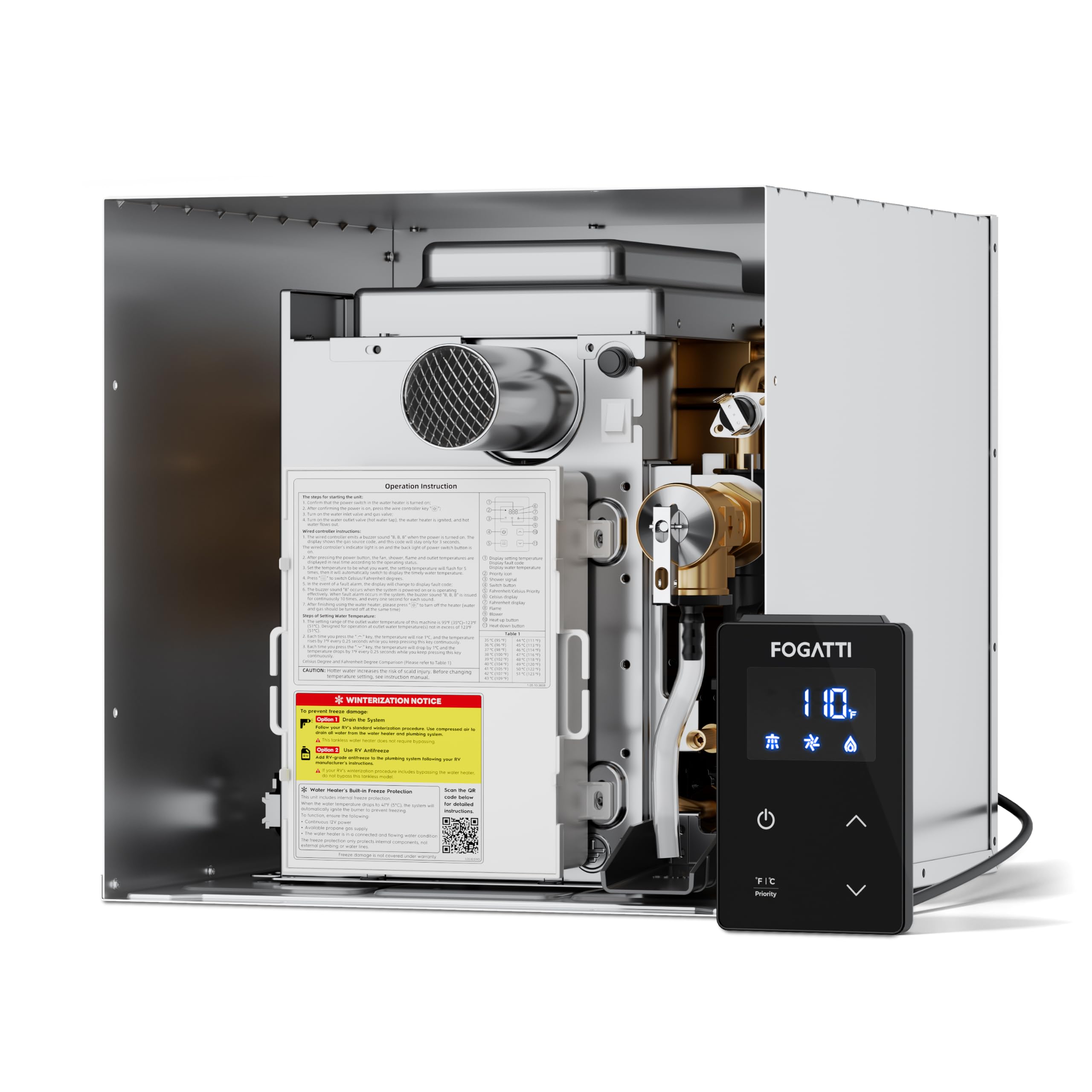
5. FOGATTI InstaShower 7 RV Tankless Water Heater
A drop-in RV upgrade that skips the drilling and brings hot water in about 22 seconds.
For RV owners, the install is the whole game, and this unit is a direct replacement for your existing tank or tankless heater — it uses your current lines with no drilling or modifications. It comes in three door sizes (15″x15″, 15″x18″, and 18″x18″) to match common RV openings, so confirm your size before ordering. Buyers report it fits existing holes perfectly and looks good doing it.
Once running, it delivers up to 2.5 GPM on demand, enough to run the kitchen and the shower together with no waiting. Adaptive staged combustion keeps the temperature steady, which matters in summer when inlet water runs warm, and it activates at just 0.5 GPM for low-flow RV fixtures. A 6.6 ft wired remote lets you set temperature from 95 to 123°F without leaving your seat, with in-cabin control and 9 built-in safety layers including flame-failure and freeze protection.
High-country campers get real help here — the unit operates normally up to 9,800 ft, and built-in auto-heat kicks in below 41°F to guard against freeze damage during cold storage. The main reservation buyers voice is value: some feel it runs expensive for what it is. Weigh that against the no-cutting retrofit and the in-cabin remote, and it earns its place for anyone who wants hot water on the road without a workshop project.
The standout: a true drop-in swap with a 6.6 ft wired remote and steady summer temperature control at a 0.5 GPM activation — built around how RVers actually shower.
The reservation: the value question comes up, so go in knowing you are paying for the fit and the convenience.
The party it suits: RVers replacing an aging tank heater who want a no-cut install and cabin-side temperature control.
The crew to skip it: anyone camped far above 9,800 ft or wanting the lowest-cost path.
6. Rheem RTEX-24 24kW 240V Electric Tankless Water Heater

The ventless electric that pushes 5.9 GPM and skips the chimney entirely.
This 24kW model provides up to 5.9 GPM across multiple fixtures, and it does it without any venting required, which simplifies the install compared to a gas tankless. The design is 90% smaller than a traditional tank heater, freeing up real floor space. Digital thermostatic controls let you set temperature in 1-degree increments from 80°F to 140°F.
What holds up under real use is performance — unlimited hot water that keeps pace with demand is the dominant theme, and installation follows close behind. The unit only heats when a tap opens, so you are not paying to keep a tank warm around the clock. For a whole-home electric setup where a vent run is a dealbreaker, that combination is compelling.
The wiring is the honest headwind. It needs 240V single-phase power, three 40-amp double-pole breakers, three sets of #8 AWG copper conductors with ground, and a recommended minimum 200-amp household panel. Heat generation draws mixed notes — some find it warms water quickly, others find it does not reach the temperature they wanted, so size it correctly and install it professionally. Plan the electrical panel first, and this becomes a strong ventless whole-home choice.
Strong Points
- 5.9 GPM across multiple fixtures
- No venting needed, unlike a gas tankless
- 90% smaller than a tank heater
- 1-degree temperature steps from 80°F to 140°F
Panel Reality Check
- Needs three 40-amp double-pole breakers and a recommended 200-amp panel
- Temperature results split opinion, so correct sizing matters
Best for: a whole-home electric setup where you can free up panel capacity and want no vent stack.
Think twice if: your panel is already loaded — the breaker math has to come first.
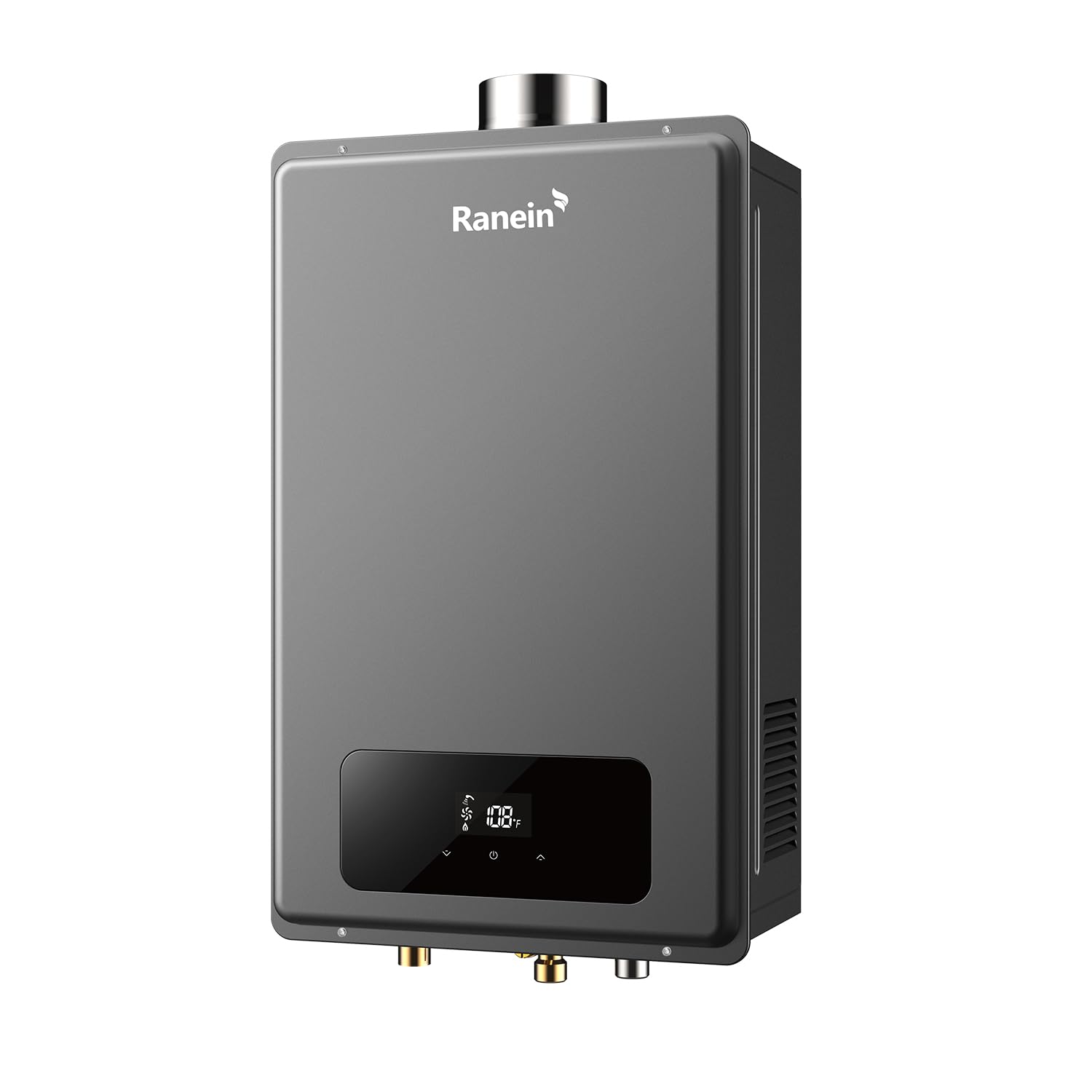
7. Ranein Propane Gas Tankless Water Heater 8.5 GPM
The high-flow propane unit built to keep four to six outlets hot at once.
With 190,000 BTU of heat output and a maximum 8.5 GPM, this heater is sized for a full family and 4-6 outlet points. It eliminates the long preheat wait of a tank and gives you unlimited hot water on demand. The installation is refreshingly quick — standard 3/4″ G water inlet fittings streamline hookup, and setup takes many owners less than half an hour.
What earns the most confidence is the sheer function and build quality, with fast heating and real energy savings noted across the household use. The blower sits underneath and auto-adjusts its speed to external wind pressure and water temperature, feeding the burner enough oxygen for full combustion. The maker points to that design as a safety and low-noise win. A compact 24.25″L x 15.08″W x 8.07″H profile means it takes up almost no space on the wall.
Altitude is the catch worth knowing. The maker does not recommend it for areas over 2,000 feet, so mountain homes need a different pick, and in cold weather you should open the pressure relief valve to drain the unit if it will sit unused. Add freeze protection to your winter routine. For a big, low-elevation household on propane, the flow and speed make it a strong contender — and it carries a 2-year warranty.
The standout spec: 8.5 GPM and 190,000 BTU puts six outlets within reach, so a busy morning does not queue up.
Set the boundary: skip it above 2,000 feet of elevation, and drain the unit for cold storage.
Built for: large low-elevation homes on propane with 4-6 hot-water points.
Not for: mountain homes above 2,000 ft or anyone who wants a hands-off winter routine.
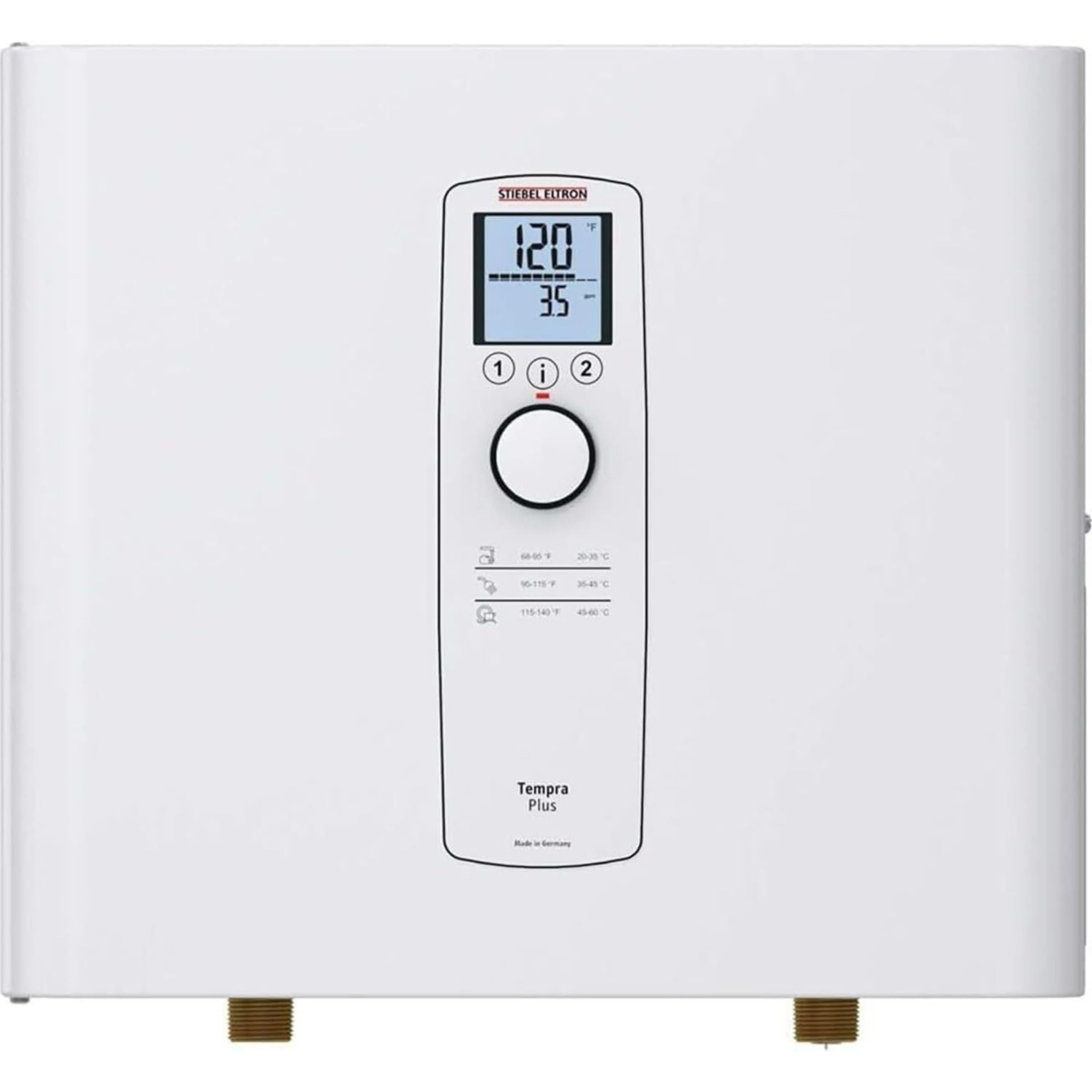
8. Stiebel Eltron Tempra 29 Plus Electric Tankless Water Heater
German-built and ventless, with two temperature presets and a slim wall profile.
A 28,800-watt draw at 240 volts makes this the most power-hungry electric unit on the list, and that is exactly the point — it is built to supply continuous, unlimited hot water on demand. The sleek design saves space and needs no venting, and two temperature memory presets make it easy to jump between settings for different needs.
The performance story holds up in real homes, with installation following as a close second strength. It requires a hard-wired 240 or 208-volt service, three separate dedicated 40-amp breakers with 8 gauge copper wiring, and a minimum 200-amp total service to the house. That is a serious electrical ask, so have a pro confirm your service before you buy.
Temperature is the fair caveat. Some owners see it bring water to the target within 30 seconds, while others have found themselves chasing either hot or cold water out of the tap. Advanced Flow Control is designed to steady output by moderating flow, and the maker cites an Eco design with energy and cost savings up to 34% in whole-home use. At 3 GPM and 19 pounds with a copper chamber, it fits a compact whole-home or a high-demand point with the right panel behind it.
Why It Stands Out
- 28,800 W delivers continuous on-demand hot water
- Ventless design with two temperature memory presets
- Copper chamber, 19 lb, and a slim wall footprint
The Fine Print
- Needs three 40-amp breakers and at least a 200-amp service
- Temperature consistency splits owner experience
For the homeowner: with a 200-amp service and a whole-home or high-demand point that needs no vent stack.
Hold off: if your panel cannot spare three dedicated 40-amp breakers.
9. Rheem RTG Series 9.5 GPM Natural Gas Tankless Water Heater
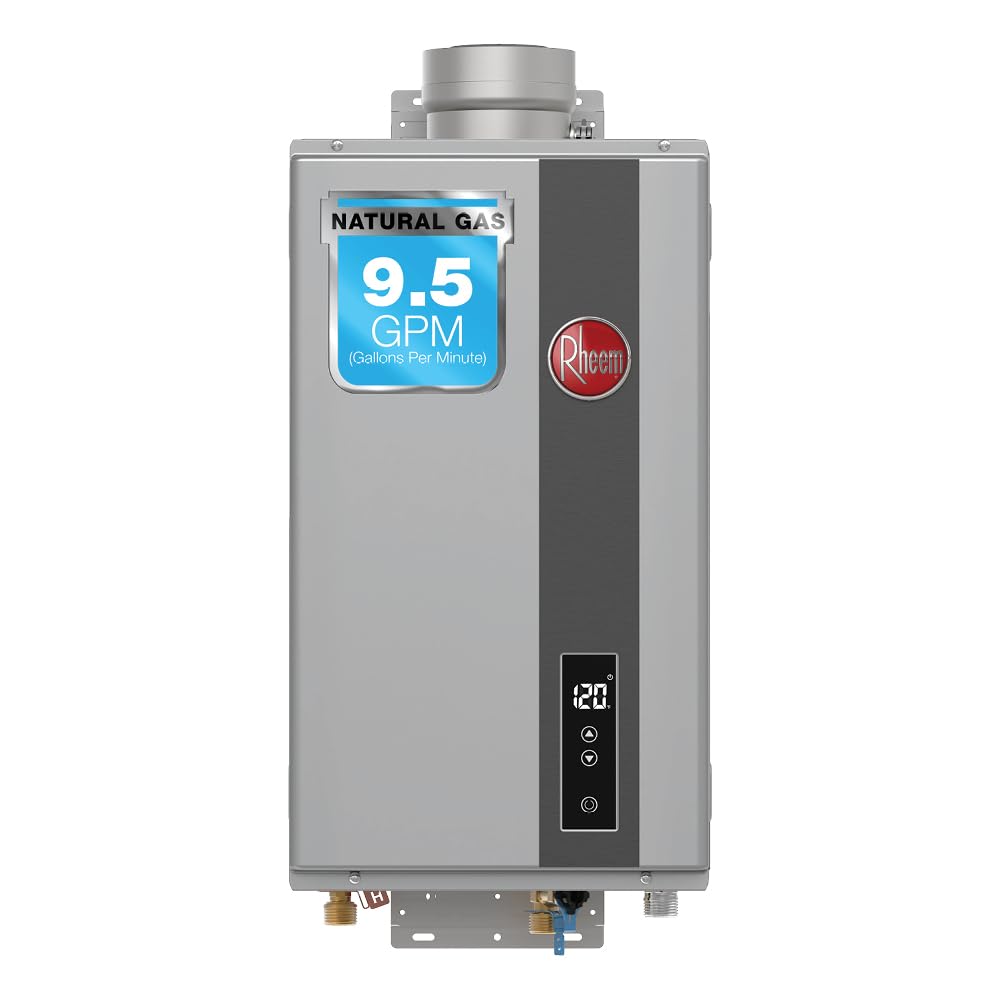
Natural-gas muscle rated for three to four showers running at the same time.
Here is the number that separates this unit: 9.5 GPM at a 35°F temperature rise, backed by 199,900 BTU/hr of output, which covers 3-4 simultaneous showers. For a large family with several bathrooms, that is the room to keep everyone hot at once. It is a non-condensing indoor unit with a direct vent system, and it runs at a 0.82 Uniform Energy Factor, which the maker cites as up to 34% savings on energy costs versus a 50-gallon electric tank.
The temperature precision is a nice touch — a digital LED panel adjusts in ±1°F steps, and built-in freeze protection plus flame-failure protection round out the safety system. It is CSA certified for natural gas and wall-mounted to free up floor space. Professional installation is required, and the package includes mounting hardware and a manual. Buyers are pleased with the performance and heat output, describing hot water abounding and fast heating.
Two things to weigh: the unit is noted as noisy, and the energy-efficiency opinions split, with some calling it a gas-bill saver and others pushing back. Its warranty runs 15 years on the heat exchanger and 5 years on parts. For a multi-bathroom home that already runs natural gas, the flow and speed earn the pick — just site the vent where the sound will not bother anyone.
The case for it: 3-4 showers at once with ±1°F temperature control and a 15-year heat exchanger warranty.
The honest note: it runs noisy, so plan the vent location, and go in expecting routine maintenance on a non-condensing unit.
The right pick: large natural-gas homes with several bathrooms and a spot for a direct vent.
Move on if: you need quiet operation or you are not running natural gas.
10. Rinnai RX199iN Condensing Smart Sense Tankless Water Heater

The suitcase-sized flagship that feeds seven fixtures and installs inside or out.
This is the most capable unit on the list — up to 11 GPM across 7 fixtures at once, from a box roughly the size of a small suitcase. It runs on either propane or natural gas thanks to the Smart Sense gas control system, and a Versa Vent lets it go indoors or outdoors (with an RX-OVC vent cap required for outdoor install). Its UEF of 0.98 is near the top of what gas tankless units reach.
The interface is built to be lived with. A Quick Flush feature simplifies flushing maintenance, and owners describe the performance as reliable with quick heating times that keep hot water flowing. It is also noted as cost-effective on utility bills and super quiet in daily use. The maker keeps professional installation in the instructions, and the Rinnai Central App helps with setup and troubleshooting.
Two honest notes: a Controlr module for WiFi control is not included, so smart-home control is a separate addition. On noise, most find it very quiet, though one voice felt it was not as quiet as a traditional tank — a fair nuance, not a flaw. The warranty matches Rinnai’s residential terms — 15 years on the heat exchanger, 5 years parts and labor, again protected only if you register within 90 days. For a large home that wants one unit to do everything, this is the range-topper.
Who it is for: a big household on gas that wants one high-flow heater with the option of indoor or outdoor placement.
The trade-off: you pay for the top-end capacity, and WiFi control needs the separate Controlr module.
Know the Specs
Flow Rate (GPM)
GPM means gallons per minute of hot water the unit can push. Add up the fixtures you run together — a shower near 2 GPM, a kitchen tap near 1.5 — and pick a flow rate above that total. Units here range from 1.56 GPM for a single point of use up to 11 GPM for a large home.
Temperature Rise
Temperature rise is how much the unit can warm incoming water at a given flow. The higher your incoming water is, the more flow you get at that rise. A unit rated 1.56 GPM at 35°F rise tells you it holds that flow when the water needs 35°F of warming.
Fuel Type And BTU
Gas units are rated in BTU per hour, electric in watts. Higher BTU or wattage means more heating power, which supports more fixtures at once. Gas tankless usually needs venting; electric tankless needs dedicated breakers but no vent.
Freeze Protection And Altitude
Freeze protection automatically warms or drains the unit so cold storage does not crack it. Altitude ratings tell you the highest elevation where the unit still burns cleanly. RV and outdoor users should check both before buying.
Common Questions
What flow rate do I need for two showers at once?
Why does an electric tankless heater need such a big breaker?
Do I need to vent a tankless water heater?
Can I use a tankless heater in an RV?
What does temperature rise mean for cold climates?
Is a gas or electric tankless heater better for a whole house?
How long does a tankless water heater last?
What is the default temperature and can I change it?
Do these units work above 2,000 feet of elevation?
What maintenance does a tankless heater need?
The Bottom Line
The strongest all-round pick for most homes is the Rinnai V53DeP, because its 5.3 GPM and 81 KW propane output keep several fixtures hot at once, and its owners simply use it without fuss. If you need ventless electric for a whole home, the Rheem RTEX-24 delivers 5.9 GPM with no vent stack. And for RVers who want a drop-in swap, the FOGATTI InstaShower 7 fits existing holes and brings hot water in about 22 seconds — a rare case where the retrofit is the whole reason to buy. The V53DeP’s 4.5+ stars rest on a smaller review base than some picks, but its 15-year heat-exchanger warranty and proven two-shower-plus-laundry capacity make it the safe anchor. Size the flow rate to your fixtures, confirm your panel or gas line, then buy once and register within 90 days to keep full labor coverage.
How we choose
We do not accept paid placement. Every pick is matched to a real buyer and a real use-case; we do not hands-on test units.
Sources
Specifications: manufacturer listings and product documentation. Review insights: verified customer reviews, as of November 2026. Pricing: not shown on this page (it changes often); check the current price via the retailer link.
As an Amazon Associate, Tactical Gear Guy earns from qualifying purchases. This does not affect which products we feature.