Specs are compiled from manufacturer listings and verified buyer reviews and can change over time — please confirm the key details on the product page before buying.
A soundbar alone fires every channel at you from the front wall. A surround sound soundbar system puts speakers behind your head and, in the better ones, fires audio at the ceiling so it rains back down. That rear-and-height coverage is what puts a helicopter above your sofa instead of inside your TV. Below are nine systems that actually include rear speakers — the part most cheap “surround” bars quietly leave out.
This guide is built by comparing the manufacturers’ published specifications and the patterns across verified customer reviews, so you get each pick’s real strengths and trade-offs instead of marketing spin.
You will see which systems need a receiver and which do not, how many channels each one really fires, and where the honest weak spots sit. Every pick here ships with rear speakers in the box, so read on for the surround sound soundbar system that fits your room and your TV.
Top Picks


How To Choose The Best Surround Sound Soundbar System
The first thing to understand is that the numbers on the box describe two different jobs. The number before the decimal point counts the main speakers around your room. The numbers after it count the subwoofer and the height speakers. So a 5.1 system gives you a bar, a sub, and two rears. A 7.1.4 system adds side channels and four height drivers that bounce sound off your ceiling.
Match the channel count to your room, not the brochure
More channels do not automatically mean better sound in a small room. A 5.1 setup fills a modest living room cleanly, and it is easier to place two rear speakers than four up-firing ones. Step up to 7.1.4 when your seating sits well back from the screen and your ceiling is flat and reflective. Those up-firing drivers depend on a hard ceiling to bounce height audio back down to you.
Decide how you will wire the rears
Rear speakers are the whole point of this category, so plan their power before you buy. Some systems use rears that plug into a wall outlet with their own power adaptors. Others, like the detachable designs from JBL, run on rechargeable batteries you lift off the main bar and place behind you. If your sofa backs onto a wall with no outlets, a detachable or battery design saves you an extension-cord headache.
Check the connections your TV actually offers
HDMI eARC (Enhanced Audio Return Channel, the single cable that carries both picture and high-quality surround audio) is the cleanest path. One cable handles Dolby Atmos and DTS:X without extra optical lines. If your TV is older and lacks eARC, look for a system with an optical input as a fallback. Bluetooth handles music from your phone, but it will not carry true surround, so treat it as a bonus rather than the main event.
Side-by-Side Comparison
| Model | Best For | Channels | Subwoofer Driver | Rear Speakers | Amazon |
|---|---|---|---|---|---|
| Samsung HW-Q990C★ Best Overall | Full cinema immersion | 11.1.4 ch | Included | Up/side firing kit | Amazon |
| ULTIMEA Skywave X70Best Value | Big bass on a budget | 7.1.4 ch | 10 inches | 2 wireless surrounds | Amazon |
| LG S40TRBig Bass Pick | Small rooms, small budget | 4.1 ch | Wireless | 2 wireless surrounds | Amazon |
| TCL S65K | Atmos on a mid budget | 5.1 ch | 6.5 inches | 2 wireless surrounds | Amazon |
| Fire TV Soundbar Plus | Plug-and-play streaming | 5.1 ch | Included | 2 surrounds | Amazon |
| Sony BRAVIA Theater 6 | BRAVIA TV owners | 5.1 ch | Wired | 2 rears via amp box | Amazon |
| Polk MagniFi Max AX SR | Dialogue-first listening | 7.1.2 ch | 10 inches | SR2 surrounds | Amazon |
| JBL Bar 1000MK2 | No-outlet rear placement | 7.1.4 ch | 10 inches | Detachable, battery | Amazon |
| JBL Bar 1300X | Flagship 3D power | 11.1.4 ch | 12 inches | Detachable, battery | Amazon |
Detailed Reviews
1. Samsung HW-Q990C 11.1.4ch Soundbar
Our pick — 4.5+★ from 500+ verified ratings; the strongest balance of quality and price.
Eleven front channels, four that fire at the ceiling, and rears that put you inside the scene.
This is the system to pick when you want the room to disappear. The 11.1.4-channel layout means 11 front-facing speakers, one subwoofer, and four up-firing channels that bounce sound off your ceiling. Those four height drivers are what let a plane pass overhead instead of just loud across the front wall. Samsung calls the effect true Dolby Atmos, and it is the most speaker-packed setup on this list.
The rear kit is the part that separates it from a plain bar. Those rear speakers fire upward and to the side, so audio wraps behind and above your seat rather than just arriving from the screen. Owners consistently call the sound quality the star of the show — a movie-theater feel in their own room is the recurring note. The ava feature (Active Voice Analyzer, which reads room noise and lifts onscreen dialogue above it) keeps quiet conversations intelligible without you cranking the volume.
Setup lands easy for most people, and the SpaceFit Sound Pro room calibration handles the tuning for you by analyzing your space and adjusting automatically. If you own a Samsung TV, Q-Symphony runs the TV speakers and the bar together as one system. The honest catch is connectivity — the wireless and Bluetooth hand-offs draw mixed feedback, so plan on a wired HDMI eARC run for your main sources. Streaming music from an iPhone works through AirPlay 2, and there are built-in voice assistants for hands-free control.
Where it pulls ahead
- 11.1.4 channels — the most drivers in this lineup, with four up-firing height channels for overhead audio
- Rear speakers fire up and to the side, so sound wraps behind your seat
- SpaceFit Sound Pro auto-calibrates to your room, and Q-Symphony pairs with Samsung TVs
- Adaptive Sound and ava pull dialogue forward even at low volume
Where to set expectations
- Wireless and Bluetooth connections draw mixed reports, so lean on the HDMI cable
- A full 11.1.4 array is more speaker real estate to place than a simple 5.1 kit
Built for: anyone who wants the most complete wall of sound and owns a Samsung TV to open up Q-Symphony.
Worth knowing: run HDMI eARC as your primary link — the wireless hand-offs are the one area that splits opinion.
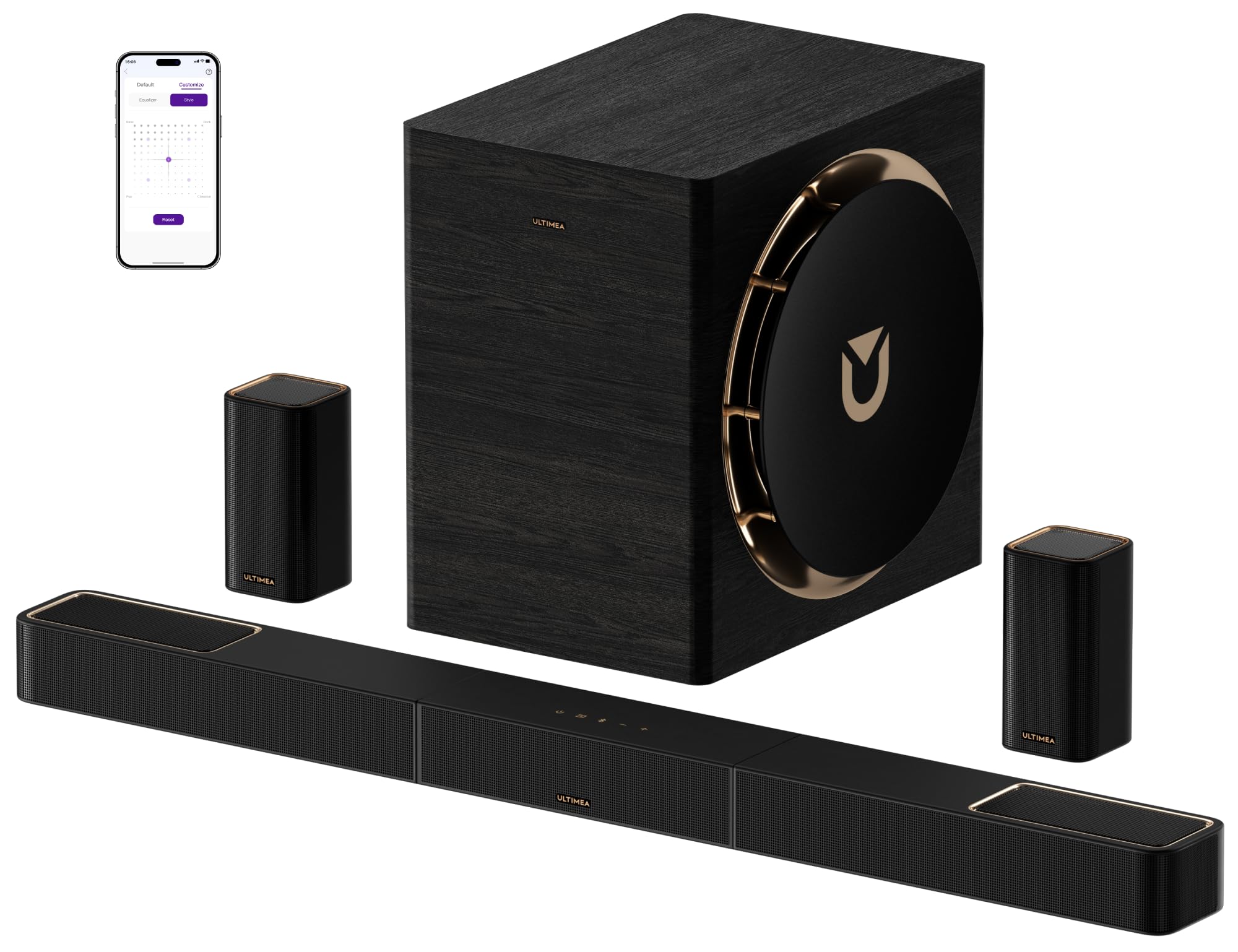
2. ULTIMEA Skywave X70 7.1.4ch System
A ten-inch sub that digs deep and a fully wireless layout that skips the receiver entirely.
Look at the subwoofer first, because that is where the Skywave X70 spends its money. A 10-inch driver is large for this category, and ULTIMEA rates the bass down to 20Hz with 980W peak output. In plain terms, that is the rumble you feel in your chest during an explosion, not just hear. The 7.1.4 layout adds four height channels on top of the surrounds for overhead cues like rain and passing aircraft.
The bigger story is that nothing here needs a receiver. Dual 5GHz wireless transmission ties the bar, sub, and two surround speakers together, and the company says the design minimizes interference and dropouts. Build quality is the second thing that wins people over — a metal grille, rose gold accents, and a wood-crafted subwoofer cabinet make it look like furniture rather than a plastic box. The 4K HDR pass-through also means your video source can route through the bar to your TV without losing picture quality.
Tuning runs deep if you want it: the ULTIMEA app offers a 10-band EQ and 121 sound presets, plus over-the-air updates. The GaN amplifier (a power stage that ULTIMEA rates at up to 98% efficiency) is the reason it stays cool at high volume. Weigh that against placement — 7.1.4 means two surrounds plus a big sub to site, and the app-driven adjustability draws mixed notes from owners who prefer a plain remote. For a medium living room, this is the most bass and the most wireless freedom per dollar here.
The spec that sells it: a 10-inch subwoofer rated to 20Hz with 980W peak — genuinely large-driver bass at this tier.
What to weigh: the deep app tuning is a gift if you enjoy dialing in sound and a chore if you just want to press power.
Reach for this if: you want the most bass and the cleanest wire-free install for the money.
Look elsewhere if: you would rather set volume and forget the app entirely.
3. LG S40TR 4.1ch Home Theater Soundbar
Four channels, zero receiver, and a footprint that fits a bedroom as easily as a den.
Not every room wants eleven channels of hardware. The S40TR is a 4.1 system — four channels, a wireless subwoofer, and two wireless rear speakers — built for people who want real surround without dominating the space. Compare it to the Samsung HW-Q990C up top and the gap is stark: 4.1 channels against 11.1.4. That is the honest trade you are making for a compact, budget-friendly footprint.
Where it earns its place is the everyday stuff. Dolby Digital and DTS Digital support means films and shows still get enhanced surround, and Clear Voice Plus analyzes the audio to push dialogue forward so conversations stay clear. The Smart Up-Mixer stretches two-channel audio across all the speakers for a wider stage. If you own an LG TV, WOW Orchestra runs the TV speakers and the bar together, and the WOW Interface lets one remote drive both.
The rear speakers connect wirelessly with no special receiver, which is the feature that makes this an easy sell for odd-shaped rooms. One thing to plan around: the surrounds still need power where you place them. Owner feedback on the physical wired connections runs negative while the sound itself draws praise, so site the rears near outlets. Budget-friendly, genuinely surround, and simple to live with.
Ideal for: smaller rooms and buyers who want true rear-channel surround without a big hardware bill.
Plan around: both rear speakers need a power source, so map your outlets before you commit to a spot.
4. TCL S65K 5.1 Channel Soundbar System
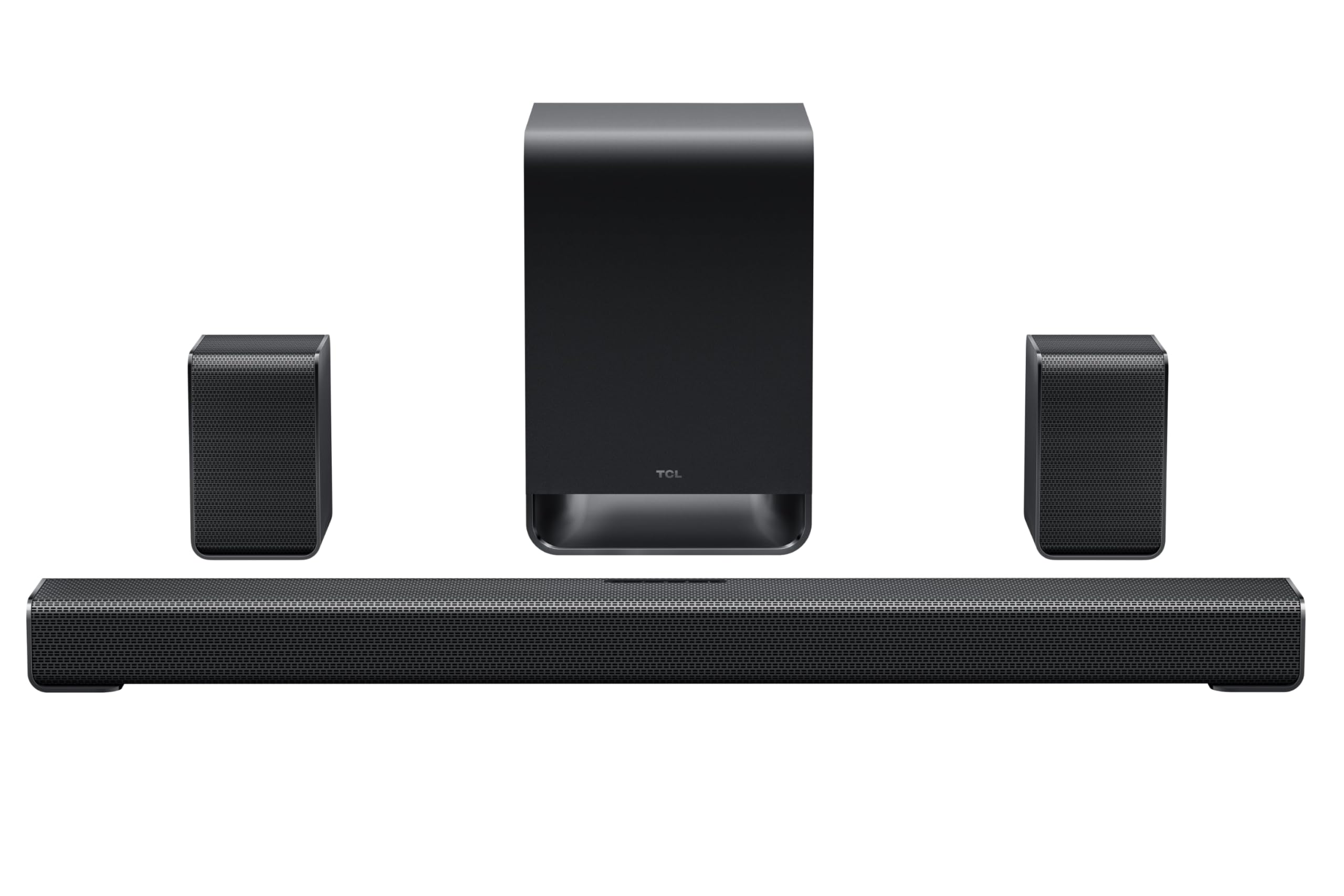
Atmos and DTS:X with a wireless sub and rears, tuned to your room by AI calibration.
Here is the mid-budget entry point for people who want spatial audio without the flagship bill. The S65K is a 5.1 system with Dolby Atmos and DTS:X support, so height and rear cues are part of the package. The wireless subwoofer uses a 6.5-inch driver with Bass Boost technology, and a built-in center tweeter handles the high frequencies so dialogue keeps its edge.
What wins owners is the bass — punchy and present is the consistent theme — paired with a setup that connects to a TV without drama. The built-in center channel keeps voices clear through loud action scenes, and Ai Sonic Auto Room Calibration tailors the sound to your specific space. ChoruSound lets the TV speakers and the bar play together for a wider stage, and one HDMI cable carries the whole movie signal. Bluetooth music streaming rounds it out for phone playlists.
The caveat is scope. This is a 5.1 layout, so it skips the side and extra height channels a 7.1.4 system brings, and the 6.5-inch sub will not dig as deep as the 10-inch drivers further up this list. If your ceiling is flat and your room is medium-sized, Atmos still reads clearly. It is a sensible first Atmos system for a medium room that will not stretch to flagship hardware.
The draw: Dolby Atmos and DTS:X together in a 5.1 package, with AI room calibration that does the tuning for you.
The ceiling: a 5.1 config and a 6.5-inch subwoofer driver — great for a medium room, less deep than the ten-inch subs in this lineup.
Suits you if: you want spatial audio with rears and a wireless sub at the entry to mid-tier.
Think twice if: you want side channels and the deepest bass the category offers.
5. Amazon Fire TV Soundbar Plus 5.1

Sub and two surrounds in the box, and a two-minute unpack before the sound kicks in.
This one is built for the person who does not want to think about setup. Plug the subwoofer and the two surround speakers into power, and they connect to the soundbar wirelessly. Owners describe unpacking and being up and running in about two minutes, which is the shortest path from box to surround sound on this list. The 5.1 layout includes Dolby Atmos and DTS:X, so 3D sound and rear cues are both on the table.
A dedicated center channel handles dialogue, which is the piece that keeps conversations sharp when a scene turns explosive. Four modes — Movie, Music, Sports, and Night — retune the system to what you are watching, and Night mode tames the loud moments for late viewing. If you already run a Fire TV setup, one remote can control both the TV and the bar and let you adjust sound in the Fire TV audio settings. Bluetooth lets you stream playlists from a phone.
The honest split is reliability — that aspect is the one that draws mixed signals, and it is worth knowing rather than a reason to pass. Features you might want, like DTS:X and the modes, land clearly, and the dialogue channel does its job. For Fire TV streamers in a small room or RV, it is the lowest-fuss surround package here.
Why it fits streamers: sub and surrounds ship in the box and connect without a receiver — setup is measured in minutes.
One thing to know: reliability is the most-split topic in owner feedback, so buy with support in mind.
Best against: anything that makes you crawl behind the sofa with a cable — this one is plug in and go.
Not the pick if: you want the longest track record of reliability or ceiling-bouncing height channels.
6. Sony BRAVIA Theater System 6 5.1ch

Three front speakers, two rears, and a center channel tuned to keep every line clear.
Own a BRAVIA TV and this system becomes a natural fit. The 5.1 layout gives you three front-firing speakers, two rear speakers, and an included wired subwoofer. Pair it with a compatible BRAVIA TV and you get Voice Zoom 3 for enhanced dialogue plus control of the soundbar straight from the TV menu. Dolby Atmos and DTS:X support brings the cinema-style mix into your living room.
Where it shines is dialogue and fullness. A dedicated center channel carries voices so you catch every word, and Multi Stereo plays the same sound from all speakers for a room-filling lift. The frequency response reaches down to 20Hz, which is the low-end floor for deep bass. The BRAVIA Connect app lets you adjust volume, sound profiles, and advanced settings from your phone, and Bluetooth streaming handles music from a smartphone.
The one real caution is the rear connection. These surrounds run through a wireless amp box, and owner feedback on reliability and connectivity is the mixed part of the picture — some hear popping from the rears. Budget for that amp box link, since it is the one weak spot in an otherwise theater-like small-room system. If you are all-in on a BRAVIA TV, the app and dialogue features make the partnership worthwhile.
Why it earns a spot
- Dedicated center channel and Voice Zoom 3 with a compatible BRAVIA TV keep dialogue clear
- Frequency response down to 20Hz supports deep bass
- Multi Stereo fills the room by playing the same sound from all speakers
- BRAVIA Connect app puts volume and profiles on your phone
Fair warnings
- Rear speakers run through an amp box, and reliability and connectivity are the mixed-topic areas — some report popping
- The sub is wired, so plan its spot near an outlet
The natural match: a BRAVIA TV owner who values clear dialogue and phone-app control.
The fine print: the rears need the amp box, so watch the wireless link once it is set up.
7. Polk Audio MagniFi Max AX SR 7.1.2
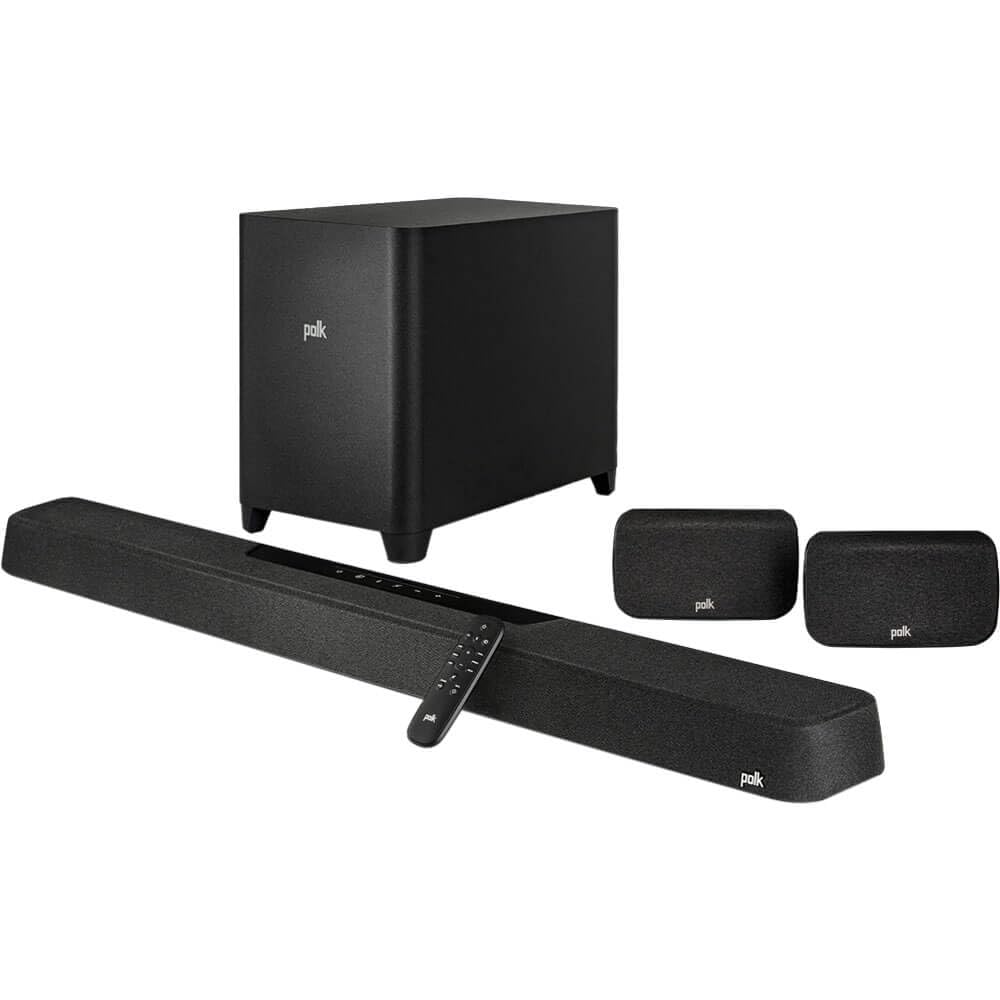
VoiceAdjust lifts the voices without touching the rest of the soundtrack.
Half the battle in home theater is hearing what people are saying. Polk’s answer is VoiceAdjust, which works with the integrated center speaker to raise vocal levels without pulling up the music and effects around them. The 7.1.2 layout adds two up-firing speakers for overhead cues and ships with SR2 surround speakers plus a 10-inch wireless subwoofer. Certified Dolby Atmos and DTS:X support the spatial mix.
The sub connects the moment you power it on, and owners describe the bass as deep for its size. Polk’s SDA 3D technology handles the surround imaging — the effect owners describe is being dropped into an auditorium. Setup is quick, measured in a handful of minutes to connect and run. Connectivity is generous too: three 4K HDMI inputs plus one HDMI eARC out, an optical in, and a USB-A port for firmware updates, with Wi-Fi, Bluetooth, Apple AirPlay 2, Chromecast, and Spotify Connect for music.
The honest note sits with reliability and connection hand-offs, which are the areas owners flag most. Sound and build carry the excitement, so the trade is a small connectivity gamble against a dialogue-focused design. If clear voices top your wish list and you want overhead height, the VoiceAdjust plus 7.1.2 pairing is a compelling fit.
Suit yourself to this: anyone frustrated by mumbling dialogue who still wants overhead height and a ten-inch sub.
Go in aware: connection and reliability draw the most divided owner notes — set it up once, carefully.
8. JBL Bar 1000MK2 7.1.4 System

Lift the surrounds off the bar, set them behind you, and skip the outlet entirely.
This is the solution for a room where outlets never land where you need them. The two surround speakers detach from the main bar with one hand and run on rechargeable batteries, so you place them behind your seat with no power cable. Four up-firing speakers in the bar plus the wireless rears deliver true Dolby Atmos and DTS:X. The 7.1.4 layout and 480W RMS output push real weight behind the effects.
The bass comes from a 10-inch wireless subwoofer, and JBL’s MultiBeam 3.0 spreads a wide stage so you are in the middle of the action wherever you sit. PureVoice 2.0 raises dialogue based on the scene’s ambient sound and your volume, which keeps quiet lines audible. There is a clever twist: take a detachable speaker into the kitchen and keep hearing the game, or park both in front of you and use night listening to mute the bar and sub for late viewing.
The HDMI eARC connection carries uncompressed Dolby Atmos through one cable and passes 4K Dolby Vision from a player or console. Set expectations around reliability, which is the mixed part of the picture here, and around battery life on the rears, which is the trade for going wireless. For a living room with no outlets near the sofa, that trade is usually worth it.
The freedom factor: battery-powered detachable surrounds mean no cable and no outlet behind your seat.
Worth knowing: reliability draws divided feedback, and the rears rely on battery — plan a charging routine.
Wins when: your sofa has no nearby outlets and you want true rears without cable runs.
Look elsewhere when: you want the largest sub in the JBL range — that is the 1300X next.
9. JBL Bar 1300X 11.1.4 Soundbar

Four up-firing drivers in the bar, two more in the rears, and a twelve-inch sub behind it all.
When you want the biggest version of everything JBL makes, this is it. The 11.1.4 layout puts four up-firing drivers in the main bar and two more in the detachable speakers, all feeding true Dolby Atmos and DTS:X through MultiBeam processing. Total system power is rated at 1170W, and the 12-inch wireless subwoofer is the largest driver on this entire list — the depth that makes an explosion land in your stomach.
The detachable speakers are battery-powered, so the surrounds go behind you with no wires and no outlets. Wi-Fi brings AirPlay, Alexa Multi-Room Music, and Chromecast built-in, opening a huge catalog of streaming services, and the connection also pulls automatic software updates. Setup is straightforward and owners consistently call the sound theater-like. It is the same detach-and-place idea as the Bar 1000MK2, but with a bigger sub and more channels.
The catch is reliability and value. Randomly shutting off is the split point in owner notes, and the price tier sits near the top of the range. Weigh both against the 12-inch sub and six up-firing drivers you cannot get anywhere else on this list. If you want the most channels and the deepest sub JBL builds, this earns the top slot; if you want to spend less for nearly as much punch, the 1000MK2 is the smarter call.
The flagship case
- 11.1.4 channels with six up-firing drivers total — the biggest array in the JBL lineup
- 12-inch wireless sub is the largest driver here, for the deepest bass
- Detachable battery surrounds with no wires or outlets behind your seat
- Wi-Fi with AirPlay, Alexa MRM, and Chromecast built-in plus automatic updates
The honest caveats
- Randomly shutting off is the split point in owner notes
- Top-tier layout and a 12-inch sub cost more than the rest of the list
The full send: buy this if you want the most channels and the deepest sub, with wireless rears to match.
The sensible step-down: the 1000MK2 gives you nearly the same detach-and-place rear trick for less.
Know the Specs
Channel count, plainly stated
The leading number is the main speaker count and the trailing numbers are the subwoofer plus height channels. A 5.1 system is a bar, a sub, and two rears. A 7.1.4 system adds side channels and four up-firing height drivers. More channels fill a bigger, flatter room; a compact 4.1 or 5.1 suits smaller spaces just fine.
Up-firing height drivers
These are speakers that aim at your ceiling, so audio bounces down to create overhead sound. They work best with a flat, hard ceiling and a listening spot set back from the screen. That is how a 7.1.4 or 11.1.4 system puts a helicopter above you rather than just in front of you.
Subwoofer driver size
The sub handles the low end, and the size in inches tells you how much air it moves. A 10-inch driver like the ones on the ULTIMEA and Polk systems delivers bass you feel, while a 6.5-inch driver handles the rumble for a medium room. Wireless connections on these subs mean placement is flexible.
Rear-speaker power options
The surrounds are the defining feature of this category, so know how they connect. Some need a wall outlet at each spot, which limits placement. Detachable battery designs like the JBL pairs let you lift the rears off the bar and put them anywhere behind you, trading wireless freedom for a charging routine.
Common Questions
Do I really need rear speakers for surround sound?
What is the difference between 5.1, 7.1.4, and 11.1.4 channels?
Will a surround soundbar system work with any TV brand?
How do detachable rear speakers stay powered?
Do I need an outlet behind my sofa for the rear speakers?
Does Dolby Atmos work without ceiling speakers?
What does HDMI eARC do that optical cannot?
Will a bigger subwoofer driver make a noticeable difference?
Can I stream music to these systems from my phone?
The Bottom Line
For the fullest cinema effect with the most drivers, the Samsung HW-Q990C wins — 11.1.4 channels and rear speakers that fire up and to the side put sound all around you. If you want the deepest bass for the money, the ULTIMEA Skywave X70 pairs a 10-inch sub with a fully wireless 7.1.4 setup. And if outlets behind your sofa are the problem, the JBL Bar 1000MK2 detaches its rears so you can place them anywhere. Match the channel count to your room and the rear-speaker power to your outlets, and the surround effect follows.
How we choose
We do not accept paid placement. Every pick is matched to a real buyer and a real use-case; we do not hands-on test units.
Sources
Specifications: manufacturer listings and product documentation. Review insights: verified customer reviews, as of November 2026. Pricing: not shown on this page (it changes often); check the current price via the retailer link.
As an Amazon Associate, Tactical Gear Guy earns from qualifying purchases. This does not affect which products we feature.