Specs are compiled from manufacturer listings and verified buyer reviews and can change over time — please confirm the key details on the product page before buying.
You want to join two wires and have the joint hold, not sit there watching a cold tip and guessing whether the heat is right. What decides that outcome is whether the kit’s wattage and tip shape match your wire gauge — a 60 W iron struggles on thicker stranded wire, while a 100 W unit with real temperature feedback tins a joint in seconds. The helping hands, solder wire and extra tips are support gear; the iron’s heat is what makes the joint.
This guide is built by comparing the manufacturers’ published specifications and the patterns across verified customer reviews, so you get each pick’s real strengths and trade-offs instead of marketing spin.
Nine kits make the cut here, sorted by how much heat they deliver and how hard they are to keep on the bench. The real split is between fixed-power pencil irons and station-style kits with a holder, a readout and adjustable temperature — and picking the wrong side is what wastes a beginner’s afternoon. This breakdown covers the best soldering kit for wires for both paths.
Top Picks


How To Choose The Best Soldering Kit For Wires
Wire work is not the same job as board work. A circuit board pad is small and forgiving; a 12-gauge stranded wire wicks heat away into the copper like a heat sink. That heat-sink effect is why wattage and tip shape matter more here than on board work.
Match wattage to what you’re actually joining
A 60 W iron handles thin hookup wire, LED leads and small gauge splices all day. Once you’re onto thicker gauge, a 100 W or 130 W tool gets the joint up to solder-melting temperature before the metal bleeds the heat away. That is why the 100 W and 130 W kits in this list exist. Look at the power figure first and the tip selection second.
The tip is the contact patch, so treat it as a wear item
Your heat transfers only at the tip, and a small conical tip has a tiny contact patch. A chisel or screwdriver shape puts more surface against a wire joint and moves heat faster. Every kit here ships extra tips for that reason — swap shapes to match the job rather than forcing one tip to do everything. Once a tip oxidizes and stops wetting solder, replace the tip rather than the iron.
Why a station beats a bare pencil once you’re soldering repeatedly
A station kit gives you a fixed holder you can’t knock over, a temperature readout, and a controller that holds the set point between joints. A pencil iron sits loose on the bench. For one splice a month, a pencil iron on the bench is fine. For weekend wire repairs, the station’s heat recovery and anchored holder matter more than extra tips.
Side-by-Side Comparison
| Model | Best For | Power | Temperature Range | Included Tips | Amazon |
|---|---|---|---|---|---|
| Plusivo S578 Station★ Best Overall | All-in-one bench for wire repairs | 60 W | 212 °F – 932 °F | 5 pcs | Amazon |
| Q-MING 80W KitFastest Start | Fast first splices on a tight bench | 80 W | 356 °F – 896 °F | 5 pcs | Amazon |
| Aucanla 100W KitMost Heat Per Dollar | High power in a portable case | 100 W | 356 °F – 896 °F | 3 pcs | Amazon |
| YIHUA 947-V Kit | Dim corners and fine wire work | 60 W | — | 5 pcs | Amazon |
| Weller WLIRK6012A | Interchangeable tips on name-brand hardware | 60 W | — | 3 pcs | Amazon |
| WEP 926LED V3 | Small desks that still need a real station | 130 W MAX | 392 °F – 896 °F | 5 pcs | Amazon |
| YIHUA 926 III | Helping hands and steady heat together | 110 W | 194 °F – 896 °F | 3 pcs | Amazon |
| Preciva 927 IV | Preset temperatures for repeat jobs | 130 W | 194 °F – 896 °F | 5 pcs | Amazon |
| WEP 926LED V1 | Stepping up from a pencil iron | 110 W | 392 °F – 896 °F | 5 pcs | Amazon |
Detailed Reviews
1. Plusivo S578 Digital Soldering Station Kit, 60 W
Our pick — 4.5+★ from 200+ verified ratings; the strongest balance of quality and price.
The one kit that replaces half your toolbox, not just the iron.
What you’re buying here is a station that also hands you the diagnostic gear. The kit ships with a digital multimeter and probes, so the same purchase lets you test a wire for continuity before you ever touch solder to it. That order of operations — test, then join — is how you avoid soldering a joint onto a circuit that was already broken somewhere else.
On heat, the 60 W iron runs a 212 °F to 932 °F range with a stated ±2 °C stability, and the LCD shows you the °C/°F reading with one-touch conversion. Those ±2 °C means the temperature you dial holds close to what the display claims, so a joint that came out right last time will come out right again at the same setting. Against the WEP 926LED V3’s 130 W MAX rating, this one is clearly the lower-power tool — but the WEP’s number is a peak figure and this one is paired with a multimeter the WEP kit doesn’t include.
The accessory load is the headline: solder wire, solder paste, solder wick, a desoldering pump, five tips, tweezers, a cutter, electrical tape, a wire stripper, mini screwdrivers, a mini PCB and heatshrink tubes all arrive in the box. A beginner needs nothing else on the bench to make a first splice. What wins people over across the reviews is build quality, and the value read follows right behind it. The honest catch is physical — 1.9 kg of station plus a full accessory spread means this is a bench fixture, not something you drop in a go-bag for a job site.
What earns the top spot
- Multimeter and probes included, so you can diagnose a wire before soldering it
- ±2 °C temperature stability with LCD readout and °C/°F conversion
- Temperature lock plus standby and sleep modes protect the tip between joints
- Full consumable spread — wire, paste, wick, pump, five tips, stripper, heatshrink
Where it costs you
- 1.9 kg station is bench-bound; this is not a portable pick
- 60 W puts it below the 100 W and 130 W tools on raw heat delivery for thick wire
Settle here if: you want one purchase that covers diagnosis, soldering and cleanup, and the bench is where you work.
Move along if: you plan to solder on site or regularly join heavy-gauge wire that drinks up heat.
2. Q-MING 80W Digital Soldering Iron Kit, 39-in-1
Twenty seconds from cold to working heat, with a handle that won’t bite back.
For a wire splice you decided to make five minutes ago, the 80 W ceramic element here gets to temperature in 20 seconds. Set the thermostat anywhere from 356 °F to 896 °F, flip the display between °C and °F, and get on with it.
The silicone handle is the underrated part. It’s insulated and built to keep a burn off your fingers during a long session, and the dual safety design backs that up. The 39-in-1 count gets you the LCD iron, solder wire, a stand, a cleaning sponge and five tips — what one buyer describes as “the basic necessary items to start soldering.” Note that this is a pencil iron, not a station, so there’s no integrated holder beyond the included stand.
Compared against the Plusivo station’s ±2 °C stability, this kit doesn’t publish a stability figure — you get adjustable temperature with an LCD readout, and that’s the honest scope of it. The ceramic element does the heavy lifting, and reviewers consistently land on adjustable temperature control as the reason it works. If you solder once a month and want the fastest route from unboxing to a tinned wire, this is it.
Where the money goes: into heat speed and a burn-resistant silicone grip rather than a full station chassis. Twenty seconds to working temperature on 80 W buys you more usable time than a bigger kit that takes longer to warm.
Fair caveat: no published temperature stability figure and no digital temperature lock, so treat the readout as a guide rather than a calibrated instrument.
Right call for: the occasional splicer who wants heat almost immediately and doesn’t need a bench-fixed station.
Wrong call for: anyone who needs repeatable, locked-in temperature across a long repair session.
3. Aucanla 100W High Power Soldering Iron Kit
A portable kit that pushes 100 W and puts itself to sleep.
Where the Q-MING kit runs 80 W and the Plusivo station 60 W, the Aucanla pushes 100 W — and unlike both of those, it does it in a package you can carry. The body is built for transport, and a protective cap on the tip makes storage less of a gamble. If your soldering happens at the vehicle, in a garage corner, or wherever the broken wire actually is, that portability is the feature that matters.
The heat range runs 356 °F to 896 °F with an HD LCD showing the set point, and the temperature holds steady enough that reviewers keep coming back to heating speed and overall function as the reasons it earns a spot. Stand it on the included heat-resistant stand for 10 minutes and sleep mode drops the temperature automatically, which cuts wear on the heating core. That stand has a wider base than a typical clip-on rest, and ships with both brass wool and a cleaning sponge.
Three plated tips come in the box, alongside a roll of solder wire and a tip protective sleeve. The trade-off is one you should hear plainly: the manufacturer states that long-term use can oxidize the tips until solder stops melting, and the fix is to replace the tip on a schedule. That’s a consumable cost, not a fault — but if you’re the type to run one tip until it dies, budget for spares.
The heat case: 100 W in a portable chassis. Thicker wire joints that stall a 60 W iron give way faster here, and the automatic 10-minute sleep protects the heating core when you get distracted mid-repair.
The tip reality: oxidation is a stated wear path on these tips, so tip replacement is a routine you accept rather than a surprise you find.
Buy this one for: high heat in a form you can carry to the repair instead of the other way round.
Think twice on: keeping a single tip indefinitely — its own documentation flags oxidation as the limiting factor.
4. YIHUA 947-V Soldering Iron Kit with 3 LED Lights
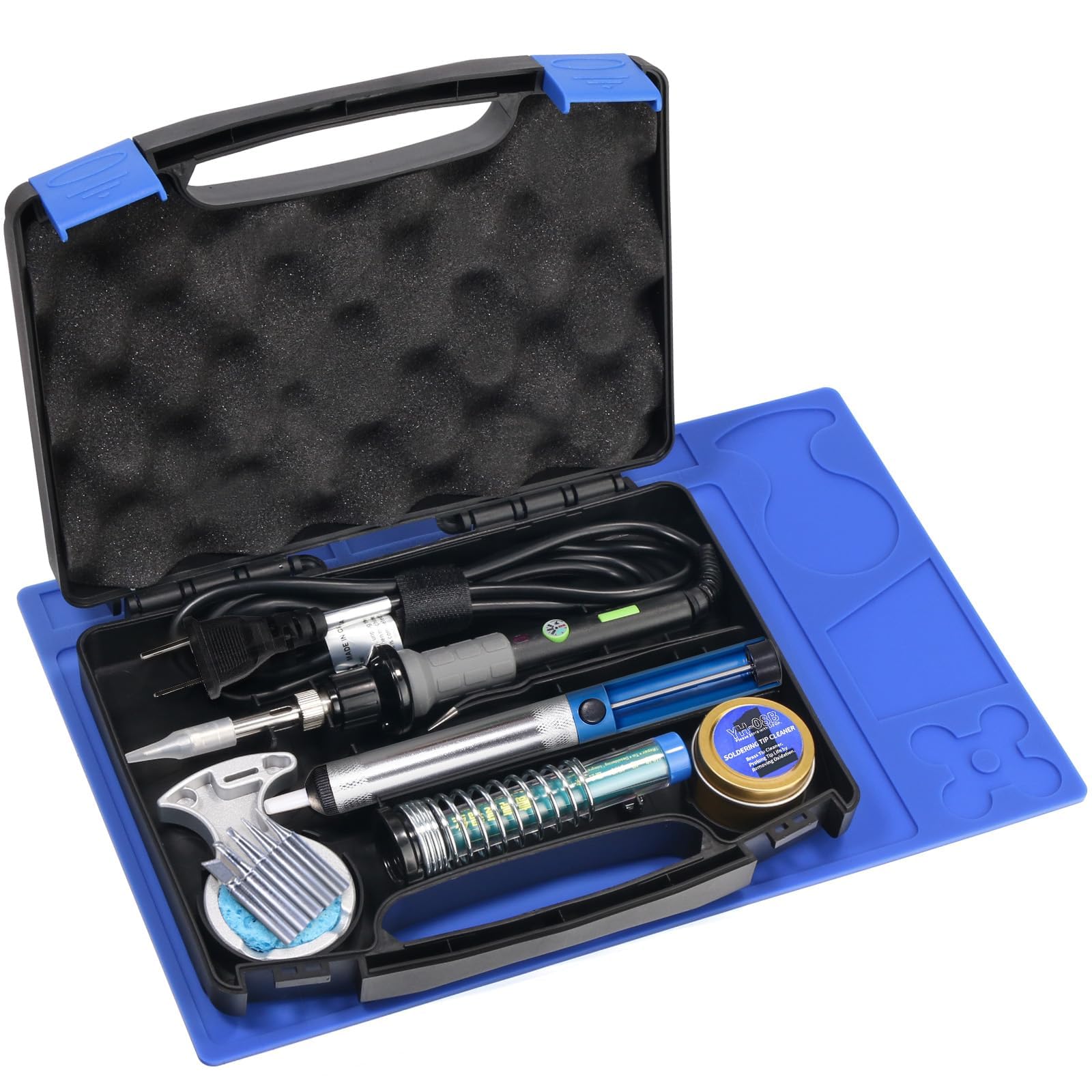
Three LEDs on the iron itself, so the joint is lit wherever you point it.
Most solder joints fail in bad light. You can’t see whether the solder flowed or beaded until it’s cooled wrong, and a desk lamp throws shadows exactly where the iron sits. This YIHUA puts three durable LEDs on the iron, switchable on or off mid-task, plus an operation indicator that tells you the tool is actually live. For a wire joint tucked behind a panel, that beam follows your hand.
The rest of the 60 W kit is a proper portable workshop: five extra tips, a roll of 1.0 mm solder, a desoldering pump, a cleaning sponge and brass wool, ESD-safe tweezers, an iron holder with a reusable sticker, and a silicone pad. The case has slotted inner sections so each piece locks into its own spot, which keeps the bits from ending up loose in a bag.
There’s a master switch on the handle that saves energy and adds a safety stop, and a temperature control system tuned for accurate, stable heat. The input is 110–127 V with a US plug, and the maker is explicit that it must not go into a 220 V socket — respect that line. What the kit hasn’t controlled for is heating consistency, since the heat-up reports split between fast and not-hot-enough across the review pages. Treat that as a unit-to-unit variance to test on arrival instead of an assumption.
The reason it earns a slot
- Three switchable LEDs on the iron light the exact spot you’re working
- 15 pieces including ESD-safe tweezers, silicone pad and desoldering pump
- Case with dedicated slots keeps every accessory organized
- Handle master switch doubles as a safety cut-off
The honest limits
- Heat-up consistency splits across reviews, so bench-test it before a critical job
- No published temperature stability figure for the 60 W element
Works best for: tight, badly-lit wire work where seeing the joint is half the battle.
Less ideal for: anyone who needs a guaranteed temperature hold on the first try without testing the unit.
5. Weller WLIRK6012A 60W Soldering Iron Kit

A halo of light around the tip and three tip shapes to switch between.
Weller’s angle is the light ring — 360 degrees of illumination around the tip itself, not a lamp off to the side. That’s the difference between seeing a shadowed seam and seeing the actual joint. The molded pencil grip gives you a controlled hold for fine work, which is where wire repairs on small connectors usually live.
The tip set is the widest here: a 0.8 mm conical for precision, a 6.4 mm chisel for flat contact, and a 2.4 mm screwdriver for general work. Tips change quickly, so a worn conical doesn’t mean a new iron — you swap the tip and keep going. The on-board safety rest holds the iron between joints, and a solder aid plus lead-free rosin solder round out the box. The iron runs 60 W on 120 V.
Backed by a 7-year warranty, this is the longest coverage window of any kit on this list. Whether that promise translates into a tool that holds up is where buyers split — quality and reliability both read as mixed in the reviews, with some finding it solid and others reporting it quit after a few hours. That’s a genuine fit-note, not a reason to write the whole brand off. If the halo light and quick tip changes are what you want, test the unit hard in the first sessions while the coverage is fresh.
What it does better than the rest: the interchangeable chisel, conical and screwdriver tips, plus 360-degree light exactly at the joint. Where the Aucanla kit leans on raw wattage, this leans on tip geometry and visibility.
The honest read: quality and reliability land mixed across the review pages. A 7-year warranty gives you a long runway, but it needs to heat consistently in week one to mean anything.
Pick it when: you want interchangeable tip shapes and the best-lit tip in the group, and you don’t mind proving the unit early.
Not the one if: you need rock-solid reliability reputations over a wide tip spread and a long warranty term.
6. WEP 926LED V3 Soldering Station Kit, 130W MAX

A 130 W MAX station sized for the corner of a small desk.
If your workspace is a kitchen table you clear every night, this station is built for you — it measures 4.84 inches deep by 6.3 inches wide by 4.45 inches tall and mounts the iron holder directly onto the body. The holder is made from a temperature-resistant material, so you aren’t dangling a hot iron off a flimsy clip. It weighs 0.9 kg, which is portability within a room rather than across town.
Heat runs 392 °F to 896 °F, adjusted by a knob, with the digital display showing real-time temperature. The built-in PID microcontroller is the piece doing the real work: it recalculates temperature compensation continuously and holds the tip at your set point. That’s why it solders smoothly where a non-stabilized iron keeps drifting. Against the Plusivo’s ±2 °C spec, WEP doesn’t publish a stability number, but the PID loop is named and functioning.
The kit brings a spool of solder wire, five tips, tweezers, a desoldering pump and a wire dispenser. Sleep mode kicks in after 10 minutes idle and drops the iron to an idling temperature to extend heater and tip life. The recurring gripes are the tips and the spool holder — tips wear faster than you’d like, and the holder doesn’t always lock. Both are small, fixable inconveniences rather than showstoppers, but know they’re there.
Floor-space winner: at 0.9 kg with an integrated holder, this is the station that fits a shared desk. The 130 W MAX rating gives it headroom the 60 W stations don’t have.
Real limitations: tip life is short and the spool holder needs a firm hand to stay put.
The match if: you solder at a desk you have to share with everything else and want station-grade temperature control in tight space.
Keep looking if: minimum tip longevity and a self-locking spool holder are non-negotiables.
7. YIHUA 926 III 110W Soldering Iron Station Kit

Two alligator clamps hold the wire so both your hands stay on the iron.
Soldering a wire splice alone is a three-handed job. This YIHUA solves it with two helping hands on alligator clamps, so the wire stays put while you bring the iron and the solder in. The package also includes a mini spanner for detaching those clamps when you don’t need them, plus a soldering wire holder mounted at the side of the station. For anyone working without a second person in the room, this is the pick that changes the workflow.
The 110 W station runs a 194 °F to 896 °F range with a knob and an LED readout, and the PID thermal compensation keeps recovery quick after each joint. That’s the part that matters on thicker wire — you don’t wait between connections. A sleep mode drops the temperature when the iron rests in the holder, cutting tip wear across a long session. The sponge at the bottom and slots for temporary tip storage are built into the compact unit.
In the box you get three assorted tips, a desoldering pump, anti-static tweezers, 35g of lead-free solder and a cleaning sponge. The quality and performance scores are positive; heating and ease of use split. Read that as a kit that rewards a patient, methodical first run.
Why it fits the list
- Two helping hands with alligator clamps free both your hands for iron and solder
- 110 W with PID thermal compensation for fast recovery between joints
- Wide 194 °F to 896 °F range and side-mounted solder wire holder
- Anti-static tweezers and desoldering pump included for wire work
What to expect honestly
- Assembly instructions are thin, so setup takes patience
- Durability is a noted weak point; a few report a short service life
Score one if: you solder one-handed and need the wire held while both hands are busy.
Weigh it carefully if: you want a kit that arrives ready to run without careful setup and long-term confidence.
8. Preciva 927 IV Soldering Station Kit, 130W
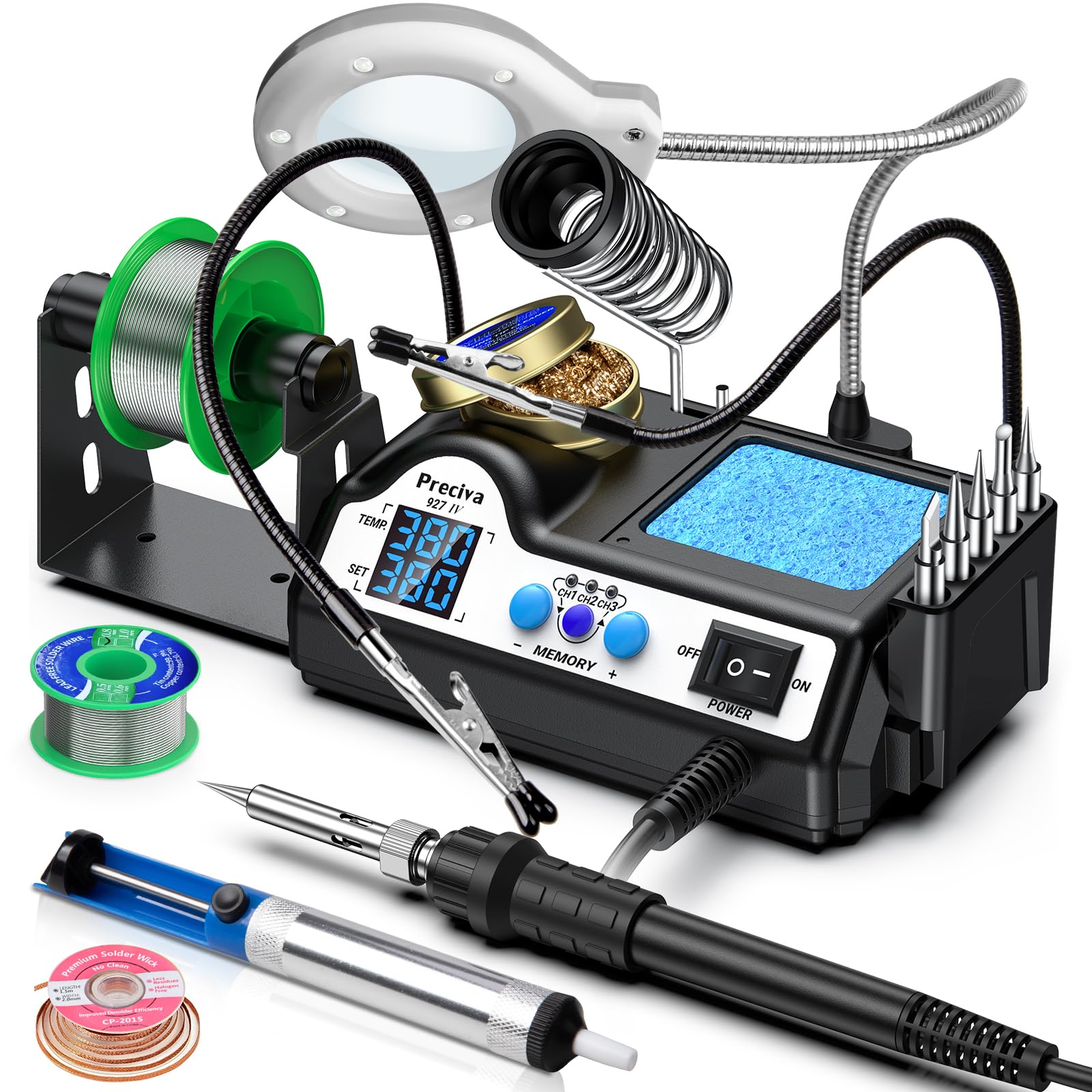
Three preset temperatures and a magnifier for the joints you can barely see.
Repeat jobs want repeat settings. This Preciva lets you store three frequently used temperatures and switch between them with a single touch, so switching from thin hookup wire to thicker stranded doesn’t mean dialing a knob back and forth each time. The 130 W ceramic core reaches 572 °F in 15 seconds, and four cooling openings bleed heat off fast between tasks. The adjustable range spans 194 °F to 896 °F.
The dual display is the detail that separates it from most stations: it shows the set temperature and the actual temperature at the same time. You can see the tip dip when you hit a cold wire and watch it climb back. PID control keeps the gap between displayed and actual temperature at ±2 °C, and auto sleep is adjustable from 0 to 99 minutes rather than fixed.
Eighteen accessories ship with it — five extra tips, two helping hands with alligator clips, a 5x magnifying glass with LED light, 30g of lead-free solder, solder wick, a sucker, a blue sponge, a tip cleaner and tip storage slots. The 5x magnifier is the standout extra for wire work where a clean strand count matters. Quality and reliability both read strongly in the review pages, and the value verdict follows. If you want a magnifier and preset switching in the same box, this is where you land.
Where it separates: dual-temperature display showing set versus actual, three one-touch presets, and a 5x lit magnifier for close wire work. The 130 W ceramic core matches the WEP V3’s 130 W MAX ceiling but adds the presets on top.
The fair caveat: the adjustment range starts at 194 °F, not the lower floor some competing stations offer, so very low-temperature work is more limited.
The pick for you if: you repeat the same few wire jobs and want those temperatures stored, with a magnifier for the fine ones.
Keep shopping if: you need to work below 194 °F or want an absolute minimum setup fuss.
9. WEP 926LED V1 Soldering Station Kit, 110W

The intermediate step: a real station, without the weight of the heavier chassis.
WEP positions this V1 for intermediate users, and the spec list backs that framing up. A 110 W proximity heating element delivers heat faster and reads temperature more accurately than a traditional station, and the PID microcontroller holds the set point between joints. You can adjust from 392 °F to 896 °F by knob, with the LED showing actual temperature as you go.
The kit includes a spool of solder wire, five tips, tweezers and a desoldering pump. Five tips covers thin hookup wire through a wider flat contact, which is what one buyer credits for handling stained glass work as well as electronics. Sleep mode after 10 minutes sits idle at low temperature to protect the heater and tip, and °C/°F toggles in one press when you follow a tutorial from another region.
One thing to know before you buy: this model uses WEP #1400 replacement tips, available direct from WEP, so don’t expect to scavenge generic tips. Rated 110–127 V for US power, it must not meet a 220 V socket. Against the Plusivo station’s multimeter-and-paste accessory load, this one is leaner on extras but heavier on heat — 110 W against 60 W is the meaningful gap if your wire gauge tends thicker.
What it brings to the bench
- 110 W proximity heating element with faster, more accurate heat than a basic station
- PID loop keeps the tip at your set temperature between joints
- Five tips and a desoldering pump included for diverse wire work
- Sleep mode extends both tip and heating element life
What to plan for
- Replacement tips are WEP #1400 specific — buy spares from WEP
- Leaner accessory set than the Plusivo or Preciva kits
You’ll like this if: you’ve outgrown a pencil iron and want station control at 110 W without paying for a full accessory spread.
Less suited to: anyone who wants a magnifier or multimeter thrown in and doesn’t want to source proprietary tips.
Know the Specs
Wattage and Heat Recovery
Wattage tells you how fast a kit can pump heat into a joint, but the better measure is recovery — how quickly the tip bounces back after it touches cold metal. A 100 W tool like the Aucanla out-powers a 60 W station on paper, and 130 W MAX on the WEP V3 and Preciva is a peak figure, not a steady ceiling. What you feel in your hand is whether the tip dips and recovers while you work. Higher wattage helps most on thick wire that drains heat away.
Temperature Range and Control
The range defines the temperatures you can set, and control defines whether the tip actually stays there. PID microcontrollers — found on the WEP kits, the Preciva and the YIHUA 926 III — recalculate and compensate continuously. A ±2 °C stability figure means the display and the tip are close, so the same setting gives the same result next time. Wide ranges like 194 °F to 896 °F suit everything from low-temp delicate joints to full heat on heavy wire. Narrower ranges like 356 °F to 896 °F cover most wire work fine.
Common Questions
What wattage do I need to solder wires?
Do I need a station or is a pencil iron enough?
What does the °C/°F conversion do and why does it matter?
How often do I need to replace a soldering tip?
What is sleep mode and does it really extend tip life?
Will these kits work on 220V power abroad?
How helpful are the helping hands and magnifier for wire work?
What is PID temperature control and why do buyers care?
What accessories should I expect in a wire soldering kit?
How do I stop solder from sticking to a cold joint?
The Bottom Line
For most people soldering wires, the soldering kit for wires that wins is the Plusivo S578 Station, because it pairs a ±2 °C temperature hold with a digital multimeter and a complete solder-and-cleanup spread — so diagnosis, soldering and cleanup all happen in one purchase. If high heat in a portable form is what you’re after, the Aucanla 100W Kit puts the power in your bag. And for small desks that still want a real station with PID control, the WEP 926LED V3 fits where the heavier units won’t.
How we choose
We do not accept paid placement. Every pick is matched to a real buyer and a real use-case; we do not hands-on test units.
Sources
Specifications: manufacturer listings and product documentation. Review insights: verified customer reviews, as of November 2026. Pricing: not shown on this page (it changes often); check the current price via the retailer link.
As an Amazon Associate, Tactical Gear Guy earns from qualifying purchases. This does not affect which products we feature.