Specs are compiled from manufacturer listings and verified buyer reviews and can change over time — please confirm the key details on the product page before buying.
The big decision with a film camera is not which brand — it is how much control you actually want. A point-and-shoot loads, winds, flashes and hands you back a roll of prints. A used SLR gives you aperture, shutter speed and a lens mount, but asks you to think before every frame. This guide separates the two camps so you can spend on the camera that matches how you shoot, not the one with the loudest spec sheet.
This guide is built by comparing the manufacturers’ published specifications and the patterns across verified customer reviews, so you get each pick’s real strengths and trade-offs instead of marketing spin.
Start with the exposure control, then check the lens mount, then decide how much camera you want to carry. Everything else follows. Here are the retro film cameras worth loading with a fresh roll.
Top Picks

How To Choose The Best Retro Film Cameras
The first question to answer is who is loading the film. If it is you, on a walk, with no interest in bracketing exposures, a compact with automatic exposure is the entire point. If it is you, with a notebook and a light meter app, an SLR with manual modes and a swappable lens is where the craft lives. Decide that once and half the list eliminates itself.
Point-and-shoot versus SLR — pick your level of control
A point-and-shoot reads the scene for you and fires. An SLR with aperture priority, shutter priority and manual modes hands you the decisions. The trade-off is weight and bulk — a 170 g compact slips into a jacket pocket, while an SLR with a zoom lens rides on a strap. Neither is better — a 170 g compact suits a jacket pocket, an SLR with a zoom suits a strap.
Zone focus versus autofocus — how the camera decides what is sharp
Zone focus means you set a distance range and the camera holds focus across it, which is fast on the street and forgiving in low light. Autofocus SLRs lock onto a subject for you, which is easier for portraits and moving subjects. A 2-zone system keeps it simple. A 7-point system gives you more targets in the frame.
The ISO range matters more than the megapixel talk
ISO on a film camera is the sensitivity rating of the roll you load. A camera rated for a narrow band of ISO speeds limits which films you can shoot in which light. A wider window — say 50 to 3200 — lets you push the same body from bright sun to a dim room with the right stock. Check this number before you fall for the body styling.
Side-by-Side Comparison
| Model | Best For | Exposure Control | Lens / Mount | ISO Range | Amazon |
|---|---|---|---|---|---|
| KODAK Snapic A1★ Best Overall | Pocket carry and easy shooting | Automatic | 3-element glass lens (fixed) | — | Amazon |
| Kodak Ultra F9Budget Starter | Cheap first roll and travel backup | Automatic | Fixed lens | 400 | Amazon |
| Canon Rebel 2000 | Everyday shooting with autofocus | Program, Aperture, Shutter, Manual, Automatic | Canon EF mount, 28-80mm included | 100-400 | Amazon |
| Canon New EOS Kiss | Portraits and travel on EF lenses | Automatic | Canon EF mount, 35-80mm included | 100-3200 | Amazon |
| Vintage Canon AE-1 | Manual vintage metal-body shooting | Manual, shutter-speed-priority | Canon FD mount, 50mm f/1.8 included | 12-3200 | Amazon |
| Pentax 17 Kit | Half-frame frame doubling with film included | Manual | 25mm f/3.5 fixed lens | 50-3200 | Amazon |
Detailed Reviews
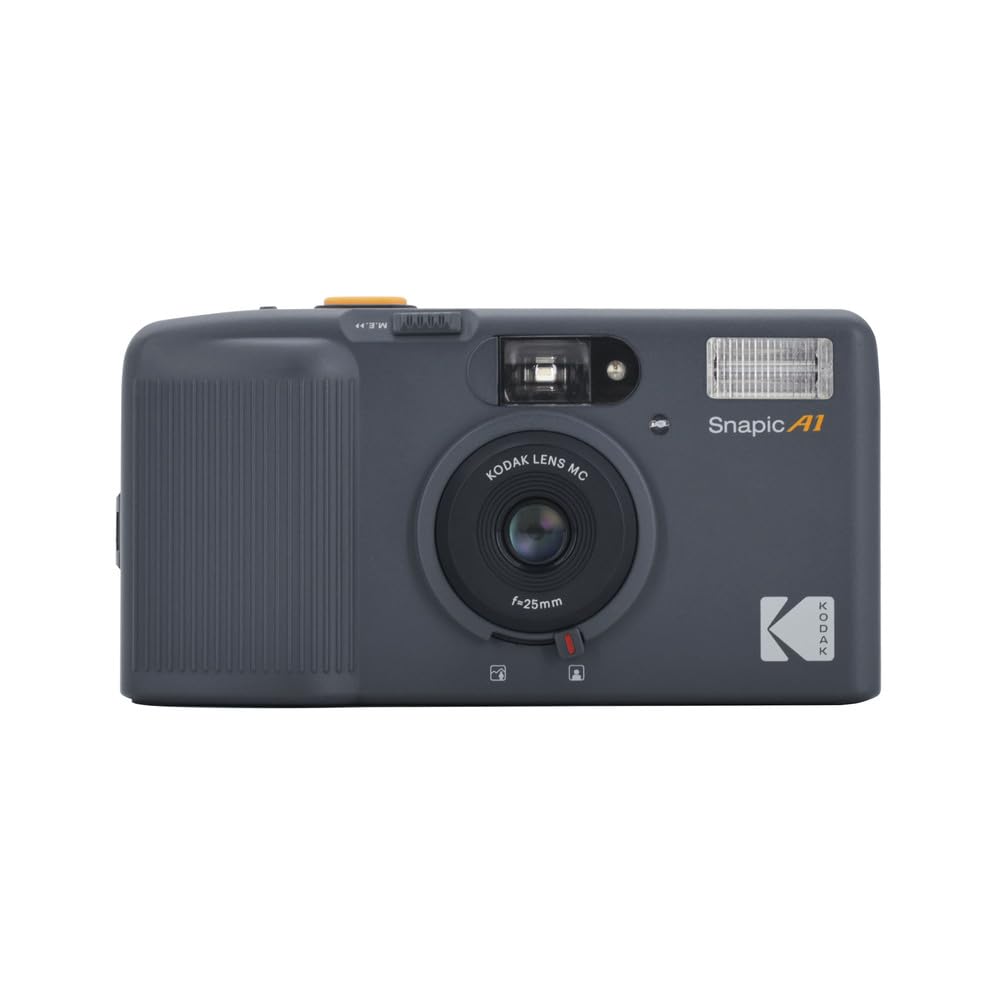
1. KODAK Snapic A1 35mm Film Camera (Rhino Grey)
Our pick — 4.5+★ from 150+ verified ratings; the strongest balance of quality and price.
The pocket compact that lets you double-expose your whole weekend.
This is the pick for the person who wants film back in their life without carrying a camera bag. It weighs 117 g, so it disappears into a coat pocket, and the whole camera is roughly the footprint of a small paperback. You load 35mm film, switch between two focus zones with one control, and shoot.
The feature that keeps people coming back is multiple exposure — you can blend two different scenes onto a single frame for layered, ghosted images you cannot get from a phone. The built-in auto flash also includes red-eye reduction for indoor shots and evening portraits. Reviewers praise the camera as a whole rather than any one spec, and call it good value for the price.
The catch is reliability. Some units work great for roll after roll, while others stop working suddenly, and that is the honest risk with any compact at this level. Exposure control and build quality also draw mixed notes. Treat it as a creative pocket camera you handle with care, not a workhorse you toss in a bag. retro film cameras rarely give you pocket portability and full manual control in one body — this one picks portability.
What makes it the top pick
- Double-exposure mode is rare at this level and genuinely fun to use.
- 117 g body rides in a jacket pocket without a strap.
- Two-zone focus keeps shooting fast on the street and in low light.
- Auto flash with red-eye reduction covers indoor and evening shooting.
What you give up
- Reliability is the mixed point — a sudden failure is the risk you take.
- Film and the AAA battery are not included, so budget for a first roll.
- No manual exposure control for deliberate over- or under-exposure.
Pick it for: creative shooting where pocket carry and double exposures matter more than dials.
Not the one for: anyone who wants manual shutter and aperture control.
2. Kodak Ultra F9 Film Camera (White x Green)
The cheapest honest way to find out if you enjoy film at all.
Here is the trade-off that defines this camera: it is fixed to ISO 400 film. That one number decides everything. A 400-speed roll is the versatile middle ground — good in daylight, workable indoors with the flash, forgiving if you are still learning. Load it, frame it, shoot it. There are no settings to get wrong.
It is light. At 170 g without film or battery versus 117 g for the Snapic A1 above, the difference is barely perceptible on a wrist strap. You get a built-in flash and automatic exposure, and the kit includes the camera body and a hand strap. The battery is a single AAA alkaline, not included.
Think of this as the roll of film you shoot to prove you like shooting film. The fixed ISO means you cannot push it into a dim room without the flash, and you cannot try slow black-and-white stocks. If you already know you love the format, the Snapic A1 gives you more room to play. If you are curious and want the smallest commitment, this is the load-and-go answer.
Plainest possible film camera: automatic exposure, built-in flash, one AAA battery, and a hand strap in the box.
The ISO 400 limit: a fixed film speed means this body is tune for the most common daylight-to-flash roll, not for experimenting across stocks.
Reach for this if: you want the lowest-risk first film camera and no menus to learn.
Look elsewhere if: you already want to choose your own film speed for a specific look.
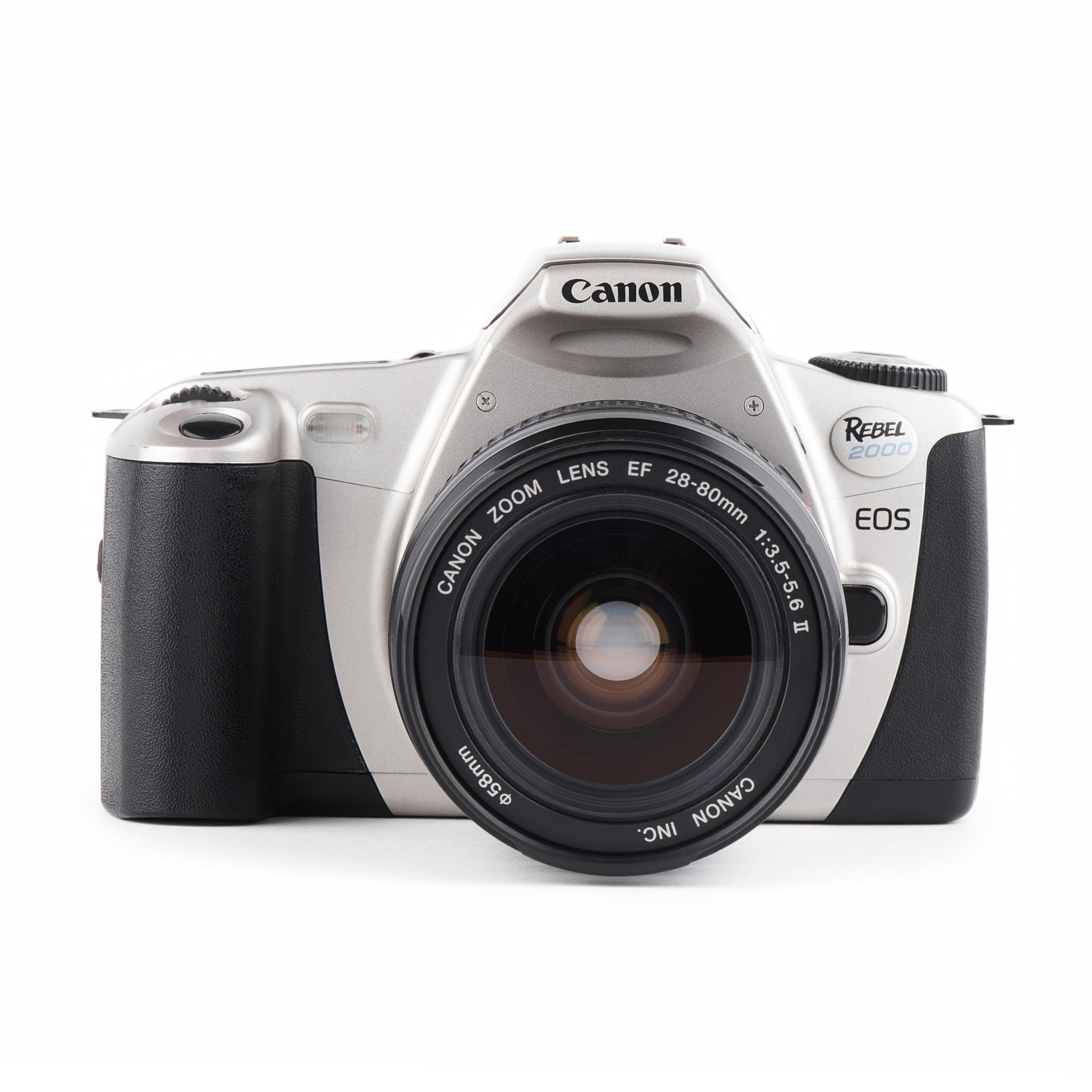
3. Canon Rebel 2000 SLR with 28-80mm EF Lens (Renewed)
Autofocus, auto-winding, and a zoom that covers almost everything you shoot.
Seven autofocus points is the headline here. That means the camera can lock onto a subject off to the side of the frame, not just whatever sits dead center. For portraits and moving subjects, that changes how reliably your shots come out sharp. The included 28-80mm zoom then covers wide street scenes through short telephoto portraits in one lens.
Film handling is fully automatic — loading, advancing and rewinding all run themselves, which removes the most common beginner mistakes. Exposure modes cover program, aperture priority, shutter priority and manual, plus a pop-up flash for fill and low light. The ISO range of 100-400 sets which film speeds the metering is built around, so stick to common color negative stocks.
What owners describe is a camera that just works and becomes the one they grab every day. That everyday-use reputation is the real endorsement: no fuss, no ritual, just a body you trust on the strap. It arrives renewed, so what you save is offset by accepting a previously owned camera. The 100-400 ISO window is also narrower than the Kiss below, so slower and faster specialty films are off the menu.
Your match if: you want autofocus SLR speed with automatic film handling on everyday outings.
The ceiling to know: the 100-400 ISO range keeps you on standard stocks rather than pushed or slow films.
4. Canon EOS Kiss SLR

The same Rebel G body, tuned for wide-area autofocus and a 3200 ISO ceiling.
Canon sold this camera as the New EOS Kiss in Japan and the Rebel G in the USA and Canada — essentially the same camera under two names. That matters if you have been comparison shopping and seen the two listings side by side. What you get is an SLR with a wide-area autofocus point, full auto, program, aperture priority and shutter priority, plus a built-in flash that doubles as fill light in bright conditions.
The ISO range is the standout: 100-3200, which lets you shoot fast film in dim rooms and slow film in bright sun without fighting the meter. Maximum shutter speed reaches 30 seconds, so long exposures on a tripod are on the table. The 35-80mm EF zoom covers portraits and travel scenes in one lens.
Owners describe a camera that works well and arrives in fantastic condition for the money. Where opinions split is photo quality — some get results they love, others hit image quality issues. That split usually traces back to lens condition, film choice and how the frame was exposed, so inspect the lens on arrival and shoot a test roll. It is also a renewed body, so expect a used camera rather than a sealed one.
Where it earns its place
- 100-3200 ISO range covers both fast and slow films.
- 30-second maximum shutter speed opens up long exposures.
- Wide-area autofocus holds sharp focus on off-center subjects.
- Canon EF mount gives you the full lens lineup to grow into.
What to watch
- Photo quality feedback splits both ways — a test roll is worth your time.
- Renewed body means used condition, not new stock.
Go here when: you shoot portraits and mixed light and want the widest ISO window on an EF body.
Do a test roll first: the photo quality verdict is split, so verify the lens before a big trip.
5. Vintage Canon AE-1 35mm SLR with 50mm f/1.8 Lens (Renewed)

Chrome, metal and a 50mm lens — the film camera people picture in their heads.
The AE-1 earns its place on two numbers. The ISO range runs 12-3200, broader than the Rebel G kit — that 12 floor reaches slow black-and-white stocks most bodies cannot meter. And the shutter spans 1/1000 down to 2 seconds plus Bulb mode, so long exposures and fast daylight shots are both covered. The included 50mm f/1.8 lens is the classic portrait and street focal length.
Through-the-lens metering reads the light through the actual lens, which keeps exposures accurate across different lighting. You get manual and shutter-speed-priority control, plus compatibility with Canon FD lenses so you can add a wide or telephoto later. It weighs 2 pounds and measures 7 x 4 x 4 inches, which is the honest price of a metal body and a fast prime — this is a strap camera, not a pocket camera.
Build quality is what owners rave about, and it makes sense — the AE-1 is a beautiful object to hold. The caveat is the risk that comes with vintage mechanicals: shutters can fail, and the renewed process is not a guarantee against age. Value opinions also split, so this is a buy for someone who wants the vintage experience and the FD lens path, not for someone who needs modern reliability.
Why the numbers matter: a 12-3200 ISO range and 1/1000-to-2-second shutter give you slow film, fast film, daylight and Bulb in one body.
The vintage reality: a metal body and a fast 50mm come with age-related risk — the shutter is the part to check on arrival.
For the tinkerer: you want manual control, FD glass, and the feel of a chrome body in your hands.
Think twice if: you need drop-in reliability and no interest in shutter servicing.
6. Pentax 17 Half-Frame Compact Film Camera Kit

Half-frame means twice the frames per roll — and a kit that starts shooting today.
The half-frame design is the whole idea here. Each frame uses half the standard 35mm area, so one roll goes twice as far. That is a real advantage when film and processing are the recurring cost, because you get more shots before the next trip to the lab. The 25mm f/3.5 fixed lens carries advanced HD coating to cut flare, and the manual ISO range of 50-3200 is as wide as any camera on this list.
You set a distance band and shoot, because focus runs on a 6-zone system (six focus distances you pick from) from 0.25m to infinity. You also get ±2 EV exposure compensation (a dial to brighten or darken the shot by up to two stops) and six shooting modes, plus an electronically controlled central shutter for precise speed control. The kit bundles the camera, a CR2 battery, a lens cap, a wrist strap, a 3-pack of Kodak Gold 200 color negative film and a microfiber cleaning cloth — so there is no extra purchase before your first roll.
The honest note: half-frame doubles your frame count but shrinks the image area on each frame, which changes the look of the prints — more frames, smaller frames. If you want big detailed enlargements from every shot, a full-frame 35mm body is the better fit. If you want more keepers per roll and a film-included kit, this is the one.
The frame math: half-frame format doubles your shots per roll, and the included 3-pack of Kodak Gold 200 means you start shooting the day it arrives.
The trade-off: a smaller image area per frame is the price of doubling the count — great for volume, not for huge enlargements.
Best fit for: a shooter who wants maximum frames per roll and a complete start-up kit in one box.
Skip the half-frame if: every shot needs to be enlarged large.
Know the Specs
ISO Range
ISO on a film camera is the sensitivity rating of the roll you load — not a sensor setting you dial by hand. A camera rated 100-3200 can meter slow and fast films across a wide spread of lighting, so you can shoot in bright sun or dim rooms. A camera fixed at 400 is locked to the most common all-round stock, which is simpler but less flexible. Wide is more adaptable; narrow is more simple to use.
Focus System
Zone focus means you pick a distance band and the camera holds sharpness across it, which is quick and reliable in low light. Autofocus means the camera locks onto a subject for you, easier for portraits and movement. More zones or points give you more precision; fewer keep shooting fast. Match the focus system to what you shoot, not to which number is larger.
Lens Mount
A lens mount decides your long-term cost. A Canon EF body takes the full EF lineup, so one camera becomes a system you can grow. A Canon FD body such as the AE-1 uses the older FD lenses, which are plentiful but separate from EF. A fixed-lens compact has no mount at all — one lens, one look, no upgrades. Choose the mount before the body — it decides which lenses you can buy later.
Half-Frame Versus Full-Frame
Full-frame 35mm uses the whole standard image area per shot, so each negative holds more detail for larger prints. Half-frame splits it, so each roll yields twice the frames at half the size — a 36-exposure roll becomes 72 shots. Half-frame is the cost-per-shot play; full-frame is the detail play. Neither is better — it depends on if you want more keepers or larger prints from each negative.
Common Questions
Do these retro film cameras come with film and a battery?
Will a Canon EF lens fit the Canon EOS Rebel G and Rebel 2000?
What does renewed mean on the Canon AE-1 and the Rebel SLRs?
What is the difference between zone focus and autofocus on a film camera?
Is half-frame worth it on the Pentax 17?
Can I use ISO 400 film in a camera rated 100-3200?
What is TTL metering and why does it matter on the Canon AE-1?
Do any of these cameras shoot long exposures?
Will the Pentax 17 kit work straight from the start?
The Bottom Line
For most people, the retro film cameras winner is the KODAK Snapic A1 because it packs 2-zone focus, auto flash with red-eye reduction and a multiple-exposure mode into a 117 g body you can pocket. If you want a lens platform you can grow, take the Canon New EOS Kiss for its 100-3200 ISO range and wide-area autofocus. And for the vintage feel with a fast 50mm, the Vintage Canon AE-1 is the one to reach for.
One nudge before you buy: decide point-and-shoot or SLR first, then load a test roll and shoot it before the trip you care about. Film rewards the person who checks the gear early.
How we choose
We do not accept paid placement. Every pick is matched to a real buyer and a real use-case; we do not hands-on test units.
Sources
Specifications: manufacturer listings and product documentation. Review insights: verified customer reviews, as of November 2026. Pricing: not shown on this page (it changes often); check the current price via the retailer link.
As an Amazon Associate, Tactical Gear Guy earns from qualifying purchases. This does not affect which products we feature.