Specs are compiled from manufacturer listings and verified buyer reviews and can change over time — please confirm the key details on the product page before buying.
Your ski watch has to survive freezing temperatures, snow packed into every crevice, a glove caught in a binding, and altitude swings from the parking lot to the summit. A plain fitness band will fog up, drain out, or crack before lunch. You want a watch built for the alpine: a barometric altimeter (a sensor that tracks vertical drop), a compass that still points the right way in a whiteout, and a battery that stays alive through a full day of laps and a cold night in the lodge.
This guide is built by comparing the manufacturers’ published specifications and the patterns across verified customer reviews, so you get each pick’s real strengths and trade-offs instead of marketing spin.
From solar-powered field watches to GPS expedition tools, every pick here earns its spot on the mountain — the rounded list below spells out exactly which features matter on the snow. The list below ranks eleven snow ski watches by sensor set, battery life, and cold-weather build.
Top Picks


How To Choose The Best Snow Ski Watch
What separates a watch that helps on the hill from one that gets in your way is sensor accuracy and cold-weather battery life, not the brand on the bezel. It is whether the watch can tell you where you are when the clouds drop, and whether it is still running after a full day in the cold. Here is what actually separates a competent snow ski watch from a generic fitness tracker.
Altitude and Weather Sensors
A barometric altimeter measures air pressure to give you a running elevation readout, so you can see how much vertical you have racked up without checking a phone with frozen fingers. A barometer also watches pressure trends, which is how a watch can hint at incoming weather. A 3-axis compass tells you which way you are facing when visibility goes flat, and it keeps working when GPS signals bounce off cliffs.
Battery Life in the Cold
Lithium batteries lose power faster in freezing conditions, so a watch rated for weeks in a warm room may not match that on the snow. Look for a stated battery life in smartwatch mode and, separately, a stated GPS tracking number. Solar charging adds a top-up on bluebird days, though it depends on direct sun and time outdoors. Wear the watch under a cuff and the solar gain drops.
Buttons, Gloves, and Readability
Touchscreens rarely work through thick ski gloves. Physical buttons you can feel with a glove on, and a display that stays legible in direct sun, are what you will actually use on a lift ride. A Memory in Pixel display is designed for high contrast in bright light, while an OLED-style screen is brighter indoors and drains more in the cold. Check which screen type a model uses before you buy.
Side-by-Side Comparison
| Model | Best For | Battery (Smartwatch) | Display | Water Rating | Amazon |
|---|---|---|---|---|---|
| Casio PRW3500 Pro Trek★ Best Overall | Tough solar field watch | Tough Solar / atomic | Digital LCD | 100M WR | Amazon |
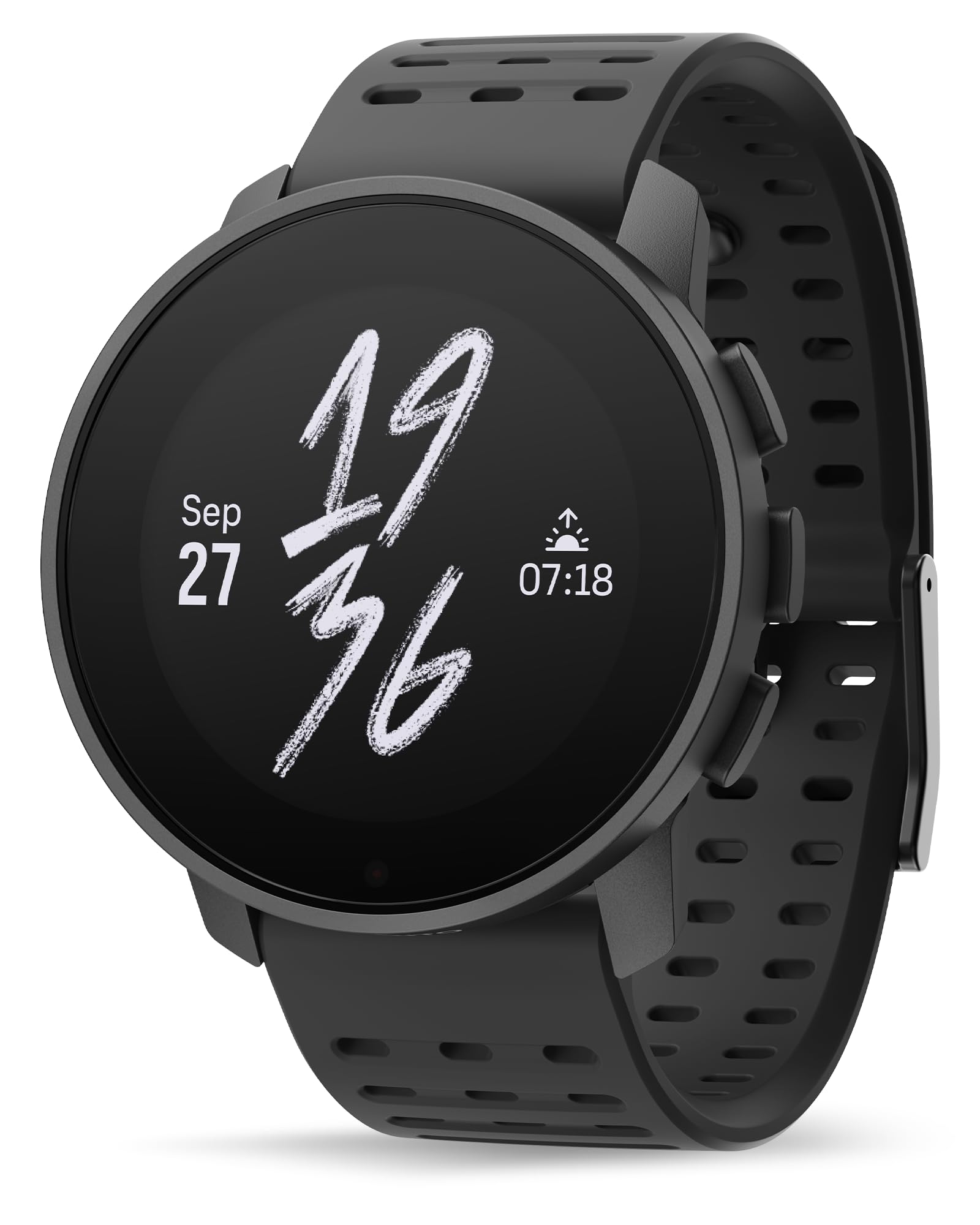
| Suunto 9 Peak ProLongest GPS Runtime | GPS tracking with long trail life | 40 hrs GPS / 300 hrs tour | MIP touchscreen | 100m waterproof | Amazon |
| Garmin Instinct 2 SolarSolar Top-Up | Solar top-up on long days | Unlimited with solar / 48 hrs GPS | MIP | 100 meters | Amazon |
| Garmin Instinct 3 AMOLED | Brighter screen for low light | Up to 24 days | 1.3” AMOLED | 10 ATM / MIL-STD-810 | Amazon |
| COROS Nomad | Full maps on a budget | 22 days daily / 50 hrs GPS | 1.3” MIP touchscreen | — | Amazon |
| Casio PRW6600Y Pro Trek | Analog ABC tool watch | Tough Solar / atomic | Analog with neon illuminator | 100M WR | Amazon |
| Polar Grit X Pro Titan | Titanium build for extreme use | 40 hrs training / 7 days watch mode | Color display | 100m | Amazon |
| Suunto Vertical | Offline maps and solar titanium | 60 hrs GPS / 500 hrs tour mode | AMOLED / sapphire lens | — | Amazon |
| Polar Grit X2 Pro Titan | Premium multi-day adventure | Multi-day Training/Power-Save | 1.39” AMOLED | — | Amazon |
Detailed Reviews
1. Casio PRW3500 Series Pro Trek
Our pick — 4.5+★ from 800+ verified ratings; the strongest balance of quality and price.
The solar field watch that climbs, tracks weather, and never asks for a charger.
The Casio PRW3500 runs on Tough Solar power, which means a small panel on the face keeps it topped up from daylight and you never plug it in. Atomic timekeeping is a radio signal that resets the hands to the exact time, so your logbook and your watch always agree. On a ski hill where your phone battery dies in the cold, a watch that charges itself is not a gimmick — it is one less thing that can quit on you.
What draws people to this watch is the look and the build — it is the most-praised trait by a wide margin. A full titanium case and band keep it light on the wrist despite the tool-watch bulk, and the package punches above its tier. The functions are laid out cleanly enough that, as the manual-free crowd reports, “you don’t have to be a rocket scientist” to work the compass, altimeter, and barometer. A 1-100 second stopwatch and a countdown timer cover lap timing and a boot-pack break.
The catch worth knowing: the thermometer sits on the wrist, so your body heat can throw off the reading, and some owners find the band clasp can pop open on its own. The alt/baro-thermo sensors give you elevation and pressure trends, but do not expect GPS routing to your car. For raw durability and zero maintenance, this is the dependable all-day companion — round the resort, on the skin track, under a jacket cuff.
Wins On The Mountain
- Tough Solar power means no charging cable to lose in the lodge
- Compass, altimeter, barometer, and thermometer in one rugged titanium body
- Atomic timekeeping keeps the clock exact without you setting it
- Light on the wrist for a full-size tool watch
Where It Gives Up Ground
- No GPS navigation to guide you back to the lodge
- Wrist-worn thermometer can read warmer than the actual air
- Clasp occasionally releases without a check
Reach for this if: you want a self-charging ABC watch that outlives your ski jacket and never needs a cable.
Pass if: you need turn-by-turn GPS routing on the hill — this one tracks the weather and altitude, not your route back.
2. Suunto 9 Peak Pro
A GPS ski watch built for a whole tour day — 300 hours of runtime in tour mode.
The Suunto 9 Peak Pro charges fully in 1 hour and carries a 600 milliamp-hour battery, which is the largest capacity in this lineup by a wide margin. In the modes most skiers use, that translates to 40 hours of battery in best GPS mode, 70 hours in endurance mode, and 300 hours in tour mode. A quick 10-minute charge gives you 2 hours of GPS training — enough for a lift-served half-day if you arrived with a dead watch.
Its GPS uses 4 different satellite systems, so it holds a fix among tall buildings, steep canyons, and tight mountain terrain. Weather alerts and avalanche maps are built in, a real consideration if you tour above tree line. The case is titanium, stainless steel, and sapphire glass, rated to 100 meters of water, with 97 sport modes to pick from and turn-by-turn navigation on the wrist. Pair it with the Suunto app and it syncs to Strava among 200 other fitness apps.
The honest limitation: some users report sleep tracking that does not match their own experience, and the interface is not the friendliest — as one condensed review notes, if you are not tech-savvy the depth of features can be a challenge. The screen is legible but not as bright as an OLED (a screen type that produces vivid colors and deep blacks). That trade-off buys you the battery edge: against the Garmin Instinct 3 Solar’s 50 milliamp-hour cell (a measure of battery capacity), this is 600 milliamp-hours — the Suunto is built to run for days, not hours.
The battery argument: 600 milliamp-hours is the biggest cell here, and the 1-hour full charge makes it easy to top up between resort days.
Fit note: the deep feature set rewards a patient owner — skim the manual before your first ski day and it all clicks faster.
Reach for this if: you ski long tours and want GPS and avalanche maps to last from first chair to last light.
Look elsewhere if: you want a bright, glove-friendly display — this is a functional MIP, not an AMOLED showpiece.
3. Garmin Instinct 2 Solar
The smaller Instinct that runs on sunshine and still finds its way home.
Garmin’s Instinct 2 Solar is the smaller-cased Instinct, built around a fiber-reinforced polymer shell and scratch-resistant Corning Gorilla glass. That solar lens gives you unlimited battery life in smartwatch mode, assuming all-day wear with 3 hours outside per day in 50,000 lux conditions. In GPS mode, up to 48 hours with continuous solar top-up under direct sun. The band is silicone at 22 centimeters long — the longest here, which suits larger wrists over a thick ski jacket sleeve.
Navigation comes from multiple global satellite networks (GPS, GLONASS and Galileo), plus a 3-axis compass and barometric altimeter for altitude and heading on the hill. Sports apps cover running, biking, swimming, and strength training, with Tracback routing to retrace your way back to the lodge. Health monitoring tracks heart rate, sleep, Pulse Ox, and respiration — Garmin tags this as an estimation, not a medical device.
Where it earns patience: solar gain is real but slow, and a grey storm day does not top you up the same way. A couple of owners say the backlight is weak, so if your eyesight is not sharp, plan to check the display in good light. Against the Instinct 3 Solar, this model charges in 2 hours — roughly double the Suunto 9 Peak Pro’s 1-hour fill. At 100 amp-hour battery capacity, it lives well past a ski weekend and into a full season of wear. As one skier-adjacent reviewer put it, it is a solid watch that “doesn’t distract me like a lot of smartwatches might.”
Solar-day math: three hours in direct sun per day keeps the smartwatch mode topped up — exactly the kind of time you rack up on a winter mountain.
Honest trade-off: a MIP screen with a modest backlight — not built for low-light readability.
Reach for this if: you want solar confidence and a watch that wears comfortably all day without a charge. skip it if you need a bright OLED screen or an interface that guides you step by step.
Skip if: you rely on a bright, backlit display in poor light — this is a sunlight-friendly screen, not a nighttime one.
4. Garmin Instinct 3 Solar

A rugged 50mm watch with an AMOLED screen you can read in a blizzard.
The Instinct 3 AMOLED swaps the solar lens for a 1.3-inch AMOLED display — the bright, saturated screen type that stays legible in low light and through goggles. It runs up to 24 days of battery life, packs a 350 milliamp-hour lithium-ion cell, and carries the same supertough 50 mm fiber-reinforced polymer case and metal-reinforced bezel. The silicone band is 26 millimeter wide. A built-in LED flashlight with variable intensities and strobe modes gives you light at the wrist when the sun drops behind the ridge.
Navigation is the full Garmin kit: 3-axis compass, barometric altimeter, and multi-band GPS with SatIQ, which keeps your position locked while trimming the battery hit. Health monitoring covers wrist-based heart rate, advanced sleep tracking, and Pulse Ox. Since this screen is the brightest of the group, it is the one to grab if you check your watch on a shadowed chairlift. It is also the constant reminder of the AMOLED trade-off: brighter screen, more drain, which is why the solar siblings stretch further between charges.
Worth a fair warning: the altimeter and barometer on some units drift, so if precise vertical gain is your whole reason for buying a ski watch, this may frustrate you. At 50 mm it is a big watch, and some buyers think Garmin pricing is climbing. For pure comfort and screen quality, it is a strong pick — one condensed note calls it “rugged, 50MM is the ticket.” The 1.3-inch AMOLED is the standout, and it stays readable on a shadowed chairlift.
The screen case: a bright AMOLED that stays readable on a cloudy lift ride, backed by 24 days of battery life.
Be aware: precise altitude tracking is not this model’s greatest strength — if exact vert matters, compare carefully.
Reach for this if: a legible, bright display and a tough 50 mm case are what you want on your wrist.
Think twice if: you need pinpoint altimeter accuracy for vertical-gain tracking.
5. COROS Nomad

Full-color maps and turn-by-turn routing without the flagship price tag.
COROS built the Nomad around pre-loaded global maps with street names, a full map view rather than a breadcrumb line, and turn-by-turn navigation on a 1.3-inch Memory in Pixel touchscreen. That screen type is chosen for high contrast in direct sun and deep color in low light — exactly what a skier needs when the snow glare washes out a normal display. The frame is dual-layer polymer with an aluminum alloy bezel, so it stays light without feeling flimsy.
Battery life is the big number: 22 days in daily use and 50 hours of GPS tracking. Coros adds an “Adventure Journal” that records voice notes, tags locations, and transcribes memos into your activity — handy for marking a stash or a photo spot on the hill. Real-time and forecasted weather, sunrise, tides, and moon phase are all on the wrist, plus back-to-start navigation and safety alerts. The built-in microphone records voice notes directly.
What holds it back is connectivity: a condensed report notes Bluetooth dropping out after a couple of weeks, first losing texts and calls. The battery capacity figure listed on the spec sheet is small, so treat the 22-day and 50-hour GPS numbers as the real guide. Against the Garmin Instinct line, the full-color map view is the standout upgrade — the navigation detail is deeper than Garmin’s breadcrumb style. For a touring skier who wants street-level map detail on the wrist, this is the value play of the lineup.
Navigation strength: a full map view with turn-by-turn routing and free global maps at a mid-range tier.
One risk to weigh: occasional Bluetooth dropouts can cut your phone notifications — test the pairing early.
Reach for this if: you want real map detail and voice notes without climbing into flagship pricing.
Look elsewhere if: rock-solid phone connectivity is a must for you.
6. Casio PRW6600Y Pro Trek

Analog hands, a neon-glowing face, and solar power that outlasts the decade.
The PRW6600Y is the analog-hand version of Casio’s Pro Trek field watch, with a Tough Solar panel (a solar cell that charges the battery from light) and atomic timekeeping (a radio signal that keeps the hands exact). Its standout is the neon illuminator — it lights the outlines of the hour and minute hands plus the tip of the second hand, so you can read time in a dark gondola or an unlit lodge without squinting at a digital display. The Smart Access crown works like a “fly-by-wire” system, letting you cycle through compass, altimeter, barometer, and thermometer functions with a twist and a press.
Comfort is a quiet strength here: owners describe the strap as comfortable and not sweat-inducing, which matters when you are layering under a ski shell all day. The baro function works well in the real world, with one pilot noting it near an airport. A 1-100 second stopwatch and countdown timer cover timed laps and a snow-safety check. World time is built in, and the case carries a 100-meter water rating.
One small annoyance, as some owners note: there is no dedicated light button, so the illuminator needs a different press to trigger. Readability gets a mixed reception — the analog hands are clear, but on a bright snow slope the legibility of tiny markings is not the same as a bold digital readout. If you like the look of a traditional field watch with modern ABC sensors and want to forget about charging entirely, this one earns its place.
The charm: analog hands with a neon glow, solar power, and ABC sensors under a no-charge battery philosophy.
Small irritation: the light needs its own button press — plan for it in the dark.
Reach for this if: you prefer analog hands and a glowing face over a screen, with solar power to match.
Skip if: you want a bold digital readout and one-touch lighting in a hurry.
7. Polar Grit X Pro Titan
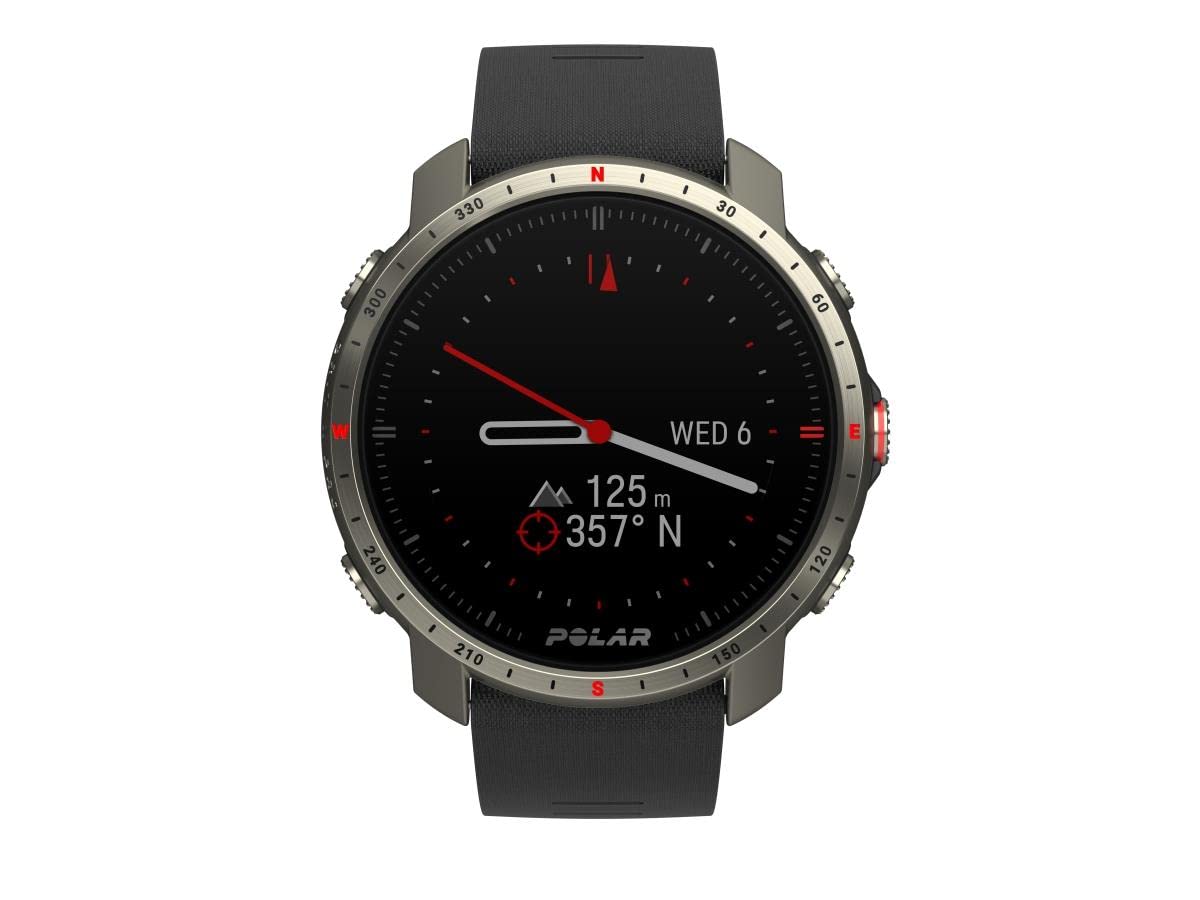
A titanium-bezel outdoor watch built to MIL-STD-810G, with sapphire glass.
Polar calls the Grit X Pro Titan the lightest and toughest watch in its Outdoor line, and the build backs that up: an ultra-strength titanium bezel, scratch-resistant sapphire glass, and MIL-STD-810G durability, all water-resistant to 100 meters. It carries a 346 milliamp-hour lithium-ion battery with up to 100 hours of average life, and 40 hours of training with full GPS and heart-rate tracking — up to 100 hours with power-save options. Watch mode with 24/7 heart-rate tracking runs up to 7 days.
Navigation on the hill comes from built-in GPS with assisted GPS for fast fix times and turn-by-turn guidance powered by Komoot, so you get real-time routing on the watch. The wrist-based heart-rate monitor is the feature Polar built its reputation on. The band is leather at 22 millimeter width, a dressier touch than silicone, though less forgiving of wet snow and gloves.
The honest note: Polar’s spec sheet does not list an altimeter or barometer for this model, so if vertical-gain logging is your priority, look at the Garmin or Suunto picks. For a rugged, titanium-built watch that handles GPS routing and training metrics in the cold, it is a serious contender — one that rewards a skier who wants a tougher-looking watch on the mountain.
Build to trust: titanium, sapphire glass, and MIL-STD-810G in a package rated to 100 meters of water.
Consider the route: no listed altitude sensor, so check that your tracking needs are covered before committing.
Reach for this if: you want a titanium, sapphire-covered training watch that can survive a hard season.
Think twice if: a dedicated altimeter and barometer are non-negotiable for your ski tracking.
8. Suunto Vertical

Offline color maps, dual-band GPS, and a sapphire lens on a 49mm case.
Suunto’s Vertical is built around a large 49 mm color display, free global maps that work offline, and a sapphire lens on the titanium model. Those maps show paths, contour lines, water, and landmarks, plus navigation features like breadcrumb trails, points of interest, and bearings — you can plan a route at the lodge and follow it without a cell signal. The barometer tracks pressure changes, and dual-band GPS holds accuracy in difficult terrain among cliffs, valleys, and skyscrapers.
Battery is the headline spec: up to 500 hours of continuous tracking in tour mode and up to 60 hours in the most accurate mode, so you can track a full day of laps and still have power for the next. Solar charging on the Titanium model adds a further boost of 30% on sunny days, according to the maker. The watch is made in Finland in Suunto’s own factory using renewable energy and is fully carbon compensated. Build quality is the most-praised characteristic here by a wide margin, and the responsive compass is the frequent highlight.
The trade-offs to weigh: the interface can feel laggy, and the charger needs to seat firmly — a couple of reports say it doesn’t stay connected for long. Battery life and value-for-money feedback is mixed rather than glowing. Still, if you tour in remote terrain and want full map detail with dual-band GPS (a GPS mode that uses two frequencies for better accuracy) and a sapphire lens (a scratch-resistant glass), this is a serious expedition tool — the kind of watch to trust when the trail disappears under fresh snow.
Map-first design: free offline color maps with contour lines and turn-by-turn features on a 49 mm AMOLED.
Worth testing early: check the charger seats firmly — a loose connection would be a daily annoyance.
Reach for this if: remote touring and offline maps are your reason to buy a dedicated ski watch.
Look elsewhere if: you want a silky-smooth interface — this one can feel sluggish.
9. Polar Grit X2 Pro Titan

Polar’s most advanced navigation tool, wrapped in titanium and cork-lined leather.
The Grit X2 Pro Titan is the top of Polar’s adventure line, with dual-frequency GPS and downloadable topographic maps for routing in complex terrain. It carries military-grade durability with sapphire crystal glass and an aerospace titanium front casing, plus an additional leather wristband with a lightweight cork inner lining. Total weight is 64 grams, which is impressive for a watch with this much hardware inside. The 1.39-inch AMOLED touchscreen is rated for 15% extra visibility over earlier models, displaying every contour on the route.
Battery life spans multi-day usage on a single charge in Training and Power-Save modes, which fits the buyer who heads into the backcountry for a weekend. On the sensing side it measures vertical speed, running power, training load, and recovery, with heart-rate and other sensors feeding the analysis. It analyzes more data than Polar’s earlier models. The leather wristband gives it a style that works off the snow as well.
This is the premium tier of the lineup, so expect premium trade-offs: the touchscreen and topo maps (detailed topographic maps) are the draw, but there is no listed altimeter and barometer on the spec sheet, so verify the vertical-tracking side if that is what you need. If money is no object and you want a titanium watch with the brightest screen and deep navigation, this is the one to reach for — it pairs a 1.39-inch AMOLED (a screen type that produces vivid colors and deep blacks) with a light 64-gram build for comfort all day.
Reach for this if: you want the biggest, brightest screen, dual-frequency GPS, and a titanium-and-cork comfort story.
Pass if: you need a built-in barometric altimeter for vertical gain — check first.
Know the Specs
Altimeter and Barometer
A barometric altimeter measures air pressure to give you an elevation reading — useful for tracking vertical gain on laps and spotting pressure swings that hint at weather. A 3-axis compass gives heading even when GPS is unreliable. Together they form the “ABC” (altimeter, barometer, compass) set that serious mountain watches build around. Not every watch on this list has one — check the spec block before you buy if vertical gain matters to you.
Solar Charging and Battery
Solar charging uses a panel under the lens to top up the battery from daylight. Garmin’s numbers assume all-day wear with 3 hours per day outside in 50,000 lux conditions — bright, direct sun. On a storm day or under a cuff, that gain drops. A MIP display draws less power than AMOLED, which is why the screen type matters as much as the battery spec. Match the battery mode to your ski day: smartwatch mode for daily wear, GPS mode for tracking on the hill.
Water and Shock Ratings
Water ratings like 100 meters or 10 ATM tell you the watch survives snow, rain, and a dunk — not that you should dive with it. A MIL-STD-810 rating is a military durability standard for shock and temperature swings, which matters when a watch bumps a binding or a tree. If you ski hard, look for a MIL-STD-810 shock rating and scratch-resistant glass such as sapphire or Corning Gorilla glass.
GPS and Navigation
GPS accuracy depends on how many satellite networks the watch can see — multi-GNSS watches track GPS, GLONASS, and Galileo to hold a fix on steep terrain. Dual-band or dual-frequency GPS uses two signal bands to stay accurate among cliffs and valleys. Full map views with contour lines and turn-by-turn routing beat a breadcrumb line when visibility drops. Free offline maps are worth having if you tour outside cell range.
Common Questions
Do I really need a barometric altimeter for skiing?
Does solar charging work through a ski jacket sleeve?
Is an AMOLED or MIP display better for snow glare?
Can I use a ski watch with thick gloves on?
How accurate is wrist-based heart rate in freezing temperatures?
Do I need offline maps for resort skiing?
What does a 100-meter water rating actually mean for a ski watch?
How long does the battery actually last in cold weather?
Is a titanium watch worth the extra weight savings on the mountain?
Can I pair a ski watch with my phone for notifications on the lift?
Do ski watches track ski-specific metrics like vertical drop?
The Bottom Line
For most skiers, the snow ski watch winner is the Casio PRW3500 Pro Trek because it combines Tough Solar power, atomic timekeeping, and a full compass-altimeter-barometer set in a titanium body that never needs a charger. If you want serious GPS tracking with the biggest battery cell here, grab the Suunto 9 Peak Pro and its 300-hour tour mode. And for full-color offline maps at a sensible tier, the COROS Nomad is the one to reach for. Whichever you pick, match the sensor set and battery mode to how you actually ski.
How we choose
We do not accept paid placement. Every pick is matched to a real buyer and a real use-case; we do not hands-on test units.
Sources
Specifications: manufacturer listings and product documentation. Review insights: verified customer reviews, as of November 2026. Pricing: not shown on this page (it changes often); check the current price via the retailer link.
As an Amazon Associate, Tactical Gear Guy earns from qualifying purchases. This does not affect which products we feature.