Specs are compiled from manufacturer listings and verified buyer reviews and can change over time — please confirm the key details on the product page before buying.
You want a big picture, but you do not want to buy a soundbar on top of it. That is the whole game here: big picture, no soundbar. The sets below all ship with real built-in audio muscle — a dedicated bass woofer, a Dolby Atmos speaker array, or a tuned multi-channel system — so explosions land with weight and dialogue still stays readable. Skip the weak-speaker models and the picture is the easy part.
This guide is built by comparing the manufacturers’ published specifications and the patterns across verified customer reviews, so you get each pick’s real strengths and trade-offs instead of marketing spin.
The list sorts by what actually fills a room: woofer size, Atmos decoding, and speaker channels, not just screen inches. Below you will find the strongest smart tv with great sound options for every budget and room size.
Top Picks

How To Choose The Best Smart TV with Great Sound
Most buyers assume a slim TV means thin audio. That is the first myth to drop. A set with a real bass woofer or a multi-channel array can fill a living room without any extra box under the screen.
Look past watts and check what is actually driving the sound
A speaker wattage number alone tells you little. What matters more is whether the set carries a dedicated bass woofer, a multi-channel array, or a tuned amplifier stage behind the drivers. The TCL QM64L runs Onkyo 2.1 audio with a separate subwoofer. The Hisense U7 leans on a 2.1.2 channel surround layout tuned by Devialet. Those are the details that decide whether a movie rumbles or just gets loud.
Dolby Atmos is only half the story
Atmos is a surround format that places effects above and around you, and several picks here decode it. But decoding is not the same as projecting. A TV with Atmos support and two small drivers will still sound flat next to one with a bass woofer. Read both lines together.
Anti-glare coatings decide your daytime picture
A matte or anti-reflection finish cuts the mirror effect from a window or a lamp. If your TV faces daylight, this matters as much as brightness. The Samsung QN90F and the Hisense U7 both carry glare-cutting treatments, and that keeps the picture readable instead of washed out.
Refresh rate: 120Hz, 144Hz, or 165Hz
Refresh rate is how many times per second the screen redraws the picture. Higher numbers keep fast sports and games smooth. Several sets here are native 144Hz, and the Hisense U7 pushes to a native 165Hz. If you mostly watch dramas, this is a nice-to-have. If you watch football or play on a console, it is the reason to pick one model over another.
Side-by-Side Comparison
| Model | Best For | Screen Size | Refresh Rate | Audio Setup | Amazon |
|---|---|---|---|---|---|
| Samsung 50″ QN90F Neo QLED★ Best Overall | Bright rooms and tight spaces | 50 inches | Up to 4K 165Hz (VRR gaming) | Object Tracking Sound Lite with Dolby Atmos | Amazon |
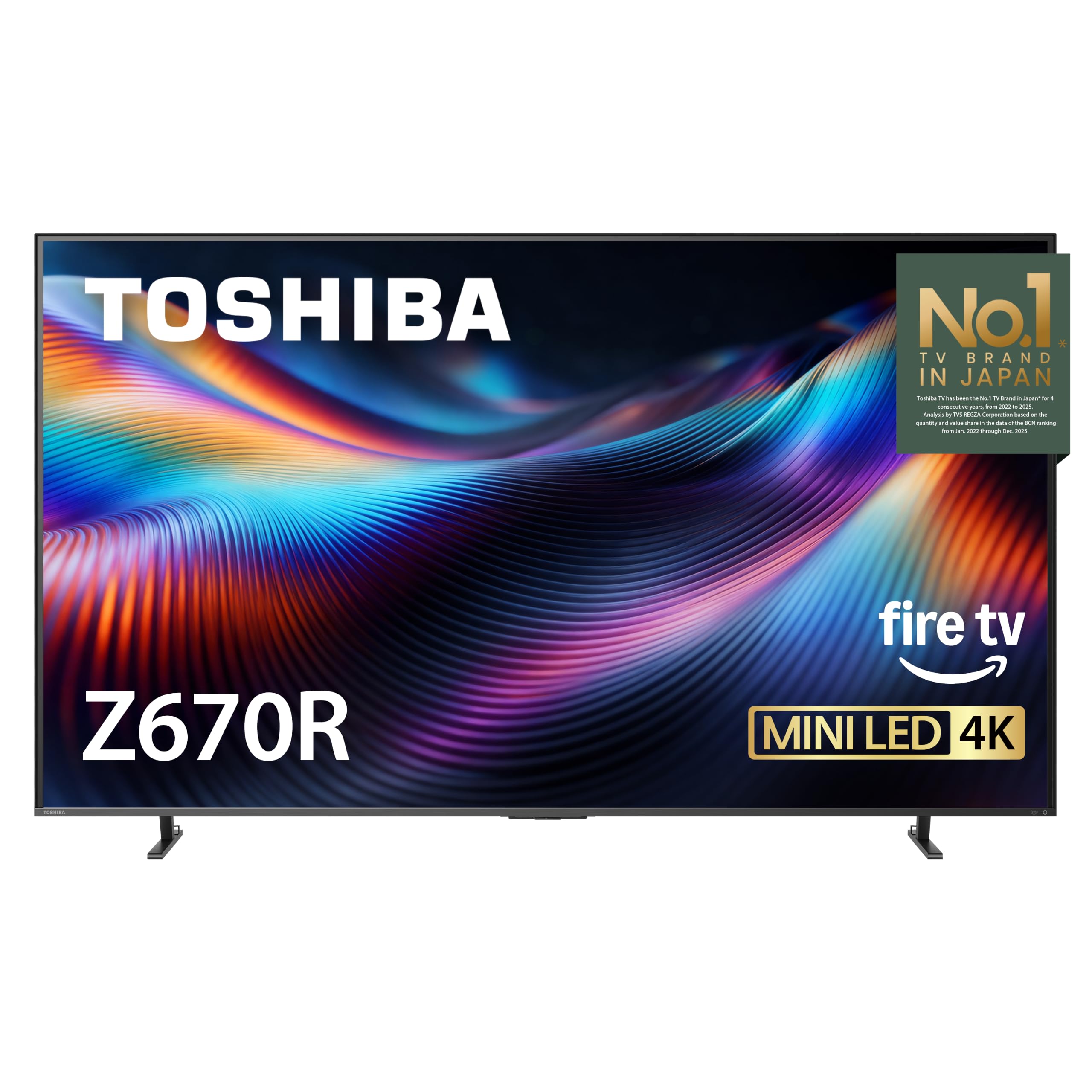
| Toshiba 55″ Z670R Mini-LEDBass on a Budget | Bass on a smaller footprint | 55 inches | Native 144Hz | REGZA Power Audio Pro with bass woofer, Dolby Atmos | Amazon |
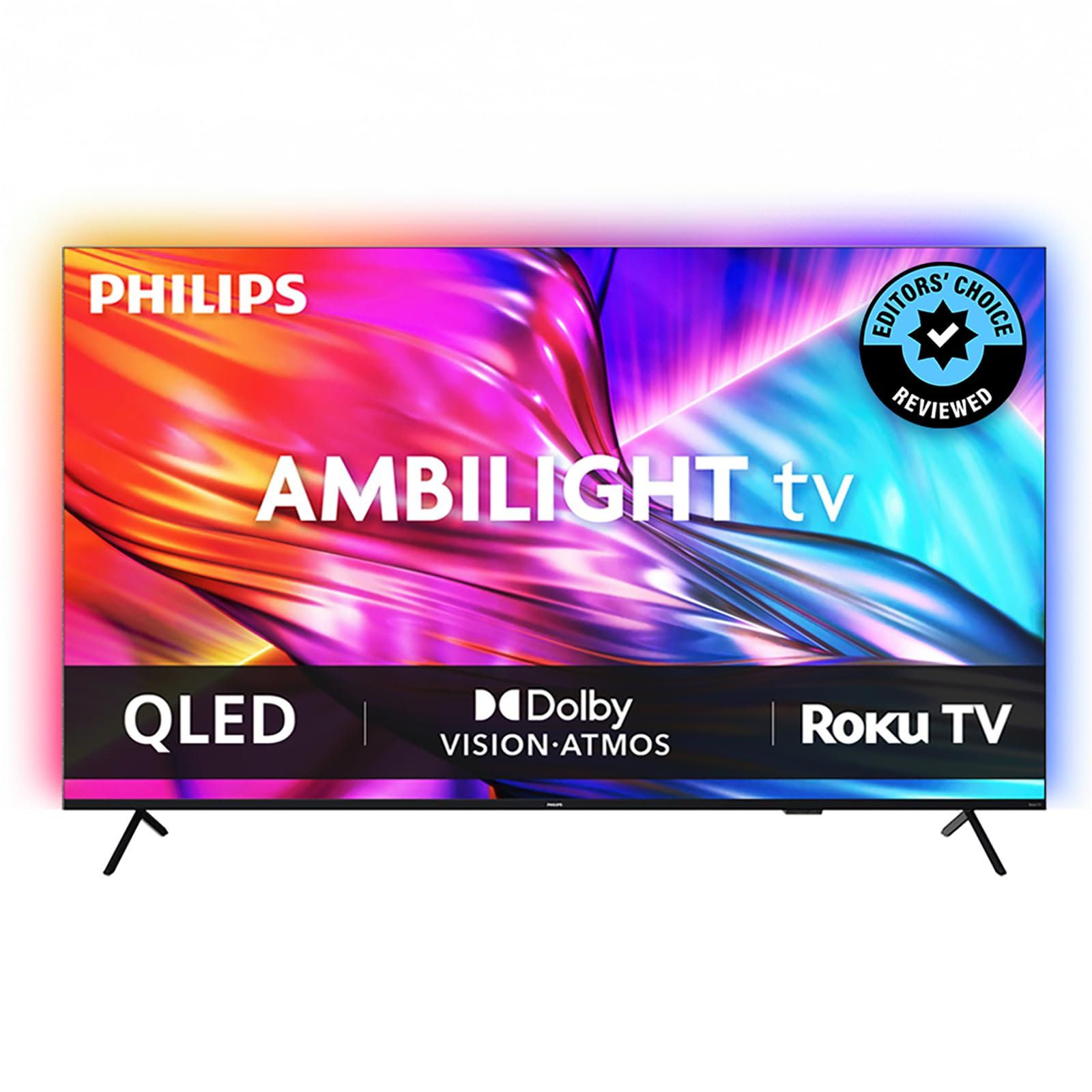
| Philips 65″ 7985 QLED AmbilightBest Ambience | Ambient lighting and Roku fans | 65 inches | 120 PMR | Two built-in speakers, Dolby Atmos, eARC on HDMI 1 | Amazon |
| Hisense 75″ E7 Cinema Mini-LED | Big-screen movies under a grand | 75 inches | Native 144Hz | Dolby Atmos | Amazon |
| TCL 75″ QM64L QD-Mini LED | Home theater bass without a soundbar | 75 inches | Native 144Hz | Onkyo 2.1 with 20W subwoofer, Dolby Atmos | Amazon |
| Hisense 65″ U7 Mini-LED | Serious gaming plus loud built-in speakers | 65 inches | Native 165Hz | 2.1.2 channel surround tuned by Devialet, Dolby Atmos | Amazon |
| TCL 65″ QM8L SQD-Mini LED | Peak brightness and B&O audio | 65 inches | 144Hz | Audio by Bang & Olufsen | Amazon |
| LG 65″ OLED AI B6 | Perfect blacks in a dark room | 65 inches | Up to 120Hz | Dolby Atmos, WOW Orchestra | Amazon |
| LG 65″ OLED evo AI C6 | Bright OLED for mixed lighting | 65 inches | Up to 165Hz | Dolby Atmos, WOW Orchestra | Amazon |
| Sony 77″ BRAVIA XR8B OLED | Large OLED and PS5 owners | 77 inches | XR OLED Motion | Acoustic Surface Audio+, Dolby Atmos, DTS:X | Amazon |
| Sony 65″ BRAVIA 8 II QD-OLED | Color-first cinephiles | 65 inches | XR Motion | Dolby Atmos, DTS:X | Amazon |
Detailed Reviews
1. Samsung 50-Inch Class Neo QLED 4K QN90F Series
Our pick — 4.5+★ from 350+ verified ratings; the strongest balance of quality and price.
The glare-free 50-inch that holds its picture with sun streaming through the window.
A 50-inch screen that keeps a readable picture with a lamp on is rarer than it should be. This one earns its top spot on that strength alone — the matte finish kills the mirror effect, and that is the trait owners bring up more than anything else.
Inside, a processor running 128 neural networks — a set of AI models that clean up and sharpen whatever you feed it — upscales everything to 4K. Motion gets smoothed so fast-moving balls and rolling text stay readable. Gaming tops out at up to 4K 165Hz over VRR, which means the screen redraws fast enough that fast pans do not smear. Audio runs through Object Tracking Sound Lite with Dolby Atmos, so effects follow the action on screen instead of sitting in one fixed spot.
Connectivity is complete: Bluetooth 5.3 for headphones, plus Ethernet, HDMI, USB and Wi-Fi. The catch worth knowing is that value is the one genuinely split topic in owner feedback — this is the premium end of the small-screen class, and a few buyers question whether it earns it. Sound also has the smallest speaker array among the big-audio picks here, so a dedicated subwoofer still beats it for chest-thump.
What earns it the crown
- Glare-free matte screen stays readable in a bright room
- 128 AI neural networks upscale everything to 4K
- VRR gaming up to 4K 165Hz keeps fast action smooth
- Object Tracking Sound Lite with Dolby Atmos follows on-screen action
Where it asks for patience
- Smallest diagonal here at 50 inches
- Premium of the small-screen class, so value is the split topic
- Add a subwoofer if you want deep bass
Grab this one: you have a bright room, limited wall space, and want a picture that survives daylight.
Think twice: you want room-shaking bass from the start — this is the leanest audio rig on the list.
2. Toshiba 55″ Z670R Series Mini-LED 4K Fire TV
A dedicated bass woofer crammed into a 55-inch frame — without a soundbar in sight.
If the sound is the reason you are shopping, start here. REGZA Power Audio Pro pairs a bass woofer with tuned amplifiers and dual clear direct speakers, and the result is vocals that stay clear while the low end fills out the room. That is the physical thing a slim TV usually fails at: real bass from inside the cabinet.
Behind the picture sits a Mini LED panel with Full Array Local Dimming — that means the backlight is split into zones that brighten and dim independently, so dark scenes go genuinely dark and highlights stay punchy. The REGZA Engine ZRi Gen3 processor, fine-tuned in Japan, adjusts clarity, contrast and audio scene by scene. Native 144Hz with AMD FreeSync Premium and VRR keeps console games tear-free. It runs Bluetooth 5, compared with Bluetooth 5.3 on the Samsung above — a small step back in wireless spec, and worth knowing if you pair a lot of headphones.
HDR support runs the full spread: Dolby Vision IQ, HDR10+, HDR10+ Adaptive and HLG. Fire TV ties live channels and apps together, and Alexa handles the rest by voice. The one recurring gripe is long-term reliability — most sets run fine, but a minority stop working early, so buy with the warranty in mind.
Why the woofer wins: a bass driver inside the cabinet means movie rumble without the extra box, and the dual speakers keep dialogue legible on top of it.
Reach for this if: dialogue-heavy dramas and action movies matter more to you than a massive screen.
Look elsewhere if: you want the longest track record — this class has a real minority reporting early failures.
3. Philips 65-Inch Class 7985 Series QLED Ambilight Roku TV
The wall behind the screen becomes part of the show.
Ambilight is the headline and nothing else here does it. Built-in rear LEDs read the 65-inch screen and throw matching color onto the wall behind it. Follow Audio pulses that light with your music, and a static glow stays on after the set is off, so the wall is not a black rectangle when the room goes quiet.
You get a sharp, colorful picture: the panel is 4K QLED at 3840 x 2160 (QLED means a quantum dot layer that boosts color brightness), so shows look vivid in a bright room. It also tunes Dolby Vision, HDR10 and HLG content (three HDR formats that add contrast and color detail). A 120 PMR rating (Picture Motion Rate, a motion-smoothing figure) keeps fast sports action from blurring. For sound, two built-in speakers with Dolby Atmos handle the audio, and HDMI 1 carries eARC (the audio return channel, which sends sound to a soundbar or AV receiver over one cable) for when you add a soundbar later.
Roku puts Netflix, YouTube, Prime Video, Disney+ and 500+ free live channels on one home screen. Four HDMI inputs take a cable box, a console, a soundbar and a streaming stick at once. The honest limit: two speakers alone will not match the woofer-equipped sets here on deep bass — the Atmos placement helps positioning, not punch. Mounting needs a 400 x 300 mm VESA bracket if you go wall-mounted.
The glow is the draw: the ambient light does what no picture setting can — it stretches the image past the bezel and softens the contrast against a dark wall.
Plan for audio upgrades: eARC on HDMI 1 means one cable to a soundbar covers you when the two built-in speakers feel shy.
Pick this for: a dark-walled living room where you want the screen to feel bigger than 65 inches.
Heads up: the built-in audio is competent but not deep — budget for a soundbar if bass matters.
4. Hisense 75″ E7 Cinema Series Hi-QLED Mini-LED Fire TV
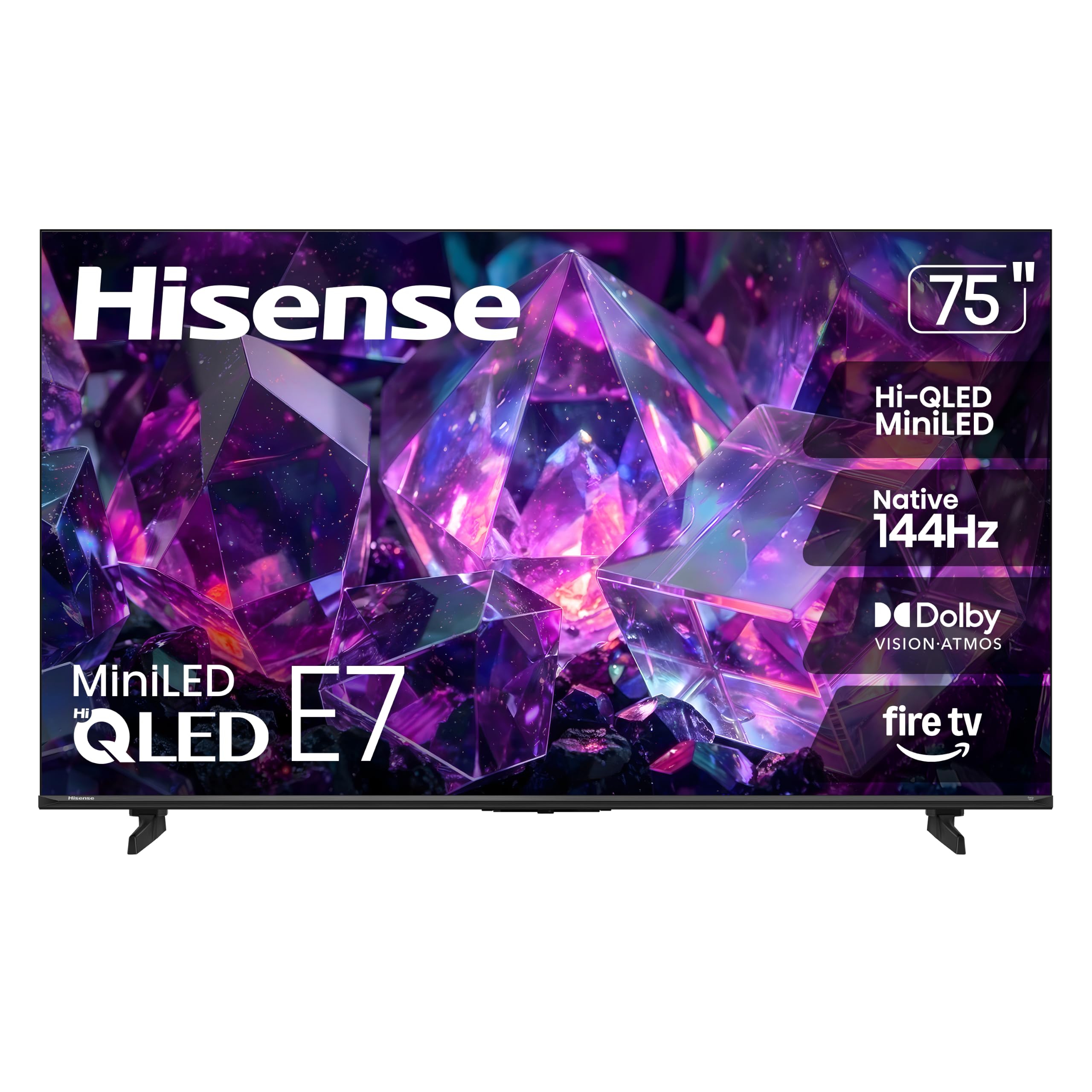
A 75-inch cinema wall that fills the sound the same way it fills the frame.
Seventy-five inches of screen and a speaker system that tries to match it. Mini-LED backlighting here runs thousands of precise light zones, so shadows stay deep and highlights punch through without washing out. Dolby Vision handles the picture side and Dolby Atmos the sound, which is the pairing that makes a big set feel like a room rather than a rectangle.
Native 144Hz keeps fast movement fluid, and AI Smooth Motion with MEMC — motion estimation that fills in frames between the real ones — sharpens quick pans and live sports. AI Sports Mode recognizes the game and boosts crowd audio to rebuild the stadium feel. Bluetooth 5.3 matches the Samsung at the top for wireless, and Wi-Fi 5 covers the streaming load. Filmmaker Mode strips the processing back so movies play in the aspect ratio and frame rate the director set.
The honest trade-off is reliability. Most buyers report years of steady service, but a minority describe the set stopping unexpectedly, so treat the warranty as part of the purchase. Budget for that small risk and this is one of the biggest screens in the guide for a value-tier layout.
Big-screen strengths
- 75-inch Hi-QLED Mini-LED panel with thousands of light zones
- Dolby Vision and Dolby Atmos decode together
- AI Sports Mode reworks picture and crowd audio for live games
- Bluetooth 5.3 and Wi-Fi 5 for streaming and headphone pairing
What to weigh up
- A minority report early failures — warranty matters
- No dedicated bass woofer, so deep punch is Atmos-only
Best fit: a family room where the TV is the wall and movies are the event.
Skip if: the deepest bass from the start is your number-one criterion.
5. TCL 75″ QM64L High Contrast QD-Mini-LED Fire TV
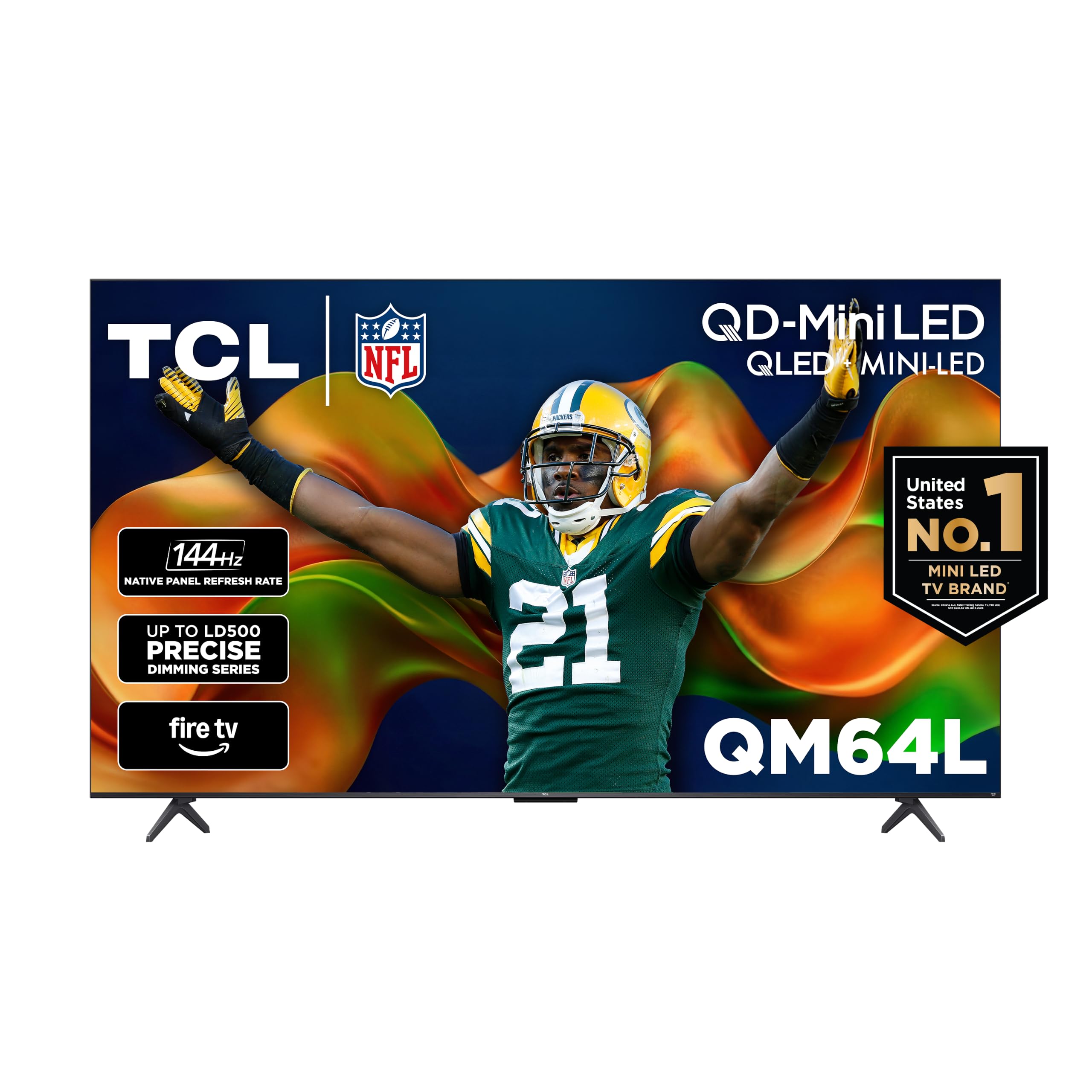
Onkyo audio with a real subwoofer built into a 75-inch panel.
If you want big sound without buying a soundbar, this is the set that takes that brief most literally. Onkyo 2.1 audio runs a dedicated 20W subwoofer (a separate bass speaker) for deeper bass, clearer dialogue and fuller sound, with Dolby Atmos and dedicated DTS layered on top. The maker’s own line captures the point: adding a soundbar is optional. Owners agree — owners mention sound is among the most-praised traits here, outpacing the audio commentary on almost every other pick in this guide.
Picture side, QD-Mini LED runs up to 500 local dimming zones with Halo Control Technology to cut the halo bleeding around bright objects. That keeps bright highlights and deep blacks in the same frame without the burn-in worry OLED owners carry. Native 144Hz with Motion Rate 480, VRR, ALLM and Game Accelerator keeps console play responsive. 1.07 billion colors with the AiPQ Pro processor cover movies and streaming. The bezel-less frame puts more picture and less border in view.
The recurring gripe is smart-system speed. The set can be slow to start up and slow to load apps, which is annoying rather than fatal — a streaming stick in one of the HDMI ports sidesteps it entirely. Treat the slow startup as a mild tax on an otherwise strong big-screen audio package.
Where it stands apart: the 20W subwoofer is the single difference-maker — dialogue and explosions no longer compete for the same small drivers.
Smart-system note: slow startup and app loading show up often enough in feedback that a cheap streaming stick is a sensible add.
Your pick when: a 75-inch screen and real bass in the same box is the entire goal.
Consider the trade: you expect a snappy smart interface — the built-in system runs slow at startup.
6. Hisense 65″ U7 Mini-LED ULED 4K Gaming Fire TV
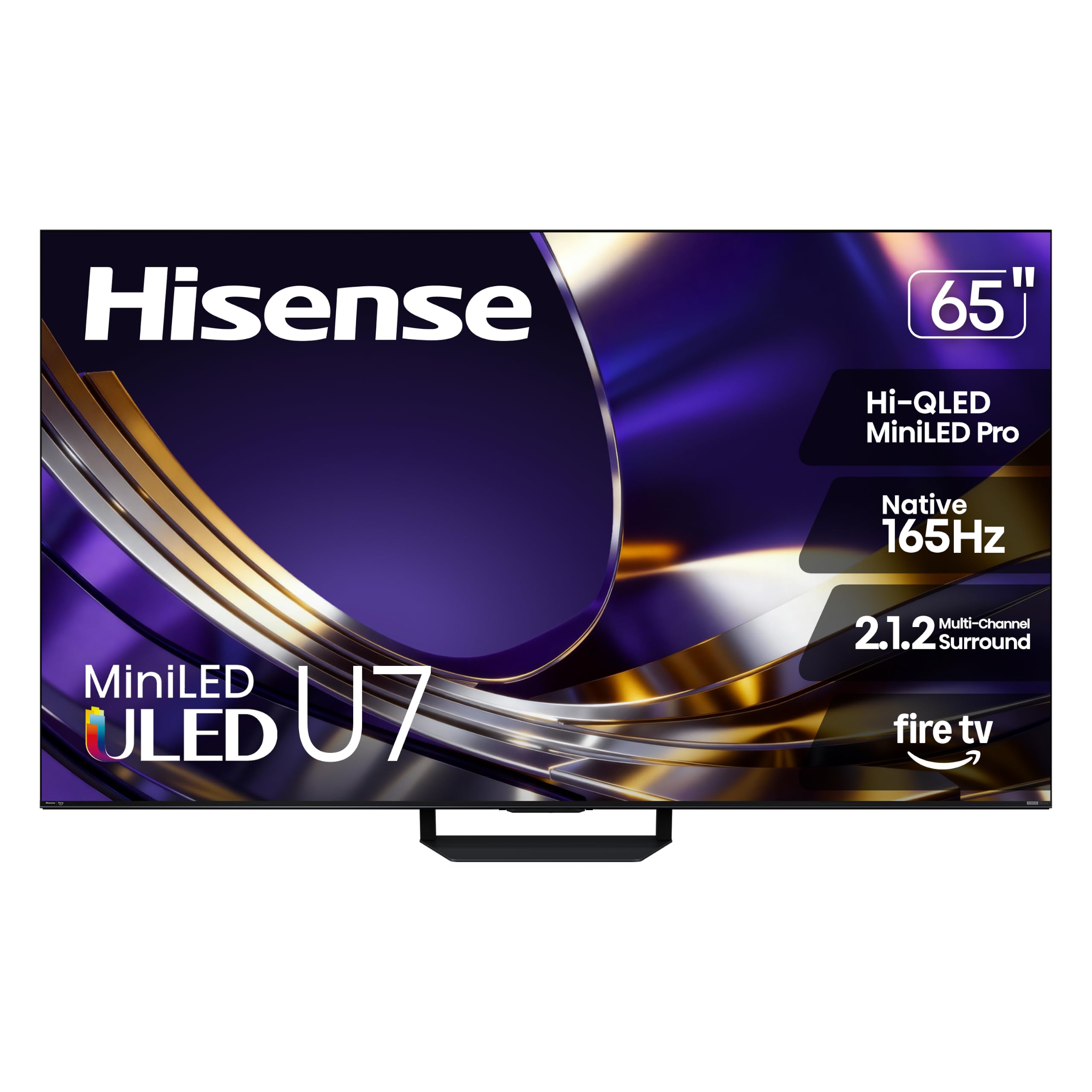
165Hz of native motion paired with a surround array loud enough to skip the soundbar.
Native 165Hz is the highest refresh number in this entire guide, and for console and PC gaming it is the reason to reach for this set. There is no blur, lag or smeared frames in fast action. The 2.1.2-channel surround setup, tuned by Devialet, carries the sound to match — two front channels, a subwoofer channel and two height channels that lift effects above the screen.
Picture quality holds up under real-world stress. Hi-QLED MiniLED uses thousands of backlights for pinpoint control, and up to 3000 local dimming zones reach up to 3000 nits of peak brightness — bright enough that a lamp-lit room does not flatten the image. The anti-glare layer with a dual-layer screen treatment goes past standard single-layer designs, and that layer earns its keep in a window-facing room.
The audio holds up without extra gear: customers note running this set at volume 8-12 with no soundbar and still finding it loud, and its 59 sound mentions place it among the most-praised audio sets on the list. Bluetooth 5.4 (the newest wireless version here) keeps headphone pairing current. The recurring risk is reliability — a minority of reviewers report sets that stopped working, so register the warranty on day one.
One spec that pays off twice: up to 3000 nits of brightness plus the dual-layer anti-glare finish means the picture holds detail whether the room is bright or dark.
Audio that earns the skip: the 2.1.2 Devialet-tuned array delivers height and bass together, so the soundbar money stays in your pocket.
Built for you if: a next-gen console lives under the TV and you want a set that keeps pace.
Look at the Toshiba instead if: long-term reliability is the deal-breaker — this set has the same minority risk.
7. TCL 65″ QM8L Series SQD-Mini LED QLED Google TV
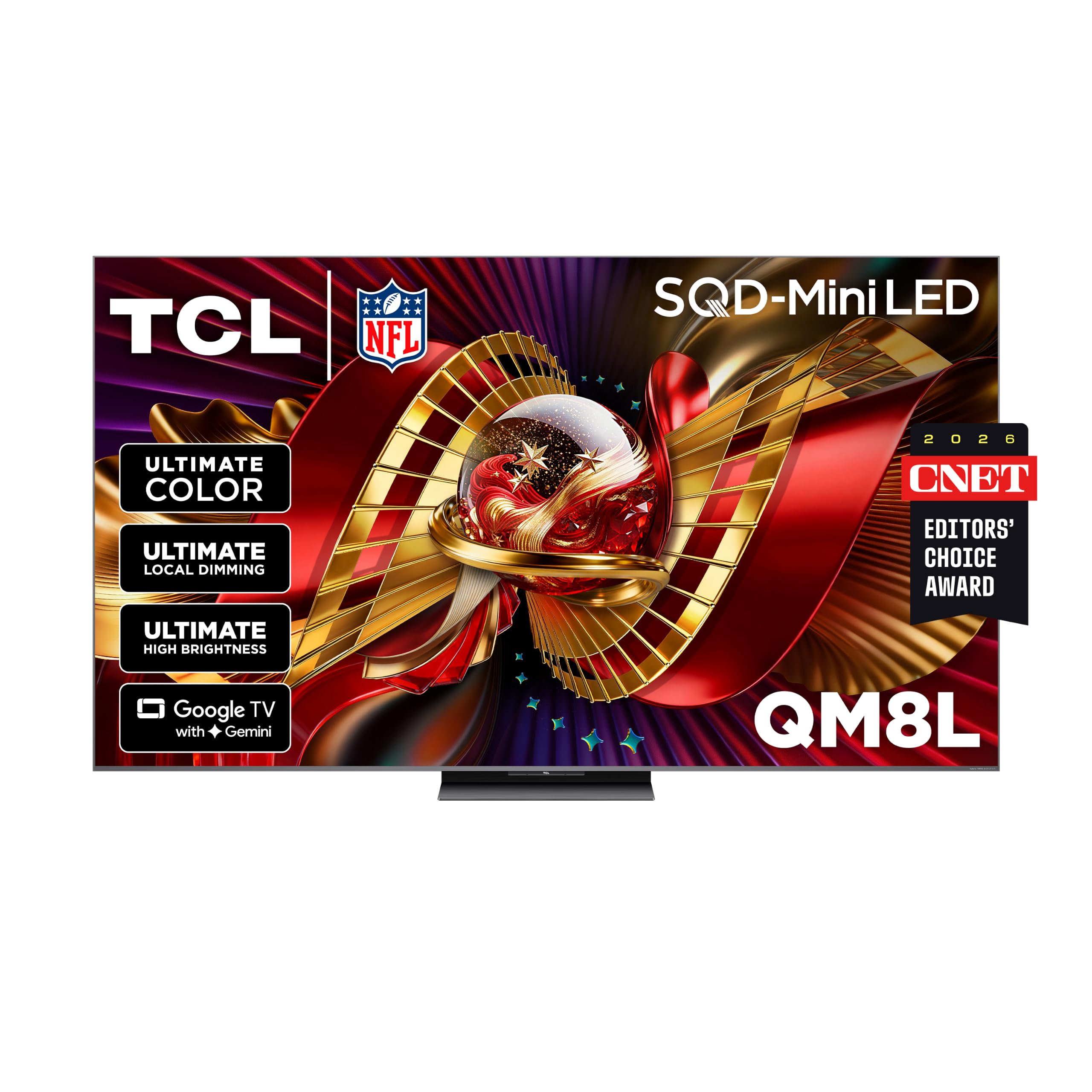
Peak brightness and a Bang & Olufsen audio tune on a Google TV panel.
The headline number is huge: up to 6000 peak nits of brightness and up to 4000+ discrete dimming zones. That is the brightness figure buyers in a sunlit room chase, and it keeps highlights vivid even when the lamp is on. SQD-Mini LED layers the TCL Deep Color System on top of the Halo Control System for cleaner edges around bright objects.
The Ultra Color Filter uses fine 5-nanometer particles versus standard 60-nanometer ones, which is the color-accuracy pitch in plain terms — more precise control over what each pixel shows. Static contrast reaches 7000:1, so light and dark scenes separate cleanly. Audio is by Bang & Olufsen, with an optional wireless subwoofer and satellite speakers to build outward from the built-in sound. The Game Pack covers Game Accelerator 288 VRR, Game Bar and AMD FreeSync Premium Pro for responsive console play.
Finding something to watch is easy: Google TV with Gemini (Google’s voice assistant built into the menu) lets you type what you want and it surfaces options. Sound is one of the strongest dimensions in owner feedback here. The honest note is that the B&O (Bang & Olufsen) tuning delivers its top-tier sound only when you add the wireless subwoofer; from the start it is strong but not subwoofer-deep.
The bright side
- Up to 6000 peak nits and up to 4000+ dimming zones
- Studio-grade color accuracy from the Ultra Color Filter
- Bang & Olufsen audio with room to add a wireless subwoofer
- Game Accelerator 288 VRR and FreeSync Premium Pro
What to consider first
- The deepest bass needs the optional subwoofer
- Brightness this high can overwhelm a pitch-dark room
Go for it: daylight floods your living room and you want the picture to stay vivid anyway.
Think again: you want to build the audio outward from the box — that means adding the optional subwoofer.
8. LG 65″ OLED AI B6 4K Smart TV

8.3 million pixels that switch off completely for pure black.
OLED changes the contrast math. Over 8.3 million self-lit smart pixels with Perfect Black and Perfect Color turn off individually, so a dark scene is genuinely dark instead of glowing grey at the edges. For a dim room and a late-night movie, nothing on this list matches the black level.
The a8 AI Processor 4K Gen3 detects what is playing and adjusts picture and sound on the fly. Dolby Vision pairs with Dolby Atmos for the sound spread, and FILMMAKER MODE with Ambient Light Technology plays movies as the director set them. Gamers get a 0.1ms response time, refresh up to 120Hz, NVIDIA G-Sync, AMD FreeSync Premium and VRR. OLED Care looks after the panel to hold picture quality over the years. webOS streams everything, LG Channels adds over 400 free channels, and Google Gemini handles search by voice.
Worth knowing: this is a lower-rated set with a smaller review base than the top picks, so the feedback is thinner — picture quality is the theme but the sample is small. And OLEDs this size tend to trade peak brightness for perfect blacks, so a sunlit room is not their natural home.
What almost no LCD can do: 8.3 million pixels dimming one by one — that is the deep-black advantage in a dark room.
The practical caution: a thinner feedback base here than the top of this list, so read the return window carefully.
The right call if: your viewing happens at night and a perfect black is worth more than a searing peak-white.
Not the one for: a bright daytime room — that is the LCD picks’ territory.
9. LG 65″ OLED evo AI C6 4K Smart TV

The OLED that pushes brightness up to survive a room with lamps on.
Brightness Booster, powered by the a11 AI Processor Gen 3, lifts the picture enough that OLED is no longer a dark-room-only proposition. Over 8.3 million self-lit pixels keep the Perfect Black and Perfect Color core. The a11 chipset against the previous-generation a9 delivers 5.6x greater AI neural processing, 50% faster operation and 70% improved graphics, so menus and scene detection keep pace with the panel.
Gaming reaches up to 165Hz with a 0.1ms response time, plus NVIDIA G-Sync, AMD FreeSync Premium and VRR — a step above the B6’s 120Hz ceiling. Dolby Vision and Dolby Atmos plus FILMMAKER MODE cover movies, and OLED Care protects the panel over time. Bluetooth 5.3 matches the Samsung at the top of this guide for wireless.
Two honest notes sit in owner feedback. Brightness is genuinely split — some find it much brighter, others find the screen reflective in a lit room. The remote and the webOS interface draw sharper criticism, described as rough to use and sluggish in places. Neither touches the picture; both touch your daily clicks.
The picture earns the praise: rich, vibrant color and deep blacks are the dominant theme, and the a11 processor carries it scene to scene.
Where the complaints land: the remote and the interface, not the panel — a streaming stick covers the interface side.
For you: OLED contrast with a brightness lift so the picture survives daylight.
Avoid if: the remote and smart platform are the thing you interact with most — those draw the sharpest notes.
10. Sony 77″ BRAVIA XR8B OLED 4K HDR Google TV

A 77-inch OLED that turns the screen itself into the speaker.
Seventy-seven inches of pure-black OLED with Acoustic Surface Audio+ — a system that vibrates the panel itself to make sound, so the dialogue follows the mouth on screen instead of sitting under it. That is the audio trick no other set on this list offers. Over 8 million self-lit pixels run with high brightness, and the XR Processor boosts color, contrast and clarity in real time.
For PlayStation 5 owners this is a natural match: Auto HDR Tone Mapping and Auto Genre Picture Mode tune the picture for both games and movies automatically. Dolby Vision, Dolby Atmos, IMAX Enhanced and DTS:X decode for the movie side, and XR OLED Motion keeps fast sports and action blur-free. Studio calibrated modes for Netflix and Prime Video preset the picture the way the creators set it.
Two honest trade-offs stand out. Reliability draws real concern — random shutdowns and spontaneous reboots show up in feedback, which is a genuine frustration for a set at this tier. And brightness holds mixed opinions, so a very bright room can dull the OLED advantage. Register the warranty on delivery day if you buy this one.
Why the picture sings
- Acoustic Surface Audio+ makes the panel itself the speaker
- PS5-specific Auto HDR Tone Mapping and Auto Genre Picture Mode
- Dolby Vision, Atmos, IMAX Enhanced and DTS:X all decode
- 77 inches of pure-black OLED
Purchase with eyes open
- Random shutdowns and reboots show up in owner feedback
- Brightness divides opinion — a sunlit room is not its best stage
Match made here: a PS5 and a home theater where the screen-as-speaker trick earns its keep.
Hedge your bet: register the warranty and buy from a seller with an easy return — reliability has a real minority streak.
11. Sony 65″ BRAVIA 8 II QD-OLED 4K HDR Google TV

Quantum dots layered over OLED, tuned for color that pops off the glass.
QD-OLED adds a quantum dot layer to OLED’s self-lit pixels, and the result here is billed as Sony’s highest OLED brightness with over 8 million self-lit pixels behind it. The XR Triluminos Max panel shows billions of real-world colors, and the XR Processor with AI lifts color, contrast and clarity scene by scene. If color accuracy is the priority, this is the pick.
Movie support runs deep: Dolby Vision, Dolby Atmos, IMAX Enhanced and DTS:X decode, and the Sony Pictures Core app adds movies included plus a large IMAX Enhanced collection. Studio calibrated modes cover Netflix, Prime Video and Sony Pictures Core. Apple AirPlay 2 and Google Cast handle casting, and there are PS5-specific features on the gaming side. The built-in mic switch is a nice privacy touch if voice control makes you itch.
The mixed signal is sound. Some find the audio good, others find it lacking — Atmos decodes, but this set leaves the bass gap that a soundbar or subwoofer fills. Brightness also draws a split verdict, with a few finding it darker than expected. Neither undercuts the picture; both are worth knowing before you buy.
The color advantage: the quantum dot layer with XR Triluminos Max is the reason shades pop rather than sit flat on screen.
Sound caveat: Atmos decodes fine, but the deepest bass needs a soundbar or subwoofer on top.
Your set if: color accuracy is the thing you will notice most and you already own a soundbar.
Look elsewhere if: you want full-throated bass straight from the box.
Know the Specs
Speaker layouts: 2.1, 2.1.2 and subwoofers
The number tells you what is actually inside. A 2.1 system is two channels plus a subwoofer — the bass driver that gives movie rumble weight. A 2.1.2 layout adds two height channels that lift sound above the screen, the Atmos idea in practice. Wattage matters less than whether a dedicated subwoofer exists: the TCL QM64L’s 20W subwoofer does more for a movie’s low end than raw speaker watts spread across small drivers.
Dolby Atmos explained
Atmos is a surround format that places sounds around and above you. A TV that decodes it can position effects — a helicopter, rain, a crowd — beyond the left and right speakers. But decoding and projecting are different jobs. A set with height channels and a subwoofer (the Hisense U7’s 2.1.2 array) projects it properly, while a two-speaker set mostly widens the spread. Read the speaker layout alongside the Atmos line.
Nits and dimming zones
Nits measure brightness — more nits keep the picture readable in a bright room. Dimming zones are the backlight patches that brighten and dim independently, so dark areas go dark and highlights stay bright. More zones mean less halo bleeding around bright objects. The TCL QM8L runs up to 6000 peak nits and up to 4000+ zones; the U7 runs up to 3000 nits and up to 3000 zones.
Refresh rate: 120Hz, 144Hz, 165Hz and VRR
Refresh rate is how often the screen redraws each second. Higher numbers keep fast motion smooth. VRR, or variable refresh rate, syncs the screen to a console’s output so frames do not tear. ALLM switches the set into low-latency game mode automatically. A native 165Hz panel like the U7 leads here, while 120Hz on the LG B6 covers most console play with headroom to spare.
Common Questions
Do I still need a soundbar if the TV has Dolby Atmos and a subwoofer?
Does a matte or anti-glare screen hurt picture quality?
Is 144Hz or 165Hz worth it over 120Hz for movies?
Will a 75-inch TV like the TCL QM64L fit my wall or stand?
Is OLED better than Mini-LED for a bright living room?
What does eARC on the Philips 7985 actually do for me?
Do these TVs work with a PS5 or Xbox Series console?
How long should a TV like this last before it needs replacing?
Is a higher refresh rate worth it if I mostly watch streaming shows?
Can I wall-mount a 65-inch set and still use the built-in speakers?
What is the difference between QLED and OLED for sound and picture?
The Bottom Line
For most rooms, the smart tv with great sound winner is the Samsung 50-Inch QN90F. Its glare-free screen and 128-neural-network upscaling (AI processing that sharpens lower-resolution video) keep the picture sharp in a bright room, and Object Tracking Sound Lite with Dolby Atmos follows the action on screen. It holds the highest score of the full-size picks here at 4.5+ stars, but value is its one split topic — weigh the 50-inch size against your room first. If bass from the start is the whole point, grab the TCL 75″ QM64L — its Onkyo 2.1 system with a 20W subwoofer is the only set here that makes the soundbar genuinely optional. And for a massive screen with Atmos sound, the Hisense 75″ E7 Cinema Series is the one to reach for, with thousands of Mini-LED zones (tiny backlights that brighten and dim in small groups) behind Dolby Vision and Dolby Atmos. If you game on a next-gen console, the Hisense 65″ U7 and its native 165Hz panel (a screen that refreshes 165 times a second) is the fastest in the lineup. Whichever you pick, register the warranty on day one — several sets here have a minority reporting early failures.
How we choose
We do not accept paid placement. Every pick is matched to a real buyer and a real use-case; we do not hands-on test units.
Sources
Specifications: manufacturer listings and product documentation. Review insights: verified customer reviews, as of November 2026. Pricing: not shown on this page (it changes often); check the current price via the retailer link.
As an Amazon Associate, Tactical Gear Guy earns from qualifying purchases. This does not affect which products we feature.