Specs are compiled from manufacturer listings and verified buyer reviews and can change over time — please confirm the key details on the product page before buying.
Most seedling trays fail for one boring reason: the roots stay soggy and the seedlings damp off before they ever reach the garden bed. The fix is simple — real drainage holes, a dome that actually holds humidity, and cells deep enough to hold a tomato start past its first week. This guide walks you through nine picks that solve those three problems in different ways, from a heavy-duty 3mm dome to a self-watering kit that runs off a capillary mat.
This guide is built by comparing the manufacturers’ published specifications and the patterns across verified customer reviews, so you get each pick’s real strengths and trade-offs instead of marketing spin.
What separates a tray you reuse for seasons from one that splits on the first fill is thickness, drainage geometry, and how the dome seats. Below you will find the nine seedling starter trays worth putting on your shelf, sorted by what each one does best. This breakdown of the best seedling starter trays covers cell counts, dome heights, and how each kit handles water so you can pick in minutes.
Top Picks

How To Choose The Best Seedling Starter Trays
Your seedlings spend their first weeks in a tray that has to do three jobs at once: hold damp soil without collapsing, let excess water escape, and keep the air around the leaves humid enough that the seed coat softens and the sprout breaks through. A tray that fails at any one of those jobs costs you a whole flat of starts. So pick by those three jobs first, then worry about how many cells you get.
Cell depth beats cell count
A deeper cell holds more soil, which means the roots have more room to spread before they hit the bottom. That extra soil also holds water longer, so you are not watering twice a day in a dry room. If you plan to start tomatoes, peppers, or anything that grows fast, a deep cell buys you a week or two before transplant. Shallow cells force you to pot up early, and that is when roots get disturbed.
Drainage holes and base trays
Every cell should have a hole at the base so excess water can leave. Without it, water sits at the bottom of the cell and the roots rot. A separate base tray catches the runoff so your shelf, windowsill, or heat mat stays dry. Some kits include the base trays, some do not — check before you buy, because a tray that drains onto your furniture is worse than no drainage at all.
Dome height and venting
The dome traps humidity around the seed while it germinates. Too much trapped moisture and you get mould and damping-off, so a dome with an adjustable vent lets you dial the humidity down as the seedlings grow. Dome height matters too: a taller cover gives the seedlings room to stand up before the leaves touch the plastic. A short dome means you have to pull it off early, and the seedlings lose their humid pocket before they are ready.
Will it fit your 1020 flat?
A 1020 flat is the standard nursery tray that measures roughly 21 by 11 inches. Many 72-cell plug trays are built to drop into one, but not all of them line up flush. If you already own 1020 flats and plan to bottom-water, buy a tray that explicitly says it fits a 1020 — otherwise you will be trimming plastic or propping trays at an angle.
Side-by-Side Comparison
| Model | Best For | Cell Count | Dome Included | Drainage | Amazon |
|---|---|---|---|---|---|
| AC Infinity Humidity Dome 5×8★ Best Overall | Reusable heavy-duty propagation | 40 seedlings | Yes, 3mm dome | Yes, with drip tray | Amazon |
| VIVOSUN 6-Pack Seed Starter TraysBest Value | Budget multi-tray kit | 72 cells | Yes, 6 domes | Yes, with base trays | Amazon |
| Mr. Pen Seed Starter Tray KitsMost Cells | Starter kit with tools | 120 cells | Yes, 10 domes | Yes, drain holes | Amazon |
| Seed Starter Trays with Grow Lights | Windowsill starting with light | 72 cells | Yes, 3.35″ cover | Yes, with base trays | Amazon |
| Seed Starter Kit 10 Pack 72 Cell | Budget bulk plug trays | 72 cells | No | Yes, drain holes | Amazon |
| RooTrimmer Deep 72 Cell Trays | 1020 flat bottom-watering | 72 cells | No | Bottom watering | Amazon |
| 60-Cell Self-Watering Seed Starter Tray | Hands-off indoor kit | 60 cells | Yes, 4.07″ dome | Self-watering mat | Amazon |
| Bootstrap Farmer 72 Cell Tray | Long-term reusable plug trays | 72 cells | No | Yes, bottom-watering cells | Amazon |
Detailed Reviews
1. AC Infinity Humidity Dome 5×8
Our pick — 4.5+★ from 600+ verified ratings; the strongest balance of quality and price.
A 3mm dome you can hand down to the next gardener in your family.
If you have ever watched a flimsy starter dome crack along the rim the second season, the AC Infinity build is the answer. The clear dome measures 3mm thick with a glossy finish — roughly three times the heft of the thin vacuum-formed domes that come with most bargain kits. That thickness does two things: it lets light through cleanly and it holds its shape so the dome seats on the tray instead of curling up at the corners and leaking your humidity out the side.
The 5×8 tray supports up to 40 seedlings and is built to drain excess water into a drip tray that is durable, reusable, and holds heavier loads without sagging. What wins people over most here is straight-up quality; owners single it out more than any other trait, and durable construction is the next thing they bring up. There are also optional height extension panels with more adjustable vents, so you can raise the dome as the plants grow instead of yanking it off early.
The honest catch is size. Some owners find the footprint a touch small for the number of starts they want to run, and the tray sits at 16 ounces, so factor that in if you plan to fill it with wet soil. Unlike the RooTrimmer trays that drop into a full 1020 flat, this one is a compact standalone unit — great for a windowsill or a small heat mat, less ideal if you are starting flats of 72 at a time. The payoff is a 40-seedling propagation kit that snaps together in minutes and holds up for years.
Where it earns its keep
- 3mm dome thickness holds humidity and survives repeat seasons
- Optional height extension panels with extra adjustable vents
- Durable drip tray handles heavy, wet loads without leaking
- 5×8 tray supports up to 40 seedlings
What to weigh first
- Footprint reads small to some growers running big seed batches
- Not built to drop into a standard 1020 flat
Made for: anyone who wants one propagation kit that survives years of tomato and pepper starts.
Think twice if: you fill full 1020 flats at a time — this is a compact setup.
2. VIVOSUN 6-Pack Seed Starter Trays
Six trays, six domes, and enough starts for a full vegetable garden.
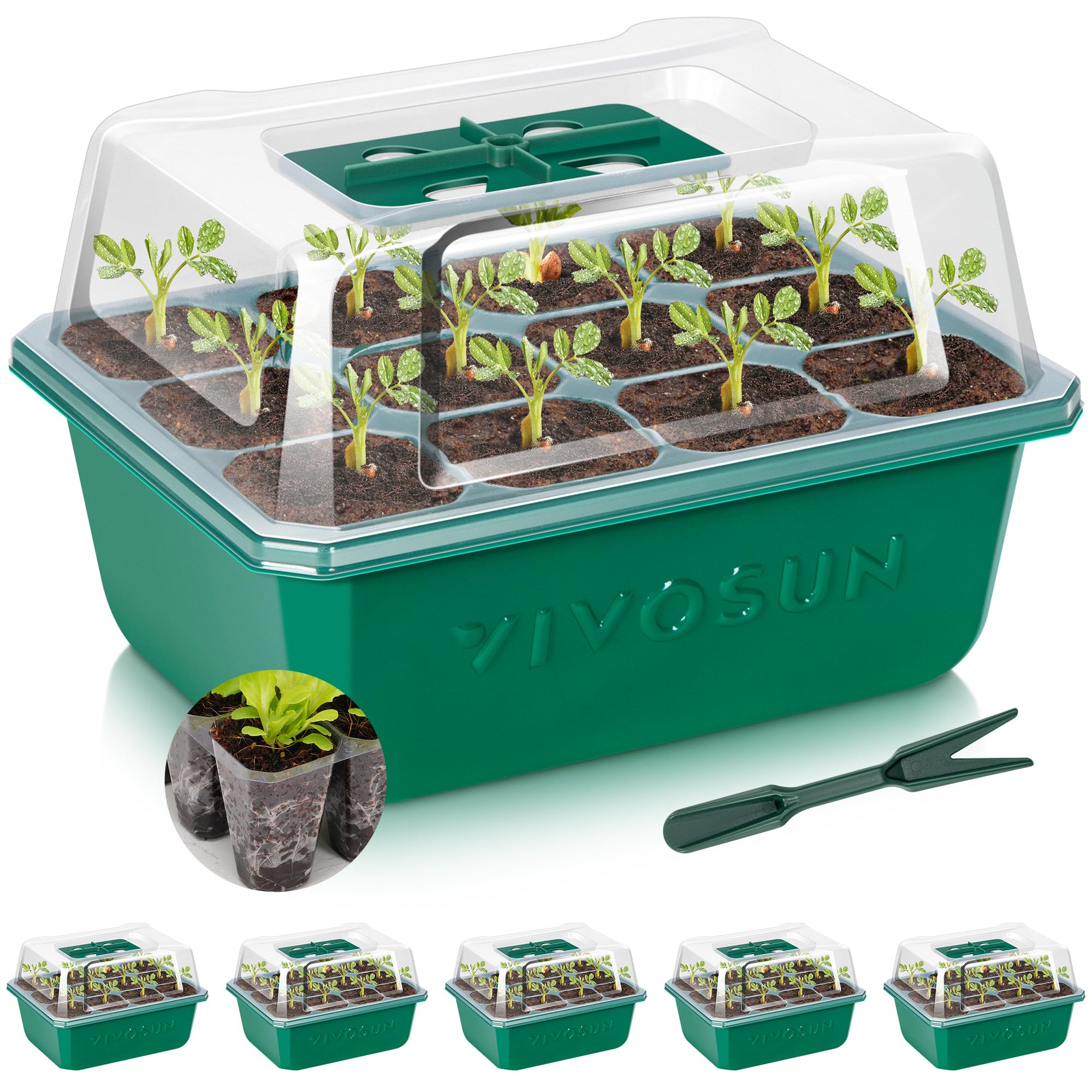
The number that matters here is six — six 12-cell trays, six base trays, six humidity domes, plus a pack of garden tools and 10 labels. That is 72 cells total, and it comes in at roughly half the piece count of the 12 Pack 144Cell kit, which carries 12 of everything. If your garden plan is two tomato varieties and a row of peppers, this is the right size; if you are starting a whole market garden, the bigger kit buys you double the cells for a similar outlay.
The included dome vents adjust to manage moisture and temperature, and every cell has a drain hole so overwatering drains away instead of drowning the roots. The plastic is rated to sit on a heat mat running from 0 to 120°F, so you can push germination speed without melting the tray. What owners rave about most is the overall quality, with the trays working exactly as advertised for starting seeds — and the domes giving the seedlings the extra humidity they need to break the surface.
Here is the trade-off you should know before you buy: the lids. The domes are the weak link — they do not stay put well and owners flag lid durability far more than anything else. The trays themselves feel sturdy to some and thin to others. Treat the domes gently, seat them carefully, and this kit does its job. For a first-time seed starter who wants trays, domes, base trays, and tools in one box, it is the sensible entry point.
Solid first kit: 72 cells across six trays, with domes, bases, and labeling tools included for a beginner-friendly setup.
Gentle on the lids: the domes are the part that gives out — handle them carefully and the trays last.
Reach for this if: you want a complete six-tray starter setup with heat-mat compatibility.
Look elsewhere if: you need domes that lock down firmly — this is the known soft spot.
3. Mr. Pen Seed Starter Tray Kits
Ten trays, 120 cells, and the tools you forgot to buy.
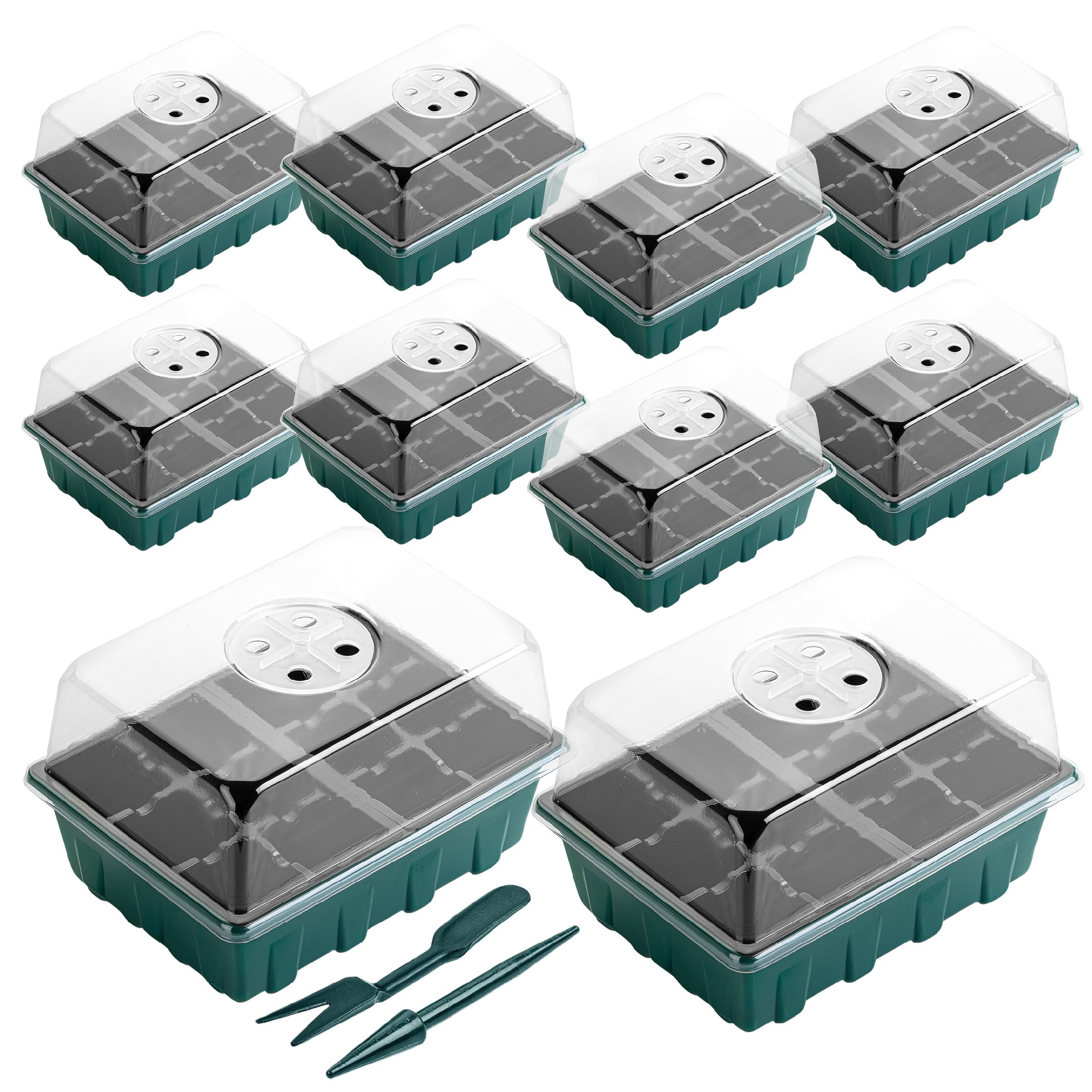
Mr. Pen packs 10 sets into one box, each with a 12-cell tray, so you get 120 cells total to fill. The kit runs 14.5 by 9 by 4.3 inches overall — the longest overall footprint of the compact kits here, and roughly 2.5 times the depth dimension of the Adawook light kit at 5.9 by 6 by 7.5 inches. More footprint means more trays side by side on the bench, which suits a gardener who wants a lot of starts going at once without buying the giant 1020 plug trays.
Each tray has a transparent dome lid with adjustable vents so you can vent the humidity as the seedlings grow, and every cell has a drain hole at the base to keep roots out of standing water. The cell design lets seedlings release gently, so you disturb the roots less when you pull them for transplant. The kit also throws in a shovel and scoop, which means you can fill and transplant without hunting for a spoon. Owners describe these as better than expected, sturdy, and perfectly sized for indoor starts.
The real question mark is the vent covers — they do not always stay seated, and a few owners also report holes in the bottom trays. Neither issue is universal; most owners find the trays durable enough to last several seasons. But if a tight-sealing vent matters to you, seat the covers with care and check the base trays on arrival. For the cell count and the included tools, it is a lot of kit for a small outlay.
What makes it a standout
- 120 cells across 10 trays for a big seed list
- Adjustable vents on every dome
- Shovel and scoop included for filling and transplanting
- Cell design releases seedlings with minimal root disturbance
Where it will test you
- Vent covers can fail to stay seated
- A few report holes in the bottom trays
Suits you if: you want a large cell count plus tools in one box.
Skip the extras if: you only need a tidy few trays and prefer thicker plastic.
4. Seed Starter Trays with Grow Lights
Six trays with built-in lights and three colour modes to push germination.
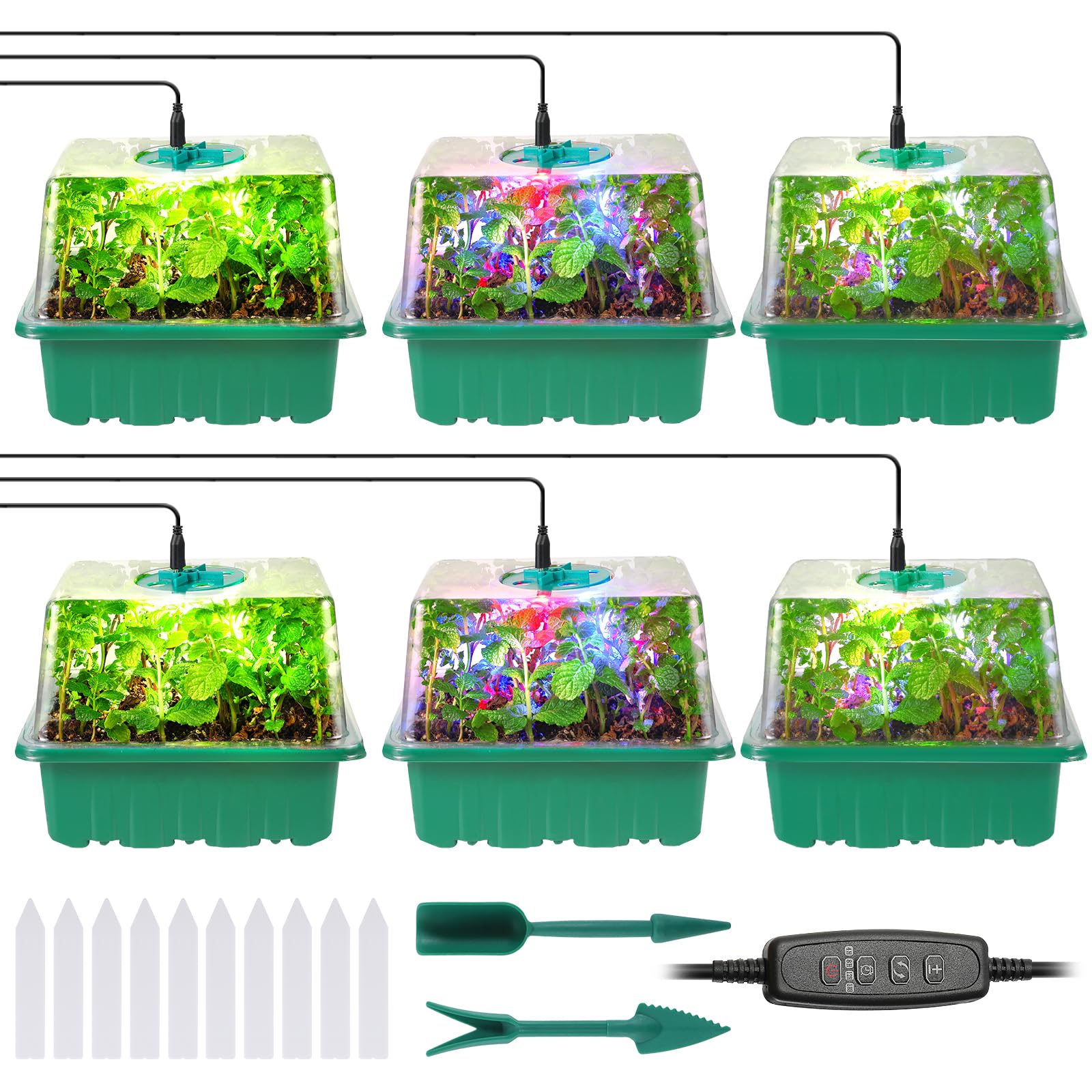
Six 12-cell trays, six grow lights, and a choice of three lighting modes — white, red plus blue, or all three together. That last combo is the one that interests a lot of seed starters: blue light is credited with curbing the leggy stretch common to windowsill starts, and red light with stem and leaf growth. You get 72 cells to fill with basil, rosemary, tomatoes, or peppers, and the 3.35-inch cover leaves room for the seedlings to stand up before the leaves touch plastic.
The humidity domes have adjustable circular vents you can dial from 50 to 100% humidity, so you can taper the moisture as the plants grow. Each cell is a 1.6-inch square with 1.97-inch depth, and the bottom trays catch the overflow so you are not mopping the bench. Setup is quick and owners describe it as easy to assemble with a well-thought-out layout. Seeds sprouting within a couple of days and fast early growth show up again and again in the feedback.
The lights are the honest weak spot — they work, but some owners find them not strong enough for the plants over a long season. The kit is also a bit less rigid than the premium trays. If you are starting seeds in a dim room and want a light source built into the kit, this gets you going with no extra gear. If your seedlings need serious wattage, plan to graduate them to a proper grow light once they are up.
Why the light modes matter
- Three lighting modes let you push roots and stop leggy stretch
- Humidity adjustable from 50 to 100%
- 3.35-inch dome height gives seedlings room to stand
- Quick setup with base trays to catch overflow
The light has a ceiling
- Some owners find the lights not strong enough long term
- Trays feel lighter and less rigid than premium options
Pick this if: you start seeds in low light and want light built into the kit.
Plan around: a weak light source — graduate seedlings to a stronger lamp as they grow.
5. Seed Starter Kit 10 Pack 72 Cell

Ten bare plug trays for growers who already own their domes and flats.
This is a tray-without-the-frills pick: 10 trays, 72 cells each, and 1.8-inch diameter cells sized for flowers, herbs, and vegetable saplings like tomatoes and cucumbers. The cell design is intended to become one with the root ball as the plant grows, which promotes aeration and lets you transplant without circling the roots. There are no domes in the box, so pair this with a flat watering tray and bottom-water to keep the seedlings from drying out fast.
These come at a lower price point than the RooTrimmer deep-cell trays and Bootstrap Farmer plugs, which is the whole point of this pick. The lightweight plastic with drain holes keeps the weight down and lets excess water out. For starting a big collection of saplings where you already have domes or a humidity tent, 72 cells per tray across 10 trays is a big runway for the season.
The honest picture here is mixed. These trays are shallow, and the big sticking point is fit — they do not align properly with a standard 1020 tray, so if you are planning to drop them into a nursery flat, measure first. Sturdiness also splits opinion: some find them sturdy, others report bending in the middle and warping quickly. Treat this as a bulk, low-cost plug tray for bottom-watering in a separate tray, not a long-term reusable system, and it does its job.
What you get: 10 trays at 72 cells each, with drain holes and 1.8-inch diameter cells for tomatoes and cucumbers.
Measure first: the fit against a standard 1020 tray is the known bugbear, and the trays are shallow.
Reach for this if: you already own domes and want budget bulk plug trays.
Look elsewhere if: you bottom-water in a 1020 flat — these do not seat cleanly.
6. RooTrimmer Deep 72 Cell Seedling Trays

Deep 2.36-inch cells that buy your seedlings extra weeks before transplant.
This is the tray for anyone who has watched a fast-growing tomato outgrow a shallow cell in a week. Each cell is 2.36 inches deep, and the tray measures 21.25 by 11 inches at the rim, so it drops into a standard 1020 flat that is 2.5 inches tall. The bigger cell volume holds more soil, which means more water and nutrients at the roots and more sub-roots forming before you move the plant. That extra depth directly translates into a longer nursery window — the seedling can stay put longer without becoming root-bound.
Ten trays at 72 cells each gives you a serious amount of planting space, and the 10.4-liter capacity means each cell is sized to hold water and nutrients well. The trays work for bottom-watering setups and for a wide range of plants, from peppers and tomatoes to sunflowers, melons, and strawberries that need more room to start. Owners describe the plastic as sturdy and flexible — it does not crack easily — and the trays hold their shape without sagging.
The fit and thickness are where the feedback splits: some owners seat these cleanly in a 1020, others find they do not sit flush, and the size draws mixed views. The thickness is also debated — some find it thicker than others, some note the cells are shallow by their standards. If you specifically need a deep-cell plug tray that fits a 1020, this is the pick; if you need a tray with a dome and base included, look at the self-watering kit above.
What the depth buys you
- 2.36-inch deep cells hold more soil for stronger roots
- 21.25 by 11-inch rim drops into a standard 1020 flat
- Sturdy flexible plastic that resists cracking
- 10 trays for a large seasonal seed run
Fit questions to check
- Some report the trays do not sit flush in a 1020
- Cell size and thickness draw mixed views
Suits you if: you bottom-water in 1020 flats and want deep cells.
Think twice if: you need a dome included or a guaranteed flush fit.
7. 60-Cell Self-Watering Seed Starter Tray
A 60-cell kit that waters itself from a capillary mat so you can leave it alone.
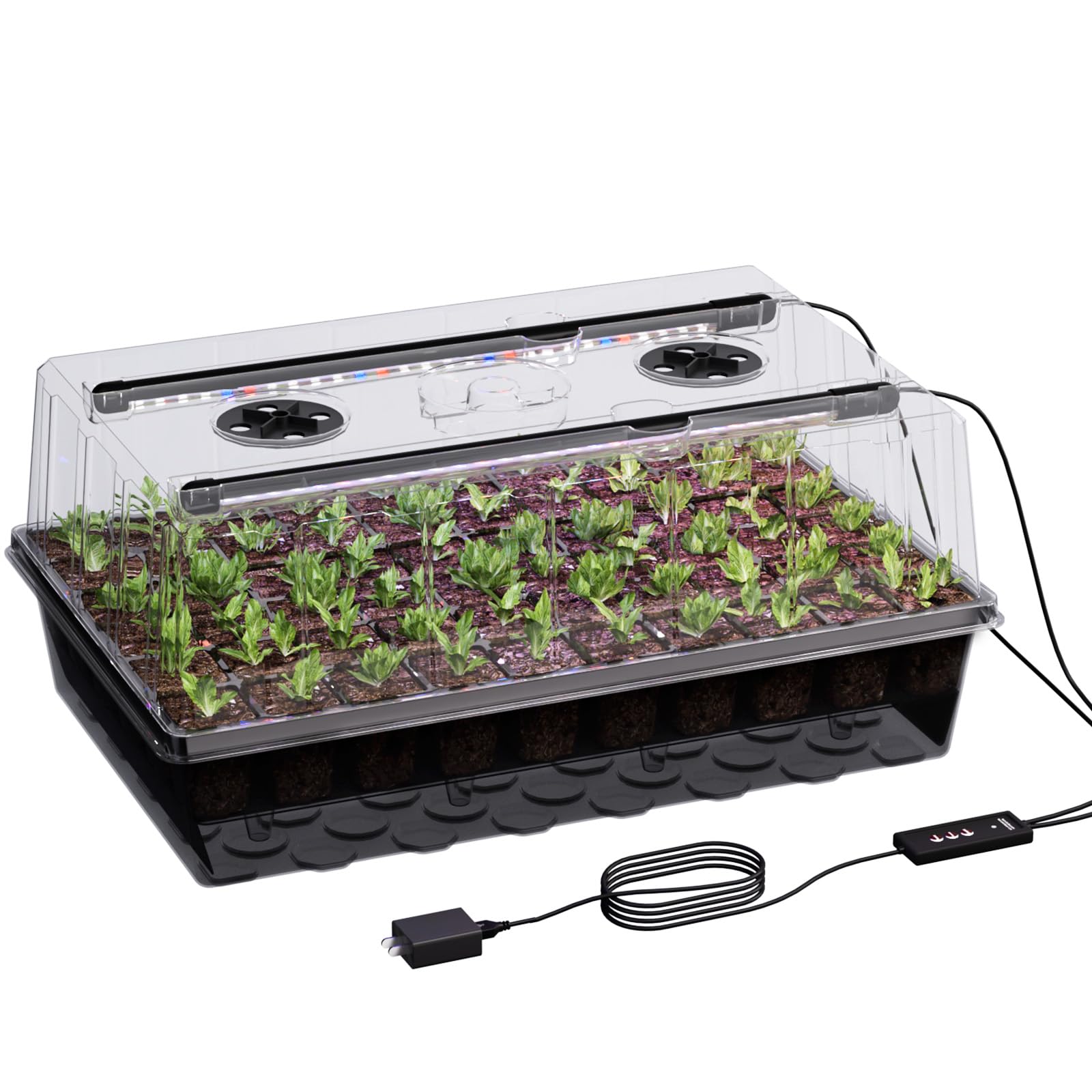
Self-watering is the headline, and it is the thing that sets this kit apart from every manual tray here. A capillary mat wicks water up into the 60 cells, so one fill of the base tray is meant to last from germination to transplant. The 60-cell tray sits under a 4.07-inch dome with two adjustable vents, and the kit is built from high-density, BPA-free PET plastic with a 1.5mm-thick dome and base tray. Owners find setup simple, and seeds sprouting within days is a recurring story — cantaloupe seeds coming up within four days, seedlings growing fast after that.
The light system is the other headline: 56 high-efficiency LED beads per tray, with adjustable brightness and a timer so you can match the light to the plant stage. Owner feedback on the usability is warm — the all-in-one nature of the kit is exactly why people reach for it. The full box includes the dome, two vents, the 60-cell tray, base tray, capillary mat, plant stand, grow light system with two strips and controller, 20 labels, and two gardening tools, plus a manual. That is a genuinely complete setup for a beginner with no gear.
The honest problem is the light over time. Some owners say the LED strips are not bright enough for strong plant growth, and a larger share of the negative feedback is about the lights quitting after a few weeks of use. The quality of the tray itself is praised, but if you plan on relying on the light for a full season, buy with the expectation that you may need a backup. Pair it with a sunny window or a separate lamp and the self-watering tray is a real convenience.
The hands-off core: the capillary mat fills in for daily watering and the 4.07-inch dome keeps the humidity locked in.
Buy it for the tray: the self-watering base and PET tray are the strong parts; the LED strips are the fragile part.
Best for: beginners who want a set-and-check starter with lighting included.
Plan around: a light that may quit within weeks — have a backup light source ready.
8. Bootstrap Farmer 72 Cell Seed Starter Tray
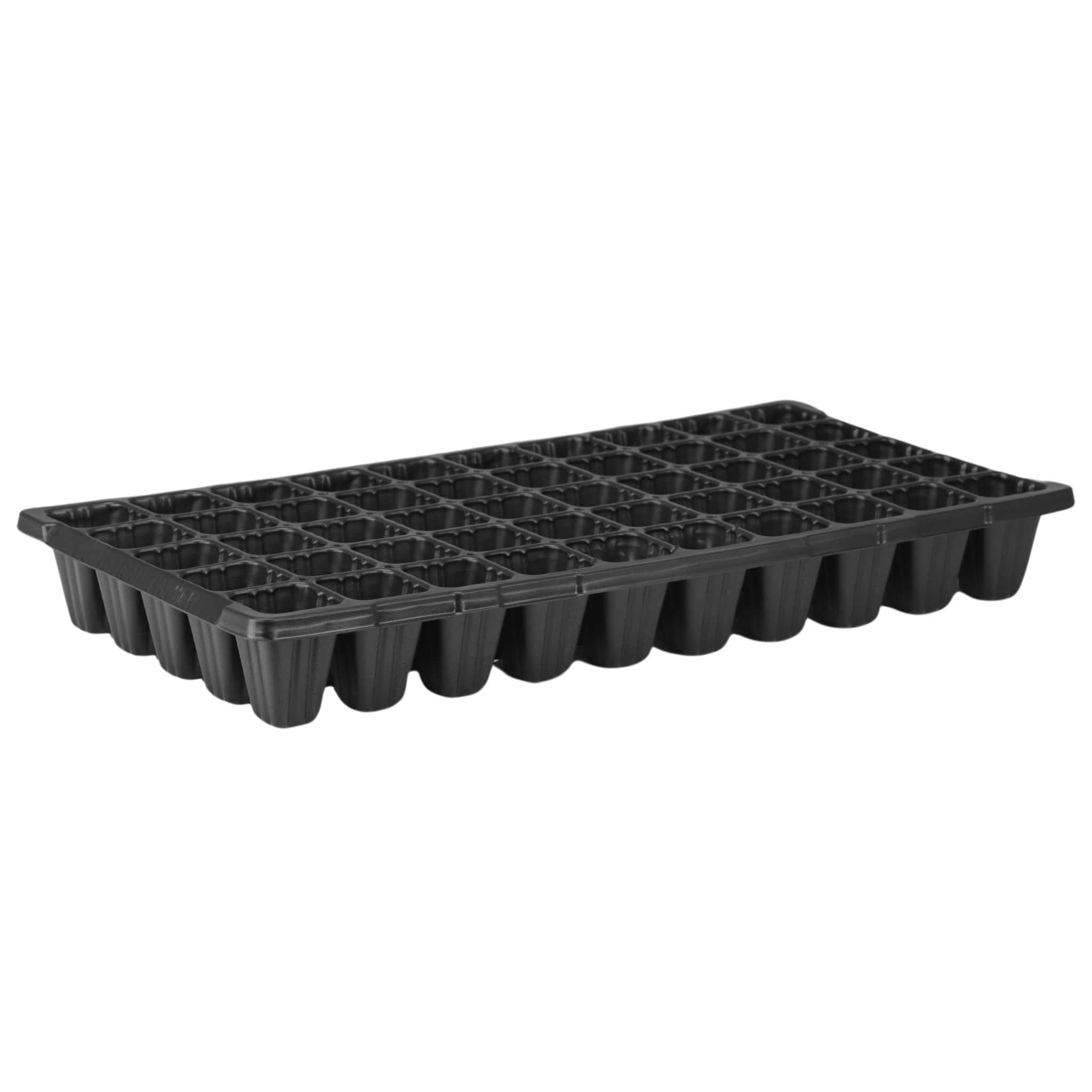
Extra-strength plug trays built to be washed and reused for years.
The defining spec here is the plastic itself: extra-strength, BPA-free, food-safe, UV-stabilised plastic that lifts full of wet soil without bending. That is the difference between a plug tray that cracks on the first fill and one you build a seed-starting routine around. Each cell is 1.5 inches square and 2.25 inches deep, and the tray measures 21.25 by 11 inches at the rim with a 2.25-inch height, so the rim rests on a standard 1020 propagation tray and the tapered cells drop inside. Drain holes in every cell let the extra run out so the roots get oxygen.
You get 10 black trays for 720 cells total, one for each 1020 flat you fill. The longer cells reach the bottom of the flat, so each plug draws from the water below and needs minimal top watering. Owners describe these as outstanding and incredible on quality and sturdy, with durability over years of use the recurring praise. The trays hold their shape season after season, which is why people keep buying more.
The one honest caveat is fit: some buyers report these do not align properly with a standard 10×20 tray, while others say they seat perfectly. Before ordering, measure your flat. And because there is no dome in the box, you will need to add a humidity cover separately if you want to trap moisture at germination. For the grower who wants one set of 72-cell plug trays to wash and reuse for several seasons, this is the one.
Built to be reused
- Extra-strength, BPA-free, food-safe plastic
- 1.5-inch square, 2.25-inch deep cells for root room
- 720 cells across 10 trays to fill 1020 flats
- UV-stabilised for outdoor use without going brittle fast
What you will want to add
- No dome included — add a humidity cover separately
- Fit in a 10×20 flat varies from owner to owner
Go for this if: you want one set of plug trays to wash and reuse for years.
Buy a dome: there is no humidity cover in the box, so add one at checkout.
Know the Specs
Cell depth
Cell depth is how far down each individual planting pocket goes. It matters because the depth decides how much soil sits under the seed and how much room the roots have before they run out. A deeper cell holds more water and nutrients and lets the plant stay in the tray longer before you transplant it. A shallow cell dries faster and forces an early pot-up.
Cell count and tray count
The cell count is how many individual planting pockets a single tray has, and the tray count is how many of those trays come in the box. Multiply the two and you get the total starts the kit can handle at once. A higher total is only useful if you have space for the trays side by side and a way to water them all.
Dome and venting
The dome is the clear plastic cover that traps humidity around the seed while it germinates. The vent is the small adjustable opening that lets you dial that humidity down as the seedling grows. A dome without a vent traps too much moisture and encourages mould, while an open tray dries out too fast — the vent is the control that lets you manage both.
Drainage and base trays
Drainage is the hole at the base of each cell that lets excess water escape so roots do not sit in a puddle. The base tray is the separate shallow tray that catches the runoff so your bench or windowsill stays dry. A tray with drainage holes but no base tray will drain onto whatever it sits on — check that the kit includes both if you plan to water from the top.
Common Questions
Will these trays fit a standard 1020 flat?
How deep should the cells be for tomatoes and peppers?
Why do my domes keep fogging up or growing mould?
Can these seed starter trays go on a heat mat?
Is a self-watering kit better than a manual tray?
Do built-in grow lights actually work for seedlings?
How long will these trays last if I reuse them?
Do I need to add drainage holes myself?
Which tray count is right for a first garden?
Will the plastic domes be BPA-free?
The Bottom Line
The best seedling starter trays for most gardeners are the AC Infinity Humidity Dome 5×8 — the 3mm dome is the thickest here, it survives season after season, and the adjustable vents plus optional height extension panels mean it grows with the seedlings. If your seed list is long and you want the biggest cell count with tools in the box, the Mr. Pen 120-cell pack gives you 120 cells and a shovel and scoop. And if you start seeds in dim light and want a self-watering kit that does the watering for you, the 60-Cell Self-Watering Seed Starter Tray is the one to reach for — with a mental note that the light may need a backup.
How we choose
We do not accept paid placement. Every pick is matched to a real buyer and a real use-case; we do not hands-on test units.
Sources
Specifications: manufacturer listings and product documentation. Review insights: verified customer reviews, as of November 2026. Pricing: not shown on this page (it changes often); check the current price via the retailer link.
As an Amazon Associate, Tactical Gear Guy earns from qualifying purchases. This does not affect which products we feature.