Specs are compiled from manufacturer listings and verified buyer reviews and can change over time — please confirm the key details on the product page before buying.
You are about to hang a motorized hoist over your garage floor, your shop bench, or a loading bay — and the wrong pick shows up as a thin chain, a remote that dies, or a motor that quits mid-lift. That is the real risk with this purchase. A hoist is load-rated equipment, not a gadget, so the numbers that matter are capacity, lift height, lifting speed, and whether you can control it safely from a distance. This guide covers four electric hoists that all run on single-phase power (the ordinary household-style current most garages and small shops already have), and explains what each one does differently.
This guide is built by comparing the manufacturers’ published specifications and the patterns across verified customer reviews, so you get each pick’s real strengths and trade-offs instead of marketing spin.
Below you will find the capacity, lift height and control setup on each unit side by side, so the differences are visible before you commit. Every pick here has to be wired into your own circuit and mounted to structure you trust, and that one install step decides how well any single phase chain hoist serves you.
Top Picks
How To Choose The Best Single Phase Chain Hoist
Start with the load you actually need to move, not the biggest number on the box. A hoist rated far above your heaviest lift can still be the wrong tool if it lifts too slowly or reaches too short. Match capacity, lift height, and lifting speed to your job, and the rest of the decision gets easier.
Capacity: how much chain weight you can safely hang
Capacity is the maximum load the hoist is built to hold, listed here in pounds and in kilos. A 1100 lb hoist handles engines, small vehicles and shop doors; a 2200 lb unit covers heavier truck parts and steel. Leave headroom between your typical load and the rating, because a hoist works hardest at its limit. Every model in this list states its capacity plainly, so compare that figure first.
Lift height and speed: reach versus control
Lift height is the distance the chain can raise a load, measured in feet. A 10 ft lift suits a garage ceiling; a 20 ft lift reaches a second-story opening or a tall bay. Lifting speed, in feet per minute, sets how long each pull takes. Slower speeds give finer control when you are placing an engine onto a mount; faster speeds save time on repetitive jobs like loading trucks. Weigh both against your most common lift: a slow hoist for precise placement, a fast one for repeated loading.
Controls, motors and the safety parts that matter
A wired pendant keeps the control close and the signal direct, while a wireless remote lets you step back from the load. Both are useful — pick based on whether your work keeps you near the hook or across the bay. Look for a motor you can run on your existing single-phase supply, plus a protected enclosure that resists dust and splash. Upper and lower limit switches stop the chain before it overruns, and an emergency stop gives you a fast cutoff.
Brakes, hook rotation and chain grade
An electromagnetic brake holds a load when power drops, which is the difference between a controlled stop and a drop. A mechanical motor brake as a backup adds a second layer. A forged hook that rotates 360 degrees lets the load swing into place without twisting the chain. Chain grade — the alloy steel rating of the links — tells you about wear resistance, so check that the hoist names its grade openly.
Side-by-Side Comparison
| Model | Best For | Capacity | Lift Height | Control | Amazon |
|---|---|---|---|---|---|
| VEVOR 1100 lbs Electric Chain Hoist★ Best Overall | Garage and shop lifts with wireless freedom | 1100 lbs | 20 ft | 328 ft wireless + 15 ft wired | Amazon |
| VEVOR 2200lbs Electric Chain Hoist | Fast repetitive lifting on a wired pendant | 2200 lbs | 10 ft | 10 ft wired pendant | Amazon |
| ANBULL 2200lbs Electric Chain Hoist | Heavy bench and truck-bed pulls with double chain | 2200 lbs | 10 ft | 10 ft wired remote | Amazon |
| Prowinch 1 Ton Electric Chain Hoist | Long-reach overhead work with two brakes | 2200 lbs | 20 ft | 300 ft wireless + 15 ft wired | Amazon |
Detailed Reviews
1. VEVOR 1100 lbs Electric Chain Hoist
Our pick — 4.0+★ from 150+ verified ratings; the strongest balance of quality and price.
The deep-reach hoist that lets you stand back and still steer the load.
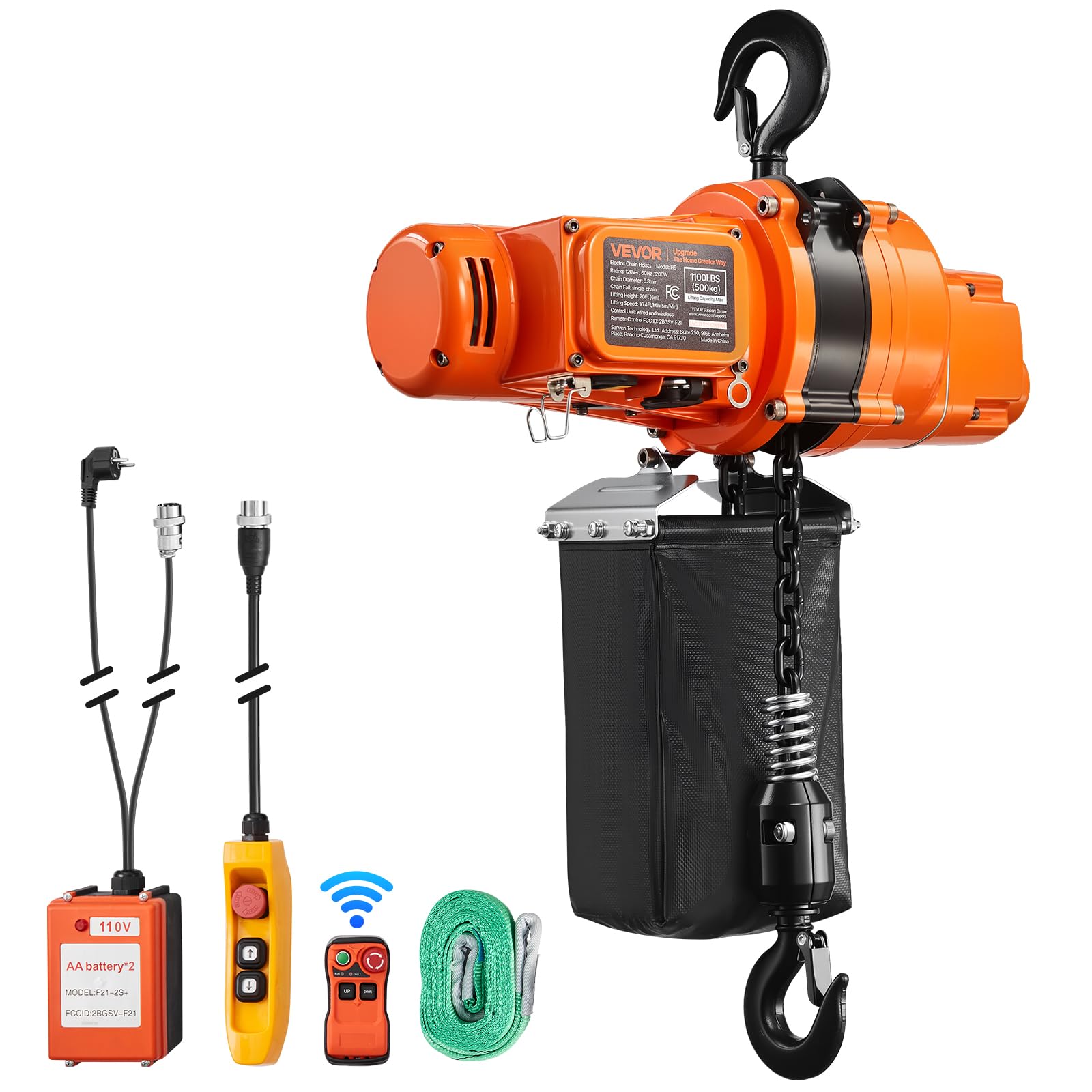
You get 20 ft of lift travel here — double the reach of the VEVOR 2200 lb wired model, which tops out at 10 ft — so you can raise loads high in a tall garage bay or over a mezzanine. Capacity sits at 1100 lbs, half the 2200 lb rating of that same wired unit, so this is the pick for engines, shop doors and generator swaps rather than truck axles. The fixed 16.4 ft per minute lifting speed is steady and predictable, which suits jobs where you stop and start a lot.
What wins people over is straightforward function — owners use it to open and close 12 ft shop doors, pull jeeps’ hard tops, and hoist a 250 lb go-kart off a ceiling joist. The build holds up too: a G100 alloy steel chain, a 360° rotating forged hook and an aluminum housing, with an IP54 motor (dust and splash protected) and a cooling fan for long sessions. The 328 ft wireless remote plus a 15 ft wired remote means you can control the lift from across the shop or stand right beside the hook.
Safety hardware is where this one earns its spot. Upper and lower limit switches stop the chain at both ends of travel, and auto braking engages on power loss so the load does not free-fall. There is an emergency stop on the remote as well. The honest catch is the paperwork: the install instructions are thin, and one recurring note is that the manual says far more about not standing under loads than about how to mount the unit. Plan your ceiling or beam attachment yourself and you will be fine.
Where it shines
- 20 ft lift reaches high bays and mezzanine openings that a 10 ft unit cannot
- 328 ft wireless remote lets you run the lift from a safe distance
- Upper and lower limit switches plus power-loss auto braking
- G100 alloy chain and 360° forged hook
Where it falls short
- 1100 lb capacity is half what the 2200 lb wired model handles
- Installation guidance in the manual is limited
Grab this one if: your ceiling is high, your loads are engines and small vehicles, and you want to operate the lift from across the room.
Reach for the heavier instead: if you routinely pull truck parts near the 2200 lb mark, the capacity here will feel tight.
2. VEVOR 2200lbs Electric Chain Hoist
Double the capacity of its 1100 lb sibling, and it moves fast.
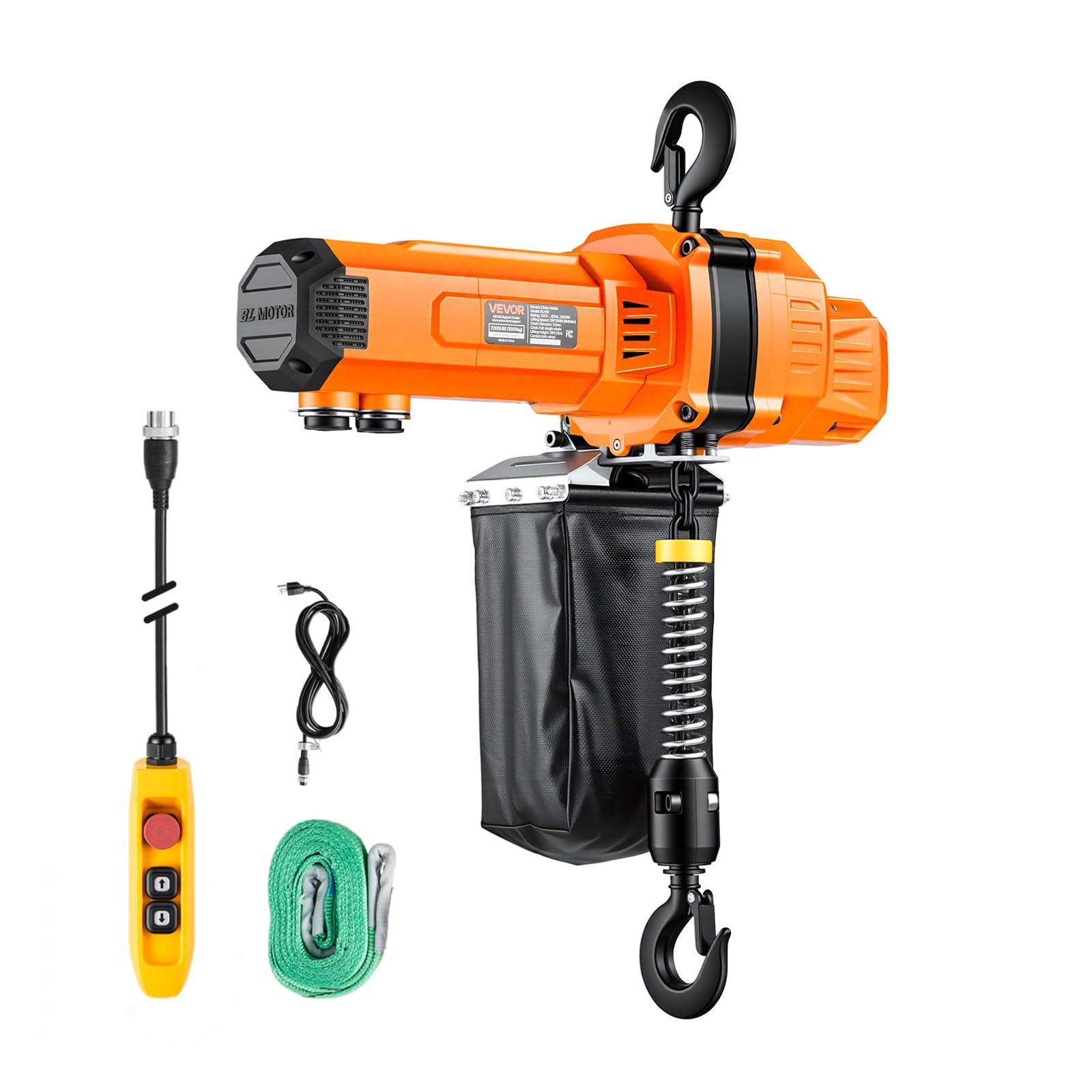
This is the quickest lift on the list, running at 29 ft/min versus the 16.4 ft/min of the smaller VEVOR. That speed matters when you are loading and unloading repeatedly — each trip up or down takes noticeably less time. Capacity climbs to 2200 lbs on a single chain, and the 10 ft lift height suits a standard garage ceiling or a bench-height rig. At 45.2 lbs it is also the lightest unit here by a wide margin, which makes hanging and repositioning far less of a wrestling match.
Function is what carries this model. Owners use it to move overhead transformers from a loading dock, to load heavy items onto trucks, and for general shop lifting, and it handles those jobs without complaint. The G100 alloy chain, 360° forged hook and aluminum housing match the build of the smaller VEVOR, and the IP54 motor with cooling fan and F-class insulation is set for daily use. A 10 ft wired pendant keeps control close and the response direct.
The catch is durability, and it is the most-discussed weakness in the reviews. Reviewers report gears stripping after about six months of once-a-week use well under the rated 2200 lb, and one shaft failing within two months. Buyers also flag the build quality as mixed, with plenty of praise alongside the complaints. Treat this as a light-to-medium duty hoist and keep loads well below the ceiling, and it performs well — but if you plan to work it hard every day, the Prowinch below is the sturdier build.
What you get: 2200 lbs of capacity, 29 ft/min speed, a 10 ft lift and a wired pendant, all in a 45.2 lb body that is easy to mount.
What to keep in mind: the gear train has a history of failing under sustained weekly use, so this suits occasional and medium-duty jobs more than a daily production line.
Lean this way if: you want max capacity and speed for lighter-duty, intermittent lifting.
Look elsewhere if: your hoist will run hard every day and durability is your top concern.
3. ANBULL 2200lbs Electric Chain Hoist

The one built around a heat-treated imported chain and two rotating hooks.
Quality is the headline here. This hoist runs a Japan-imported FEC chain in DT grade carburized alloy steel — a heat-treated alloy chosen for wear resistance and for holding up under heavy loads. The maker claims a 4x safety factor and a heat-resistant grade rated to 200 degrees. Capacity lands at 2200 lbs (1000 kg) on a double chain, with a 10 ft lift height and a 10 ft per minute lifting speed that trades speed for control.
What stands out is the hardware. You get two 360° rotatable manganese steel hooks with safety latches, so you can rig a load from either end. A double brake system stops the load immediately after a power failure. A quick connector lets you move the unit without wire entanglement, and the package includes a chain bag, limit switch, electromagnetic brake and a 6.5 ft automotive-grade sling. The 1300 W motor runs on 120V / 60Hz single phase.
The one real gripe is the pendant. It is a 10 ft wired remote with up, down and emergency stop buttons, and the recurring note is that the controller feels cheap and bulky in the hand. It works, and it keeps you at a safe distance, but it is not the smoothest control on this list. Duty is also capped at 15 minutes per hour, so this is not a nonstop production hoist — it is a well-built tool for truck beds, welding machines and bench work.
The build story
- Japan-imported FEC chain in DT grade carburized alloy steel
- Double brake system stops the load after power loss
- Two 360° manganese steel hooks with safety latches
- Includes chain bag, limit switch and a 6.5 ft sling
The trade-offs
- 10 ft per minute speed is slower than the 29 ft/min VEVOR
- Wired pendant feels cheap and bulky
- Duty limited to 15 minutes per hour
The right call for: buyers who put chain grade, brake system and hook quality above speed.
Think twice if: you need nonstop lifting or want a wireless remote.
4. Prowinch 1 Ton Electric Chain Hoist
The heavy-duty long-reach hoist built to workshop standards and rated for real overhead duty.
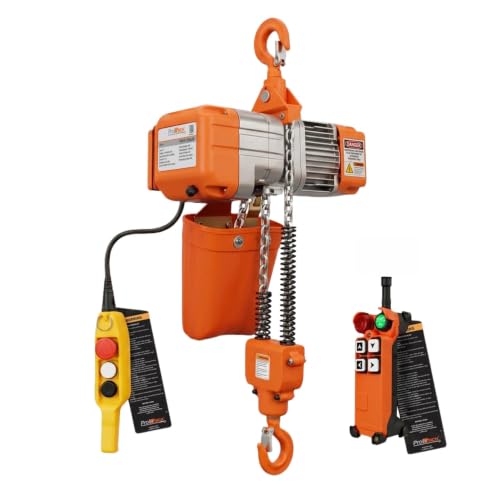
This is the most specified hoist on the list, and it shows in the numbers. It lifts 2200 lb (1000 kg) up to 20 ft on a double fall of G80 load chain, matching the long reach of the 1100 lb VEVOR but at double the capacity. Lifting speed is 8 ft per minute — the slowest here, and deliberately so: with a 20 ft reach and a heavy load, you want fine control over speed. That trade-off is the whole point of a workshop-duty hoist.
The duty rating is the story. It carries duty class H2, M3, 1Bm, Class B, built to ASME HST-1 and ASME B30.16 — published overhead-lifting standards rather than unstated claims. The 0.65 kW motor uses IP54 protection, the pendant is IP65 sealed, and overload protection is built in, all in a cast aluminum housing. An F21-4 wireless remote with up, down and emergency stop reaches 300 ft and carries FCC ID OFNF21, and a 15 ft wired pendant backs it up. A forged top hook rotates 360 degrees so you can hang it from a beam clamp, gantry, jib or fixed I-beam trolley.
Braking is the other strength. An electromagnetic brake holds the load with no power, and a mechanical motor brake backs it up, with upper and lower limit switches and a red emergency stop rounding out the safety package. The obvious catch is weight: at 176.6 lb, this is nowhere near the 45.2 lb of the fast VEVOR, so plan on a two-person install or a lift assist. It also ships with open leads for hardwiring, so you need a proper single-phase connection rather than a plug.
The standard-built case for it: published ASME duty rating, a sealed IP65 pendant, two brakes and a 300 ft wireless remote — this is a hoist built for sustained overhead work, not weekend tinkering.
The honest weight question: 176.6 lb is a serious install job, and the open leads mean an electrician or a confident DIYer is required.
Pick this if: you need long reach, full 2200 lb capacity and a certified duty rating for shop-scale work.
Stay away if: you want a light, plug-and-play unit you can hang solo.
Know the Specs
Capacity and safety factor
Capacity is the maximum load a hoist is rated to hold, stated in pounds and kilos. Working well under that ceiling extends the life of the chain and brake. A higher safety factor means the chain and hooks are built with more margin beyond the rated load.
Lift height and speed
Lift height is how far the chain travels, measured in feet — 10 ft for a standard ceiling, 20 ft for a tall bay. Lifting speed, in feet per minute, sets how long each pull takes. Slower speeds give finer control for placing a load; faster speeds suit repetitive loading.
IP rating and motor protection
An IP rating tells you how well the motor and pendant keep out dust and water. IP54 means protected against dust and splashing; IP65 on a pendant means protected against dust and low-pressure water jets. In a dusty shop or damp garage, a higher rating means less maintenance.
Brakes and limit switches
An electromagnetic brake holds the load when power is lost; a mechanical motor brake is a backup. Upper and lower limit switches stop the chain before it overruns its travel. An emergency stop gives you an instant cutoff on the remote.
Common Questions
Will a single phase chain hoist run on a standard garage circuit?
How much capacity do I actually need for lifting an engine?
What is the difference between a 10 ft and a 20 ft lift height?
Is a wireless remote or a wired pendant better on a chain hoist?
What does IP54 mean on an electric hoist motor?
How often can I run a chain hoist before it needs a rest?
What happens to the load if the power goes out mid-lift?
Can I mount one of these hoists to a wooden ceiling joist?
Does chain grade really matter on a single phase hoist?
The Bottom Line
The strongest all-round pick is the VEVOR 1100 lbs Electric Chain Hoist — 4.0+ stars across 180+ owners — because it pairs a 20 ft lift with a 328 ft wireless remote at a capacity that covers most garage and shop jobs. If speed and raw capacity on a wired pendant (a corded control box) are what you want, the VEVOR 2200lbs runs at 29 ft/min, though its gear train has a history of durability complaints. For the sturdiest chain-and-brake build, the ANBULL 2200lbs uses an imported FEC double chain and a double brake system. And if you need certified workshop duty with long reach, the Prowinch is the one built to ASME standards (the U.S. safety code for hoists) — just plan for a two-person install at 176.6 lb. Whatever you pick, match capacity and lift height to your actual loads, mount to structure you trust, and never stand under a suspended load.
How we choose
We do not accept paid placement. Every pick is matched to a real buyer and a real use-case; we do not hands-on test units.
Sources
Specifications: manufacturer listings and product documentation. Review insights: verified customer reviews, as of November 2026. Pricing: not shown on this page (it changes often); check the current price via the retailer link.
As an Amazon Associate, Tactical Gear Guy earns from qualifying purchases. This does not affect which products we feature.