Specs are compiled from manufacturer listings and verified buyer reviews and can change over time — please confirm the key details on the product page before buying.
Your factory radio sounds thin, your phone keeps sliding off the seat, and every single-DIN deck on the shelf looks identical in the photo. The real decision depends on three things: whether the chassis clears your dash cavity, whether Bluetooth holds the pairing instead of dropping it, and whether the amp inside can push your speakers without straining. This guide sorts nine single-DIN Bluetooth radios by who they actually suit, from old pickups to boats to work trucks.
This guide is built by comparing the manufacturers’ published specifications and the patterns across verified customer reviews, so you get each pick’s real strengths and trade-offs instead of marketing spin.
You will see which decks need an amp, which ones fight your phone, and which ones reward a careful install. Here is the honest shortlist of the best single din bluetooth radio options for a dash that actually fits.
Top Picks


How To Choose The Best Single DIN Bluetooth Radio
A single-DIN radio replaces your factory deck in the same rectangular opening the car came with. That opening is roughly 7 inches wide and 2 inches tall, so the box that slides in has to match that sleeve. Get that wrong and no amount of sound tuning helps.
Chassis depth decides whether it drops in clean
Old dashboards, boats, and motorcycles often have very little room behind the fascia. A short-depth receiver, sometimes called a mechless deck because it skips the CD mechanism, slides into those tight cavities without surgery. Look for a depth figure in the specs before you buy, not after you have the trim ring off.
Watts, preamp outputs, and what your speakers need
The built-in amplifier rating tells you how hard the deck can push your door speakers on its own. Preamp outputs (the RCA jacks that feed a separate amp or subwoofer) decide how far you can grow the system later. A deck with more preamp channels and higher voltage gives a cleaner signal to an outboard amp, which matters once you add bass.
Bluetooth that stays paired
Streaming is the whole point of a modern single-DIN deck, so pairing behavior matters more than the feature list implies. Dual-phone support lets a driver and passenger both connect. Voice dialing and an included microphone mean you can take calls with both hands on the wheel. Ask yourself if you want a physical remote or app control, because those two are not the same experience in traffic.
Side-by-Side Comparison
| Model | Best For | Power Output | Media Inputs | Chassis Note | Amazon |
|---|---|---|---|---|---|
| KENWOOD KMM-BT332U★ Best Overall | Built-in Alexa, deep sound tuning | 50W x 4 | USB, AUX, Bluetooth, SiriusXM-ready | 7-3/16″ x 2-1/8″ x 3-15/16″ | Amazon |
| JBL Celebrity150Best Value | Simple, budget-friendly swap | High preamp voltage | USB, AUX, SD card, Bluetooth, FM | 1.97″D x 7″W x 3.43″H | Amazon |
| Pioneer MVH-S230BTBest for Tight Fits | Short-depth installs | 50W x 4 | USB, Bluetooth, AM/FM | Under 4″ deep | Amazon |
| JVC KD-SX27BT | Budget audiophile tuning | 100W (50W x 2 output) | USB, AUX, Bluetooth, AM/FM | 3.94″D x 7.17″W x 2.09″H | Amazon |
| Sony DSX-A410BT | Voice control and dual phones | 4-channel | USB, AUX, Bluetooth, AM/FM | — | Amazon |
| KENWOOD KMM-BT270U | Loud MOSFET output on a budget | 200W max | USB, AUX, Bluetooth, AM/FM | — | Amazon |
| JVC KD-SR87BT | CD player with Spotify control | 50W x 4 | USB, AUX, CD, Bluetooth, AM/FM | 7-3/16″ x 2-3/16″ x 6-1/8″ | Amazon |
| Sony MEX-N5300BT | CD player plus SiriusXM-ready | — | USB, AUX, CD, Bluetooth, AM/FM | — | Amazon |
| Pioneer SPH-10BT | Phone-as-touchscreen app control | — | USB, AUX, Bluetooth | — | Amazon |
Detailed Reviews
1. KENWOOD KMM-BT332U Bluetooth Single DIN Car Stereo
Our pick — 4.5+★ from 600+ verified ratings; the strongest balance of quality and price.
A 13-band EQ with digital time alignment gives this Kenwood more sound-shaping control than any other deck here.
If your old radio died and your speakers never sounded good anyway, this Kenwood is the one to beat. It carries a 13-band equalizer with digital time alignment (a setting that delays each speaker by milliseconds so the sound from all four reaches your ears together), which is the kind of control you normally only see on pricier head units. Add the 6-channel preamp outputs (2.5-volt rear and sub) and you have room to grow into a proper sub and amp setup later without replacing the deck.
Power comes from a 50-watts-per-channel amplifier, and it plays FLAC and WAV high-res files from a USB stick. The front USB port pushes 1.5A to charge a phone while it streams. Bluetooth handles audio streaming and hands-free calls with the included microphone, and you can have two phones connected at once. Built-in Amazon Alexa is unusual at this size, letting you ask for directions or music by voice. The faceplate detaches, which is a real theft deterrent in a truck that parks on the street.
What wins people over is the sheer amount of sound shaping — mids and highs stay clean, and the deck drives stock speakers with enough authority that you may not feel the urge to upgrade them. The catch is surprisingly practical: there is no remote in the box and no standalone remote that works with this model, so you are meant to run it through the app. A recurring gripe is that the app connection itself can be finicky, so treat the phone app as a bonus rather than the main control and you will be happy. The display is also fairly plain, which some drivers find boring to look at.
What Owners Rave About
- 13-band EQ with digital time alignment gives fine control over your sound stage
- 6-channel preamp outputs (2.5V rear/sub) leave room for a sub and amp later
- Built-in Amazon Alexa for voice music and directions
- Detachable faceplate adds theft protection
- Plays FLAC and WAV high-res files from USB
Where It Falls Short
- No working standalone remote — app control is the intended path
- The app connection can be unreliable
- Display is plain compared with flashier units
Go for this if: you want the most control over sound quality in a standard single-DIN opening, and you plan to add a sub or amp eventually.
Know this first: the included app is supposed to replace the missing remote, and that app does not always hold the connection.
2. JBL Celebrity150 Single DIN Bluetooth FM Radio
A mechless deck with a 1.97-inch body and high-voltage preamp outputs that feed an add-on amp a clean signal.
For a driver who just wants Bluetooth, a USB port, and a radio in an older vehicle, the Celebrity150 does the job with almost no learning curve. It is a mechless receiver, meaning there is no CD slot, which keeps the box shallow — the listed chassis runs about 1.97 inches deep, roughly half the depth of the JVC KD-SX27BT at 3.94 inches. That shorter body makes it far easier to seat into a cramped dash or a motorcycle fairing.
It reads USB drives, AUX, SD cards, and FM radio, and the ISO connector with the included wiring harness simplifies the swap. The standout technical point is the high preamp voltage on its RCA outputs — that is the signal level going to an add-on amplifier, and a strong signal there means a cleaner feed to your amp. The sound itself gets plenty of praise for a basic head unit, and the simple push-button layout is genuinely easy to use while driving.
The honest catch with this one is volume ceiling. The deck sounds good and pairs easily, but a few drivers find it short on outright volume once you push it, and the EQ is limited with only a handful of bands and no crossover tuning for a subwoofer. One quirk a few owners hit: after cycling the ignition, they have to press the reset button to get sound back. It is the trade-off for a basic deck at this tier, so buy it for simplicity, not for a custom sound stage.
The easy-swap pick: ISO connector and included harness mean less wiring guesswork, and the short chassis depth of 1.97 inches fits tight cavities that the deeper JVC deck will not.
The honest limit: basic EQ and no subwoofer crossover mean you will not fine-tune the low end without extra gear.
The simple route: ideal for an older car or bike where you want Bluetooth and USB without menu diving.
Look elsewhere if: you need serious volume or subwoofer tuning out of the deck.
3. Pioneer MVH-S230BT 1-Din Car Stereo
An under-4-inch chassis at 1.1 pounds, plus Advanced Sound Retriever processing that rebuilds detail lost in compressed streams.
This Pioneer earns its spot mostly on install-friendliness. The chassis depth is listed as under 4 inches, so it drops into dashes that will not swallow a CD-deck housing. If you have ever wrestled a factory radio back out to find a heater duct sitting where the CD mechanism should go, this is the fix. It also keeps the weight down: at 1.1 pounds it is lighter than the Kenwood KMM-BT332U at 1.3 pounds, about 18% less, which is welcome in motorcycles and boats where mass behind the fascia can add vibration.
Sound comes from a 50W x 4 output stage, and the Advanced Sound Retriever feature (a processing mode that rebuilds detail lost when music is compressed to MP3 or streamed) makes streaming audio sound less thin. It handles MP3, WMA, AAC, and WAV. The front USB port charges a device while you play from it, and Bluetooth gives you hands-free calls with the phone in your pocket. Selectable front or subwoofer RCA output lets you route bass separately if you add a sub later.
Bluetooth is the split opinion here — some drivers get an instant connection every time, while others see frequent dropouts. The included instructions are thin enough that programming the station presets and sound menu takes patience. And it is a mechless deck, so there is no CD player. That is fine for most drivers now, but if you still spin discs, you will need a different unit.
Best for shallow cavities: under 4 inches of depth protects you from cutting the dash or removing a factory brace.
Bluetooth honesty: pairing is instant for some and flaky for others, so keep a USB cable handy as a backup audio path.
The light-duty installer’s pick: right for a bike, boat, or classic dash where space behind the fascia is scarce.
Skip if: you rely on a CD player or want a rock-solid Bluetooth connection you never touch.
4. JVC KD-SX27BT Car Stereo with Bluetooth, 100W

A budget JVC with a 13-band EQ, time alignment, and Sound Lift for drivers who build their own sound signature.
Inside this JVC is a lot of tuning for the tier. You get a 13-band equalizer, time alignment, and Sound Lift (a processing mode that raises the perceived height of the audio image) on top of K2 technology, which is JVC’s own digital restoration processing for compressed files. Drivers who like to build their own sound signature in an old truck or a Harley install get plenty to work with. The 1.5A front USB charges a phone quickly, and it plays MP3, WMA, WAV, AAC, and high-res FLAC from a stick.
Bluetooth handles streaming and hands-free calls with the included mic, and you can connect two phones full-time plus up to five Bluetooth devices at once. The JVC Remote app for iOS and Android lets you control the deck from your phone. That means one small screen running both your music and the head unit settings, which is handy in a vehicle with limited dash space.
Two recurring complaints are worth knowing before you commit. The clock does not reliably keep correct time, and the deck is not especially loud for some owners. It also sits at a chassis depth of 3.94 inches, which is deeper than the Pioneer MVH-S230BT’s under-4-inch body — still fine for a standard opening, but tight in a shallow dash. If the clock accuracy matters to you, plan to read time off your phone instead.
Why Tinkerers Like It
- 13-band EQ, time alignment, and Sound Lift suit custom sound tuning
- Dual phone connection plus up to five Bluetooth devices
- Plays high-res FLAC files from USB
- 1.5A USB port charges phones at a useful rate
- JVC Remote app for iOS and Android
The Real-World Warts
- The clock does not reliably hold the correct time
- Some drivers find it short on maximum volume
- Depth of 3.94 inches may crowd a tight dash
Reach for it if: you enjoy dialing in an EQ and want audiophile-style controls without a premium-tier budget.
One caution: a clock that drifts is a daily annoyance, so do not buy this if you glance at the deck for the time.
5. Sony DSX-A410BT Single Din Bluetooth Car Stereo

A call-first Sony that keeps two phones paired at once and runs music, directions, and messages by voice.
Some drivers want the radio to disappear into the background and let voice do the work. That is the Sony’s whole personality. Voice control lets you manage music, pull real-time directions, and message contacts by speaking, so your hands never leave the wheel. Dual Bluetooth keeps two phones paired simultaneously, so a work phone and a personal phone can both take calls on the drive.
Sound quality is the feature that wins people over here — drivers describe hearing parts of familiar songs they never noticed before, and the built-in 4-channel amp runs the speakers cleanly without distortion. It handles USB, AUX, and Bluetooth audio, and the front AUX and USB ports give you a wired fallback. Installation is straightforward: the deck uses a universal wiring harness, and drivers report fitting it into everything from a 1992 Honda Accord to a 1977 Toyota with no drama.
Two things to weigh. The user interface has more layers than some drivers want, and one owner flat-out called it over-complicated. Faceplate reattachment also takes a firm hand, so if you pull the faceplate at night to deter theft, get smooth at snapping it back. There is no CD slot on this model, so disc collectors should look to the Sony MEX-N5300BT further down the list. It is a strong pick for call-heavy commuting, less so for tinkerers who want deep EQ control.
Why calls sound so good: dual Bluetooth and dedicated voice control make hands-free calls the star of the show, not an afterthought.
The learning curve: menus run deep, so set aside time with the manual before you assume something is broken.
Made for talkers: perfect if most of your drive time is phone calls and music streamed from two paired devices.
Not your deck if: you want one-touch simplicity or a CD slot in the fascia.
6. KENWOOD KMM-BT270U Bluetooth Digital Media Receiver

A 200-watt-max MOSFET amp for drivers who want the deck itself to push upgraded speakers without an add-on amp.
If you are not adding an amp but you do want the radio to push your speakers harder, this Kenwood brings a MOSFET amplifier rated up to 200 watts max. That is the headline number that makes it attractive for someone replacing a tired factory deck in an old van or pickup. The trade-off in simplicity: no CD player, just USB, AUX, and Bluetooth media playback. It plays music files from USB sticks, reads iPods and iPhones over USB, and streams from a Bluetooth phone with the included mic for hands-free calls.
A high-contrast LCD and detachable face keep the front panel readable and theft-resistant. A 13-band EQ gives you room to tweak the tone, and controls are laid out plainly enough that drivers call them simple to operate. Setup runs through a menu system that takes a few minutes the first time, then settles down. The front USB port also charges your phone while it plays.
The honest side is reliability — a recurring pattern shows some of these decks working well at first and then developing Bluetooth pairing trouble after a few weeks. That is not everyone’s experience, but it is common enough to mention. If you are buying for a project vehicle you may want a return window with some cushion. Otherwise the sound adjustments, straightforward controls, and strong power output make it a solid fit for a budget dash swap.
What Makes It Stand Out
- MOSFET amplifier rated up to 200 watts max for louder output without an add-on amp
- High-contrast LCD with a detachable faceplate
- 13-band EQ for tone shaping
- Simple controls that drivers adapt to quickly
What to Watch For
- A pattern of Bluetooth pairing trouble after several weeks for some units
- No CD player — mechless only
- Menu setup takes a few minutes of patience
Amp-free loudness: a fit for anyone who wants the head unit itself to drive upgraded speakers hard.
Buy smart: keep the receipt handy for a few weeks and test the Bluetooth pairing before the return window closes.
7. JVC KD-SR87BT Single DIN Car Stereo with CD Player

One of the few single-DIN decks left with a CD slot, plus wireless Spotify and Pandora control from Android.
Most single-DIN decks these days are mechless, so if you have a shelf of CDs and still want Bluetooth streaming, this JVC fills a shrinking gap. It plays discs, reads USB, handles AUX, and streams Bluetooth with dual-phone connection and voice recognition dialing. The included microphone opens hands-free calls, and you can control Pandora and Spotify wirelessly from an Android device — useful if you keep playlists on your phone.
The sound engine has a 13-band equalizer with digital time alignment and K2 technology for restoring compressed tracks, plus a front USB port that pushes 1.5A to charge your phone. Two preamp outputs (2.5-volt rear and sub) feed out to an external amp or subwhen you want more bass. The front panel detaches, the LCD is high-contrast, and the package includes a wiring harness and microphone with a bracket.
The fit dimension is worth noting. The display is also dim for some drivers even at its brightest setting, and a few report the clock not staying set. If you drive a modern dash or a slim cavity, this is not the unit for you. If you have room and want disc playback, it is one of the few good options.
Built for disc and streaming both: dual-phone Bluetooth plus CD playback covers old media and new in one chassis.
Space is the price: a 6-1/8-inch deep body demands a roomy dash cavity, and the dim display is a compromise in bright sun.
Keep spinning discs: the pick for a collector with a roomy dash who still wants Bluetooth and Spotify control.
Measure first: if your cavity is shallow, this deep body will not seat without modifications.
8. Sony MEX-N5300BT Car Stereo Single Din Radio
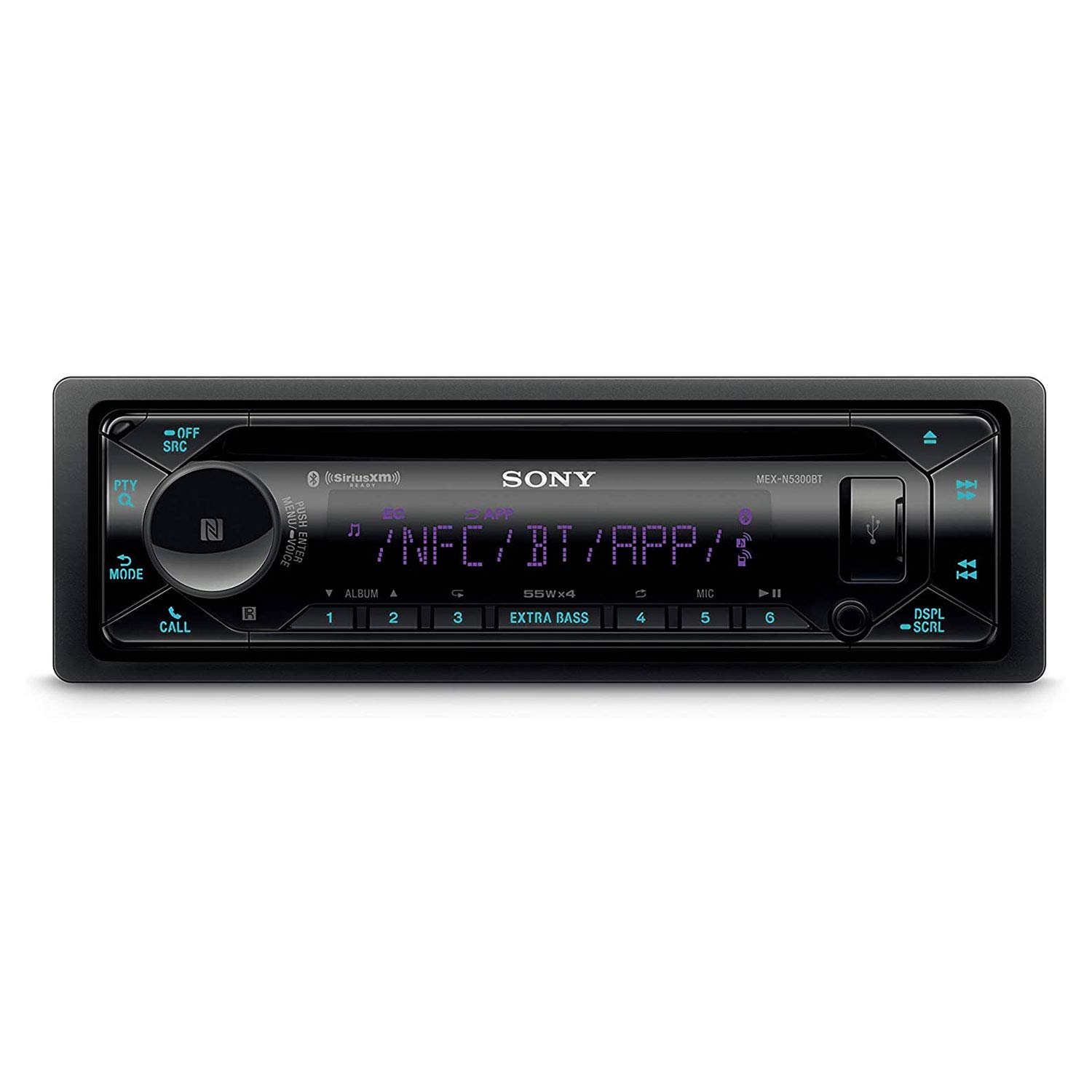
A SiriusXM-ready Sony with a CD player and a solid, near plug-and-play build for long-haul driving.
Long-haul drivers get the most from this Sony. It is SiriusXM-ready, which means you can add satellite service for music, sports, and news that keeps playing where cell coverage drops — helpful on rural highways and long tows. It also has a CD player, so road-trip discs are still in play, plus USB and AUX inputs for your phone. Bluetooth covers hands-free calling and audio streaming with artist, album, and song search on the screen.
Build quality is the standout. The unit feels solid, menus are labeled intuitively, and drivers describe installation as close to plug-and-play. The sound is clean, and the 42-out-of-50 clean-volume note from the review pages suggests the deck can run loud before it distorts. RDS on the FM tuner displays the station name and song info on screen, which saves you squinting at preset numbers.
The one thing to plan for is the satellite tuner. It is sold separately, not in the box, so budget for that add-on if satellite radio is the reason you are buying. Bluetooth is generally good, but a few drivers note occasional dropouts. No touchscreen here either, which is fine because the physical buttons are easier to hit while driving than glass. For a farm truck or a work van, it is a durable choice.
Road-trip ready: SiriusXM-ready with CD, USB, and Bluetooth covers every media source you might want on a long drive.
Cost of entry: the satellite tuner is a separate purchase, so factor that in if SiriusXM is the draw.
The long-haul companion: the deck for someone who wants satellite radio, CDs, and USB in one durable chassis.
Budget note: the SiriusXM tuner is not included, so plan for that extra hardware.
9. Pioneer SPH-10BT 1-Din Smart Sync Car Stereo

Turns your phone into the touchscreen your single-DIN slot never had.
This is the deck for a driver who does not want a screen in the dash but also does not want to squint at a tiny radio display. The Pioneer SPH-10BT uses a built-in phone cradle that tilts 90 degrees and holds almost any phone, then runs Pioneer Smart Sync on your phone to build a touchscreen interface. Navigation, hands-free calling, messaging, and music all run through the app, so the dash stays clean and removable.
MIXTRAX technology adds DJ-style transitions and lighting effects for a more entertaining music stream — a small touch, but it makes road music feel less like a radio broadcast. Bluetooth is built in, and there are USB and AUX inputs for wired connections. The deck also supports a backup camera and can pair with brand backup sensors, so you can grow the setup into a safety tool. Sound quality is strong here, with bass response that does not need an add-on sub to feel present.
The trade-off is app dependence. The Smart Sync app can be distracting in traffic, and a few drivers report the app being unreliable or failing to auto-connect. The phone holder is the cleverest part but also the fussiest if you use a bulky case or a flip phone. If you dislike touchscreen menus, this is not the deck for you. For a driver who already runs everything from the phone, it is a smart fit.
What Makes It Clever
- Phone cradle creates a touchscreen interface without replacing the dash
- Pioneer Smart Sync app handles navigation, calls, messages, and music
- MIXTRAX adds DJ-style transitions and lighting effects
- Supports backup camera and brand backup sensors
- Strong sound quality from the start
Where the App Hurts
- Relies heavily on the app, which can be unreliable or fail to auto-connect
- Touch-heavy interface is distracting while driving
- Bulky phone cases may not fit the cradle cleanly
A dash-friendly screen: right for a driver who wants modern touch control without cutting the fascia for a larger display.
The dealbreaker for app-averse drivers: if you dislike phone menus, the app dependence here will frustrate you every trip.
Know the Specs
Amplifier Watts per Channel
The wattage rating tells you how loud the deck can drive your door speakers on its own. A 50W x 4 deck (four channels, 50 watts each) has enough power for most factory speakers. A 200-watt max rating signals more headroom, so the sound stays clean at higher volume before it distorts. If you plan to add external amplification, the deck’s built-in power matters less than its preamp outputs.
Preamp Outputs and Voltage
Preamp outputs are the RCA jacks that send low-level audio to a separate amplifier or subwoofer. The voltage number (like 2.5V or a higher figure) is the signal level that the RCA carries — a higher-voltage signal means a cleaner feed to the amp. More preamp channels (like the 6-channel outputs on some units) let you feed front, rear, and subwoofer amps separately. A basic deck with no preamp outputs is fine for speakers-only use but limits later upgrades.
Dual Phone Bluetooth Pairing
Dual phone connection lets two phones stay paired at the same time, so a driver and passenger can both take hands-free calls or stream music without unpairing the other device. Some decks extend that to several paired phones at once, which is useful if the vehicle has multiple regular drivers. The practical test is whether the deck reconnects automatically when you start the car — that is what makes or breaks daily use.
Mechless vs. CD Player Design
A mechless deck (no CD mechanism) has a shallower body than a CD-playing unit. That shallow depth is why a mechless receiver fits into older or tight dashes that a CD deck cannot. The trade-off is no disc playback, so if you still own and play CDs, you need to look for a unit that still has a CD player built in. Mechless decks are the more common choice among modern single-DIN Bluetooth radios.
Common Questions
Will a single DIN radio fit my car without cutting the dash?
Do I need an amplifier if the radio says 200 watts max?
What is the difference between preamp output voltage on these radios?
Can I connect two phones to these Bluetooth radios at once?
Do I need a wiring harness adapter for these radios?
Is it worth buying a deck with a CD player if I mostly stream music?
How do I keep the clock on these radios accurate?
Can I add a subwoofer to a single DIN Bluetooth radio?
What does mechless mean on a car stereo?
Do these radios come with a remote or just app control?
The Bottom Line
For most drivers, the single din bluetooth radio winner is the KENWOOD KMM-BT332U because its 13-band EQ and 6-channel preamp outputs give you more control than anything else in the dash-swap bracket. If you stream satellite radio or want a disc player, the Sony MEX-N5300BT covers CD playback and SiriusXM-ready radio in one durable chassis. And if your dash cavity is tight, the Pioneer MVH-S230BT and its under-4-inch body will fit where the deeper decks will not. One honest nudge: if sound control is the whole point, the Kenwood’s 13-band EQ with time alignment is the feature that most clearly earns a spot in the final two.
How we choose
We do not accept paid placement. Every pick is matched to a real buyer and a real use-case; we do not hands-on test units.
Sources
Specifications: manufacturer listings and product documentation. Review insights: verified customer reviews, as of November 2026. Pricing: not shown on this page (it changes often); check the current price via the retailer link.
As an Amazon Associate, Tactical Gear Guy earns from qualifying purchases. This does not affect which products we feature.