Specs are compiled from manufacturer listings and verified buyer reviews and can change over time — please confirm the key details on the product page before buying.
You want a camera that still shows you a face when the porch light is off and the rain is coming sideways. That is the whole job. Everything else — the app, the siren, the solar panel — is there to support one promise: when something happens at 2 a.m., you get a clear picture instead of a grey blur. The picks below cover wired floodlights, solar battery cams, and full multi-camera kits, and each one is built for exterior mounting rather than indoor use.
This guide is built by comparing the manufacturers’ published specifications and the patterns across verified customer reviews, so you get each pick’s real strengths and trade-offs instead of marketing spin.
How far the camera sees at night, which Wi-Fi band it uses, and where the footage is stored will decide your satisfaction more than megapixels do. The picks here run from a 2K floodlight that replaces your old porch light to a 4MP eight-camera kit that records to a local hard drive. So it helps to know which of these shop outdoor security cameras matches how your yard is actually wired.
Top Picks
How To Choose The Best Shop Outdoor Security Cameras
Most buyers start with megapixels and end up disappointed. An outdoor camera fails you on one of three things: it goes offline, it can’t see past ten feet in the dark, or it charges you monthly for footage you thought was yours. Get those three sorted and the rest is taste.
Power: plug-in, battery, or solar
A plug-in camera never needs charging, but you need an outlet near the mounting spot. Battery and solar models go anywhere — the trade is that cold weather eats capacity, and solar charging on the Tapo C645D KIT needs temperatures above 32°F to work. If your camera sits under a north-facing eave, plan on running a cable or buying a second battery.
Night vision: infrared versus spotlight
Infrared night vision gives you a monochrome picture that can reach 100ft on models like the REOLINK 5MP. A built-in spotlight gives you full color — enough to read a license plate or a hoodie color — but it also announces the camera’s position. Many cameras let you switch between the two, so check for that toggle before you mount anything.
Storage: card, base station, or cloud
A microSD card (a small memory card that slots into the camera) keeps footage local and free of monthly fees, and capacity matters more than people expect. The REOLINK RLC-510WA takes a card up to 512GB, which holds a lot of event clips. A base-station kit with a hard drive, like the Hiseeu eight-cam system, bundles 1TB of storage for local recording. Cloud plans add convenience and AI features, but they are a recurring bill, so decide up front if you want that.
Weatherproofing ratings explained
An IP rating is a two-digit weatherproof score: the first digit covers dust and the second covers water. IP65 means protected against dust and water jets; IP67 means it can survive brief immersion. Neither rating is permanent — seals wear with sun and frost — so mount under cover where you can. Note that the REOLINK E1 Outdoor Pro needs to be installed upside down outdoors for its best water resistance.
Wi-Fi bands and signal
2.4GHz Wi-Fi travels farther through walls; 5GHz is faster but shorter. Cameras that support both let you pick based on distance, and dual-band support is what separates a camera that stays connected from one that drops every storm. Cameras mounted far from the router — a back gate or a barn — benefit most from the 2.4GHz band.
Side-by-Side Comparison
| Model | Best For | Resolution | Power Source | Max Local Storage | Amazon |
|---|---|---|---|---|---|
| Ring Floodlight Cam 2K★ Best Overall | Replacing a porch light | Retinal 2K | Wired (hardwired floodlight) | — | Amazon |
| eufy Security eufyCam C37No Subscription | Zero monthly fees | 2K (4 mp) | Detachable 3W solar panel + battery | 256GB microSD | Amazon |
| VicoHome 2CG6Solar Runtime | Long solar runtime | 2K (3MP quad-pixel) | Solar + 5200mAh battery | — | Amazon |
| REOLINK RLC-510WA | Card capacity and metal housing | 5MP | Plug-in (Wi-Fi) | 512GB microSD | Amazon |
| REOLINK E1 Outdoor Pro | Pan, tilt, and optical zoom | 4K (8 mp) | Plug-in (Wi-Fi 6) | 512GB microSD | Amazon |
| Tapo C645D KIT | Two views from one mount | Dual 2K lenses | Solar + 10,000mAh battery | microSD (card not included) | Amazon |
| Arlo Essential 2K (3rd Gen) | Multi-camera coverage | 2K (1440p) | Rechargeable battery | Cloud (paid plan for history) | Amazon |
| Arlo Pro 2K HDR (6th Gen) | Wide yard coverage | 2K HDR | Rechargeable, swappable battery | Cloud (paid plan for history) | Amazon |
| Hiseeu 8-Cam Solar Kit | Whole-property setup | 4MP | Solar + base station | 1TB HDD included | Amazon |
Detailed Reviews
1. Ring Floodlight Cam 2K (newest model)
Our pick — 4.5+★ from 600+ verified ratings; the strongest balance of quality and price.
The camera that swaps out your porch light and starts watching the driveway the same evening.
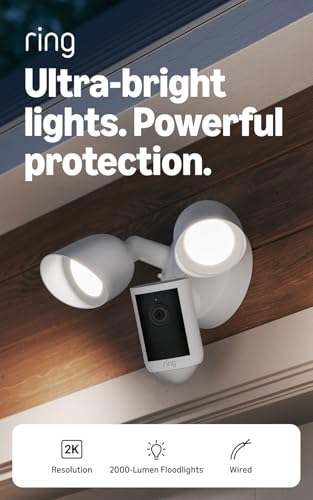
This is the pick for the person who already has a floodlight over the garage and wants that fixture to do more than blind the mailman. Ring built the Floodlight Cam 2K around a wide-angle Retinal 2K sensor, so the thing lighting your driveway is also recording it. That single-fixture trick is why it takes the top slot: you get a camera, a motion light, and a siren without running new cable or drilling a second set of holes.
Detail is the part people keep coming back to. The sensor records wide-angle 2K and the app lets you push in with up to 6x Enhanced Zoom, so a face at the end of the walk stays worth zooming into. The light and siren both fire from a tap in the Ring app, and the motion light kicks on automatically when the camera senses movement. Live View and Two-Way Talk let you answer a delivery driver without opening the door.
Here is the catch, and it is the one worth knowing before you buy. Intelligent alerts, rewatching past events, and the smarter notifications sit behind a Ring Protect Plan subscription, which is sold separately. Live view and instant motion alerts work without it. The other honest note is the floodlight brightness — that is the one spec buyers split on most, with plenty finding it plenty bright and a smaller group wanting more throw across a wide yard. Mount it lower and closer to the walk to get the most from it.
The install path helps here too. Ring walks you through the DIY wiring in the app, or you can bring in an installation expert if the existing fixture wiring looks older than you’d like. Either way, you are not paying a second contractor to run cable to a spot that already has power.
What earns it the top slot
- Camera, floodlight, and siren in one hardwired fixture — no separate power run.
- Wide-angle Retinal 2K video with up to 6x Enhanced Zoom for reading detail at distance.
- Live View and Two-Way Talk let you answer the door from your phone.
- Siren triggers from a single tap in the Ring app rather than a buried menu.
Where it asks more of you
- Intelligent alerts and video history require a Ring Protect Plan sold separately.
- Floodlight brightness is the spec owners split on — bright for a walkway, less throw for a wide yard.
- You need existing outdoor fixture wiring at the mount point.
Right call for: anyone replacing an old porch or garage floodlight who wants recording and a siren in the same hole.
Think twice if: you want free video history forever — that feature rides on the paid plan.
2. eufy Security eufyCam C37
One camera, a full 360° sweep, and no monthly bill attached to the footage.
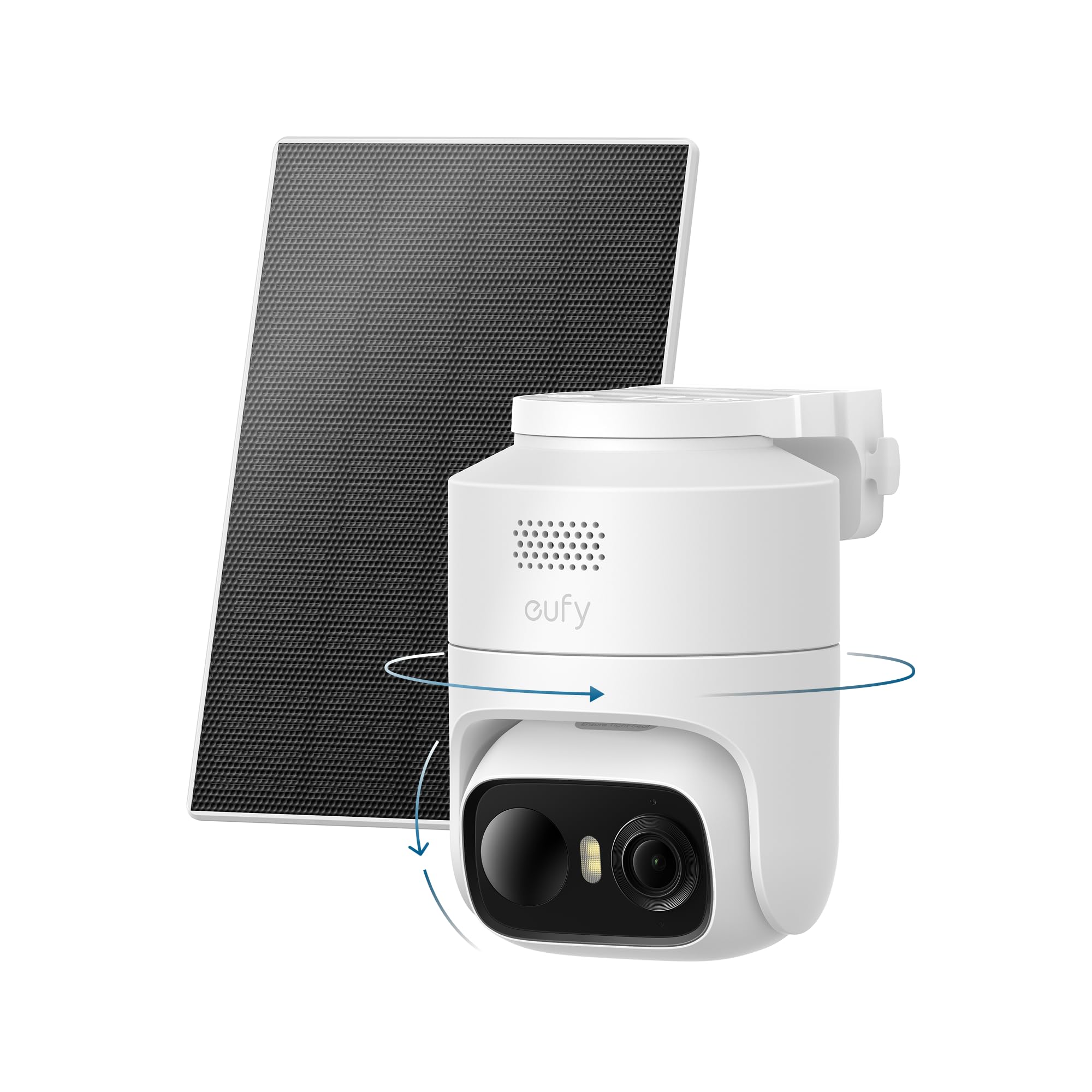
The eufyCam C37 answers the question a lot of buyers ask before anything else: can I record without a subscription? Yes — you insert a microSD card up to 256GB, sold separately, or connect the camera to a eufy HomeBase. Cloud storage isn’t supported at all, which sounds like a limitation until you realize it means your clips never leave your house. eufy claims the no-fee design saves up to three years of subscription costs.
Coverage is the other half of the pitch. A single camera pans and tilts through a full 360° and auto-tracks whatever it locks onto, so you don’t need two cameras to watch a side yard and a back door. The sensor records 2K color night vision — eufy puts that at 77% more pixels than 1080p — and a built-in spotlight lights faces and plates in color after dark. Smart detection sorts people, vehicles, and pets, so the alerts you get are the ones worth reading.
The detachable 3W solar panels are a genuinely useful wrinkle. You can point the panel at the sun and the camera at the gate, instead of compromising one to serve the other. Buyers report the solar keeps it running for days without a recharge. The honest caveat is reliability: a portion of buyers describe a unit that stops working after a few days, which is the pattern to watch for during your return window. Set it up, run it hard for the first week, and confirm it holds before the window closes.
One compatibility note that matters before checkout: it works with HomeBase Mini, HomeBase 3, HomeBase Professional, Network Video Recorder S4, and Smart Display E10, but not with HomeKit, HomeBase2, or Network Video Recorder E50. If you already own one of the unsupported hubs, this isn’t the camera for that shelf.
Storage math worth knowing: the C37 tops out at a 256GB microSD card, while the REOLINK RLC-510WA below takes 512GB — a literal 2.0x gap in card ceiling. If you record motion constantly and hate clearing old clips, that difference adds up over a season.
Buy it because: you refuse a recurring cloud bill and want one camera to cover a whole corner of the property.
Have a plan for: the occasional dead-on-arrival unit — test it thoroughly in the first days rather than trusting the box.
3. VicoHome 2CG6 2K AI Solar Security Camera
Built around a battery big enough that you stop thinking about charging it.
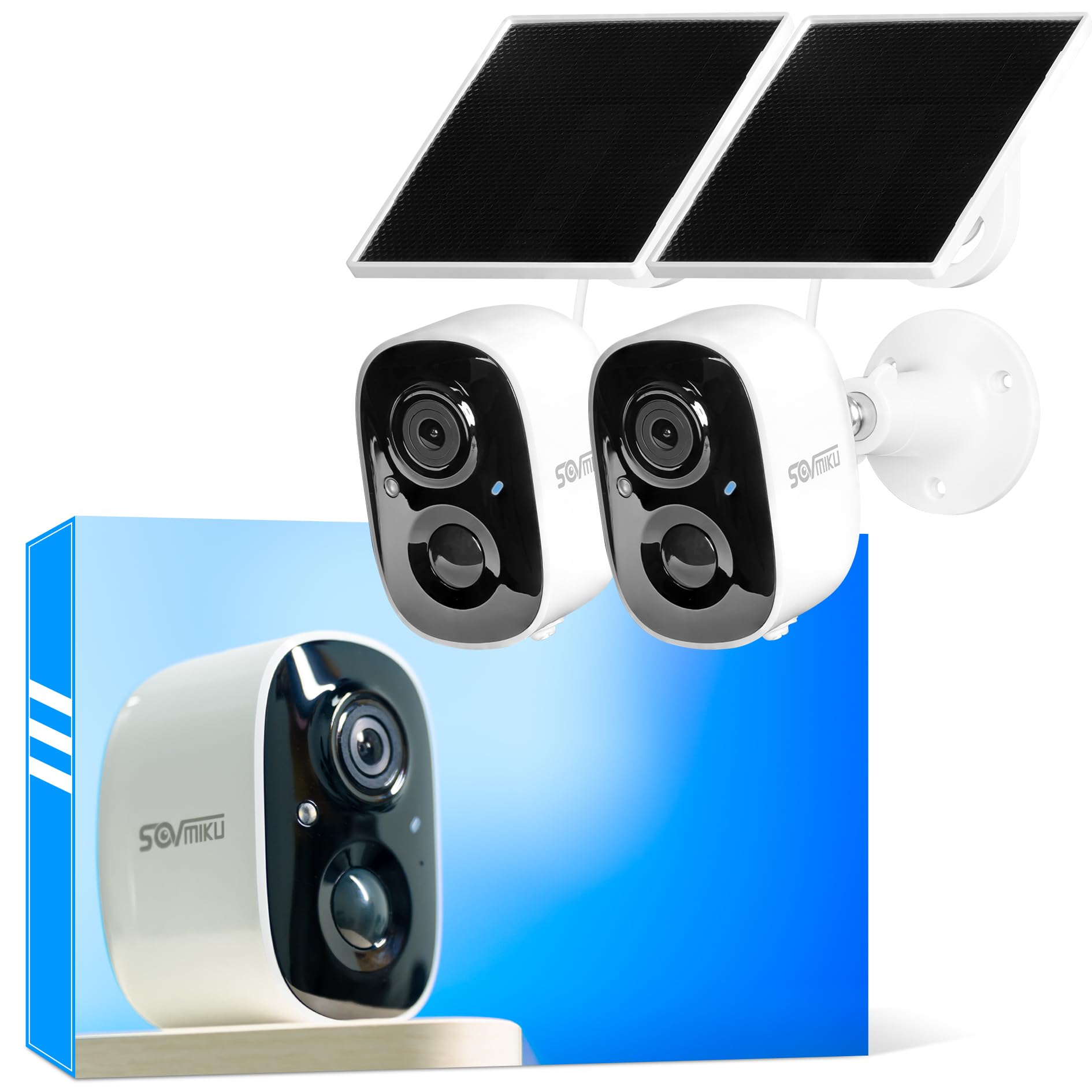
Where most solar cameras treat the panel as the main event, the VicoHome 2CG6 leads with a 5200mAh battery inside the camera body. VicoHome claims a full charge lasts two months or more, with monocrystalline panels converting at up to 23%. Buyers back that up: one reviewer reports 59 days of operation on solar alone. That is the number that matters if climbing a ladder every few weeks sounds miserable.
Picture quality lands where it should for this tier. The main camera uses a quad-pixel sensor that works from 3 megapixels, delivering 2K footage with a 110-degree field of view — wide enough to hold a driveway plus the corner of a garage. The PIR sensor (a passive infrared sensor that spots body heat) stays on constantly, then wakes the camera in just over 10 milliseconds when a warm body passes. At night it also kicks on the spotlight, and if you enable Alarm Flash and Alarm Siren, the camera flashes and sounds off on its own.
The durability spec is an IP65 rating under IEC standard 60529 — dust-protected and able to shrug off water jets, though VicoHome is upfront that resistance fades with normal wear. The charging port gets a silicone waterproof plug, which is a small detail that saves a big headache outdoors. Setup runs about 20 minutes, and buyers describe the process as straightforward with solar working as advertised.
Wi-Fi is the recurring complaint. Some owners mention frequent disconnections, and Wi-Fi connectivity is the mixed spot in the feedback. Pairing this with a mesh network (several routers that share one signal) or a router with strong 2.4GHz reach at the camera’s corner makes a real difference. If the camera is going on a detached barn or far gate, test the signal before you commit to the spot.
Where this one shines
- 5200mAh internal battery with up to 23% efficient monocrystalline solar panels.
- PIR sensor wakes the camera in just over 10 milliseconds and triggers spotlight and alarm.
- IP65 weatherproofing with a silicone plug over the charging port.
- 110-degree field of view covers a driveway and garage corner from one mount.
Worth knowing up front
- Wi-Fi drops come up often enough to make signal strength a real install consideration.
- Battery life is mixed in owner feedback rather than a uniform rave.
- Weather resistance wears over time — the IP65 seal is not permanent.
Fits best: a spot with decent sun and a strong 2.4GHz signal, where charging access is the enemy.
Check first: whether your router reaches that corner — this is a camera that lives or dies on signal.
4. REOLINK 5MP WiFi Outdoor Camera RLC-510WA
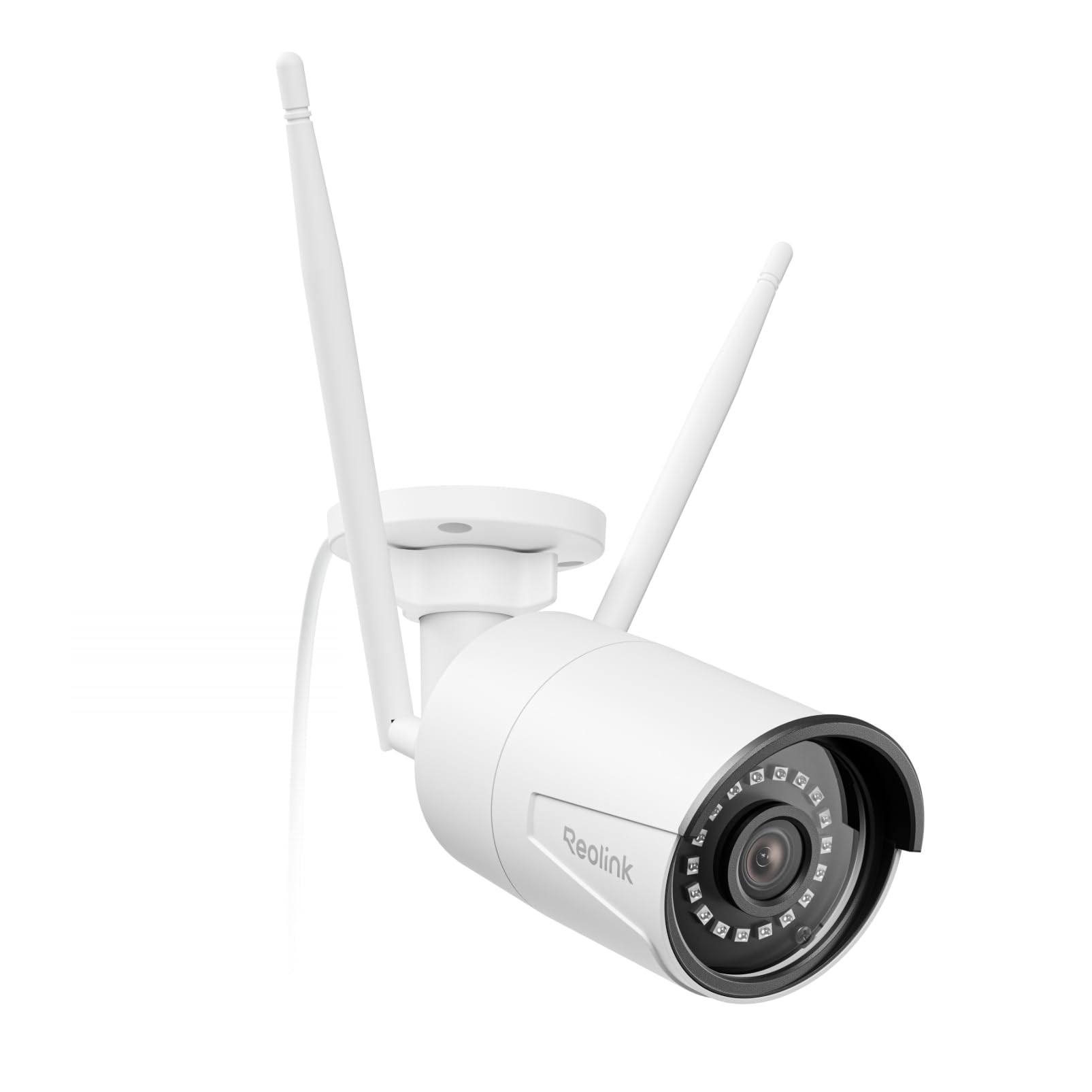
The plug-in workhorse with a metal body and a card slot that swallows half a terabyte.
Two specs make the RLC-510WA the detail-first pick on this list. The first is the 5MP sensor — that is 5 megapixels of effective still resolution, and it beats the eufyCam C37’s 4 mp effectively, which is roughly a 25% pixel edge on paper. The second is storage: this camera takes a microSD card up to 512GB, or 2.0x the eufyCam C37’s 256GB ceiling. If you record continuously, run a busy driveway, or just hate deleting old clips, that card ceiling is the most liberating number in this comparison.
Night vision reaches 100ft, so a driveway, a side gate, or a back patio all land inside the frame after dark. The camera runs on dual-band 2.4/5GHz Wi-Fi — 2.4GHz for range through walls, 5GHz to dodge interference from neighbours’ networks — and you can switch bands based on where the camera sits. Person, vehicle, and animal detection cuts down junk notifications, and sound capture adds an audio track to every clip.
The body is metal with an IP67 rating, which is the tougher of the two weather ratings in this comparison. IP65 on the VicoHome 2CG6 covers water jets; IP67 on this one survives brief immersion, so a hard rainstorm against a wall is comfortably inside the spec. That metal housing is a big part of why this camera feels built for a decade of weather rather than a season.
The trade-offs are real and worth stating plainly. This is a plug-in camera, so you need an outlet near the mount point, and it will not run on solar. Connectivity and reliability both show up as mixed in owner feedback — some units connect and run flawlessly, others drop or stop. Setup is praised often for being quick. The honest counsel: test the Wi-Fi pairing from the exact mounting spot before you drill, because card capacity is worth nothing if the stream keeps dropping.
Who this is for: a buyer with power at the mount point who prioritizes crisp detail and a big local card over wireless freedom.
Where it bites: mixed feedback on connectivity — do a signal test at the mount point before committing to the location.
Pick it for: the strongest daytime and low-light detail on this list paired with the largest card slot.
Not the one if: there’s no outlet within reach — this camera needs mains power, no way around it.
5. REOLINK E1 Outdoor Pro 4K PTZ Camera

The zoom lens that lets you read a plate from across the yard without moving a muscle.
The E1 Outdoor Pro is the only camera here with an actual optical zoom, and that changes what you can do with one mount. A 3x optical zoom moves real glass, so pushing in on a face or a license plate keeps the detail intact in a way digital zoom can’t. Pair that with 4K HD color at night and infrared night vision reaching 100ft, and you get a camera that sees both the whole yard and the small detail inside it.
Movement is where the numbers get interesting. The lens pans 355° and tilts 50°, which covers almost everything except directly overhead. On top of that, the camera auto-tracks detected people and vehicles, and you can set motion zones and schedules so it only watches the parts of the frame you care about. It runs Wi-Fi 6 across 2.4GHz and 5GHz, which is the newer wireless standard — wider range and faster throughput than the older Wi-Fi generations used by the REOLINK RLC-510WA above.
Storage gives you options: microSD up to 512GB, or a REOLINK NVR or Home Hub if you prefer a central recorder. The bundled 2-year limited warranty is a straightforward safety net for a camera this feature-heavy. Setup is widely described as straightforward, and customers note the 4K detail is what sells it.
The honest note is tracking consistency. Auto-tracking and adjustability both come up mixed in owner feedback — it works well most of the time, and occasionally it’s hit or miss on a given movement. PTZ travel feels limited to some buyers too. And for outdoor mounting, REOLINK specifically says to install the camera upside down for better water resistance, which is a small install detail worth reading twice before you drill.
What it does that others can’t
- 3x optical zoom keeps real detail when you push in — digital zoom can’t match it.
- 355° pan and 50° tilt covers almost the full horizon from one mount.
- Wi-Fi 6 connectivity with both 2.4GHz and 5GHz bands.
- 4K color night vision and 100ft infrared range for detail after dark.
The fine print
- Auto-tracking is hit or miss on some movements — motion zones help, but don’t expect perfection.
- Outdoor install must be upside down to hit the best water resistance.
- Plug-in power only, and you’ll want strong Wi-Fi at the mount point.
Best match: a wide yard where you want one camera to sweep the lot and still zoom on a stranger at the gate.
Weigh carefully: tracking consistency is the mixed spot — if you need rock-solid automatic following, manual zones are more reliable.
6. Tapo 2K Dual Lens Pan/Tilt Security Camera C645D KIT
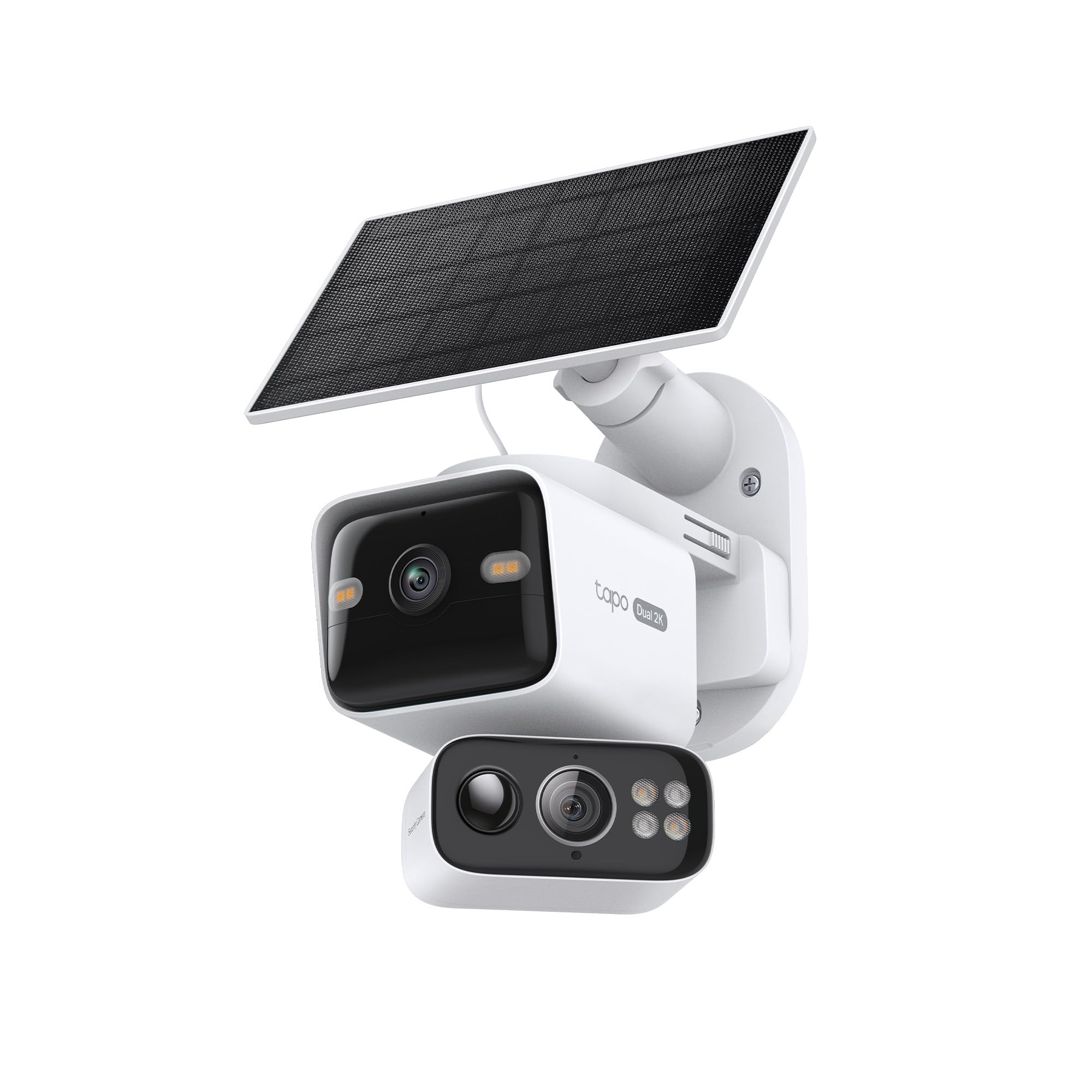
Two lenses on one bracket, so the wide view and the zoomed view happen at the same time.
Tapo solved the blind-spot problem with hardware instead of software. The C645D KIT carries two 2K lenses: a fixed ultra-wide 165° lens that watches one broad area, and a pan/tilt telephoto lens that gives you a 360° horizontal sweep of a second area. Both work at once. That means a fixed wide view of the driveway while the moving lens tracks somebody crossing the yard, and you don’t have to sacrifice one view to get the other. USA TODAY named it a CES Top Pick for its hardware and subscription-free recording.
Power is the other strong number. A 10,000mAh battery sits inside, and Tapo says 1 hour of direct sunlight powers a full day of use, and the battery lasts up to 4 months per charge through cloudy stretches. If you’ve been worried about a solar camera dying mid-winter, that reserve is the point. One hard limit: solar charging needs temperatures above 32°F, so a deep-freeze week means the battery carries the load on its own.
Detection covers people, vehicles, and pets without a subscription, so false alerts from swaying bushes and passing shadows get cut down. You get both full-color night vision with spotlights and an infrared option for power-efficient watching. The dual-band Wi-Fi works on 2.4GHz or 5GHz, and setup uses push-button pairing with a screw-in mount.
Owners describing this camera as the best they’ve had is the recurring theme, with clear video and solid night vision topping the praise. Dual-lens coverage works out to the full 360° as advertised. That said, this is a plastic-bodied unit, so treat the mount and housing with normal care. Note that the 5GHz band is faster only at shorter range — check which band your router performs best on at the mount point.
Why the dual lens matters: you get a fixed panorama and an active tracker from a single install spot, which is a lot of coverage from one bracket.
The part to plan for: the 32°F solar charging floor — if you get hard winters, factor in a manual charge during cold snaps.
Reach for it if: you want both a wide view and a zoom view of the same property without mounting two cameras.
Consider the calendar: in a hard-freeze climate, plan on the battery alone carrying the coldest weeks.
7. Arlo Essential Wireless Security Camera 2K (3rd Gen) – 3-Cam
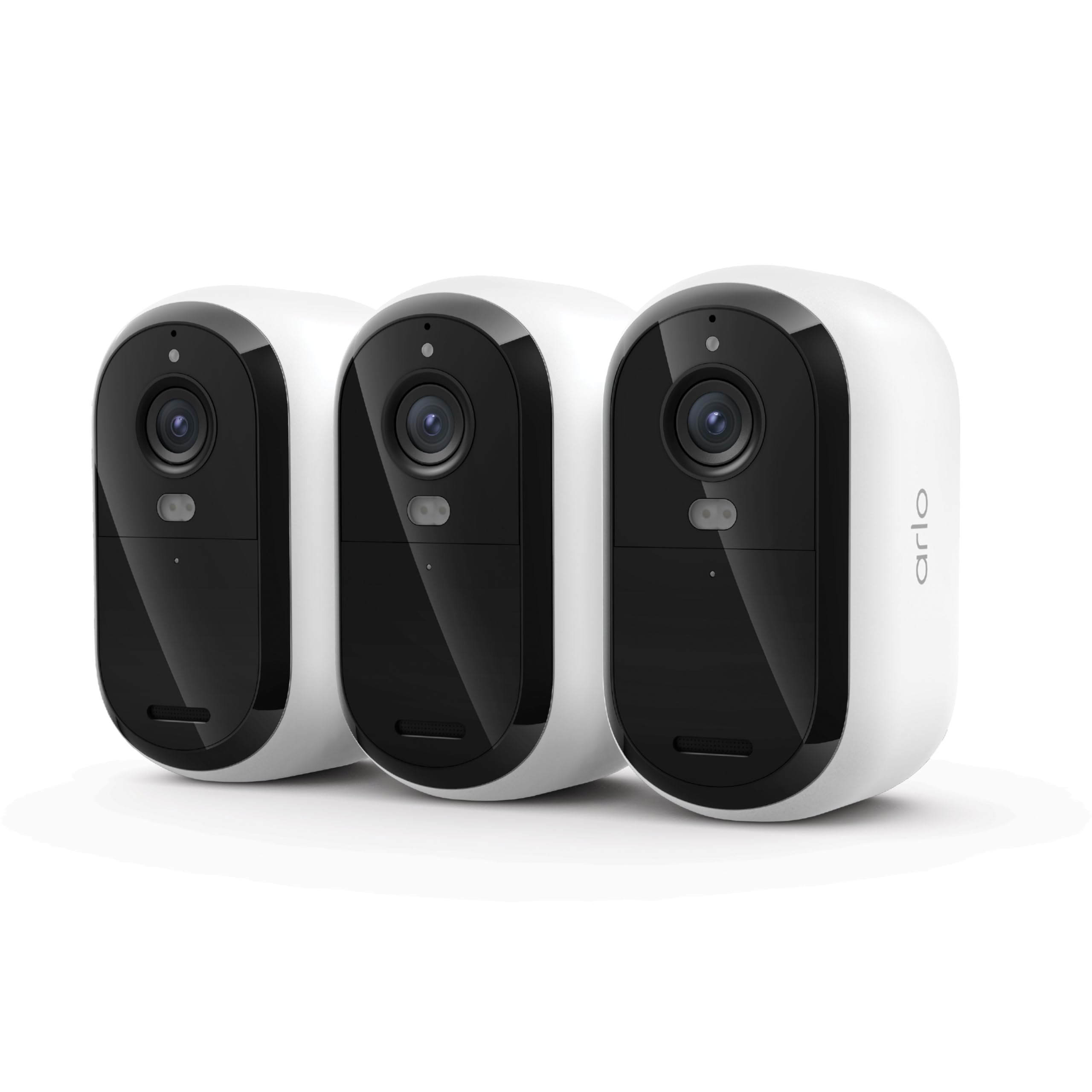
Three rechargeable cameras to cover three sides of the house in one order.
Most people buy one camera, find the gap it misses, then buy two more. Arlo skips that step by bundling three 2K cameras here, and the bundle even throws in a yard sign for the front lawn. Each camera records 2K video at a 130° field of view — a comfortable slice that holds a driveway, a walkway, or a back door in the frame. All three are rechargeable and wire-free, so placement is a matter of needing Wi-Fi coverage at the spot, not a cable.
The app is where Arlo does a lot of the heavy lifting. You get smart alerts for person and vehicle recognition plus pet and package detection, so you know what set off the camera before you open the clip. You also get animated event previews, a remote siren you can trigger from the phone, and 12x zoom on any live or recorded view. Color night vision and a built-in spotlight handle the dark. The camera works with Alexa, Apple Home, Google Home, Samsung SmartThings, and IFTTT if you have smart-home routines set up.
Arlo Secure is the feature layer that matters after the first month. The 1-month trial gets you 60-day video history, intelligent alerts, and 24/7 emergency response. After that, a paid plan is required for those extras — but live streaming and basic alerts keep working without a subscription. That is the part to remember when you compare against the eufyCam C37 and its card-based recording.
Battery life is the honest sticking point, and it’s a mixed bag in owner feedback: plenty report excellent runtime, while the front-door camera in a busy spot dies more often than once a week for some. High-traffic doors drain these faster, so plan on a rotation where the busiest camera gets charged more often. Order the package-detection settings tuned down at a busy porch and the battery stretches noticeably further.
What you’re actually getting
- Three rechargeable 2K cameras in one bundle for full-yard coverage.
- Person, vehicle, pet, and package detection with animated event previews.
- Works with Alexa, Apple Home, Google Home, SmartThings, and IFTTT.
- 2K video at a 130° field of view with 12x zoom and color night vision.
Where you’ll feel it
- 60-day video history and intelligent alerts need a paid plan after the 1-month trial.
- The busiest camera — usually the front door — drains fastest and needs more charging.
- Wire-free convenience still means occasional trips up a ladder with a charging cable.
The right buy for: a house with three separate angles to watch and no appetite for running cable to any of them.
Plan around: the busiest camera needing regular charges — a spare battery or a rotation schedule solves it.
8. Arlo Pro Wireless Security Camera 2K HDR (6th Gen) – 4-Cam

Four cameras, a 160° panoramic view each, and a battery you can swap without unplugging anything.
The Arlo Pro 6th Gen is the camera for someone with a big yard and no patience for a charging cable. It records 2K High Dynamic Range video across a 160° panoramic field of view — wider than the 130° on the Arlo Essential above — so a single camera holds more of a driveway or fence line at once. HDR (High Dynamic Range, which balances bright and dark areas in one shot) earns its keep at a doorway: it balances bright sky against a shaded porch so faces don’t disappear into shadow.
The battery is the practical win. It uses rechargeable, swappable 22 watt-hour lithium-ion batteries — watt-hours measure how much energy the pack holds — so you can carry a freshly charged one up the ladder and bring the empty down, instead of waiting for a charge. With four cameras in the kit, that rotation keeps the whole property live without a day of downtime.
Smart detection handles people and vehicles with custom alerts, and AI-generated event captions summarize activity so you can skim without watching every clip. Keyword search lets you jump straight to the event you remember. If something genuinely urgent happens, the Arlo Secure app can trigger emergency response to police, fire, or medical services tied to the camera’s location with your details pre-filled. The same 1-month trial then paid plan structure applies, while live streaming and basic alerts keep working without a subscription.
The picture quality is what buyers keep praising — the 2K HDR resolution and ease of setup come up most often, and installing each camera is quick. Reliability is the mixed spot, with a portion of owners describing a unit that doesn’t do its basic job. Because this is a four-camera kit, spread your testing out over the first week and verify each camera individually rather than trusting the batch at once.
Where it pulls ahead: the 160° panoramic view and swappable battery make it easier to cover a wide lot than the 130° Arlo Essential bundle.
Where you should slow down: reliability is uneven across units — test all four cameras during the trial period.
Suits: a large property that needs wide coverage, and a household willing to keep a charged spare battery in rotation.
Skip the splurge if: three cameras already cover your angles — the Essential bundle does that with fewer units.
9. Hiseeu Solar Security Camera System – 8 Cam Kit
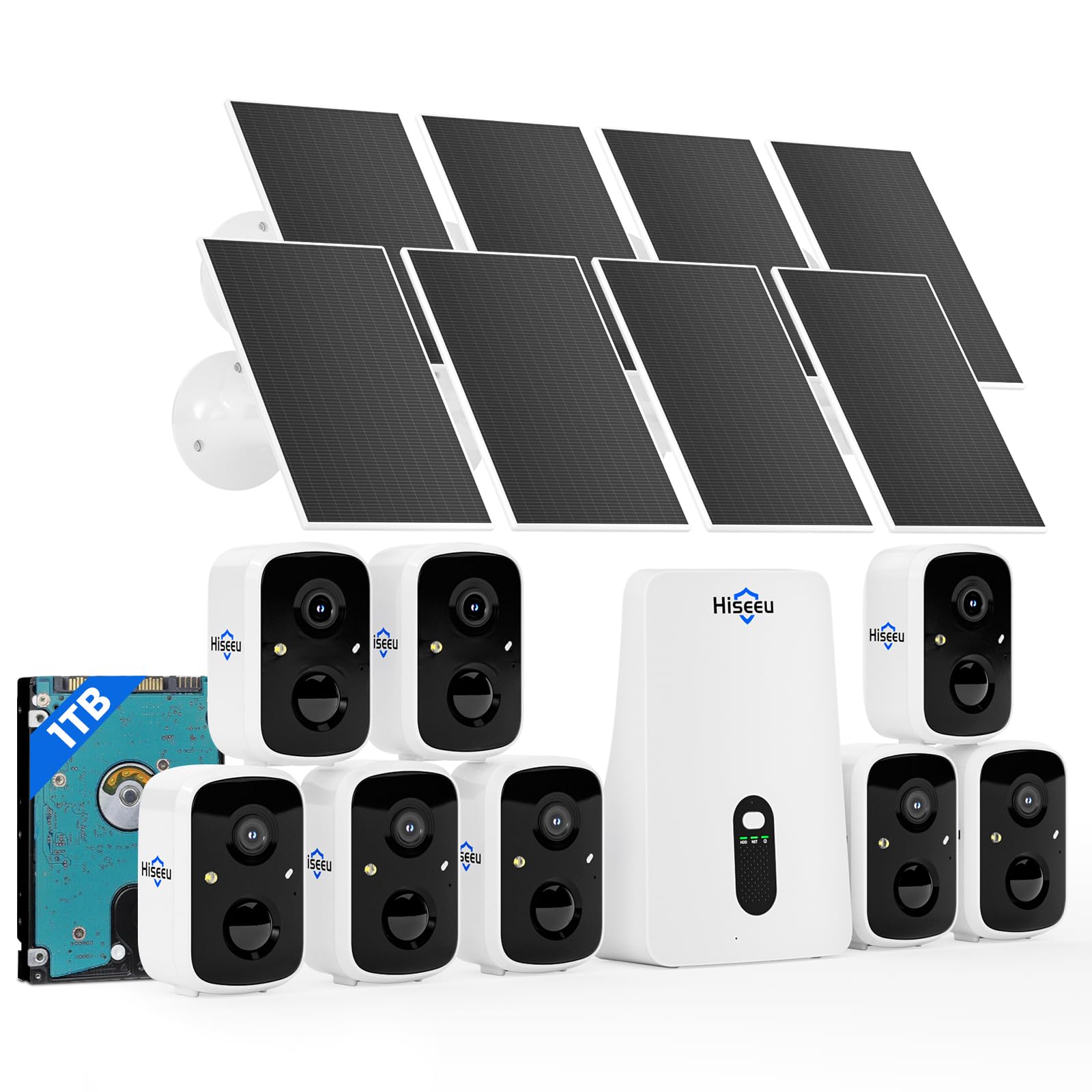
Eight solar cameras, one base station, and a terabyte of footage that never leaves your property.
The Hiseeu kit is the whole-property answer rather than the single-camera answer. Eight 4MP solar cameras feed a base station with a 1TB hard drive, which Hiseeu figures at 36+ months of recording. Nothing goes to a subscription for basic recording. If eight cameras isn’t enough, the system scales from 1 to 10 cameras and the base station accepts a 256GB SD card or a hard drive up to 8TB.
Two features make this the rural or off-grid pick. First, the base station can connect to a TV or display over HDMI for local viewing without any internet connection — genuinely useful for a cabin, a workshop, or a barn where the internet is unreliable or absent. Second, the cameras are 100% wireless, and Hiseeu says 4 hours of daily sunlight keeps them running 365 days a year. That combination is what makes this the pick for a property with no router in easy reach of the cameras.
Each camera records 4MP with color night vision so a red hoodie or a plate stays readable at midnight, and the 135° wide lens is wide enough to cover corners rather than leaving them to shadows. PIR motion detection cuts false alerts from leaves and pets, with AI detection for people, vehicles, and pets available on an upgraded cloud plan. Two-way talk through the EseeCloud app lets you speak through the camera, and smart siren and white-light alerts add more deterrent choices.
The honest thing to plan for: eight cameras means eight installs, though the maker describes 5 minutes and three drilled holes each. Reliability and connectivity both show up mixed in owner feedback, so budget one afternoon to test all eight and route the base station carefully. It’s also a heavier package at 4.58 kg, so it’s not an impulse install.
Built for big properties
- Eight 4MP solar cameras with a 1TB hard drive in the base station.
- HDMI local viewing works with no internet connection at all.
- Scales from 1 to 10 cameras, with support for a drive up to 8TB.
- 4MP color night vision and a 135° wide lens catch the corners.
The setup reality
- Eight cameras means eight mounts and eight signal checks before you’re done.
- Reliability and connectivity show mixed owner feedback across units.
- The 4.58 kg kit is a two-person job for a roof or high mount.
Built for: a farm, a cabin, or a multiple-building property where internet is spotty and eight cameras is the right number.
Not for everyone: a single front door — you’d be paying for seven cameras you don’t need.
Know the Specs
Resolution: megapixels versus “2K” labels
Resolution is the amount of detail in each frame. A 2K camera and a 5MP camera can describe similar-sounding results in different units, so check the raw megapixel figure when two cameras look close on the box. The REOLINK RLC-510WA sits at 5 mp, the eufyCam C37 at 4 mp, and the Arlo Essential at 1440 pixels of effective video resolution. Higher numbers help you see faces through zoom, but only when the lens keeps up — a high-megapixel sensor behind a soft lens still gives you a soft picture.
IP ratings in plain terms
An IP rating has two digits. The first covers dust resistance and the second covers water; IP65 protects against dust and water jets, while IP67 adds short-immersion tolerance. Neither rating is a lifetime guarantee — sun, frost, and seals wearing down all reduce protection over time. Mount cameras under an eave where you can, and note that some cameras need a specific mounting orientation outdoors; the REOLINK E1 Outdoor Pro should be installed upside down for better water resistance.
Solar power and battery capacity
Battery capacity in mAh (milliampere-hours) is really a measure of how long the camera runs between charges. The VicoHome 2CG6 carries 5200mAh, while the Tapo C645D KIT carries 10,000mAh with a stated four months on a single charge during cloudy stretches. Solar panels recharge the battery during daylight, but their output depends on sun angle and temperature — Tapo specifically requires temperatures above 32°F for solar charging, so cold climates mean the battery carries more of the load.
Local storage versus cloud plans
Local storage keeps your footage on a card or hard drive in your own space. The eufyCam C37 uses a microSD card up to 256GB or a eufy HomeBase, the REOLINK models take up to 512GB, and the Hiseeu kit ships with a 1TB hard drive. Cloud plans add features like 60-day history and AI alerts, but they are a recurring cost. Decide before you buy: the Arlo cameras give you live streaming and basic alerts without any plan, but the richer history and detection sit behind a paid subscription.
Common Questions
Can I run these outdoor security cameras without a subscription?
Will a solar-powered security camera still work through winter?
How far can an outdoor camera see at night?
Is 2K good enough, or should I buy a 4K outdoor camera?
What does IP65 or IP67 actually mean on a security camera?
Do these cameras need Wi-Fi, or can they record without internet?
Can I mix a new outdoor camera with the hub or NVR I already own?
How long does a wireless outdoor camera battery really last?
Where should I mount an outdoor camera for the best view?
Will an outdoor security camera work with Alexa or Google Home?
How much footage can a local hard drive hold compared with a microSD card?
The Bottom Line
For most homes, the shop outdoor security cameras winner is the Ring Floodlight Cam 2K, because it replaces an existing porch or garage light with a recording camera, a motion floodlight, and a siren in one hardwired fixture — no second cable run, no extra mount. If you want footage that never touches a subscription, grab the eufyCam C37 and its 256GB card slot. And for a farm, cabin, or multi-building property where the internet is unreliable, the Hiseeu 8-Cam Kit is the one to reach for — eight 4MP solar cameras and a 1TB drive that records with no connection at all.
One last thing worth doing before you order: measure how far your router actually reaches the spot you plan to mount. Three of the picks here — the VicoHome 2CG6, the REOLINK RLC-510WA, and the REOLINK E1 Outdoor Pro — all carry mixed owner feedback on connectivity. A five-minute signal check with your phone at the mount point tells you more than any spec sheet can.
How we choose
We do not accept paid placement. Every pick is matched to a real buyer and a real use-case; we do not hands-on test units.
Sources
Specifications: manufacturer listings and product documentation. Review insights: verified customer reviews, as of November 2026. Pricing: not shown on this page (it changes often); check the current price via the retailer link.
As an Amazon Associate, Tactical Gear Guy earns from qualifying purchases. This does not affect which products we feature.