Specs are compiled from manufacturer listings and verified buyer reviews and can change over time — please confirm the key details on the product page before buying.
You already know the drill: one foot on the brake, a shout through the wheel well, and a pedal that goes soft anyway. A self bleeding brake kit fixes that by pulling or pushing fluid without a helper, so you can do all four corners on your own schedule. The picks below all work solo — the only real differences are how they build vacuum, how much fluid they hold, and how well their adapters seal.
This guide is built by comparing the manufacturers’ published specifications and the patterns across verified customer reviews, so you get each pick’s real strengths and trade-offs instead of marketing spin.
Some kits use a handheld pump you squeeze by hand, others hook to a shop air compressor and do the work for you. Below you will find honest trade-offs on reservoir size, adapter fit, and how much suction each tool really holds. Every pick here is a self bleeding brake kit that lets one person finish the job.
Top Picks


How To Choose The Best Self Bleeding Brake Kit
Start with one question: do you own an air compressor? If yes, a pneumatic kit pulls fluid fast and quietly with almost no arm work. If no, a handheld vacuum pump is your tool — it runs on your grip and nothing else. Everything else is detail on top of that fork in the road.
Handheld pump or air-compressor kit
A handheld pump uses a piston you squeeze to create vacuum, and a gauge in inches of mercury (Hg) tells you how much pull you have. It is fully portable and needs no power. A pneumatic kit taps your compressor’s air supply to create continuous suction, so you are not re-pumping between wheels — but you need a compressor and a reasonably quiet work area if noise matters.
Reservoir capacity and how far it goes
Fluid has to go somewhere. Small handheld kits collect into a cup measured in ounces, while the bigger pneumatic units use tanks measured in liters. A larger tank means you drain fewer times mid-job and spill less, which matters most on trucks and long lines.
Adapters, hoses, and sealing
A poor seal at the adapter (the fitting that screws onto your bleeder screw or master cylinder) is the number one reason a kit “doesn’t work.” So count how many adapters come in the box, and check whether the hoses are silicone or plain PVC (polyvinyl chloride, a stiffer plastic) — silicone stays flexible and resists brake fluid better. A kit with lots of adapters and a tight coupler saves you a mid-job hunt for the right fitting.
Brake fluid is paint stripper
DOT brake fluid eats paint and damages skin, so plan for drips before you start. A kit with a sealed reservoir, clamped hoses, and a spill-conscious design keeps fluid where it belongs.
Side-by-Side Comparison
| Model | Best For | Power Source | Reservoir | Weight | Amazon |
|---|---|---|---|---|---|
| Mityvac MV8500 Silverline Elite★ Best Overall | All-around shop work | Handheld vacuum/pressure | 4.5 oz | 4.9 lbs | Amazon |
| Orion Motor Tech 23pc HandheldBest Value | Tight-budget first kit | Handheld vacuum | — | 2.14 lbs | Amazon |
| Yonligonju 23PCS Vacuum Pump TesterMost Versatile | Vacuum plus pressure testing | Handheld vacuum/pressure | 2 bottles | 2.77 lbs | Amazon |
| YEYETUO 3L Brake Bleeder Kit | Quiet garage bleeding | Pneumatic (air compressor) | 2L tank + 1L refill | 3.85 lbs | Amazon |
| Performance Tool W87030 | Lightweight portability | Handheld vacuum | — | 1.3 lbs | Amazon |
| Orion Motor Tech 2L Pneumatic | Wide vehicle coverage | Pneumatic (air compressor) | 2L tank + 1L refill | 4.4 lbs | Amazon |
| FOUR UNCLES 2L Vacuum Kit | High-volume shop use | Pneumatic (air compressor) | 2L tank + 1L refill | 4.27 lbs | Amazon |
| Orion Motor Tech 2.5L Pressure Kit | Older domestic cars | Hand-pump pressure | 2.5L + 500mL bottle | 4.16 lbs | Amazon |
Detailed Reviews
1. Mityvac MV8500 Silverline Elite Brake and Clutch Bleeding Kit
Our pick — 4.5+★ from 2,500+ verified ratings; the strongest balance of quality and price.
The metal-bodied workhorse that bleeds, tests, and primes without a second person.
Here is the tool that earns the top slot not because it is flashy but because it does the most jobs. The MV8510 pump body is zinc-aluminum die-cast (a cast metal housing that resists corrosion), so brake fluid and shop grime do not chew through it the way they chew through plastic pumps. That die-cast body is why it keeps showing up in the same toolbox year after year.
The 4.5 oz fluid reservoir (a catch cup for the old fluid you pull out) handles a normal wheel-by-wheel bleed without constant emptying. Beyond brakes and clutches, the same pump does vacuum and pressure testing on fuel, hydraulic, coolant, and differential systems — so a soft pedal and a mystery vacuum leak both get diagnosed with one tool. It carries a 1 yr warranty on material and workmanship from the manufacturer.
What wins people over is the sheer versatility; the kit ships complete with adapters and fill plates that cover a wide range of vehicles. The trade-off is real and worth saying plainly: this is a hefty hand tool, and it feels it. It weighs 4.9 pounds versus the 1.3 pounds of the Performance Tool W87030 below — a 3.8x difference. Squeezing that mass overhead on a lifted truck is more arm work than a light plastic pump demands. If you mostly do quick motorcycle bleeds, the 4.9-pound heft will annoy you; if you want one pump that outlives a drawer of cheap ones, it is the right buy.
What earns it first place
- Die-cast metal pump body shrugs off corrosion and fluid exposure.
- Does vacuum and pressure testing beyond brakes, so one tool covers diagnostics.
- Complete kit with adapters and fill plates ready to use out of the case.
- Backed by a 1 yr material and workmanship warranty.
Where it asks more of you
- At 4.9 pounds it is the heaviest pump here and tires your grip on long jobs.
- The 4.5 oz reservoir fills faster than a multi-liter pneumatic tank.
Reach for it if: you want one durable pump for brake bleeding plus general vacuum and pressure diagnostics on cars, trucks, and motorcycles.
Think twice if: your main job is a light, quick bleed and arm fatigue from a heavier metal body would get in the way.
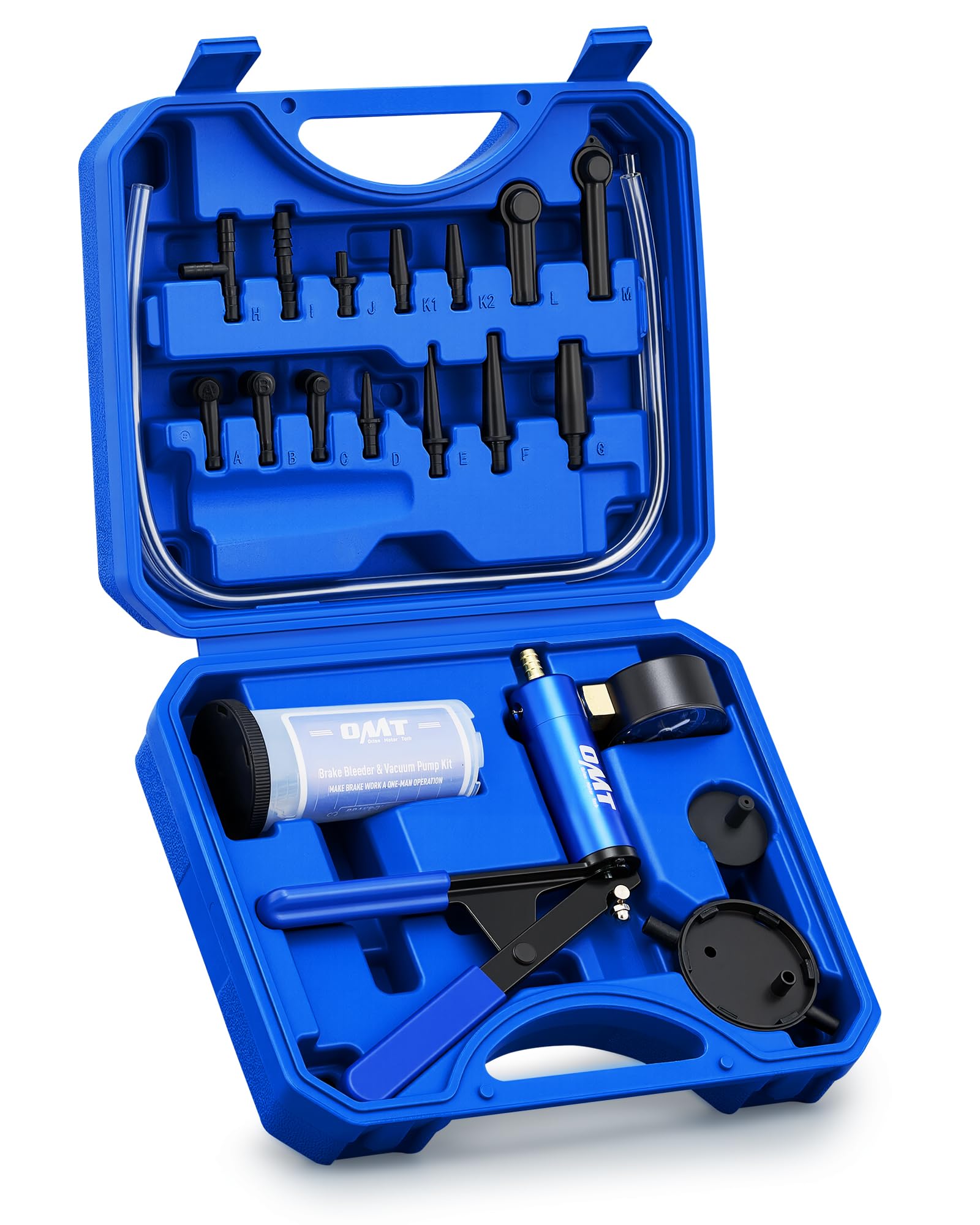
2. Orion Motor Tech 23pc Brake Bleeder Kit
Budget entry into solo bleeding, with a metal pump body and a case that keeps it all together.
For someone just starting to do their own brake work, the appeal here is simple: a reinforced aluminum alloy pump body (a metal housing stiffer than plastic) at entry-level money, wrapped in a 23-piece set. The maker claims under 5 minutes per wheel with the handheld pump — a real advantage when you have four corners to finish on a Saturday morning.
Sealing is where a cheap kit usually fails, and this one addresses it up front. Barbed fittings, hose clamps, and PVC hoses lock together, and the airtight gaskets come pre-assembled in the cups so you cannot install them wrong. That pre-assembly detail is small but it saves the classic leak hunt. It also doubles as a fluid extractor and a basic vacuum tester, with adapters that reach cars, motorcycles, and bicycles, and a carrying case to keep the fittings sorted at 2.14 pounds total.
Weigh this before you buy: it is a very new listing with a thin review history. At 2.14 pounds it is lighter than the metal-bodied Mityvac MV8500 at 4.9 pounds — easier on your arm, but weight is not the only measure of a pump. This suits a hobbyist who bleeds brakes a few times a year as a first kit, not a pro who needs a proven workhorse on day one. Want a fuller track record? The FOUR UNCLES kit further down has more time in owner hands.
Sealed and simple: pre-assembled gaskets, clamps, and barbed fittings cut the setup fiddling that sinks novice bleeds.
The small print: a short review runway means you are an early adopter here, so buy it as a starter kit rather than a lifelong tool.
The smart starter: a hobbyist who wants a complete 23-piece solo bleeding setup with metal pump parts and does not need years of reviews to feel comfortable.
Not the call yet: shop mechanics who need a battle-tested pump with a long, deep ownership record behind it.
3. Yonligonju 23PCS Handheld Vacuum Pump Tester Brake Bleeder Kit
A two-in-one gauge that reads both pressure and vacuum, so bleeding and testing share one tool.
There is one number that defines this kit: a gauge that scales to 40 PSI of pressure and 20 inHg of vacuum (inches of mercury — the unit for measuring suction). That dual readout means it is not just a bleeder but a diagnostic tester you can point at vacuum-operated systems around a car, truck, pickup, or motorcycle. The stainless steel construction backs up the working end of that job.
When it works, it works simply — sucking out the old fluid and air, guiding fresh fluid through, all without an assistant. Owners describe successful bleeds, and it comes in a portable storage case that makes it easy to carry and store, at 2.77 pounds.
The honest caveat is consistency, not concept. Some units do their job cleanly, while others draw criticism for a handle pin that gives way or a gauge needle that sits slightly off center. Treat this as a light-duty diagnostic and bleeding kit for occasional home maintenance and it delivers; treat it as a pro pump used weekly and you may be the unlucky one. It is the pick for someone who wants vacuum and pressure testing on a friendly budget and will handle the tool with care.
The draw of the dual gauge
- Reads 40 PSI pressure and 20 inHg vacuum for real diagnostic work, not just bleeding.
- Stainless steel build in a portable case for home use.
- Solo operation pulls fluid and guides new fluid in without a helper.
Reason for pause
- Build consistency is uneven, with reports of the handle failing under use.
- Precision can be loose at the gauge, which matters for fine tuning.
Best if: you need a vacuum and pressure tester plus a bleeder for occasional home garage work on cars and bikes.
Look elsewhere if: you are chasing precise gauge readings or need a pump that survives weekly pro-level use.
4. YEYETUO 3L Brake Bleeder Kit

A pneumatic tank with a silencer, so the fluid comes out without the usual air-tool hiss.
This is a compressed-air kit for the person who does not want a hand pump workout. It runs from your air compressor at 2.8-12 bar (40-170 PSI inlet pressure) and keeps extracting fluid continuously, which is the whole point of a bleeder that does not force you to re-pump between wheels. The built-in silencer reduces the racket, letting you keep a quieter workspace while vacuum does the bleeding.
Storage is strong too: a 2L main reservoir with a 1L refill bottle holds plenty for a full flush, so you are not stopping to top up mid-job. Two silicone hoses — a 59 inch bleed hose with a universal rubber adapter and a 45 inch master cylinder evacuation hose — let one person reach tough points. A variable thumb throttle keeps airflow steady, and 16 bleed screw adapters fit most models. Buyers report flushing bikes and fitting all-new calipers on a Ford F250 with hours saved.
The caveat is fit and finish on the quick connections. Some owners find the tops do not thread back on cleanly or the alloy coupler misbehaves, which is the difference between a smooth afternoon and a fumbling one. It is not a reason to pass on the whole kit — it is a reason to check every fitting before you start. For most home mechanics doing a yearly flush on a car or a couple of bikes, the gentle noise and big capacity are worth a little care at the couplers.
Quiet and capable: the silencer and steady thumb throttle make a big flush calmer, and the 2L-plus-1L capacity means fewer interruptions.
Check the fittings first: coupler and cap threading can be fussy, so seat every connection before you pressurize.
Worth it for: the home mechanic with an air compressor who wants a quiet, large-capacity hydraulic flush and does not need help at the pedal.
Not for you if: you have no air compressor, since this kit needs a steady air supply to work at all.
5. Performance Tool W87030 Hand Vacuum Pump Brake Bleeder Kit

The featherweight pump that reaches 25 inches of mercury and slips into any drawer.
At 1.3 pounds, this is the one you can hold overhead under a lifted car without your forearm burning. It develops and holds up to 25 inHg of vacuum (inches of mercury — the suction-strength gauge) and pumps roughly 1 cubic inch per stroke, with a gauge scaled in Hg so you are reading real numbers. For a socket-wrench DIYer who wants a portable partner for brake bleeding and quick vacuum testing, this lightness is the feature.
The all-in-one kit is claimed to cover one-person brake bleeding and automotive diagnosis, so it does double duty from the start. Where it earns careful handling is the pump handle — several owners mention it snapping during use, and the gauge assembly can arrive with pieces separated. Buyers split on the vacuum it holds: some pull a strong, steady reading, while others find it does not form vacuum at all. That inconsistency means you should test it the moment it arrives and know your return window.
Even with that, the case for it is straightforward: a light, low-cost hand pump you keep as a backup or a first bleeder, ideal for a motorcycle or a single set of brakes. It stumbles on the handle that people break. Buy it as an occasional-use tool and it earns its keep; lean on it weekly and a sturdier pump is the better call.
Why it still sells
- Genuinely light at 1.3 pounds for overhead and cramped work.
- Reads up to 25 inHg with a marked gauge.
- Covers brake bleeding and basic vacuum diagnosis in one kit.
What to watch
- The pump handle has broken under use for some buyers.
- Vacuum strength is inconsistent unit to unit, so test it on arrival.
Pick it for: an occasional bleed on a bike or a single car where a light, portable pump is all you need.
Skip it for: heavy everyday use where a snapped handle would leave you stranded mid-job.
6. Orion Motor Tech 2L Vacuum Brake Bleeder Kit

Nineteen adapters and a 2L tank, aimed at whatever is in your driveway.
Compatibility is the headline with this pneumatic unit. It comes with 19 adapters and flexible hoses, and Orion says it fits most standard and ABS brake systems for cars, trucks, ATVs, snowmobiles, and motorcycles. That breadth matters when you maintain more than one vehicle — a bleeder that only fits your daily driver is a one-trick tool.
Hooking it to an air compressor pulls old fluid quickly and safely, and a 1L refilling bottle uses automatic gravity feed to keep the master cylinder topped up so air cannot sneak back in. The design draws fluid straight from the bleeder valves on your calipers, keeping the workspace clean, and the polypropylene-and-metal build with nickel and zinc coatings resists rust. At 4.4 pounds it is heavier than the handheld pumps, which is expected once a tank and bottles are involved.
What tempers the enthusiasm is that this is a fresh listing with little owner data behind it yet. You get a well-specified kit — 2L tank, 1L refill bottle, broad adapter set — without a long record to lean on. Think of it as a full-featured pneumatic bleeder from a known name, bought with the expectation that you will verify every seal on the first flush. It is a strong choice for a multi-vehicle household jumping straight to air-powered bleeding.
Built for variety
- 19 adapters cover cars, trucks, ATVs, snowmobiles, and motorcycles.
- 2L tank and 1L automatic gravity-feed refill keep the system topped.
- Nickel and zinc coatings resist rust on a metal-and-poly build.
The caveat
- A short review history means fewer owner experiences to guide you.
- At 4.4 pounds it needs a compressor and bench space to set up.
The fit-focused choice: a garage with a compressor and several vehicle types that needs broad adapter coverage in one kit.
Hold off if: you want a long owner track record before you spend, or you have no compressor to feed it.
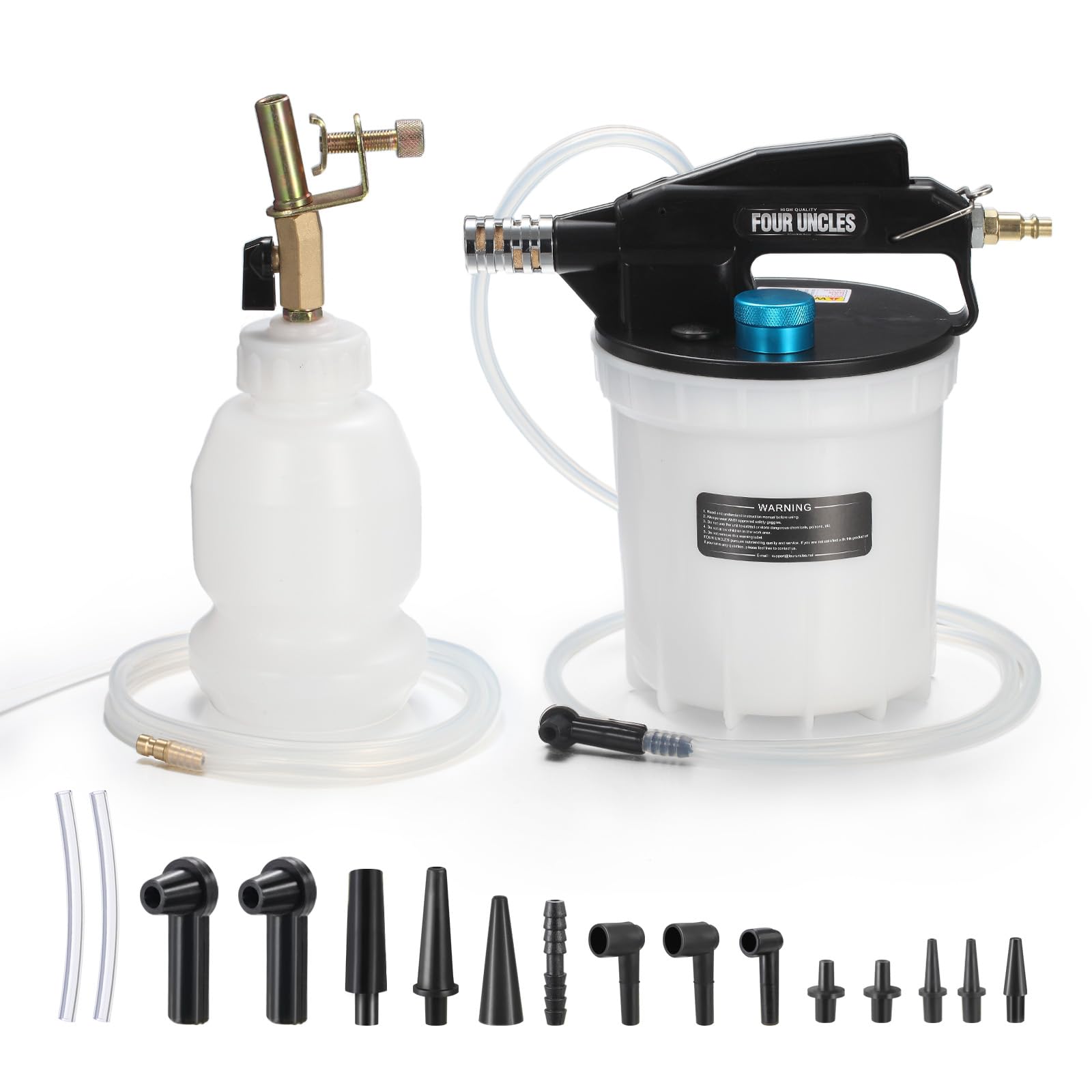
7. FOUR UNCLES 2L Vacuum Brake Bleeder Kit, Pneumatic
The shop-grade pneumatic kit that turns a four-wheel flush into a one-person job.
If you already own a compressor and want to stop asking a friend to pump the pedal, this is the well-worn pick. It pairs a 2L fluid tank with a 1L refill bottle and 16 adapters, and two 60-inch silicone hoses (flexible lines that resist brake fluid) let you reach awkward bleed points solo. A built-in silencer keeps the workshop volume down and the adjustable thumb throttle gives smooth, steady suction.
Owners put the one-person operation to work: a full-time mechanic notes it makes bleeding and flushing a solo task, and others cleared four motorcycles plus a truck with no pedal helper. The unit is sized to serve cars, trucks, motorcycles, UTVs, and ATVs, and at 4.27 pounds it is manageable on a bench or rolling cart.
The honest catch is the fluid stream. Some owners note air gets sucked through the line alongside the fluid, so you see fluid mixed with bubbles rather than a solid column — it still pulls, just not in a clean ribbon. There is also the usual report of a connection that stops mating after a few jobs. Neither undermines the kit at this level; it just means you watch the hose and keep your couplers clean. For heavy, repeated bleeding, its long record of owner use makes it the safest pneumatic pick here.
A proven solo worker: the pairing of twin 60-inch hoses, 16 adapters, and steady thumb-throttle suction handles car and bike flushes without a helper.
The honest hitch: expect some air mixed into the fluid stream and a coupler that can wear over time — clean and re-seat as you go.
Best for: the frequent bleeder with a compressor who wants a well-tested one-person vacuum kit for cars and motorcycles.
Think again if: you need a perfectly solid fluid stream for a clean read, or you lack the air supply to run it.
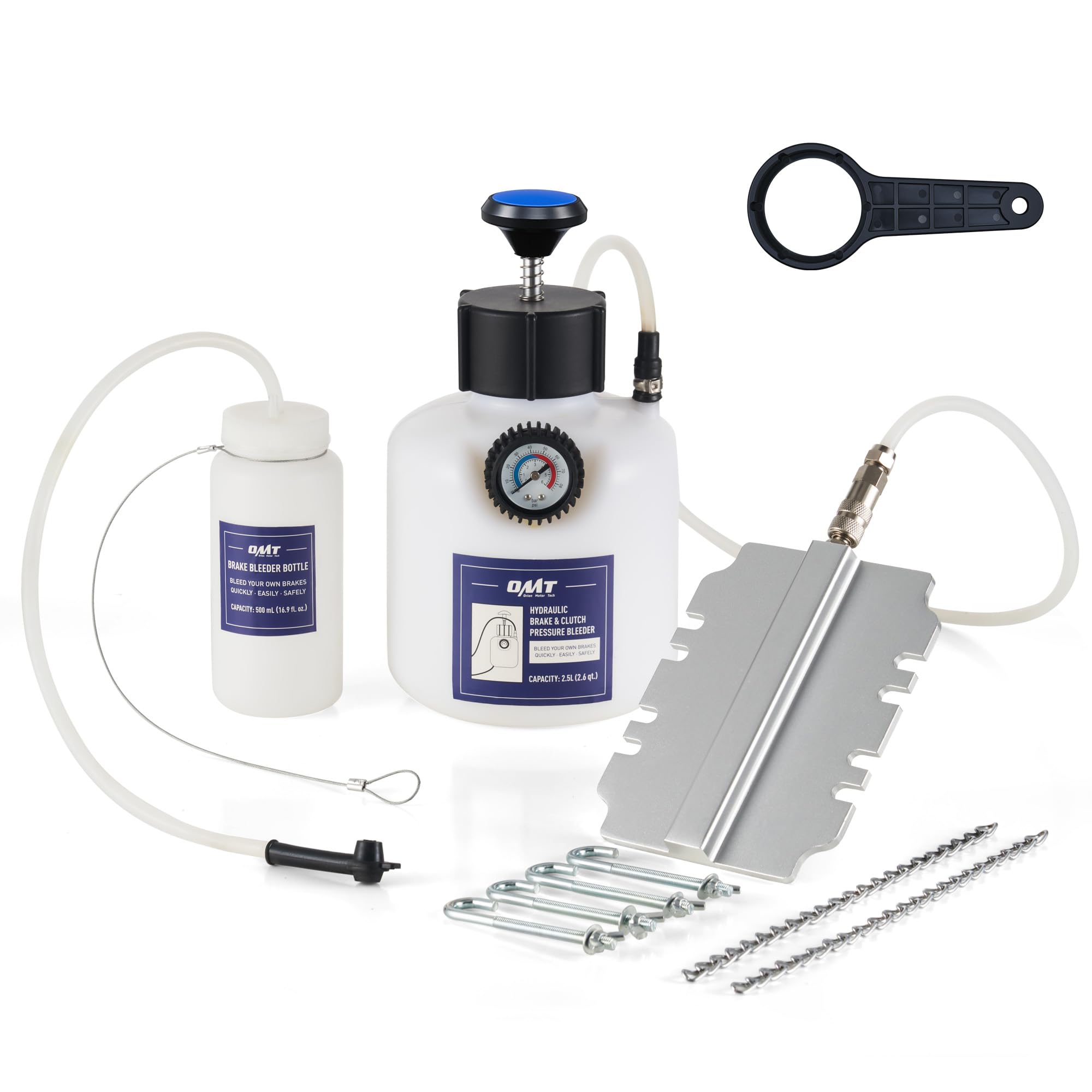
8. Orion Motor Tech 2.5L One-Person Pressure Brake Bleeder Kit
A pressure-style kit with a rectangular adapter cut for older American iron.
This one plays a different game than the vacuum pullers above: it pressurizes fresh fluid through the system to push out the old. The included 4.25″x6.75″ rectangular adapter is sized for AMC, Chevrolet, Ford, Jeep, and Dodge, and Orion lists fit for most cars from 1967 to mid-80s. If you wrench on a classic, that rectangle is the reason to look here.
The capacity is generous — a 2.5L reservoir plus a 500mL collection bottle — enough fresh fluid to service a whole brake system in one fill. The method is simple: fill the reservoir, clamp the adapter, pump by hand to pressurize, and let the bottle catch the fluid. Polyethylene and silicone parts hold up to heat and chemical exposure, so brake fluid will not eat through the hardware.
The trade-off lives in pressure and fit. Owners note it swells above about 30 psi and that the hoses can be cheap and lack a pressure relief valve, so you unscrew the cap to release before removing it. Fit is also vehicle-specific: the cap did not seat on one older Audi. That makes this the pick for a classic-car owner whose master cylinder matches the adapter, working at modest pressure. For newer cars with a different cap style, one of the vacuum kits is a safer bet.
The right tool for old reserves: the 4.25″x6.75″ adapter and 2.5L tank suit classic domestic master cylinders and a full-system flush in one go.
The pressure limit: keep hand pumping modest, release the cap before removal since there is no relief valve, and confirm your cap fit first.
Made for: the classic-car owner with a compatible master cylinder who wants to pressurize fresh fluid through a full system solo.
Choose another if: you drive a modern vehicle whose cap does not match the rectangular adapter, or you prefer vacuum bleeding.
Know the Specs
Vacuum in Inches of Mercury (inHg)
Vacuum is measured in inches of mercury, a unit that tells you how hard the pump can pull fluid. A gauge scaled in Hg — as on the Performance Tool W87030, which reaches up to 25 inHg — lets you confirm a steady, strong pull rather than guessing at the squeeze. More pull means fluid and trapped air move faster through the lines.
Pressure in PSI and Bar
Pressure kits push fluid through rather than pull it out, and they are rated in PSI (pounds per square inch) or bar. The YEYETUO pneumatic kit lists inlet air pressure of 2.8-12 bar (40-170 PSI), while the Orion pressure bleeder is a hand-pump design where keeping pressure modest matters. Too much pressure can stress seals and the bottle, so a controlled, lower setting does the job safely.
Reservoir Capacity
The reservoir is the tank that catches or holds brake fluid. Small handheld pumps use cups measured in ounces, like the Mityvac’s 4.5 oz, good for a wheel or two. Pneumatic and pressure kits use liters — a 2L tank, a 2.5L reservoir, a 1L refill — which means fewer drain-and-refill stops during a full flush.
Adapters and Hose Material
A poor seal at the adapter (the fitting that clamps or threads onto your bleeder screw or master cylinder) is the top cause of a kit that “won’t work.” So count the adapters and check hose material — silicone stays flexible and resists brake fluid, while plain PVC (polyvinyl chloride, a stiffer plastic) is stiffer. More adapters and better hoses mean a tighter, more reliable connection on more vehicles.
Common Questions
Can one person really bleed brakes with these kits?
Do I need an air compressor for a pneumatic brake bleeder?
How do I know which adapter fits my car?
How much brake fluid does a full flush need?
Is vacuum bleeding or pressure bleeding better?
What is the safest working pressure for a pressure bleeder?
Will these kits work on motorcycles and ATVs?
How do I keep brake fluid from damaging paint?
How long should a brake bleeder kit last?
The Bottom Line
For most people shopping for the best self bleeding brake kit, the Mityvac MV8500 Silverline Elite is the winner: its die-cast metal pump does brake and clutch bleeding plus vacuum and pressure testing in one tool, backed by a 1 yr warranty. If you have a compressor and want the most tested pneumatic (air-powered) performer, grab the FOUR UNCLES 2L Vacuum Kit, whose 60-inch hoses and 16 adapters have already proven themselves on bikes and trucks alike. And if you are restoring a classic domestic car, the Orion Motor Tech 2.5L Pressure Kit with its 4.25″x6.75″ rectangular adapter is the one built for your master cylinder. Whichever you choose, buy the one whose power source and adapter set match the vehicles you actually work on — that fit is what turns a frustrating solo bleed into a one-afternoon job.
How we choose
We do not accept paid placement. Every pick is matched to a real buyer and a real use-case; we do not hands-on test units.
Sources
Specifications: manufacturer listings and product documentation. Review insights: verified customer reviews, as of November 2026. Pricing: not shown on this page (it changes often); check the current price via the retailer link.
As an Amazon Associate, Tactical Gear Guy earns from qualifying purchases. This does not affect which products we feature.