Specs are compiled from manufacturer listings and verified buyer reviews and can change over time — please confirm the key details on the product page before buying.
Buying a card for a camera is where a lot of people get burned. You plug in a card that sounded fast and your camera locks up mid-burst, or your video stops recording after a few seconds. The fix is simpler than the marketing suggests: match the card’s speed class and capacity to what your camera actually writes, and skip everything else. This guide covers nine cards that clear that bar, from cheap two-packs for trail cameras to a 1TB option for people shooting 4K all day.
This guide is built by comparing the manufacturers’ published specifications and the patterns across verified customer reviews, so you get each pick’s real strengths and trade-offs instead of marketing spin.
Below you’ll find the fastest options, the ones that suit a point-and-shoot perfectly, and the bulk packs that make sense for a house full of trail cams. If you simply want the one most people should buy, the sd memory card pick at the top is the safest all-round choice.
Top Picks


How To Choose The Best SD Memory Card
The card is the cheapest part of a camera kit and the one most likely to stall a burst or cut a video short. Getting it right takes about five minutes of matching speed class and capacity to your gear. Here is what actually decides it.
Match the speed class to what you shoot
The class rating tells you the guaranteed minimum write speed, and that’s what stops your recording from stalling. A Class 10 or U1 card (U1 means it can sustain at least 10MB/s of writing) is the floor for full HD 1080p video. If you shoot 4K, you want U3 and V30 (V30 means a sustained 30MB/s), which is the rating serious video cameras expect.
Read speed is about waiting, write speed is about shooting
Read speed is how fast files come off the card and onto your computer. Write speed is how fast the camera fills the card. A card advertised at 140MB/s of read speed can be notably slower at writing, so if your camera fires continuous bursts, look hard at the write number rather than the big headline figure.
Check the form factor before you buy
Full-size SD cards are the wide ones that slot into the side of a DSLR or camcorder. Some of the cards here are full-size SDHC, which only works in devices marked SDHC or SDXC, and won’t work in an older SD-only slot. If you’re buying for several cameras or a wall of trail cams, confirm each device’s spec first.
Side-by-Side Comparison
| Model | Best For | Capacity | Speed Rating | Top Read Speed | Amazon |
|---|---|---|---|---|---|
| SanDisk 128GB Ultra SDXC (100MB/s)★ Best Overall | Everyday cameras and full HD video | 128 GB | C10, U1 | 100MB/s | Amazon |
| SanDisk 128GB Ultra SDXC (140MB/s)Best for 4K | Big capacity with faster transfers | 128 GB | C10, U1 | 140MB/s | Amazon |
| Lexar 256GB SILVER SDFastest Transfer | 4K video and fast file transfers | 256 GB | U3, V30 | 225MB/s | Amazon |
| Inland 32GB SDHC (2 Pack) | Trail cameras and budget cameras | 32 GB each | C10, U1 | 60MB/s | Amazon |
| Silicon Power 32GB SDHC (5 Pack) | Equipping several cameras at once | 32 GB each | C10, UHS-1 | 40MB/s | Amazon |
| Gigastone 32GB SDHC (10 Pack) | Large trail camera spreads | 32 GB each | C10, U1 | 80MB/s | Amazon |
| Gigastone 1TB SDXC Pro Series | All-day 4K shooting | 1 TB | V30, C10 | 150MB/s | Amazon |
Detailed Reviews
1. SanDisk 128GB Ultra SDXC Memory Card
Our pick — 4.5+★ from 90,500+ verified ratings; the strongest balance of quality and price.
The 128GB card that quietly covers almost every camera in the house.
You get 128GB of storage and a C10/U1 rating (U1 means it can sustain at least 10MB/s of writing), which is exactly what a point-and-shoot or mid-range camera needs to record full HD 1080p video without stalling. The payoff is real: 128GB keeps a full HD camera recording through a birthday party without a card swap. That’s why it’s the default pick for full HD shooters who don’t want to think about cards again.
The thing that wins people over is the quality — it takes far more praise than any other trait on this card. Owners routinely say it does exactly what the box promised, with no fuss. Speed lands around 100MB/s for reads (the transfer rate when you pull files onto a laptop), so a full card’s worth of photos lands on your computer quickly. And it’s built to shrug off heat, water, and X-rays (X-rays being the scanner at airport security), which is a small thing until you’ve lost a card to a hot car.
The recurring gripe is reliability — a chunk of buyers have hit a corrupt card or a read error, so a handful will land on a bad unit. That’s a fit note rather than a fatal flaw: format the card in the camera, not the computer, and a bad unit is easy to swap. The 4.5+ star rating across 90,000+ owners tells you the vast majority never hit a bad unit.
What earns its keep
- 128GB holds a huge library of photos and full HD 1080p clips without swapping cards
- Up to 100MB/s read speed makes pulling files off the card a short wait
- Rated for temperature, water, and X-ray resistance
- Works with a broad spread of cameras, including Canon bodies and HD models
Worth knowing
- Reliability is the one mixed note in the reviews — some units arrive corrupt
- U1 is plenty for full HD but not the class to buy for heavy 4K work
Reach for this if: you shoot full HD on a normal camera and want one card that just works.
Look elsewhere if: your camera is set to 4K — step up to a U3 card instead.
2. SANDISK 32GB Extreme SD Memory Card
Same 128GB of room as the top pick, but with a faster exit ramp for your files.
Read speed is the waiting part of owning a card, and this one moves files at up to 140MB/s — a step up from the 100MB/s top pick and a noticeable step over the 60MB/s Inland two-pack. If you come home with a card full of shots and want them on the laptop before dinner, that gap is the difference between a quick job and a slow one. You still get 128GB of space and a C10/U1 rating for full HD 1080p video on compact and mid-range cameras.
Owners like how it behaves across a spread of devices — video recorders, underwater cameras, laptops, digital cameras — and the capacity gets a lot of affection for holding well over a thousand pictures with room to spare. It also carries a long list of protection ratings: drop, magnetic, temperature, water, and X-ray. That makes it a sensible travel card, because a wrong turn near a magnet or a hot car isn’t the end of it.
The one mixed note is reliability — some buyers have run into card errors, so treat a bad unit as a rare miss rather than a pattern. A fair read: this is a capacity-and-speed upgrade over the 100MB/s Ultra, not a ruggedized 4K card. If your camera shoots 4K, go up to the Extreme or beyond.
Why it’s on the list: the fastest read speed of the full-HD Ultra family plus 128GB of room makes downloading painless.
Pick this when: you want maximum storage and quick transfers without paying for 4K write speed you won’t use.
Skip the upgrade if: your card reader caps out lower than 140MB/s — you won’t feel the extra speed.
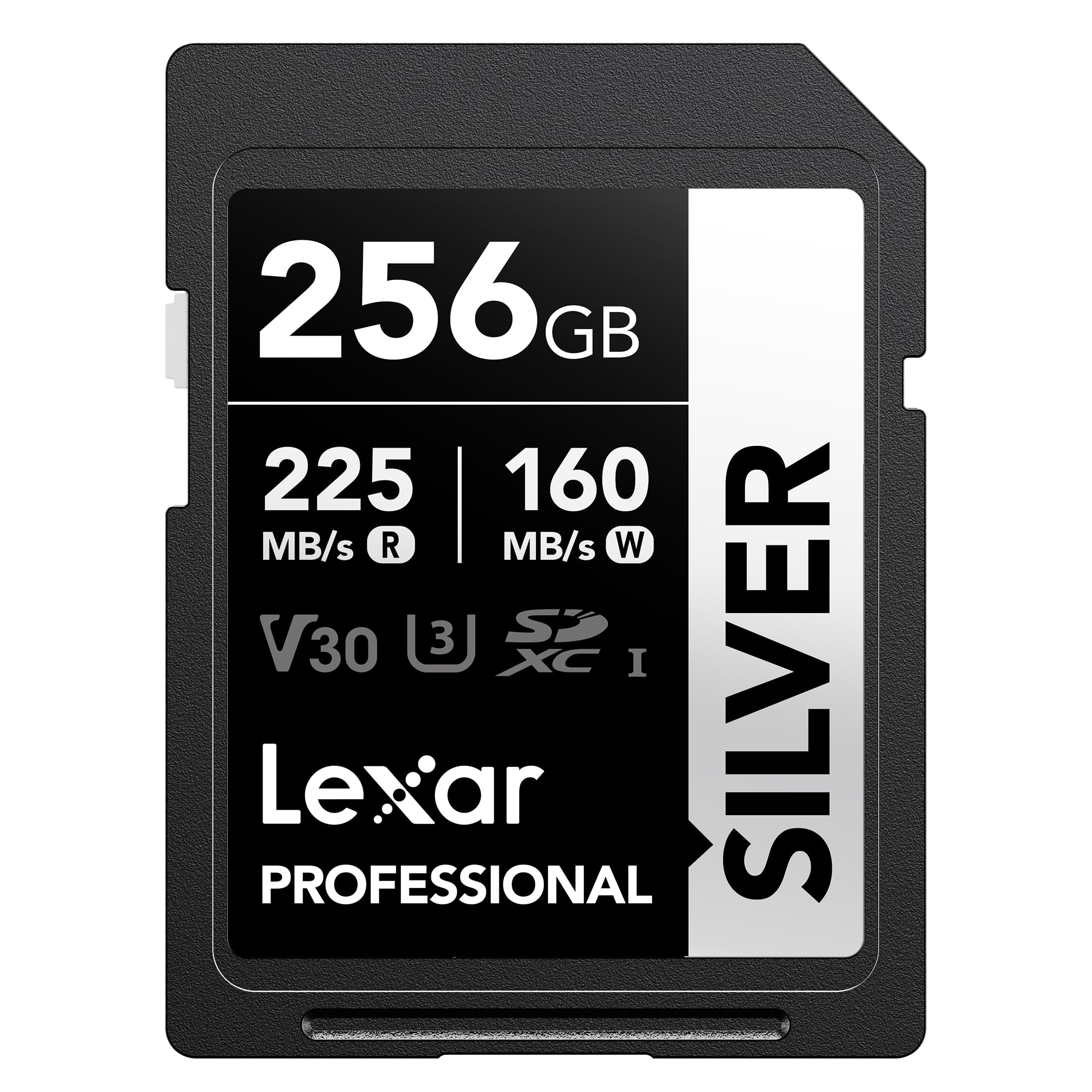
3. Lexar 256GB SILVER SD Memory Card
The 225MB/s card for photographers who hate waiting on a download.
This card reads faster than anything else on this list. At up to 225MB/s (megabytes per second), it moves files roughly twice as quickly as the 100MB/s Extreme and Ultra cards. So a full 256GB card offloads in a fraction of the time a slower card would take. Write speed runs up to 160MB/s, the quickest burst rate here, so fast continuous shooting won’t choke. And V30 (a video speed rating for 30MB/s) plus U3 (another speed class) mean it can record 4K at up to 60FPS (frames per second) without dropping frames.
Buyers describe the performance across different shooting conditions as excellent and reliable, and it works with Canon, Sony, and Nikon bodies without complaint. It’s rated for wearproof, drop-proof, temperature-proof, X-ray-proof, shockproof, magnetic-proof, and vibration-resistant use — a lot of abuse tolerance for a card you’ll probably never stress. To compare: 256GB on this card versus 32GB on the Extreme is eight times the storage for someone shooting 4K all day.
Buyers report mixed results on video quality and durability: some record pristine 4K, others hit files that wouldn’t open. That can happen with any high-capacity card, but it’s worth checking footage before you format. The capacity itself is the bigger draw: 256GB at these speeds is the balance for a working photographer who shoots and offloads daily.
Why photographers keep buying it
- 225MB/s read speed — the fastest transfer rate on this list
- 160MB/s write speed keeps burst shooting from stalling
- V30 and U3 support 4K video at up to 60FPS
- 256GB of room with a seven-way durability rating
What to weigh first
- Video quality and durability are the mixed aspects in reviews — a few cards have produced unreadable files
- You’ll only feel the 225MB/s advantage with a card reader that can keep up
Built for: photographers and videographers shooting 4K who move large files daily.
Not the match for: a point-and-shoot owner who’d never use the speed or the capacity.
4. INLAND 32GB SDHC Flash Memory Card (2 Pack)

Two 32GB cards for the trail-camera crowd and the budget camera bag.
This is a pair, not a single card — two 32GB SDHC cards that together give you a spare you didn’t plan for. Read speeds run up to 60MB/s and write speeds up to 10MB/s, which is fine for trail cameras, DSLRs, and point-and-shoots that record full HD. The value angle is obvious: the 60MB/s read speed here is a third of the 140MB/s Ultra’s and less than half the 225MB/s Lexar. For a game camera uploading stills, you won’t notice the difference.
Owners love the value — getting two cards for the price of one is the most-praised thing about this pick — and quality follows closely behind. The storage draws a lot of warmth for holding up to 2000 pictures, and hunters and birdwatchers report amazing photos of animals. Picture quality also lands well, with clear video footage coming back from these cards.
The mixed notes deserve honesty: reliability and compatibility are the two traits buyers split on. Some cards won’t be recognized by a given device, and a few stop working. Size is the other fit question — it’s a full-size SDHC card, so confirm your device takes SDHC or SDXC before you buy, because an older SD-only slot won’t read it. A cheap spare is only a bargain if your device actually takes SDHC.
What you’re really buying: a spare card for cheap — two 32GB SDHC cards with 60MB/s reads, aimed at trail cameras and entry-level cameras.
The compatibility check: SDHC-only, not backwards compatible with SD slots, so check the logo on your device first.
Best fit for: trail cameras, game cams, and cameras where you want a spare in the bag.
Think twice if: your camera is a recent model that needs a faster writing class for video.
5. 32GB 5-Pack SDHC Flash Memory Card Silicon Power

Five cards in one box — for arming a whole fleet of trail cameras at once.
Five 32GB SDHC cards at C10 and UHS-1, with read speeds up to 40MB/s. This is the card you buy when the job is quantity rather than speed: five cameras, five cards, done. They’re suited for DSLRs and digital cameras with continuous photo shooting, and they support Content Protection for Recordable Media (a form of copy protection some playback devices look for). For simple stills and full HD on a trail camera, 40MB/s reads are all you need to get files off in a reasonable time.
Compatibility is the pleasant surprise — these work with trail cameras, Wii systems, and 3D printers, which is a broader spread than the label suggests. Buyers find them good value and decent quality overall. The honest catch is reliability: the reviews flag cards that arrive dead, with more than one report of two out of five failing. That’s a small sample of reviews, but it’s the one thing worth checking the moment the box lands.
Because this is a five-pack, a single dead card doesn’t end the world — you still have four. The best way to use this set is to test each card in its device before you depend on it, and label them so you know which camera each lives in. For the money and the sheer number of cards, it’s a practical choice.
The quantity play: five 32GB cards in one order makes the most sense when you’re outfitting several devices at once.
Worth it if: you run multiple trail cameras or printers and want a card for each.
Not for you if: you need one fast card for 4K — this set isn’t built for that.
6. GIGASTONE 32GB SD Card 10-Pack

Ten cards, ten mini cases, one order — the trail-camera outfitter’s shortcut.
Ten 32GB SDHC cards with up to 80MB/s transfer speeds and Class 10/U1 ratings for full HD. That 80MB/s figure is double the Silicon Power set’s 40MB/s, which makes offloading noticeably quicker when you’re pulling ten cards in one sitting. Each card comes with its own mini case, which sounds small until you’re carrying cards loose in a pocket and drop one in the dirt. The maker says these are twice as fast as ordinary SD cards, a claim worth taking with a grain of salt but reasonable given the rating.
These are aimed squarely at trail cameras and game cams — SPYPOINT, TACTACAM, and WOSPORTS are named — plus digital point-and-shoots, camcorders, DSLRs, and PCs. Owners mention the cards are reliable, work as intended, and match the advertised specifications. They’re also rated waterproof, temperature-proof, X-ray-proof, shock-proof, and magnetic-proof, with a five-year limited warranty.
File integrity is the one weak spot — some buyers hit corrupted files or system crashes, so a full test of each card up front is worthwhile. Compatibility is mixed too, with some finding exactly what they needed and others running into trouble. With ten cards in the box, a single problem costs you one card rather than the whole job.
Why bulk buyers pick it
- Ten 32GB cards plus ten mini cases in a single order
- Up to 80MB/s transfer speed — twice the Silicon Power set’s 40MB/s
- Built for trail cameras including SPYPOINT, TACTACAM, and WOSPORTS
- Five-year limited warranty and five-way protection ratings
Where it can let you down
- Some cards arrive with file corruption or cause crashes — test each before you fill it
- Class 10/U1 is fine for full HD but not the class for 4K
Load up if: you’re stocking ten cameras and want a case for every card.
Think again if: you’re shooting 4K or need guaranteed write speed.
7. GIGASTONE 1TB SDXC Memory Card 4K Pro Series, Up to 150MB/s

A terabyte in your camera — the card for people who never want to stop filming.
One terabyte is the whole story. That’s about as much storage as you can get in a single SD card, and for a videographer it means shooting for weeks without offloading. It carries V30 and Class 10 ratings for 4K UHD recording, and up to 150MB/s transfer speed. Put it against the top pick’s 128GB and it’s eight times the storage — the card for someone who wants one card to rule the whole shoot.
The Pro Series also bundles five years of free data recovery, which is a genuine comfort if a card ever fails at a bad moment. It’s rated waterproof, temperature-proof, X-ray-proof, shock-proof, and magnetic-proof, with a five-year limited warranty. It works with point-and-shoots, camcorders, DSLRs, and PCs. Buyers describe it as reliable, with quality and functionality both landing positively.
The trade-off is that this is a specialist’s card. V30 at 30MB/s sustained writing is plenty for 4K but not the sort of headroom a pro cinema camera wants, and a 1TB card that fails can take a lot of footage with it. If you’re a casual shooter, a 128GB card is more than enough.
The capacity verdict: a full terabyte of V30-rated storage is the answer for long 4K shoots and anyone tired of juggling cards.
The honest limit: V30 sustained writing suits 4K but isn’t the class for high-end cinema recording.
Made for: videographers who want a single card that can swallow a whole 4K project.
Overkill for: stills shooters and full HD video — a 128GB card does that job with room to spare.
Know the Specs
Speed Class (C10, U1, U3, V30)
The speed class is the guaranteed minimum write speed, and that’s what keeps video capture from stalling. Class 10 and U1 rate cards for full HD 1080p, and U3 with V30 rate them for 4K, because V30 means a sustained 30MB/s. If you shoot 4K, choose a card with a V30 or U3 rating; for stills and full HD, C10 or U1 is plenty.
Read vs Write Speed
Read speed is how fast files move from the card to your computer — the number that decides how long a download takes. Write speed is how fast the camera fills the card, and it’s the number that matters for continuous bursts and video. Cards often advertise the read speed loudly and mention the write speed quietly, so check both if your shooting style depends on them.
Capacity and Card Form
Capacity decides how long you can shoot before you need to offload, and it also affects how many images and videos fit in one session. SDXC cards go above 32GB, while SDHC tops out at 32GB. Check your device’s logo to see which it accepts, because an SDHC card won’t work in an SD-only slot and older cameras may not read SDXC.
Durability Ratings
Cards are rated for protection against things like temperature, water, X-rays, shock, and magnets. Those ratings don’t make a card indestructible, but they do cover the real hazards — a hot car, an airport scanner, a drop. If your camera lives outdoors or travels with you, look for a card with those protections listed.
Common Questions
Will a full-size SD card fit my camera?
What speed class do I need for 4K video?
Is a 32GB card enough for a trail camera?
Why does my camera say the card is not supported?
Should I format my SD card before first use?
What’s the difference between SDHC and SDXC?
Can I use an SD card from a camera in a laptop?
How long will an SD card last?
How do I avoid corrupt photos on a memory card?
Can I use a 1TB SD card in any camera?
The Bottom Line
For most camera owners, the best SD memory card here is the SanDisk 128GB Ultra — 128GB of room, a C10/U1 rating for full HD, and the biggest crowd of happy buyers behind it. If you shoot 4K, step up to the SanDisk 32GB Extreme and its U3 and V30 ratings. And if a whole wall of trail cameras is the job, the Gigastone 10-Pack puts a card in every one.
How we choose
We do not accept paid placement. Every pick is matched to a real buyer and a real use-case; we do not hands-on test units.
Sources
Specifications: manufacturer listings and product documentation. Review insights: verified customer reviews, as of November 2026. Pricing: not shown on this page (it changes often); check the current price via the retailer link.
As an Amazon Associate, Tactical Gear Guy earns from qualifying purchases. This does not affect which products we feature.