Specs are compiled from manufacturer listings and verified buyer reviews and can change over time — please confirm the key details on the product page before buying.
Your remote control car charger must match your battery’s chemistry and cell count. A charger built for 2S LiPo packs (2-cell lithium polymer, a common RC car battery) will safely handle your basher truck. But it will not serve a 6S speed rig (6-cell lithium polymer) or a NiMH trail truck (nickel-metal hydride) without the right modes. The nine picks below cover dual-channel workhorses, pocket-sized trail chargers, and premium units that balance cells while you watch. Each entry translates the key specs — amps, wattage, cell range — into what they mean for a 2S basher or a 6S speed pack.
This guide is built by comparing the manufacturers’ published specifications and the patterns across verified customer reviews, so you get each pick’s real strengths and trade-offs instead of marketing spin.
The short version: dual-channel output, cell-count range, and charge current decide whether a charger fits your fleet. This breakdown of the remote control car charger market sorts the specs that actually matter from the noise.
Top Picks
How To Choose The Best Remote Control Car Charger
A charger without balance-lead support cannot equalize individual cells, which is how packs drift out of balance and die early. The first thing to check is not wattage — it is whether the unit supports your chemistry and cell count, and whether it includes the connector your RC car actually uses. Everything else, including charge speed and dual-channel convenience, sits on top of that foundation.
Match the chemistry and cell count first
LiPo packs in RC cars are usually 2S or 3S for bashers, and 6S for speed runs, so a charger rated 1S-6S covers nearly every car pack on the market. NiMH and NiCd packs use a different charge algorithm, so look for explicit NiMH/NiCd support if you still run brushed trail trucks. LiFe and LiHV are niche chemistries — you only need those modes if you actually own those packs.
Understand charge current and what it does to your session time
Charge current is measured in amps, and it sets how fast a pack refills. A 6A charger will still fill a large 6S pack, just slower than a 16A unit. Higher amp ratings only help if your charger, your power supply, and your pack’s safe charge rate all support them. For most 2S and 3S basher packs, a 6A to 10A charger is enough for a normal afternoon session.
Decide between dual channel and single port
A dual-channel charger lets you run two packs at once, on two separate circuits, so one pack charges while another discharges. This matters most at the track, where waiting for a single port to cycle through four packs kills your run time. If you only ever charge one pack at a time, a single-port unit is simpler and lighter to carry.
Check the input: AC wall power or DC field power
AC input means you plug the charger into a wall outlet and skip the separate power supply. DC input means you can run the charger from a car battery or a field pack. Many chargers support both — just confirm you never run the AC and DC cables at the same time, since that is a real way to damage the unit.
Side-by-Side Comparison
| Model | Best For | Charge Current | Cell Range | Ports | Amazon |
|---|---|---|---|---|---|
| HTRC Dual LiPo Charger★ Best Overall | Dual-pack charging without waiting | 16A per channel | 1S-6S LiPo, 1S-15S NiMH | 2 | Amazon |
| Hiyiton V6 6A ChargerBudget Champion | Budget multi-chemistry backup | 6A | 1S-6S LiPo, 1S-15S NiMH | 2 | Amazon |
| Traxxas EZ-Peak iD USB-CTraxxas Owners Pick | Traxxas iD owners who want plug-and-go | 4A | 2-3S LiPo, 5-7 cell NiMH | 1 | Amazon |
| SKYRC B6Neo | Pocketable field charger | 10A DC | 1S-6S LiPo, 1-15S NiMH | 2 | Amazon |
| HTRC 150W 10A LiPo Charger | Single-pack speed with accessories included | 10A | 1S-6S LiPo, 1S-15S NiMH | 1 | Amazon |
| ISDT 608AC | Compact AC/DC with detachable supply | 8A | 1S-6S LiPo, NiMH NiCd | 1 | Amazon |
| Gens Ace IMARS D300 | Smart dual-channel for G-Tech batteries | 16A per channel | 1-6S LiPo, 1-16S NiMH | 2 | Amazon |
| HOTA D6 Pro | Race-day dual charging with a big IPS screen | 15A | 1-6S LiPo, 1-16S NiMH | 2 | Amazon |
| Venom Power Pro Duo | Full lead set for every pack type | 7A per channel | 1S-6S LiPo, NiMH NiCd Pb | 2 | Amazon |
Detailed Reviews
1. HTRC Dual LiPo Charger
Our pick — 4.5+★ from 950+ verified ratings; the strongest balance of quality and price.
Two packs on two channels, topped up before the next heat rolls around.
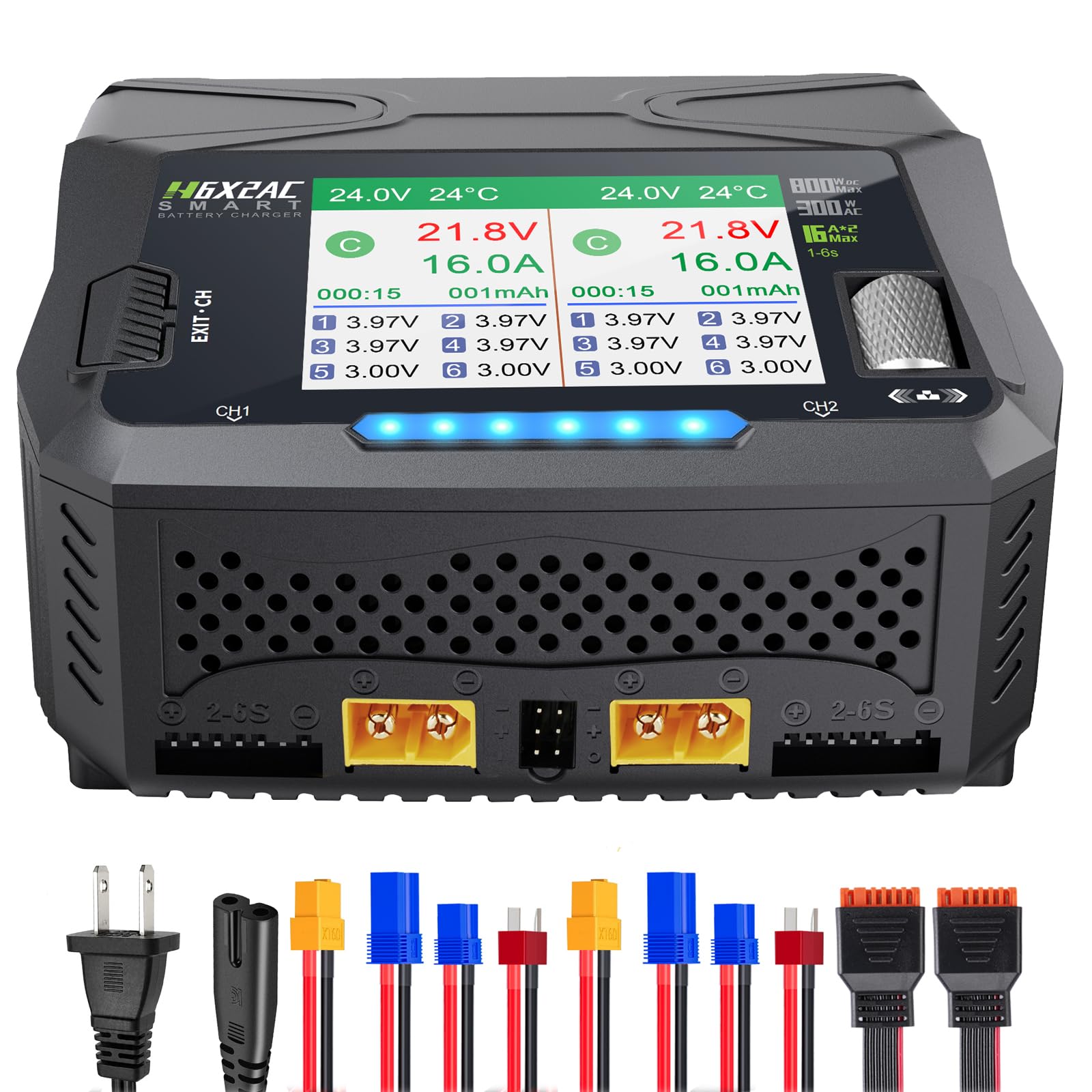
This is the pick for the basher who owns a stack of batteries and hates dead time. It runs two independent channels at up to 16A each, which means you can charge a 2S pack and a 6S pack side by side without juggling cables. The 300W AC ceiling and 400W DC ceiling mean neither channel chokes when you push current into a bigger pack. It also reads and balances 1S-6S lithium packs, 1S-15S NiMH and NiCd, and 2V-20V lead-acid, so it covers a mixed RC car and trail-truck lineup.
The 16A charge current here is the standout number — roughly four times the Traxxas USB-C charger’s 4A output. On paper that means faster refills on large-capacity packs. The 120V input voltage versus the Hiyiton’s 18V is a gap the spec sheet spells out plainly, but both plug into standard household power; the difference shows up in how much headroom each unit has for high-current charging. Two XT60-to-EC3/EC5/T adapters ship in the box, so most popular RC car connectors are covered without a trip to the hobby shop.
What it gets right
- Two channels at 16A each means both packs in your bag can charge at once.
- Handles LiPo, LiHV, Li-Ion, LiFe, LTO, NiMH, NiCd, and Pb chemistries in one box.
- Storage, discharge, balance, and balance-only modes make off-season pack care easy.
- XT60-to-EC3/EC5/T adapters included, so most RC car connectors work from the start.
Where it asks for care
- Heavier than the pocket chargers here at 1.9 pounds — a bench charger, not a pocket one.
- Long-term durability is the one recurring note — treat it as a bench unit and avoid drops.
- Balance-port extension cords ship in the box, but swapping batteries mid-session can leave you hunting for the right lead.
Best for: RC car owners who routinely carry two or more packs and want them charging simultaneously on one bench.
Worth knowing: It is a stay-put charger at 1.9 pounds — great for the workbench, not the one you toss in a field bag.
2. Hiyiton 6A Lipo Battery Charger
A do-it-all backup charger with the connectors already in the bag.
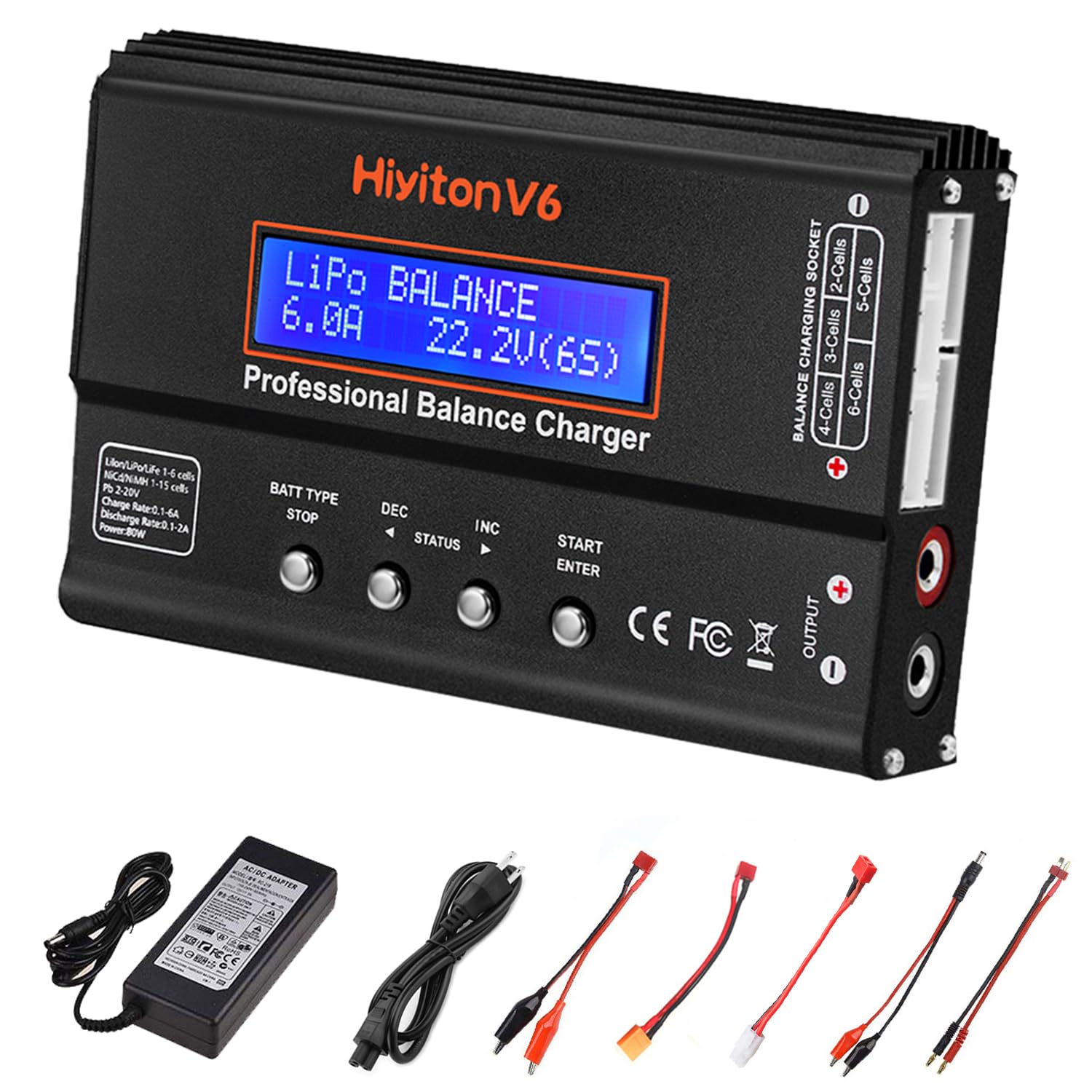
If you need one charger to cover every pack in a drawer full of old RC stuff, the Hiyiton V6 is a sensible starting point. It handles LiPo 3.7V-22.2V from 1S to 6S, Li-Ion, LiFePO4, NiMH/NiCd 1.2V-18.0V up to 1S-15S, and SLA 2V-24V — so most hobby packs in a mixed collection will find a home here. The 6A charge current puts it a step down from the dual-channel HTRC, but for a 2S or 3S basher pack it is a perfectly workable refill speed.
A smart chip inside guards against over-current, over-discharge, over-voltage, and short-circuit. The connector package includes Tamiya, XT60, Deans, Futaba, alligator clips, and a 4mm-to-Deans lead, so you likely will not need to buy a cable separately.
The honest read: What earns it a spot is the sheer connector variety and the smart-chip safety layer at a budget price. Heat is the one recurring gripe — the unit runs warm during a long charge, so give it open air rather than a padded bag. A couple of owners have flagged that it does not ship with charging leads for every connector type, so verify your battery’s plug before you assume it is covered.
Reach for this if: You have a mixed chemistry pile and want one charger that talks to nearly every plug type without extra cable shopping.
Look elsewhere if: You need high charge current for big 6S packs or want a cooler-running charger for long back-to-back sessions.
3. Traxxas USB-C Battery Charger
Plug in, let the iD chip do the thinking, go drive.
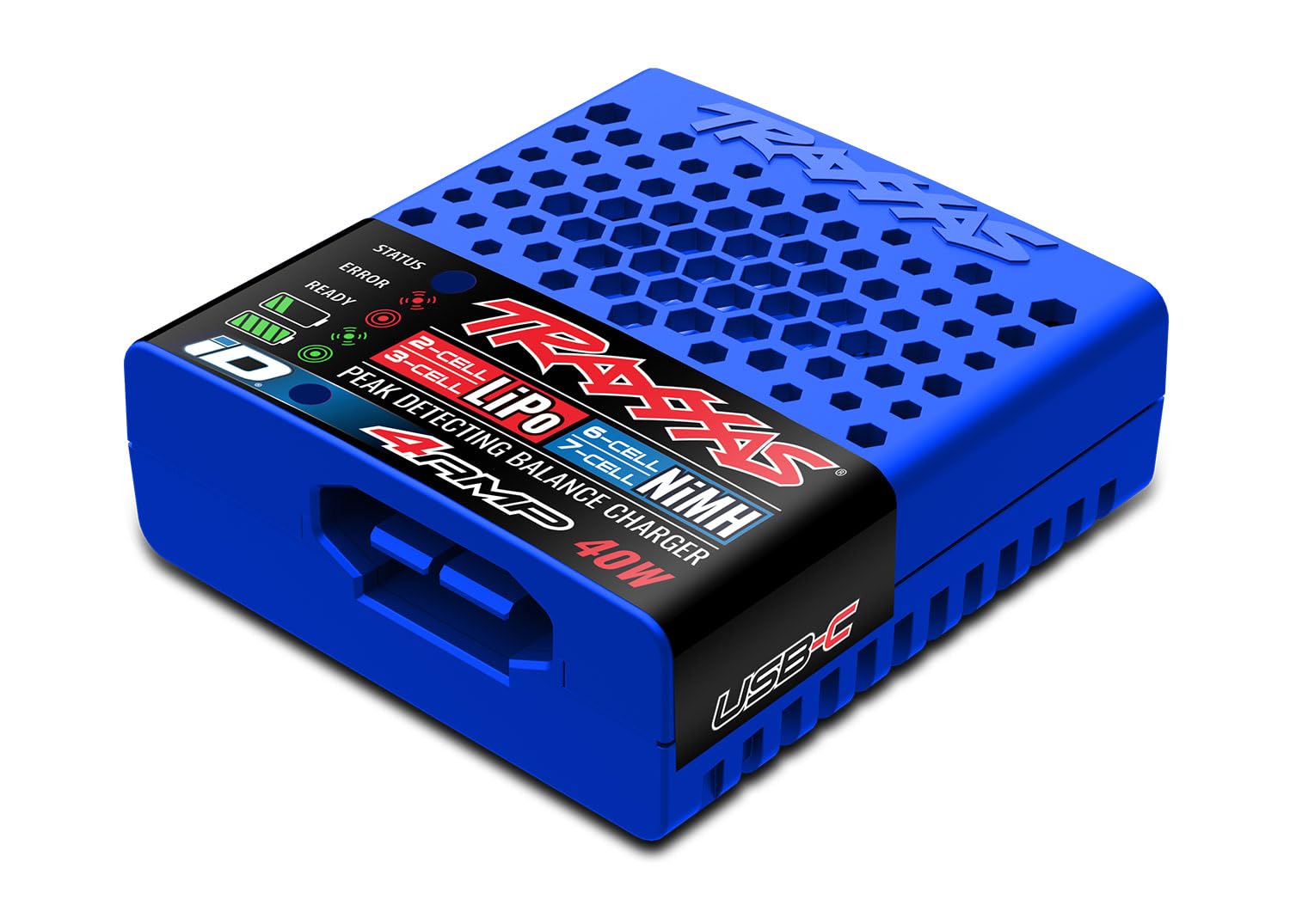
This one is for the Traxxas owner who does not want to memorize menus. The 2985 auto-recognizes Traxxas iD batteries and sets the charge profile for you, so the 40W, 4A max output lands on your pack without you scrolling chemistry options. It covers 5-7 cell NiMH and 2-3 cell LiPo, which maps directly to the packs most Traxxas cars and trucks actually run. The LED progress indicator tells you where the charge stands at a glance.
The catch you should know upfront: the box includes the charger, and you supply the USB-C cable and power supply. That is a milder ask than it sounds for a household with a decent USB-C wall brick, but it is an extra thing to sort out. It is also a single-port charger at 4A, so it will not top up a stack of packs in a session the way a dual-channel unit does.
Why it earns a look: If every battery you own says Traxxas on it, the auto-detect feature removes the single most common charger mistake — picking the wrong chemistry and cooking a pack. It is small too, at 2.72 ounces, so it lives in the car toolbox without complaint.
Choose this if: You run Traxxas iD packs and want zero thinking between drive sessions.
Pass on it if: You own packs from multiple brands or need to charge two batteries at the same time.
4. SKYRC B6Neo Balance Lipo Battery Charger

Pocket-sized enough for the field bag, quiet enough to barely know it is running.
At 82 grams and sized to throw in a bag, this is the charger that goes where your car goes. It pushes 200W at up to 10A in DC mode, and 80W at 5A when fed from Type-C PD — which means a USB-C power bank can keep you charging at the track. The 48 dB noise level is the detail that separates it from louder bench units; on a quiet morning at the field you will hear your car, not the charger. Two ports and an active balancer help keep 1S-6S packs healthy over the long haul.
Beyond charging, it also runs a discharger mode up to 24W when the balance port is connected, a storage mode, and a battery checker. Firmware is upgradeable, and the safety layer includes short-circuit and over-temperature protection. On the port side the layout is XT60 plus Type-C PD input, so your field power source and your car’s connector need to line up. The compact body is also a real comparison point — its footprint measures 1.26″D x 2.76″W x 1.97″H, versus the Traxxas unit at 4.72″D x 4.72″W x 1.97″H, so it fits where that one will not.
The field-charger case: Reliability is what keeps this pick in the conversation — it earns consistent praise for steady performance and easy menu navigation. The honest gap is the power cord: some buyers wish a cable came in the box, and the DC-only peak output means your Type-C PD feed caps you at 80W. Pair it with a stout PD source and it is a capable travel unit.
Best fit: Track-day and trail-day RC drivers who want one small charger in the bag that runs on DC or USB-C PD.
Think twice if: You plan to charge only at home from the wall, where the PD cap will feel limiting without a proper DC supply.
5. HTRC 150W 10A LiPo Battery Charger with Accessories
A single-port speed charger that ships with the entire adapter drawer already filled.
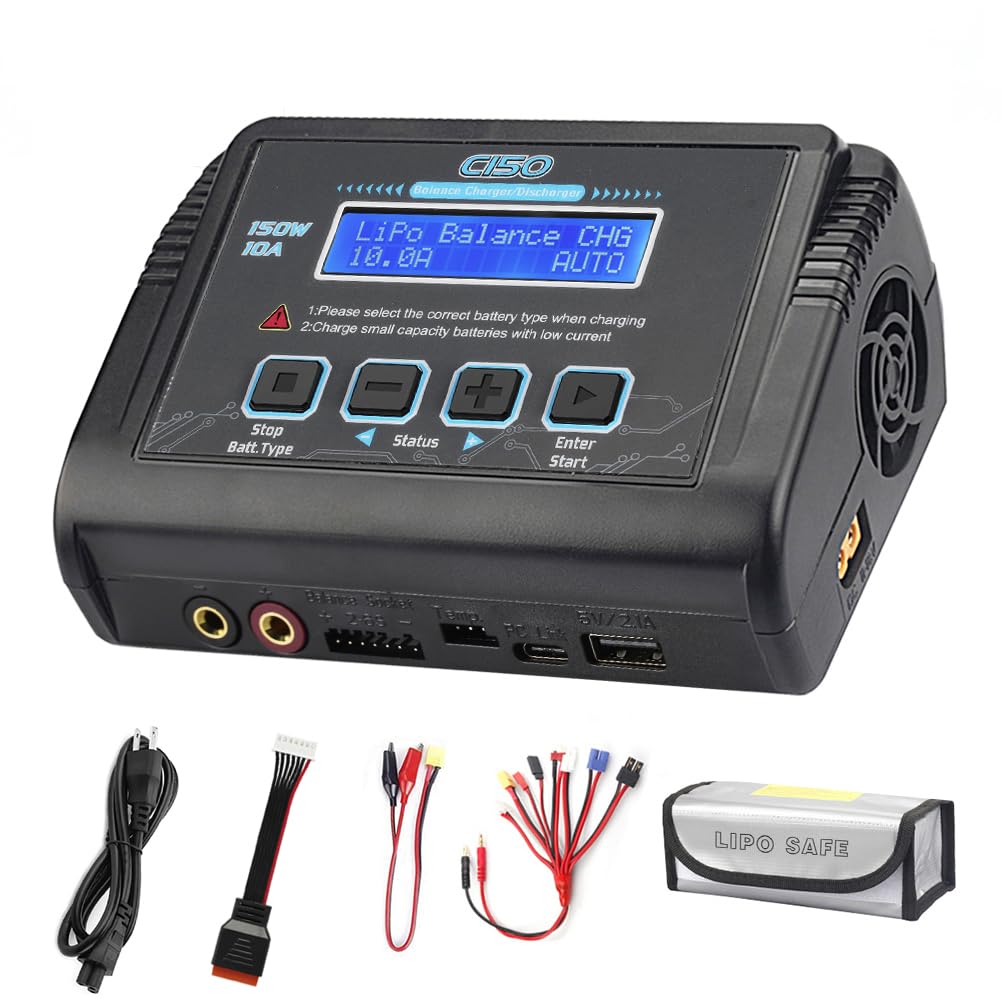
What sets this one apart is not the 10A charge current — it is the box. You get an 8-in-1 octopus harness covering Tamiya, Tamiya mini, JST, T Plug, EC3, TRX, and Deans, plus an explosion-proof charging bag and a balance extension cable. For an RC car owner with a mixed bag of packs, that combination removes nearly every trip back to the hobby shop for a new lead. The 150W output and 0.1-10A range give you room to speed up or slow down depending on pack capacity.
A built-in cooling fan keeps the internals breathing, and the shell is made from fire-proof material. You also get a 5V 2.1A USB output port, which means the charger doubles as a small charging station on a race day. It reads 1S-6S LiPo/Li-Ion/LiFe/LiHV, 1S-15S NiMH/NiCd, and smart packs, and it stores 20 memory profiles. Terminal voltage is adjustable from 3.85V to 4.3V per cell, but the maker flags that as an expert setting.
What you actually get in the box
- 8-in-1 connector harness plus a balance extension cable and a charging bag.
- 10A charge current handles most 1S-6S packs at good speed.
- 20 memory slots let you pre-store settings for each battery you own.
- USB output port turns it into a race-day gadget charger too.
The trade-offs worth weighing
- The cooling fan is audible — long sessions carry a background whine.
- Reliability across long-term use is a mixed picture; handle it as a bench tool rather than a throw-in-the-bag charger.
- Terminal voltage changing is flagged expert-only — leave it alone unless you know precisely what you are doing.
Suits you if: You want one charger with every lead you could possibly need in the package.
Worth skipping if: You want a whisper-quiet unit or plan to charge two packs at once — this is a single-port design.
6. ISDT 608AC Balance Charger

One knob, three modes, and a power brick that unsnaps when you travel.
The single shuttle-roll knob is the defining feature here: roll it, press it, and the charge starts. There are no nested menus to tunnel through, which makes it a genuinely welcoming first charger for someone getting into the hobby. It covers 1-6S LiPo, LiFe, Li-Ion, LiHV, Pb, and NiMH/NiCd packs across charge, discharge, and storage modes. The 8A, 200W output is competitive, and the detachable power supply is a real convenience — the brick comes off and the unit packs flatter.
There is a fifth use case beyond charging: the 608AC can run as a variable DC power supply, capped at 50W, with current adjustable from 0.2A to 5A and voltage from 2V to 30V. For a pit-table powering a tire warmer or a bench test, that is useful. The XT60 output is the standard for most RC car packs, so an adapter is only needed if your pack runs a different connector.
Where it wins: Ease of use gets the most consistent goodwill — the knob genuinely lowers the intimidation factor for a new RC owner. Charging performance is also steady, and the compact footprint at 4.35″D x 4.35″W x 1.22″H keeps it tidy on a crowded bench.
The honest caveat: Reliability over the long haul is the piece to weigh. Some buyers report the unit stopping properly over time, so treat this as a good starter charger rather than a forever one. If you need a battle-hardened workhorse, the dual-channel HTRC above is a sturdier bet.
Ideal for: A first-time RC owner who wants a simple, compact charger that is not intimidating to operate.
Reconsider if: You want a charger with a long proven service record — this is more of a smart starter than a long-lifer.
7. Gens Ace IMARS D300 Smart Dual Lipo Charger
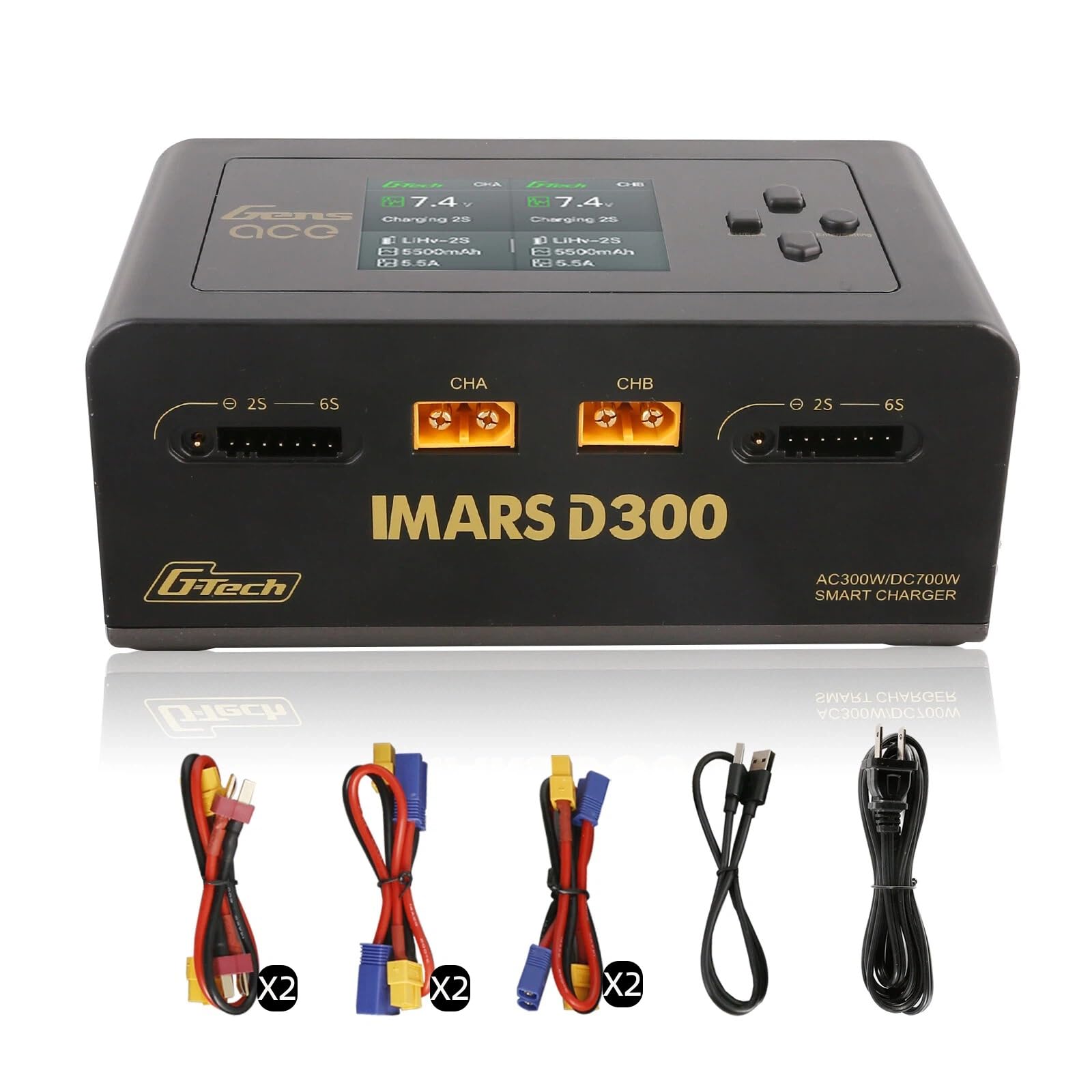
Dual channels that read your G-Tech packs and set themselves.
This is the dual-channel charger for the owner who wants the speed of a 16A-per-channel unit without fiddling with menus every time. The built-in smart chip recognizes G-Tech smart battery information and sets the charge automatically, stopping when full. If you run Gens Ace G-Tech packs, that removes the guesswork entirely. The 300W output splits across two channels, and there are seven operating modes including charge, balance, storage, sync charging, and a digital power supply mode.
The 2.4-inch IPS LCD lets you watch total voltage, charging and discharging current, and working time in real time, which makes diagnosing a sluggish pack easy. Safety features include a UL94-V0 flame-retardant grade on the housing. Cell balancing covers 1-6S lithium and 1-16S NiMH/NiCd, so the range is broad. Its dual-channel 16A output positions it above the Traxxas 4A single-port unit in raw throughput — if you are charging two packs back-to-back, the time difference is real.
Why owners warm to it: Effectiveness is the strong suit — a step up in quality that handles whatever pack you throw at it, with fast charging on high-voltage LiPo. The UI is intuitive and the unit stays compact on the bench.
The piece to watch: Durability is genuinely mixed. Some owners mention failures after three months of use, so register the warranty and keep it ventilated. For most buyers this is a solid performer; it just is not the longest-lived unit in this lineup.
Best for: Gens Ace G-Tech pack owners who want automatic detection and dual-channel speed.
Look elsewhere if: You want the longest proven service record — check the Venom Power below instead.
8. HOTA D6 Pro Dual Channel RC Battery Charger
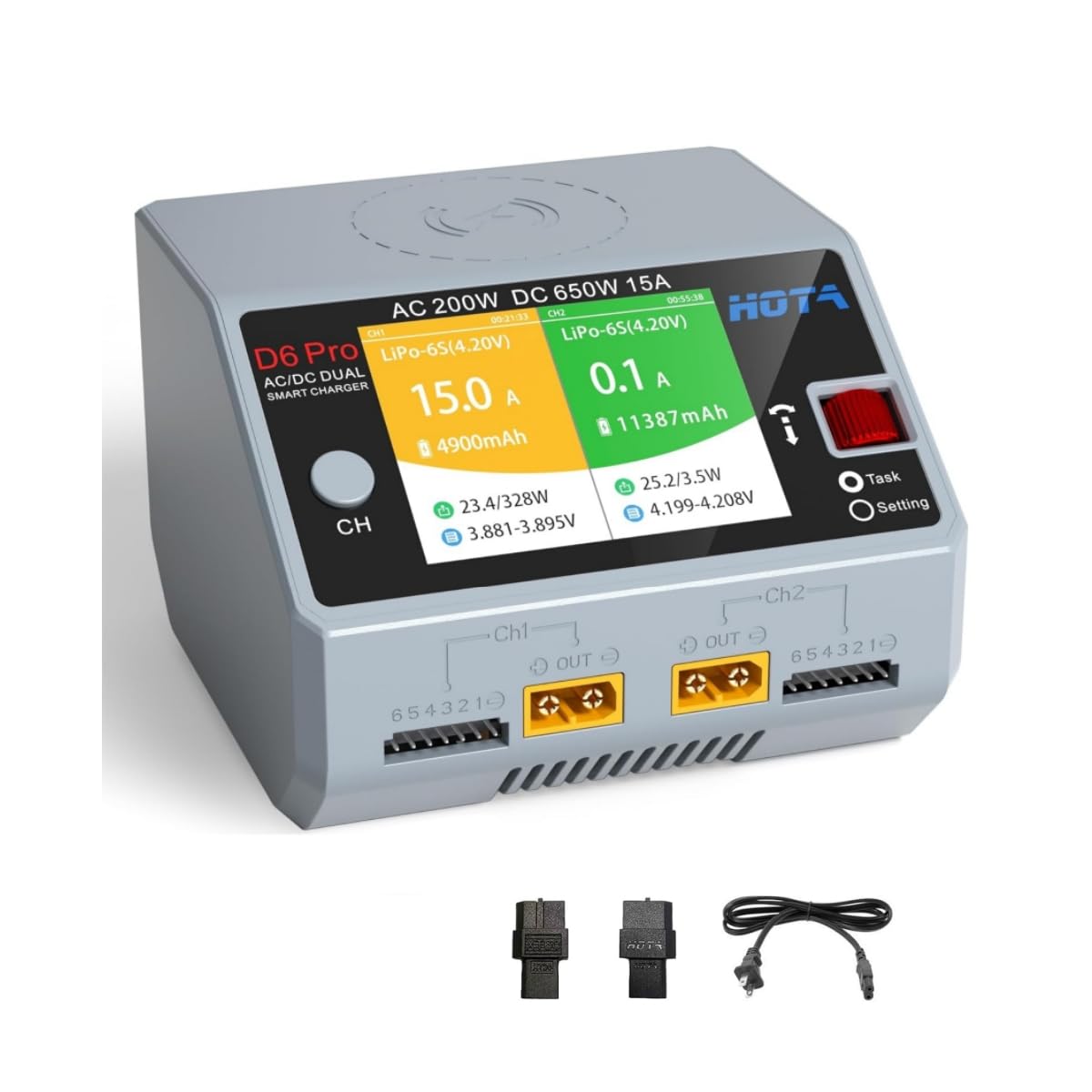
A big bright screen and a wall of protection circuits for the pit table.
The D6 Pro’s large IPS screen is the feature you notice first — wide viewing angle, true color, and a clear readout of what the charger is doing at any moment. That matters at a crowded track when you are glancing at it from an angle. The 15A charge current and 200W AC / 325W DC output are both substantial, and it takes AC 100-240V or DC 6.5-30V, so it travels between home and field without a fuss.
The protection layer is where this unit really pads its resume: overheating, time-exceeding, capacity, input reverse, output, short circuit, output current, output voltage, and overcharge protection all sit inside the chassis. Compatible packs run from LiH/LiF/Li-Ion/LiXX 1-6S through NiMH/NiCd 1-16S, smart batteries 1-6S, lead-acid 2-24V, and Eneloop cells. Both Chinese and English menus can be selected, and the output connector is XT60-to-XT60.
What works well: Functionality is the strongest thread — it works reliably and the setup is straightforward. The 584g body is compact for what it packs inside.
What to keep in mind: Battery life is the point to weigh here, since some customers note the AC power supply failing after a couple of months. It still runs on DC from a field battery if that happens, so a failed brick is not the end of the unit. Just plan for the possibility that the AC side does not last forever.
Pick this for: The racer who wants a big readable screen and serious built-in protection circuits.
Be aware: The AC power supply is the part most likely to give up first — keep a DC field battery on hand as a backup.
9. Venom Power Pro Duo LiPo Battery Charger

Leads for every pack you own, all shipped in the same box.
Two independent 80W circuits give this charger 160W total across its two ports, so a pair of packs can charge simultaneously on separate circuits rather than taking turns. The seven-amp charge current is not the highest in this lineup — but what makes it stand apart is the included lead set: alligator, Deans, EC3, EC5, JST, receiver (RX), Tamiya, and XT60, all in the box. If you own an assortment of packs across brands, that alone saves a shopping trip and a frustrating connector mismatch.
The feature list is complete: balance charge, fast charge, discharge, cycling, storage charge, and a battery meter, plus five battery profile slots so you can save settings for each pack you rotate through. A built-in temperature monitor automatically stops the charge when the set threshold is reached, which is a real safety layer for long unattended sessions. The lightweight frame at 2 pounds with an integrated handle means it moves from home bench to track without needing an armful of power supplies.
What earns it premium status: Effectiveness is consistently praised — this is a charger people describe as the best they have purchased. The eight leads and five-profile memory make it the most self-contained unit in this lineup.
The caveats worth naming: Reliability is mixed, so warranty registration matters. Some owners note a port or fan stopping after prolonged use. The AC brick and internal fans are the parts most frequently mentioned when something goes wrong — keep the unit out of a bag during charging and give the vents room.
Worth it if: You want one box that covers every connector type, five battery profiles, and temperature-monitored safety in the same package.
The honest trade-off: It costs more than the dual-channel HTRC and Gens Ace units above and carries a mixed reliability record, so buy it for the eight included leads, not for value.
Know the Specs
Charge current (amps) — how fast your pack refills
Charge current is how fast power flows into the pack. Higher amps mean a faster refill, but only if the pack’s own safe charge rate supports it. The 16A per-channel output on the HTRC dual charger and the Gens Ace IMARS D300 is far more than the 4A on the Traxxas USB-C unit. That is why a dual-channel high-amp unit suits large 6S packs better. If you are charging a small 2S basher pack, 6A is plenty, and the Hiyiton V6 sits exactly there.
Wattage — the total ceiling between input and output
Watts measure total power, and the relationship between input watts and output watts is what actually reaches the battery. A 150W charger like the HTRC single-port unit will charge a small pack fast but may bottleneck on a large 6S pack. The 300W AC / 400W DC dual-channel unit has headroom for two channels at once. The 200W AC / 325W DC HOTA D6 Pro splits its total between its two channels. Higher wattage is only an advantage if a single pack actually needs that much — a 2-3S basher pack rarely does.
Common Questions
Can I charge a 6S LiPo pack with a 1S-6S charger?
What is the difference between balance charging and regular charging?
Do I need to match the charger connector to my RC car battery?
What does dual channel actually mean for a car charger?
Why does my charger get hot during a charge?
Can I use a USB-C power bank to run a field charger?
Is a higher-wattage charger always better for RC car batteries?
What is storage mode on a LiPo charger and when should I use it?
Can I charge NiMH and LiPo batteries on the same charger?
How long does an RC car charger actually last?
The Bottom Line
For most RC car owners, the remote control car charger winner is the HTRC Dual LiPo Charger. Its dual channels at 16A each cover a fleet of packs. And its 1S-6S LiPo plus NiMH chemistry range means it handles nearly every car battery on the market. If you want automatic pack detection and a bigger screen, grab the Gens Ace IMARS D300 for its smart-chip G-Tech auto-detect. And for a field bag, the SKYRC B6Neo at 82 grams with 48 dB operation is the one to reach for.
How we choose
We do not accept paid placement. Every pick is matched to a real buyer and a real use-case; we do not hands-on test units.
Sources
Specifications: manufacturer listings and product documentation. Review insights: verified customer reviews, as of November 2026. Pricing: not shown on this page (it changes often); check the current price via the retailer link.
As an Amazon Associate, Tactical Gear Guy earns from qualifying purchases. This does not affect which products we feature.