Specs are compiled from manufacturer listings and verified buyer reviews and can change over time — please confirm the key details on the product page before buying.
You want a car battery that still cranks on a freezing morning a few winters from now. Three numbers decide that: cold cranking amps (CCA, the burst of power that turns a cold engine over), reserve capacity (how long the battery keeps accessories alive if the alternator quits), and group size (the physical dimensions that drop into your tray). Get those three right and the rest is brand trust and warranty. This guide walks through six 12-volt automotive starting batteries and tells you plainly which one fits which driver.
This guide is built by comparing the manufacturers’ published specifications and the patterns across verified customer reviews, so you get each pick’s real strengths and trade-offs instead of marketing spin.
Below you’ll find group sizes, cold cranking ratings, and the honest gripes that show up again and again, so you can match a battery to your vehicle instead of guessing. Use this breakdown of the rating car batteries to pick the one that fits your tray and your climate.
Top Picks


How To Choose The Best Rating Car Batteries
Buying a car battery is a fitment puzzle wearing a power spec. If the box does not physically drop into your tray with the positive and negative posts on the right sides, nothing else matters. So you work in a fixed order: confirm the group size, then the terminal layout, then the CCA rating your engine actually calls for, and only then look at brand and warranty.
Start with group size, not brand
Group size is a standardized footprint — a coded shape that tells you the length, width, and height of the case. A Group 34, a Group 47, a Group 48, a Group 65 and a Group 34R are all different physical envelopes. Measure your old battery and compare, or use your vehicle’s fit tool. Getting this wrong is the single most common reason a battery gets returned.
Then check the terminal layout
Terminal position means which side the positive and negative posts sit on. A reversed layout will not reach your cables without stretching them, which is a fire risk you do not want. Note the “R” in a name like 34R — that usually signals a reversed terminal arrangement compared with the standard part.
Match CCA to your climate
Cold cranking amps measure how much current the battery can deliver for 30 seconds at 0°F while staying above 7.2 volts. If you live somewhere mild, a 650 CCA battery is generally plenty. If your winters bite, higher CCA like 750, 800, or 930 gives you a bigger margin on the coldest mornings.
Decide if you need AGM
AGM stands for absorbed glass-mat — the electrolyte is suspended in fiberglass mats instead of sloshing as free liquid. That makes it spill-proof and more vibration-resistant. Vehicles with start-stop systems (the engine shuts off at red lights) generally require AGM because those systems cycle the battery far more often than a plain flooded battery handles well.
Side-by-Side Comparison
| Model | Best For | Cold Cranking Amps | Group Size | Weight | Amazon |
|---|---|---|---|---|---|
| MARXON Group 34 AGM★ Best Overall | Everyday start-stop cars | 650 CCA | Group 34 / 24 | 42 lb | Amazon |
| Weize Platinum AGM Group 47Best Value | Cold-climate daily drivers | 680 CCA | Group 47 (H5) | 41.6 lb | Amazon |
| Interstate MTX-65 AGM | Long-life start-stop power | 750 CCA | Group 65 | 45 lb | Amazon |
| ACDelco Gold 48AGMHR | GM vehicles needing exact fit | — | Group 48 | 46.3 lb | Amazon |
| OPTIMA 34R RedTop | Vibration-heavy trucks | 800 CCA | Group 34R | 37.9 lb | Amazon |
| Odyssey ODX-AGM65 | Maximum cranking power | 930 CCA | Group 65 | 60 lb | Amazon |
Detailed Reviews
1. MARXON Group 34 Car Battery 12V 55Ah 650CCA AGM
Our pick — 4.5+★ from 800+ verified ratings; the strongest balance of quality and price.
The start-stop battery that drops straight into a well-worn factory tray.
This Group 34 battery fits where many Group 24 trays sit, so you can move up from a smaller battery without cutting anything. It holds 55 Ah (amp-hours, a measure of charge capacity) and fires 650 cold cranking amps into a 12-volt system — the middle of the pack on cranking power, but plenty for a four-cylinder or a modest six in a temperate climate. At 10.87 inches long and 6.61 inches wide, it slips into the same space as many Group 24 trays.
If your vehicle shuts the engine off at stoplights, that start-stop capability is the whole reason to pick AGM over a plain flooded battery. The maker claims the AGM chemistry charges 40% faster than an SLA (sealed lead-acid) battery and trims fuel and emissions in stop-start driving. Treat those as manufacturer figures rather than something you can measure in your driveway. The leak-proof, maintenance-free design means no topping up with acid and water between services.
Buyers praise build quality first and cranking performance second, and installation is quick — often under half an hour with basic hand tools. Installation is quick, often under half an hour with basic hand tools, and the fitment earns consistent praise from buyers swapping out a tired OEM unit. The honest caveat is longevity. This is not the battery to expect a decade out of, so if you plan to keep the car long-term, budget for a replacement down the road. A three-year replacement warranty from a US-based office takes some of the sting out of that.
Where it delivers
- 650 CCA and 55 Ah handle everyday start-stop driving without strain.
- Compact 10.87-inch length fits Group 34 and many Group 24 trays.
- AGM design is spill-proof and maintenance-free.
- Three-year replacement backed by US offices and warehouses.
What to weigh first
- Longevity is the honest weak spot — not a decade battery.
- 650 CCA is modest if you face brutal winters or a big engine.
- Confirm your terminal layout and group size before ordering.
Reach for this if: you drive a start-stop car with a Group 34 or Group 24 tray and want a dependable daily battery.
Think twice if: you live where winters drop hard and you need maximum cranking margin.
2. Weize Platinum AGM Battery Group 47, H5 12V 60Ah 680CCA
A sub-zero starter that comes from the start already charged.
Start with the coldest-morning number: 680 cold cranking amps. That is a modest step up from the MARXON above (650 CCA), and it is the reason this Group 47 keeps firing in weather that has other batteries whimpering. Reserve capacity sits at 100 minutes, meaning the battery can keep your lights and accessories running for that long if the alternator ever quits. Capacity is 60 Ah, and the maker rates it at up to twice the cycle life of a conventional battery.
The self-discharge figure is worth noting: under 8% after 90 days of storage. That means a spare or a seasonal vehicle will still have useful charge months later. Operating range runs from -22°F to 158°F, so it is built for real weather swings rather than a showroom. It is leak-proof and certified non-spillable, with added vibration resistance built into the case.
Buyers report it fires up immediately and keeps working in sub-zero cold, with a fully charged state on arrival being a recurring note. Fitting is the one thing you must handle yourself. Measure your old battery, confirm the dimensions line up (9.52 inches long, 6.89 wide, 7.48 tall), and make sure the tapered terminals sit left-negative, right-positive. The manufacturer is blunt about this: they are not suitable for deep-cycle uses like solar setups or marine duty. This is a starting battery, full stop.
Cold-weather strength: 680 CCA and a -22°F low end mean it keeps cranking in weather that sidelines weaker batteries.
The honest catch: fitment is entirely on you — a reversed terminal or wrong footprint will not work, so verify before you order.
Pick it for: a Group 47 car that sees genuine cold and needs a battery that starts without hesitation.
Steer clear if: you are shopping for a deep-cycle setup — this one is a starting battery only.
3. Interstate Batteries 12V 68Ah 750CCA Group 65 AGM
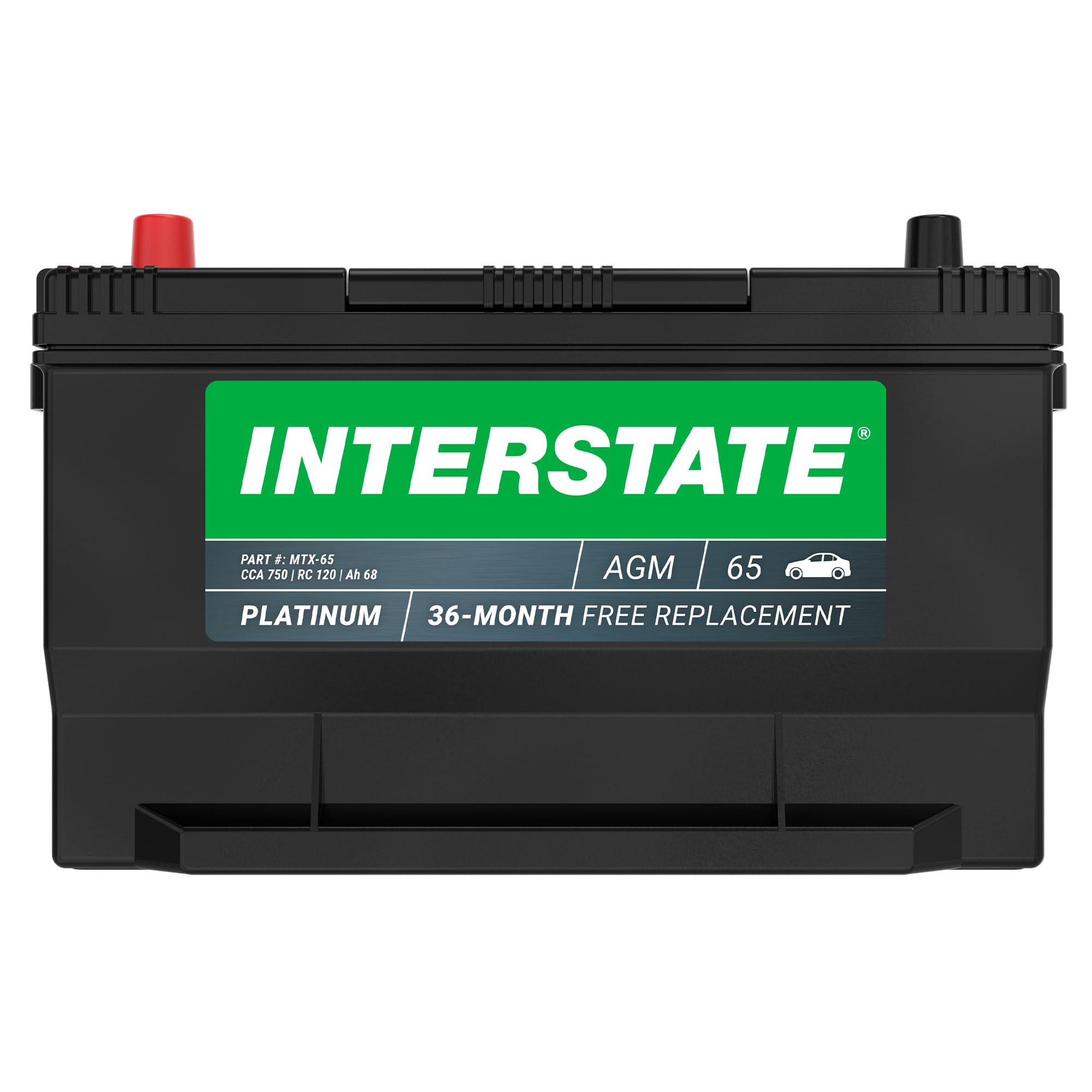
The high-capacity pick built to outlast a basic flooded battery.
Interstate’s MTX design packs more lead into the case, and the numbers show it: 68 Ah of capacity and 750 cold cranking amps. That 68 Ah is a clear jump over the 55 Ah MARXON above, with more reserve for accessories and plug-ins. The company claims a service life of 2X a conventional lead-alloy AGM and 3X a conventional flooded battery. Those are maker figures, not something you can confirm at purchase, but the pure-lead construction is the basis for them.
The valve-regulated AGM design keeps the electrolyte suspended in fiberglass mats instead of free-flowing liquid, so the battery is spill-proof and vibration-resistant. That matters on rougher roads and in trucks that see real work. It is a Group 65, one of the larger common footprints, so this is a battery that suits full-size cars, trucks, and SUVs rather than compacts.
Where the MTX earns its keep is reserve capacity: 68 Ah carries the extra electrical load of a modern vehicle without straining. The recurring honest note is battery life, which draws a real mix of experiences: some owners mention it holding charge well over time while others see it fall short after a couple of years. That is the trade-off on any high-capacity AGM, and it is why buying from a brand with real warranty support matters. Confirm Group 65 fit and terminal placement first, then set your expectations for a solid several years rather than a permanent one.
Why it earns a spot
- 68 Ah and 750 CCA give real headroom for accessories and big engines.
- Pure-lead AGM construction is spill-proof and vibration-resistant.
- Maker claims 2X the life of a conventional lead-alloy AGM.
- Group 65 suits full-size cars, trucks, and SUVs.
Where it can disappoint
- Battery life draws mixed real-world reports.
- Group 65 is a larger footprint — verify tray space and terminals.
- Premium build means a higher upfront cost than value AGMs.
Good fit for: trucks and SUVs running extra electrical load that need capacity and cranking power together.
Not the one if: you drive a compact with a smaller Group size, or you want the shortest budget path to a replacement.
4. ACDelco Gold Automotive Battery 48AGMHR | PN 88866268

The factory-style replacement for GM vehicles that wants an exact original match.
This is a Group 48 AGM aimed squarely at specific GM models — Chevrolet Camaro, Equinox, Malibu, Tahoe, and Trailblazer among them. The whole pitch is fit and provenance: GM-backed engineering, a high-reserve AGM build, and the kind of application-specific construction that a generic replacement battery will not match. Weighing 46.3 pounds, it is no lightweight, but it is built with high-density plates and a leak-resistant pressurized valve system to support long-term use.
The warranty is the standout term: 36 months or unlimited miles, parts only. That is a straightforward commitment most budget batteries will not make. If you own a GM vehicle and simply want the battery to fit the factory location without adapters or guesswork, this is the least dramatic route to a replacement.
Fit and finish: a vehicle-specific Group 48 AGM that drops into the factory location the way the original did.
What to know: this is a narrowly focused battery — confirm your year, make, model, and engine before ordering, because it will not suit just any car.
Buy it when: you own one of the listed GM vehicles and want an original-style AGM with a clear 36-month warranty.
Keep looking if: your vehicle is not on the fitment list — this battery is deliberately specific.
5. OPTIMA Batteries 34R RedTop Sealed AGM, 800 CCA

Spiral-wound cells built to shrug off the shake of a rough road.
The 800 CCA here versus the Weize’s 680 CCA above is a real margin for a big engine on a bitter morning. The OPTIMA’s other numbers tell a consistent story: 50 Ah capacity, 100 minutes of reserve capacity, and a 37.9-pound weight that is lighter than most on this list. That lighter case with strong cranking is the whole appeal.
The defining tech is SpiralCell construction, a wound-cell design using 99.99% pure lead. The maker claims it outperforms conventional flat-plate batteries and resists vibration 15 times better than standard flooded designs, with up to 3 times longer life. In plain terms, spiral cells are packed tighter and more resistant to the internal flex that kills batteries on bumpy roads. The 34R code flags a reversed terminal layout, so check that your cables reach correctly.
Owners praise build quality most and cranking performance right behind it, describing confident starts even in deep sub-zero cold. Value and long-term life are the honest question marks: this is not the cheapest per year of service, and some owners get impressive longevity while others see shorter runs. If you run a truck or a rig that gets shaken hard, the vibration resistance is where the premium goes. If you just need a commuter battery, a value AGM covers you without the spend.
Cranking muscle: 800 CCA and 100 minutes of reserve keep a bigger engine starting and accessories alive.
The trade-off: the pure-lead spiral build costs more, and real-world longevity is uneven, so weigh the premium against how long you plan to keep the vehicle.
Best for: trucks and off-road rigs that take a beating and need maximum vibration resistance.
Skip the premium if: you drive a light commuter where a value AGM already covers your cranking needs.
6. Odyssey Battery ODX-AGM65 Extreme Series AGM

The heaviest hitter on the list, with cranking amps that dwarf the rest.
Read the spec sheet top to bottom and one figure dominates: 930 cold cranking amps. Nothing else here comes close — the Interstate MTX-65 sits at 750 CCA and the Weize at 680. Add 135 minutes of reserve capacity and a 1,350 hot cranking amps rating, and you have a Group 65 battery built to start big, hungry engines without flinching. The case weighs 60 pounds, the heaviest of the six, so plan for a two-hand lift when you swap it in.
The Extreme Series is aimed at drivers who need serious power — large displacement engines, accessory-heavy rigs, or vehicles that come under real demand. It uses Group 65 tin-plated brass SAE posts and a right-side negative terminal, so confirm your cable routing lines up. The 4-year manufacturer warranty is the longest term in this group, which offsets the steep commitment considerably.
Buyers respond to the raw output — “unbelievable” is the word that keeps surfacing around this battery’s cranking power. Life and value are the honest split: some customers note it outlasting everything they have tried by a wide margin, while others see early failures and balk at the cost. That spread is real and worth knowing before you commit. If your priority is the most cranking power in a Group 65 footprint and you accept a higher upfront outlay, this delivers. If value per year is your first filter, a cheaper AGM will serve you.
Choose this for: a demanding engine or heavy-accessory vehicle where maximum CCA and a 4-year warranty justify the spend.
Look elsewhere if: you drive a modest car and want the best cost-per-year, since this is the priciest route here.
Know the Specs
Cold Cranking Amps (CCA)
CCA is the burst of current a battery can deliver for 30 seconds at 0°F while staying above 7.2 volts. It is the number that decides whether your engine turns over on a freezing morning. Higher CCA (like the 930 on the Odyssey) gives a bigger safety margin for large engines and cold climates, while lower CCA (650 on the MARXON) is fine for mild weather and smaller engines.
Reserve Capacity (RC)
Reserve capacity is how many minutes the battery can keep essential accessories running if the alternator fails. A 100-minute rating means you have roughly that long to reach safety before the battery drains. If your vehicle is accessory-heavy — lights, sound systems, plug-ins — a higher RC number gives you more cushion.
Group Size and Terminals
Group size is the physical footprint and height of the battery, while the terminal layout is which side the positive and negative posts sit on. A 34R with reversed terminals will not reach cables routed for a standard 34. Always verify both before ordering — this is the top cause of battery returns.
AGM vs Flooded
AGM (absorbed glass-mat) suspends the electrolyte in fiberglass mats, making it spill-proof and more vibration-resistant than a flooded battery. Start-stop vehicles cycle the battery far more often, so they generally need AGM construction. A plain flooded battery can cost less but does not handle the cycling or the vibration as well.
Common Questions
Will a Group 34 battery fit where a Group 24 came out?
Do I need an AGM battery if my car has start-stop?
What does the R in a 34R battery mean?
Is 650 CCA enough for my car?
Can I use a start-stop battery for a solar or marine setup?
How long should a car battery last?
What is reserve capacity and why does it matter?
Should I install a car battery myself?
Does a heavier battery mean more power?
The Bottom Line
For most everyday drivers, the rating car batteries winner is the MARXON Group 34 because it balances 650 CCA, 55 Ah capacity, and start-stop readiness (it handles engines that shut off at red lights) in a compact case that fits both Group 34 and many Group 24 trays. If cold weather is your biggest worry, grab the Weize Platinum Group 47 for its 680 CCA and -22°F operating floor (it keeps working down to that temperature). And for maximum cranking power in a Group 65 footprint, the Odyssey ODX-AGM65 is the one to reach for with its 930 CCA and 4-year warranty.
How we choose
We do not accept paid placement. Every pick is matched to a real buyer and a real use-case; we do not hands-on test units.
Sources
Specifications: manufacturer listings and product documentation. Review insights: verified customer reviews, as of November 2026. Pricing: not shown on this page (it changes often); check the current price via the retailer link.
As an Amazon Associate, Tactical Gear Guy earns from qualifying purchases. This does not affect which products we feature.