Specs are compiled from manufacturer listings and verified buyer reviews and can change over time — please confirm the key details on the product page before buying.
A pulse oximeter for athletes is a tiny finger clip that gives you a blood-oxygen number before or after training — and the honest truth is that accuracy and a readable screen matter far more than app features or a fancy case. Below are nine devices worth your attention, sorted by what they actually do for a training day, a climb, or a flight.
This guide is built by comparing the manufacturers’ published specifications and the patterns across verified customer reviews, so you get each pick’s real strengths and trade-offs instead of marketing spin.
Nearly every model here takes two AAA batteries, reads at roughly plus or minus two percent accuracy, and wants your hand dead still — so the real split is between screen quality, sensor behavior on cold fingers, and how fast a number appears. That last detail is exactly what separates a useful pulse oximeter for athletes from one that sits in a drawer.
Top Picks


How To Choose The Best Pulse Oximeter for Athletes
Start with what you actually want from the reading. If you are checking how you recover between intervals, you need a fast number and a screen you can read with a towel over your head. If you are a climber or pilot watching oxygen at altitude, you need a device that tolerates cold, poor circulation, and a shaky hand.
Accuracy Is A Range, Not A Perfect Number
The most common figure on these devices is a measurement accuracy of plus or minus two percent, usually quoted across a 70% to 100% SpO2 range. In plain terms, a device reading 96% could genuinely be 94% to 98%. That is fine for spotting a real drop during a hard effort at altitude. It is not fine for self-diagnosing anything, and no fingertip clip is built for that.
Look For A Plethysmograph And Perfusion Index
A plethysmograph is a small live waveform that pulses with every heartbeat, and the perfusion index is a number showing how strong the signal is at your fingertip. Together they tell you whether the reading you see is being taken from a solid signal or a weak one. On cold hands — which is exactly what happens on a ski lift or a summit push — that signal check is worth more than any extra feature.
Screen Readability Beats Screen Size
An OLED screen (organic LED, which stays visible in bright light) shows up far better in direct sun than a dim red LED display. If you plan to read your oxygen on a trail or a runway, prioritize an OLED panel and a display that faces you when your finger is in the clip.
Battery, Case, And Finger Fit
Two AAA batteries with automatic shutoff covers most of these devices for weeks of spot checks. A travel case protects a plastic clip rattling in a gym bag. And finger fit matters: several models use a spring-loaded chamber to grip a wide range of finger sizes, which keeps the sensor pressed against your nail bed instead of sliding loose mid-reading.
Side-by-Side Comparison
| Model | Best For | Accuracy | SpO2 Range | Battery | Amazon |
|---|---|---|---|---|---|
| Innovo Deluxe iP900AP★ Best Overall | All-round training and altitude checks | +/-2% | 70% – 100% | 30 hours (2x AAA) | Amazon |
| AccuMed CMS-50D1Best for Travel | Gym-bag and flight-bag carry | — | — | Up to 32 hours (2x AAA) | Amazon |
| WRINERY Oxygen Saturation MonitorBest Value | Fast checks with a case included | — | — | 2x AAA included | Amazon |
| Zacurate 500 Series | Readings facing you, full SpO2 display | +/-2% | SpO2: 0-100%, PR: 30-250 BPM | 30 hours (2x AAA) | Amazon |
| Amemo OLED Oxygen Monitor | Reading in strong sunlight | — | — | 2x AAA included | Amazon |
| ADC Advantage 2200 | Simple one-button spot checks | SpO2 +/-2%, HR +/-5% | — | 2x AAA included | Amazon |
| Zacurate 500B-B Bluetooth | Logging readings in an app | — | 70% – 100% | 2x AAA included | Amazon |
| Innovo iP900BP-B Bluetooth | Recording plus respiratory rate | +/-2% | 70% – 100% | 30 hours (2x AAA) | Amazon |
| Herz P1 | Training-bag portability | 80%~100% +/-2% | 70% – 100% | 2x AAA included | Amazon |
Detailed Reviews
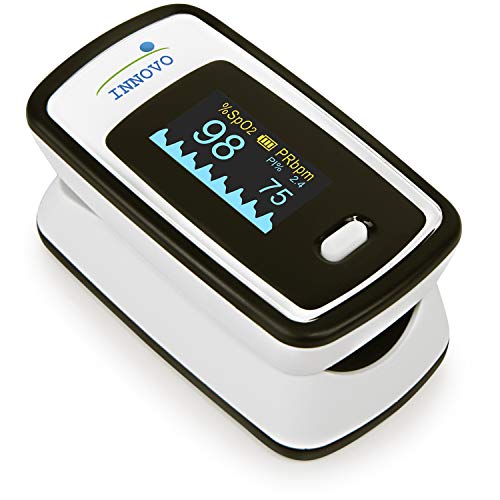
1. Innovo Deluxe iP900AP Fingertip Pulse Oximeter
Our pick — 4.5+★ from 51,000+ verified ratings; the strongest balance of quality and price.
The pick that holds a steady SpO2 reading on cold, low-perfusion fingers.
The number that decides a training oximeter is measurement accuracy, and this Innovo is rated at +/-2% across a 70% – 100% SpO2 range — meaning a 96% reading is honest to within a couple of points rather than a guess. It backs that up with an improved LED and sensor that the maker says holds SpO2 and pulse rate readings even at low blood perfusion. That is the scenario you hit on a summit push or after a hard sprint, when blood is pooled in your legs and your fingertip goes pale.
What wins people over is the build and the simplicity together — it is the crowd favorite at 4.5+ stars across 51,000+ ratings, and the recurring theme is a device that leaves the box working. It ships with 2x AAA batteries and a lanyard, so there is no first-day setup beyond clipping it on. A plethysmograph waveform and perfusion index both show on screen, which lets you see whether a number came from a clean pulse or a shaky one. For athletes that is the difference between trusting the reading and re-taking it three times.
Battery life is rated at 30 hours, and the display brightness is adjustable with an auditory alarm and pulse detection beeps you can lean on when you don’t want to stare at the screen. The trade-off is honest: reliability is the mixed note here, with a small share of units reported to quit early. Treat it as a device to check before a big trip rather than assume — and keep the batteries fresh.
Where it pulls ahead
- +/-2% accuracy across a 70% – 100% SpO2 range, so readings hold up to comparison
- Plethysmograph and perfusion index confirm you have a clean signal
- Adjustable brightness plus pulse beeps for quick checks in bright light
- 2x AAA batteries and a lanyard included, so it works the moment it arrives
What to keep in mind
- Reliability is the one mixed signal, so some units need checking before travel
- 2.5″L x 1.35″W x 1.25″H body is a touch longer than the Zacurate 500 Series at 2.25″L
- No Bluetooth, so nothing logs to an app
Go with it if: you want one device for pre-run, post-run, and altitude checks with a signal you can verify on screen.
Look past it if: you need an app recording every reading — the Bluetooth picks further down handle that.
2. AccuMed CMS-50D1 Fingertip Pulse Oximeter
Fifty grams of clip that lives in a flight bag and asks nothing of you.
Carry weight is the whole argument here. At 50 grams it disappears into a gym bag or flight bag, and it arrives with a travel case that keeps the plastic body from getting scratched in transit. Up to 32 continuous hours of battery life from two AAA cells is the longest figure in this group, so a multi-day hiking or flying trip does not turn into a battery hunt.
The rotating LED display reads in portrait or landscape, auto-detecting your hand movement so the number faces the right way without you turning your wrist. A reading lands in eight to ten seconds — the maker is clear that you need to hold still, and not while in motion, which rules out mid-stride checks but suits a pause at the trailhead. The lanyard clips to the case or the unit itself.
It fits fingers from kids above four years old up to adults, which makes it a family device rather than a personal one. What to plan around: response time splits opinion, with some finding it quick and others slow. The bottom battery plate can also work loose over time — a small annoyance, not a failure. The maker states plainly that it is not intended for medical use, which is the right frame for training and aviation checks.
The case for the little guy
- 50 grams with a protective travel case included
- Up to 32 continuous hours on two AAA batteries
- Auto-rotating display reads in portrait or landscape
- Fits fingers from kids above four to adults
Where it asks for patience
- Response time splits opinion — some find it slow
- The battery plate can work loose
- Reading takes eight to ten seconds and needs a still hand
Pick it for: a kit that travels light and packs itself away in the supplied case.
Reach for something else if: you want instant numbers without waiting on the readout.
3. WRINERY Oxygen Saturation Monitor, Pulse Oximeter Fingertip
The bundle does the talking: case, lanyard, hook, and batteries in one box.
Most oximeters make you buy the case separately, and this one does not. The WRINERY arrives with a protective case, a hook, a lanyard, and 2x AAA batteries, so it is genuinely ready to drop into a training bag. Its OLED display is the sharp, vivid kind that stays readable outdoors, and the maker quotes a reading within 8 seconds — quick enough for a check between sets.
What it is built around is straightforward function — it is designed for mountain climbers, skiers, bikers, and anyone tracking SpO2 and pulse rate, with a finger chamber that the maker says covers a wide range of sizes from young people to elders. There is no plethysmograph or app here; you get the two numbers and the fast read. For a first oximeter that is generally enough.
The honest limit: this is a low-volume model, so the review base is smaller and a few reports question accuracy on hard-to-read fingers. Place the clip fully and keep your hand still, and it behaves. It is also explicitly not for medical use — the same standing caveat across this whole category.
What you actually buy: a complete, ready-to-go kit with case and batteries, an OLED screen readable in daylight, and an 8-second read — without paying for features you may never touch.
Worth grabbing if: you want everything in one box and a fast read at the gym.
Step up if: you need a signal-quality waveform to confirm readings on cold hands.
4. Zacurate 500 Series Fingertip Pulse Oximeter
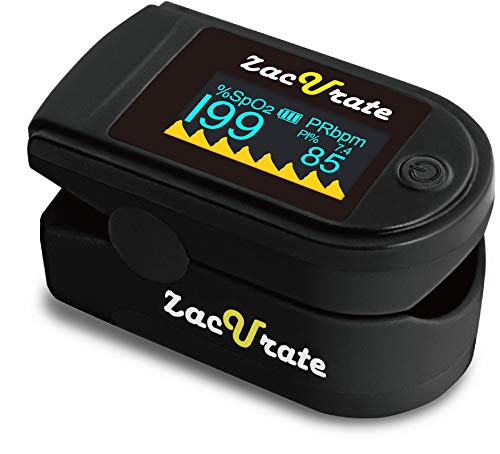
A display that turns toward you, on a body shorter than the Innovo it competes with.
The Zacurate 500 Series is the only LED model in this group that the maker claims reads and displays SpO2 all the way up to 100%, on a measuring range listed as SpO2 0-100% and pulse rate 30-250 BPM. Accuracy is rated at +/-2%. The display faces the user — a small thing that means you read your number without craning your hand around, which matters when you are already out of breath.
Size is where it beats the Innovo above: 2.25″L x 1.25″W x 1.25″H against the Innovo’s 2.5″L x 1.35″W x 1.25″H. It is the more pocketable of the two and still ships with a silicone cover, a lanyard, and 2x AAA batteries good for 30 hours. A spring-loaded finger chamber (the maker calls it a SMART Spring System) grips a wide range of finger sizes for ages 12 and above.
What the review pages sum up is a device that just works and reads cleanly — even with chilly fingers, the numbers vary the way they should as activity changes. The recurring detail worth knowing: the silicone cover collects lint, so give it a wipe now and then. Otherwise this is the pick with the longest track record in the group and a 12-month warranty behind it.
The screen advantage: a user-facing LED readout that shows your full SpO2 value, wrapped in a silicone cover with batteries and lanyard included.
One small chore: that silicone cover picks up dust in a gym bag, so a periodic wipe keeps the display clear.
Best for: athletes who want the number pointed at their own eyes without turning their wrist.
Consider the next pick if: you read in direct sun and want an OLED panel instead.
5. Amemo OLED Display Oxygen Monitor Fingertip

Built for reading a number on a sunlit trail, not in a dim bedroom.
Outdoor readability is the headline. The dual-color OLED screen is designed so you can read SpO2 and pulse rate clearly even in strong sunlight — the specific situation a trail runner, skier, or pilot actually faces. The maker rates the deviation at less than 1% under lab conditions, though that is a lab figure and not a promise for your cold fingertip; the sensor is upgraded to hold SpO2 and pulse rate at low blood perfusion.
It carries a plethysmograph and perfusion index, so you can judge whether the number you are looking at came from a real signal. An auditory alarm warns when your SpO2 or pulse rate goes beyond set limits — useful when you are watching a number during altitude exposure and don’t want to keep checking the screen. The chamber uses a smart spring system for a wide range of finger sizes, from children over three years old to adults.
Two things to weigh. The unit does not power itself off unless you pull the batteries, which is an odd quirk worth remembering before you pack it. And durability is the mixed note — some units stop working after a short run. Store it in the included case, treat the clip gently, and this is a strong outdoor reader.
Why it earns a spot outdoors
- Dual-color OLED readable in strong sunlight
- Plethysmograph and perfusion index confirm signal quality
- Auditory alarm for SpO2 and pulse limits
- 24-month manufacturer warranty
Small quirks to plan for
- Does not auto power off unless batteries are removed
- Durability is the mixed note across its history
- No Bluetooth logging
Suits you if: your readings happen in daylight and you want an alarm to keep watch.
Skip the hassle if: a device that needs a battery pull each session would drive you up the wall.
6. ADC Advantage 2200 Fingertip Pulse Oximeter
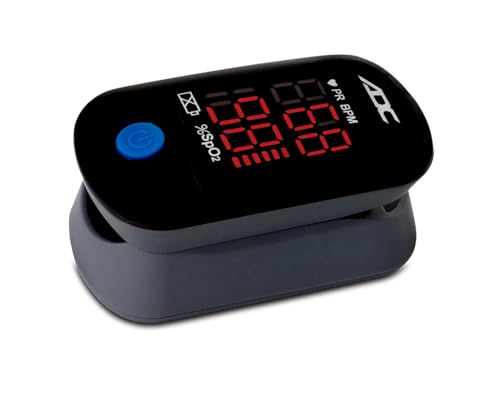
Two big red numbers, one button, and no menu to learn.
The ADC Advantage 2200 keeps it deliberately plain: bright red LED numbers in two changeable display modes, a carry lanyard, 2x AAA batteries, and an instruction booklet. Accuracy is published as SpO2 +/-2% and heart rate +/-5% BPM. The maker is explicit that it is not for medical use and is intended for sports and aviation, so it slots into the training-bag role cleanly.
Functionality is the number buyers keep coming back to — put it on a finger, press the button, and a reading calibrates in a few seconds. It pulls off your finger and turns itself off. The one wrinkle is the readout orientation: the display can be harder to read from the natural finger position, so you may need to rotate your hand. It is bright and well-sized print when you do.
For an older, lower-volume model this still holds its ground, and its compact body fits easily alongside a first-aid kit or an AED. If simplicity is what you want from a spot check, this delivers it without any app or signal-wave reading to interpret.
What you get: published +/-2% SpO2 and +/-5% heart rate accuracy, a bright red LED in two modes, and a one-button flow that calibrates in seconds.
The catch to accept: the display can be awkward to read at the natural finger angle, so expect a hand twist.
Reach for it when: you want one-button spot checks and nothing else to think about.
Move on when: a screen that faces you matters more than the stripped-down layout.
7. Zacurate 500B-B Wireless Bluetooth Fingertip Pulse Oximeter
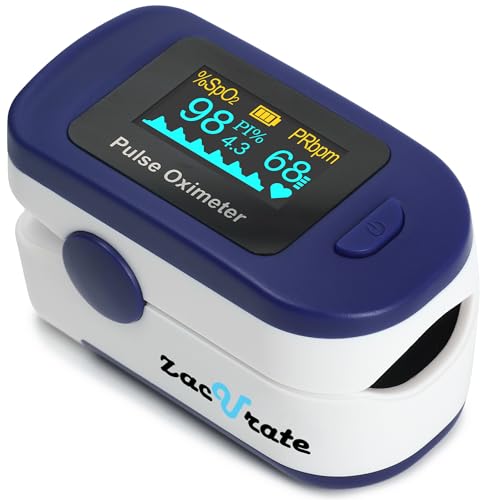
Actually logs the numbers, so your training notes stop being a memory exercise.
There is a phone app in the loop here. Pair the 500B-B with the free Beyond Oximeter App (iOS and Android) and it records SpO2, pulse rate, and pulse strength in real time, with multiple users and long-term storage supported — ideal for comparing how your oxygen recovers across a training block. The measuring range is 70% – 100% SpO2, and the display is OLED, so it reads well in daylight.
What you get alongside accuracy is the waveform. A plethysmograph and perfusion index let you verify your reading is really coming from a clean signal, and the sensor is enhanced to handle low blood perfusion. The maker positions it for climbers, skiers, and bikers and suggests using it before or after exercise rather than continuously — hold still during the measurement.
Bluetooth is great, and it comes with a downside: mixed accuracy reports have cropped up, so treat a single reading with the pleth check rather than as gospel. The finger chamber uses the same SMART Spring System sizing for age 12 and above, and it ships with 2x AAA batteries and a lanyard.
Where it shines: a free app that logs every reading, plus a plethysmograph and perfusion index so you can see whether a number is trustworthy.
Where to take care: Bluetooth is only as useful as the sensor’s accuracy on your finger — cross-check against the pleth waveform, and hold still.
For you if: you are building a training log and want the numbers recorded automatically.
Think twice if: you would rather not deal with a phone pairing at all.
8. Innovo iP900BP-B Fingertip Pulse Oximeter with Bluetooth

The one that measures respiratory rate too, then sends it to your phone.
Most devices in this category stop at SpO2 and pulse rate. This one adds respiratory rate (RR) measurement to its improved LED and sensor, across a 70% – 100% SpO2 range with +/-2% accuracy and 30-hour battery life from two AAA cells. For an athlete watching how hard they are breathing at altitude, that extra number is the reason to look here rather than the plain iP900AP above.
The multi-directional display is the physical a neat extra: six layout options, switched at the push of a button, so a coach or training partner can read it without taking it off you. Bluetooth pairs with iOS or Android through the Beyond Oximeter app, recording readings and visualizing the SpO2 waveform. The plethysmograph and perfusion index do their usual job of checking signal quality.
Two habits make it behave. The app recording stops if your phone screen times out, so set a screen timeout before you start. And turning it off can take several button presses — a frustration rather than a fault. Speed and Bluetooth both draw split opinions, so use the waveform as your confidence check.
Why it stands out: respiratory rate plus a six-layout display and Bluetooth logging, with +/-2% accuracy over a 70% – 100% range and a 30-hour battery.
Setup habits to build: keep the phone screen awake during app recording, and budget a few presses to power down.
Fullest fit if: you want three metrics and app logging in one device you can point at a training partner.
Pass if: you want a one-button, no-phone, no-fuss clip.
9. Herz P1 Pulse Oximeter for Sports & Fitness
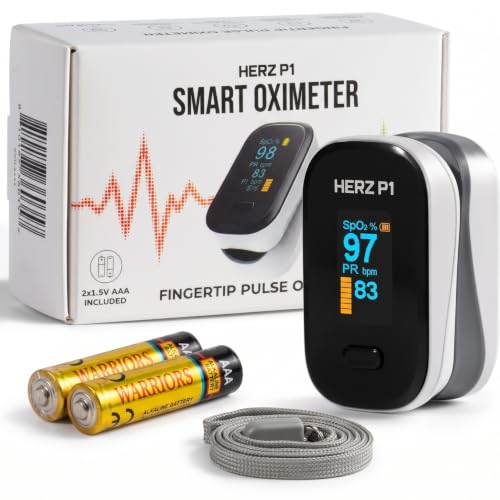
Aimed squarely at the gym-goer and the pilot, with no app on the spec sheet.
Here is the one built explicitly as a sports and fitness tool. The Herz P1 is a fingertip SpO2 and pulse rate reader designed for athletes, gym-goers, cyclists, and runners — clip it on, press one button, and read your numbers in seconds between sets, sprints, or recovery. It runs on 2x AAA batteries with automatic power-off, so there is no charging cable to worry about.
Portability is the point. The compact clip carries on the included lanyard and fits into a gym bag, backpack, or flight bag, and the maker positions it as an aviation and high-altitude companion for private pilots, hikers, climbers, and skiers. Its OLED screen is stated at 80%~100% +/-2%, with a 70% – 100% measuring range and the same plus-or-minus caveat as everything else here.
Be realistic about the data supporting it: the review base is small, so the track record is short, and there is no plethysmograph published in its feature list to double-check a weak signal. If you want a simple, purpose-built training clip without extra fuss, it earns its place — and its high rating shows the early buyers are happy so far.
What it promises: a one-button OLED spot check, battery-powered with auto shut-off, sized for a gym bag or flight bag at 2.28″L x 1.18″W x 1.1″H with a lanyard included.
What is missing: a short review history and no signal-quality waveform, so a training check relies on a steady finger.
Made for: the athlete who just wants a quick clip-and-read between efforts.
Skip if: you want a long track record or a pleth check on cold fingers.
Know the Specs
SpO2 Range And Accuracy
SpO2 is blood oxygen saturation as a percentage, and a common published range is 70% to 100%. Accuracy is typically stated as plus or minus two percent, which means a 96% reading represents 94% to 98%. For athletes that is enough to spot a meaningful drop at altitude — it is not a diagnostic figure. Hold still during the read so the number comes from a settled fingertip.
Plethysmograph And Perfusion Index
The plethysmograph is the live waveform that pulses with each heartbeat, and the perfusion index is a strength-of-signal number shown alongside it. Together they answer the question “is this a real reading?” When your hands are cold, the waveform flattens and the number wobbles — that is your cue to warm up and re-place the clip rather than trust the result.
Battery Life And Auto Shut-Off
Most of these devices run on 2x AAA batteries. The published life figures in this group are 30 hours and up to 32 continuous hours, which covers plenty of spot checks. Automatic power-off saves the cells when you set the device down; a few models lack it, so check before you tuck it into a bag.
Display Type
An LED panel shows bright, simple numbers; an OLED panel is sharper and holds up better in direct sunlight. Either is fine indoors, but if you read on a trail or runway, lean toward OLED. A display that faces the user saves you twisting your hand in the middle of an effort.
Common Questions
Can I use a pulse oximeter during a workout?
How accurate is a fingertip oximeter for athletes?
Does a cold fingertip affect the reading?
What is the difference between an OLED and an LED pulse oximeter?
Do I need Bluetooth on a training oximeter?
Will a fingertip oximeter fit larger fingers?
How long do the batteries last in a pulse oximeter?
Can I use a sports oximeter for altitude training?
Is a reading taken before exercise different from one taken after?
Do these devices need a warranty check before buying?
The Bottom Line
For most athletes, the pulse oximeter for athletes winner is the Innovo Deluxe iP900AP — it pairs +/-2% accuracy over a 70% – 100% range with a plethysmograph and perfusion index, so you can confirm a reading on cold fingers instead of guessing. If logging matters, grab the Innovo iP900BP-B for its respiratory rate and Bluetooth app. And for a carry-anywhere clip that travels in its own case, the AccuMed CMS-50D1 is the one that slips into a flight bag at 50 grams. Whichever you choose, check the waveform before you trust the number.
How we choose
We do not accept paid placement. Every pick is matched to a real buyer and a real use-case; we do not hands-on test units.
Sources
Specifications: manufacturer listings and product documentation. Review insights: verified customer reviews, as of November 2026. Pricing: not shown on this page (it changes often); check the current price via the retailer link.
As an Amazon Associate, Tactical Gear Guy earns from qualifying purchases. This does not affect which products we feature.