Specs are compiled from manufacturer listings and verified buyer reviews and can change over time — please confirm the key details on the product page before buying.
Pull-on safety boots exist for one reason: you should not have to bend double and fight laces when your hands are full, your back aches, or your boots are caked in mud. The catch is that a boot easy to pull on can also be a boot that lets water in, rubs your heel raw, or punishes your toes under a dropped load. This guide covers nine lace-free safety boots and explains exactly what each one is good at, so you spend your money once.
This guide is built by comparing the manufacturers’ published specifications and the patterns across verified customer reviews, so you get each pick’s real strengths and trade-offs instead of marketing spin.
Some of these boots are steel toe, some composite, some are made for wet ground and others for dry warehouse floors. No single boot wins every job, but one clearly wins for most men who want a tough slip-on they can live in. That is why this breakdown of pull-on safety boots leads with the boot that gets the most all-round approval.
Top Picks
How To Choose The Best Pull-On Safety Boots
A pull-on boot has no laces to adjust, so everything that makes it comfortable or uncomfortable is baked in at the factory. That means you check a few things before you buy, not after your first ten-hour shift.
Start With Toe Protection And What It Is Rated For
A steel toe is a metal cap over your toes that takes the impact when something heavy drops. A composite toe does the same job with a non-metal material. Look for an ASTM F2413 rating printed on the boot — that is the safety standard a toe cap is tested against. Two of the picks here carry ASTM F2413-18 ratings outright, including a C/75 impact and compression figure, which tells you the cap is genuinely certified rather than simply described as “steel toe.”
Decide if you need Waterproof Or Just Water-Resistant
Rubber and neoprene boots are built waterproof from the shell outward, which is what you want standing in a wet trench or a wash-down bay. Leather boots are usually water-resistant at best, meaning they shrug off rain and splashes but will soak through if you stand in a puddle. Match the boot to the wettest condition you actually work in, not the driest.
Check The Shank And Sole For Underfoot Protection
A steel shank is a flat metal plate sitting between the insole and the outsole. It stiffens the boot, supports your arch across long shifts, and shields the sole from nails and sharp debris. Puncture-resistant soles add a layer underfoot for the same reason. If you work around scrap, offcuts or roofing nails, this matters more than any cosmetic feature.
Get The Fit Right With No Laces To Help
Because you cannot tighten a pull-on boot, sizing errors show up fast — as heel slip, as pressure across the top of your foot, or as a boot you cannot get off at the end of the day. Measure your foot and compare against the maker’s size chart. One pick here even asks you to choose a size roughly 0.16 inches longer than your measured foot, which is the kind of concrete instruction worth following.
Side-by-Side Comparison
| Model | Best For | Toe Type | Shaft / Height | Standout Feature | Amazon |
|---|---|---|---|---|---|
| Carhartt Chelsea Wedge★ Best Overall | Everyday work comfort | Steel or soft toe | Chelsea (ankle) | Insite footbed, twin gore panels | Amazon |
| TIDEWE Rubber Work BootWet-Ground Value | Wet ground and mud | Steel toe | Ankle-high | 100% waterproof rubber, steel shank | Amazon |
| SUREWAY 10in WellingtonLeather Wellington | Leather-look work boot | Steel toe or soft toe | 10 in | Pull-on leather wellington | Amazon |
| Hunthor Steel Toe Rubber | Cold and wet outdoor jobs | Steel toe | Rubber boot height | Puncture-proof, steel shank | Amazon |
| ANGRYRAM Cowboy Work Boot | Style-led light duty | Steel toe | Western boot height | Square toe western profile | Amazon |
| ROCKROOSTER Gammon | Certified EH protection | Steel toe | 6 in | ASTM F2413-18 I/75 C/75 EH | Amazon |
| MUCK Chore Met Guard | Heavy impact protection | Steel toe + met guard | Tall rubber boot | 5 mm neoprene, metatarsal guard | Amazon |
| Carhartt Rugged Flex 11″ | Mud-shedding western cut | Steel toe | 11 in | Shallow mud-releasing tread | Amazon |
| Ariat Workhog | Premium stability and waterproofing | Composite toe | 11 in | ASTM F2413 M/I/C EH, Duratread outsole | Amazon |
Detailed Reviews
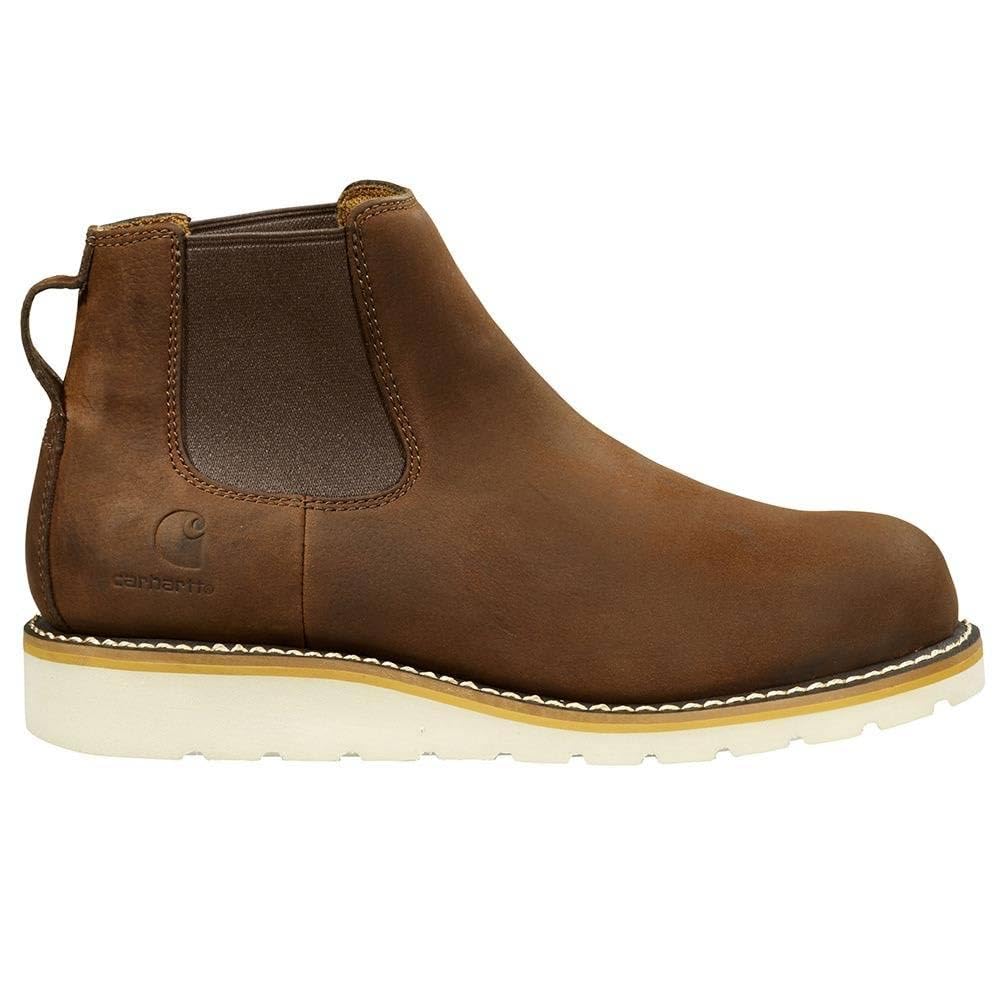
1. Carhartt Men’s Chelsea Boots
Our pick — 4.0+★ from 950+ verified ratings; the strongest balance of quality and price.
The wedge Chelsea that makes a ten-hour shift feel less like a punishment.
What you get here is a boot you can step into without touching it — two elastic gore panels do the flexing so the oil-tanned leather shaft opens and closes around your ankle. That is the whole point of a pull-on, and Carhartt made it the centre of the design rather than an afterthought. It is the crowd favourite here, at 4.0+ stars across 900+ ratings.
The part that earns its keep over a long day is the Insite footbed. Its high-rebound foam with podiatrist-designed arch support springs back underfoot instead of flattening by lunchtime. A FastDry lining pulls sweat away from your foot, and a dual-density Carhartt rubber outsole grips on concrete, gravel and shop floors. Goodyear welt construction holds the upper to the sole with a stitched seam rather than just glue.
Two versions exist — a steel toe for impact protection and a soft toe for lighter duty — so check which one you are ordering if your site requires a safety cap. The honest trade-off is the sole: the quality and comfort are what win people over, while the wedge sole draws the most divided opinions, with a share of owners reporting separation over time. Fit runs on the generous side too, so try your true size first before sizing up. Think of this as the boot for the man who wants one pair for the truck, the yard and the site — not the man standing in a flooded trench all winter.
What Carries The Day
- Twin gore panels let you step in hands-free and walk out the door
- Insite footbed with high-rebound cushioning and arch support for full shifts
- FastDry lining wicks sweat so your feet are not swimming by hour eight
- Dual-density rubber outsole holds grip on wet and dry job surfaces
Where It Gives Ground
- Wedge sole is the divided part — a portion of owners see it come apart sooner than they would like
- Sizing skews large, so a true-to-size try-on first is wise
- Leather is water-resistant, not built for standing water
Best for: the all-rounder who wants one comfortable, certified slip-on for mixed dry work.
Think again if: you work in standing water — a rubber shell serves you better.
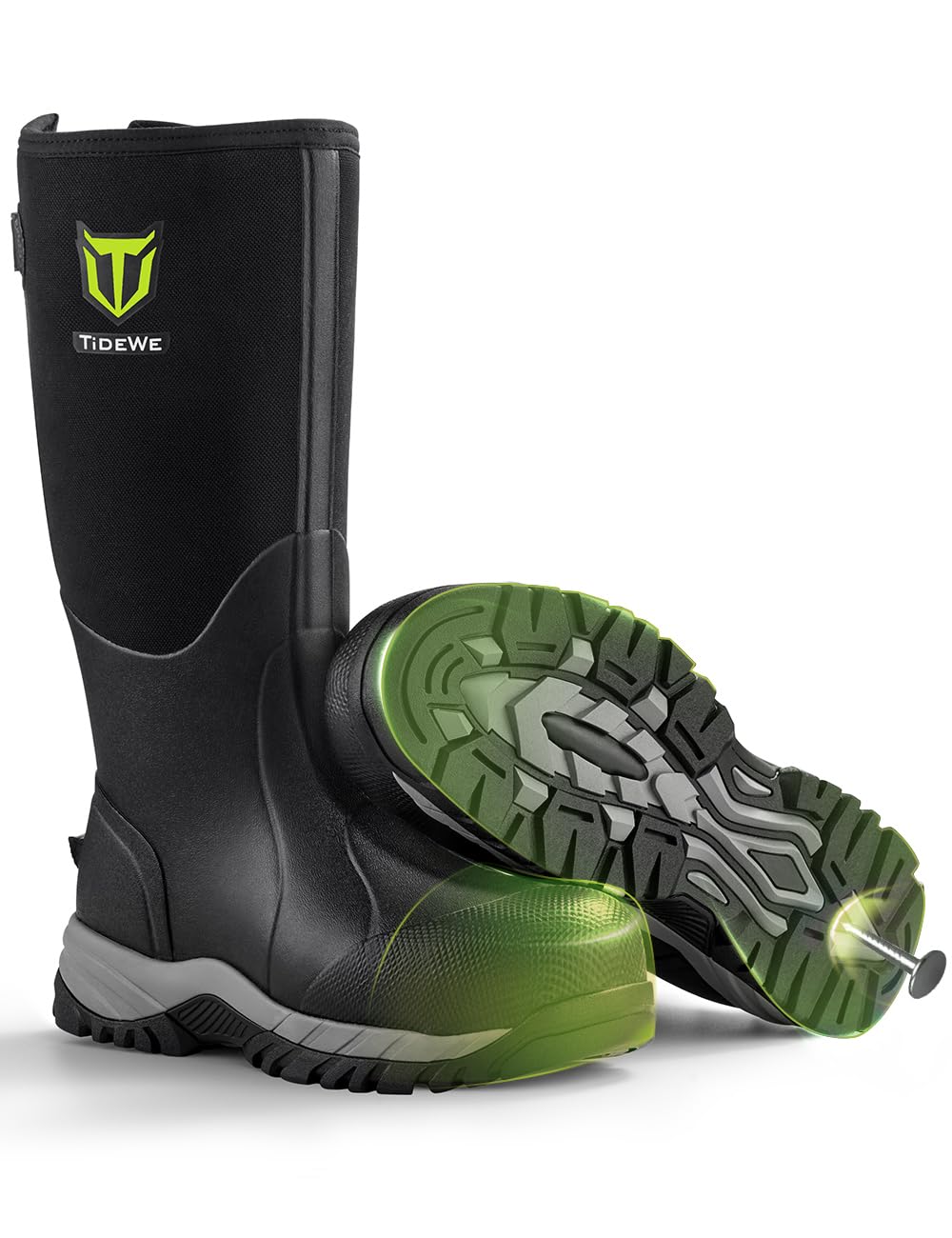
2. TIDEWE Rubber Work Boots
A full rubber shell with a steel cap, built for ground that is wet all day.
If your job means standing in a wet trench, a fishery floor or a wash-down bay, a leather boot is the wrong tool. This one is made from 100% waterproof rubber and neoprene, so the moisture stays outside from the first minute rather than after a waterproofing spray or a break-in period. A steel shank sits between the insole and outsole to stiffen the boot, support your arch and shield the sole from nails and offcuts.
The steel toe takes impact from falling or rolling objects, and the rubber outsole has deep tread for uneven ground. Inside, a breathable lining keeps air moving when it is warm, and 6mm of neoprene in the boot adds warmth when the temperature drops — so the same pair covers summer and late autumn. The pull-on loop and kick tab mean you are out the door without bending over.
Getting the fit right takes one extra step: the maker wants you to measure your foot and pick a size roughly 0.16 inches longer than that measurement. Skip that step and the fit can feel off. The rubber shell is also the boot’s weak seam over the long haul. Quality and comfort read a step above the price tier, but opinions split on the rubber, with a share of owners seeing splitting in the middle and water finding its way in. Treat it as a hard-wearing wet-ground boot rather than an heirloom — and size it properly from the chart on day one.
The pull-on win: a kick tab plus a wide rubber opening means you step in and out without fighting anything.
The sizing ask: follow the insole-length chart and add that 0.16 inches, or the fit can land wrong.
Reach for this if: your shifts happen on wet ground and you want the shell waterproof from hour one.
Look elsewhere if: you need a boot that stays dry through years of standing water — expect to replace it eventually.
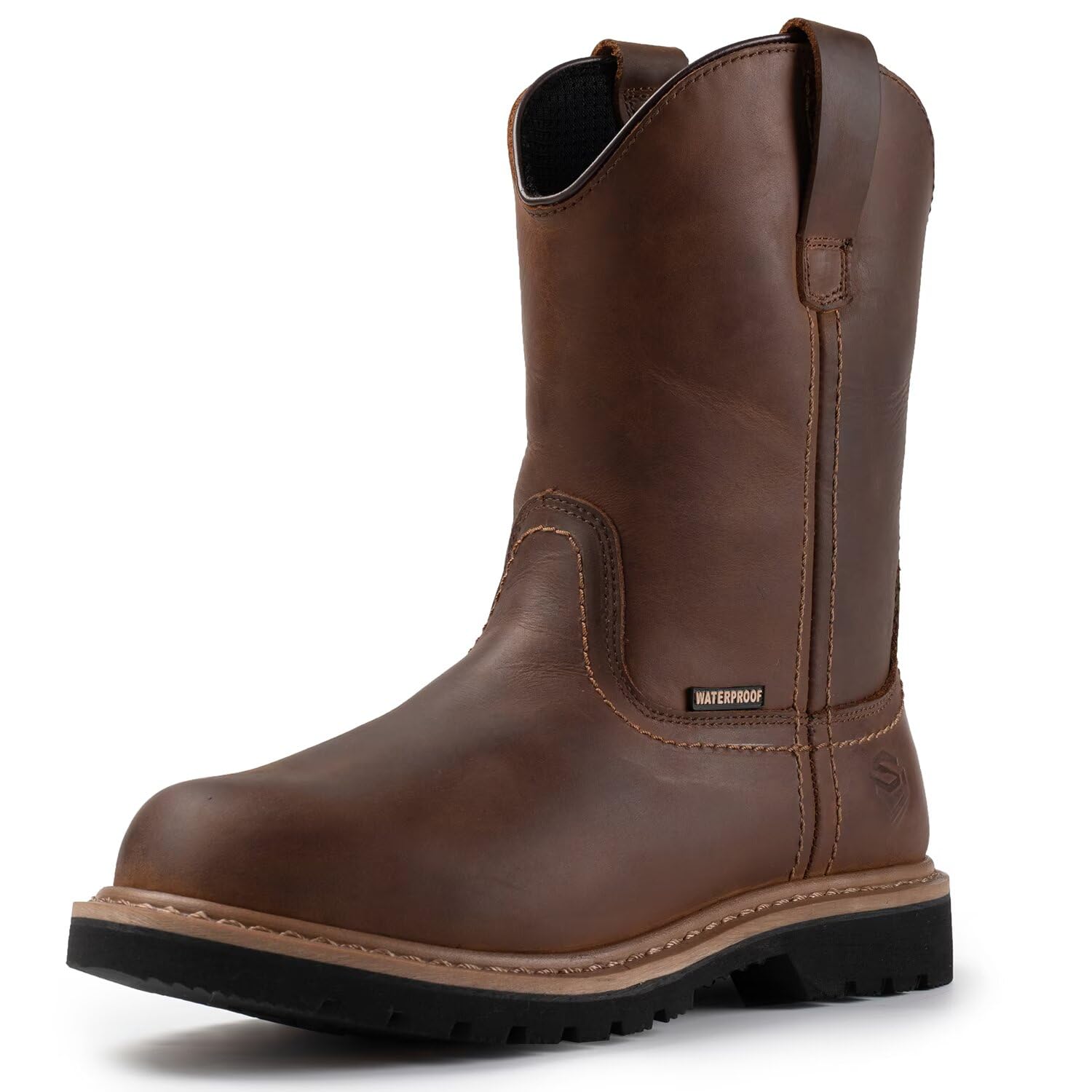
3. SUREWAY 10in Mens Wellington Work Boot
A tall leather wellington for the man who wants a work boot that still looks like a boot.
Ten inches of leather shaft is the number that defines this pick. That extra height covers more of your calf than a Chelsea, which keeps debris out and gives the boot a classic western profile you can wear off the clock. A high-strength steel toe handles the impact side of the job, and the pull-on design gets you in and out without a lace in sight.
The boots are built for men who want both jobsite protection and a boot that passes on a night out, and the appearance is where the design lands cleanly. Quality is the aspect that draws the most approval — plenty of men describe these as the best work boots they have owned. Comfort and fit hold up too, with a true-to-size run that removes the guesswork.
Two things worth knowing before you order. First, the model line offers a soft toe and a steel toe, so confirm which version lands in your cart. Second, the liner is the recurring weak point — a share of buyers report the inside liner breaking free at the heel and tearing early. Putting the boot on also draws split opinions, with some finding it a quick break-in and others finding it hard to get off. If you have a narrow heel and a wide calf, try these on with a thick sock before committing to a full season.
Height and honesty: the 10-inch shaft delivers the western work look and more calf coverage than a short Chelsea.
The one to watch: heel-liner wear is the pattern to keep an eye on, so check that seam when the boot arrives.
Suits: men who want a tall, leather, certified steel-toe wellington that looks smart as well as tough.
Skip if: you need a boot that slides off without a fight at the end of every shift.
4. Hunthor Steel Toe Rubber Work Boots

Puncture-proof underfoot and rubber-tough on top, aimed at cold, sloppy outdoor work.
The feature that decides this boot is what sits under your foot. A steel shank runs between the insole and the outsole so nails, offcuts and jagged scrap cannot push through the sole into your arch. That single plate is why this pick makes sense on demolition, farm and general site work, and it also stiffens the boot enough to hold your arch across a long standing shift.
Around that, it is a rubber boot built for wet conditions. Waterproofing is genuinely watertight in the accounts owners give, and warmth holds up in winter weather. The back gusset is cut to fit different calf sizes, so you are not fighting a boot that grabs too tight or flaps too loose. A rear kick tab gives you a place to push off with the other foot when it is time to get out of them, and a quick wipe takes the mud off the outsole.
The honest catch is heft. The weight divides opinion, with a share of people describing them as very heavy — which is what a steel toe, steel shank and rubber shell. Cracking on the rubber is the other pattern to expect over time. For a boot you wear standing still in the cold and wet, that bulk is a trade you may take happily. For a boot you climb ladders in all day, think twice.
Why It Makes The List
- Steel shank gives real puncture protection underfoot
- Waterproof rubber shell keeps feet dry and warm in winter conditions
- Back gusset adapts to different calf sizes
- Kick tab and easy-clean outsole simplify end-of-shift
What You Are Trading
- Heavy enough that some owners call it out as very heavy
- Rubber can crack with age and hard use
- Bulk limits agility if you need to climb and crouch all shift
Pick this for: cold, wet, debris-heavy ground where underfoot protection matters more than speed.
Not for: agile ladder work — the weight and bulk become a chore.
5. ANGRYRAM Steel Toe Cowboy Work Boots
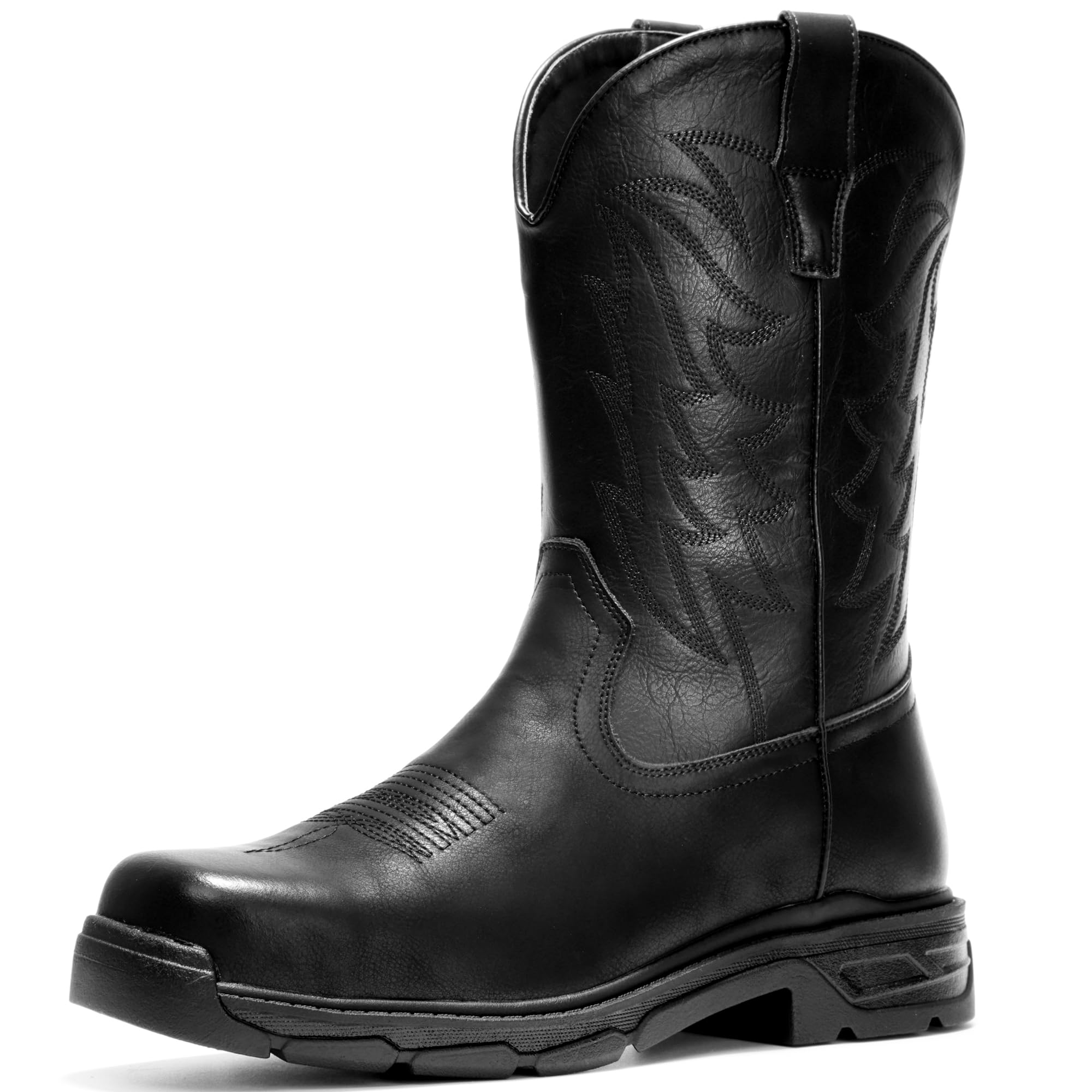
A square-toe western boot with a steel cap, for the man who wants his work boot to look sharp.
These are built around the silhouette as much as the safety spec. A square toe western profile with a steel cap gives you a boot that reads like a cowboy boot on the truck seat and still counts as safety footwear on the site. The synthetic-material sole is described as about 20% lighter than a normal work boot while holding decent grip and wear resistance.
Comfort is where the boot wins its fans — it is the aspect that draws the strongest approval, and the looks come a close second with sunny feedback. Sizing runs to your usual western boot size, so if you already know what fits, that is the number to order.
Then come the limits, and they are the ones that matter on a hard site. The toe area is where the boot shows wear, with a share of owners reporting it ripping and tearing. Fit runs narrow, so wide feet will feel pinched across the vamp and ball. Both point to the same advice: this is a good-looking, comfortable boot for lighter duty and mixed use, not a boot to lean on for heavy impact work day after day. If you want a steel toe that survives a pounding, look further up the list. If you want the western look with a safety cap for lighter work, this is the pair.
The style play: a square-toe cowboy profile that hides a steel cap inside it.
The fit warning: narrow last — wide-footed men should size carefully or look elsewhere.
Tailored to: men who want safety footwear with western character for lighter-duty work.
Choose differently if: your job puts daily impact stress on the toe cap or your feet run wide.
6. ROCKROOSTER Gammon Men’s Work Boots

The one where the safety ratings are printed on the box and mean something.
Most pull-on boots describe themselves as protective. This one names the standard: ASTM F2413-18 I/75 C/75, with an EH electrical hazard rating on top. In plain terms, the steel cap is tested for impact at 75 and compression at 75, and the boot is built to reduce the risk of a shock if you brush a live circuit — the sort of thing that matters if you work around tools, panels or wiring. It also carries an ASTM F3445 slip-resistance rating on the rubber outsole.
The build underneath is full grain leather on a 6-inch shaft, direct-attached to a PU midsole with a nylon shank. A wide EE bottom gives your forefoot more room than a standard last. Coolmax fabric manages moisture and wicks sweat, Poron XRD foam absorbs shock, and a Sanitized finish is added to keep odour down. It also carries a water-resistant rating and an oil-resistant outsole.
The maker is specific about one thing worth repeating: wear these with crew socks so the leather does not rub directly against your bare ankle. Beyond that, the fit runs on the tight side, with a portion of wearers finding them snug and the weight dividing opinion as well. If your feet are genuinely wide, order with care or look at the wide EE version specifically. For everyone else, this is the pick when compliance paperwork matters as much as comfort — comfort being what draws the most positive feedback here, with the build quality a close second.
Compliance-first: ASTM F2413-18 I/75 C/75 EH and ASTM F3445 are stated outright, which is rare at any price.
Wear-a-sock note: the maker asks for crew socks to prevent leather-on-ankle rubbing — worth heeding from day one.
Built for: anyone whose site or insurer wants a named ASTM rating and an Electrical Hazard claim.
Hold off if: you need a roomy forefoot by default — narrow feet fit this one best.
7. MUCK Men’s Chore Met Guard Work Boots
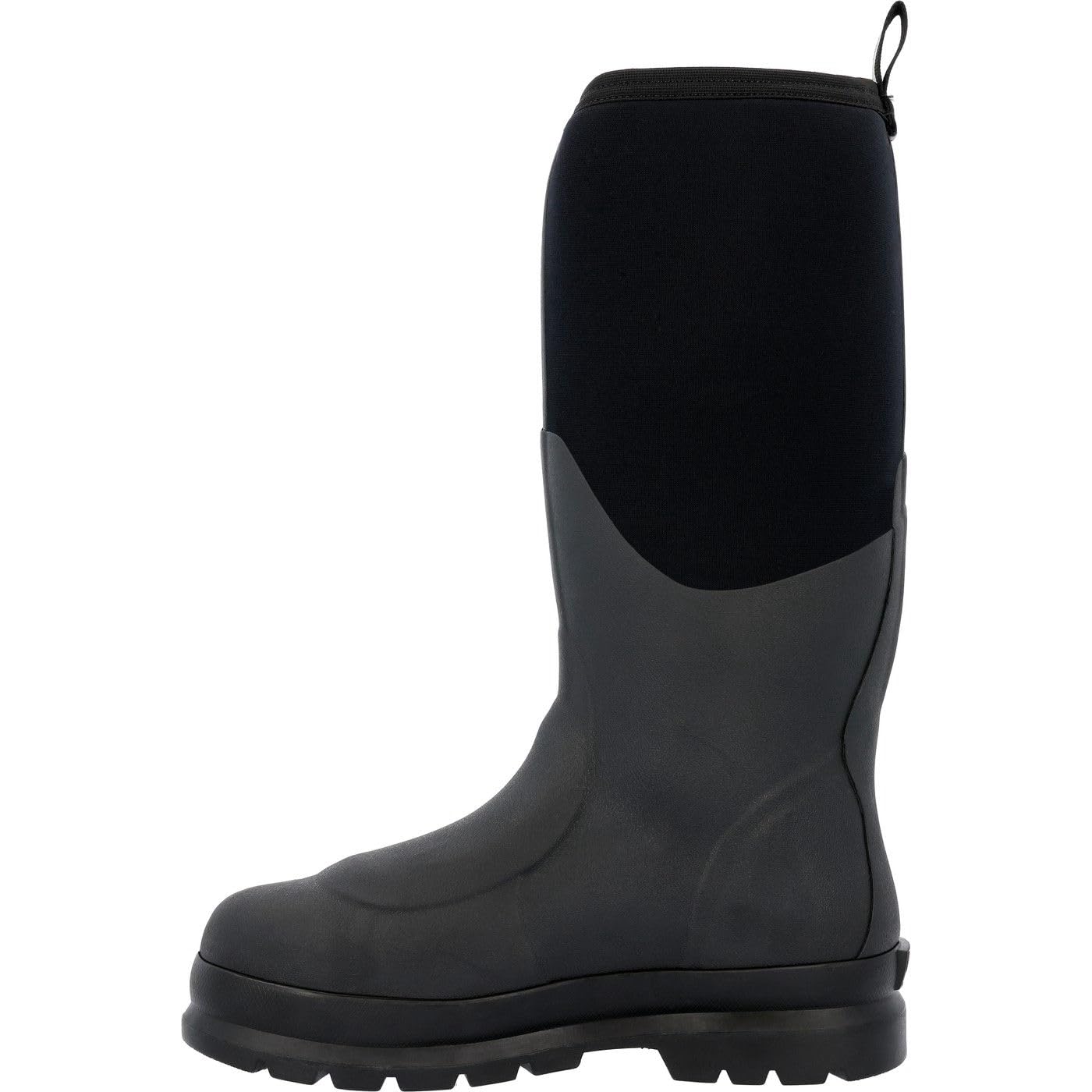
Protection that goes beyond the toe and covers the whole top of your foot.
A steel toe protects four or five toes. A metatarsal guard protects the long bones behind them — the ones that break when a steel beam or a paving slab lands flat across the top of your foot. That is the whole reason this boot exists, and it is what most steel-toe boots leave out. The Muck guard is soft and flexible when you are moving, then stiffens instantly on impact, so it protects without turning your foot into a cast.
Around the guard sits a rubber shell over 5mm of neoprene, which is waterproof and shock-absorbent and also retains heat — the reason these are popular with landscaping and construction crews working outdoors in cold weather. A steel shank adds support, and a wicking liner moves perspiration away from the skin so the waterproof shell does not turn into a sweat bath. The rubber overlays and outsole wipe clean with a hose.
What has to be said plainly: the durability is where the boot draws its most mixed feedback. Some owners get about two years out of a pair, while others see the sole separate, the top crack or the rubber break down far sooner, and some report leakage. The roomy toe box and correct sizing are what win people over, so start size-true. Buy this for the met guard and the waterproof protection, and treat the lifespan as the price of the shell doing that much work.
The Real Case For It
- Metatarsal guard covers the top of the foot, not just the toes
- 5 mm neoprene shell is waterproof and retains heat
- Steel toe plus steel shank for impact and arch support
- Wicking liner keeps the inside from turning into a sweat trap
- Roomy toe box suits men who feel squeezed in narrower boots
The Price You Pay For It
- Lifespan ranges wide — some pairs last about two years, others far less
- Some owners mention leakage over time
- Sole and top crack are recurring patterns
Worth it when: heavy loads drop flat across your foot and a standard steel cap is not enough.
Weigh the cost: a waterproof rubber shell with a met guard does not last forever — budget for replacement.
8. Carhartt Rugged Flex 11” Steel Toe Wellington
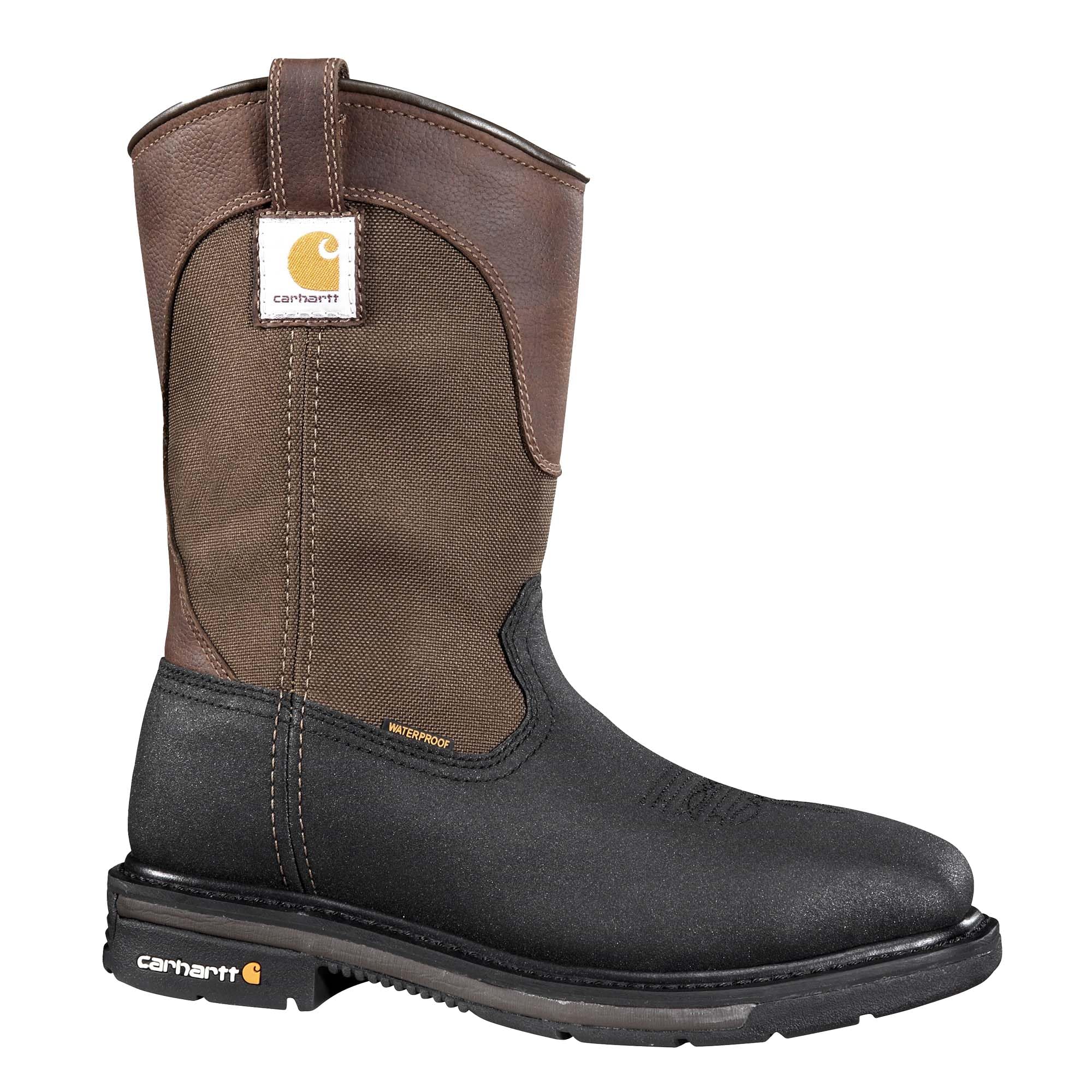
An 11-inch western wellington with shallow tread that dumps mud instead of carrying it.
The tread is the smartest thing here. These outsoles are cut shallow on purpose, so mud and dirt release as you walk rather than packing into deep lugs and following you into the cab. If you go from a muddy yard to a concrete floor ten times a day, that detail saves you a lot of scraping. An 11-inch square-toe leather shaft with a steel cap gives you the western work look, and Goodyear welt construction stitches the upper to the outsole for long-term hold.
Inside, FastDry lining wicks sweat away, and a Carhartt PU insole plus a CMEVA midsole with PU strobel pad handle cushioning and reduce foot fatigue. Quality is the strongest point in the accounts owners give — plenty describe these as fantastic everyday footwear, and the appearance gets a warm reception too. There is a break-in period with a leather wellington this tall, so give it a week rather than judging on day one.
Fit is the make-or-break. The last runs narrow, and a share of men find them too small or pinched across the forefoot, so wide feet should either size up or choose a different pick. Durability splits too, with some soles falling apart and some tops splitting at the end of their run. Water resistance is not this boot’s strength either — leather will soak through in a puddle. There is a lot to like in the mud-shedding sole and the leather feel; just be honest with yourself about your width.
Sole intelligence: shallow tread designed to release mud keeps your boots cleaner and your truck floor cleaner.
Width reality: narrow last — if you normally wear a wide, order up or look at a different pick.
Fits the bill for: men working in and out of mud who want a tall, smart western steel-toe boot.
Reconsider if: you have a wide forefoot or regularly stand in water — this one runs narrow and leather soaks.
9. Ariat Men’s Workhog Waterproof Composite Toe Work Boot

Composite toe, DRYShield waterproofing and a Duratread outsole — the top of the line here.
This is the one to pick when you want the best on this list rather than the best value on it. An 11-inch distressed-brown leather boot with a square composite toe, it carries ASTM F2413 M/I/C EH and ASTM F3445 ratings, which in plain terms means certified impact and compression protection plus electrical hazard and slip resistance. A composite toe does the same job as steel while staying lighter, which matters over an 11-inch shaft.
What makes it comfortable over a long shift is the side-to-side stability. The WorkHog is built with a Performance Cushion insole and shock absorption in the outsole, so the boot handles the twisting and turning of uneven outdoor ground — oil and gas work is the design brief, and a Duratread oil- and slip-resistant outsole backs that up. A DRYShield waterproof membrane keeps water out while a wicking lining handles sweat on the inside.
The honest bit is on and off. Because these are composite, waterproof western boots with high shafts, they can be awkward to remove — that is the trade-off built into the design, and it gets worse after the first month once the leather relaxes. Sizing runs slightly narrow across the top of the foot too, so try them on with the socks you actually work in. If you want a waterproof upgrade over a plain steel-toe wellington and can accept a real break-in, this is the premium pick.
Top of the stack: composite toe, DRYShield waterproofing and two ASTM ratings in one boot.
The daily friction: high-shaft western boots with a waterproof membrane are awkward to pull off — plan for that.
Best for: buyers who want certified protection, waterproofing and comfort in one premium boot.
Not ideal if: you need to kick boots off fast at the end of every shift.
Know the Specs
ASTM F2413-18 And What I/75 C/75 Means
ASTM F2413 is the safety standard a protective toe cap is tested against. The “I/75” is impact protection — the cap must take a 75-foot-pound strike without letting it reach your toes. The “C/75” is compression — the cap must take a 75-pound-per-square-inch load without crushing down on your foot. When you see a boot with just “steel toe” and no ASTM number, it may well be a real cap — but only the ASTM rating tells you it was tested to that threshold.
EH Rating, And What It Actually Promises
EH stands for Electrical Hazard. A boot carrying that rating is built with a non-conductive sole and heel so that a chance contact with a live circuit is less likely to travel through you. It is not an electrician’s insulated boot and it does not make a live wire safe to touch — it is a secondary protection layer for the man using tools near wiring. If your site requires it, buy a boot that states the rating outright rather than one that implies it.
Steel Toe Versus Composite Toe
Both are safety caps. Steel is a metal cap that takes impact well and conducts cold — it gets chilly in winter. Composite is a non-metal cap that does the same protective job without the metal, so it is usually lighter and warmer on the foot. Neither is a comfort upgrade by itself; the fit and the insole decide what your day feels like. On this list, the Ariat Workhog uses composite; most of the rest use steel.
Shanks, Puncture Resistance And Underfoot Safety
A steel shank is a flat plate between the insole and the outsole. It does two jobs: it stiffens the boot so your arch is supported through a long standing shift, and it stops a nail or offcut from pushing up through the sole. Puncture-resistant soles do the same protective job with a different construction. If you walk on scrap-heavy ground, treat this as a must-have — the TIDEWE and Hunthor boots both make it a headline feature.
Waterproof Versus Water-Resistant Leather
A rubber and neoprene boot is waterproof — the shell itself does not let water through, so it holds up in a puddle, a trench or a wash-down. Leather is generally water-resistant, which means it shrugs off rain and spray but can soak through if you stand in water. There is a third category, a leather boot with a waterproof membrane (like DRYShield on the Ariat), which sits between the two. Match the boot to the wettest condition you regularly face.
Fit, Width And The Pull-On Problem
With no laces, a pull-on boot has to be sized right from the shop. A narrow last will pinch a wide foot with nothing you can loosen to fix it. If the maker offers a wide size (the ROCKROOSTER runs to a wide EE bottom), buy that one rather than sizing up a standard width. And measure — the TIDEWE maker asks for a size roughly 0.16 inches longer than your measured foot, which is a more reliable method than guessing.
Common Questions
What is the difference between a steel toe and a composite toe in a pull-on boot?
Will a pull-on safety boot stretch out enough to fit a wide foot?
How do I know if my safety boots meet the ASTM F2413 standard?
Are rubber pull-on boots better than leather for wet work?
What does the EH rating on a safety boot actually protect against?
Why are my pull-on boots so hard to get off at the end of a shift?
Do I need a steel shank or puncture-resistant sole on my work boots?
How long should a pair of pull-on safety boots last?
Can I wear pull-on safety boots with a wide calf?
Is a met guard boot overkill for general construction work?
The Bottom Line
For most men after a lace-free, safety-rated boot, the winner is the Carhartt Chelsea Wedge — it pulls on hands-free, puts real cushioning under your arch for a full shiftand keeps its grip on wet or dry floors. If wet ground is the reality of your working day, the TIDEWE Rubber Work Boot seals out water from the first step and shields your sole with a steel shank. And when the work involves heavy loads dropping across the top of your foot, the MUCK Chore Met Guard is the one to reach for.
If compliance paperwork sits alongside comfort on your list, the ROCKROOSTER Gammon names its ASTM rating outright and still draws warm feedback on comfort, while the Ariat Workhog sits at the top of the range for anyone who wants a composite toe, DRYShield waterproofing and oil-resistant grip in a single boot. The Carhartt Chelsea remains the most-praised all-rounder on this list for one simple reason: it puts comfort and ease first and gets both right.
How we choose
We do not accept paid placement. Every pick is matched to a real buyer and a real use-case; we do not hands-on test units.
Sources
Specifications: manufacturer listings and product documentation. Review insights: verified customer reviews, as of November 2026. Pricing: not shown on this page (it changes often); check the current price via the retailer link.
As an Amazon Associate, Tactical Gear Guy earns from qualifying purchases. This does not affect which products we feature.