Specs are compiled from manufacturer listings and verified buyer reviews and can change over time — please confirm the key details on the product page before buying.
If you want the shortest path from the box to a graded frame, buy the Sony FX3. It is the pick that needs the least extra gear to look like a finished film. The rest of this list splits between bodies that lean on RAW workflows and bodies that lean on a mounted rig. Every claim below traces back to the maker’s published specifications and the patterns across verified buyer feedback, so you can weigh real trade-offs instead of brochure promises.
This guide is built by comparing the manufacturers’ published specifications and the patterns across verified customer reviews, so you get each pick’s real strengths and trade-offs instead of marketing spin.
This breakdown covers sensors, recording formats, mounts and rigging so you can pick from the best pro cinema cameras with confidence.
Top Picks


How To Choose The Best Pro Cinema Cameras
A cinema camera is not a stills camera with a video button. The body, the recording format and the cooling all change how long you can roll and how far you can push the image afterward. The four choices below decide most of that before you ever mount a lens.
Start with bit depth and RAW, not megapixels
Bit depth is the number of shade steps per color channel. A 10 Bit file gives you far less room to lift shadows than a 12 Bit one before the image breaks into visible steps. If you grade heavily, 12 Bit RAW is the safer place to sit — the Blackmagic Cinema Camera 6K records 12-bit Blackmagic RAW, and the Nikon RED Z Cinema captures 12-bit REDCODE RAW footage. A 10 Bit body still shoots beautifully when you nail exposure on set.
Decide how much rig you are willing to carry
Some bodies are built to be stripped down and handheld; others want a cage, a monitor and a battery plate. The Sony FX3 is compact and cage free with ¼”-20 mounting points, while the Blackmagic Pocket 6K watches weight carefully at a 74 g battery. Ask yourself whether you are shooting solo documentary or a crewed set, because that answer picks your body for you.
Check the lens mount against the glass you already own
Mount compatibility is the quiet budget killer. Canon EF glass fits the Blackmagic Pocket 6K’s EF mount; Sony E/FE glass fits the FX3, the FX2 and the FX30; Nikon Z glass fits the RED Z Cinema. The Canon EOS C50 and R5 C take RF glass. Buying a body that ignores your existing lens set means buying a whole new set of glass alongside it.
Match the media to your shooting day
Card type decides how long you can roll and how fast you offload. CFexpress Type A bodies suit compact setups, CFexpress Type B bodies handle heavier RAW data rates, and one body here records straight to an external SSD over USB-C. Think about the longest single take on your typical shoot before you commit.
Side-by-Side Comparison
| Model | Best For | Sensor / Resolution | Bit Depth | Lens Mount | Amazon |
|---|---|---|---|---|---|
| Sony Alpha FX3 ILME-FX3 | Solo shooters who want finished color | Full-frame 4K | 10 Bit | Sony E/FE | Amazon |
| Sony Cinema Line FX30 (Renewed) | Entry into the Cinema Line | 20.1 MP Super 35 APS-C | — | Sony E | Amazon |
| Blackmagic Cinema Camera 6K (L Mount) | RAW grading plus free Resolve Studio | Full-frame 6K, 6048 x 4032 | 12 Bit | Leica L | Amazon |
| Nikon RED Z Cinema | RED color science in a light body | 6K full-frame | 12 Bit | Nikon Z | Amazon |
| Canon EOS R5 C (Renewed) | 8K/60P internal RAW recording | 8K full-frame | 12 Bit | Canon RF | Amazon |
| Blackmagic Pocket Cinema Camera 6K (EF) | Canon EF shooters who want 6K RAW | Super 35, 6144 x 3456 | — | Canon EF | Amazon |
| Canon EOS C50 | 7K 60P internal RAW capture | 7K full-frame | 10 Bit | Canon RF | Amazon |
Detailed Reviews
1. Sony Alpha FX3 ILME-FX3 | Full-frame Cinema Line Camera
The body that skips the rig and still delivers a graded-looking frame.
What makes the FX3 the pick here is that it needs almost nothing bolted on. Sony put ¼”-20 mounting points on a compact, cage free body, so you can shoot handheld and still have a top handle with XLR inputs for your mics. That is the difference between a camera you take out alone and a camera that needs a crew.
You get usable footage without a long edit session. It records up to 4K 120p at 10-bit 4:2:2 (ten bits per color channel, with no extra color compression), so skin tones and skies hold together when you push them. It also does full pixel readout in all recording modes — every pixel on the sensor contributes to the frame instead of skipping lines, which keeps fine detail clean. S-Cinetone (Sony’s out-of-camera color profile, borrowed from its VENICE cinema colorimetry) is what most owners praise: footage tends to land close to finished without a grade session. The 15+ stop dynamic range and 4K full-frame sensor are what buy you recoverable highlights on a bright day, so a blown window can still be pulled back.
None of that matters if the body overheats mid-take, and this one holds uninterrupted 4K 60p thanks to an in-body cooling fan. Where it pulls ahead of the Blackmagic Pocket 6K is autofocus — 627 autofocus points against 49 on the Canon EOS R5 C, a gap you feel the moment you put a subject in motion. The honest limit is the file itself: 10 Bit is less forgiving than the 12 Bit RAW bodies further down this list if you plan to push extreme grades.
Where the FX3 earns its keep
- S-Cinetone delivers a cinematic look without grading time
- 4K 120p at 10-bit 4:2:2 with full pixel readout in every mode
- In-body cooling fan holds uninterrupted 4K 60p
- Cage free body with ¼”-20 points and an XLR top handle
Where it asks more of you
- 10 Bit only, so heavy grade pushes have less headroom than a 12 Bit body
- Sony E/FE mount locks you into Sony glass
Reach for this if: you shoot solo documentary or run-and-gun and want finished color with the least gear on set.
Look elsewhere if: your workflow lives in 12 Bit RAW grading and you need maximum latitude.
2. Sony Cinema Line FX30 Super 35 Camera, Grey (Renewed)
A Super 35 body that hands you Cinema Line color for far less rigging.
If you want the Sony cinema look but a full-frame sensor is out of reach, this is the door in. The 20.1 MP Exmor R sensor is APS-C size, also called Super 35mm format, which is the classic cinema frame size and still gives you a wide dynamic range. The 14+ stop range plus Dual Base ISO is how you get usable footage from a dim interior without pushing the gain into noise.
Color straight out of the camera is what wins people over. S-Cinetone is on board alongside Flexible ISO, Cine EI Quick and Cine EI Log modes, and you can apply your own user LUTs (a look-up table — a saved color recipe) to the LCD, to the HDMI output, and even embed them in the clips. That means your monitor on set matches the frame you hand off, not a flat log image. A 70-100mm F2.8 zoom lens comes in the box, which softens the sting of buying into a new system — you can shoot the day it arrives.
The trade-off is the sensor size and the listing itself. The APS-C crop means you are working at a narrower frame than the full-frame picks here, and this is a renewed unit, so you take on the condition of a refurbished body rather than a sealed one. It connects over Bluetooth and Wi-Fi and takes Sony E-mount glass, so it slots into an existing Sony kit.
The value read: a genuine Cinema Line body, with a zoom lens, that gets you the Sony color pipeline without a full-frame outlay. For a first serious cinema camera, that trade is easy to live with.
Who it fits: first-time cinema buyers who want S-Cinetone and a bundled zoom without stretching to a full-frame body.
Who should pause: shooters who need the full-frame crop or insist on a factory-sealed body.
3. Blackmagic Design Cinema Camera 6K
A full-frame 6K body that throws in the editing suite with it.
For shooters who live inside a RAW grade, this is the body that hands you the most data. It records 12-bit Blackmagic RAW from a full-frame 6K sensor with a native resolution of 6048 x 4032, and 13 stops of dynamic range gives you room to pull detail back from both ends of the exposure. Dual gain ISO up to 25,600 keeps grain down when the light drops. That 12 Bit figure is the one that matters if you push grades hard — the Sony FX3 above tops out at 10 Bit.
Then there is the bundled software. A DaVinci Resolve Studio activation code is included, and Resolve Studio combines editing, color correction, visual effects, motion graphics and audio post in one tool. The screen is another headline: a 5” HDR LCD that tilts and hits 1500 nit, bright enough that you may not need an external monitor at all. It records to CFexpress Type B or to an external SSD over USB-C, and it has a built-in OLPF (an optical low-pass filter that softens fine detail handling) plus mini XLR and 3.5mm mic inputs.
Two things to know before you commit. The Leica L mount is its own lens ecosystem, so your EF or Sony glass will need adapting. It also ships with an NP-F570 battery and charger rather than a long-life pack, so plan on spares.
The freedom of the body: a carbon fiber polycarbonate composite shell with a multifunction handgrip carrying the controls you actually use, so it stays light for its sensor size.
Choose it for: a RAW-first workflow where 12 Bit depth and Resolve Studio bundled in make the L-mount switch worth it.
Think twice if: you own a big set of Canon EF or Sony E glass you do not want to adapt.
4. Nikon RED Z Cinema ZR

RED color science packed into a 1.18 lb body you can rig without a fight.
Sound is the sleeper feature on the Z Cinema, and it is a big one. Industry-leading 32-bit float audio recording means you capture a very wide range of loudness in one take, so a whisper and a shout can both stay usable in the same file instead of clipping. Anyone who has ever ruined a take with a blown audio peak will understand why that matters.
The image side pairs RED color science with Nikon engineering. A 6K full-frame sensor with 15+ stops of dynamic range and Dual Base ISO gives you latitude across bright exteriors and dark interiors. It records REDCODE RAW (R3D NE) footage, which opens the same color space and Log curve as RED cameras, and it puts all of that behind a 4-inch DCI-P3 touchscreen that swivels. The whole body weighs just 1.18 lbs, so it rigs onto cages and control grips without dragging the build down.
The catch is data weight. The high file size of 6K footage is a recurring point among buyers, and it is the trade you accept for that much color depth. Nikon calls the Z mount the widest, shallowest full-frame mount, per its own research as of September 10, 2025 — a manufacturer’s claim, not an independent measurement.
What sets this one apart
- 32-bit float audio captures huge loudness swings in a single take
- REDCODE RAW (R3D NE) for the RED color space and Log curve
- 6K full-frame with 15+ stops and Dual Base ISO
- 1.18 lb body with a swiveling 4-inch DCI-P3 touchscreen
The data cost
- High file sizes for 6K footage, so storage and offload demand real planning
- Nikon Z mount narrows your native lens options
Pick it when: audio cleanup on set is your least favorite job and a 1.18 lb body suits your handheld work.
Pass if: your storage pipeline is already tight and 6K file sizes would choke it.
5. Canon EOS R5 C Cinema Camera Body

The 8K RAW body that keeps rolling because the fan never stops.
Resolution is the reason this one is on the list. It records 8K/60P internal RAW, and the internal cooling fan is what lets it keep that up without a cooldown pause — the Classic dilemma of the high-resolution body, solved with air. The 8K sensor and DIGIC X processor drive internal Cinema RAW Light up to 8K/60P, plus 8K HDR recording in HLG/PQ, and it can record different formats simultaneously.
Sensor quality is what buyers talk about most here, and the professional controls back it up. You get 13 assignable buttons and an expanded interface laid over the familiar EOS body shape, so muscle memory from a Canon carries over. The battery is rated at 3 hours, and the 12 Bit depth matches the other RAW bodies here.
There is a real trade on the autofocus side, and it is worth knowing before you buy. This body lists 49 autofocus points — the Sony FX3 above more than triples that at 627. For a locked-down interview or a controlled set that is a non-issue. For a moving subject it is the thing you will feel most. This is also a renewed body, so you are buying refurbished.
The resolution stance: if your deliverable benefits from 8K — reframing a 4K cut from an 8K frame, or delivering in 8K HDR — the R5 C does that internally with no external recorder. That single capability is why it earns its spot.
Best for: shoots where 8K capture and simultaneous formats matter more than lightning autofocus.
Look on if: your work depends on tracking a fast-moving subject, where 49 autofocus points leave less margin than 627.
6. Blackmagic Design Pocket Cinema Camera 6K with EF Lens Mount
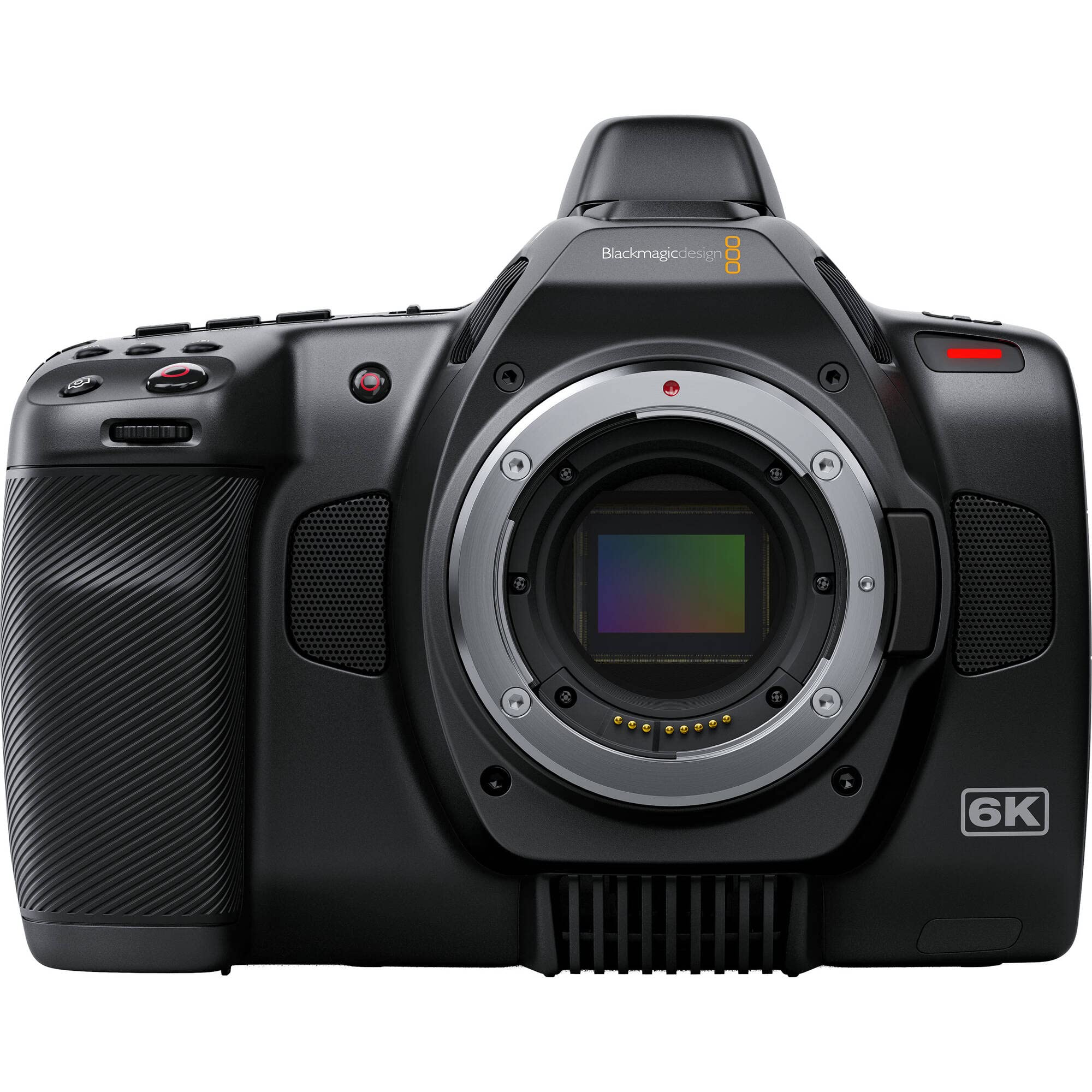
The crowd favorite that shoots 6K and takes the EF glass you already own.
This is the most established body on the list, and it earns that the simple way: picture quality and a native Canon EF mount, so the Canon glass you already own screws straight on. The Super 35 sensor at 23.10 x 12.99 millimeter shoots 6144 x 3456 (6K) up to 50 fps, 6144 x 2560 (6K 2.4:1) up to 60 fps, 4096 x 2160 (4K DCI) up to 60 fps, and 1920 x 1080 up to 120 fps. Off-speed frame rates run up to 60 fps in 6K 2.4:1 and 120 fps in 2.8K and 1080, which covers slow motion without a separate body — one camera handles the wide shot and the slow-mo insert.
What wins people over is the image itself — 6K RAW capability at a price that undercuts the full-frame RAW bodies here, with an EF mount that means a shelf of Canon glass works without an adapter. The size splits opinion: some call it a powerful compact device, others find it bulkier than expected. Reliability also has a mixed read, with a firmware update flagged in the feedback, so verify your unit and firmware status on arrival. Its 74 g battery is the lightest cell here, just under the Canon R5 C’s 81 g.
The honest caveat is autofocus. It uses contrast detection only, with no phase detection, so you drive focus yourself on moving subjects. For cinema work that is often exactly what you want anyway.
Why the following: a Super 35 sensor with 6K RAW and an EF mount lets working shooters use the glass they trust — and that is why it stays a reference point in this category.
It wins if: you own Canon EF glass and want 6K RAW without switching lens systems.
It is not for: shooters who want the camera to track focus for them on unpredictable subjects.
7. Sony FX2 Full-Frame Cinema Camera Body Only, Gray
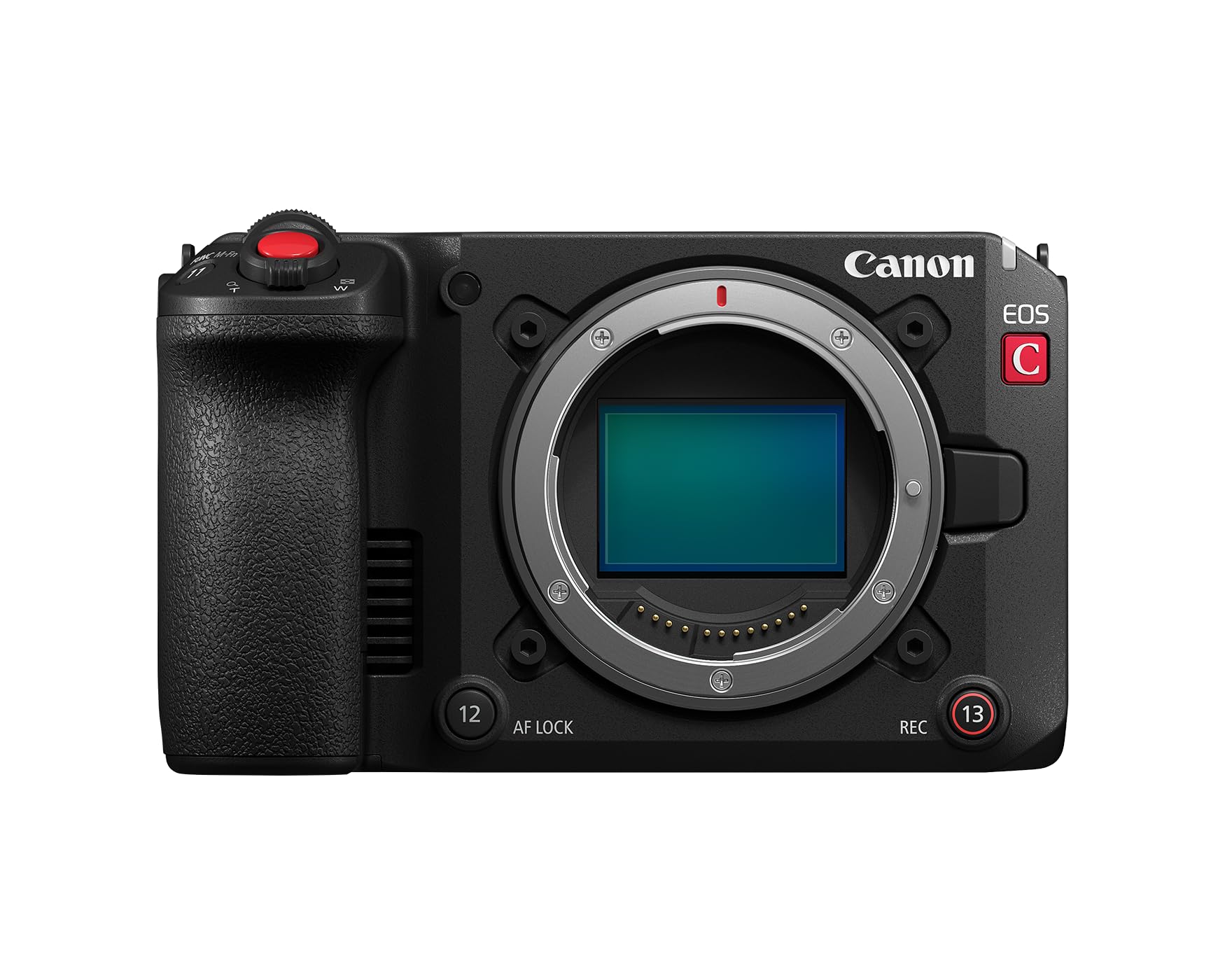
A 7K sensor built around internal RAW and a clean two-point ISO plan.
The C50 is the newest sensor design on this list, and it is built for internal capture rather than external recorders. A newly developed 7K full-frame CMOS sensor handles 7K 60P internal RAW recording and 4K 120P high frame rate recording, with sensor modes including full-frame 3:2. Dual Base ISO is on board, so you shoot at the two clean sensitivity points rather than guessing in between.
What makes it a set camera is the recording flexibility. It supports simultaneous 2K crop recording alongside your main format, which means you can pull a second framing from one setup without adding a camera. The Canon RF mount takes RF glass natively, it records to SD cards, and it connects over Wi-Fi and USB-C. The battery is a 46 g lithium-ion cell, the lightest here.
The catch is bit depth and lens system. It records 10 Bit, so it hands you less grading headroom than the 12 Bit bodies on this list, and the RF mount means RF or adapted glass only. Its beige finish is a small thing, but it is worth knowing if you prefer a black body on a dark set.
The format spread: 7K 60P RAW internally, 4K 120P for slow motion, and a 2K crop recorded at the same time. That is a lot of deliverable formats from one body sitting on one tripod.
The right body for: a Canon RF shooter who needs internal 7K RAW and a simultaneous 2K crop.
Worth passing on if: you need 12 Bit depth or a black body for a dark set.
Know the Specs
Bit depth and RAW
Bit depth counts the shade steps each color channel can hold. Ten bits is the common floor for cinema bodies and 12 bits gives noticeably more room to lift shadows before the image shows steps. RAW formats like Blackmagic RAW, REDCODE RAW and Cinema RAW Light keep more of that data before it is baked in, which is why they grade further. If your work depends on heavy color work, favor the 12 Bit bodies. If you nail exposure on set and deliver clean, the 10 Bit bodies are a joy to shoot.
Dynamic range and Dual Base ISO
Dynamic range is the spread from the brightest highlight to the darkest shadow the sensor holds in one frame. It is often quoted in stops, and a 15+ stop figure here means more recoverable highlights on bright exteriors. Dual Base ISO means the sensor has two clean sensitivity points — two gain settings where noise stays low rather than a smooth ramp between them. You plan your lighting around those two ISO points, which is why cinema shooters talk about them more than a maximum ISO number.
Lens mounts and crop
The mount decides which glass you can attach without adapting. Sony E/FE, Canon RF, Canon EF, Nikon Z and Leica L each carry their own lens sets. A full-frame sensor uses more of the image circle than an APS-C or Super 35 sensor, which crops in. If you already own a set of lenses, the mount is often the deciding factor — switching systems is a far bigger commitment than switching bodies.
Recording media and cooling
Card type and cooling determine how long you can roll. CFexpress Type A and Type B cards handle higher data rates than SD, and one body records to external SSD over USB-C. Cooling matters just as much: an in-body fan is what allows long uninterrupted takes at high frame rates. Match media to your longest typical take, and check whether the body cools itself or wants a break.
Common Questions
Can I use my existing Canon EF lenses on a Sony cinema body?
Is 10-bit footage enough, or do I need 12-bit RAW?
How long can I record before a cinema body overheats?
What does Dual Base ISO actually do for my footage?
Is a full-frame cinema sensor better than Super 35?
Do I need CFexpress cards or can I shoot on SD?
What does 32-bit float audio mean on the Nikon RED Z Cinema?
Are renewed cinema cameras a safe buy?
How much autofocus difference is there between these bodies?
Does a cinema camera body come with a lens?
The Bottom Line
For most shooters, the winning pick among these pro cinema cameras is the Sony Alpha FX3 because it delivers S-Cinetone color straight out of the body, 4K 120p at 10-bit 4:2:2, and a cooling fan that holds long takes — without demanding a cage. If you want the most grading headroom, reach for the Blackmagic Cinema Camera 6K, which records 12-bit RAW and bundles DaVinci Resolve Studio. And if you want RED color science in a 1.18 lb body, the Nikon RED Z Cinema is the one to rig up. The FX3 backs that up with 4.5+ stars across 200+ ratings.
How we choose
We do not accept paid placement. Every pick is matched to a real buyer and a real use-case; we do not hands-on test units.
Sources
Specifications: manufacturer listings and product documentation. Review insights: verified customer reviews, as of November 2026. Pricing: not shown on this page (it changes often); check the current price via the retailer link.
As an Amazon Associate, Tactical Gear Guy earns from qualifying purchases. This does not affect which products we feature.