Specs are compiled from manufacturer listings and verified buyer reviews and can change over time — please confirm the key details on the product page before buying.
An air compressor is the hardest small load you will ever ask an inverter to run. The motor pulls a hard startup surge the moment it kicks on, then settles into a steady draw while it fills the tank. Buy for the surge, not the running watts, and the job gets simple. This guide keeps a running note on sizing: not every pick here matches your exact wattage number, because I include the nearest same-type size that does the same job.
This guide is built by comparing the manufacturers’ published specifications and the patterns across verified customer reviews, so you get each pick’s real strengths and trade-offs instead of marketing spin.
Every pick below puts out a pure sine wave — the clean grid-style AC an induction motor needs — and enough continuous wattage to carry a compressor through its fill cycle. Here is the honest shortlist of the best power inverter for air compressor duty.
Top Picks
How To Choose The Best Power Inverter for Air Compressor
You are sizing for two different numbers. The first is the watts your compressor draws while it runs. The second, and the one that trips a weak inverter, is the spike it pulls for a second or two when the motor kicks in. A unit that only meets the running number will shut down every time the compressor restarts.
Match the surge, then the running watts
Look for a peak or surge rating above your compressor’s startup draw. Every pick here lists both a continuous and a peak figure, such as 3000W continuous with a 6000W surge. That peak window is what carries the motor past its first hard turn.
Insist on pure sine wave
A compressor motor is an inductive load, meaning it builds a magnetic field as it spins. Pure sine wave output — a smooth AC curve that mimics wall power — lets that motor start cleanly. A modified sine wave unit, with its blocky stepped output, can make the motor buzz, run hot, or refuse to start.
Pick your battery voltage first
Input voltage sets how much current flows through your cables at a given wattage. The SUMRY runs on 24V DC input; the OLTEANP wants a 48V battery pack; most of the others take a standard 12V battery. Higher-voltage input means less current and less cable heat, but only if you already own that battery bank.
Do not trust the box cables
Thin, short cables strangle output before the inverter ever runs out of headroom. Several picks ship with proper heavy-gauge cable, but the honest word from owners is that some included sets fall short. If your compressor wants big current, upgrade the cable run.
Side-by-Side Comparison
| Model | Best For | Continuous Watts | Surge Watts | Input Voltage | Amazon |
|---|---|---|---|---|---|
| SUMRY Hybrid Solar Inverter 4000W★ Best Overall | Whole off-grid workshop | 4000 W | 8000 W | 24 V DC | Amazon |
| LANDERPOW 2000W InverterBest Value | RV and job-site compressor duty | 2000 W | 4000 W | 12 V DC | Amazon |
| BESTEK 2000W Pure Sine WaveCompact Pick | Compact van and truck installs | 2000 W | 4000 W | 12 V | Amazon |
| OLTEANP 48V 2500W | 48V solar battery banks | 2500 W | 5000 W | 48 V DC | Amazon |
| EGSCATEE 3000W | Regulated output for sensitive gear | 3000 W | 6000 W | 12 V | Amazon |
| Renogy Inverter P2 3000W | Cabin solar with GFCI outlets | 3000 W | — | 12 V DC | Amazon |
| GoWISE Power PS1004 3000W | Trailer AC plus compressor combos | 3000 W | 6000 W | 12 V | Amazon |
| GIANDEL 4000W | Big motor starts on 12V | 4000 W | 7000 W | 12 V DC | Amazon |
Detailed Reviews
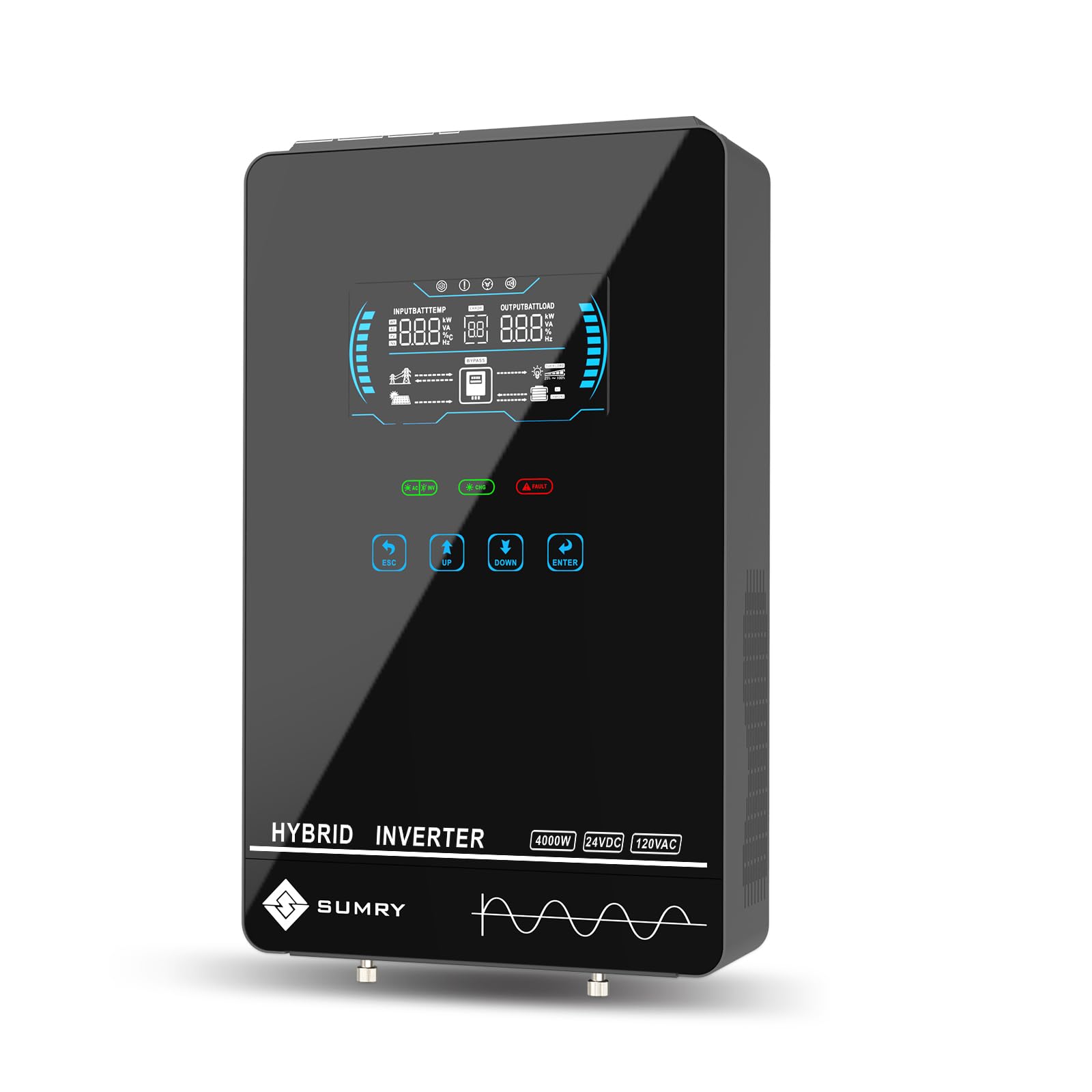
1. SUMRY Hybrid Solar Inverter 4000W DC24V
Our pick — 4.5+★ from 500+ verified ratings; the strongest balance of quality and price.
Double the headroom of the value picks, built for a workshop that never sits idle.
If your compressor shares a wall with a table saw and a shop vac, the SUMRY is the pick that will not flinch. It holds 4000W continuous and 8000W peak (the short burst a motor draws at startup), which is exactly double the running watts of the LANDERPOW below — 4000W against 2000W. That is real margin for a compressor kicking on while other tools are running.
The input side is where it differs most. It runs on 24V DC, not the 12V most of this list uses — double the input voltage of the LANDERPOW’s 12V. In plain terms, higher input voltage means less current pushing through your cables, so an equally heavy compressor start creates less strain. It also packs a built-in 140A MPPT charge controller (the circuitry that squeezes the most usable power from solar panels), rated for max PV 5600W 350VDC and up to 98% conversion efficiency.
Two things set it apart beyond raw power. It will run loads straight off solar during the day without a battery attached, as long as PV input exceeds 120V and the grid is not connected. And the tempered glass top with a 6.25 inch LCD and touch buttons gives you live data at a glance. What wins people over most is the overall build — the part owners praise loudest by a wide margin — and install ease runs a close second. The honest catch is consistent output. Judgments split on reliability, with some owners reporting units that stop charging batteries over time; a smart-battery charge design and three cooling fans are the brand’s answer, but it is the one thing to watch.
Where the SUMRY pulls ahead
- 4000W continuous and 8000W peak — double the headroom of the 2000W picks here
- 24V DC input halves the current demand versus a 12V unit at the same wattage
- 140A MPPT controller with 98% conversion efficiency for solar-first setups
- 6.25 inch glass-topped LCD with touch buttons for live monitoring
- Runs loads battery-free in daylight when PV input tops 120V
The trade-offs to weigh
- Needs a 24V battery bank, not the 12V most RV owners already own
- Some buyers report units that stop charging batteries over time
- Manual is electronic-only on the product page, and the 24V setup must be followed closely
Made for: the off-grid workshop running a compressor alongside other tools, with a 24V bank already in place.
Pass on it if: your whole system is 12V — you would need a new battery bank to use the extra headroom.
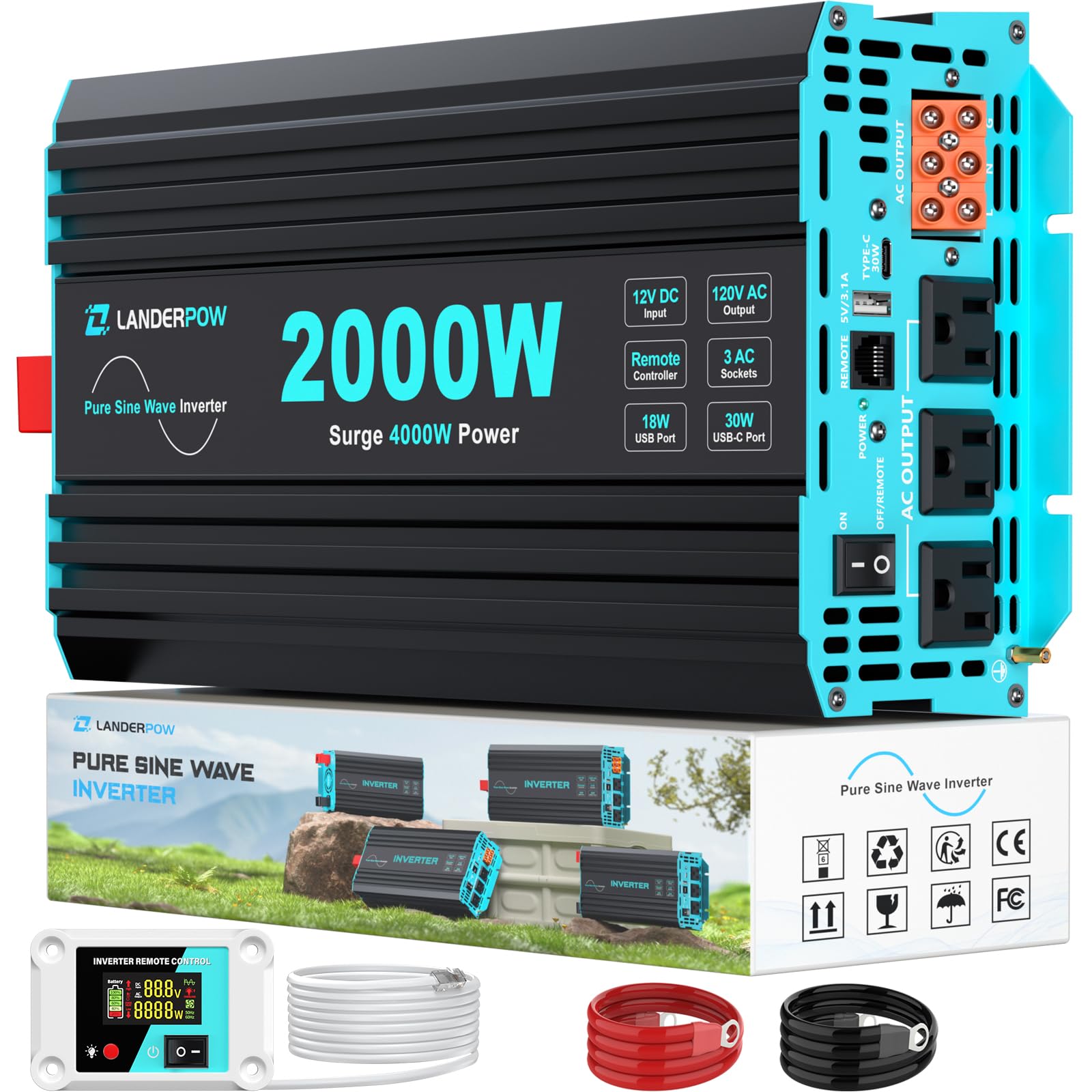
2. LANDERPOW 2000 Watt Inverter 12V
2000W continuous and 4000W of surge — enough to start a compressor motor without drama.
Here is the smart-buyer move on this list. You get 2000W continuous and a 4000W surge for a compressor motor’s startup, delivered as a pure sine wave so the motor turns cleanly instead of buzzing. Rated efficiency runs above 91%, which means less of your battery power leaks away as heat on the way to the compressor.
The remote is the quietly great feature. A 15ft wired controller with an LED screen tracks battery level, output, and error codes from your cab or campsite — no walking back to the unit to check whether the compressor has cut out. You also get 5V/3.1A USB and 30W PD ports for phones, and a hardwired AC terminal alongside the 3 standard outlets for heavier gear.
Owners lean hard on the performance side, and the praise is consistent — running lights, a mini fridge, a small pump, and a shop vac with no issues at all. The noise split is the one to know: some call it super quiet, others find it loud, which usually tracks with how hard you push it. The full metal shell and a 3-year coverage window (a 1-year replacement plus 2 years of support) soften that. Think of it as the value pick with 4000W of surge behind a 2000W continuous rating.
The read on value: for a compressor within 2000W running draw, this lands the strongest blend of surge headroom, remote monitoring, and support coverage on the list.
Watch this: noise varies by unit and load, so if the compressor runs indoors near living space, plan around it.
Reach for this if: you want big surge headroom and a genuine remote without paying premium-tier money.
Look elsewhere if: your compressor runs above 2000W continuous — step up to a 3000W or 4000W unit instead.
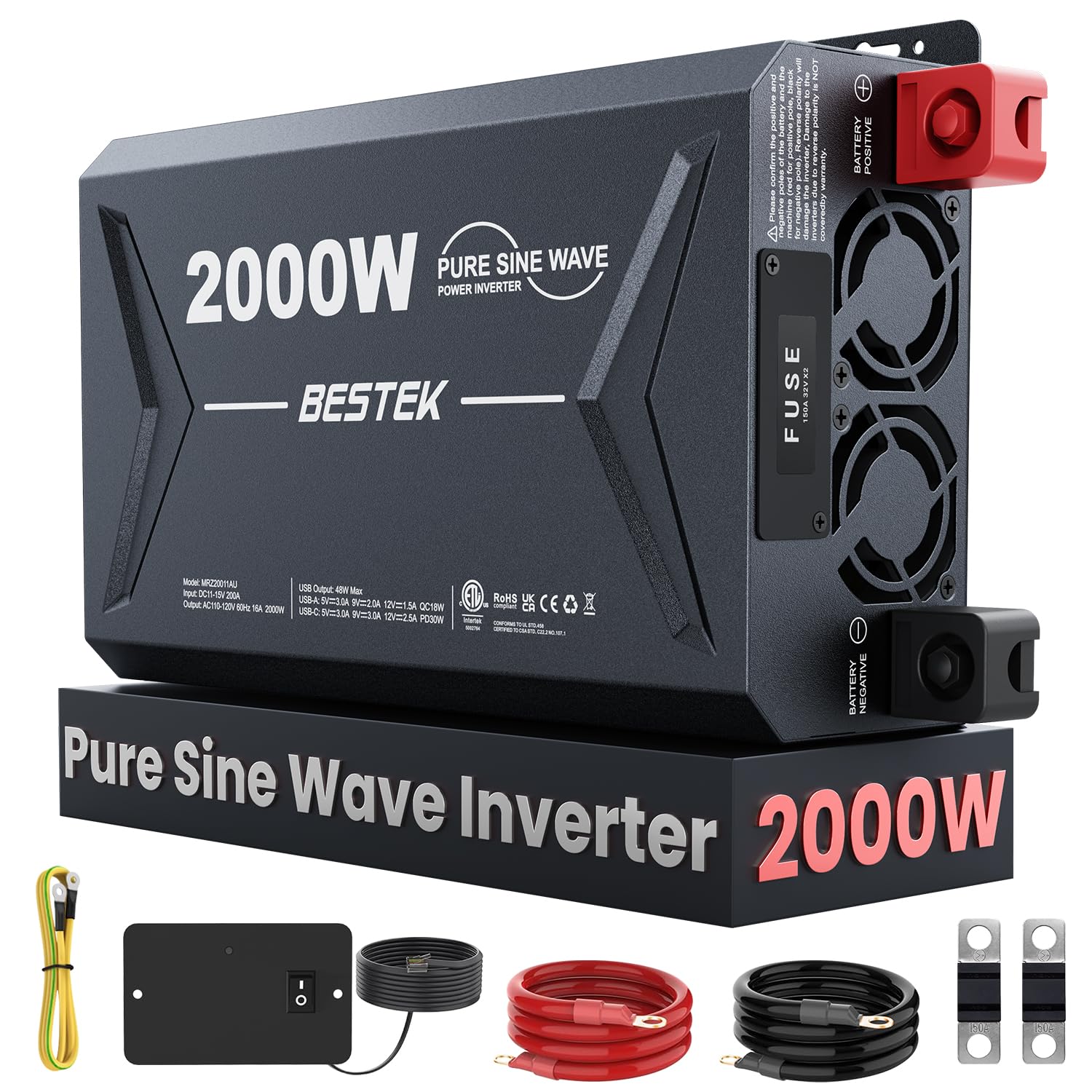
3. BESTEK 2000 Watt Pure Sine Wave Inverter
A compact 2000W unit with a 4000W peak, sized for tight van and truck installs.
The BESTEK stays true to its 2000W continuous rating with a 4000W peak, and it is the smaller footprint of the two 2000W units here. That matters in a van or a pickup bed where floor space is tight. It carries 3 standard AC outlets plus USB-A (QC18W) and Type-C (PD30W) fast-charging ports, so phones and a compressor can share the unit without juggling plugs.
Its real selling point is the protection suite — seven separate guards covering overload, overvoltage, undervoltage, high temperature, short circuit, leakage, and reverse polarity. If anything trips, the LED indicators cut off to signal the fault. The portable LED display is removable, and the remote cable reaches up to 16.4 feet, so you can kill power from across the garage.
What wins owners over is reliability — the trait they praise most, with build quality close behind. One buyer notes it pulled 1600 watts from an EV battery with no struggle, and another pushed it with a 350 watt rotary tool and a heat gun. The practical caveat: wire it straight to a proper battery and never run a full load through a cigarette lighter — the brand says so plainly, and a compressor will punish that shortcut instantly.
Small but stubborn: 2000W continuous and 4000W peak in the tighter-cabinet body, with seven protection layers and a 16.4ft remote.
The setup rule: direct battery connection with clamp cables is the only safe path for a motor load — lighter sockets will not carry a compressor start.
Right answer for: tight install spaces and buyers who value the deepest protection lineup at this wattage.
Not the one if: you need more than 2000W continuous to run a large compressor.
4. OLTEANP 48V 2500W Pure Sine Wave Inverter
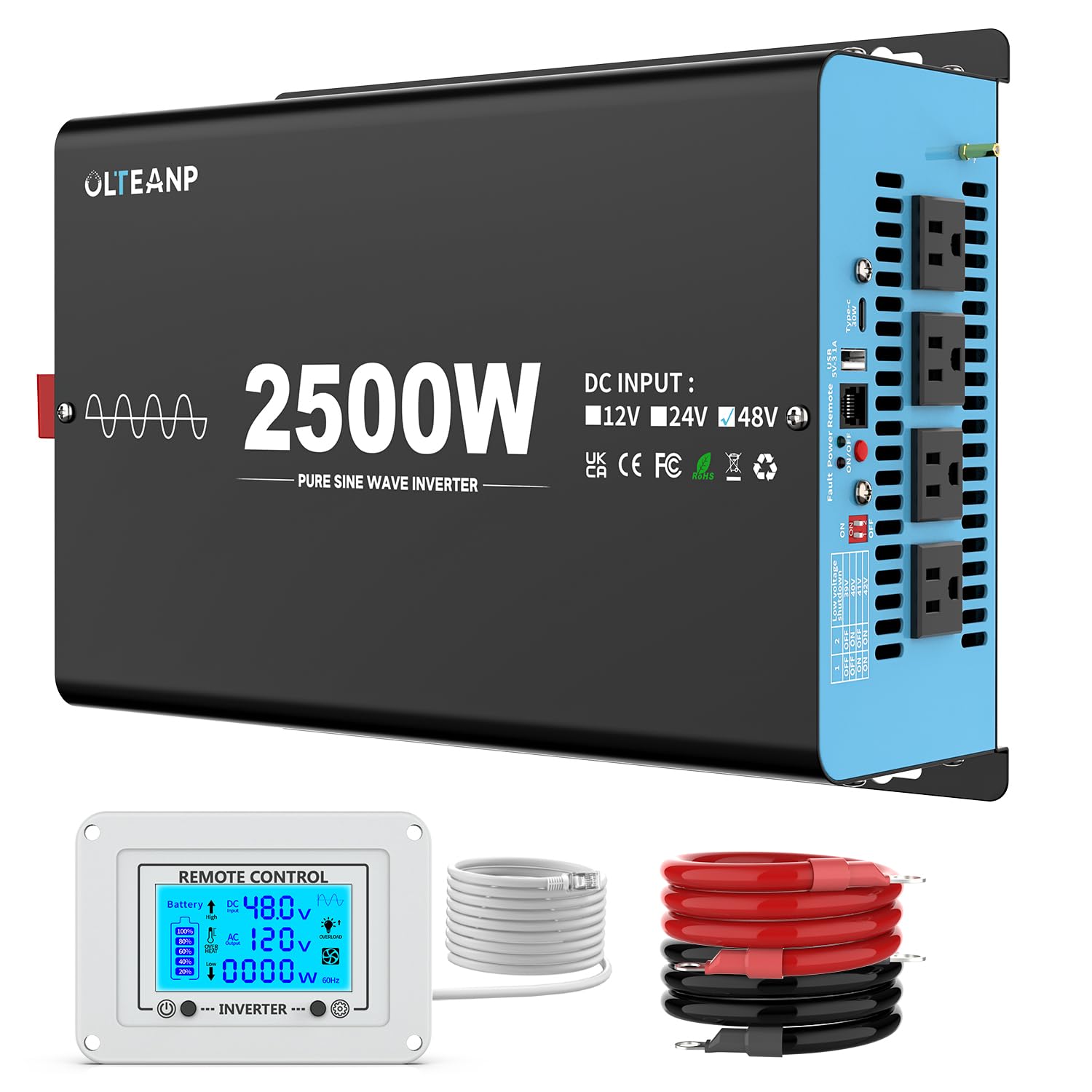
Built around a 48V battery bank, with a cutoff you can tune to protect it.
This one is for the owner who already runs a 48V solar battery bank — LiFePO4, AGM, GEL, or deep-cycle. It delivers 2500W continuous and 5000W peak, a pure sine wave that lets a motor start cleanly, and it runs on 48V DC input. That is four times the input voltage of the 12V picks, meaning far less current for the same compressor load.
The feature that earns its keep is the adjustable low-voltage protection. You can dial the shutdown threshold between 39V and 42V to match your battery maker’s recommendation, so the inverter stops before your pack is drained too far. That protects the battery long-term. A wired 15ft LCD remote shows battery input voltage, AC output voltage, load wattage, and fault alerts from inside the RV or cabin.
Owners mention it doing the heavy lifting — running fridges, microwaves, and coffee makers, with one noting it holds a clean 2000 watts without trouble. It runs quietly, and installs easily. The genuine limitation is the battery requirement: if you do not already own a 48V bank, this pick is not for you, since the whole point is what that higher voltage buys you. For a 48V bank owner, the adjustable 39V–42V cutoff and 15ft LCD remote make it a well-monitored workhorse.
The fit: 48V solar owners who want controlled discharge and a full read-out on one remote.
The mismatch: 12V setups — you would be fighting the input spec from the first connection.
5. VOLTWORKS 3000 Watt Pure Sine Wave Inverter

3000W of clean power with a 30ft remote, made for trucks with a big wall between cab and bed.
The VOLTWORKS turns 12V DC into 3000W of continuous, pure sine wave AC, delivered through 2 AC outlets, an AC hardwire terminal for a permanent compressor circuit, and a 2.4A USB port. That hardwire terminal is the star for a fixed shop or truck install — it lets you wire the compressor in like a real wall outlet instead of plugging into a socket.
The remote reaches 30ft, and it is genuinely convenient — one of its owners loves flipping the switch from inside the RV. It is RJ10, 4P4C, so if you need more length you can splice your own cable rather than hunt a special part. The aluminum housing takes drops and bumps, and the internal fan stays off at startup, only kicking in above 104F or past a 1400W load to save your battery.
Owners rave most about reliability, and its quiet running ranks among the things they like. There is an honest split on output, though — some owners say it delivers up to 2000 watts comfortably, while others report it falling short of that figure. If your compressor runs in that mid range, size around the reported output; if you need steady moderate power with a 30ft remote, this is a clean, well-housed choice.
Install convenience: a 30ft remote plus a hardwire terminal turns it into a permanent, switchable circuit for a fixed compressor.
The catch: reported output varies, and some owners find it short of the mid watts they expected — size to your compressor with margin.
Good pairing: a truck or RV where the compressor sits far from the driver and needs a hardwired feed.
Think twice if: your compressor runs near the top of the mid wattage range and you need every watt guaranteed.
6. EGSCATEE 3000W Pure Sine Wave Inverter
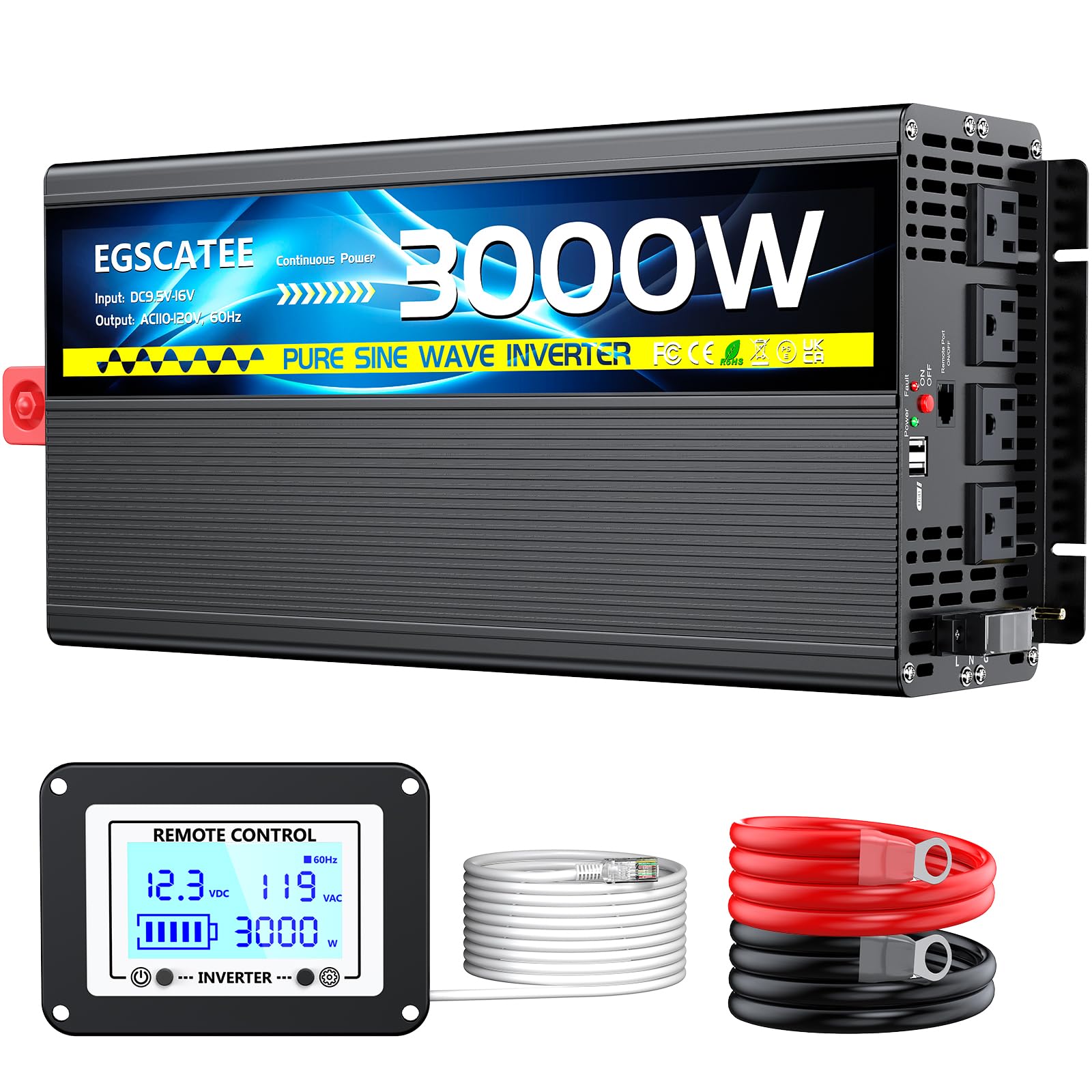
The regulated one — it holds voltage steady even as the battery sags under a motor load.
Here is the spec that matters when a compressor drags your battery voltage down mid-run. The EGSCATEE maintains 115V–120V AC output while your battery input stays above 12V, and holds above 110V even when input drops to 10V–11V. In everyday terms, your compressor keeps the voltage it needs to run rather than stalling out as the battery weakens. It pairs that with 3000W continuous and a 6000W peak, pure sine wave for clean motor starts.
Connection options are the most generous around: 4 AC outlets, a hardwire terminal, a 5V/3.1A USB, and a 30W USB-C PD port. The thermal system is smart too — dual aluminum heat sinks and fans that switch on only once the internal temperature passes 113°F, keeping it quiet under light loads. A 14.76 ft wired LCD remote shows battery voltage, live output power, and error codes.
Customers note it earning its place in off-grid duty — running a full-size fridge and a window AC, or a 1hp sump pump, without trouble. One note that says a lot: it started an 1800W inductive cooktop that a cheaper modified sine wave unit could not run. The included cables are four 5 AWG lengths, paired per terminal to equal roughly 2 AWG combined. The honest limit is the warranty — a single year, short beside the multi-year coverage on some picks here.
Why it steadies: regulated output keeps 110V+ flowing to a compressor even when battery input dips to 10V–11V.
Sized-for-tools detail: 6000W peak handles the hard first turn of a motor, and the four 5 AWG cables pair up to roughly 2 AWG combined.
Best for: off-grid and emergency setups where voltage sag is a real daily risk.
Know before buying: the 1-year warranty is the shortest here — factor that into the value read.
7. Renogy Inverter P2 3000W
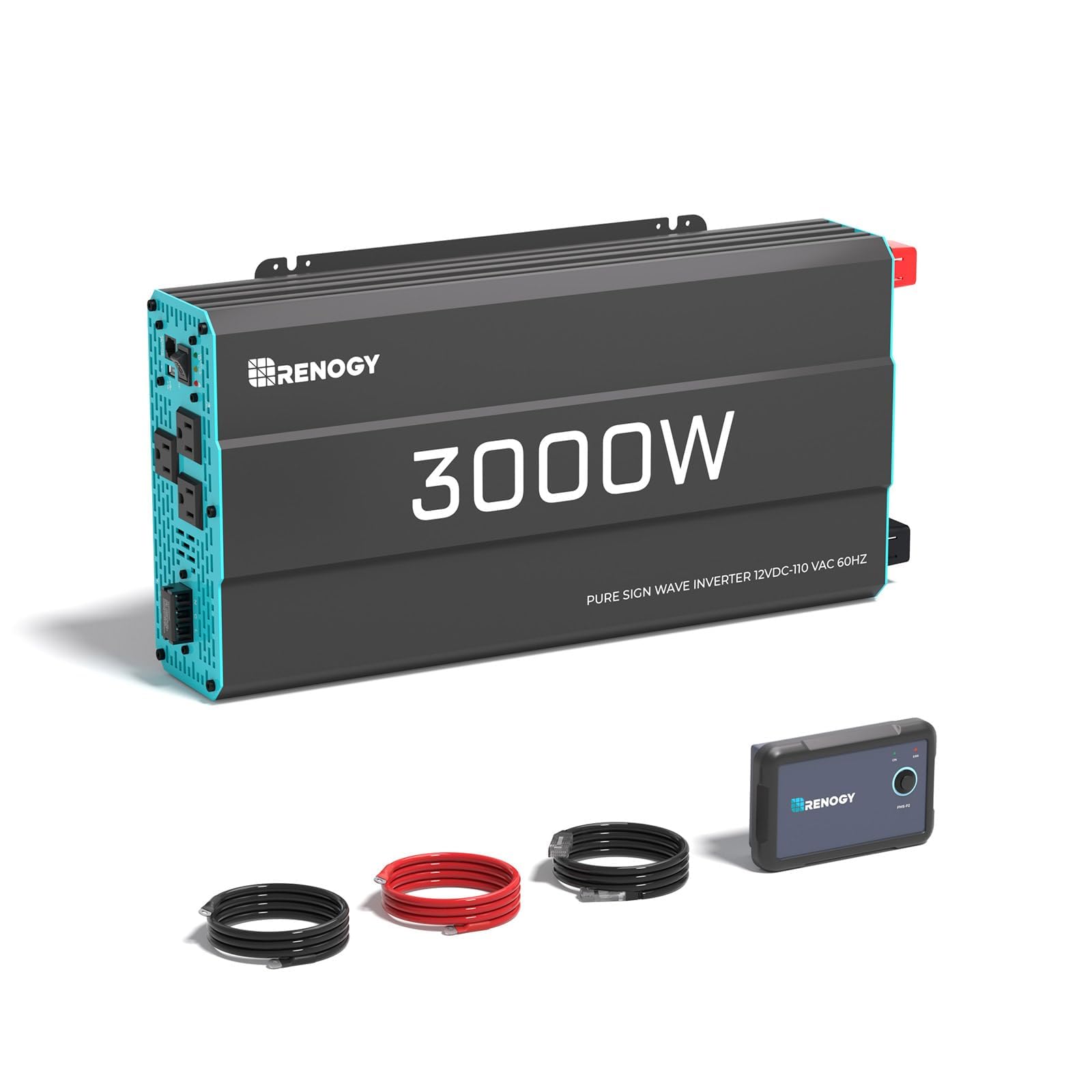
A cabin-grade 12V unit with ground-fault protection built into the outlets.
Renogy’s P2 brings 3000W of pure sine wave output on 12V DC input, with GFCI protection on the outlets — the ground-fault interrupter that trips if current leaks, the same safety you expect from a kitchen wall socket. For a compressor running in a damp cabin or a workshop, that is a sensible layer. It ships with two 1/0AWG 3ft cables and a 16.4ft wired remote, and meets UL 458 and CSA C22.2 certification.
The conversion efficiency runs above 90%, so the battery drain to run your compressor stays reasonable, and pure sine wave keeps the motor cool and quiet. A metal housing guards it from bumps. Reviewers point out one thing above all: performance that holds up during extended power outages, doing the job at a cabin with solar panels without trouble. The value read is split — some owners call it a great buy, while others felt it did not work out for them.
One practical note from the listing: the input should come from a deep-cycle battery with capacity to handle the draw. That is not a flaw, just the reality of a 3000W unit — it wants a real battery behind it. Pair it with a deep-cycle bank and the GFCI outlets make it a safety-forward choice for a solar cabin.
Choose it if: GFCI protection on a 12V cabin or workshop compressor circuit is a priority for you.
Size up first if: your battery bank is small — a 3000W unit needs a deep-cycle pack capable of feeding it.
8. GoWISE Power PS1004 3000W Inverter

3000W continuous and 6000W surge, packaged for trailer owners who run AC and more.
The PS1004 puts up 3000W continuous and a 6000W peak, a pure sine wave with total harmonic distortion under 3% — a measure of how clean that AC wave is, so motors run smooth. Four output sockets, a remote switch, and starter cables are in the box, plus five protection systems covering thermal, overload, over and under voltage, and a low-voltage alarm. Soft-start tech is designed to ease a motor’s first turn.
The good news from owners is genuine. One runs an RV AC and microwave at the same time without overloading; another praises the clean power after a previous unit kept tripping its AC on thermal shutdown. Powering a 5th wheel’s AC unit is a real use-case it reportedly handles. Overheating is precisely what a compressor motor punishes, so the clean sine wave matters here.
The catch to take seriously is in the box. Some owners find the provided battery cables too thin and too short for a full load, and one had the unit cut off early until better cable was added. Swap to proper heavy-gauge cable and the unit behaves like its rating. It is a solid pick for a trailer that already carries a strong battery and can supply its own heavy-gauge wiring.
What goes right
- 3000W continuous, 6000W surge, THD under 3% for clean motor power
- Four output sockets plus a remote switch for flexible installs
- Soft-start tech designed to ease inductive motor startup
- Owners run RV AC and microwave together without overloading
What to plan around
- Included battery cables are criticized for being short and thin
- Some owners saw early shutdowns until heavier cable was added
- It is physically long, so measure your mounting space
Fits: a fifth wheel or travel trailer where AC and heavy motors run together on a strong battery.
Buy cable with it: plan for heavier wiring from day one if you want the full 3000W to reach a compressor.
9. GIANDEL 4000W Pure Sine Wave Power Inverter
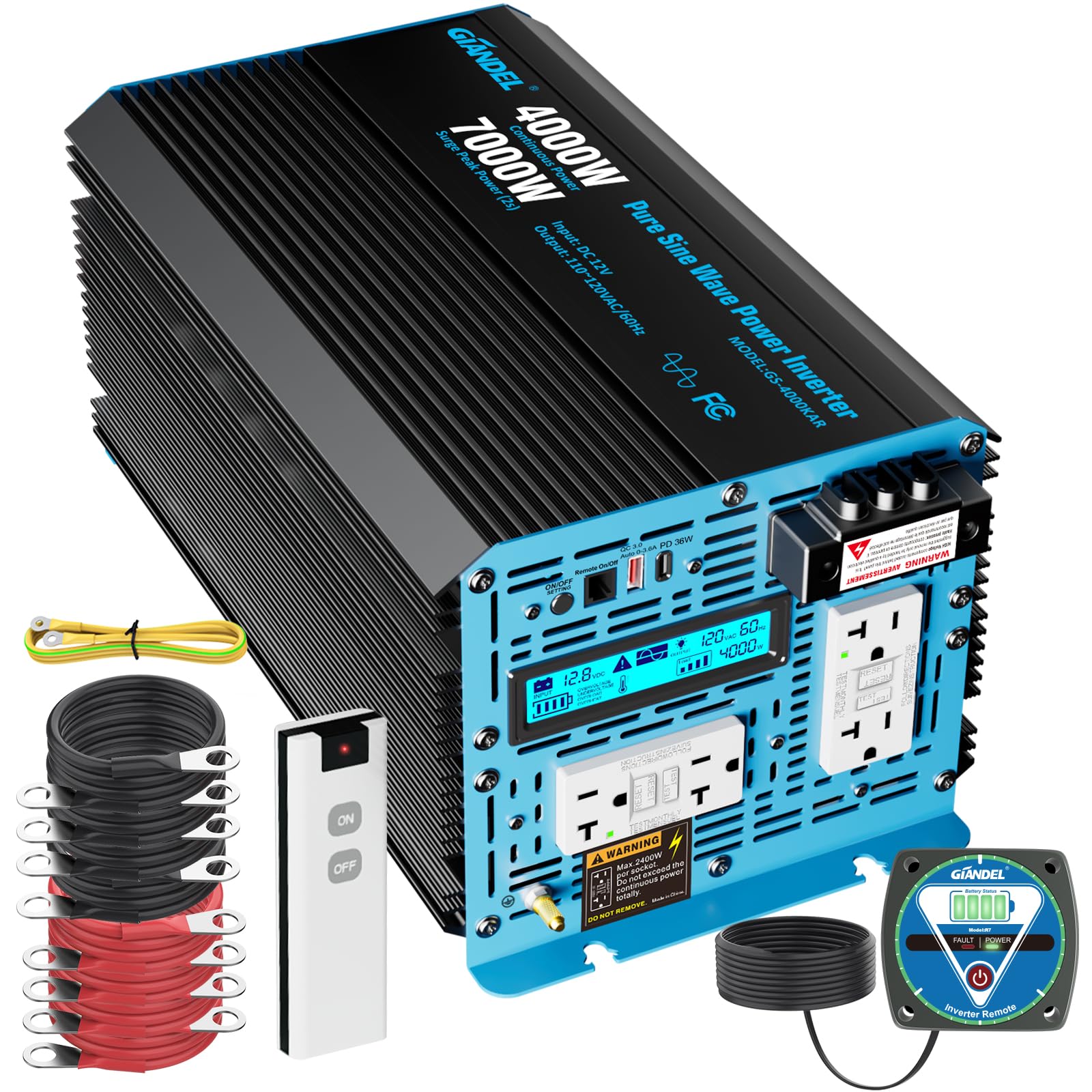
The biggest motor-starter here — 4000W continuous and 7000W of surge, all on 12V.
If you want maximum startup muscle on a standard 12V battery, this is the one. It puts out 4000W continuous and a 7000W surge for two seconds, enough to swing a big motor like an air conditioner or an air compressor into life. The listing names air compressors directly among its intended high-startup loads. It is a patented design, and it runs on 12V DC input, so it fits the battery most owners already have.
Two features make it easy to live with. A big LCD shows input and output voltage, load power, frequency, and any protection code, and the outlets are UL-listed 20 Amp GFCI for ground-fault safety. For control you get both a 30ft wired on/off remote and a wireless backup that works to 20 meters. The low-voltage protection is resetable from 9.5V to 11.5V to match LiFePO4 or lead-acid batteries.
Shoppers say it delivering what it promises — one ran a 1050W microwave, an Instant Pot, a pancake air compressor, and a 1500W space heater without trouble. The all-insulated ring-terminal cables are sturdier than clip styles. The honest note is durability, which draws mixed reviews over long-term use, and occasional cable criticism. For big motor starts on a 12V system, that 7000W surge is the most headroom here.
Raw starting power: a 7000W surge for 2 seconds means a stubborn compressor motor starts where smaller units trip.
Honest caveat: long-term durability draws mixed feedback, so treat the included cables with care and keep the load within rating.
Made for: big compressor and AC startup on a 12V system that wants the most surge watts available.
Weigh first if: you want proven long-term durability above maximum startup headroom.
Know the Specs
Continuous vs. surge watts
Continuous watts is the power an inverter can supply all day while the compressor runs. Surge watts is the brief peak it can hit for a second or two to get a motor spinning. Size for the surge first — a unit that only meets the running watts will shut down every time the compressor restarts under pressure. That is why you see pairs like 3000W continuous and 6000W peak on the same unit.
Pure sine wave output
Pure sine wave is a smooth, wall-style AC curve, and it is what an inductive motor needs to start cleanly. A modified sine wave unit, with its stepped output, can make a compressor motor buzz, run hot, or stall. Every inverter here is pure sine wave, and that is deliberate — it is the single feature that decides whether a motor load runs or fights back.
Input voltage and battery current
Input voltage — 12V, 24V, or 48V DC — sets how much current a given wattage pulls through your cables. The SUMRY runs on 24V input, the OLTEANP on 48V, and most others on 12V. Higher voltage means lower current for the same load, which lets you use lighter cable and generates less heat. Match the inverter to the battery bank you actually own or plan to buy.
Battery cables and current limits
The cables are where many setups fall short. Thin or short wire chokes current and can trigger early shutdowns well before the inverter reaches its rating. Look for heavy gauge like 2AWG or 1/0AWG, and keep runs short. Several picks here ship proper cable; a couple carry honest owner notes that the included set is the weak link. Treat cable as part of the power budget, not an afterthought.
Common Questions
How many watts do I need to run an air compressor on an inverter?
Why does my compressor trip the inverter every time it kicks on?
Is pure sine wave really required for an air compressor motor?
Will a 2000W inverter start a compressor rated near 2000W?
Does 24V or 48V input matter for running a compressor?
Why did my inverter shut off early even below its wattage rating?
Can I run a compressor and other tools at the same time on one inverter?
Do I need GFCI outlets on an inverter for a compressor?
Can I hook a compressor up through the AC hardwire terminal instead of a socket?
How long a remote cable can I get for an inverter running a compressor?
The Bottom Line
For most workshop and off-grid compressor owners, the winner is the SUMRY Hybrid Solar Inverter — 4000W continuous and 8000W peak give the motor-start margin a compressor demands, with the MPPT solar side built in. If you want genuine surge headroom without the premium outlay, the LANDERPOW 2000W is the value pick, pairing a 4000W surge with a 15ft LED remote. And when the job needs maximum startup muscle on a standard 12V battery, the GIANDEL 4000W delivers a 7000W surge for the hardest motor starts.
Whatever you choose, buy for the surge, insist on pure sine wave, and treat the battery cable as part of the power budget. Get those three right and your compressor will start on the surge, not trip on it.
How we choose
We do not accept paid placement. Every pick is matched to a real buyer and a real use-case; we do not hands-on test units.
Sources
Specifications: manufacturer listings and product documentation. Review insights: verified customer reviews, as of November 2026. Pricing: not shown on this page (it changes often); check the current price via the retailer link.
As an Amazon Associate, Tactical Gear Guy earns from qualifying purchases. This does not affect which products we feature.