Specs are compiled from manufacturer listings and verified buyer reviews and can change over time — please confirm the key details on the product page before buying.
If your portraits look flat, orange, or shadowed under the eyes, the fix is usually not the camera — it is the light. A softbox spreads a bare bulb’s harsh beam across a wide white panel, so the light reaches your subject soft and even instead of as one hot spot. The catch is that not every kit on the shelf spreads it well. The strongest overall value here is the NiceVeedi 85W 2-Pack: CRI 97+ color accuracy, 63-inch tripods, and a remote that controls both brightness and color temperature.
This guide is built by comparing the manufacturers’ published specifications and the patterns across verified customer reviews, so you get each pick’s real strengths and trade-offs instead of marketing spin.
Below you’ll find nine softbox and strobe kits sorted by who they actually suit, from a lightweight two-pack for a spare bedroom to a studio strobe set built for paid portraits. Each entry spells out the softbox size, the color temperature range, and the one compromise you should know about before you commit to a portrait lighting kit.
Top Picks

How To Choose The Best Portrait Lighting Kit
A portrait kit lives or dies on two things: how soft the light lands on a face, and how accurately it shows skin tone. Everything else — remotes, carry bags, tripod hardware — is convenience layered on top. Decide those two first and the shortlist shrinks fast.
Softbox size is the shadow dial
The white panel is what softens the bulb, and a bigger panel wraps light around the face instead of blasting one cheek. A 16″ x 16″ box is the compact standard and works fine for head-and-shoulders shots in a small room. A 20″ x 28″ box spreads wider, so it flatters a full torso or two people side by side. Larger panels also sit further from the subject at the same softness, which gives you room to move the light off-axis for shaping.
CRI tells you whether skin looks human
CRI, or color rendering index, scores how truthfully a bulb reproduces color on a 0-100 scale. Low-CRI bulbs push skin green or grey no matter how you white-balance. For faces, higher is almost always better, and the difference between a mid-80s bulb and a 97-rated one shows up in cheeks and lips before anywhere else.
Continuous light or strobe flash
Continuous LED kits stay lit, so you see the exact shadow on your subject’s nose before you press the shutter — ideal for video, streaming, and anyone learning lighting. A strobe kit fires a short, powerful burst that freezes motion and overpowers daylight, which is why working studios still use it. Beginners usually learn faster on continuous light; a paid portrait business often ends up with a flash.
Tripod height and footprint
Stand height decides whether you can light a standing subject from above or must shoot seated. A stand that reaches into the 60s of inches covers most seated and half-body work. Stands that reach 78 inches give you overhead and full-length options. Check the folded length too — a compact fold is what makes a kit portable rather than permanently parked in one room.
Side-by-Side Comparison
| Model | Best For | Softbox Size | Color Temp | CRI | Amazon |
|---|---|---|---|---|---|
| NiceVeedi 85W Softbox Kit 2-Pack★ Best Overall | Accurate color on a budget | 16″ x 16″ | 3000K–6000K | 97 | Amazon |
| MOUNTDOG Softbox Lighting KitMost Reviewed | High-volume beginner studio | 19.7″ x 27.5″ | 2800K–5700K | 85 | Amazon |
| BEIYANG Softbox Kit 20″x28″Best For Tall Rooms | Tall stands and wide panels | 20″ x 28″ | 3000K–6000K | 90 | Amazon |
| Torjim Softbox Lighting Kit | Tabletop product shots | 16″ x 16″ | 3000K–7500K | 80 | Amazon |
| EMART Softbox Kit 16″x16″ | Apartment-sized setups | 16″ x 16″ | 3000K–6000K | 80 | Amazon |
| HPUSN Softbox Kit 2pcs | Long-reach stand height | 30″ x 30″ | 5400K | 80 | Amazon |
| EMART Pull Softbox 20″x20″ | Fast setup between takes | 20″ x 20″ | 3000K–6000K | 93 | Amazon |
| Andoer Studio Kit 3-Light | Three-point video rigs | 20″ x 28″ | 2800K–5700K | 80 | Amazon |
| Godox Studio Flash Kit | Paid portrait work | 20″ x 28″ | 5600K | — | Amazon |
Detailed Reviews
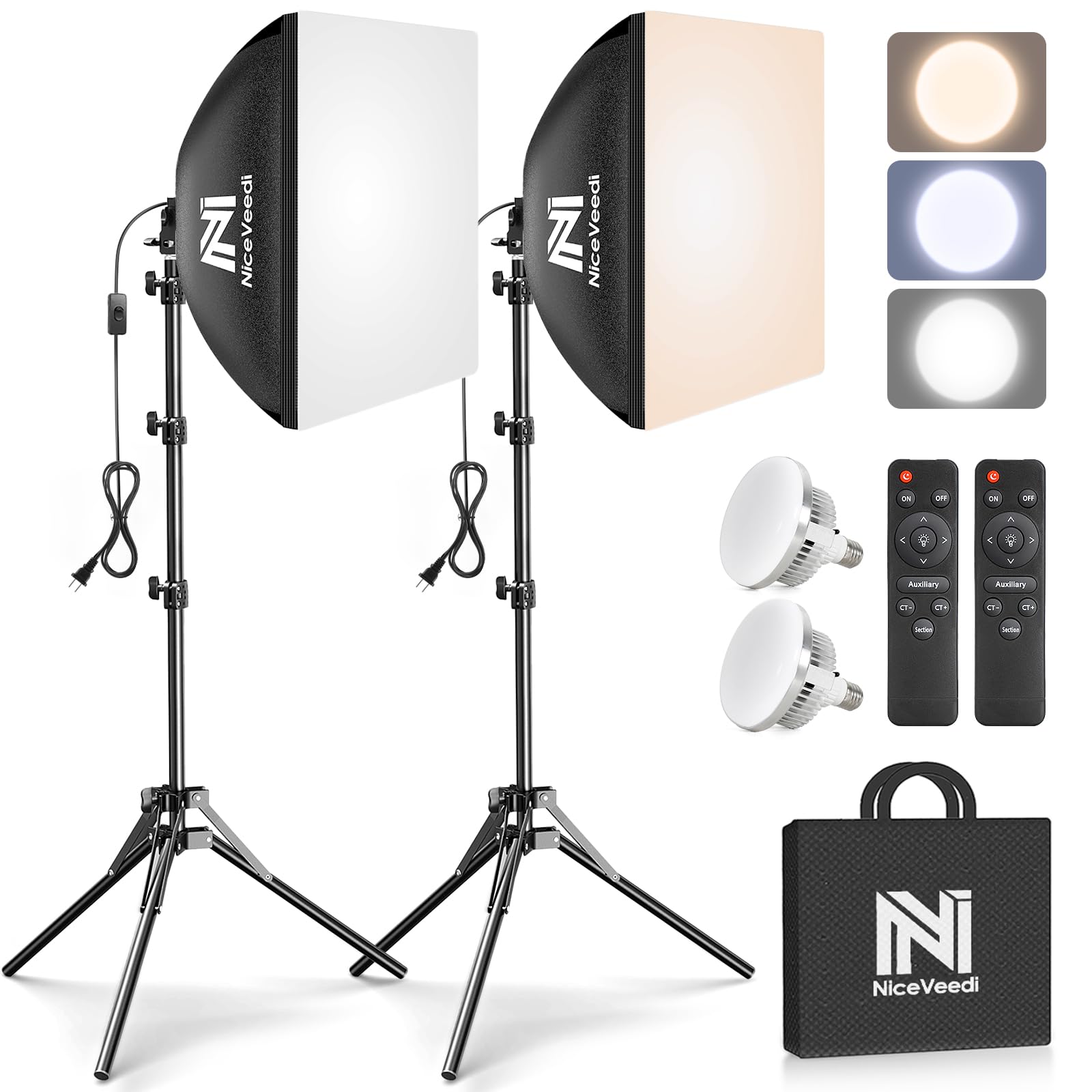
1. NiceVeedi 85W Softbox 2-Pack
Our pick — 4.5+★ from 300+ verified ratings; the strongest balance of quality and price.
The most color-accurate LED kit here, with CRI 97+ bulbs that keep skin tones true.
Start with the number that decides skin tone: a CRI of 97, which is the color rendering index — a 0-to-100 score for how truthfully a bulb shows color. That is the highest score among the LED kits compared here, ahead of the Torjim’s 80. In practice it means cheeks and lips land where they should instead of drifting grey or green, so you spend less time fixing white balance after the shoot.
Both bulbs are 85W and step between 3000K and 6000K — Kelvin being the warm-to-cool scale, where lower numbers give you a golden lamp glow and higher numbers give you daylight. Two lights, two softboxes, two tripods, two remotes and a carry bag come in the box. The tripods reach 63 inches and fold down to 17 inches, which is short enough to drop in a car boot or a closet shelf between shoots.
The 1/4″ screw on top of each tripod (a standard camera thread) lets you screw on a phone holder or a ring light instead of the softbox. That flexibility is what wins people over most — the kit gets used for portrait sessions, live streaming, interviews and product photos without needing a second purchase. On the honest side, the build quality splits opinion: some owners find it very sturdy while others have had trouble around the bulb housing, so treat the housings gently and store the softboxes in the bag.
What earns it first place
- CRI 97+ — the most color-accurate bulb in this lineup
- Wireless remote controls both brightness and color temperature
- Tripods reach 63 inches and fold to 17 inches
- 1/4″ screws take a phone holder, ring light or action cam
The honest caveats
- Bulb housing draws mixed reports on long-term sturdiness
- 16″ x 16″ panels are compact — tighter wrap than a 20″ x 28″ box
Reach for this if: you shoot portraits, talking-head video or product shots and accurate skin color matters most.
Think twice if: you need broad, full-body lighting — a wider panel serves that better.
2. MOUNTDOG Softbox Lighting Kit, 2×19.7″x27.5″ 85W 5700K
The most-reviewed kit here: 19.7″ x 27.5″ panels and 78-inch stands for a first studio.
Big panels, full stop: each softbox measures 19.7″ x 27.5″, so the light wraps a face and shoulders rather than punching one bright spot. That size is what makes a portrait look shot in a studio instead of a hallway. The two 85W LED bulbs run 2800K to 5700K, giving you a warm end for cozy indoor portraits and a cool daylight end for clean commercial looks.
Setup is the other draw. The stands reach 78 inches via a three-section column and lock with independent knobs, and the heads rotate 210° so you can aim the panel without moving the tripod. Two remotes are included — and MOUNTDOG packs a spare in case one dies, which is a small thing that saves a session. Owners consistently describe it as ready to use straight from the box.
It is the most-discussed kit in this lineup by a wide margin, and what owners praise most is the lighting quality itself — the output is bright enough to work in a normally lit room and dims down when you want mood. The trade-off is the sheer number of controls: three color modes plus brightness means a learning curve, so expect your first session to be mostly knob-turning. Stand footprint is another consideration in a tight bedroom.
Why it lands here: 19.7″ x 27.5″ panels, 78-inch stands and a spare remote make this the most complete all-rounder for someone building a first studio — it beats the compact 16″ panels on spread.
Where it asks patience: three color modes plus brightness steps take a session or two to learn, and the stands need floor space.
Pick this one when: you want wide, soft panels and tall stands without jumping to a strobe system.
Pass it over when: your shooting space is a corner of a small apartment — the stands want room.
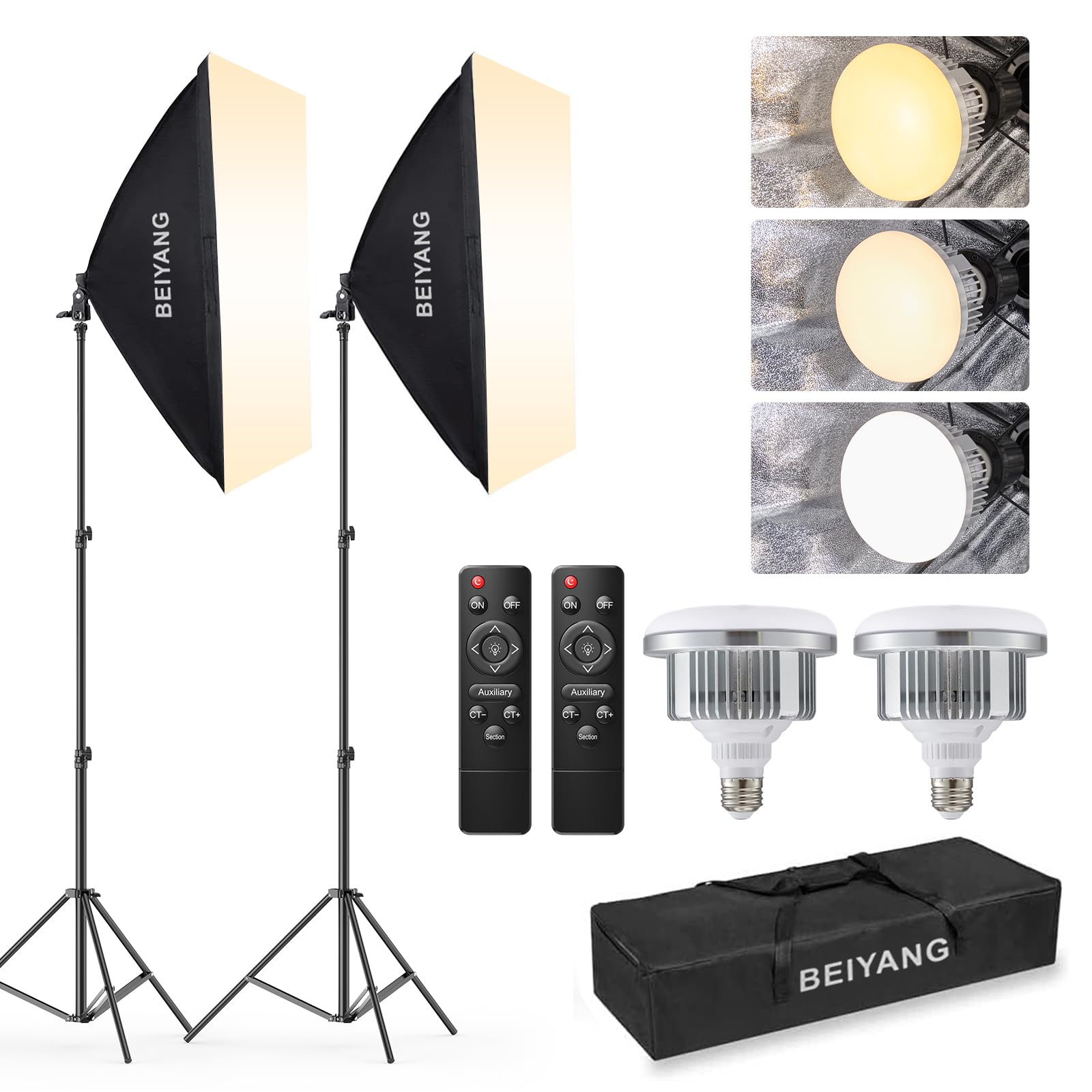
3. BEIYANG Softbox Lighting Kit 2×20”x28”
Stands that extend to 78 inches, paired with 20″ x 28″ softboxes.
The stand height is the headline: a three-section column extends from 26 inches up to 78 inches, so you can raise the light above a standing subject and angle down for a flattering fall across the forehead. Paired with 20″ x 28″ softboxes, that height is a serious step up in spread. For scale, that panel is the same family of size as the MOUNTDOG above, but here you get the full 78-inch ceiling of travel printed as the maximum.
The 85W bulbs sit in standard E27 sockets — the common screw-in household fitting — which matters because you can swap in a replacement bulb from a hardware shop instead of ordering a proprietary part. Each bulb holds 108 LED beads and runs 3000K to 6000K, with a CRI of 90. Setting up is quick and the remote gets a warm reception, with the multiple brightness steps doing most of the work.
What owners value most is the overall quality of the build and the light it throws, and value for money follows close behind. The recurring gripe is output: a share of buyers find it not quite as bright as other lights rated 85 watts, so plan for a darker room or a second bulb if you shoot in a bright space. Stability under a raised stand is the other thing to watch — sandbags or a weighted base keep it planted.
The stand argument: 26 to 78 inches of travel plus 20″ x 28″ panels makes overhead and full-length portraits possible in one kit.
Fair warning: brightness reports are mixed against other 85W kits, and a raised stand wants weight at the base.
Best fit for: taller subjects, overhead beauty light, and anyone who wants standard bulbs they can replace anywhere.
Less suited to: bright rooms where you need maximum output from a single bulb per panel.
4. Torjim Softbox Photography Lighting Kit 16″ X 16″ & 85W LED

The widest color range here at 3000K–7500K, with assembly that takes under 10 minutes.
Its 3000K to 7500K range is the widest color temperature span in this group — 7500 Kelvin sits cooler than daylight, which is useful for a crisp, clinical look on product or fashion shots. The trade-off comes at the other end of the spec sheet: CRI is 80 here, well below the NiceVeedi’s 97, so skin tones are less faithful out of the camera. For tabletop product work that hardly matters; for portrait skin, it does.
The softbox uses a PET fabric front with a foldable nylon cover and a silver-particle inner baffle, which is the layered construction that evens out the beam and kills shadows. A 210° rotatable head lets you tilt the panel without shifting the tripod. Two 62-inch stands, two diffusers, two bulbs and one remote come in the box. Buyers report the kit is easy to set up, taking less than 10 minutes, which is the pattern across the listing — assembly is genuinely quick.
Setup speed and lighting quality are the two things that carry this kit in owner feedback. The honest friction lives in the controls: the adjustability is a love-it-or-hate-it affair, and the remote has a reputation for working well at first and then getting fiddly. If you plan to leave the settings alone and shoot, none of that will bother you.
Strengths worth noting
- Widest color range here at 3000K–7500K
- 210° rotating head aims without moving the stand
- Two 62-inch stands plus diffusers in the box
Keep an eye on
- CRI 80 is the low end for accurate skin tone
- Remote longevity reports are mixed
- 16″ x 16″ panels suit head-and-shoulders, not full body
Worth choosing for: fast tabletop and product shoots where you want the widest warm-to-cool dial in the group.
Look to the NiceVeedi instead if: faces are the main subject and color accuracy is non-negotiable.
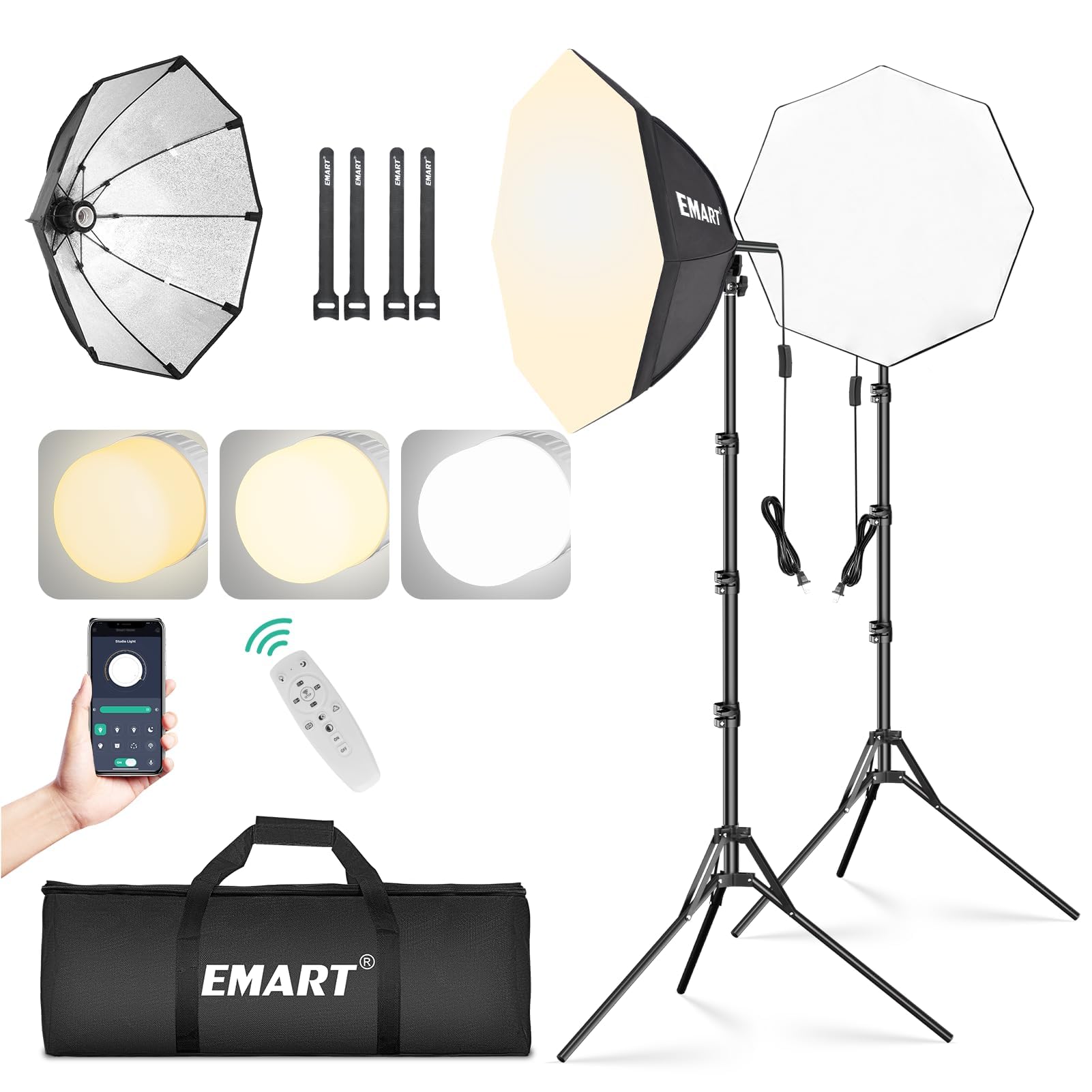
5. EMART Softbox Lighting Kit 85W 16″x16″ 2-Pack
Reverse-folding stands that collapse to 18 inches, sized for a spare bedroom.
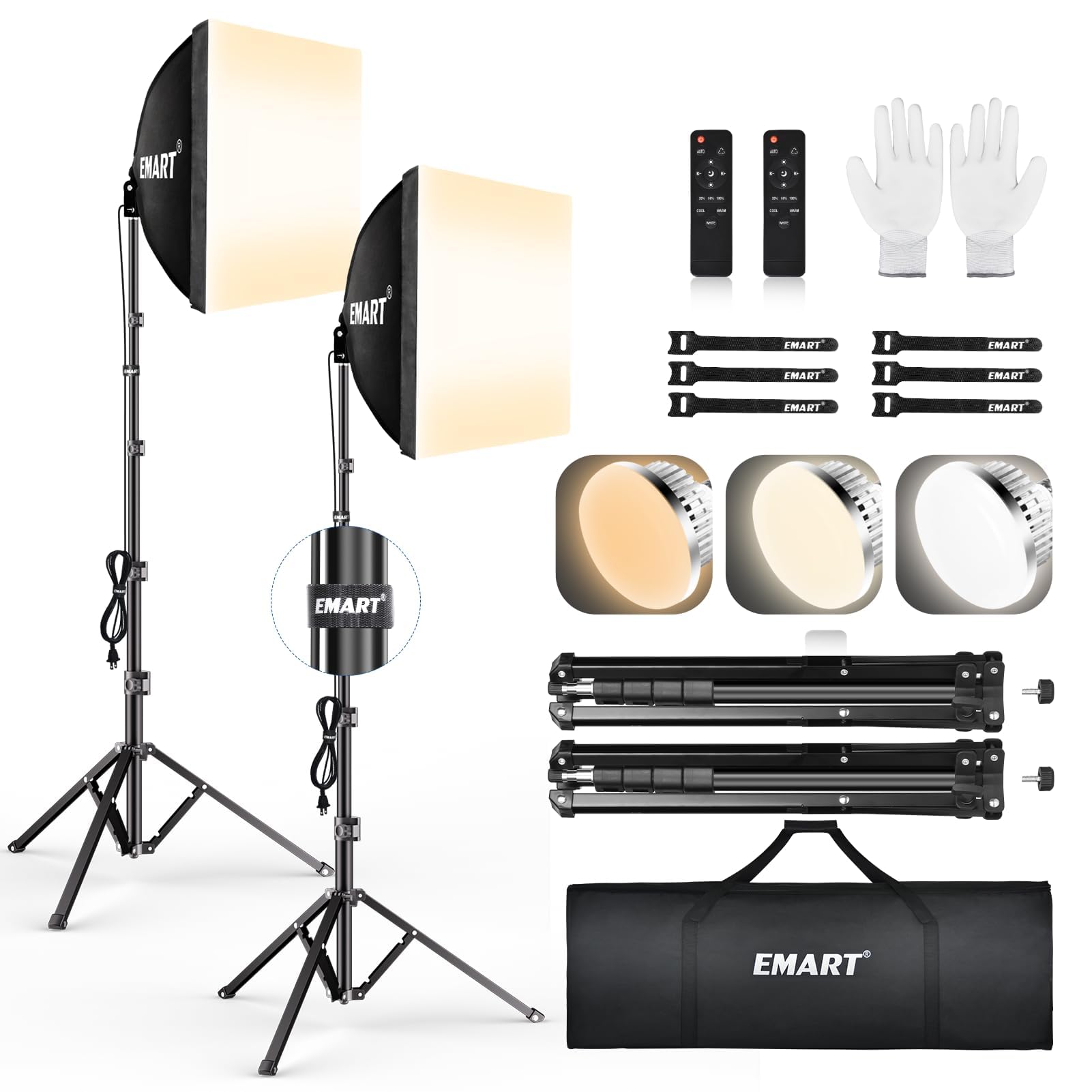
The stands here use a reverse-folding design — the legs and column collapse inward rather than splaying out, which is the layout that keeps a lighting kit from eating a room. Height adjusts from 18 inches to 65 inches with a plate-buckle node, and rubber sleeves on the feet keep them planted on smooth floors. The 85W bulbs run 3000K to 6000K, and the remote reaches around 7M (23 ft) so you can adjust without stepping into frame.
The 16″ x 16″ softboxes pair a silver reflective lining with a removable front diffusion panel that spreads the bulb into an even wash. The kit ships with a 3-meter power cord on each softbox, which is what lets you slide the light further from the stand without dragging an extension lead. Gloves, six Velcro cable ties and a carry bag are included — small extras that make a difference on a first session.
Owners consistently find the kit outperforms what they expected for the tier, and the brightness and adjustable settings draw steady approval. The one recurring snag is guidance: the instructions are thin enough that some people find setup vague, while others click straight through it. Worth knowing before you order a kit you plan to assemble alone at night.
Space-saving verdict: the reverse-folding stands and 65-inch reach make this the tidiest kit for a home corner, and the 23 ft remote range means no dash back to the light.
Read before buying: assembly instructions are thin, and the stand tops out at 65 inches.
Go with this for: apartment setups and home studios short on floor space, with cabling you can organise.
Step up instead if: you need overhead height above 65 inches.
6. HPUSN Softbox Photography Lighting Kit 2pcs with 5400K
30″ x 30″ softboxes — the largest panels here — on stands that reach 75.2 inches.
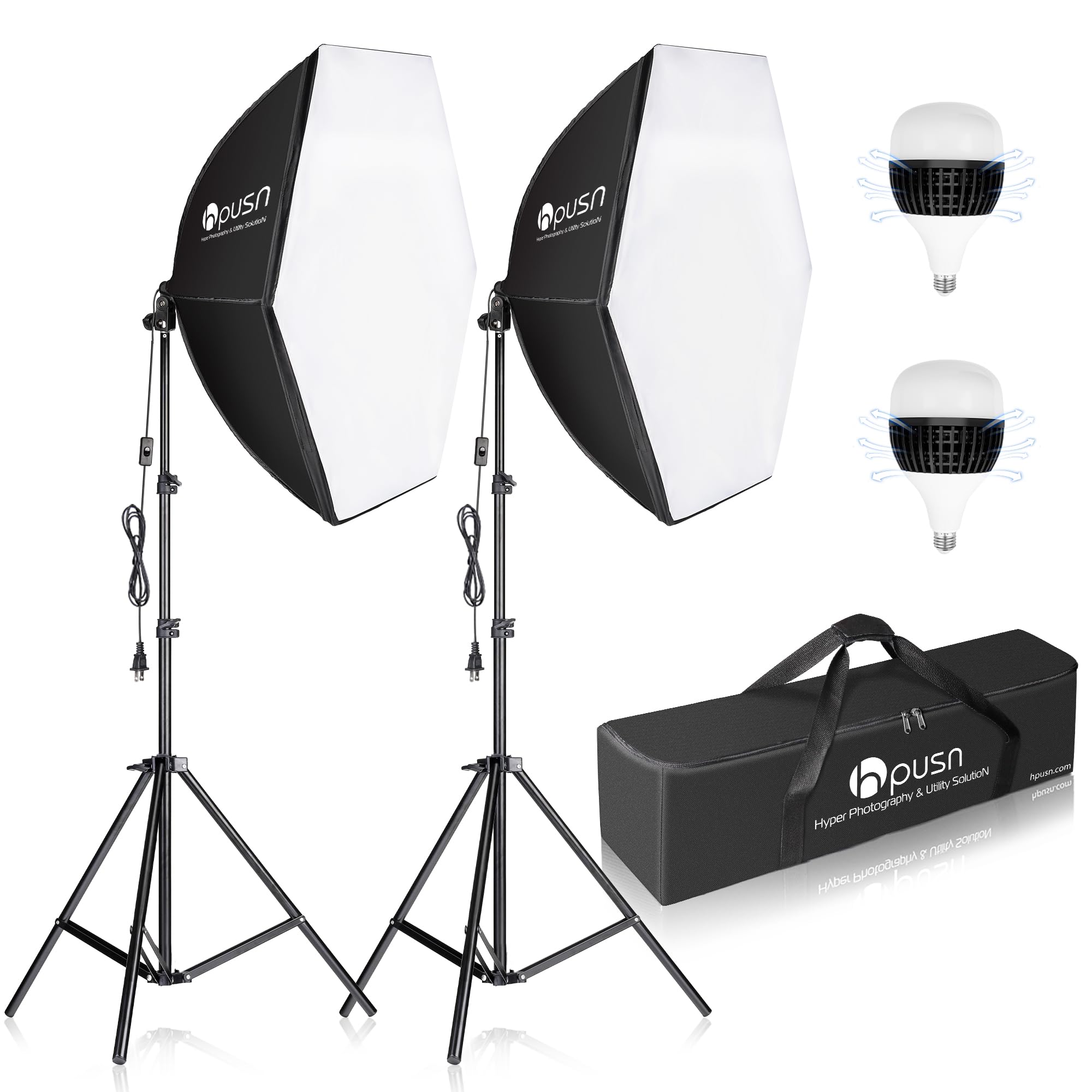
Panel size is the reason to look here: each softbox is 30″ x 30″ — bigger than the 16″ and 20″ boxes taking up most of this list. A bigger panel wraps light further around a face, which is exactly what flatters mid-shot portraits and two-person shots. The stand reaches from 32.3 inches up to 75.2 inches, so you have proper overhead positioning without buying extra hardware.
The bulbs are E27 60W units running at 5400K, a neutral daylight-neutral temperature that sits comfortably between warm and cool. The kit also ships with a 1/4″ screw adapter for cameras and accessories, a 210° rotating head, an extended power cord, and a carrying case. Aluminum tripods with independent locking knobs hold the panels steady.
Where owners are happiest is functionality — the kit simply does its job for regular portrait and video work, and versatility gets mention. Sturdiness and durability are the honest friction points: the stands are described as less solid than the panels, and the softbox fabric draws some complaints about cracking over time. Store the boxes folded and away from sharp edges, and plan the stand placement rather than tossing it around.
Where the size pays off: 30″ x 30″ panels and a 75.2-inch stand give you broad, even wrap at a height most kits can’t hit.
What to watch: the stands are the softer link — treat them as semi-permanent rather than road gear.
Choose it when: panel size and reach are your priority and the kit stays put in one room.
Rather not, if: you fold the kit up and carry it to different locations weekly.
7. EMART Pull Softbox Photography Lighting Kit 20″x20″ 50W
A push-button, pull-rod softbox that opens in seconds instead of threading a rod through fabric.
The setup is the story here. Instead of threading a rod through a sleeve and fighting the fabric, you press a button and pull the rod out — and the 20″ x 20″ softbox is open. Each 50W LED light is individually controllable for brightness and color temperature, running 3000K to 6000K.
Color accuracy is unexpectedly good for this part of the list: CRI ≥93, which sits well ahead of the CRI 80 bulbed kits nearby and just shy of the 97-rated NiceVeedi. The removable front diffusion spreads the beam into an even wash, and the 3-meter cord gives the panel room to move. Two 17″ to 63″ stands, four cable ties and a carry bag round out the box.
Owners most often describe the light as nice quality that brightens up a room, and setup speed earns praise. The catch is adjustability — some find the light output stubborn to change, so if you rely on fine dimming you may find the steps coarse. A handful also find the stands less solid than the panels, which is common at this tier.
The case for it
- Push-and-pull softbox setup measured in seconds
- CRI ≥93 — strong color accuracy among LED kits
- Each light adjustable independently for brightness and temperature
Take it or leave it
- Adjustability draws mixed reports on fine dimming
- Stands are the softer link in the kit
Right for: shooters who want a quick-open box and strong color fidelity without a long assembly routine.
Another route, if: you need broad floor-to-ceiling stands — 63 inches is the ceiling here.
8. Andoer Studio Photography Lighting Kit

The full three-light setup with a boom, for anyone building a proper key-fill-rim look.
Three lights is the shape of a classic portrait setup: one key light, one fill, and one rim or background light. Andoer ships that in one box — three 85W LEDs, three 20″ x 28″ softboxes, three stands, three remotes and a boom arm. The boom is the piece most two-light kits leave out, and it is what lets you put light directly above a subject’s head without a stand in the frame.
Each LED carries 140 high-quality beads and supports 2800K to 5700K bi-color temperature with 1%-100% adjustable brightness — the full dim range is useful when a wide softbox is close to a face. The stands extend from 26 to 78 inches, and a 3-leg design with locking system holds them steady. The 20″ x 28″ panels with white diffuser cloth spread the output evenly.
Now the honest read, because this one rides on both praise and complaint. Functionality and easy setup draw the positive consensus — it works, and it goes up without fighting you — but lighting quality, brightness and value all draw split opinions. The sturdiness is the weakest point: the light stands are the ones to watch, so sandbag them and keep them out of a busy walkway.
What you gain: a full three-point rig with a boom arm and 78-inch stands — the widest spread of lighting positions in this lineup.
What it asks in return: the stands are the weaker component, and output reaches further for some buyers than others.
Best for: creators ready for key-fill-rim shaping who want the three-light geometry in one purchase.
Might not suit: anyone wanting a small, light, easily carried kit — this is a studio fixture.
9. Godox Professional Studio Flash Kit 2x180W 5600K Monolights

A real studio flash kit, with the power to freeze motion and beat daylight.
Everything above this entry is continuous light — always on, easy to see, gentler on output. Godox brings the other approach: two 180W monolights (self-contained flash heads) firing at 5600K with a guide number of 45, the rating that describes how much light a flash throws at a given distance. Flash duration runs 1/2000s to 1/800s, so motion stops dead, and the 1/200s sync speed is there for your shutter.
Output adjusts from 1/8 to full stepless, with a 75W 3200K yellow continuous lamp for modelling so you can see where the light lands before it fires. Each head includes an energy-save sensor and a cooling fan for longer sessions. The RT-16 trigger set works through the hot shoe on Canon, Nikon, Fujifilm, Olympus and Pentax bodies, with wireless range up to 30 meters. Two 20″ x 28″ softboxes and two stands complete the kit.
The quality consensus is decent build and good value for a flash kit at this tier, and the setup is described as workable though thin on instructions. Reliability is the one to plan around: the trigger and receiver are the parts that most often get reported as failing, so test the channel pairing before a paid shoot and keep the spare receiver in the bag. Bulbs also take a beating in some reports — treat the heads gently on transport.
The case for strobe: 180W heads, GN 45 and a 1/2000s-to-1/800s flash duration outgun any continuous kit here for freezing motion and overpowering room light.
The case against: a trigger system and bulb reports to plan around, and a steeper learning curve than continuous light.
The right call for: paid or semi-pro portrait work where flash power and motion-freezing matter.
Learn continuous light first if: you are still finding out how shadows shape a face.
Know the Specs
CRI: the skin-tone score
CRI stands for color rendering index, a 0-to-100 measure of how faithfully a bulb shows color compared with true daylight. For portraits it is the number that decides whether skin looks natural or slightly off — greenish, greyish, or flat. A higher CRI is usually the better bet when faces fill your frame, and the gap shows up first in lips and cheeks. Bulbs land anywhere from the low 80s to 97 in the kits here, so it is worth checking before you buy.
Color temperature in Kelvin
Kelvin describes the warm-to-cool color of light: a lower figure tends toward a golden, lamp-like glow, and a higher figure toward cool daylight. A wide adjustable span lets you match a portrait mood to the shot — warm for cozy indoor work, cool for crisp commercial looks. If you mix a kit with window light or a phone screen, matching the Kelvin setting stops the mix looking muddy. Look for a range that reaches both ends you will actually shoot in.
Softbox size and softness
The white panel is what turns a hard bulb into soft light, and its size sets how broad that light spreads. A larger panel wraps around the face and softens shadow edges, which is why a 20″ x 28″ or 30″ x 30″ box flatters a mid-shot better than a compact 16″ square. Bigger panels also let you work further back at the same softness, which gives you room to angle the light for shaping. Smaller panels are easier to store and better in tight rooms.
Continuous vs strobe flash
Continuous LED kits stay on the whole time, so what you see on your subject is what the camera captures — great for video, streaming, and learning how light shapes a face. A strobe kit fires brief, powerful bursts that freeze motion and beat bright rooms, which studios rely on. Continuous is easier to learn and kinder to video; strobe is stronger per shot. Many shooters keep both — continuous for video, flash for stills.
Common Questions
What size softbox do I need for portraits?
Is CRI 97 worth it over CRI 80?
Do these kits work for video as well as photos?
What is the difference between CFL bulbs and LED bulbs in these kits?
Can I use these lights with my phone?
How much room does a portrait lighting kit need?
Will a portrait lighting kit replace natural window light?
What does 5600K mean and why does it matter?
How heavy are these kits to move around?
Do I need sandbags for a softbox stand?
The Bottom Line
The kit that gives you the most accurate skin tone and the flexibility to shoot portraits, video and product shots is the NiceVeedi 85W 2-Pack — the CRI 97+ bulbs, 3000K–6000K range and remote control earn its spot at the top. If a first full studio with wide panels is the goal, the MOUNTDOG kit offers the largest spread of softbox area and stands up to 78 inches. For paid portrait work where you need to freeze motion and overpower daylight, the Godox flash kit is the one to reach for.
If you want the biggest panel and a stand that clears 75 inches, the HPUSN earns its place on this list. And if setup speed is the thing that slows down every shoot you do, the push-and-pull EMART 20″ x 20″ kit opens in seconds. Buy the one whose spec sheet matches the shot you plan to take most often — that is the honest way to pick a portrait lighting kit.
How we choose
We do not accept paid placement. Every pick is matched to a real buyer and a real use-case; we do not hands-on test units.
Sources
Specifications: manufacturer listings and product documentation. Review insights: verified customer reviews, as of November 2026. Pricing: not shown on this page (it changes often); check the current price via the retailer link.
As an Amazon Associate, Tactical Gear Guy earns from qualifying purchases. This does not affect which products we feature.