Specs are compiled from manufacturer listings and verified buyer reviews and can change over time — please confirm the key details on the product page before buying.
You know the feeling: your rig is loaded, the road is open, and your phone drops to one bar right when the GPS needs to reroute. A truck signal booster fixes that by grabbing the weak outside signal and pumping it back inside the cab, so calls stop dropping and maps keep loading. The picks below are all powered amplifiers built for vehicle use, and the top slot goes to the one that balances gain, band coverage, and price best for most truckers. One note up front: these boosters need at least a faint signal outside to work with, so they improve a weak connection rather than creating one in a total dead zone.
This guide is built by comparing the manufacturers’ published specifications and the patterns across verified customer reviews, so you get each pick’s real strengths and trade-offs instead of marketing spin.
Some kits want a permanent antenna mount, others stick to glass with a suction cup, and that one decision shapes how much work install day becomes. Below you’ll find the differences laid out in plain terms, plus what each booster actually does for your cab. Read on for the phone booster for truck picks that keep your bars steady mile after mile.
Top Picks
How To Choose The Best Phone Booster for Truck
The first thing to understand is that your booster does not create a signal. It takes whatever cellular signal reaches your truck’s outside antenna and amplifies it inside the cab, so a spot with one bar can climb to several, while a spot with zero bars stays dead. Every kit here tells you the same thing in its own words, and it is the single fact that decides whether a purchase helps you at all.
Match the bands to your carrier
Carriers broadcast on numbered frequency bands — think of them as separate radio lanes, each one a different slice of the spectrum. Verizon leans on Band 13, AT&T and T-Mobile use Band 12/17 and Band 2/4 heavily, and Band 5 and Band 25/66 fill in elsewhere. A kit that lists all of those lanes covers every major U.S. carrier, while a narrower kit can leave you stranded on one network.
Decide how the outside antenna mounts
A suction-cup or magnetic antenna sets up in minutes and lifts off when you change vehicles. A fold-down or permanently mounted antenna survives brush, low garage doors, and rough washboard roads far better. If you drive the same rig every day and want to set it once, the permanent mount pays you back in durability. If you swap between a personal truck and a work van, portability wins.
Plan for more than one phone
A cab full of people means a cab full of devices competing for the boost. Multi-user kits broadcast to several phones and tablets at once, which matters for team drivers, families, and anyone running a hotspot for work. A single-device booster forces everyone to take turns near the inside antenna.
Side-by-Side Comparison
| Model | Best For | Bands | Stated Range | Warranty | Amazon |
|---|---|---|---|---|---|
| RV Cell Phone Signal Booster (FREEQUEEN)★ Best Overall | Most truckers overall | 2/4/5/12/13/17/25/66 | 5–8 miles | 2 Years | Amazon |
| JACOOL Vehicle BoosterLongest Coverage | Longest warranty coverage | 2/4/5/12/13/17/25/66 | 4000 sq ft | 3 year manufacturer | Amazon |
| GAGBK Upgarde Cell BoosterMost Field-Tested | Buyer volume and support | 2/4/5/12/13/17/25/66 | 5–8 miles | 2 Year Manufacturer | Amazon |
| subroad Truck Booster | Fast DIY install | Quad-Band | — | 2 years | Amazon |
| weBoost Dash | Built-in wireless charging | 12/17, 13, 5, 4, 25/2 | Inside vehicle | — | Amazon |
| Metarepeater LCD Booster | Seeing the boost on screen | 4/12/13/17/5/2/25 | 5–8 miles | 3 year | Amazon |
| HiBoost Overland Booster | Overland and low-clearance rigs | 12/17, 13, 5, 4, 25/2 | — | 3 Years | Amazon |
| weBoost Drive X OTR | Full-time long-haul drivers | 12/17, 13, 5, 4, 25/2 | — | — | Amazon |
| SureCall Fusion2Go OTR | Fleet and heavy-duty work vans | 600/700/850/1700/2100/1900 MHz | 10 feet | 3-year warranty | Amazon |
Detailed Reviews
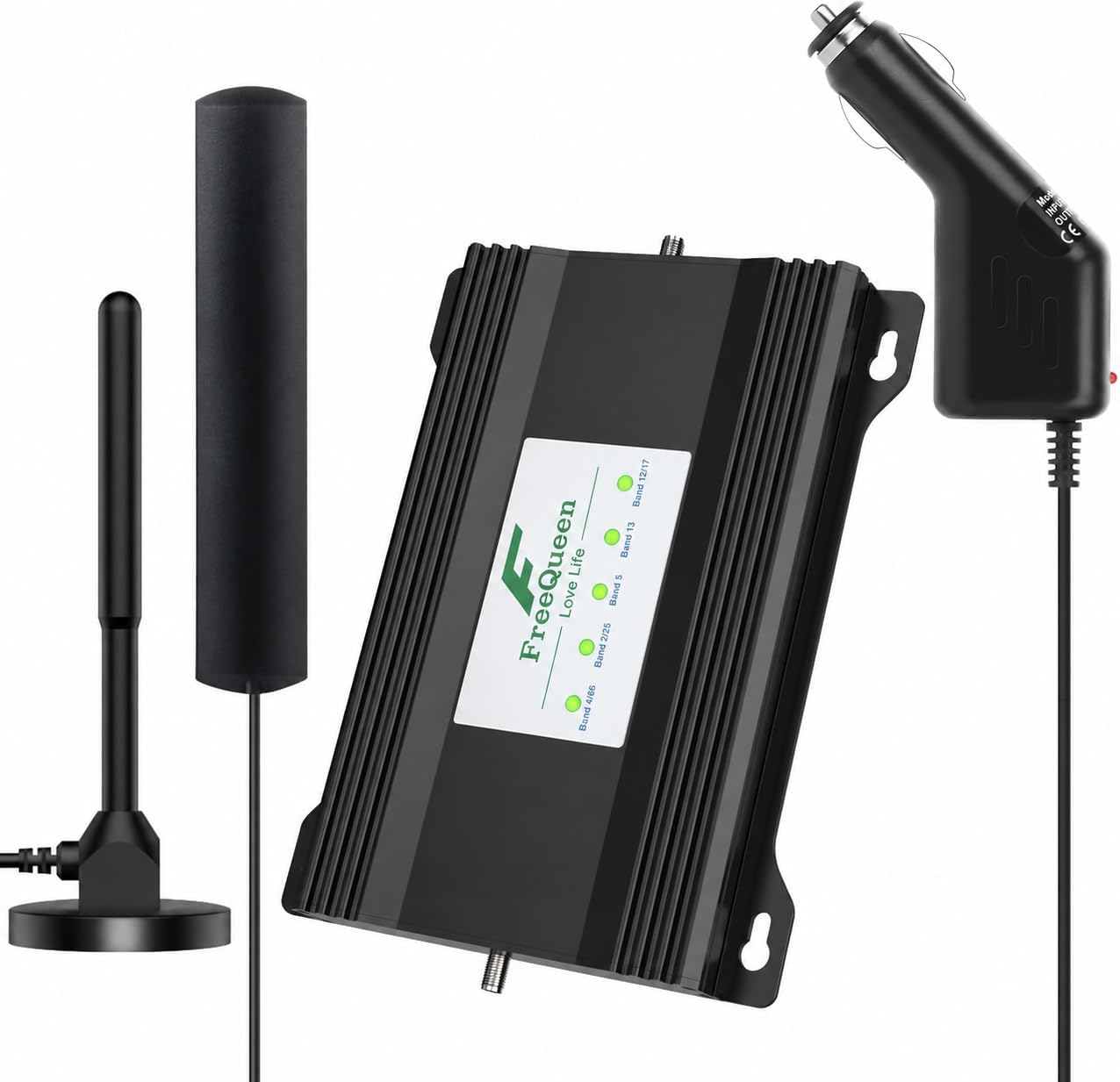
1. RV Cell Phone Signal Booster Car Truck RV (FREEQUEEN HF50)
Our pick — 4.5+★ from 750+ verified ratings; the strongest balance of quality and price.
Eight bands, a 65dB gain rating, and a plug-and-play install that suits nearly any rig.
If you drive a truck and want the widest safety net for the money, start here. This kit covers Band 2, 4, 5, 12, 13, 17, 25, and 66 — the full spread of lanes Verizon, AT&T, T-Mobile, Straight Talk, Cricket, and U.S. Cellular use — so you are not gambling that your carrier happens to sit on a band the box skipped. That 65dB gain rating is what turns a faint outside reading into a usable signal on your dash.
Setup is genuinely simple: the box ships with a 12V 3A power adapter, an outdoor magnet antenna on a 16ft RG174 cable, and an indoor patch antenna on a 10ft cable. Drop the magnet on the roof, run the cable in through a door gap, and plug in. From there the automatic gain control tunes itself as conditions shift, and the oscillation elimination feature guards against feedback when the two antennas sit too close together. The stated 5–8 mile range describes how far the outside antenna is built to reach for a tower.
The honest catch is that all this reach still depends on a real signal existing outside your truck — the booster lifts a weak connection but cannot conjure one in a true zero-bar hole. It also runs on the included 12V adapter rather than hardwiring, so plan your cigarette-lighter socket accordingly. For a trucker who wants broad carrier coverage without a permanent install, this is the most balanced kit here.
What earns it the top spot
- All eight major bands including 25 and 66, so it fits every big U.S. carrier
- 65dB gain with automatic gain control that self-tunes as you drive
- Magnet antenna and 16ft cable make roof mounting a ten-minute job
- Boosts multiple phones and tablets at once for a full cab
Where it asks something of you
- Needs an existing outside signal to amplify — not for true dead zones
- Runs off the 12V adapter, so one socket stays busy
- Magnet mount is less armored than a fold-down or permanent antenna
Best fit for: owner-operators and RV haulers who want one kit that covers every carrier without drilling holes.
Think twice if: you regularly drive through total no-signal wilderness — nothing on this list can fix zero bars.
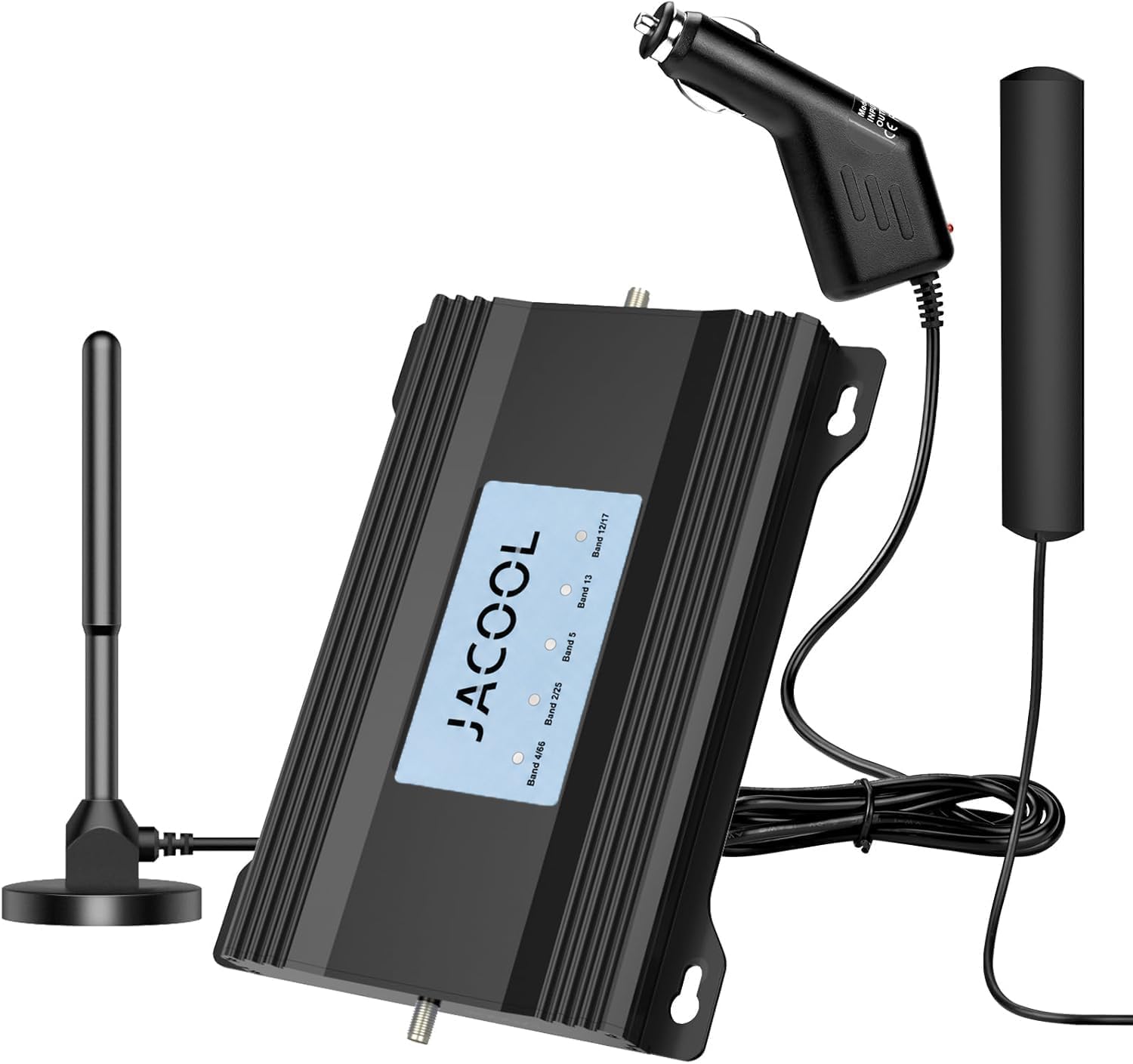
2. Vehicle Cell Phone Booster for Car Truck RV (JACOOL)
The kit that backs its electronics with a full three-year manufacturer warranty.
This JACOOL kit carries a 3 year manufacturer warranty, while the GAGBK kit below ships with a 2 Year Manufacturer term — a year more of coverage on the same class of hardware. That extra year matters when a component fails mid-season and your income depends on staying reachable.
On the radio side, it supports Bands 2, 4, 5, 12, 13, 17, 25, and 66, so the full carrier spread is intact. The outside antenna is omnidirectional, meaning it listens in every direction at once and needs no aiming at a tower — you set it down and drive. Its suction-cup mount holds it securely to your rig, though the maker is explicit that you should keep the inside patch antenna off any metal surface in the cab or you will cut its performance.
The stated 4000 square feet of coverage describes the interior space the boost is meant to serve — enough for a sleeper cab or a crew van. Automatic gain control keeps the amplifier in check, and the whole thing is FCC certified. The trade-off worth knowing: it still needs at least 1–2 bars of outside signal to amplify, and it boosts cellular bands only — not Wi-Fi. For a driver who wants the longest backing in this price range, it is a smart anchor.
Why the warranty matters: three years of manufacturer coverage on a device that lives through vibration, heat, and dust gives you confidence most kits in this tier do not offer.
Pick this when: you want the strongest after-sale backing from a mid-range kit and mostly drive the same truck.
Look elsewhere if: your cab has lots of exposed metal near the dash — the patch antenna placement rule is strict here.
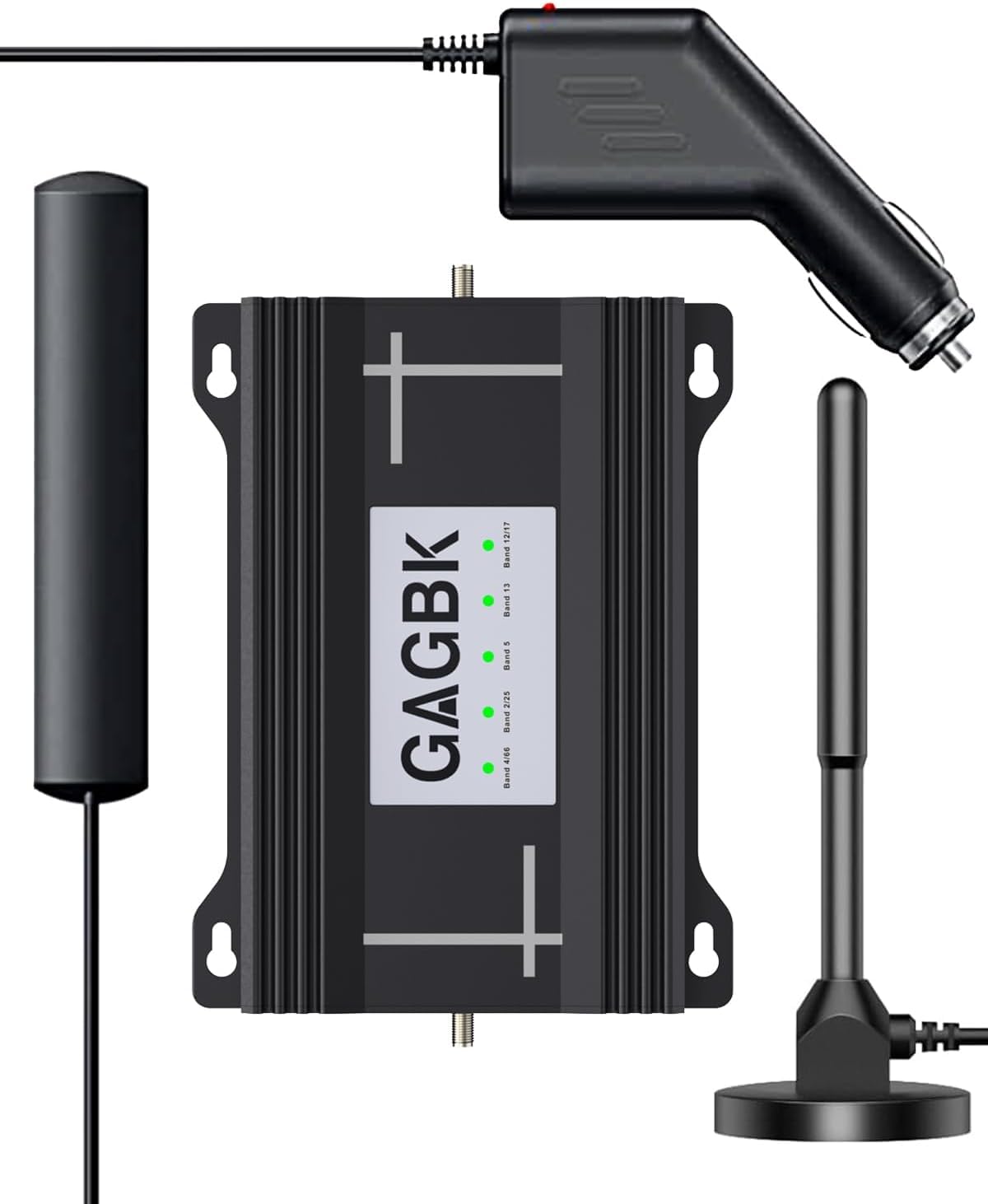
3. Upgarde Cell Booster for Car, Truck (GAGBK)
The booster with the biggest crowd behind it — proven by volume, built on the same eight-band frame.
This is the most-reviewed full-size truck kit here, and that many buyers means the basic job is being done on real highways. Its 65dB amplifier is rated to boost 2G, 3G, 4G LTE, and 5G signals. It reaches across Band 2, 4, 5, 12, 13, 17, 25, and 66 (the radio frequencies carriers use), so Verizon, AT&T, T-Mobile, Straight Talk, Cricket, and U.S. Cellular all get service.
The hardware matches the FREEQUEEN top pick closely — a 12V 3A power adapter, a 16ft outdoor magnet antenna, a 10ft indoor patch, automatic gain control, inactivity mode, and oscillation elimination. Where it differs is the backing: a 30-day money-back window, a 90-day replacement policy, and a 3-year manufacturer guarantee, all with a technical support line attached. That support structure is exactly what first-time booster buyers need when initial antenna placement needs a second try.
The catch is in the setup, not the hardware. It is a plug-and-play unit, but the outdoor magnet must be mounted where it can actually hear a tower, and the indoor patch must stay clear. Rush either step and you will wonder why the bars did not move. Set it up with care and the metal-sided cab — a notorious signal trap — gets real help.
The buyer-volume read: this many owners settling on one box is the clearest real-world signal that the eight-band formula handles everyday trucking miles.
Choose this for: drivers who value a wide support net and a same-as-premium band spread at a mid-range position.
Not the one for: anyone expecting a plug in and walk away — antenna placement on metal cabs is where this kit lives or dies.
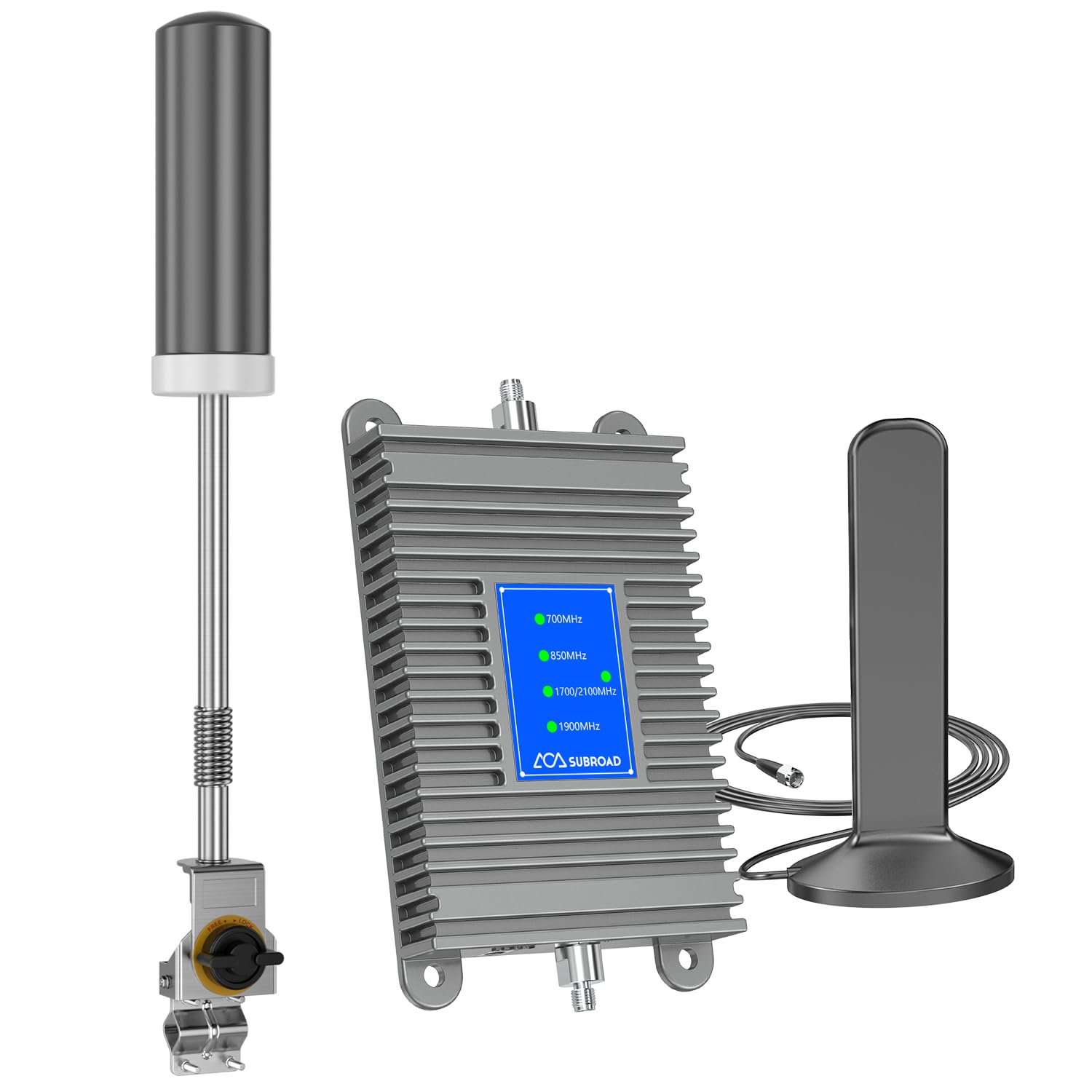
4. subroad Cell Phone Signal Booster for Truck
Rated for a twenty-minute DIY install — the weekend project that keeps your workday connected.
Some boosters make you read a manual twice before you trust the antenna placement. This one is pitched at do-it-yourselfers: follow the included instructions and the maker claims you finish the install in 20 minutes. The outdoor antenna is high gain and omnidirectional, so it pulls from every direction at once and can chase the farthest towers it can hear.
It also covers a wide vehicle set — RVs, campers, trucks, vans, SUVs, semi-trailers, off-road rigs, and boats — and it works across the major U.S. carriers including Verizon, AT&T, and T-Mobile. A quad-band frequency class keeps it in the mainstream carrier lane, and it’s built to keep data and voice flowing for multiple devices. The FCC certification and 3-year manufacturer’s warranty round it out.
That suits a buyer who wants to assemble their own kit and finish the install in an afternoon rather than a weekend of trailer wiring. Consider this your starter rig if you are new to boosters and want the shortest path to a working install.
The install pitch: a 20-minute DIY timeline makes this the least intimidating first booster for a driver who has never run antenna cable before.
Go for it if: you want a straightforward install and broad vehicle compatibility with a real warranty behind it.
Keep looking if: you want the reassurance of thousands of long-term owners — this one is newer to the field.
5. weBoost Dash Cell Phone Signal Booster with Wireless Charger
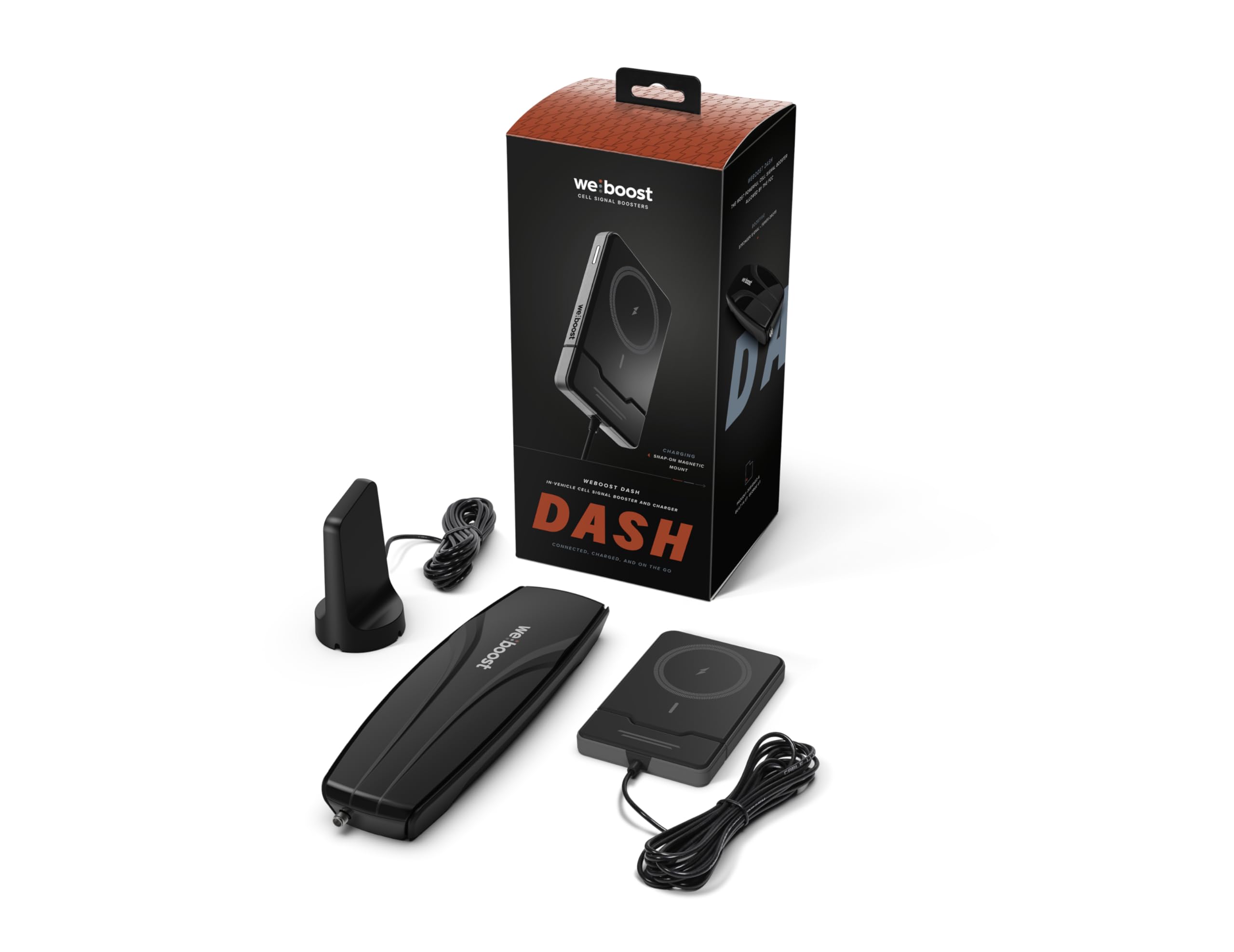
Two jobs, one low-profile puck: signal boost and a Qi2 wireless charge pad in the same unit.
No other pick here combines a booster and a charger. The weBoost Dash pairs a cellular booster with a Qi2-compatible wireless charger (Qi2 is a wireless charging standard), so your phone sits on the dash pulling stronger signal while it tops up — a useful combo for a delivery driver who lives on the phone. At just 5.92 ounces, it stays out of the way and lifts off for use in a second vehicle.
Band support covers Band 12/17, 13, 5, 4, and 25/2, and it plays across Verizon, AT&T, and T-Mobile. A magnetic mount keeps setup quick and secure, and the whole thing is FCC approved. For cars, trucks, SUVs, and vans, it is about as portable as a booster gets.
Here is where the Dash asks you to read carefully: its range is limited to inside the vehicle, with the charger magnetized near the inside antenna, and the smaller form factor reflects that tighter focus. Think of it as a single-coverage-focus booster that also charges rather than a full cab reach machine. If a quick portable boost plus a charge pad sounds like exactly what your dash is missing, it is the only pick built to do both.
The two-in-one angle: combining the boost and the charge pad cuts one cable clutter point out of your console and keeps the phone in one spot all day.
Built for: commuters and delivery drivers wanting a portable, dual-purpose dash unit rather than a permanent truck install.
Skip if: you need full-cab multi-device reach — this one concentrates the boost near the inside antenna.
6. Metarepeater Cell Phone Booster

An on-dash screen that tells you, band by band, exactly how much boost you are getting.
Most boosters leave you guessing whether the signal actually improved. This Metarepeater rig puts a large color LCD display right on the unit, showing working status in real time and the gain across its five frequency bands at once. For a driver who wants proof rather than a green light, that readout alone justifies the upgrade — you can see the boost rise as you pull out of a canyon.
Under the screen, it boosts Band 4, 12, 13, 17, 5, 2, and 25 for 4G LTE and 5G, so a full cab of phones, tablets, and data modems stays connected together. The included omnidirectional antenna grabs signal from all directions, and its spring-mounted base flexes over rough roads. That base is also described as weatherproof, built to resist dust, oil, and water for off-road and long-haul use — a real consideration for a truck that lives outside.
One line in its own listing is the smartest advice of any kit here: test your phone’s frequency band before you buy, to be sure the one it uses is covered. It carries a 3-year warranty and FCC certification, and its stated loop of 5–8 miles of range and 100x signal enhancement describes how far it reaches. If you want feedback on your dash, this is the pick built around that.
The dashboard readout: real-time gain across five bands turns a shot-in-the-dark install into something you can actually verify and adjust.
The one check first: confirm your phone’s band is on the list before ordering — the listing tells you to, and it’s the fastest way to avoid disappointment.
The right buy for: drivers who want to see the boost working and need a weatherproof antenna for rough roads.
Reconsider if: you’d rather not think about matching bands — the display is a gem, but the band check is on you.
7. HiBoost Cell Phone Signal Booster
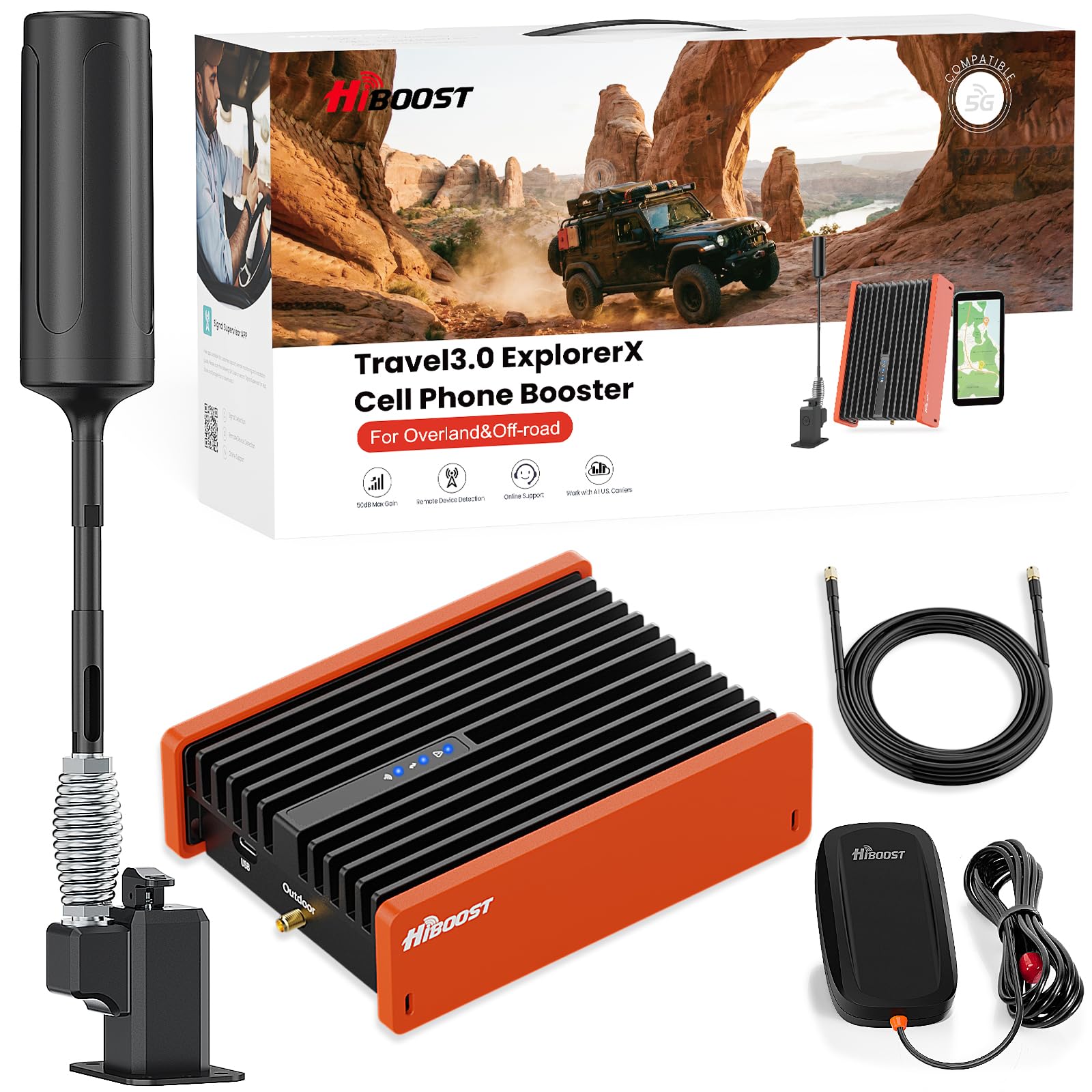
The fold-down antenna you can drop for low tunnels and store flat between runs.
Overland and over-height drivers, this one is aimed at you. The HiBoost’s fold-down outdoor antenna lets you collapse it for low-clearance entrances and stash it compactly when the truck is parked, and it accommodates T-track, pole, and fixed mounting setups. That flexibility matters if you pass under garage doors or tree limbs that a rigid mast would catch.
Owners clearly rate its core job highly — functionality and build quality both draw steady praise, and the sense across buyers is that the booster does exactly what was promised on remote roads and overland trips. The Signal Supervisor app shows gain, output power, and device status across supported bands, which turns troubleshooting into a two-minute check. Band coverage runs Band 12/17, 13, 5, 4, and 25/2 for Verizon, AT&T, T-Mobile, and U.S. Cellular, with 4G LTE and supported 5G DSS on your existing plan.
Setup needs a real outside signal to work with, and the 12 V DC vehicle adapter is the power source, so plan your socket. A 3-year warranty and U.S.-based tech support back it up. If your driving takes you where the pavement ends, the fold-down design earns its place.
Why overlanders gravitate to it
- Fold-down antenna clears low roofs and stores out of the way
- Signal Supervisor app reports gain and status on each band
- Three mounting styles fit a wide range of truck beds and racks
- U.S.-based technical support from install through daily use
What to sort out before you commit
- Still needs a detectable outside signal — a canyon dead zone stays dead
- Runs on the 12 V DC adapter rather than a hardwire
- Pricier than the magnet-mount kits without the extra bands
Made for: overland drivers and lifted-truck owners who need an antenna that folds out of harm’s way.
Pass if: you only ever drive highway and a simple magnet mount would do the job.
8. weBoost Drive X OTR Cell Phone Signal Booster for Trucks
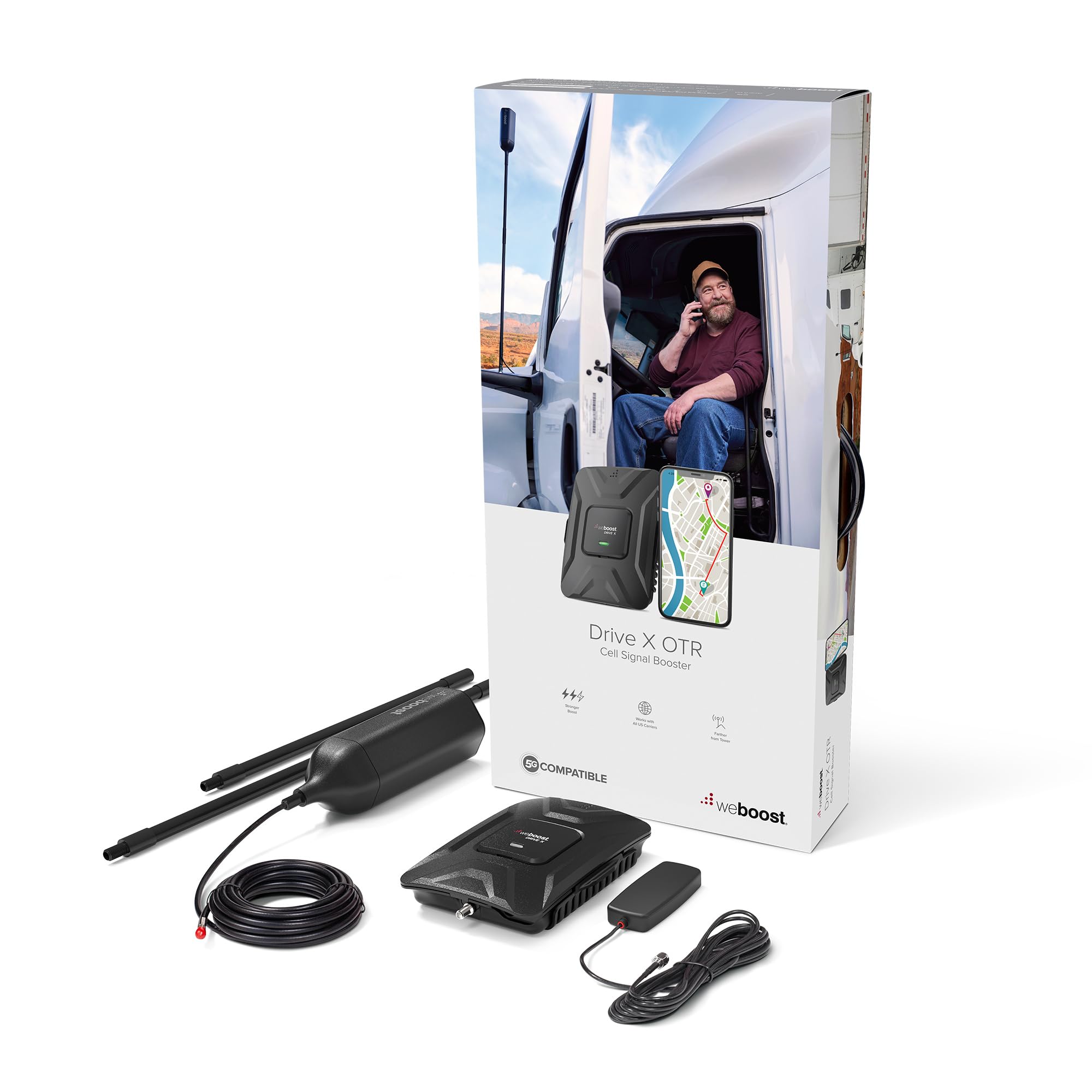
A weather-resistant 17-inch trucker antenna and up to 50 dB of gain aimed at full-time drivers.
This booster is built for people who spend their lives behind the wheel. The kit pairs an omnidirectional, weather-resistant 17” antenna (it picks up signal from all directions) with a 3-way CB antenna mount, a mast extension, and a side exit adapter — the parts you need to mount on a real truck cab rather than stick on a windshield. It’s rated up to 50 dB gain (decibels of boost), and it boosts 5G and 4G LTE across Verizon, AT&T, T-Mobile, Sprint, and U.S. Cellular, with multi-user support so every passenger stays connected.
Owners consistently come back to build quality and service when they talk about this rig, and the general pattern is that it pulls its weight on remote stretches and in weak spots. The included hardware runs off a 12V CLA power supply, and the kit claims up to 2 hours of extra talk time from more efficient signal handling.
Be realistic about what you’re getting: this is a well-known long-hauler’s booster, and buyer reports split — plenty of drivers say it works well in remote areas, while others do not see the jump they hoped for. That is typical of any booster that has to work with whatever signal is physically present. Mount the antenna high and clear, and you tilt the odds in your favor.
The trucker detail: the 17-inch antenna and 3-way CB mount are chosen to survive a working cab, not a weekend car.
The realistic expectation: results follow the signal you give it — high, clear antenna placement is what separates a great install from a frustrating one.
Suits you if: you drive a dedicated truck and want a proven, heavy-duty antenna setup built for the long haul.
Look elsewhere if: you want a quick portable unit you can move between vehicles.
9. SureCall Fusion2Go OTR 5G/4G Cell Signal Booster

Built for work fleets — an antenna that mounts permanently and shrugs off water and dust.
If you run a work van or a fleet, durability is the whole game. The Fusion2Go OTR is built to take a beating: a weather-tested exterior antenna that permanently mounts to a large vehicle, with a built-in ground plane so it works on metal, fiberglass, wood, or plastic. Components are protected from water, dust, and the worst road conditions.
Its patented 2XP technology doubles uplink power — the push from your phone up to the tower — which is what matters when uploading job-site photos or running a video call. You get antenna height options of 16″ and 32″ with an optional mast extension, a 10ft integrated cable plus a 5ft extension, and a two-clamp mount with thread-lock glue to fight vibration.
Coverage spans all North American carriers across 600, 700, 850, 1700/2100, and 1900 MHz, and the company designs and assembles in the U.S. with a 3-year warranty and lifetime U.S. support. The honest reality: it’s the most specialized kit here, and some drivers report the boost falls short of what they hoped in tough spots, so set realistic expectations. For fleets that prize a permanent, rugged install over quick setup, it fits the bill.
The fleet argument: a permanent, weather-proofed antenna with a ground plane that mounts to any surface is built to outlast a truck’s service life, not a road trip.
Best for: fleet operators and work-van drivers who want one rugged, permanent install they can trust through hard use.
Not ideal if: you need portability or are chasing the largest possible boost in marginal signal — results vary with conditions here.
Know the Specs
Gain (in dB)
Gain measures how much the amplifier multiplies the signal, in decibels (dB — a logarithmic unit bigger numbers mean more amplification). The kits here range from 50 dB up to 65 dB, and more gain helps you pull a usable signal out of a faint reading. But gain only works on a signal that exists, so placement of the outside antenna still does most of the heavy lifting.
Frequency Bands
Bands are the numbered radio lanes each carrier broadcasts on — Verizon leans on Band 13, AT&T and T-Mobile rely on Band 12/17 and 2/4, and Band 5, 25, and 66 fill in elsewhere. A booster that lists all eight covers every major U.S. carrier. Check your phone’s band before buying so the kit you pick actually speaks your carrier’s language.
Common Questions
Do I need an existing signal for a truck booster to work?
Will a truck booster work with Verizon, AT&T, and T-Mobile at the same time?
Can I install a truck booster myself without a technician?
What is the difference between a magnet mount and a fold-down antenna?
Will a booster speed up my data or just fix dropped calls?
How far can a truck signal booster reach for a tower?
Do these boosters support 5G networks?
Is it legal to run a cell phone booster in my truck?
Can more than one phone use the booster at once?
How long should a truck booster last and what warranty should I expect?
The Bottom Line
For most truckers, the phone booster for truck that earns the top spot is the FREEQUEEN RV Cell Phone Booster because its 65dB gain, eight-band coverage, and simple magnet install cover every major carrier without a permanent mount. If you want a full extra year of manufacturery backing, the JACOOL kit gives you that 3-year term. And for overland driving where you need to fold the antenna down for low clearance, the HiBoost Overland booster is the one to reach for. One last nudge: the FREEQUEEN is the most-balanced kit here, and its wide band list is what keeps it ahead for the widest range of drivers.
How we choose
We do not accept paid placement. Every pick is matched to a real buyer and a real use-case; we do not hands-on test units.
Sources
Specifications: manufacturer listings and product documentation. Review insights: verified customer reviews, as of November 2026. Pricing: not shown on this page (it changes often); check the current price via the retailer link.
As an Amazon Associate, Tactical Gear Guy earns from qualifying purchases. This does not affect which products we feature.