Specs are compiled from manufacturer listings and verified buyer reviews and can change over time — please confirm the key details on the product page before buying.
Water showing up where it should not is only half the problem. The other half is finding out before it has soaked a basement, a camper floor, or the ground around a sump pit. An outdoor leak detector does that one job: it sits on the ground, senses water, and makes noise or sends an alert. The picks below cover both styles, from an app-connected sensor that pings your phone to a loud standalone siren that needs no hub and no Wi-Fi.
This guide is built by comparing the manufacturers’ published specifications and the patterns across verified customer reviews, so you get each pick’s real strengths and trade-offs instead of marketing spin.
Two things decide whether a detector is worth owning: how it tells you, and where it is willing to sit. A sensor rated for outdoor use can handle rain and spray; an indoor-only unit will not. Before you compare models, know how each one alerts you and how far its sensor reaches. The right outdoor water leak detector is the one whose alert you will actually hear or feel.
Top Picks

How To Choose The Best Outdoor Water Leak Detector
Your buying decision depends on two jobs. First, sensing: where does the water land, and does the sensor touch it in time? Second, telling you: does it beep loud enough to hear from the driveway, or does it push a notification to your phone? Match the sensor’s IP rating and alert type to the spot you have in mind, and the shortlist narrows fast.
The weather rating decides where it can live
An IP rating (Ingress Protection — a two-digit code for how well a case keeps out dust and water) is your first filter. IP65 and IP66 sensors shrug off rain and hose spray, which is what a sensor sitting in a yard, under a downspout, or beside a sump lid needs. IP67 units tolerate brief submersion, useful where a pit can flood over the top of the sensor. Skip any detector with no rating if it will sit outdoors — indoor electronics and wet weather do not get along.
How you get alerted: siren versus phone
A standalone siren needs no hub, no Wi-Fi, and no account. It beeps at the unit, so you must be within earshot. An app-based sensor reaches you anywhere, but it depends on a hub and a working network. If the wet spot is in your own basement, a 100 dB local siren you can hear through the door is simpler than any hub. If the space is a vacation cabin or a remote pump house, remote alerts matter far more than raw decibels.
Reach and placement: float switches and cords
A float switch (a hinged arm that lifts as water rises) turns a detector into a level gauge rather than a puddle-spotter. A long float lets you set the trigger height well above the normal water line, so a small ripple does not set it off. Check the power cord length too — a corded alarm needs to reach a live outlet, while a battery unit goes wherever you drop it. Measure the outlet distance and pit depth before you buy, because a 6-foot cord or a short float will not reach the water.
Side-by-Side Comparison
| Model | Best For | Waterproof Rating | Alert Type | Power / Reach | Amazon |
|---|---|---|---|---|---|
| eufy Security Water and Freeze Sensor★ Best Overall | Remote alerts and freeze warnings | IP65 | App notifications via HomeBase | Battery, 2-year life | Amazon |
| VETOUCH Water Leak Detector 5-Pack | Whole-home coverage on a budget | IP66 | 100 dB siren and LED flash | Battery, 5-year standby | Amazon |
| Sekelo Sump Pump Alarm | Sump pits and sewage tanks | IP67 | 110 dB siren and LED | 10-foot float, 6-foot cord | Amazon |
| SPI Observer 500 | Long-reach outdoor level monitoring | — | 85 dB horn and large light | 15-foot float, 6-foot cord | Amazon |
Detailed Reviews
1. eufy Security Water and Freeze Sensor with Remote Alerts
Our pick — 4.5+★ from 450+ verified ratings; the strongest balance of quality and price.
The detector that taps you on the shoulder from another state — water or freezing cold, straight to your phone.
Most leak detectors shout into an empty room. This one talks to you. It pairs with a HomeBase 2 or HomeBase 3 hub (eufy’s own base station) over Sub-1G wireless — a low-frequency link that reaches around walls better than Wi-Fi — and pushes a notification to the eufy Security app when it senses water or when the temperature dips below freezing. That freeze half is the part people forget to shop for. A pipe that splits in an unheated garage does as much damage as a burst fitting.
The weatherproofing here is rated IP65, meaning the case sheds rain and low-pressure spray without letting water into the electronics. That is enough for a covered porch, a garage floor, or under a deck — not enough to sit submerged in a flooded pit. Battery life runs up to 2 years from a single replaceable lithium-ion cell, and the app shows the charge level so you are not guessing. The trade-off is the hub: without a HomeBase, this sensor has nothing to talk to. Budget for that, or look at a standalone siren instead.
What consistently wins people over is how dependable the thing is and how little fuss it takes to place — set it down, pair it once, forget it. The recurring gripe is on the app side: a few find the interface or the setup experience clumsy compared to the hardware itself. None of that touches the sensor’s core reliability, but it is worth knowing if you expect a polished app.
Where it earns its spot: Remote notification is the whole point of a cabin or second-home detector, and this delivers water and freeze alerts to your phone from anywhere. Water and freeze alerts to your phone from anywhere are why it takes the top slot.
What it will not do: It cannot operate without a HomeBase 2 or 3, so this is a bundle purchase, not a drop-in.
Reach for this if: the leak you worry about is somewhere you are not — a vacation home, a rental, a garage across town — and you want your phone to tell you first.
Look elsewhere if: you have no eufy hub and no wish to add one; a hub-free siren below suits you better.
2. VETOUCH Water Leak Detector with Loud Alarm, 5-Pack
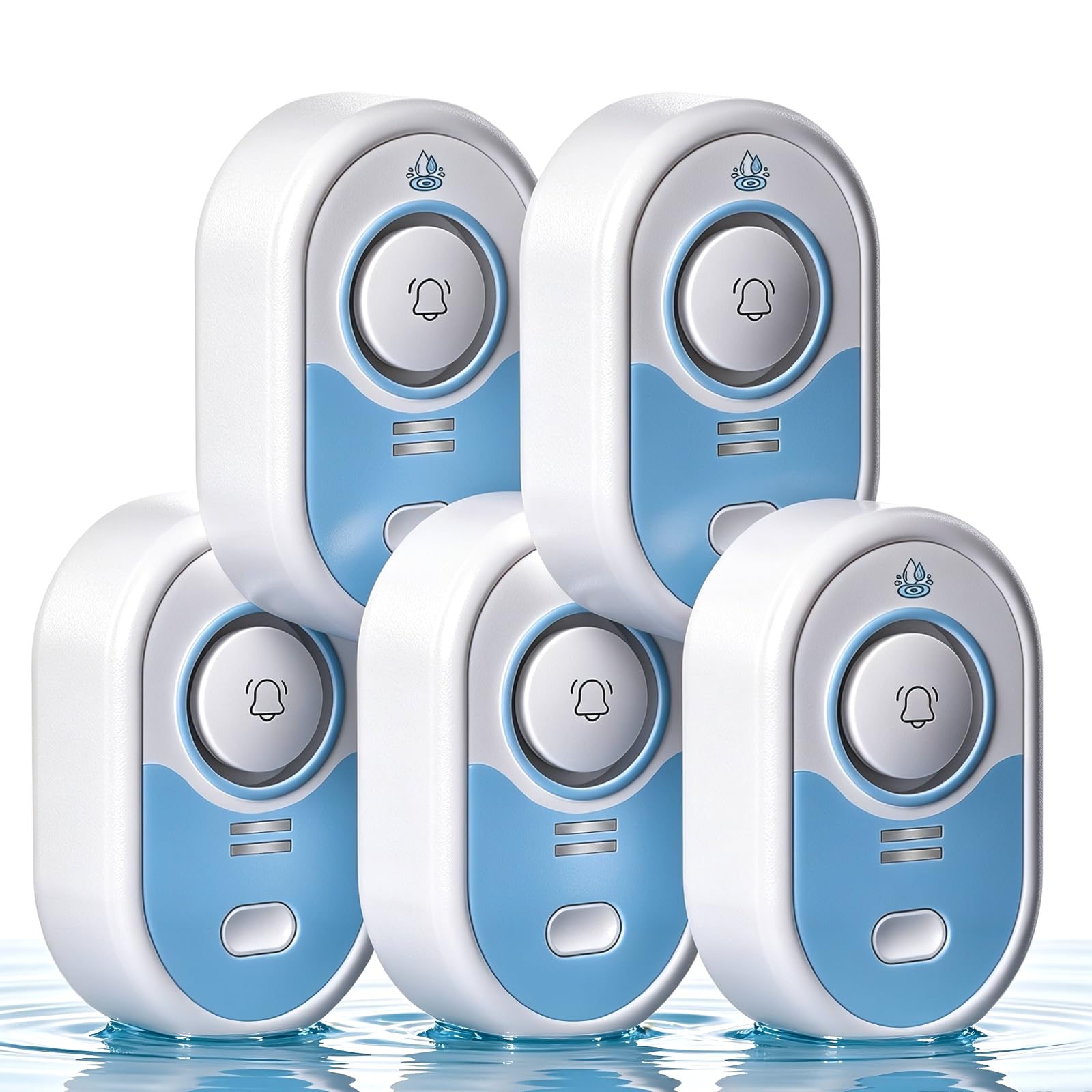
Five battery-included sirens that cover five trouble spots, no hub and no app in sight.
Coverage is a numbers game. One sensor guards one puddle, and most homes have four or five places water would announce itself first: under the kitchen sink, beside the water heater, behind the washing machine, in the basement, on the camper floor. This pack puts a 100 dB siren (about the volume of a car horn at close range) in each of them. Batteries come pre-installed, so there is no tab to pull and no setup — drop each unit and it is live.
The numbers worth knowing: IP66 waterproofing (protected against powerful water jets, so rain and splashes are fine), up to 5 years of standby battery from 2 AAA cells, and a low-battery warning that beeps and flashes yellow below 5% charge. The alarm is adjustable across four volume levels with a mute, which matters if you have a unit in a bedroom or nursery and want a softer alert at night. A self-test button beeps and shows a green LED so you know the sensor is awake.
The one honest catch: swapping the battery later is fussier than it should be. You remove four white plugs on the bottom to reach the screws, and prying at the back casing can damage it — so follow the instructions rather than improvising. That is a rare-use annoyance, not a daily problem, and the 5-year standby means you will not face it often.
Why this pack pays off
- Five units cover five rooms or one whole basement wall
- 100 dB siren plus LED flash for noisy rooms
- Up to 5 years of standby from 2 AAA batteries
Small things to know
- Battery swap needs care with the bottom plugs and screws
- Siren sounds at the unit — you must be within earshot
The short version: if your water worries span several rooms under one roof, this is the cheapest way to blanket all of them at once.
The catch to accept: no remote alerts — this works by sound alone.
3. Sekelo Sump Pump Alarm

Built for the pit, not the puddle — a 110 dB siren that fires when the water climbs past your line.
This is a level alarm, not a spot sensor. A 10-foot float switch lifts as water rises and trips the alarm at the height you set, which makes it the right tool for a sump pit, a water tank, a lift station, or a sewage basin. The 110 dB alarm is the loudest on this list, and it comes with LED indicators so you get a visual cue alongside the noise. IP67 waterproofing means it tolerates brief submersion, so a pit that floods over the sensor does not take the alarm out with it.
Compare the float reach: 15 feet on the SPI Observer 500 versus 10 feet here, so the SPI can sit higher or in a deeper pit. But the Sekelo answers with volume — 110 dB here against the SPI’s 85 dB. If the alarm has to blast through a closed basement door or over the drone of a running pump, the Sekelo’s horn is the one you will hear. Its long float also means you can set a high trigger height, so normal ripples will not set it off.
One install note: this is a corded unit, and the 6-foot power cord means the outlet has to be close. Plan that run before you mount it. It is a heavier, more industrial piece of gear than the little tabletop sensors, so treat it as permanent installation rather than something you toss behind a toilet.
The loudest on the list: 110 dB is the headline number and it earns the “Loudest Alert” label — this is the unit for a pit where a quiet beep would never carry.
Built for: sump pumps, sewage basins, and tanks where the alarm needs to carry through a door and over running machinery.
Not for: spots far from an outlet — the 6-foot cord sets your limit.
4. SPI Observer 500 Indoor/Outdoor High Water Alarm

The 15-foot float that reaches into the deepest pit — a wall-mounted sentry for big water systems.
Reach is this alarm’s whole reason for being. The 15-foot mechanical float outruns every other pick here, so it can hang into a deep well, a large tank, or a lift station where a 10-foot switch would not go. It mounts to a wall with a 6-foot power cord, and it fires an audible horn plus a large light — so you get a sound cue and a visible one, which helps when you glance at the unit from across a utility room.
The trade-off versus the Sekelo above is volume and water rating. This horn sounds at 85 dB, versus the Sekelo’s 110 dB, and SPI does not publish an IP rating here — so it is an indoor/outdoor alarm by design, but one you should shelter from direct rain and standing water. Functionality and easy installation are the two things it does best, and both fit the job: mounting it on a wall and dropping a long float into a pit is a straightforward weekend task.
It is the premium choice on this list, and the fairest way to read that is by what you get for the reach. For a deep sump or a large tank, the 15-foot float reaches trigger heights a 10-foot switch cannot.
Where the reach wins
- 15-foot mechanical float handles deep pits and large tanks
- Audible horn plus a large light for a visual cue
- Wall mounting keeps it up and out of the water path
What you give up
- 85 dB is the quietest horn here
- No published IP rating, so shelter it from direct rain
Made for: deep sumps, wells, and large tanks where the float has to travel far to hit the trigger.
Wrong tool for: a simple floor puddle, where a small battery siren does the job for far less hardware.
Know the Specs
IP water ratings (IP65, IP66, IP67)
The two digits after “IP” tell you how well a case keeps out solid objects and water. A higher water digit means more protection: IP65 handles rain and spray, IP66 handles powerful jets, and IP67 tolerates brief submersion. For a detector sitting outdoors, anything below IP65 is a gamble. Match the rating to the worst your spot sees: IP65 for a covered porch, IP67 for a pit that can flood over the sensor.
Float-switch reach and cord length
A float switch trips the alarm at a set water height, so its length decides how deep a pit or tank it can guard. Longer floats let you set a higher trigger point, which cuts false alarms from ripples. Cord length is the other half of the equation: a corded alarm can only go as far as its power cable from an outlet, so measure the run before you commit.
Common Questions
Will an outdoor water leak detector survive rain and snow?
Do I need a hub or Wi-Fi for these detectors to work?
How loud is loud enough to hear a leak alarm?
What is the difference between a float switch alarm and a spot water sensor?
How long do the batteries last in a leak detector?
Will a leak detector warn me before my pipes freeze?
Can I place a battery leak detector in a camper or RV?
How many detectors do I need for a whole house?
Does the alarm reset itself after it sounds?
The Bottom Line
For most people, the best outdoor water leak detector is the eufy Security Water and Freeze Sensor, because it tells you about water and freezing cold on your phone from anywhere — the only pick here that reaches you when you are not home. If you want whole-home coverage on a budget, grab the VETOUCH 5-Pack, which puts a 100 dB siren in five rooms at once. And for a sump pit or tank that needs a float switch, the Sekelo Sump Pump Alarm fires the loudest alert here at 110 dB, while the SPI Observer 500 is the one to reach for when a 15-foot float has to go deep.
How we choose
We do not accept paid placement. Every pick is matched to a real buyer and a real use-case; we do not hands-on test units.
Sources
Specifications: manufacturer listings and product documentation. Review insights: verified customer reviews, as of November 2026. Pricing: not shown on this page (it changes often); check the current price via the retailer link.
As an Amazon Associate, Tactical Gear Guy earns from qualifying purchases. This does not affect which products we feature.