Specs are compiled from manufacturer listings and verified buyer reviews and can change over time — please confirm the key details on the product page before buying.
You want your speed and engine temperature floating in your line of sight, not buried down by your knee. That is exactly what an OBD2 head-up display does — it plugs into your car’s diagnostic port and projects live data onto a small screen or your windshield. The tricky part is that not every unit talks to every car, and a few of these boxes quietly give up on older models. The short answer: buy a dual OBD2-plus-GPS unit, so you get engine data where your car supports it and satellite speed everywhere else.
This guide is built by comparing the manufacturers’ published specifications and the patterns across verified customer reviews, so you get each pick’s real strengths and trade-offs instead of marketing spin.
Some displays read engine data straight from the diagnostic port, while others fall back on satellite tracking when your car won’t cooperate. Below are the differences that separate a display you keep from one you unplug in a week. This breakdown of the best obd2 heads up display covers dual-system units, screen types, and the car models that refuse to connect at all.
Top Picks

How To Choose The Best OBD2 Heads Up Display
The first thing to settle is whether your car will actually hand over engine data. An OBD2 port (the diagnostic socket your mechanic plugs a scanner into) only speaks the language on cars built to a certain standard. Most units here work on models from 2008 onward, and a few reach back to 2003. If your car is older, imported, diesel, hybrid, or a truck, the GPS half of a dual-system display is what keeps the screen useful.
Check the car list before you fall for the screen
Dual-system displays split into two jobs. OBD2 mode pulls real engine numbers — coolant temperature, battery voltage, RPM, fuel consumption — straight from the car’s computer. GPS mode reads your speed from satellites, so it works on anything with a windshield. A display with both modes is the safer buy: a protocol mismatch leaves you with GPS speed instead of a blank screen. Several listings here name specific excluded brands outright, and that list matters more than any feature bullet.
Reflective film versus a self-lit screen
Some head-up displays throw their image onto a piece of reflective film stuck to your windshield. That gives the floating-in-air look, but daytime glare can wash it out. Others use a small LCD or TFT screen that lights itself, so you read it directly without any film. Both work, but the self-lit screen holds up better in bright sun, while the film setup keeps the image closer to your natural sightline.
Side-by-Side Comparison
| Model | Best For | Connection | Screen | Weight | Amazon |
|---|---|---|---|---|---|
| LORPHEIR L5010★ Best Overall | All-round pick for mixed car ages | OBD2 + GPS | Digital display, film or bracket | 10 oz | Amazon |
| MAIMEIMI P8Compact Pick | A-pillar mounting in tight cabins | OBD2 + GPS | Auto-dimming, anti-glare | 4.96 oz | Amazon |
| MH MH-P6 | Fault-code scanning plus live data | OBD2 + GPS | Adjustable backlight, 10 interfaces | 4.16 oz | Amazon |
| X AUTOHAUX Mini | Small dash footprint, no film needed | OBD2 (EUOBD) | 2.2″ TFT LCD, self-lit | — | Amazon |
| CAMECHO F16 | Big 3.5″ readout on a base mount | OBD2 + GPS | 3.5″ IPS, ambient brightness | 0.26 kg | Amazon |
| KONNWEI KW206 | Clearing check-engine codes yourself | OBD2 | 3.5″ color LCD | 275 g | Amazon |
| Qiilu Multifunction Gauge | Cheapest way to try a HUD | OBD2 | Backlit, with reflective film | 124.74 g | Amazon |
Detailed Reviews
1. OBD2 GPS Dual System Car HUD Display
Our pick — 4.0+★ from 70+ verified ratings; the strongest balance of quality and price.
The dual-system pick that keeps showing your speed even when your car won’t share engine data.
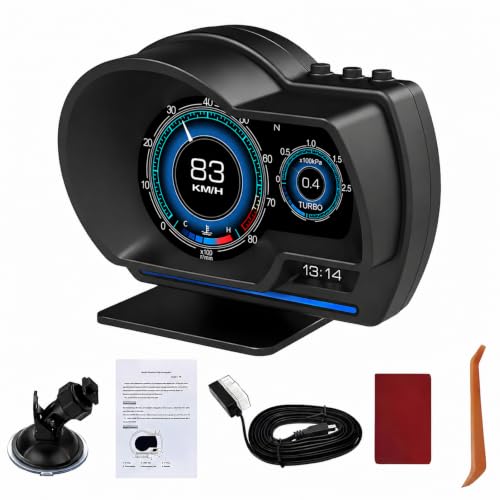
LORPHEIR’s L5010 covers both bases: OBD2 mode for cars from 2008 onward, and GPS mode for everything else, including older and specialty vehicles. That second path is the reason to start here. Cars that refuse the diagnostic handshake — an older import, a modified ECU, a diesel — still get a working speed readout because the GPS side doesn’t need the car’s computer at all.
What you actually see is broad: over 20 driving parameters including speed, RPM, water temperature, voltage, fuel consumption, altitude, driving time, distance, turbo pressure, intake pressure and oil temperature. Turbo pressure and intake pressure are the two that matter most if you drive something boosted and want to watch the numbers climb. Display modes are customizable, so you can strip the screen down to just speed and coolant temp instead of scrolling through everything at once.
What wins people over is build quality, with ease of use close behind — the plug-and-play OBD connection means most owners are running it minutes after opening the box. The honest catch is consistency: this is a “good value when it works” display, and the functionality verdict is split, so a small share of cars just don’t cooperate. Check the compatibility notes against your model before ordering. At 10 ounces and 4 x 3 x 2 inches it’s a chunkier unit than the MAIMEIMI P8, which sits at 4.96 ounces and 3.82 x 2.38 x 1.9 inches — this one is noticeably the bigger box on the dash.
dual GPS and OBD2
- OBD2 and GPS in one unit, so old and new cars both get a live reading
- Over 20 parameters on screen, from water temp to turbo pressure
- Dual-core processor with data accuracy listed within 1% variance
- Three mounting routes: 360° rotating suction bracket, console base, or adhesive tape
- Rated for -40°C to +80°C with built-in voltage protection from 11-18V
setup takes patience
- Functionality feedback is split — some cars simply don’t deliver data reliably
- Heavier and larger than the compact MAIMEIMI P8, so it eats more dash space
- Getting the mounting angle right takes a little fiddling before it’s readable
want both feeds: you own more than one vehicle or an older car that needs the GPS fallback, and you want the widest set of engine readings in one place.
prefer simple install: your car is on a known incompatible list — the GPS side still works, but you’d be paying for engine data you can’t get.
2. OBD2 Digital Speedometer Heads Up Display
A tiny box you can strap to the A-pillar so it lands right in your eyeline.
The mounting flexibility is the story here. MAIMEIMI’s P8 ships to sit in two places: an adjustable strap that hugs the A-pillar (the angled pillar between your windshield and side window) for cars with steeply raked glass, or a non-slip pad on the dashboard for a low-profile setup. If you’ve tried a dash-mounted HUD that ended up buried behind your wiper line, the strap route is the fix. Twist the screen 90° when you switch modes and calibrate the angle per the manual.
Functionality is what carries the reputation — the plug-and-play connection powers up with the car and starts feeding speed, RPM, battery voltage, fuel efficiency, coolant temperature and turbo pressure. An ambient light sensor adjusts brightness automatically, so the anti-glare screen stays readable in glaring sun and soft at night without you touching a setting. There are 15+ functions in total, including customizable alarms for overspeed, high RPM, overheating and low voltage.
Here’s the trade-off worth knowing before you buy: accuracy is a split verdict, with some drivers finding it right on and others getting numbers they don’t trust. The compatibility list is also long and specific — the OBD2 side is off for pre-2008 cars, hybrids, diesels, trucks and RVs, plus a named set of brands. Weighing 4.96 ounces and measuring 3.82 x 2.38 x 1.9 inches, it is the compact counterpoint to the LORPHEIR’s 10 ounces and 4 x 3 x 2 inches — roughly the difference between something you forget is there and something that owns a corner of your dash.
OBD2 plug and play: run your make and model against the exclusion list before you commit. The GPS mode covers any vehicle, but the engine readings are the whole point of the OBD2 side, and a mismatch turns this into a speed-only display.
check your port: a cabin where dash real estate is tight and you need the readout up high rather than on the console.
newer protocol cars: your car is a diesel, a hybrid, or one of the excluded brands — the engine half simply won’t light up.
3. MH Head Up Display for Car

The display that doubles as a code reader and lets you clear a check-engine light on the spot.
Most HUDs just show you numbers. The MH-P6 goes further: it scans your car for fault codes, displays the fault information, and clears the code with a short press of the OK button. It also reads real-time data streams and runs acceleration and brake tests. That makes it a pocket diagnostic tool as well as a gauge — useful if you’ve ever paid a shop just to read a warning light.
On the display side you get speed, tachometer, fuel consumption, water temperature, drive time, altitude, mileage, turbo pressure, compass, clock and voltage. Customization is unusually deep — 10 interface styles, a backlight brightness scale from level 1 (darkest) to level 8 (brightest), and switchable units for °C/°F and km/mph. Alert thresholds are user-set across speeding (5-200 km/h), engine temperature (50-200°C), voltage (10.0-15.0V) and RPM (1000-8000), so you can tune exactly when it starts nagging you.
Functionality is the theme that keeps coming up, along with the display itself and the straightforward install. The one to weigh honestly is reliability: it’s the most-discussed topic on this listing with a mixed verdict, meaning this is a display that some owners find rock-solid and others find finicky. Bear that in mind if you expect appliance-like dependability. At 4.16 ounces it’s the lightest dual-system unit on this list, and the 4.3 x 3.3 x 3 inch body gives it a taller screen face than the flatter MAIMEIMI P8.
wide gauge coverage: the scan-and-clear fault-code ability is a genuinely different feature among these picks, and the brightness scale up to level 8 means it can punch through bright daylight.
want many gauges: drivers who want to read and reset their own warning lights without buying a separate scanner.
want minimal menus: cars running diesel, hybrid, pickup, RV or a modified ECU — the OBD2 half drops out and you’re left with GPS metrics only.
4. X AUTOHAUX Mini HUD Head Up Display

A self-lit LCD screen that skips the windshield film entirely.
Plenty of HUDs make you stick a reflective sheet to your glass so the image has something to bounce off. The X AUTOHAUX Mini throws that out — its 2.2-inch TFT LCD screen lights itself, so there’s no film on your windshield and no glare battle to manage. You read the panel directly, and the screen color is adjustable to suit your taste. The whole unit measures 2.76 x 2.72 x 1.81 inches, which makes it the smallest footprint here.
It reads the car’s electronic control unit for voltage, mileage, water temperature, driving speed, instantaneous and average fuel consumption, rotational speed and engine temperature. Alarms cover overspeed, rotational speed, engine fault, engine temperature and battery voltage. Installation is meant to be a find-the-port job: plug both ends in with the cable, turn it on, and go — the listing notes the OBD socket sits under the steering wheel on Japanese cars, near the dashboard on German cars, and in the inspection cover on American pickups.
What to know going in: value is the praise, but functionality leans mixed — the “nice when it works” camp and the “doesn’t work properly” camp are both loud here, and accuracy draws attention for reading fast. This is an OBD2-only unit, so older or non-compliant cars get nothing from it, unlike the GPS-equipped picks above. Buy it for the small size and the film-free screen, and check that your car plays nicely with the diagnostic port first.
tight dashboard space: you want the smallest possible dash footprint and refuse to mess around with reflective film on your windshield.
need big display: your car predates the OBD2 standard or you need a satellite-speed fallback — this one has no GPS mode to save you.
5. Head Up Display HUD F16
A 3.5-inch IPS panel for drivers who want their numbers big and legible.
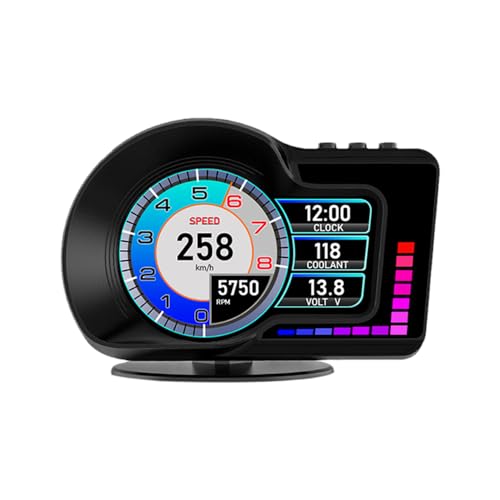
Screen real estate is the reason to look at the CAMECHO F16. A 3.5-inch IPS panel (a type known for wide viewing angles, so the numbers stay readable even from an off-centre glance) is a physical step up from the 2.2-inch LCD on the X AUTOHAUX Mini. Brightness swings with the ambient light around you, so day and night both stay clear without you reaching for a knob. You can switch between multiple display interfaces to show only what you care about.
Both systems are on board — OBD2 for cars after 2008, GPS for anything else. The OBD2 side pulls speed, water temperature, oil temperature, voltage, fuel consumption, RPM, clock, one-way distance, one-way time, travel direction, altitude, latitude and longitude, plus acceleration and brake tests. Alarms cover speed, high water temperature, low battery and a fatigue-driving reminder, and it will detect and clear fault codes. The GPS side handles altitude, GPS speed, distance, direction, time and date on any vehicle.
One thing the maker is upfront about: each car displays different data because of protocol compatibility and openness, so what shows up depends on your specific model. Mounting goes on the dashboard with a base or onto the windshield, and the bracket rotates in all directions for angle. It’s the heaviest unit listed at 0.26 kg, so it wants a stable surface rather than a shaky dash mat.
F16 dual system: the large IPS screen and dual-system coverage are a strong pairing, but treat the exact data set as model-dependent — confirm your car is post-2008 and OBDII-compliant to get the full engine readout.
dual source fans: a small screen strains your eyes and you’d rather glance at one big panel than squint at a compact module.
bright daylight drivers: you run a diesel, hybrid, pickup or modified ECU — the listing excludes them and you’d fall back to GPS metrics.
6. KONNWEI KW206 Car OBD2 HUD Digital Meter Gauge

Half gauge, half scanner — the pick for anyone tired of guessing at a check-engine light.
The KW206 is the most tool-like device on this list. It pairs a live gauge with a full diagnostic scanner that reads and erases DTCs (diagnostic trouble codes — the stored faults behind your check-engine light) and checks the live data stream. That lets you pinpoint why the light came on and possibly fix it without a dealer visit. It displays hundreds of real-time engine parameters on a 3.5-inch color screen, including speed, RPM, coolant temperature, fuel consumption and total miles.
Compatibility is wider than most here: all 2003 or newer OBDII-certified gas and diesel cars, SUVs and light trucks, covering J1850, CAN and EOBD protocols. A 4-button layout keeps the menu work quick. It switches units between metric and imperial, auto-adjusts screen brightness, runs a 0-100 speed-up test, and supports lifetime software updates. Leave it plugged in and it drops into sleep mode when the engine is off, waking when it detects ignition.
Straightforward setup and a clear display are what people notice first. The split verdict sits with accuracy and reliability — some drivers find it dead-on across their cars, while others flag speedometer readings and compatibility with specific older models. That’s a fair reminder that protocol quirks exist even on a 2003-and-up device. At 275 g and 1.02 x 3.31 x 5.12 inches, it’s a cable-connected gauge you’ll want to mount deliberately rather than toss on the dash.
one device setup: the owner who wants to clear a warning light and read live engine data without adding a separate scan tool to the glovebox.
clean dash lovers: you want a film-style floating speed readout on the glass — this is a self-lit color gauge, not a windshield projector.
7. Obdii Hud Car Speedometer

The entry-level projector that throws your speed onto a strip of film.
This Qiilu unit is the simplest take on the idea: an OBD2-only projector that beams speed, water temperature, voltage and one-way mileage onto the included reflective film. There’s an adaptive light sensor that brightens the backlight in daylight and softens it at night, and the listing claims a clear, ghost-free image. Installation is a plug-and-play job with a buckle-style connector built to hold firm on rough roads.
Alarms are the practical side — overspeed, water temperature, voltage, fatigue-driving reminders and fault alerts all live here. The ABS plastic housing (a tough, hard-wearing plastic) is described as heat-resistant with good electrical performance. At 124.74 g it’s light enough to sit out of the way, and it’s the least expensive way to find out whether a head-up display fits your driving habits at all.
Visibility is the moot point: it holds up decently in direct sun, but some drivers find it hard to read during the day, which is the inherent risk of the film-projection approach compared with the self-lit screens above. It’s also OBD2-only, so pre-standard cars get nothing. Go in expecting a budget experiment, and it delivers exactly that.
first HUD buyers: you want to test the whole head-up-display idea without spending much, and your car is a post-2008 OBD2 model.
advanced tinkerers: daytime legibility runs thin on the film-based image, and there’s no GPS fallback for a non-compliant car.
Know the Specs
OBD2 vs GPS: what each mode does
OBD2 mode pulls numbers straight from the car’s computer — things satellites can never know, like coolant temperature, battery voltage and RPM. GPS mode reads speed and position from satellites, so it works on any vehicle but can’t see under the hood. A dual-system display gives you both, which is why it’s the safer choice if your car’s protocol is uncertain. If a car isn’t OBD2-compliant, a display with only OBD2 mode simply shows nothing.
Screen type and why it changes legibility
Reflective-film displays bounce an image off a sheet stuck to the glass, which gives a floating look but can wash out in bright daylight. Self-lit panels — an LCD or TFT screen — light themselves so you read them directly, holding up better in sun. Screen size matters for glanceability: a 2.2-inch panel is compact and out of the way, while a 3.5-inch screen is easier to read at a glance but takes more dash space. Auto-dimming and ambient light sensors help in both cases.
Common Questions
Will an OBD2 head-up display work on my car?
Do I need to stick reflective film on my windshield?
What is the difference between OBD2 mode and GPS mode?
Can a heads-up display clear my check-engine light?
Where does the OBD2 port sit in my car?
Is a bigger screen always easier to read?
Why does my display show different data than another car’s?
Can I leave a head-up display plugged in all the time?
Does a head-up display replace my dash gauges?
The Bottom Line
For a mixed garage that includes an older or imported car, the LORPHEIR L5010 is the one to reach for — it runs both OBD2 and GPS, so the speed readout never quits even when the engine data won’t come through. If your priority is clearing a check-engine light yourself, the KONNWEI KW206 doubles as a real scanner across 2003-and-newer cars. And if you simply want to test whether a heads-up display suits your driving before committing, the Qiilu projector is the low-risk entry point. Match the unit to your car’s protocol first — the best-looking screen is useless if your model won’t hand over the data.
How we choose
We do not accept paid placement. Every pick is matched to a real buyer and a real use-case; we do not hands-on test units.
Sources
Specifications: manufacturer listings and product documentation. Review insights: verified customer reviews, as of November 2026. Pricing: not shown on this page (it changes often); check the current price via the retailer link.
As an Amazon Associate, Tactical Gear Guy earns from qualifying purchases. This does not affect which products we feature.