Specs are compiled from manufacturer listings and verified buyer reviews and can change over time — please confirm the key details on the product page before buying.
Dry socks and warm toes on a slushy walk to work decide whether a boot gets worn all winter or sits by the door after two weeks. That one job is the whole test. The catch: “waterproof” and “warm” get used loosely in this category. The pairs that actually work combine a sealed waterproof build with enough insulation for your local cold, then stay light enough to walk in all day.
This guide is built by comparing the manufacturers’ published specifications and the patterns across verified customer reviews, so you get each pick’s real strengths and trade-offs instead of marketing spin.
Below, nine verified waterproof winter boots are sorted by how they handle cold, wet, and slush — with honest fit notes and weight trade-offs spelled out. The goal is simple: help you land a pair of the best Men’s Waterproof Winter Shoes without a return trip.
Top Picks


How To Choose The Best Men’s Waterproof Winter Shoes
Start with the weather you actually walk in, not the coldest temperature on any label. A commuting boot for wet city sidewalks needs a very different build from a boot you wear standing in snow for hours. Get that match right and most of the other decisions fall into place.
Waterproof means the boot is sealed, not just sprayed
A waterproof boot has a barrier built into it, so water cannot soak through the upper into your sock. A water-resistant coating just slows water down and gives up after a while in wet snow. Look for the word waterproof in the construction notes, plus a rubber shell or a seam-sealed build. That is the difference between a dry walk and a cold, soggy one.
Match insulation grams to your winter
Insulation is measured in grams, and more grams means a thicker warm layer. A 200g or 400g boot suits most town winters and everyday errands. A 1200g boot is built for standing around in deep cold, and it runs heavy and bulky for a normal commute. Pick the lowest gram rating that covers your coldest realistic day and you will get more wear.
Sole grip matters more than lug depth alone
Deep lugs chew through snow, but on bare ice what matters is the rubber compound and the tread pattern. Boots designed with a specific ice tire technology hold better on wet pavement and packed ice. If your route crosses plowed sidewalks or parking lots, check what the outsole is actually built for before you buy.
Size for thick socks, and read the fit notes
Winter boots should leave room for a wool sock and still let your toes move. Many of these boots run large or small depending on the model, and that shows up clearly in the fit patterns. When a boot runs large, half a size down usually fixes it. When it runs small, size up rather than squeezing your foot in.
Side-by-Side Comparison
| Model | Best For | Insulation | Weight | Waterproof Build | Amazon |
|---|---|---|---|---|---|
| Columbia Men’s Firecamp Boots★ Best Overall | Everyday cold-weather wear | Low-bulk insulation | — | Waterproof construction | Amazon |
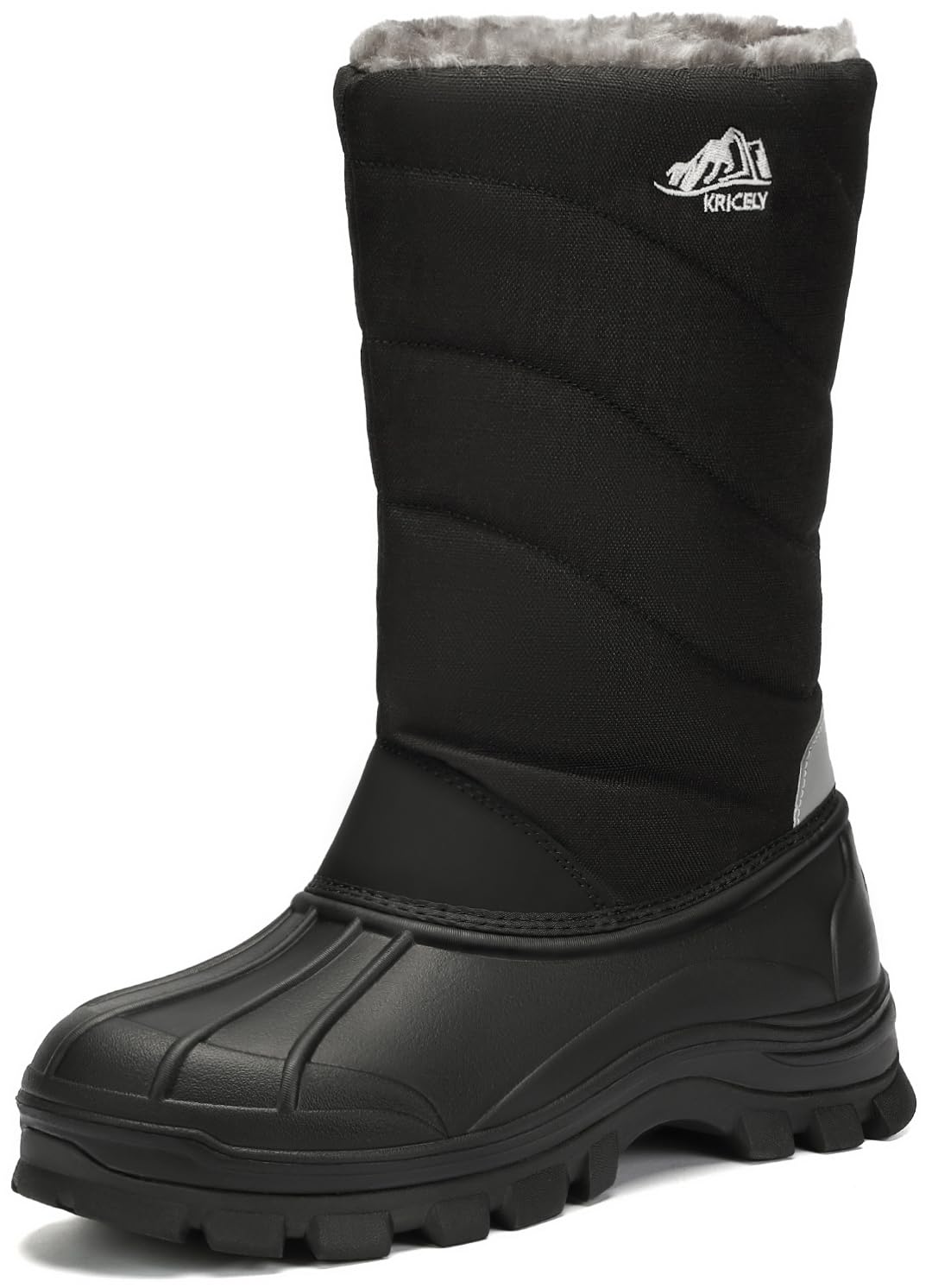
| Kricely Men’s Snow BootsCold-Weather Value | Deep cold on a budget | 3M 400g Thinsulate | — | Waterproof, zipper plus hook-loop | Amazon |
| Guide Gear Men’s Side Zip Duck BootsEasiest On Feet | Easy on/off in wet slush | 400-gram Thinsulate | — | 100% waterproof rubber shell | Amazon |
| Sperry Men’s Cold Bay 3-Eye | Rain and wet city days | Thermal insulation | 2 pounds | Rubber shell, waterproof upper | Amazon |
| BOGS Mesa Boot | Slip-on warmth and durability | — | 2.5 pounds | Waterproof | Amazon |
| ROCKY Blizzard Stalker 1200G | Standing in deep cold | 1200 g Thinsulate Ultra | 5.4 pounds | Rocky Waterproof construction | Amazon |
| The North Face Chilkat V | Versatile winter walking | 200g premium insulation | — | Fully waterproof, non-PFC DWR | Amazon |
| SOREL 1964 Pac Nylon | Style plus slick-terrain grip | — | — | Seam-sealed construction | Amazon |
| Merrell Coldpack 3 Thermo Mid | Ice traction and warmth | 200 grams | — | Waterproof construction | Amazon |
Detailed Reviews
1. Columbia Men’s Firecamp Boots
Our pick — 4.5+★ from 950+ verified ratings; the strongest balance of quality and price.
The all-rounder that keeps socks dry without weighing down your walk.
The Firecamp is the pick here for one reason: it handles the everyday cold-weather walk better than anything else on this list. Columbia builds it with a waterproof construction and low-bulk insulation, which means you get a dry foot and a warm foot without the bulky, heavy feel of a deep-cold boot. If you are walking the dog, heading up a trail, or crossing a slushy downtown, that balance is exactly what you want.
What wins people over is the overall build quality — it is the single most-praised trait on this boot by a wide margin, with comfort right behind it. Owners describe warm feet on cold days and dry socks after a slushy walk. The fit gets good marks too, and plenty of room in the toe box shows up as a recurring plus. It is a boot that simply does its job without fuss.
The catch is that low-bulk insulation is exactly that — low bulk — so this is not the boot for standing still in bitter cold for hours. It is built for movement and normal winter conditions. The crowd favorite here sits at 4.5+ stars across 900+ ratings, a score that holds up as the strongest overall on this list.
What buyers keep coming back to
- Waterproof construction keeps socks dry through slush and wet trails
- Low-bulk insulation adds warmth without the heavy, clunky feel
- Plush cushioning underfoot for long walking days
- Generous toe room reported by owners who sized normally
Where it gives ground
- Not built for prolonged standing in deep, biting cold
- Less insulation than the heavyweight hunting boots further down
Made for: the guy who wants one boot for commuting, errands, and light trail walks in wet cold.
Look elsewhere if: you plan to stand still in sub-freezing temperatures for hours on end.
2. Kricely Men’s Snow Boots Waterproof Non-Slip Outdoor Hiking
A big insulation number at an entry-level spot — with a sizing quirk to plan for.
Here is the contrast that jumps out: the Kricely packs 3M 400g Thinsulate insulation and a temperature rating down to -40℃ / -40℉, while the ROCKY deep-cold boot further down carries 1200 g. That is a 3.0x gap in insulation grams in ROCKY’s favor, but the Kricely covers everyday winter conditions at a fraction of the bulk. For most town and trail use, 400g is plenty, and the fur lining adds a soft, warm feel right out of the gate.
Owners talk about build quality more than anything else, with warmth the second most-praised trait. The soft interior and the waterproof build both get called out, and the zipper plus hook-and-loop closure makes these easy to pull on and off with cold hands. That ease matters on a frosty morning when you are trying to get out the door.
The honest caveat is fit. Sizing draws mixed feedback — some say true to size, others find them snug for the stated size. Read the size chart carefully and lean toward sizing up if you wear thick socks. At 4.5+ stars across 400+ ratings, the fit question is the main thing to manage, not a reason to walk away.
Best real-world use: a warm, waterproof everyday boot for cold commutes and light snow, at an entry-level price that makes it easy to try.
The sizing question: treat the stated size as a starting point — the mixed fit feedback means you should order with thick socks in mind.
Reach for this if: you want serious warmth for typical winter days and the zipper entry convenience.
Think twice if: you are between sizes — the fit feedback is genuinely split, so order deliberately.
3. Guide Gear Men’s Side Zip Insulated Leather Duck Boots
Pull them on in three seconds flat — then walk through puddles without a care.
For a wet, slushy commute where you are constantly taking boots on and off, this Guide Gear duck boot earns its spot. The side zipper and stretchy twin side gore panels mean your foot slides in without wrestling laces, and the 100% waterproof rubber shell handles rain and snow with nothing to prove. Add 400-gram Thinsulate insulation and you have a boot that stays warm while staying easy.
Build quality is the most-praised trait here, and ease of use ranks right behind it — the zip panel design is the star. Buyers report dry, warm feet and a rubber shell that still looks nearly new after six months of slush. The premium Ortholite open-cell foam insole is a real comfort detail, built to resist compression so the fit does not flatten out over time.
The two things to watch: fit runs large for some wearers, and durability opinions are mixed — a padded leather boot like this asks for reasonable care rather than hard abuse. At 4.5+ stars across 700+ ratings, it is a dependable pick as long as you check the size and treat the rubber well.
The zip-panel advantage: leather uppers with a full rubber shell and a side zip, so slush stays out and your foot goes in fast.
The honest limit: sizing leans large for some and the rubber bottom prefers care over constant hard wear.
the balance: you get leather looks, a sealed rubber shell, and the fastest on/off of the bunch.
Size check: try the size down if you are between sizes, since large-running fit shows up in the feedback.
4. Sperry Men’s Cold Bay 3-Eye Waterproof Duck Boot
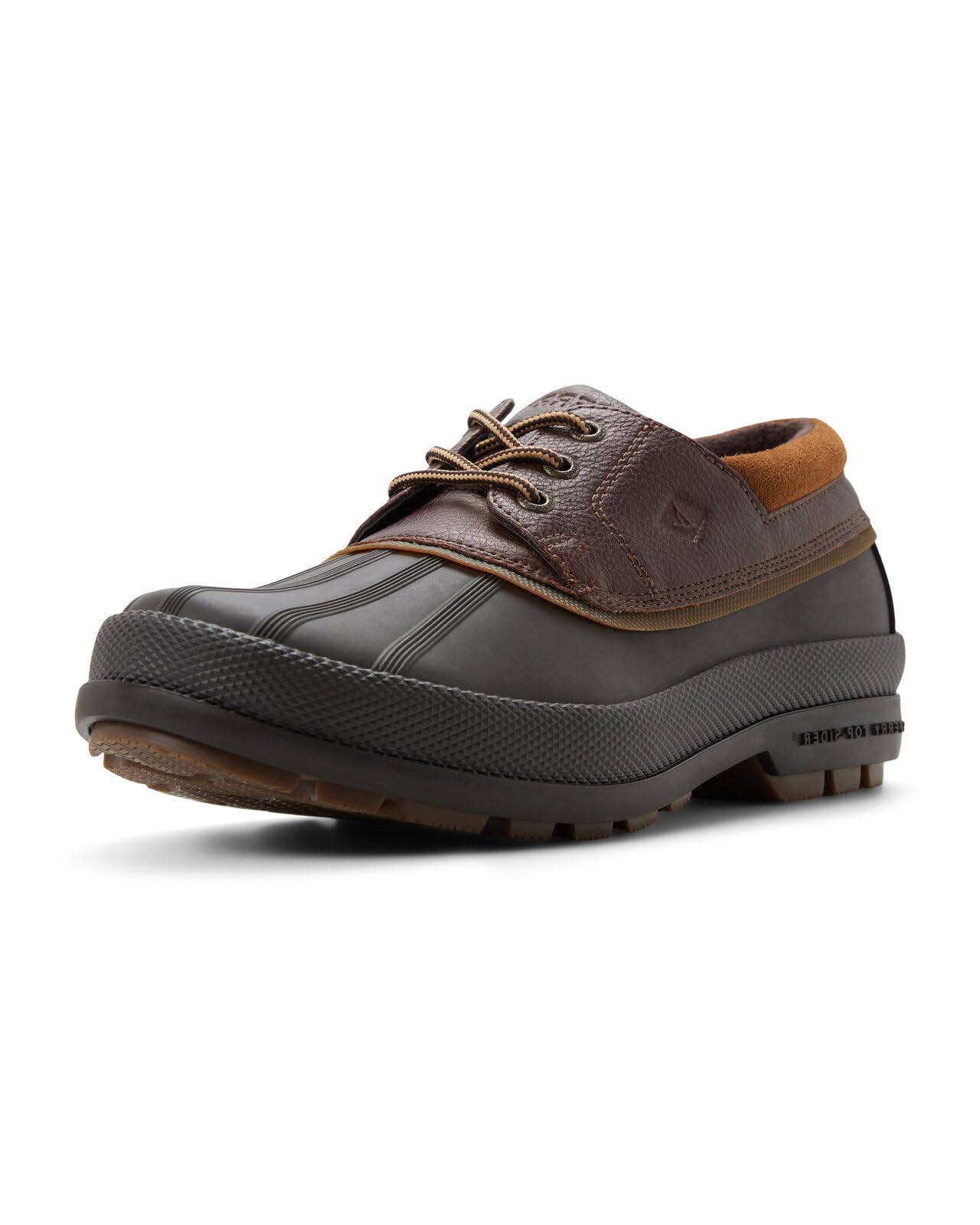
The low-profile duck boot that slips under jeans and shrugs off puddles.
Sperry cut this one with a low-profile silhouette, which is why it wears like a normal shoe instead of a clunky snow boot. It pairs fine with jeans and slacks, and the classic rubber shell with a waterproof upper does the wet-weather work. If your winter is more rain and slush than deep snow, this is the shape you want.
It also lands at 2 pounds — a far lighter carry than the 5.4-pound ROCKY further down, which is a 2.7x gap in weight that you feel at the end of a long day. The molded Wave-Siping outsole gives dependable grip on wet pavement, and the thermal insulation keeps a cold morning manageable. Owners call out the waterproofing working in rain and puddles, and the overall quality is the most-praised trait here by a clear margin.
Where it falls short is deep cold and deep snow — it is a transitional-weather boot, not a snowdrift boot. Durability earns good marks, with one long-term wearer saying the rubber shell has held up like iron. At 4.5+ stars across 800+ ratings, this is a strong everyday-wet-weather pick.
Why it works for wet commutes
- Rubber shell and waterproof upper keep puddles and rain out
- Low-profile cut wears easily with jeans and slacks
- Molded Wave-Siping outsole grips wet ground
- 2-pound build stays light across a full day
Know before you buy
- Transitional-weather design, not built for deep snowdrifts
- Thermal insulation is modest compared to the 1200g boots
Choose this for: rainy, slushy city winters where you want a light boot that looks like a shoe.
Not the one for: serious snowpack or long hours in freezing cold.
5. BOGS Mesa Boot Men’s Boot

No laces, no fuss — just a warm, dry foot you can pull on and forget.
The Mesa is for the guy who hates bending over to tie boots in the cold. It slides on and off easily, stays warm and dry through winter conditions, and is built to last for many seasons. Where a lot of boots try to do everything, this one sticks to warm, dry, and durable, and does it well.
Quality is what buyers rave about most, with warmth close behind. Owners mention the Mesa stays comfortable in cold weather and holds up over multiple seasons of wear. At 2.5 pounds, it sits in the middle of the weight range — lighter than the 5.4-pound ROCKY, heavier than the 2-pound Sperry. For a pull-on boot, that is a reasonable carry.
The one thing to note is sizing — some find it true to size, others say it runs a bit large. It sits at 4.5+ stars across 160+ ratings, a solid score for a no-nonsense slip-on.
What it does best: warm, waterproof, and durable, with a slip-on entry that saves you a cold-morning struggle.
The fit note: sizing runs large for some, so decide your size against thick socks before ordering.
Ideal for: slip-on simplicity and long-term durability for daily winter errands.
Give it a second look if: a precise, locked-in fit matters more to you than easy entry.
6. ROCKY Blizzard Stalker Waterproof 1200G Insulated Boot
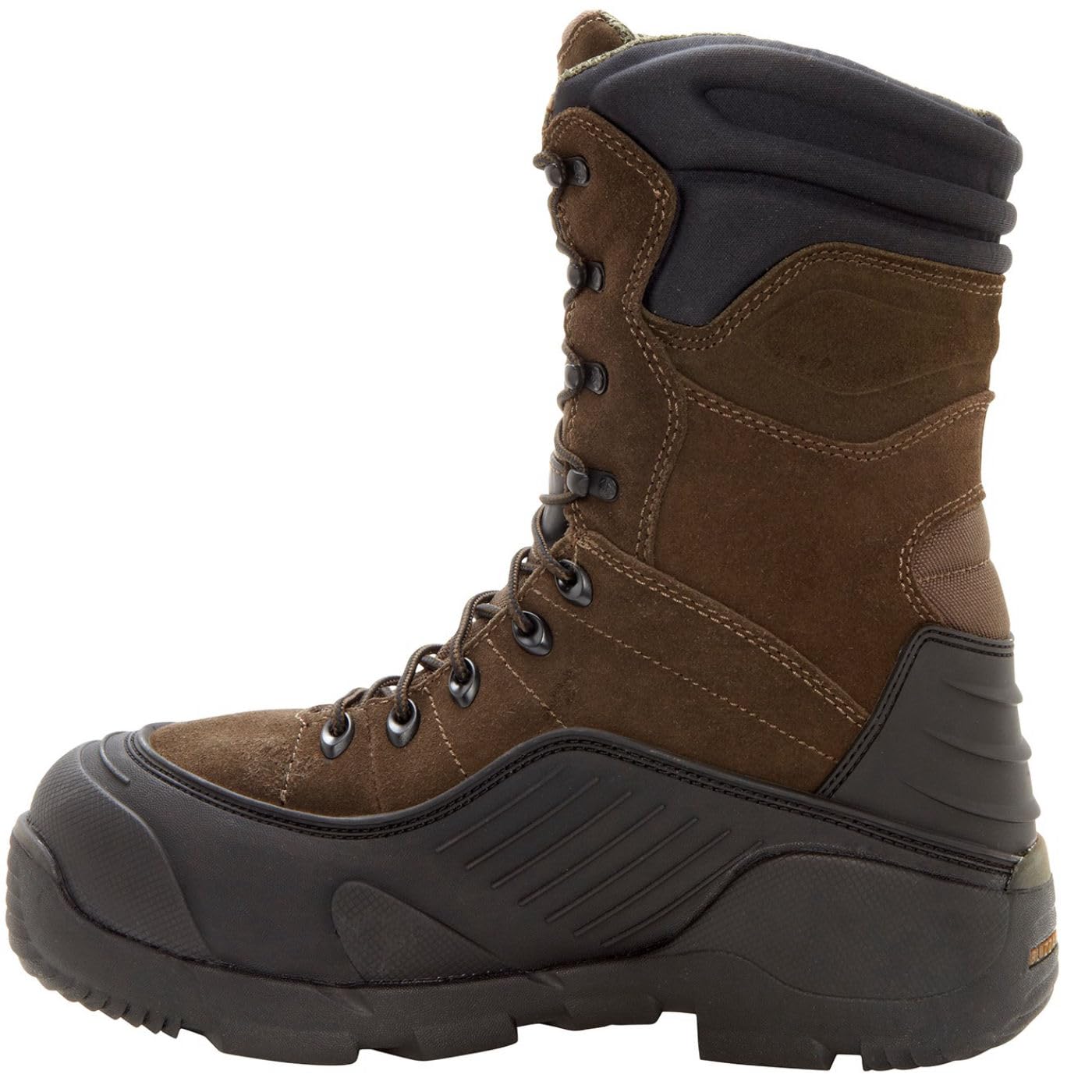
Built for standing in the snow all day — and it feels every gram of it.
If your winter means sitting in a blind or standing on a frozen job site, this is your boot. The Blizzard Stalker carries 1200 g of Thinsulate Ultra insulation, the single biggest warmth number on this list. It also stands 8 inches high, so snow and slush have a hard time getting in over the top. It is 5.4 pounds per pair for a size 10, a heavy boot that trades agility for warmth.
The build is serious: Rocky Waterproof construction, a split suede and 900 denier high-abrasion textile upper, a molded foam padded collar, and a multi-directional Blizzard outsole built to grip snow-covered or icy ground. The removable mesh PU footbed with a TPU heel stabilizer keeps your heel locked in place. Owners praise the 1200g warmth and the room for thick wool socks, with build quality the most-praised trait.
Two honest notes. Sizing draws negative feedback, so check the size carefully. Durability is mixed — some report stitching coming apart, while others say it is built to last. At 4.0+ stars across 900+ ratings, it is a purpose-built cold-weather tool, not a general-purpose shoe.
Built for the deep freeze
- 1200 g Thinsulate Ultra delivers the most warmth on this list
- 8-inch height blocks snow and slush from getting in
- Multi-directional Blizzard outsole grips snowy, icy ground
- Plenty of room for thick wool socks
What you trade for it
- 5.4 pounds per pair makes it a heavy walk
- Sizing and stitch durability draw mixed feedback
Pick it for: hunting, farm work, or long standing hours in genuinely bitter cold.
Pass if: you want a light boot for a quick town walk — this one is built for staying put in the cold.
7. The North Face Men’s Chilkat V Lace-up Waterproof Snow Boot

Lighter insulation that punches above its weight in real winter conditions.
The Chilkat V is the versatile pick for anyone who wants one boot that works on dirt, mud, in creeks, and through light snow. It carries 200g of premium insulation, which sounds modest next to the 1200g ROCKY, but it is paired with a fully waterproof build and a non-PFC durable water-repellent treatment. That combination keeps snow, rain, and wind out without the weight of a deep-cold boot.
What buyers praise most is comfort and warmth on cold days, with durability close behind through real winter use. The lightweight design shows up in the feedback too, which matters when you are walking a fair distance. It is a boot built for moving, not for standing around.
The trade-off is straightforward: 200g of insulation is not deep-cold standing warmth. If your winters are mild-to-moderate and you are active, this covers it. At 4.5+ stars across 400+ ratings, it is a well-liked all-rounder for active winter days.
The all-rounder case: waterproof plus 200g insulation plus lightweight performance across mixed winter terrain.
The limit to know: 200g is active-warmth, not standing-in-the-cold-for-hours warmth.
Best for: active winter days on mixed ground where you want to keep moving comfortably.
skip it if: you need maximum insulation for hours of standing in deep cold.
8. SOREL Men’s 1964 Pac Nylon Waterproof Boot

A winter boot with real style that still seals out snow at the seams.
The SOREL 1964 Pac is the pick for anyone who wants a winter boot that looks the part. It uses seam-sealed construction, meaning the seams are sealed to block water, plus a Sherpa cuff for cozy warmth around the ankle. The vulcanized rubber shell with an extra-grip sole is built to hold traction on slick terrain, so you get style and grip in one boot.
Owners praise the seam-sealed build and warmth most, and describe comfortable feet on cold, snowy walks. It is the kind of boot you reach for when you want to brave a snowy trail and look sharp doing it. The classic SOREL shape is the reason many buyers pick this pair in the first place.
The fit is where you should pay attention — some wearers find it perfect, others say the sizing is off, and build quality draws a mix of praise and one dissenting note. At 4.5+ stars across 250+ ratings, it is a well-regarded boot as long as you get the size right.
Why it stands out: seam-sealed waterproofing, a Sherpa cuff, and a vulcanized rubber shell with an extra-grip sole.
Size it carefully: the fit feedback is genuinely mixed, so confirm your size before buying.
The fit for: buyers who want a classic-looking winter boot that seals and grips in snow.
Be careful if: you order fast without checking sizing — that is where the mixed feedback lands.
9. Merrell Men’s Coldpack 3 Thermo Mid Waterproof

The ice-ice specialist — Vibram Arctic Grip underfoot when the pavement turns to glass.
When the whole street is a sheet of ice, this is the boot that earns its keep. The Coldpack 3 runs a Vibram Arctic Grip outsole, a rubber and tread build made to bite on cold, slick surfaces. Add waterproof construction, 200 grams of insulation, and a fleece lining, and you have a boot that stays warm and dry while keeping you upright on the worst days.
Owners single out the Vibram Arctic Grip traction on bare ice, the exact surface that sends most winter boots sliding. The quality and warmth tie as the most-praised traits, and the fit gets good marks, with lots of room above the toes. It is a comfortable, well-fitting winter boot for daily wear.
The honest note is that 200 grams of insulation is active warmth, not deep-cold standing warmth, so it suits most town winters rather than long hours in bitter cold. At 4.5+ stars across 200+ ratings, it is a smart pick for anyone whose route takes them across icy sidewalks.
Grip you can feel on ice
- Vibram Arctic Grip outsole bites on bare ice
- Waterproof construction keeps feet dry
- Fleece lining and 200 grams of insulation warm the foot
- Roomy above the toes for a comfortable fit
The trade-off
- 200 grams suits town winters, not long hours in deep cold
- Insulation is lighter than the 1200g hunting boot above
The pick for: icy sidewalks, frozen parking lots, and anyone who has slipped on a winter street.
Not the one if: you need a deeply insulated boot for standing still in extreme cold.
Know the Specs
Insulation grams, explained
Insulation is measured in grams, and it tells you how thick the warm layer is. A 200g boot is a light-to-moderate winter boot, good for active use in normal cold. A 400g boot adds more warmth for colder days. A 1200g boot is a deep-cold specialist, built for standing around in serious cold — and it comes with bulk and weight to match. Choose the lowest gram rating that covers your real winter and you will get more comfortable day-to-day wear.
ICe traction and outsole grip
Deep lugs help in snow, but on bare ice what matters is the rubber compound and tread pattern. Boots made with a specific ice-grip outsole, like Vibram Arctic Grip, are built to hold on slick, cold surfaces. A vulcanized rubber shell or an extra-grip sole also helps. If your route crosses plowed sidewalks or parking lots, check what the sole is designed for before buying.
Waterproof versus water-resistant
A waterproof boot has a sealed barrier that keeps water out of your sock. A water-resistant coating only slows water and gives up in wet snow. Look for construction notes like a rubber shell, a waterproof membrane, or seam-sealed build. Those terms signal a real barrier rather than a light coating, and that is what keeps your feet dry through a slushy walk.
Boot weight and height
Weight tells you how much boot you are carrying all day. A 2-pound pair is light and easy for walking, while a 5.4-pound pair is heavy and built for warmth and standing. Height matters for slush — an 8-inch boot blocks snow from getting in over the top, while a low-profile boot is easier to pair with jeans. Match both to how you actually use the boot.
Common Questions
What is the difference between waterproof and water-resistant winter boots?
How many grams of insulation do I need for winter boots?
Should I size up or down in men’s waterproof winter boots?
Will these boots keep my feet warm while standing still in the cold?
Can I wear waterproof winter boots with jeans and dress pants?
How do I stop snow from getting in over the top of my boots?
Do these winter boots hold grip on ice?
Are fur-lined or Thinsulate winter boots warmer?
How do I keep waterproof winter boots from cracking or wearing out?
Can I use waterproof winter boots for hiking?
The Bottom Line
For most buyers, the men’s waterproof winter shoes winner is the Columbia Firecamp because it pairs a waterproof build with low-bulk insulation for a warm, dry, easy walk all winter. If deep cold is your reality, grab the ROCKY Blizzard Stalker with its 1200g insulation. And for icy sidewalks, the Merrell Coldpack 3 and its Vibram Arctic Grip outsole are the one to reach for.
How we choose
We do not accept paid placement. Every pick is matched to a real buyer and a real use-case; we do not hands-on test units.
Sources
Specifications: manufacturer listings and product documentation. Review insights: verified customer reviews, as of November 2026. Pricing: not shown on this page (it changes often); check the current price via the retailer link.
As an Amazon Associate, Tactical Gear Guy earns from qualifying purchases. This does not affect which products we feature.