Specs are compiled from manufacturer listings and verified buyer reviews and can change over time — please confirm the key details on the product page before buying.
You walk into the laundry room with a basket of clothes and no free hand for the switch. That is the exact moment an indoor motion sensor light switch earns its keep: the light comes on as you cross the threshold and shuts off after you leave. The picks below cover the real differences that decide a good one from a frustrating one — whether it needs a neutral wire (the white return wire most modern homes already have in the box), how much lighting load it can carry, and how long the shut-off delay runs.
This guide is built by comparing the manufacturers’ published specifications and the patterns across verified customer reviews, so you get each pick’s real strengths and trade-offs instead of marketing spin.
Start with your wall box before anything else — a switch that needs a neutral wire behaves very differently from one that runs on the hot and load wires alone. Below you get the full breakdown of each Indoor Motion Sensor Light Switch so you can match the wiring in your wall to the right unit the first time.
Top Picks
How To Choose The Best Indoor Motion Sensor Light Switch
Nearly every disappointment in this category traces back to one of two things: the switch was wired into a box it was never designed for, or its load ceiling was too low for the fixture hanging off it. Get those two right and the rest is preference — timer length, sensing range, how it looks on the wall.
Check the neutral wire in your wall box first
A neutral wire is the white return line that completes a circuit. Older homes sometimes run only hot and load to a switch, which means a unit that requires a neutral will not power up at all. Some switches here, including the RAYZEEK, are built to run on hot and load alone — no neutral, no ground. Others, like the ECOELER and the ELEGRP, require that neutral connection and will not work without it. Look inside the box before you order anything.
Match the load rating to what you are switching
Manufacturers rate each switch by bulb type, because an LED driver and an incandescent filament pull current differently. The Leviton DOS15-1LZ lists 600W for LED and CFL and 1800W for incandescent and halogen. The Deako lists 600W incandescent/halogen and 600W LED. A single LED bulb is a tiny load, so most closets and hallways sit far under any of these ceilings — but a bank of high-wattage fixtures or an exhaust fan is where the rating starts to matter.
Decide between occupancy and vacancy modes
Occupancy mode turns the light on for you the moment you enter and shuts it off after the room goes quiet. Vacancy mode makes you press the switch on, then turns it off automatically once motion stops. Vacancy is the safer pick for a room where you want a deliberate action before the lights come on — a bedroom, for instance. Occupancy is the whole point in a laundry room or garage where your hands are full.
Single-pole versus three-way circuits
Single-pole means one switch controls the light. Three-way means two switches control the same fixture, like at the top and bottom of a staircase. Most of the units reviewed here are single-pole only and will not drop into a three-way circuit. The EverElectrix four-pack is the exception — it is built specifically for three-way applications.
Side-by-Side Comparison
| Model | Best For | Wiring Requirement | LED/CFL Load | Circuit Type | Amazon |
|---|---|---|---|---|---|
| Deako Simple Motion Sensor Switch★ Best Overall | Hands-full entry rooms | Deako backplate with neutral | 600W | Single pole | Amazon |
| ECOELER Motion Sensor DimmerBest Value | Dimming control | Neutral required | 150W dimmable | Single pole | Amazon |
| ELEGRP Matte White OccupancyBest Look | Clean look and adjustability | Neutral required | 200W | Single pole | Amazon |
| RAYZEEK PIR Motion Sensor | Old wiring, no neutral | No neutral, no ground | — | Single pole | Amazon |
| Leviton DOS02-LW | Pantry and closet basics | Neutral optional, ground required | 150W | Single pole | Amazon |
| GE In-Wall Motion Sensing | Large rooms, 30ft reach | Hard wire | — | Single pole | Amazon |
| Lutron Maestro Sensor Switch | Any bulb, daylight learning | Neutral optional, ground available | 150W | Single pole | Amazon |
| Leviton DOS15-1LZ | High-wattage fixtures and fans | Hard wire | 600W | Single pole (3-way with companion) | Amazon |
| EverElectrix 4 Pack | Multi-switch 3-way homes | Neutral required | — | 3-way | Amazon |
Detailed Reviews
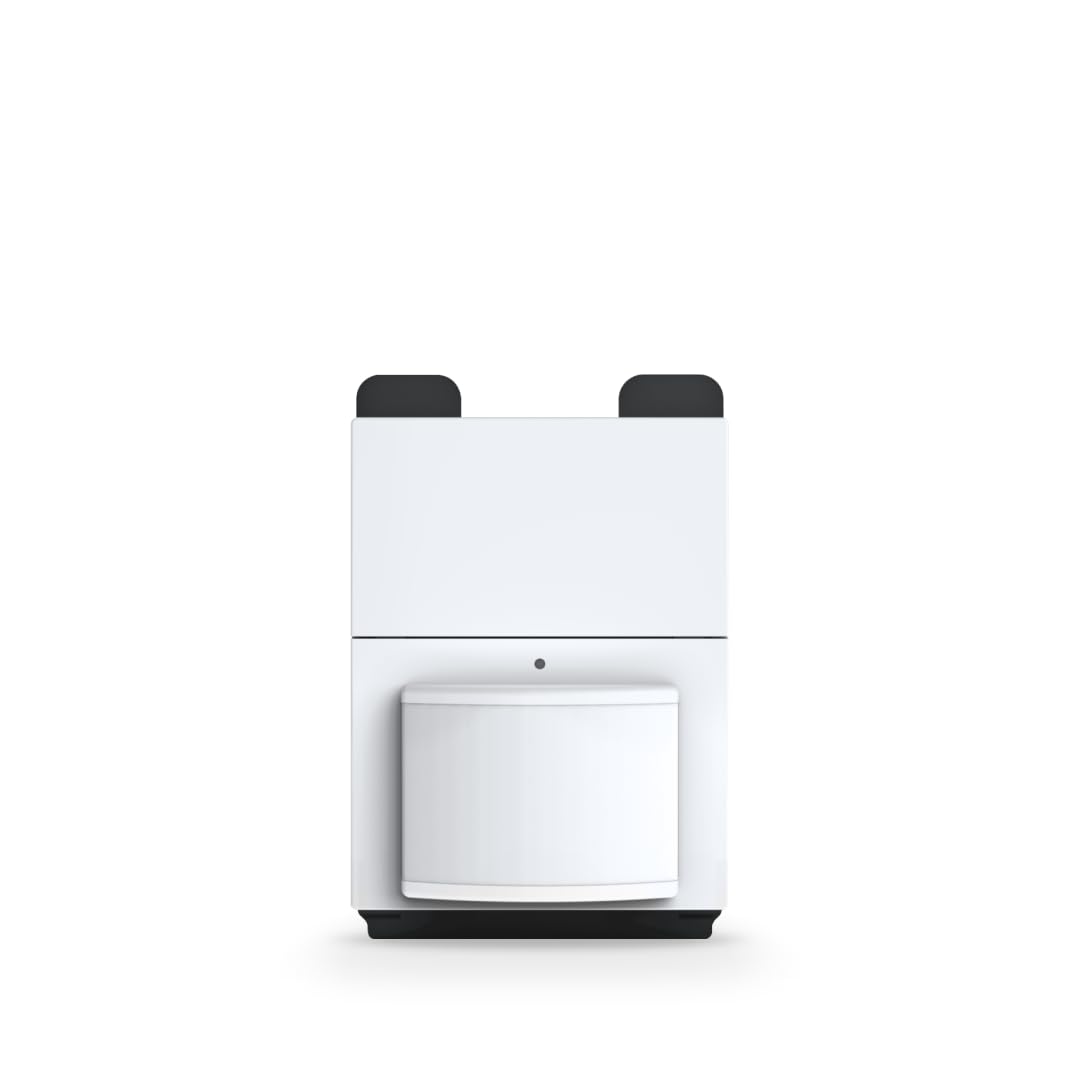
1. Deako Simple Motion Sensor Switch
Our pick — 4.5+★ from 450+ verified ratings; the strongest balance of quality and price.
A 600W LED-rated motion switch with 30-second, 5-minute and 20-minute timers
Carrying a full laundry basket or a plate of food through a doorway is exactly the scenario this switch was built for. Walk in and the light comes on. Walk out and it shuts itself off after your chosen delay — 30 seconds, 5 minutes or 20 minutes. Deako also states plainly that pets will not trigger the sensor, which matters if you have a cat that patrols the hallway at night.
The electrical ceiling is generous for a house full of LEDs. It carries 600W of incandescent or halogen, 600W of LED, ELV or MLV, and a 1/6 HP motor load. Compare that to the Leviton DOS02-LW, which tops out at 250W incandescent/halogen against this unit’s 600W — a meaningful headroom difference if you are switching a fixture with several bulbs in it.
Here is the catch, and it is a wiring one rather than a quality one. This switch only installs on a Deako backplate that already has a neutral wire connection, and only on single-pole circuits. If your wall box does not already have that Deako plate, this is not a drop-in replacement. The upside is real though: Deako says the swap takes seconds without cutting the power at the breaker, so you sidestep an electrician visit entirely.
Where it scores
- Three automatic timer steps — 30 seconds, 5 minutes, 20 minutes — cover both a quick closet glance and a long garage session
- 600W LED and 600W incandescent/halogen load ceiling handles multi-bulb fixtures
- Occupancy and vacancy modes both included, with a main button for manual override
- Pets do not trip the sensor, per the manufacturer
What to weigh first
- Requires an existing Deako backplate with a neutral wire — not a universal drop-in
- Single-pole circuits only, so no three-way staircase use
- The recurring gripe among owners is the light cutting out while someone is still in the room; size your timer generously
Made for: a Deako-equipped home that wants the fastest possible install and a wide timer spread.
Think twice: if your box has no Deako plate, or if you need a three-way circuit.
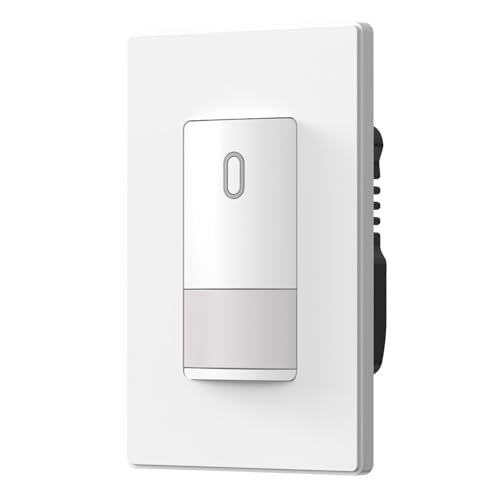
2. ECOELER Motion Sensor Dimmer Light Switch
A motion switch with a built-in dimmer that ramps light up gradually instead of snapping on
Most motion switches give you on and off. This one gives you a gradual ramp instead of a blast of light, which is the difference between squinting in a bathroom at night and being able to see. The dimmer runs on MCU-based digital control — a small chip that manages the dimming curve — and ECOELER says it stays compatible across a wide range of LEDs.
The delay settings are the most granular in this group: 15 seconds as a test setting, then 1, 5, 15 or 30 minutes. The ECOELER also carries 10A of current capacity, sitting well above the Leviton DOS02-LW’s 2A — worth knowing if you are switching anything beyond a small light fixture. Its 150W dimmable LED/CFL and 300W incandescent/halogen ceilings cover a standard bathroom or closet fixture with room to spare.
What wins people over here is the sheer number of adjustments — the settings menu covers dimming level, sensor mode and delay all in one unit. The one thing to brace for is the manual. A set of owners describe the instructions as incomplete, so plan to work it out by feel and a quick YouTube refresher rather than the paper insert. Neutral wire is required and it is single-pole only, so check your box first.
Strengths worth paying for
- Dims through a range of dimmable LEDs on MCU-based digital control
- Five delay steps from 15 seconds to 30 minutes
- 10A current capacity, generous for a single light circuit
- Ambient light sensor keeps the lamp off when the room is already bright
Manage your expectations
- Neutral wire required, single-pole only
- The printed instructions leave gaps — expect to sort settings out hands-on
Reach for this if: you want dimming and occupancy in one device without a premium-tier price.
Look elsewhere if: you need a three-way setup or have no neutral wire in the box.
3. ELEGRP Matte White Single Pole Occupancy Motion Sensor
A matte, frameless faceplate that sits flush with the wall like a standard rocker
Most motion sensors in this category look like sensors. This one wears an exquisite matte finish and a frameless face that sits flush with the wall plate, which is the reason a lot of buyers pick it over a plain white rocker. The housing is tough thermoplastic that shrugs off impacts and scratches, and the material is rated flame resistant to the highest grade of 5VA.
On the electrical side it carries 200W of LED/CFL, which is more LED headroom than the Leviton DOS02-LW offers at 150W — meaningfully more if you have several LED fixtures on one switch. It also handles 500W MLV, 500W incandescent/halogen, 5A for ballast and a 1/6HP fan. The PIR sensor reads across a 120° field, so it catches you coming through a doorway from either side. Neutral wire is required here, and it is single-pole only.
The adjustability is deeper than the marketing suggests — sensitivity control, a luminosity threshold (the light level below which it will trigger) and an activation duration setting all live behind the faceplate. The recurring gripe is the manual click when you press it, which some describe as unresponsive until you learn the exact touch. It is a small learning curve on an otherwise polished unit, and worth the trouble if the wall finish matters to you.
The finish is the pitch: a 120° PIR sensor and a matte frameless plate in one, at 200W LED capacity.
The trade-off to know: the manual click needs a firm, deliberate press — not a fingertip tap.
Best fit for: a hallway or bathroom where the switch is visible and the wall finish matters.
Pass on it if: you need three-way switching or lack a neutral wire.
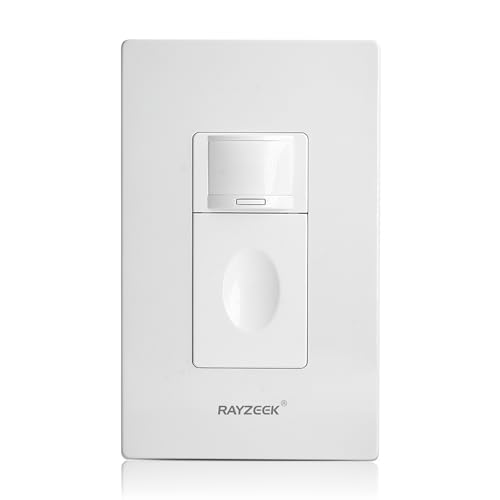
4. RAYZEEK PIR Motion Sensor Light Switch
Runs on hot and load wires alone, with no neutral or ground connection needed
If your home predates modern wiring, most switches in this list are ruled out before you unwrap them. This RAYZEEK runs on just the hot and load wires — no neutral, no ground. For an old house with a two-wire box, that turns a no-go installation into a normal afternoon job.
The three-way mode switch is the second reason it earns a place. It supports Occupancy (auto on, auto off), Vacancy (manual on, auto off) and manual override. The delay range stretches from 15 seconds to 30 minutes, and you set it by pressing buttons — no screwdriver needed for the time delay, lux threshold or sensitivity. Defaults from the start are 1 minute, 25 lux and high sensitivity, which is a sensible starting point for most hallways.
The wiring freedom comes with a condition the maker is upfront about: use a 3W or higher lamp to avoid flickering. A tiny 1W LED filament can make this switch misbehave, so check your bulb before you blame the unit. FCC listed, 120VAC at 50/60Hz, 5.0A, 1/6HP motor, with a PC fireproof housing and a one-year warranty. It also will not work with dimmable bulbs or fixtures that have their own controllers.
The old-house answer: hot and load wiring only, no neutral, no ground — the switch simply fits where others cannot.
Honest limit: it needs a bulb of 3W or higher, and it will not drive dimmable fixtures.
Your match if: the wall box is a two-wire setup in an older home and you want motion control without a rewire.
Skip if: you are switching dimmable bulbs or a fixture with its own controller.
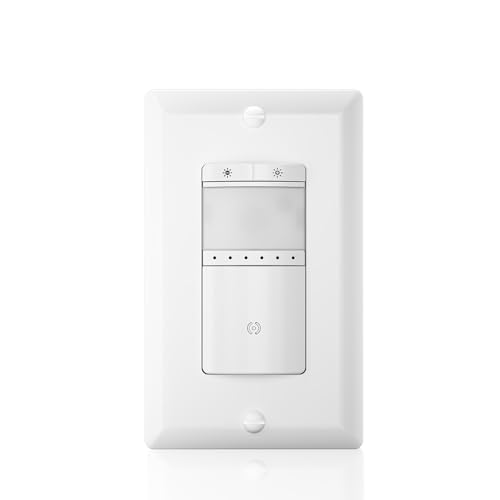
5. Leviton Decora Motion Sensor Light Switch, DOS02-LW
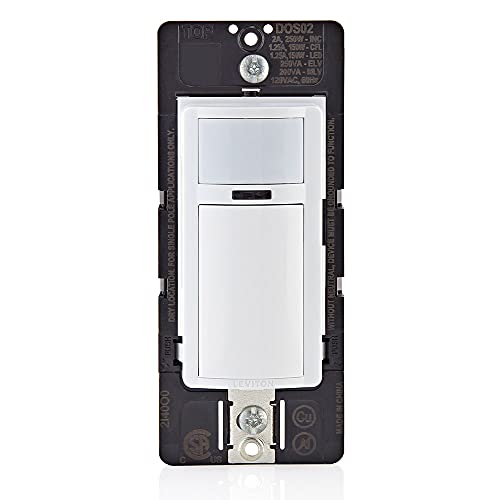
A 180° field of view and 900 sq ft of coverage in a standard Decora face
This is the switch you want when the room is bigger than a broom closet. The 180° field of view and 900 sq ft of coverage mean it catches you moving across a pantry, closet, laundry room or basement rather than waiting until you are directly in front of it. It installs with or without a neutral wire, though a ground is required — that flexibility makes it easier to drop into an older box than the neutral-only units here.
The electrical profile is modest but sensible: 150W LED/CFL, 250W incandescent/halogen, 200VA magnetic low voltage, 250VA electronic low voltage, and 2A resistive. That 2A ceiling sits below the ECOELER’s 10A, so keep this to lighting and small loads rather than anything with a motor or high current draw. It can also be set to vacancy mode if you would rather press it on manually.
Reliability is where this model builds its case — the consistent theme across owner feedback is that it keeps working year after year with no fuss. The one wrinkle is programming: some owners find the instructions wrong and end up fiddling with the button sequence to get the settings right. It is a five-minute frustration, not a deal on the device. Faceplates in white, ivory, light almond, gray, black and brown are available separately if you want it to match the room.
Why it earns the spot
- 180° field of view and 900 sq ft coverage catch movement across the whole room
- Installs with or without a neutral wire — ground required, which many older boxes already have
- Six faceplate colors available separately for a matching finish
- Vacancy mode for manual-on, auto-off control
What to plan for
- 2A current rating keeps it to lighting and small resistive loads
- Programming instructions trip some owners up — patience on first setup
Pick this one if: you are covering a decent-sized room and want coverage first.
Not the one for: high-wattage fixtures, fan loads, or three-way circuits.
6. GE In-Wall Motion Sensing Light Switch

A 30ft detection range and 150° zone that hold a sensor on you at the far end of a garage
The numbers to hold onto here are the 30ft range and the 150° detection zone. Those two combined mean a switch mounted by the door still sees you at the far end of a garage or a long hallway — which is exactly where a weaker sensor fails by switching off mid-task. Occupancy mode handles both on and off hands-free, and vacancy mode lets you turn the light on at the switch and walk away while it handles the shut-off.
Like the Lutron Maestro below, this one has a broad load tolerance on paper. It also carries a timer adjustment so you decide how long the light stays on after movement stops. At 15A of current capacity it takes on loads that a 2A unit like the Leviton DOS02-LW would not touch. Single-pole only, hard-wired, standard electrical devices including lights, fans and small appliances.
The honest part is the reliability feedback, which is genuinely mixed. This switch is a workhorse in a restroom where the motion trigger is what buyers praise most, but there is a real set of owners who have seen units fail early. It is a strong pick for a spot where a failed switch is inconvenient rather than dangerous — not the switch I would put on a critical circuit. Some also find the motion sensing can be disabled too easily by accident, so read the setting sequence before you fit it.
The long-room specialist: 30ft range and a 150° zone, plus 15A current capacity for heavier loads.
The honest caveat: reliability feedback is mixed, so this suits a low-stakes room over a critical one.
Right pick if: you are fitting a long garage, hallway or utility room where reach matters.
Consider a different model if: the circuit is mission-critical or you need three-way control.
7. Lutron Maestro Motion Sensor Switch & Wallplate

An ambient light sensor that learns your preferred brightness and holds the lights off in daylight
Most sensors respond only to motion. This Lutron also reads the ambient light in the room and learns your preferred level over time — so on a bright afternoon the light stays off even when you walk in, and on a grey morning it comes on. That daylight learning is the feature that separates this pick from the rest of the list, and it saves the most energy in a room with a window.
The delay runs 1, 5, 15 or 30 minutes after leaving the room, and both occupancy and vacancy modes are included. Load capacity is 150W CFL/LED, 250W incandescent, halogen and electronic low voltage, 200W magnetic low voltage, or 2 amps of ballast. Install is quoted at as little as 15 minutes, and the package includes both the switch and a coordinating wallplate — one less part to buy.
The flexibility that matters most: it installs using the ground wire if there is no neutral in the box. That alone makes it a viable option in an older home where the neutral-required units will not work. Reliability and motion sensitivity are what earn this thing its following — it simply does not miss movement. The paperwork is where it slips, with some owners describing the instructions as vague. Set aside time to experiment rather than expect the manual to walk you through.
The daylight learner: ambient light sensing plus 1 to 30-minute delay and a wallplate in the box.
The caveat: the instructions are vague — plan on trial and error for setup.
Go here if: the room has a window and you want the lights to ignore daylight on their own.
Choose another if: you need a three-way circuit or high-wattage capability.
8. Leviton Decora Motion Sensor Light Switch, DOS15-1LZ

600W LED/CFL and 1800W incandescent/halogen capacity for multi-bulb and fluorescent fixtures
Most motion switches top out around 150W or 200W of LED. This one carries 600W LED/CFL and 1800W incandescent/halogen, plus 1200VA magnetic/electronic low voltage and fluorescent, a 1/2HP fan, and 15A resistive. That is the spec that matters if you are switching a bank of high-output fixtures, a fluorescent setup, or an exhaust fan rather than a single bulb. Pair it with the same 180° field of view and 900 sq ft of coverage as the DOS02-LW.
Versatility is the second story. It runs single-pole as standard, but a Leviton DD0SR switch companion turns it into a three-way setup, and two DOS15 sensors can be combined to cover a coverage area that one cannot reach — the maker cites an L-shaped room as the example. That flexibility is unusual compared to most single-pole-only units in this group.
Setting it up is done by pressing and holding the paddle to adjust sensitivity range, ambient light and timeout — no dip switches to fumble. The owner feedback is uniformly warm on the build, and the adjustable settings get more praise than complaints. The multi-way setup draws a split reaction, with some owners reporting they could not add companion switches the way they expected. Read the companion-switch requirement carefully before you plan a three-way job.
What stands out
- 600W LED/CFL and 1800W incandescent/halogen capacity for heavy fixtures
- 180° field and 900 sq ft coverage
- Can become three-way with a companion switch, or multi-sensor with two units
- Press-and-hold paddle programming for sensitivity, ambient light and timeout
Where it can let you down
- Companion-switch multi-way setup does not work the way every owner expects
- Its 5A configuration is below what the GE unit handles on a 15A load
Your switch if: you are driving a high-wattage fixture, a fan, or a fluorescent setup that needs headroom.
Look on if: you just need closet-basic control and want to spend less for it.
9. EverElectrix 4 Pack 3-Way Motion Sensor Light Switch

The four-pack built for three-way stairwells, not single-pole boxes
Almost every switch in this list will refuse to work on a three-way circuit. This one is the opposite — the four-pack is built specifically for three-way applications, where two switches control the same light. It connects all five wires including the neutral, senses movement across a 180° field of view, and lists a maximum range of 8 meters. For a stairwell, a long hallway with a switch at each end, or a garage with two entry points, that is the whole reason to buy it.
It carries both modes you would expect: occupancy for auto on and auto off, and vacancy for manual on with auto off. The timer runs from 5 to 30 minutes after no activity is detected, and sensitivity is adjustable so you can dial it down when a pet or a draft sets it off. It is UL certified, FCC listed and California Title 24 compliant, which matters if you are fitting out a property that has to meet code. The package is four switches.
This is the model to buy with your eyes open, though. Feedback on it is genuinely mixed — plenty of buyers report it works well in bathrooms, hallways and garages, and plenty report the opposite. The two big pain points are the reliability and the instructions: some units stop working after a few months or switch on and off on their own, and the manual is described as vague with only two diagrams to work from. I would treat it as a fit for a space where a dead switch is an inconvenience, not a hazard. If the circuit is critical, buy a name-brand single unit instead.
The multi-switch answer: a four-pack of three-way units with a 5 to 30-minute timer and Title 24 compliance.
Buy it with care: reliability and the manual both draw real complaints, so this suits non-critical rooms.
Best for: a home with several three-way stairwell or hallway circuits to fit out in one go.
Forget it if: you need a single reliable switch for a critical room.
Know the Specs
Neutral wire requirement
The neutral is the white return wire in a circuit that carries current back to the panel. A switch that needs a neutral will not power on without it, so a two-wire box rules it out entirely. Units like the RAYZEEK and the Lutron Maestro are built to run without a neutral — the RAYZEEK on hot and load alone, the Maestro on the ground wire. Check your box before you order.
Load rating by bulb type
Manufacturers list separate ceilings for LED/CFL versus incandescent/halogen because the two pull current differently. A low LED ceiling can be a limit when a fixture holds several bulbs. The Leviton DOS15-1LZ lists 600W LED/CFL and 1800W incandescent/halogen, while the DOS02-LW lists 150W LED/CFL and 250W incandescent/halogen. Match the rating to the total wattage of the fixture, not the bulb count.
PIR sensing and field of view
A PIR sensor is a passive infrared detector — it reads body heat moving across its window rather than emitting anything. Field of view is the arc it can see; range is how far. The GE unit lists a 150° zone with a 30ft range, the ELEGRP a 120° field, and both Leviton models 180° with 900 sq ft of coverage. Wider coverage suits large rooms; a tight closet is fine with less.
Occupancy versus vacancy modes
Occupancy mode means the light comes on when you enter and goes off after motion stops, with no button press. Vacancy mode means you press the switch to turn it on, then it shuts off automatically once the room goes quiet. If the room is one where you want a deliberate press before light — a bedroom, for instance — vacancy prevents surprise activation in the dark.
Single-pole versus three-way
Single-pole means one switch controls one light, and that is what most switches here require. Three-way means two switches control the same fixture, which is what the EverElectrix four-pack is built for. Putting a single-pole switch in a three-way circuit is a wasted purchase, so map your existing wiring before ordering.
Timer delay settings
The timer decides how long the light stays on after movement stops. Ranges here run from a minimum of 15 or 30 seconds up to 30 or 20 minutes depending on the model. A short delay suits a closet where you only pass through; a longer delay suits a garage where you work with your hands full. Choose the switch whose delay range matches how you actually use the room.
Common Questions
Will a motion sensor switch work in a house with no neutral wire?
Can I use a motion sensor light switch on a three-way circuit?
Why does my motion sensor switch turn the light off while I am still in the room?
Will a motion sensor switch make my LED bulbs flicker?
Can I put a motion sensor switch on a ceiling fan or exhaust fan?
How do I stop pets from triggering the motion sensor?
Do I need an electrician to install an indoor motion sensor light switch?
What is the difference between occupancy and vacancy mode?
How long should the timer delay be on a motion sensor switch?
Can a motion sensor switch save on energy bills?
The Bottom Line
For most homes, the strongest pick is the Deako Simple Motion Sensor Switch because it pairs three timer steps with 600W LED capacity and a no-power-off install — provided you already have a Deako backplate. If you want dimming inside the same switch, the ECOELER gives you the finest delay range here, from 15 seconds to 30 minutes. For a high-wattage fixture or a fan, the Leviton DOS15-1LZ at 600W LED and 1800W incandescent is the one to reach for.
The smartest move before you buy anything: pull the switch plate, confirm whether a neutral wire is present, and check the total wattage of the fixture. That single five-minute look saves you a return and gets you into the right switch the first time.
How we choose
We do not accept paid placement. Every pick is matched to a real buyer and a real use-case; we do not hands-on test units.
Sources
Specifications: manufacturer listings and product documentation. Review insights: verified customer reviews, as of November 2026. Pricing: not shown on this page (it changes often); check the current price via the retailer link.
As an Amazon Associate, Tactical Gear Guy earns from qualifying purchases. This does not affect which products we feature.