Specs are compiled from manufacturer listings and verified buyer reviews and can change over time — please confirm the key details on the product page before buying.
Drill a hole, drop a line, and stare at blank ice for twenty minutes and you are fishing blind — a sonar unit (a device that sends sound down and reads the echo) is the fix. The hard part is that “fish finder” covers three very different machines. One is a flasher dial that shows your jig in real time. One is a screen with GPS maps built in. One is a castable ball you throw on a string and read on your phone. Here is how all three differ, so you buy the one that matches how you actually fish.
This guide is built by comparing the manufacturers’ published specifications and the patterns across verified customer reviews, so you get each pick’s real strengths and trade-offs instead of marketing spin.
You will see which units hold a signal in a heated shack, which ones show your lure and the fish chasing it, and which depth figures actually matter on hard water. Below is the honest shortlist of the Best Ice Fishing Fish Finders.
Top Picks


How To Choose The Best Ice Fishing Fish Finders
The first thing to settle is what you want to look at all day. A flasher dial shows a spinning color ring that reacts instantly to your jig. A flat screen shows a scrolling graph, maps, and numbers. A castable ball shows everything on your phone. Each one changes how you fish, so pick the display before you pick the brand.
Target separation is where cheap units give themselves away
Target separation is the smallest gap the sonar can tell apart — the distance between your lure and a fish sitting right beside it. A tight figure means you see two marks instead of one smear. Loose separation means a fish hugging the bottom looks like bottom. This is the single spec that separates a dial you trust from a dial you argue with.
Real-time flasher response versus a scrolling graph
A flasher updates the moment your jig moves, so you can watch a fish rise to it and set the hook. A graph records history and is easier to read for structure and depth changes. Many ice units carry both modes, which is the reason a screen-based sonar can replace a dial if you are willing to learn the layout.
Depth range, beam angle, and the water you fish
Depth range tells you how deep the transducer can read before the bottom goes blank. A narrow beam drills down on a specific spot under the hole, while a wide beam covers more ground. On a shallow panfish lake, a wide beam and a low-power mode matter more than a big depth number you will never reach.
Cold, batteries, and the shuttle that carries it
Ice units live in a shuttle — the pack that holds the head unit and the battery so you can hop holes. Sealed lead-acid batteries are heavy but familiar, while lithium packs cut weight and often run longer. Check what charger is included and whether the battery sits inside the shuttle, because hauling a bare unit across the ice gets old fast.
Side-by-Side Comparison
| Model | Best For | Display | Max Depth | Power | Amazon |
|---|---|---|---|---|---|
| Garmin Striker Plus 4 Ice Bundle★ Best Overall | All-around ice and open water | 4 in. WVGA color | — | Rechargeable battery | Amazon |
| LUCKY Portable SonarBudget Champion | Budget wireless casting | LCD handheld | 147 ft | Battery, 5–6 hrs (10+ in save mode) | Amazon |
| Garmin Striker CastPhone Companion | Phone-based scouting | Phone/tablet via app | — | Internal USB rechargeable, 10+ hrs | Amazon |
| Deeper PRO+ 2 | Castable GPS mapping | 2.4 in. OLED/small LCD | 100 m | USB-C rechargeable | Amazon |
| Vexilar FLX-12 Genz Pack | Shallow-water dial work | LED flasher | 120 ft | Battery powered | Amazon |
| Humminbird HELIX5 CHIRP G3 | All-season screen sonar | 5 in. LCD | — | 9Ah battery and charger | Amazon |
| Vexilar FL-18 Genz Pack | Dedicated flasher fans | LED flasher | — | Battery powered | Amazon |
| Humminbird ICE 55 | Big fiber-optic dial | 6-color fiber optic | 200 ft | 12V 9Ah battery and charger | Amazon |
| MarCum LX-7Li | Large-screen lithium setup | 8 in. color LCD, 800×600 | 300 ft | 12V lithium-ion, rapid charger | Amazon |
Detailed Reviews
1. Garmin Striker Plus 4 Ice Fishing Bundle
Our pick — 4.5+★ from 450+ verified ratings; the strongest balance of quality and price.
A four-inch screen that fishes like a flasher and remembers where the fish were.
The 4-inch WVGA color screen is what makes this bundle the easy first pick — it shows fish arches and bottom detail clearly even in flat shack light. It carries CHIRP traditional sonar (a signal that sweeps several frequencies at once so marks come back cleaner) and a dual-beam ice transducer in the box. Both live in a portable carrying case with the base, handle, and foam float, so you drop it on the ice and drill.
The built-in GPS is what wins people over. Built-in high-sensitivity GPS plus Quickdraw Contours mapping lets you mark a hot spot on the ice and find it again next weekend — no more guessing which hole produced. For a one-screen setup it also does a lot of work: flasher-style feedback, a scrolling graph, and navigation, all on a unit that fits in a bag. Its 4-inch screen is also the biggest here by a wide margin — versus the Deeper PRO+ 2’s 2.4 inches — which matters when you are reading marks in bright sun with gloves on.
The honest catch sits in the fine print: target separation is the split point in owner feedback, with a handful finding it less crisp than a dedicated dial when fish hug bottom tight. Battery life is the counterweight — the rechargeable cell inside runs multiple days on one charge, which for a weekend of hole-hopping is the number that actually counts. A 4.5+ star score across 400+ ratings is the crowd verdict.
What earns its spot
- 4-inch WVGA color screen with built-in high-sensitivity GPS
- Dual-beam ice transducer with Garmin CHIRP sonar in the box
- Quickdraw Contours mapping to mark and return to hot spots
- Rechargeable battery that holds up over multiple days
Trade-offs to accept
- Target separation draws more disagreement than the rest of the unit
- Bigger footprint than a phone-based sonar ball in a pocket
Grab this one if: you want one screen that covers ice flasher work, mapping, and open-water scouting without buying a second unit.
Think twice if: you only ever fish one shallow lake and a simple dial would do the job.
2. LUCKY Portable Sonar Fish Finder
The no-cable ball that floats if it falls in and glows when the light dies.
If the thought of a cable getting wet and shorting out keeps you up, this is the unit built for you. The transducer is a lightweight ball with no long cable — you tether it to your line and cast it, and it floats on the surface if it goes in the water. The ball reads down to 147 feet and streams wirelessly up to 656 feet, which is more range than you will ever need in a shack or on a kayak. Compare that depth to the Vexilar FLX-12 Genz Pack’s 120 feet and the LUCKY reads deeper, though on ice you rarely fish past either number.
What it shows you is genuinely useful for the money: water depth, fish location, fish size marked small, middle, or big, water temperature, and bottom contour. You can also switch the units between feet and meters and between Fahrenheit and Celsius. The sonar runs at 125kHz through a 90-degree beam (a wide cone that covers more ground under the hole), and it sounds an alarm when it spots fish or shallow water. The replacement cap glows in the dark so you can find the ball on a night bite.
The honest notes: value, durability, and battery life are each a mixed bag in owner feedback, and the recurring gripe is durability — an antenna that breaks takes the device out of commission. Treat the shell carefully and dry the display after ice use. Run time is 5 to 6 hours on a full charge, stretching past 10 with the battery-save mode on. Packing a second power source lets you fish a full day without worry.
What it gives you: a castable, waterproof sonar head with night-glow cap and a wide 90-degree beam for budget-friendly scouting.
Where it asks for care: the build is not armored, so a broken antenna can end the trip early.
It earns its place for: kayak and ice anglers who want to throw a sonar ball instead of dragging a cable, and value a low ticket.
Be gentle with: the unit’s housing and antenna, which are the weak link in owner experience.
3. Garmin Striker Cast
Seventy-five grams of sonar you cast like a lure and read on your phone.
For anyone who already carries a phone on the ice, this is the lightest way to see under it. The whole sonar ball weighs 75 grams and casts out to stream the picture wirelessly to the free STRIKER Cast app on an Apple or Android device. Once you drop it in, the unit powers on when it floats and shuts off when you pull it out — nothing to remember to switch. Setup is a download and a pair, so you are fishing in minutes.
You get two ways to read the water: traditional 2-D sonar and an ice-fishing flasher mode. Maps come from the Garmin Quickdraw Community (a shared pool of maps other users upload) at up to 1-foot contours (lines marking each 1-foot change in depth). So you can scout depth and structure and save the map for later, all without a boat. Against the Deeper PRO+ 2 above, the Garmin has the cleaner reliability reputation. The Deeper wins on raw depth and on target separation (how well it tells two close objects apart), at 0.4 inches in its narrow beam.
Here is where you need to plan around it: connectivity has a ceiling. The signal holds well up close, but connection loss shows up around 50 to 60 feet out, so treat the cast distance carefully. Battery life is mixed too — some runs last and some drain the phone quickly. The good news is the nudge to conserve; the internal USB-rechargeable cell is rated at 10+ hours, with usage affecting that figure. What you get in return is a rugged little sonar that performs in both shallow and deep water with a carrying bag and 20-foot tether included.
The everyday win: no head unit to carry, no cable to drag — just a 75-gram ball, your phone, and a flasher mode that streams from the Strike app.
Plan around this: wireless range is limited, and the phone itself becomes part of the power equation.
Right for: anglers who want a pocket sonar and like seeing the display on a screen they already carry.
Less ideal for: fishers who plan on casting well beyond 50 feet and expecting a rock-solid link the whole way.
4. Deeper PRO+ 2 Sonar Fish Finder
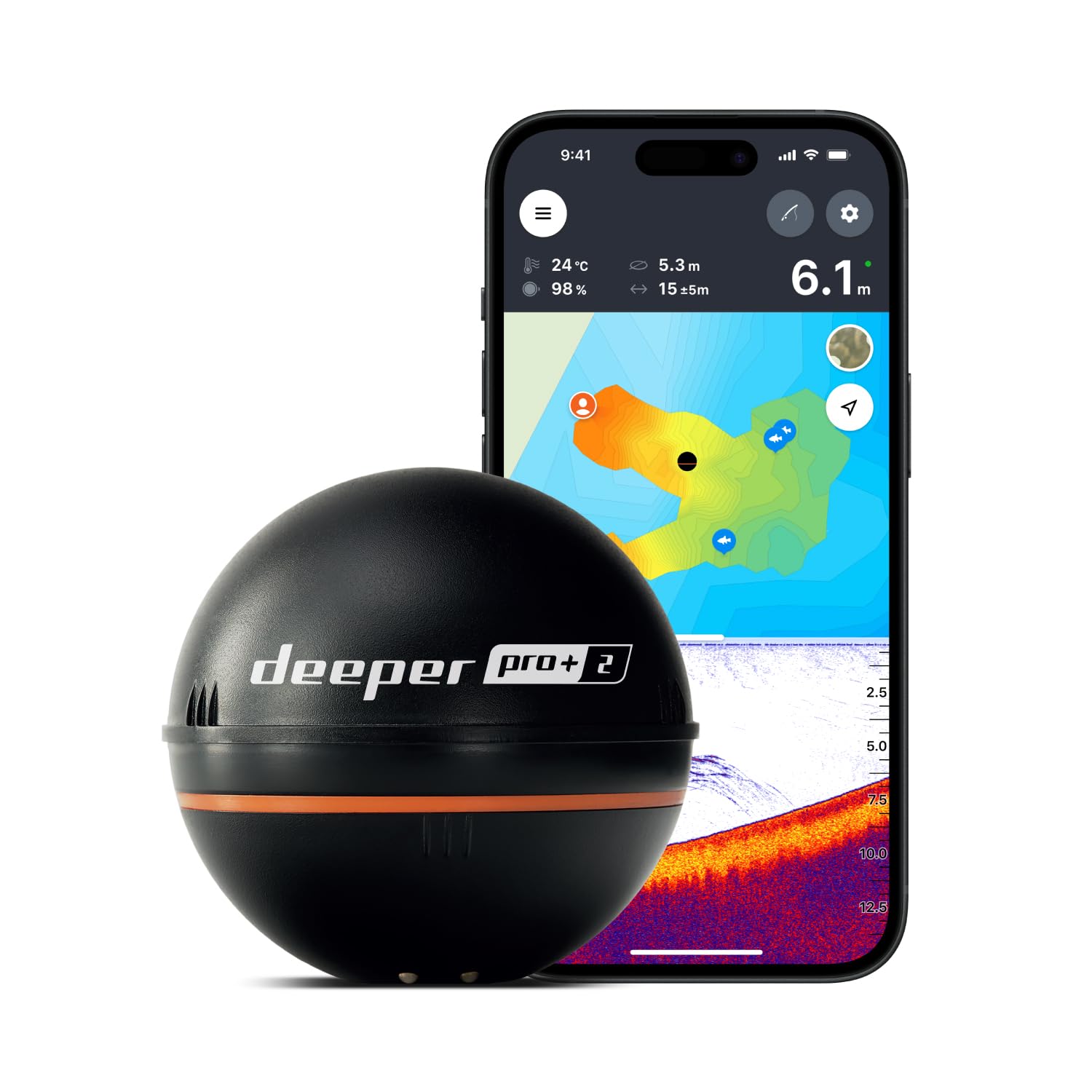
The castable ball that maps the lake bottom while you work a jig.
Cast this one, reel it across a flat, and it builds a bathymetric map — a contour drawing of the bottom — that saves to the Fish Deeper app. That is the draw for anyone who wants to learn a new lake and not just see right under the hole. It reads to 100 meters (about 328 feet by the maker’s own claim) on its own Wi-Fi link, and the box weighs 3.2 ounces, so it disappears into a tackle box. Just note the form factor gap: this ball is 2.56 inches on each side versus the Garmin Striker Plus 4 bundle’s 13.3 x 10.1 x 8.2-inch case and shuttle, so it is the packable choice by far.
Precision is where it makes its claim. Target separation is 0.4 inches on the narrow beam and 1 inch on the wide and mid beams, which lets you pick out a tiny jig when you are vertical jigging. Three beam options let you cover water or drill down on a single spot. The battery charges over USB-C, and the app handles storage of every map you make.
Reliability is the honest headline here — it draws the most owner discussion of anything about this unit, and it splits both ways. Some units run flawlessly, others arrive unusable or refuse to power on, and the recurring second gripe is the Wi-Fi connection cutting out mid-session. With no local screen, the phone is the only place you see the picture, so a dropped link ends your view too. Buy it for the mapping and the tight target separation, and understand the wireless link is the part that can let you down.
Why mapping hunters pick it
- Builds bathymetric maps from shore, dock, or bank into the app
- 0.4-inch target separation in the narrow beam
- Wide, mid, and narrow beams for coverage or pinpointing
- USB-C charging and a 3.2-ounce form factor
What it asks you to gamble on
- Reliability and Wi-Fi connectivity are the most debated points in owner feedback
- No built-in screen, so your phone is the whole display
Pick it for: lake-bed mapping and tight vertical-jigging detail from a castable ball.
Look elsewhere for: a self-contained display you can trust without a phone link.
5. Vexilar FLX-12 Genz Pack
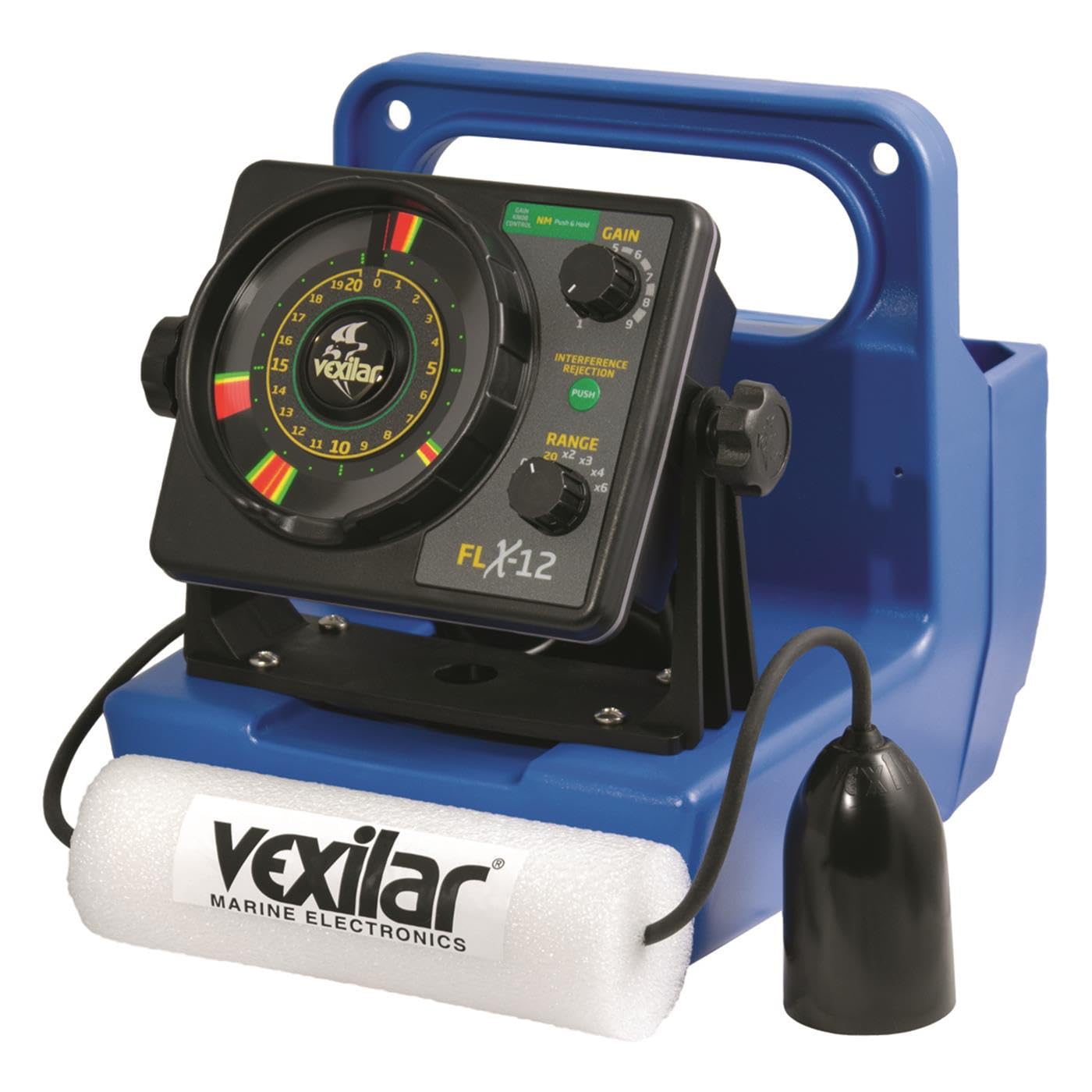
Built for skinny water, with a dim-the-lights mode for first and last drill.
Shallow-water panfish anglers get the most from this one. It has a special low-power mode that keeps target resolution sharp in extremely shallow water — the situation where a stronger sonar signal blows out the bottom and shows you nothing. It covers five depth ranges out to 120 feet, and the LED dial is a real flasher: a spinning readout that reacts to your jig instantly. There is also a night mode that dims the display, handy when the shack goes quiet and you want the ring to stop glaring.
This is the smallest-audience tool on the list in terms of feedback volume, but what feedback exists is clean — accuracy is the trait buyers bring up and it holds up well for a readout this simple. If you fish tight to structure and want to see a tiny jig and the fish sitting two inches off bottom, that low-power mode is the reason to choose it over a sharper-but-stronger unit.
The honest note: there is no GPS, no mapping, and no app — this is a dial and nothing more. If you want to save a hot spot or read a bottom profile, this is the wrong tool. Buy it because you want a flasher that reads shallow water well and keeps its own company.
Where it shines: a low-power mode for extremely shallow water plus a five-range dial to 120 feet and a night mode that dims the glare.
Good match for: panfish anglers working shallow lake flats who want a flasher dial with a low-power trick.
Mismatch if: you need mapping, GPS, or a screen — none of those live here.
6. Humminbird HELIX5 CHIRP G3 Ice Sonar System
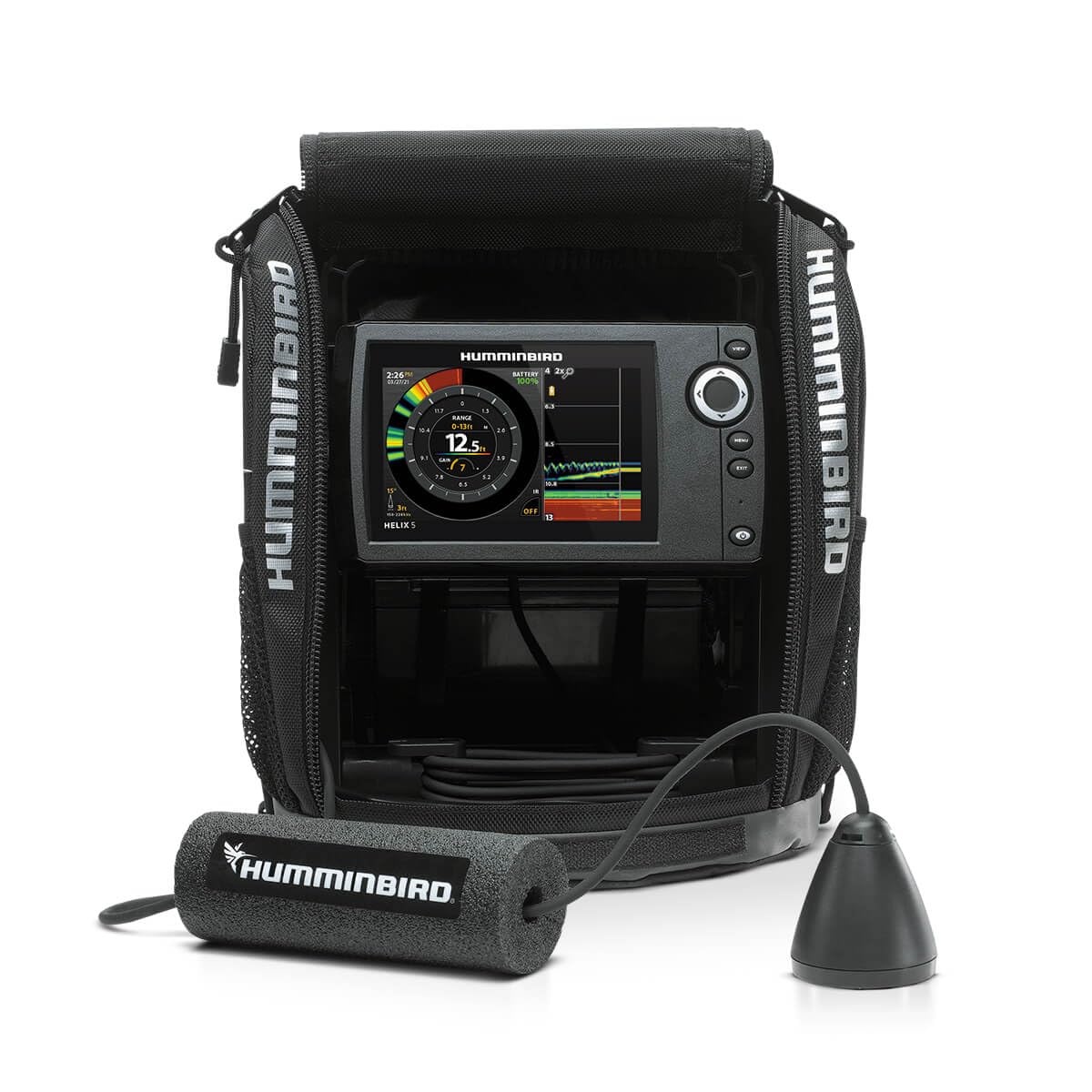
A five-inch CHIRP screen that swaps from hard water to open water with a transducer change.
If your season does not end when the ice goes out, this is the all-season pick. Dual Spectrum CHIRP in ICE mode gives crisp fish arches and clear bottom detail, and the bundle includes the XI 9 1521 ice transducer along with the shuttle, the 9Ah battery, the charger, and a portable bag. Mounts for open-water use are the flex it offers — you are buying one head unit that does two jobs.
The ICE views are the real story. Flasher, A-Scope (a vertical strip that shows exactly when your bait enters the cone), zoom, and interference rejection modes are all there, so you can tune out the angler drilling next to you. Built-in GPS on select models lets you mark waypoints and navigate between productive spots. At 5 inches the display is bigger than either castable ball and easier to read in a bright shack than a phone.
Weighing 12 pounds, this is not a unit you dangle from a backpack strap — it rides in the shuttle and gets pulled on a sled. That is the price of a real screen with real power behind it. The trade-off you accept for the all-season build is bulk, so if you are a bare-ice minimalist this is more machine than you need.
The two-season argument: Dual Spectrum CHIRP with flasher, A-Scope, zoom, and interference rejection, plus an ice transducer, 9Ah battery, and charger in the box.
Count the weight: at 12 pounds it belongs on a sled, not in a pocket.
Suits: anglers who fish both hard water and open water and want one head unit that covers both.
The catch: the five-inch screen and 12-pound build make this a sled-hauler, not a pocket rig.
7. Vexilar FL-18 Genz Pack
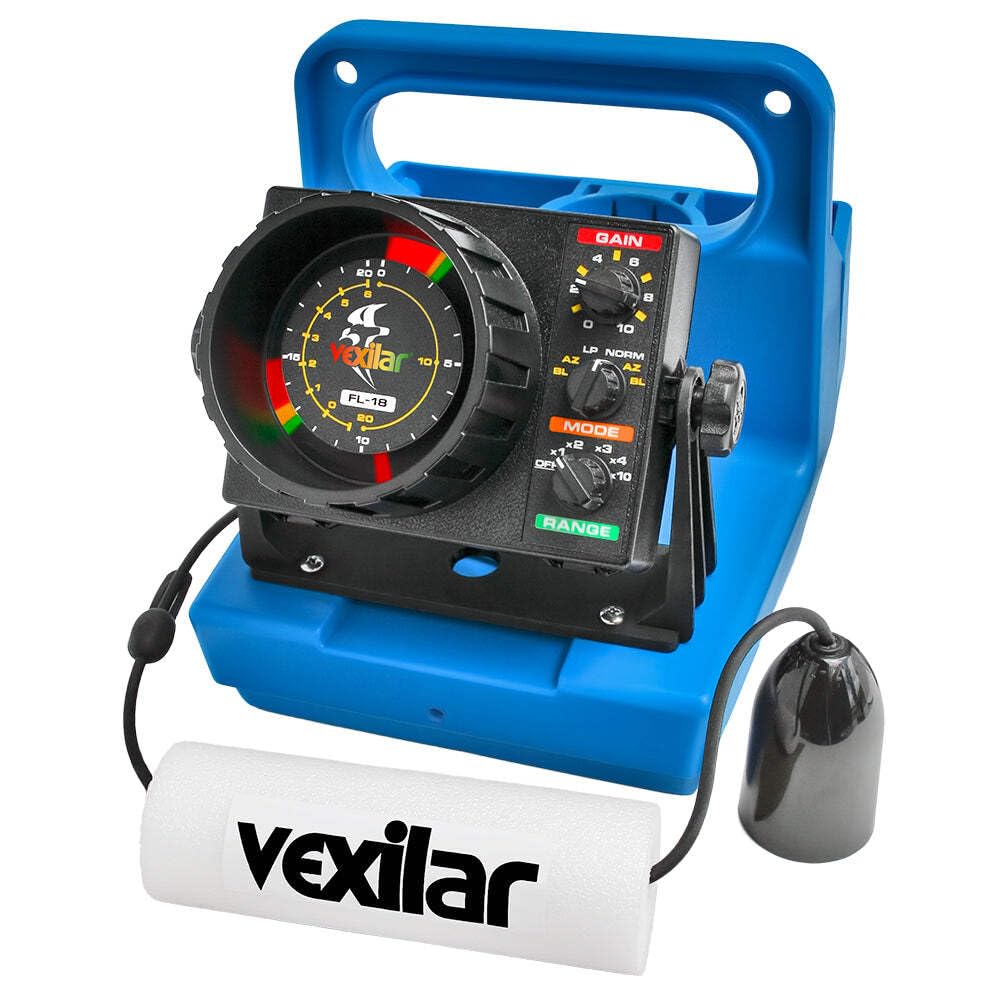
A dial ice anglers buy once and drag for a decade.
This is a flasher for the purist — an LED unit on the Genz Pack carrying system, the fan-favorite configuration that keeps the dial out in the cold where you can see it. There is no screen to squint at and no phone to pair. You drop the transducer in the hole, the ring spins, and your jig reads as a mark you can watch rise and fall. Buyers single out the FL-18 model, and the praise is straightforward: it simply works and is considered essential kit on the ice.
What it asks you to accept is a narrower toolkit. This is a flasher, so you get real-time dial feedback and not much else — no mapping, no contours, no saved waypoints. The counterweight is simplicity: fewer parts, fewer things to fail in the cold, and a dial layout you can read through a breath cloud.
The one real limitation is the one you bring with you: if you want to see structure drawn on a screen or save a spot to a map, this unit does not do that. It does its one job without drama, and for a lot of hard-water anglers that is exactly the point.
Why it lasts: an LED flasher on the Genz Pack, tuned for real-time jig feedback and built to keep working in cold conditions.
What it leaves out: no mapping or GPS — the dial is the whole tool.
Choose it if: you want a no-fuss flasher and care about live jig feedback over maps.
skip it if: you would miss contour mapping or saved waypoints.
8. Humminbird ICE 55 Flasher

A high-visibility six-color dial that separates bait from the fish chasing it.
The headline here is the display. A 526-segment, six-color fiber-optic center gives you instant target feedback, and the bright ring is easy to read even when the sun is on the ice. Target separation is the reason flasher fans pay for this — it distinguishes bait from fish in jigging scenarios, so you can see a fish slide up to your lure rather than guess. Adjustable gain and zoom let you lock onto the strike zone, and it reads to 200 feet, deeper than the Vexilar FLX-12’s 120 feet.
Cold-weather performance is baked into the shuttle and transducer build, and the box includes the XI 9 19 transducer, a 12V 9-amp-hour battery with charger, and a portable carrying case. It is compatible with ICE transducers and conversion kits if you want to expand later.
The honest caveat: reliability and sensitivity are the two points that split owner feedback, and the recurring gripe is a dial that occasionally acts up. With a bright display and a big frame, this is the pick for someone who plants on a bucket and reads a dial all day, not for a run-and-gun scout.
What you see: a 526-segment six-color fiber-optic dial with adjustable gain and zoom, reading to 200 feet.
What to watch: sensitivity and reliability draw mixed notes, so dial in the gain carefully.
Good for: bucket-sitters who want a bright, big dial and tight bait-versus-fish separation.
Not for: anglers who hop holes constantly and want a lighter carry.
9. MarCum LX-7Li Lithium Combo
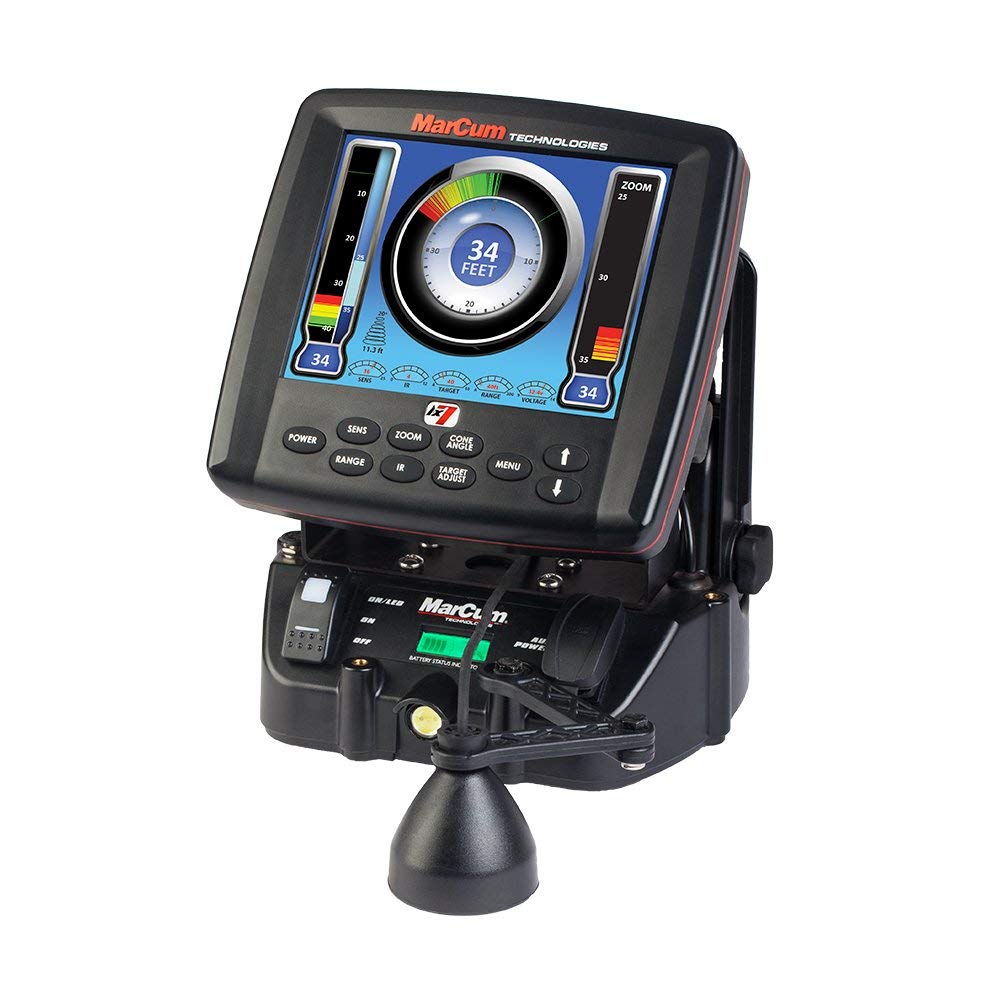
An eight-inch panel with 4,800 watts behind it and a lithium shuttle to carry it.
The feature that defines this unit is the display: an 8-inch flat-panel color LCD at 800×600 pixels with four color palettes to choose from. That is the largest screen on this list, and it makes split-screen layouts readable — you can run vertical, vertical zoom, flasher, graph, or graph zoom, or any combination, at once. The 4,800 watts of managed power push a dual-beam 8/20-degree transducer on an 8-foot cable, and it reads to 300 feet, deeper than the Vexilar FLX-12’s 120 feet and the ICE 55’s 200 feet.
Target separation is 1/2 inch, enough to tell a fish from the bottom or schooling fish from each other, and the patented Infinitely Adjustable Zoom lets you zoom anywhere in the water column. Twelve interference-rejection settings are there to tune out the noise around you. It all rides on the Marcum Lithium Shuttle, powered by a 12V lithium-ion battery and a 3-amp rapid charger, with a padded red soft pack and snow shield faceplate in the box.
The honest trade-off is weight at 11 pounds and the learning curve of a big feature set. This is a premium tool for the angler who wants the largest display and top-end depth, not a simple dial. If you are ready to use the split screens, it earns its keep on hard water.
Where the premium goes
- 8-inch 800×600 color LCD with four color palettes
- 1/2-inch target separation and Infinitely Adjustable Zoom
- 300-foot depth and 4,800 watts of managed power
- Lithium shuttle with a 3-amp rapid charger in the box
What it costs you in effort
- 11 pounds and a big feature set to learn
- More machine than you need if you want a simple dial
Sized for: anglers who want the biggest screen and deepest range here and will use the split-screen layouts.
Overkill if: you just want to drop a jig and read a bright ring.
Know the Specs
Target separation
The smallest gap the sonar can tell apart — the distance between your jig and a fish beside it. A tight figure means you see two separate marks instead of one blur, which is what lets you watch a fish rise to your bait. Loose separation turns a bottom-hugging fish into a lump of bottom.
Depth range
How deep the transducer can read before the return goes blank. A bigger number only matters if you fish big water; on a shallow lake you will never reach it. Pair the depth figure with beam angle, because a wide beam covers more ground while a narrow one drills into a spot.
CHIRP sonar
A signal that sweeps several frequencies at once instead of one, which returns cleaner marks and better bottom detail. It tends to read through the noise more cleanly than a single-frequency ping, so fish arches and structure look sharper on screen.
Shuttle and battery
The shuttle is the pack that holds the head unit and battery so you can move between holes. Lithium packs cut weight compared with sealed lead-acid, and the included charger tells you how fast you can top up between trips. Check whether the battery sits inside the shuttle or rides loose.
Common Questions
Do ice fish finders work through the ice without drilling?
What is target separation and why does it matter for ice fishing?
Can I use a castable fish finder for ice fishing?
How long does a fish finder battery last on the ice?
Is a flasher better than a screen for ice fishing?
Do I need GPS on an ice fish finder?
What beam angle should I look for on hard water?
Does a fish finder work in extremely shallow water?
Can I use an ice fish finder on a kayak or boat in summer?
How deep can an ice fish finder read?
The Bottom Line
For most anglers, the ice fishing fish finders winner is the Garmin Striker Plus 4 Ice Bundle. It puts a sharp 4-inch screen, CHIRP sonar (a signal that sweeps a range of frequencies for clearer returns), and built-in GPS mapping in one bag you can drop on the ice. Want a dedicated flasher dial instead? Reach for the Vexilar FLX-12 Genz Pack and its shallow-water low-power mode. Want the largest screen and deepest range here? The MarCum LX-7Li is the one to reach for — its 8-inch LCD and 300-foot depth are the top of this list. The Striker Plus 4’s crowd-favorite standing, 4.5+ stars across 400+ ratings, is a good reason to start there.
How we choose
We do not accept paid placement. Every pick is matched to a real buyer and a real use-case; we do not hands-on test units.
Sources
Specifications: manufacturer listings and product documentation. Review insights: verified customer reviews, as of November 2026. Pricing: not shown on this page (it changes often); check the current price via the retailer link.
As an Amazon Associate, Tactical Gear Guy earns from qualifying purchases. This does not affect which products we feature.