Specs are compiled from manufacturer listings and verified buyer reviews and can change over time — please confirm the key details on the product page before buying.
If you have ever felt a pipe wrench jaw slip off a rusted shower fitting and bark your knuckles, you already know the wrong tool costs you skin. The fix is a wider jaw opening, a longer handle for leverage, and teeth that bite instead of skate. This guide breaks down nine heavy-duty wrench picks built for plumbers, ironworkers, electricians, and home mechanics who are tired of rounding off stubborn nuts.
This guide is built by comparing the manufacturers’ published specifications and the patterns across verified customer reviews, so you get each pick’s real strengths and trade-offs instead of marketing spin.
You will see how jaw capacity, handle length, and steel choice each change what a wrench can actually do on a job site or under a sink. Each pick below is built for one specific job — match it to yours. Here are nine heavy-duty wrench picks that earn their place in your toolbox.
Top Picks


How To Choose The Best Heavy-Duty Wrench
Picking by brand name alone is the fastest way to buy the wrong wrench. Match the tool to the fastener first, then check the numbers. Here is what actually separates one heavy-duty wrench from another.
Start with jaw capacity, not handle length
Jaw capacity is the widest opening the wrench can clamp onto, and it is the one number that decides whether a tool can touch your job at all. A 1.5-inch opening handles most household nuts and small fittings. A 4-inch opening swallows large-diameter pipe, which is what you need for gas tank repair or oil field work. If your pipe is wider than the jaw opening, the wrench cannot grip it at all.
Handle length and shape set your leverage
Turning force comes from length and from how the handle spreads weight across your palm. A long I-beam handle — the shallow channel shape you see on serious pipe wrenches — gives you a straighter pull and less hand fatigue on a long job. Longer handles also reach deeper into a recess, which matters when a fitting sits behind a tank or under a sink.
Pipe wrench versus spud wrench versus ratcheting set
A pipe wrench is built to bite round, smooth pipe with angled teeth. A spud wrench has a tapered tail for lining up bolt holes on steel beams, plus an adjustable jaw for nuts. A ratcheting combination set is for hex fasteners in cramped engine bays, where a 72-tooth gear lets you work in a tiny swing arc. Each type is built for a different fastener — buy for the one you actually turn.
Side-by-Side Comparison
| Model | Best For | Jaw Capacity | Overall Length | Weight | Amazon |
|---|---|---|---|---|---|
| Bahco 9035 R US Ergo X-Wide★ Best Overall | Confined spaces and wide nuts | — (handles jobs up to 55mm) | 12 inches | 1 kg | Amazon |
| RIDGID Model 18 Straight Pipe WrenchMost Versatile | Daily plumbing work that lasts | 2.5 inches | 18 inches | 4 pounds | Amazon |
| GEARWRENCH 13-Pc SAE Ratcheting SetPremium Pick | Reversible ratcheting for SAE fasteners | — | 12.6 inches | 5.8 pounds | Amazon |
| HORUSDY 4-Pack Pipe Wrench Set | A full size range on a budget | — | 14 inches (largest of four) | — | Amazon |
| IRWIN VISE-GRIP 18-Inch Pipe Wrench | Stubborn valves and hammering | 2.5 inches | 18 inches | 2.7 pounds | Amazon |
| Lichamp 16-Inch Spud Wrench | Ironwork and hole alignment | 1.5 inches | 16 inches | 2.2 pounds | Amazon |
| KARRYTON 24-Inch Aluminum Pipe Wrench | Large pipe at arm’s length | 4 inches | 24 inches | 2.38 kg | Amazon |
| WORKPRO 10-Piece Ratcheting Set | Tight engine bays, full metric range | — | 19.69 inches | 2.84 kg | Amazon |
| KLEIN TOOLS 3239 Spud Wrench | Heavy nuts and tethering on a lift | 1.63 inches | 16 inches | 2.4 pounds | Amazon |
Detailed Reviews
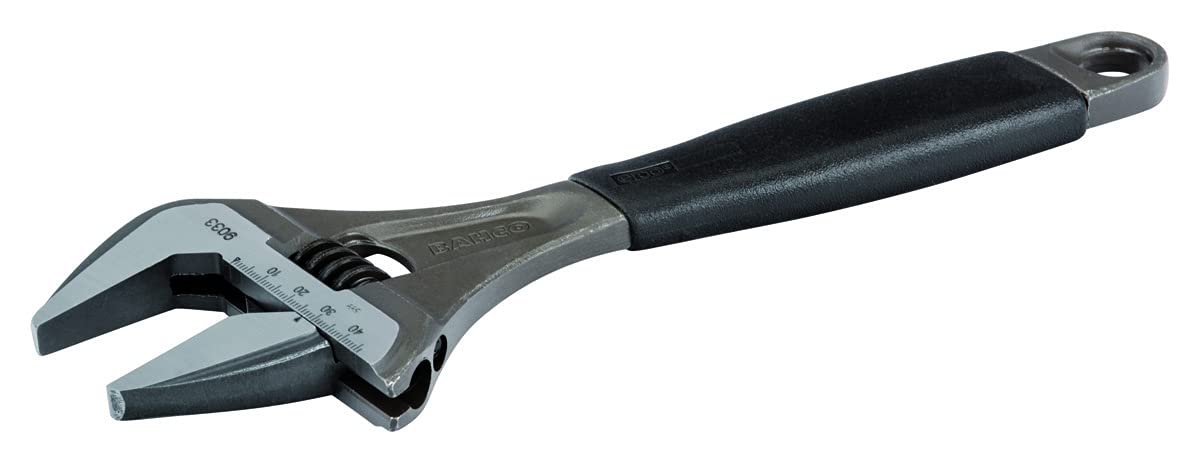
1. Bahco 9035 R US Ergo X-Wide Adjustable Wrench, 12-Inch
Our pick — 4.5+★ from 500+ verified ratings; the strongest balance of quality and price.
The wide-jaw shorty that reaches where a long handle simply cannot fit.
Most adjustable wrenches force a trade — you either get a jaw wide enough for a big nut, or a handle short enough to swing in a tight cabinet. Bahco builds both into one tool. The 12-inch handle keeps the swing tight for work behind a toilet or inside a panel, while the extra-wide jaws open far enough to handle jobs up to 55mm. If you are an electrician or plumber squeezing into confined areas, this is the shape you want.
It is shorter and lighter than the KARRYTON 24-inch pipe wrench — 12 inches next to 24 inches, and 1 kg against 2.38 kg — so it travels in a tool bag without dragging your shoulder down. The trade-off is reach: that extra length on the KARRYTON is what gives you leverage on a big pipe, and the Bahco does not try to compete there. It is built for access, not for hauling on stubborn four-inch pipe.
What wins people over is the grip — the jaws clamp and hold instead of skating off a rounded fastener. The build feels solid in hand, and the adjustment screw turns smoothly, which is what you want when you are re-setting the jaw one-handed overhead. Buyers report it handles jobs up to 55mm, and that is a real figure to check against your own fitting before you commit. The finish is a black phosphate treatment that resists corrosion, and the slim head with tapered jaws gets into gaps a fat head would block.
What buyers keep coming back to
- Extra-wide jaw opening reaches nuts many 12-inch adjustables cannot touch.
- Short 12-inch handle fits confined spaces where a long pipe wrench will not swing.
- Grip holds on rounded fasteners instead of slipping, per buyer consensus.
- Black phosphate finish resists corrosion on damp plumbing jobs.
Where it draws the line
- At 12 inches it gives up leverage against the 24-inch KARRYTON on large pipe.
- Not a pipe wrench — angled teeth for smooth round pipe belong to the RIDGID and IRWIN.
The right tool if: you work in tight cabinets and panels and need a jaw that opens wider than a normal 12-inch adjustable.
Look elsewhere when: the job is a big-diameter pipe that needs a long handle and pipe-wrench teeth.
2. RIDGID 31025 Model 18 Pipe Wrench
The pipe wrench that survives the floor jack and asks for the next job.
If your work is plumbing, day in and day out, the specification that matters here is the floating hook jaw. A full floating forged hook jaw pivots to seat itself flat against the pipe, so the bite stays even as you crank. The 2.5-inch jaw capacity covers the standard pipe sizes a service plumber meets, and the self-cleaning threads keep the adjustment turning even after a season of gunk. At 18 inches and 4 pounds, it is heavier than the Lichamp spud wrench at 2.2 pounds — you feel that heft, and that heft is what lets you put your shoulder into a stuck joint.
The I-beam handle and ductile-iron body are built to take a drop without shattering, and that is the durability reputation this tool carries. Owners mention it has taken brutal treatment and kept working, including one account of it surviving a floor jack. The replaceable hook and heel jaws are the quiet long-term win — when the teeth eventually wear, you swap the jaw instead of the whole wrench.
Two things to know before you buy. First, the teeth are made to bite pipe, so using this on chrome or polished fittings can mar the surface. Second, it complies with federal specification GGG-W65IE, Type ll, Class A — a real benchmark if your job site has spec requirements. The painted red finish makes it easy to spot in a dark crawlspace, which sounds small until you have hunted for a dropped wrench with a flashlight.
Editor’s read: the jaw replacement alone justifies the price over a sealed cast wrench — you buy the handle once and the teeth a few times.
Skip-worthy if: you need a lightweight carry tool for occasional use, where the IRWIN at 2.7 pounds trims some weight off the handle.
3. GEARWRENCH 13 Pc 72T Wrench Set
Thirteen SAE sizes and a reversing lever you can flip without lifting the wrench.
This is the set for anyone whose fasteners are measured in fractions, not millimetres. You get one wrench in each size from 5/16 inch through 1 inch, so the day you meet a 9/16 bolt you already own the answer. The flush mounted reversing lever lets you switch direction without pulling the wrench off the bolt — useful when you are backing out a fastener in a spot your hand barely reaches.
The 72-tooth gear is the heart of it. More teeth mean a smaller swing arc between clicks, so the wrench still turns a bolt where a coarser ratchet would jam against a firewall or a pulley. The off-corner loading design on the box end grips the flat of the nut instead of the corners, which is exactly how you avoid rounding a fastener that someone else already chewed up. Build quality feels solid in hand, and the polished finish wipes clean.
Two honest trade-offs. This is the heaviest tool on the list at 5.8 pounds for the set — that is the cost of thirteen steel wrenches in one roll. And the ratcheting mechanism is the part that draws complaints when a set is mistreated; treat the lever like a precision part and it holds. If your fasteners are metric, this set is the wrong measurement standard — go to the WORKPRO metric set instead. Same ratcheting idea, matching 8-19 mm range.
Built for: mechanics and DIYers who turn SAE bolts in cramped engine bays and want the full fractional range in one roll.
Not your set if: every bolt on your bench is metric, or you want a single general-purpose wrench instead of thirteen.
4. KLEIN TOOLS 3239 16-Inch Adjustable Spud Wrench

A forged spud wrench with a tether hole, built for work at height.
If you work off a lift or steel, the feature that sells this wrench is the designated lanyard hole. It takes the Klein TT1 tether, so a dropped wrench stops being a hazard to the crew below. The extra-wide adjustable jaw opens to 1-5/8 inch and fits heavy nuts and bolts up to 1 inch — a wider opening than the Lichamp spud wrench at 1.5 inches, and the difference matters when the bolt head is on the large side.
The 16-inch length comes with a continuous-taper handle, which is the part you use for lining up bolt and rivet holes rather than turning. That taper slips into a misaligned hole and pries the steel into position, which is why ironworkers carry a spud at all. The jaws are precision-machined and individually chosen and assembled by hand, and the knurl turns smoothly so you can set the jaw size without fighting it. The industrial finish resists corrosion on wet or outdoor sites.
Forged and made in the USA from select alloy steel at 2.4 pounds, it carries itself well on a belt. The dollar-per-inch math is the steepest on this list, and Klein backs it with a lifetime warranty on material defects and workmanship for the normal life of the product. Durability is what buyers praise here — the jaws hold their setting and the steel does not corrode. It is a specialist’s tool: if you never align structural holes, this is more wrench than your job calls for.
Why the pros carry it
- Lanyard hole takes the TT1 tether so the tool stays attached at height.
- Jaw opens to 1-5/8 inch for heavy nuts and bolts up to 1 inch.
- Continuous-taper handle aligns bolt and rivet holes on structural steel.
- Lifetime warranty on material defects and workmanship.
The honest caveats
- Premium-tier cost for a single wrench — you are paying for USA forging and the tether feature.
- Only worth it if hole alignment is part of your work.
Good match for: ironworkers and lift operators who tether their tools and align steel all day.
Overkill for: a homeowner who just needs to loosen a garden-hose fitting twice a year.
5. WORKPRO Ratcheting Wrench Set 10-Piece

Ten metric ratcheting wrenches that reach the bolt your hand cannot.
Here is the difference two sets can make: this WORKPRO set gives you 10 wrenches in metric sizes from 8 mm to 19 mm — that is more than twice the count of the HORUSDY four-piece pipe set, which covers four. The extra-long handles are the point. When a serpentine belt tensioner sits buried behind the engine, a standard-length wrench will not get there; the extra reach on these does, and the 72-tooth gear means you can ratchet in a 5-degree arc once you are in.
The 10-piece range covers the common metric sizes: 8, 10, 12, 13, 14, 15, 16, 17, 18, and 19 mm. The box end delivers torque without rounding the fastener, and the anti-slip tooth design holds tight even on nuts that years of wear have already rounded. Chrome vanadium steel with heat treatment and a black electrophoretic coating is built to resist corrosion. A heavy-duty rolling pouch with clear size markings, a hanging rope, and a strong fastener keeps the set organised on the go.
The catch is the measurement standard. These are metric only, so an SAE bolt will not fit — that is what the GEARWRENCH thirteen-piece set solves with its fractional sizes. And the 2.84 kg set weight is real when you carry it in a bag all day. For anyone working on modern cars and metric machinery, though, this is a complete working set in one roll.
The long-and-short of it: extra-long handles plus a 5-degree swing arc are what make hard-to-reach fasteners reachable — the tool reaches the bolt and then turns it without room to spare.
Where it stumbles: metric-only sizing leaves SAE jobs uncovered.
6. KARRYTON 24 Inch Aluminum Pipe Wrench, 4-Inch Jaw Opening

The widest jaw on this list and a handle long enough to use it.
Four inches. That is the jaw opening here, and it is the number that sets this wrench apart — it swallows pipe diameters up to 3 inches, and it is wider than the 2.5-inch jaw on both the RIDGID and the IRWIN. A 24-inch aluminum alloy handle gives you the reach to swing it, and the chromium-molybdenum jaw is drop forged for hardness so the teeth bite instead of skate. If your pipe is too big for a standard service wrench, this is the one that takes it.
The aluminum I-beam handle is the other smart piece. The maker states it is 40% lighter than cast iron wrenches, and at 2.38 kg this long wrench is easier to hold overhead than its full cast-iron size would suggest. The V-shaped jaw opening clamps onto pipes, bolts, and hex nuts, and the thirty-degree wave teeth are shaped to grip without slipping. A pair of industrial-grade Nitrile palmed gloves comes in the box, which is a thoughtful add for a tool this size.
Now the honest part. Durability is the weak spot in this wrench’s reputation — reports of it breaking apart early are the recurring complaint, and it is the most frequently cited concern in the feedback. A tool this wide and this affordable asks a lot of its jaw, and the failures cluster around heavy use. Buy it as a large-jaw helper, not as the daily driver a RIDGID is built to be.
Reach for this when: the pipe is wide enough that every other jaw on your rack falls short.
Keep it as a helper: for daily heavy work, the RIDGID’s durability is the safer bet.
7. HORUSDY 4 Pack Heavy Duty Pipe Wrench Set, 8″ 10″ 12″ 14″

Four pipe wrenches in four sizes, one bag, one small outlay.
A home garage does not need one perfect pipe wrench; it needs the right size on hand when a fitting fights back. This HORUSDY set covers 8, 10, 12, and 14 inches, so the small 8-inch gets into tight tank work while the 14-inch gives you the leverage to crack a stubborn joint. For home plumbing, tank maintenance, and vehicle jobs, that spread does most of what a single big wrench would do — and covers more.
The build is honest for the tier. The handle is high-strength malleable cast iron and the head is heavy forged steel, and the sharp teeth are shaped to seat on smooth round surfaces like shower heads, bathroom sinks, and gutters. The handles are wrapped in plastic so you can grip firmly without the wrench sliding in your palm, and the wide I-beam handle spreads weight to save your arm on a long pull. Quality is what buyers praise most — it is the aspect that comes up again and again.
Understand a few limits. This is a set that does the job, not a set built for daily trade use, and the mixed feedback on durability reflects that. Several note the wrenches run a little loose in the adjustment. Treat it as the good-enough garage set it is, and the price-to-coverage is hard to argue with: four tools in one bag for the cost of one decent single wrench.
Fair read: the plastic-wrapped handles and I-beam shape make long pulls less punishing on the hand, which is a nice touch at this tier.
Size it right: four sizes cover more household jobs than one large wrench, but the adjustment runs loose, so expect to re-set the jaw as you work.
8. Lichamp 16-Inch Adjustable Construction Spud Wrench

A light ironworker’s spud with a tapered tail for lining up holes.
For aligning steel, reach and weight matter more than brute force. This spud wrench runs 16 inches overall and weighs 2.2 pounds — lighter than the 2.7-pound IRWIN pipe wrench, which makes it easier to swing into place one-handed on a beam. The tapered end is the working end for iron work: it slips into a misaligned hole and coaxes the steel into line.
The adjustable jaw opens to 1-1/2 inches, and the wrench carries both imperial and metric scales right on the tool, so you can check a fastener without pulling out a tape. Drop-forged alloy steel with a black oxide finish resists corrosion on an outdoor site. Quality is the leading praise in the feedback, and value for money runs second — buyers feel they got a solid spud for the outlay.
The one thing to watch is jaw alignment. The jaws can come in loose, and a loose jaw wanders as you turn, which is annoying on a precision fit. Add a drop of care on wet sites — a few note surface rust appears if it lives outdoors. Neither is a reason to pass it up for iron work, where its taper and light weight are exactly what the job wants.
Where it earns its keep
- 2.2 pounds is light enough to swing one-handed up on a beam.
- Tapered tail aligns holes for ironwork and rivet fits.
- Imperial and metric scales printed on the tool for quick checks.
- Black oxide finish resists corrosion on outdoor sites.
What to square away first
- Jaws can arrive loose, so re-set the adjustment before a precision pull.
- Surface rust shows up if it sits outside — wipe it down after wet days.
Fits the ironworker who: aligns beams all day and wants a light spud that will not tire an arm.
Not the best fit for: a pipe job that needs a jaw wide enough for big fittings.
9. IRWIN VISE-GRIP Pipe Wrench 18-Inch
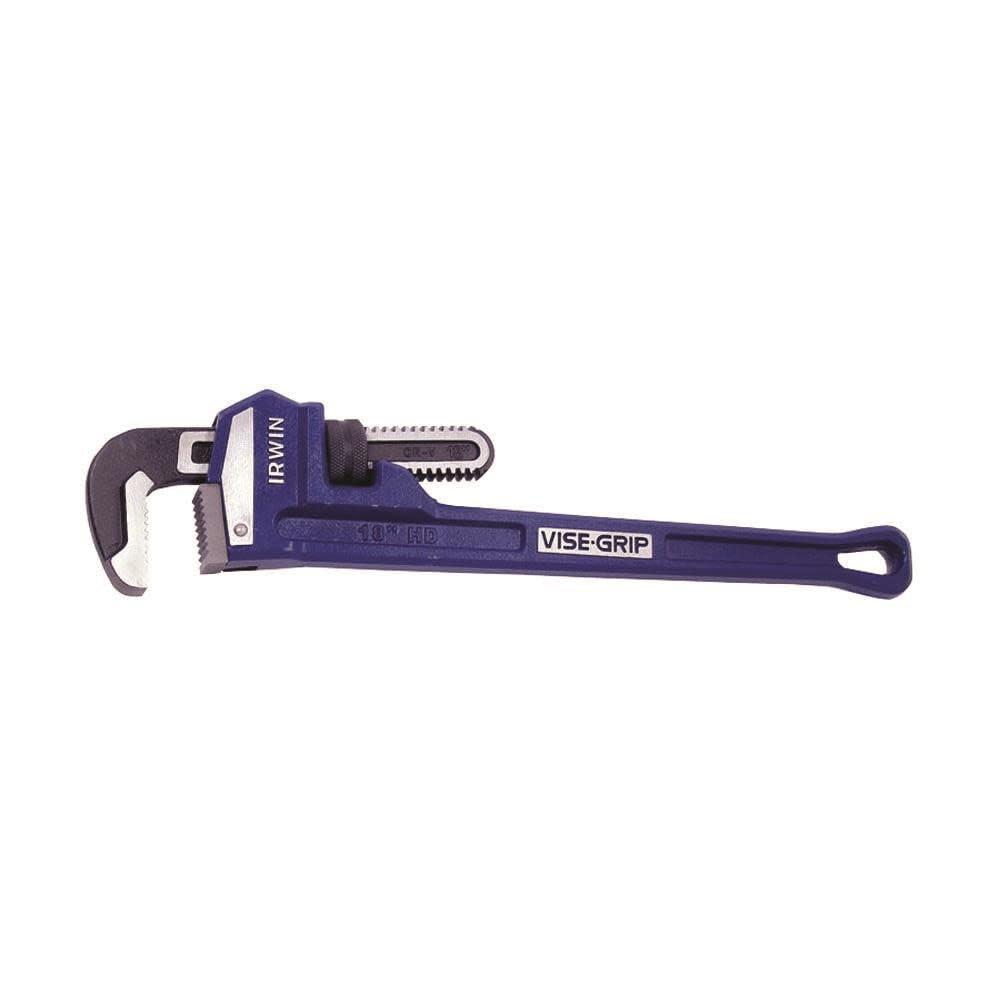
A pipe wrench with a flat hammer face where you least expect a tool to be useful.
Two jobs in one hand: this IRWIN’s head has a unique hammer-head design, giving you a flat surface for tapping on a stuck fitting without reaching for a second tool. The 2.5-inch jaw capacity handles standard pipe, and the hardened teeth are shaped to bite hard when you load them. The I-beam handle spreads weight, so you can lean into a pull without your palm burning at the corner.
Drop-forged cast iron, heat-treated to resist distortion or breakage, is the backbone here — the material is chosen for what happens when a wrench falls off a ladder. At 2.7 pounds and 18 inches, it sits between the light Lichamp spud and the heavy 4-pound RIDGID, which makes it an easy carry for a tool bag. The easy-spin adjusting nut is heat-treated too, so the jaw stays adjustable even after a season of use.
What customers note is strength — it breaks tough valves loose, including high-pressure ones. That is the trait you want on a stuck joint. The caution is cosmetic: the wrench you receive does not always look exactly like the pictured version, and the finish can carry marks. Function is not affected. If appearance matters for a gift, check the listing carefully; if you just need a wrench that bites, this is a workhorse that will get the job done.
Real strength: the hammer face is the kind of detail you only appreciate after you have tapped a fitting with the back of a wrench and wished you had a proper surface.
Finish caveat: the delivered look can differ from the photo, so buy for the function, not the picture.
Know the Specs
Jaw capacity — the number that decides if the tool fits
Jaw capacity is the widest opening the wrench can clamp onto, and it is the first spec to check against your job. A 1.5-inch opening suits household nuts and small fittings, while a 4-inch opening takes on large-diameter pipe. If the fastener is wider than the jaw opening, the wrench cannot grip it, whatever the handle length. Measure the pipe or nut across its width before you buy.
Ratchet teeth and swing arc — for tight spaces
On a ratcheting wrench, the tooth count sets how much room you need to work. A 72-tooth gear clicks into a smaller arc than a coarse ratchet, so the wrench still turns a fastener where there is barely room to move. That is what makes a ratcheting set useful in an engine bay or behind a panel, where a plain wrench would need a full half-turn of clearance.
Handle length and I-beam shape — your leverage
Turning force grows with handle length, and the I-beam shape spreads that force across your palm so a long pull does not dig in. A longer handle also reaches deeper into a recess, which is why pipe wrenches run long. The trade is swing room: a long handle needs space around it, so a shorter wrench wins inside a cabinet.
Steel type and finish — weight and corrosion
Alloy steel and chromium-molybdenum jaws are drop forged for hard teeth that resist wear, while cast iron bodies take a knock without shattering. Aluminum handles shave weight — the maker of the KARRYTON wrench states its aluminum handle is 40% lighter than cast iron wrenches. Finishes like black phosphate, black oxide, or powder coating slow corrosion on damp and outdoor jobs.
Common Questions
How do I know which jaw capacity I need for my pipe?
What is the difference between a pipe wrench and a spud wrench?
Will an adjustable wrench round off a bolt?
Should I buy metric or SAE wrenches?
How many teeth should a ratcheting wrench have?
Can I use a pipe wrench on a chrome fixture?
How long should a heavy-duty wrench handle be?
Does a package offer tethering for work at height?
What should I check on a pipe wrench before a first use?
Can I replace worn jaws instead of the whole wrench?
The Bottom Line
For most people, the winner of this heavy-duty wrench lineup is the Bahco 9035 R because its extra-wide jaw reaches nuts a normal 12-inch adjustable cannot, and it still fits in tight spaces. If daily plumbing is your job, grab the RIDGID Model 18 — the replaceable jaws and the floating hook grip make it the one that lasts. For metric fastening in cramped engine bays, the WORKPRO 10-piece set is the one to reach for. Whatever you pick, match the jaw opening and measurement standard to the fasteners on your bench first — that single check is what keeps a heavy-duty wrench from becoming a drawer ornament.
How we choose
We do not accept paid placement. Every pick is matched to a real buyer and a real use-case; we do not hands-on test units.
Sources
Specifications: manufacturer listings and product documentation. Review insights: verified customer reviews, as of November 2026. Pricing: not shown on this page (it changes often); check the current price via the retailer link.
As an Amazon Associate, Tactical Gear Guy earns from qualifying purchases. This does not affect which products we feature.