Specs are compiled from manufacturer listings and verified buyer reviews and can change over time — please confirm the key details on the product page before buying.
A gas tankless heater heats water only as you use it, so a shower no longer runs cold halfway through. The catch is that these units are not interchangeable — flow rate and BTU output decide whether your household of four gets a comfortable shower or a lukewarm trickle. This guide breaks down the trade-offs across 11 units so you can match one to your plumbing, climate, and family size.
This guide is built by comparing the manufacturers’ published specifications and the patterns across verified customer reviews, so you get each pick’s real strengths and trade-offs instead of marketing spin.
You will learn how flow rate, BTU rating, venting, and freeze protection actually affect daily use. Whether you are replacing an old tank or sizing a new install, the picks below are ranked by GPM, BTU output, venting, and freeze protection.
Top Picks


How To Choose The Best Gas Water Heater
A tankless gas heater is a multi-year purchase, and an undersized unit shows it every morning. Three specs — GPM, BTU output, and UEF — settle most of the decision before you read a single marketing line.
Flow Rate and BTU Output
Flow rate is measured in GPM (gallons per minute) — the volume of hot water the unit can deliver while it is running. A 4.3 GPM unit like the Ranein handles 3-4 water points, while an 11 GPM model like the Rinnai RX199iN can feed up to seven fixtures at once. BTU (British Thermal Units) measures heating power, and the two numbers work together: more BTUs let the unit raise more water to temperature in the same time.
Condensing vs Non-Condensing
A condensing unit captures heat from the exhaust gas that a non-condensing model lets escape. The Rinnai RX199iN reaches a UEF (Uniform Energy Factor, a standard efficiency score) of.98, while the Rheem RTG sits at 0.82. Higher UEF means lower monthly gas use, but condensing units need a drain line for the condensate they produce.
Venting and Installation
Every indoor tankless heater needs a vent pipe to carry exhaust outside. Some units require a specific diameter — the GASLAND Gasmart C Max needs a 3-inch exhaust pipe, and the APUS ships with its vent pipe included. Professional installation is recommended across the board because gas line connections and code compliance are not DIY territory.
Climate and Freeze Protection
If you live where winters drop below freezing, look for built-in freeze protection. The Ranein resists temperatures down to 14°F, and the APUS activates its freeze protection near 41°F. Without it, a cold snap can crack the heat exchanger and take the whole unit offline.
Side-by-Side Comparison
| Model | Best For | Flow Rate | Heat Output | Weight | Amazon |
|---|---|---|---|---|---|
| Rinnai RX199iN★ Best Overall | Whole-home performance | 11 gpm | 199,000 BTU | 55 lbs | Amazon |
| APUS Natural Gas TanklessBudget Champion | Budget-friendly 3-4 point installs | 5.43 gpm | 120,000 BTU | 19.2 lbs | Amazon |
| Ranein Natural Gas TanklessMost Popular | Preset modes and easy setup | 4.3 gpm | 100,000 BTU | — | Amazon |
| GASLAND Gasmart C Max | Tight spaces and small homes | 5 gpm | 113,000 BTU | — | Amazon |
| Mizudo 120,000 BTU WiFi | Smart control and indoor/outdoor flexibility | 5.1 gpm | 120,000 BTU | — | Amazon |
| GASLAND Gasmart E | High-capacity value | 7.6 gpm | 199,000 BTU | 37.5 lbs | Amazon |
| Westinghouse 180,000 BTU | Low-pressure and well-water homes | 7.9 gpm | 180,000 BTU | 39.3 lbs | Amazon |
| Rheem RTG Series | Large families, 3-4 bathrooms | 9.5 gpm | 199,900 BTU | 46.5 lbs | Amazon |
| Rinnai RE199iN | Non-condensing whole-house value | 9.8 gpm | 199,000 BTU | 52.1 lbs | Amazon |
| Noritz NRC66DVNG | Efficient mid-capacity condensing | 6.5 gpm | — | 38 lbs | Amazon |
| A. O. Smith ATI-540P-N | Instant recirculation for big homes | 10 gpm | 199,000 BTU | 61 lbs | Amazon |
Detailed Reviews
1. Rinnai RX199iN Condensing Smart Sense Tankless Water Heater
Our pick — 4.5+★ from 150+ verified ratings; the strongest balance of quality and price.
The whole-home workhorse that feeds seven fixtures without breaking a sweat.
Where most tankless heaters on this list top out around 5 GPM, this Rinnai pushes 11 GPM — more than double the Ranein’s 4.3 GPM and enough to run up to seven fixtures at once. The 199,000 BTU heat output matches the A. O. Smith and the Rinnai RE199iN, but the condensing design lifts efficiency to a UEF of.98, the highest figure in this group. For a large household where two showers and a dishwasher can overlap, that headroom is the whole point.
Buyers consistently say the hot water simply never runs out, and heating kicks in fast. The flexible install matters too: Rinnai’s Versa Vent system lets the same unit go indoors or outdoors (with the RX-OVC vent cap required for outdoor use), and the Smart Sense gas control runs on either propane or natural gas. At 55 pounds it is the heaviest pick here — the APUS is just 19.2 pounds — so plan for two people and a solid wall anchor.
The one honest caveat is noise. Most owners call it quiet, but it is not silent, and a low hum is part of the deal with any tankless unit. The bigger consideration is install: Rinnai strongly recommends a qualified technician, and the 5-year labor warranty only holds if you register within 90 days of installation.
What earns it the top spot
- 11 GPM flow feeds up to seven fixtures at once
- UEF of.98 — the highest efficiency on this list
- Runs on propane or natural gas via Smart Sense control
- Versa Vent allows indoor or outdoor installation
- 15-year heat exchanger warranty
Where it asks more of you
- 55 pounds — heaviest unit reviewed, needs two installers
- Low hum is audible, though most owners call it quiet
- WiFi control needs the Controlr module, sold separately
- Labor warranty requires registration within 90 days
Built for big households: This is the pick for a large home that needs to run several fixtures at once without a temperature drop.
Know before you buy: It is the heaviest and most install-intensive unit here, so budget for a licensed technician.
2. APUS Natural Gas Tankless Water Heater 120,000 BTU
A featherweight 19.2-pound unit that punches well above its size on paper.
At 19.2 pounds the APUS is the lightest heater on this list — the Rinnai RX199iN weighs 55 pounds, and even the compact GASLAND Gasmart C Max has a much narrower 9.6-inch body. That light weight makes it a realistic one-person install onto a wall, and its 19.29-inch width is roughly double the C Max’s 9.6 inches, so measure your closet or utility nook before ordering. The 120,000 BTU output and 5.43 GPM flow suit a home with 3-4 water points — two showers plus a sink running together, for example.
What wins buyers over is the build quality relative to the outlay. Owners describe it as better-made than they expected, straightforward to hang, and good-looking on the wall. The ±1°F temperature control from 95-149°F holds steady when another tap opens, and the freeze protection kicks in near 41°F so pipes do not crack in a cold snap. An LED touchscreen keeps your setting visible at a glance.
The catch is heat consistency. While plenty of owners say it heats quickly and delivers good hot water, a share report only lukewarm results — usually a sign the unit is sized too small for the demand on it. If you routinely run two showers plus laundry at once, step up to a higher-BTU model like the GASLAND Gasmart E at 199,000 BTU. For a smaller household, this is a lot of heater for the outlay.
The value play: Quality and easy installation are what buyers praise most, and at 5.43 GPM with a 2-year warranty this is a sensible entry into tankless for a modest home.
Size it honestly: The reported lukewarm results point to under-sizing on busy households, so match the 120,000 BTU ceiling to your real demand.
Reach for this if: You have 3-4 water points and want a light, affordable unit you can hang without a crew.
Look elsewhere if: Your family runs multiple high-flow fixtures at the same time and needs more BTU headroom.
3. Ranein Natural Gas Tankless Water Heater 4.3 GPM
Four one-touch modes and cold-weather protection in a compact 100,000 BTU package.
The draw here is the four intelligent preset modes — a one-click switch for 4-season, Kitchen, Bathtub, and Shower. Kitchen defaults to 100°F, and the bathtub mode supports 50-800L volume adjustment, so you set it and stop fiddling with the temperature dial every time you switch tasks. The 95-155°F adjustable range includes a high-temp lock that prevents scalding, which matters in a house with kids or older family members.
Freeze protection is built in with a dedicated anti-freeze device rated to resist 14°F/-10°C, so it will keep pipes from cracking in a hard cold snap. Add overheat, dry-burn, exhaust-blockage, and low-water-pressure startup protection, plus a fan-forced exhaust that guards against CO leakage, and the safety package is thorough for a 100,000 BTU unit. The technical specs also list a 116 psi maximum pressure and a 155°F maximum temperature.
The honest caveat is durability. Performance and quick setup are what buyers praise most, and many units are going strong long after install — but a share report failures starting around the 8-month mark. That pairing of a large, generally happy owner base with a smaller failure tail points to install conditions and water quality as likely culprits, not a design-wide flaw. Have a licensed plumber check your gas line pressure before you commit.
Reasons buyers choose it
- Four preset modes for kitchen, bath, shower, and all-season
- High-temp lock protects kids and elders from scalding
- Anti-freeze device handles down to 14°F/-10°C
- Temperature memory saves your preferred setting
The trade-off to weigh
- 100,000 BTU limits it to 3-4 water points
- A minority report failures around 8 months in
- Fan-forced exhaust requires proper vent install
Pick it for simplicity: The preset modes and scalding lock make this an easy, family-friendly choice for a 3-4 point home.
Check your install: A qualified tech on the gas connection is the best insurance against the durability issues some owners hit.
4. GASLAND Gasmart C Max Tankless Water Heater
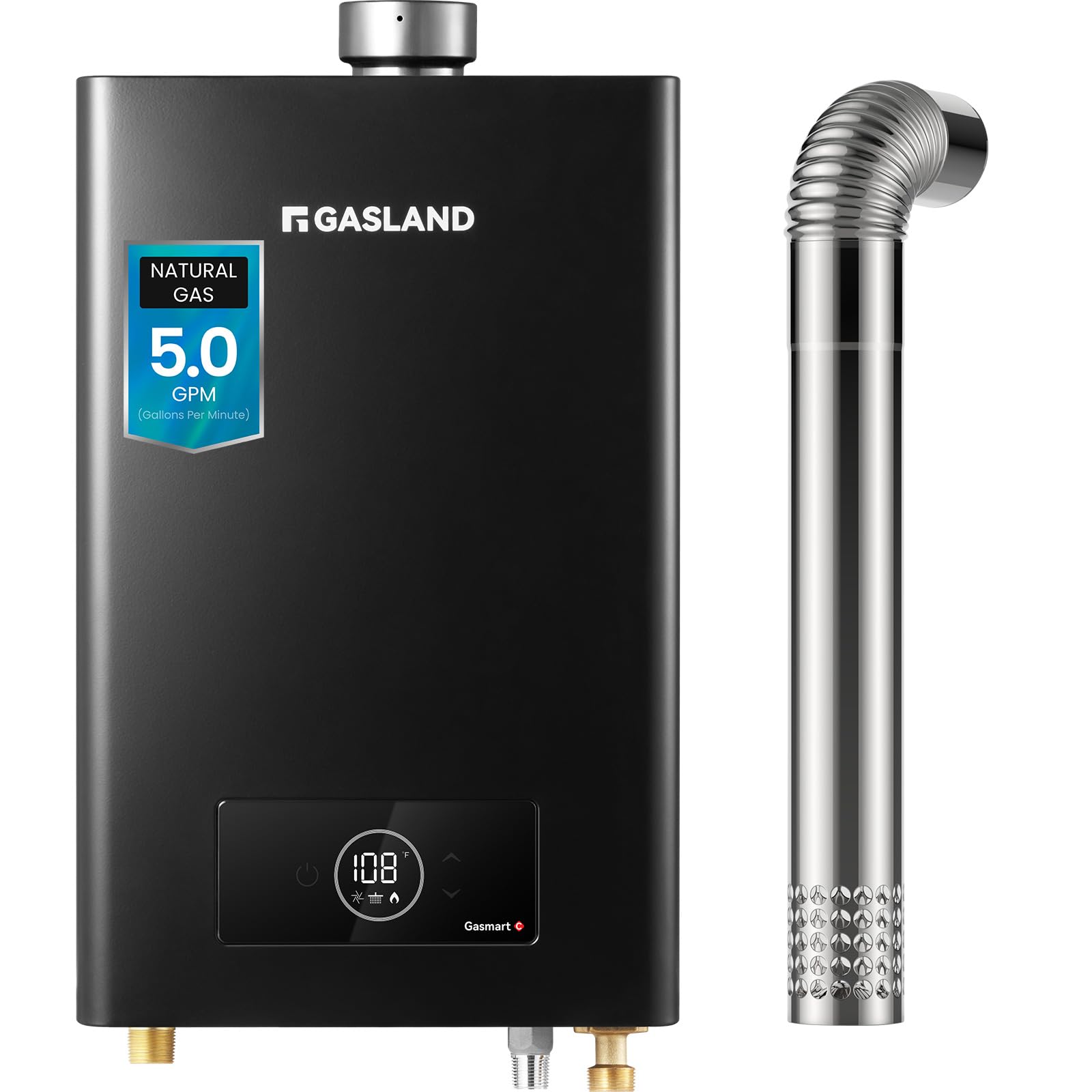
The closet-friendly square of a heater built to shrug off hurricane-force wind.
At just 9.6 inches wide and 15.6 inches tall, this is the most space-efficient unit here — less than half the width of the 19.29-inch APUS, so it slips into a tight utility closet or basement corner where a bigger box will not go. The 5 GPM flow and 113,000 BTU output are rated for a single-family home, and the 1/2″ NPT connections match most standard plumbing so your plumber is not hunting for adapters.
The engineering has some genuine standouts. A DC variable-frequency fan is rated to withstand Category 10 typhoon-force wind, avoiding backflow and flameout in extreme weather — a real consideration on an exposed exterior wall. Safety is thorough for the category: built-in freeze protection that starts heating below 41°F, an overheat cutoff fuse, inlet and outlet thermistors to monitor temperature, and a built-in flame sensor. The LED display shows water flow, fan, and flame status with error codes to speed up diagnosis.
Two limits deserve a close read. First, it must be installed in a well-ventilated area and is not recommended above 2,000 feet of elevation, so mountain homes need a different unit. Second, the 3-inch exhaust pipe is a fixed requirement — check that against your venting plan before you buy. The 80+ ratings back a solid owner experience on performance, though water flow draws mixed feedback.
Space-saving win: The 9.6-inch body and typhoon-rated fan make this a smart pick for a small home with a tight install spot and a windy exposure.
Height matters: The 2,000-foot elevation ceiling rules it out for many mountain properties.
Best for the space-starved: A compact single-family home with limited wall room and standard plumbing.
Not for high country: Homes above 2,000 feet of elevation should look at a different model.
5. Mizudo Natural Gas Tankless Water Heater 120,000 BTU
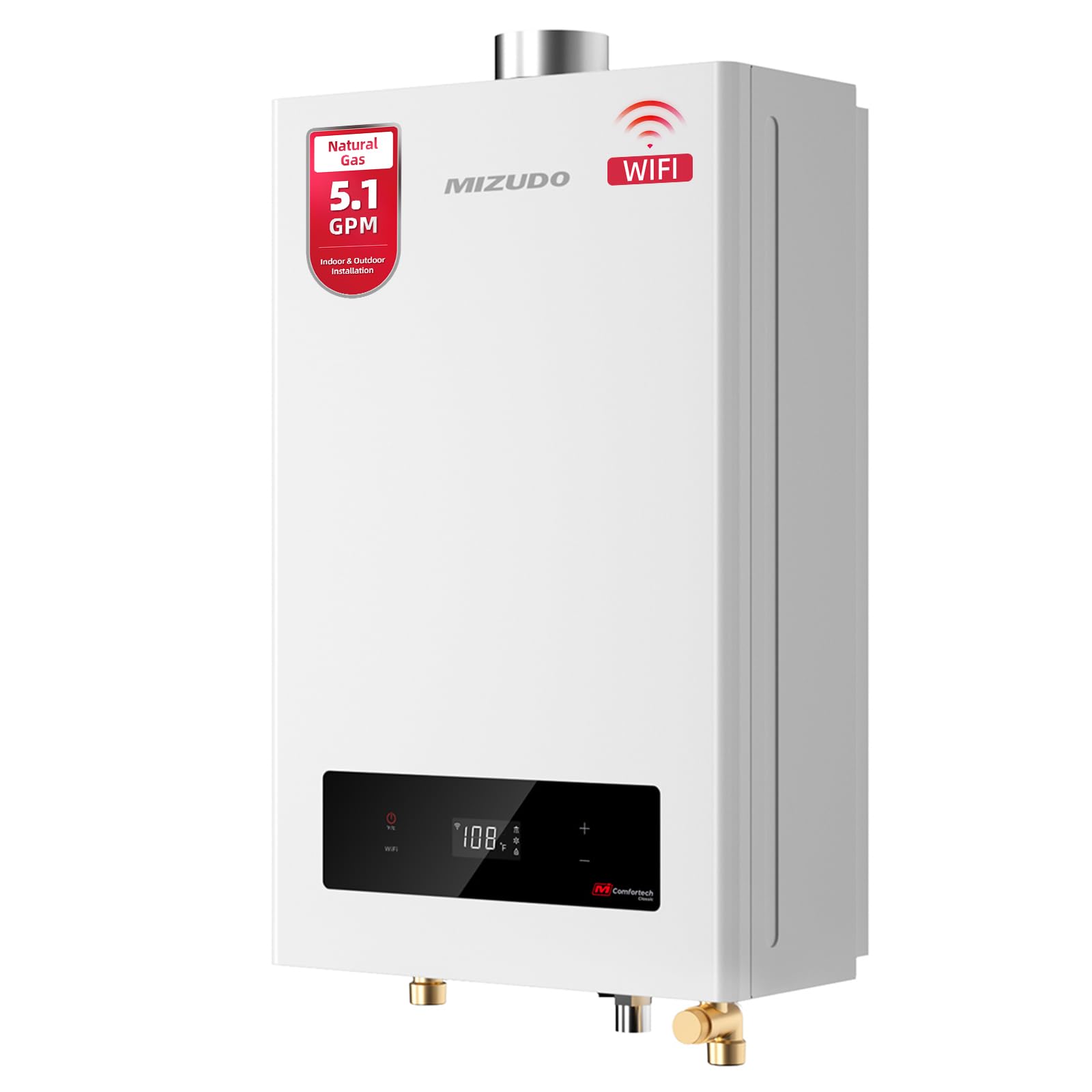
The heater you can move outdoors later and adjust from your phone.
Flexibility is the headline. This Mizudo installs indoors from the start, then converts to outdoor use with an accessory kit you buy separately, so the same unit follows you if your space needs change. The dedicated app handles temperature settings, energy monitoring, and maintenance alerts from anywhere — a feature none of the budget picks here offer. The 120,000 BTU output and 5.1 GPM flow cover 2-4 outlets, with ±1°F temperature stability during simultaneous fixture use.
Build quality earns the most praise, with industrial-grade phosphorous-deoxidized copper in the heat exchanger and a stainless steel combustion chamber. It is CSA certified for US safety standards and packs freeze protection, dry-burn prevention, flame-failure detection, and exhaust-blockage protection. The warranty covers the full unit for 2 years and the heat exchanger for 5 — solid for this price tier. Size is another win, with tiny-home owners finding the footprint a good fit.
The one trade-off is output consistency. Most owners get plenty of hot water for showers and kitchen use, and heating speed is quick — but a share report only 60-90 seconds of hot water before it turns cold. That pattern usually signals the 120,000 BTU ceiling is being pushed harder than it should, so match it to a household of two or three rather than a large family. Required venting is specific: a 3-inch OD vent pipe indoors or the Mizudo vent cap kit for outdoor.
The smart-control angle: App control, energy monitoring, and indoor-to-outdoor flexibility make this the most adaptable unit under the premium tier.
Weight the output reports: The short bursts of hot water some owners describe are a sizing signal, not a defect — stay within 2-4 outlets.
The pick if you like smart home control: A 2-4 outlet home where remote temperature management and future outdoor flexibility matter.
Look bigger if: You have a large family that runs several fixtures at once and needs more sustained output.
6. GASLAND Gasmart E Tankless Water Heater
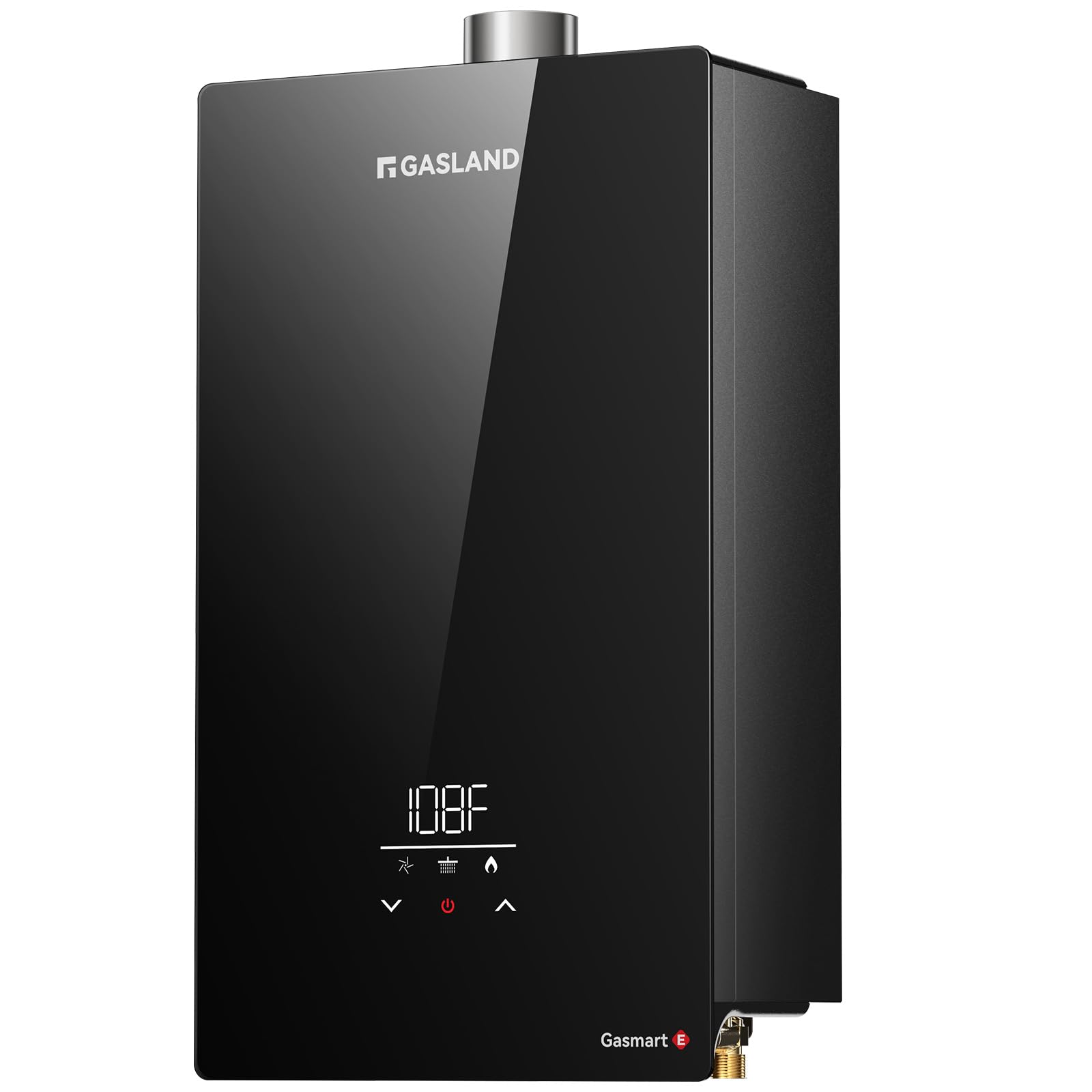
A full 199,000 BTUs and 7.6 GPM without the premium-tier outlay.
If you want serious whole-house capacity but not the premium price, this is the bridge pick. The 199,000 BTU output matches the Rinnai RX199iN and the Rinnai RE199iN, and at 7.6 GPM it sits above the Westinghouse’s 7.9 GPM only slightly below — but reaches that capacity in a 37.5-pound body, roughly 18 pounds lighter than the Rinnai RX199iN. That makes the wall-mount install more manageable.
Efficiency is a genuine selling point. The UEF of 0.8 beats a 50-gallon tank water heater’s 0.6, and GASLAND claims it is 34% more energy-efficient as a result — manufacturer figures, but a fair benchmark for comparing condensing versus tank. The compact suitcase-sized body fits a closet or basement, and the built-in overheat, flame-out, and freeze protection covers the safety essentials. A CSA certification backs the claims, and the 1-year free-replacement policy is reassuring.
Installation is where experiences diverge. Most owners find it performs well, heats water quickly, and delivers enough flow — a strong endorsement for the capacity you get. But the instruction manual draws criticism from a share of buyers, so plan on a licensed installer who does not depend on the included paperwork. The 140°F maximum temperature is lower than the Westinghouse’s 149°F and the Ranein’s 155°F, so very hot-water households should check that ceiling.
Where it delivers
- 199,000 BTU at 7.6 GPM for whole-house capacity
- UEF of 0.8 — efficient against a standard tank
- 37.5 pounds, lighter than comparable-BTU rivals
- Overheat, flame-out, and freeze protection built in
- 1-year free replacement policy
What to plan around
- Instruction manual draws criticism from some owners
- 140°F max temperature is lower than some rivals
- Installation ease is mixed, so budget for a pro
The capacity-per-dollar winner: A large home that wants 199,000 BTU output but does not want to pay premium prices or hang a 50-pound unit.
Bring your own installer: Skip the manual and go straight to a licensed pro for the venting and gas line.
7. Westinghouse Tankless Water Heater Gas Indoor
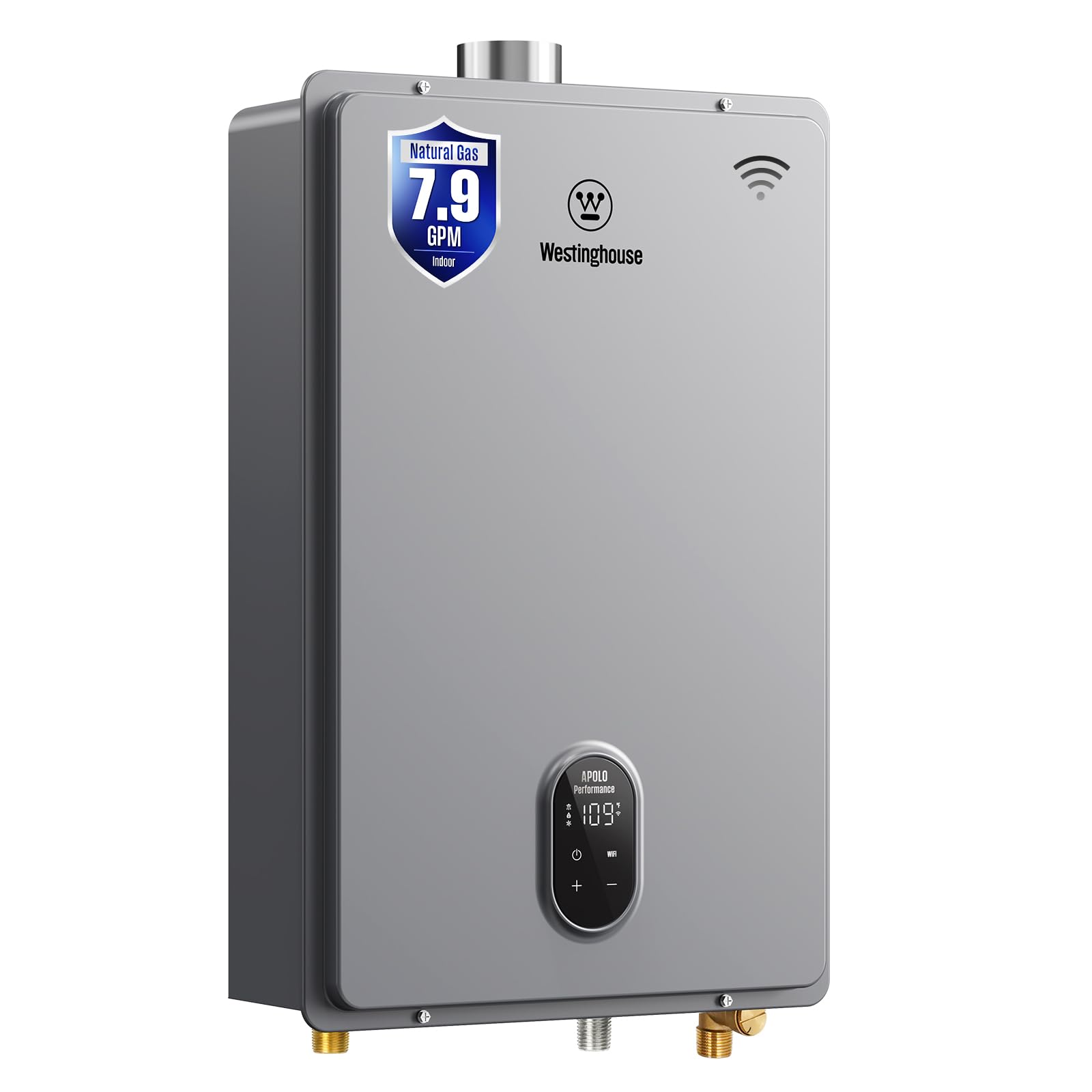
Built for homes where the water pressure is low and the showers are many.
The spec that matters most here is the flow ceiling. A 7.9 GPM rating at 180,000 BTU is enough to run three showers at once, which covers most families with room to spare. But the real standout is the 0.53 GPM minimum activation flow and operation down to 15 PSI — a pairing that makes it a practical choice for private well systems, older plumbing, and low-flow faucets where many tankless heaters simply will not trigger.
Smart control is included without extra accessories. Built-in WiFi and voice control let you change the temperature, check operating status, and get fault alerts remotely. The self-modulating technology targets ±1°F stability, and the 95-149°F range gives you a wide band to work with. Natural gas on-demand heating avoids standby loss compared to a tank, and the unit is CSA certified. The warranty covers the full unit for 2 years and the heat exchanger for 5.
Temperature accuracy is the point of caution. Installation and overall performance are what buyers praise most, but a share report inconsistent water temperature — often tied to pressure swings or an oversized gas supply. Have a plumber confirm your line and pressure before install. Note also that it needs standard 3/4″ NPT residential plumbing and 120V AC power to run.
Low-pressure specialist: The 0.53 GPM activation and 15 PSI floor make this the right answer for well-water and older-plumbing homes.
Watch the temp stability: Reported inconsistency points to install conditions, so line and pressure checks are essential.
Reach for this if: You have a well system or low water pressure that stalls other tankless heaters.
Look elsewhere if: Your priority is rock-steady temperature over low-flow activation.
8. Rheem RTG Series Tankless Water Heater
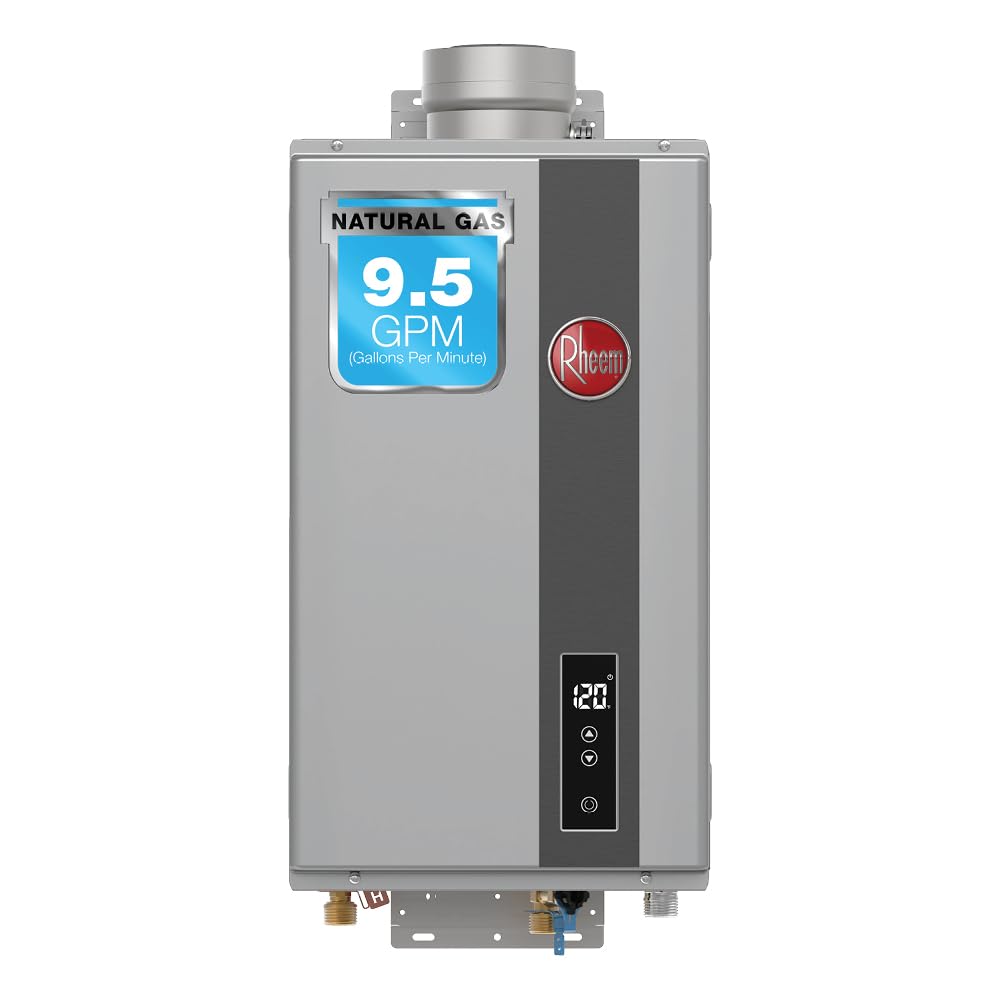
A nine-and-a-half gallon-per-minute tank buster for multi-bathroom homes.
This Rheem is designed for households where three or four showers can run back to back. The 9.5 GPM rating at a 35°F temperature rise, with a 199,900 BTU/hr output, is rated for 3-4 simultaneous showers — a step above the Rinnai RE199iN’s 9.8 GPM only marginally, but the 199,900 BTU figure is the highest heat output in this entire roundup. The non-condensing design needs a direct vent system for indoor install, and the wall-mount body frees up floor space a tank would have eaten.
Efficiency is respectable for a non-condensing unit. A UEF of 0.82 is quoted as saving up to 34% on energy costs compared to a 50-gallon electric tank. The digital LED panel allows ±1°F precision adjustments, and the safety package includes freeze protection, flame-failure protection, and a multi-point system. Stainless steel construction at 46.5 pounds is solid without being burdensome. The warranty is the standout: a 15-year heat exchanger and 5-year parts coverage.
The honest catch is noise and a split on energy savings. The unit is audible in operation, which is the recurring note buyers raise, and while many owners call it a money saver on gas bills, a share push back. The broader picture is a capable whole-house heater for large families who value capacity and warranty over whisper-quiet operation.
Capacity plus warranty: The 199,900 BTU output and 15-year heat exchanger coverage make this a long-term buy for a busy household.
Louder than most: The unit runs audibly, so do not place it against a shared bedroom wall.
For the full house: Three or four bathrooms that need to run at once with a warranty built to last.
Skip if quiet is king: The operating sound is noticeable compared to the rest of this list.
9. Rinnai RE199iN Natural Gas Tankless Water Heater

The non-condensing big-capacity option that skips the condensate drain.
The RE199iN delivers 9.8 GPM at 199,000 BTU — enough to run showers, laundry, and the dishwasher simultaneously. Its 52.1-pound body is lighter than the 55-pound Rinnai RX199iN and heavier than the GASLAND Gasmart E’s 37.5 pounds. The key difference from the RX199iN is that this is non-condensing, which means no drain line for condensate and a simpler install in some layouts — but it gives up the RX199iN’s.98 UEF for a lower efficiency figure.
Owners consistently describe the build as high-quality, and temperature consistency is the specific thing that gets called out — hot water when you need it, without scalding surprises. The LED display shows diagnostic codes and service reminders to make maintenance easier, and the 15-year heat exchanger warranty matches the rest of the Rinnai family. Watts and silent operation are not the story here; dependability and ease of service are.
WiFi is a caveat, not a feature from the start: the Controlr module is sold separately, so plan for that if smart control matters. The other limit is that the reported 5-year-on-labor terms require registering within 90 days of install, or the labor warranty drops to 1 year. Professional install is recommended.
Simple and proven: Non-condensing install, high 9.8 GPM output, and a 15-year heat exchanger warranty make this a low-fuss whole-house pick.
No condensate drain needed: A real advantage if your drain routing is complicated.
For the straightforward install: A whole-house home that wants high capacity without a condensate drain.
Register or lose labor: The extended labor warranty needs registration within 90 days.
10. Noritz NRC66DVNG Tankless Hot Water Heater

A quiet condensing heater that vents through ordinary PVC pipe.
The install detail is what makes this one interesting. It can be vented with Schedule 40 PVC pipe and fittings — a standard, widely available material that many condensing units do not allow. That can simplify and speed the venting run compared to a proprietary exhaust pipe. The 6.6 GPM flow and condensing design rate it for mid-sized homes, and low NOx output keeps it compliant in stricter air-quality regions. A remote thermostat and 6-foot power cord are in the box.
Performance is what buyers praise most, and it handles multiple fixtures and appliances at once without complaint. Efficiency, quiet operation, and reliable power supply all get consistent backing, and one long-serving unit is reported to have lasted 20 years — a useful point of confidence given the 12-year heat exchanger warranty. At 38 pounds it is one of the lighter condensing models here, which helps on the wall-mount.
Temperature consistency splits opinions. Some owners get endless hot water; others report cold-water issues, and heating time is a recurring gripe. That pattern usually means the unit is wrestling with a demand spike or a cold groundwater supply. If your incoming water is very cold, a higher-BTU unit may serve you better.
Why it stands out
- Schedule 40 PVC venting — standard, easy-to-source pipe
- Condensing, high-efficiency design with low NOx output
- 38 pounds keeps the wall-mount manageable
- 12-year heat exchanger warranty
The honest limits
- 6.6 GPM is a mid-capacity ceiling, not a big-family unit
- Heating time draws criticism from some owners
- Cold-water complaints appear in the review tail
Choose it when PVC venting wins: A mid-size home where running Schedule 40 is the easy path to a condensing install.
Size up if water runs cold: Very cold incoming water may need more BTU than the 6.6 GPM ceiling provides.
11. A. O. Smith ATI-540P-N Water Heater
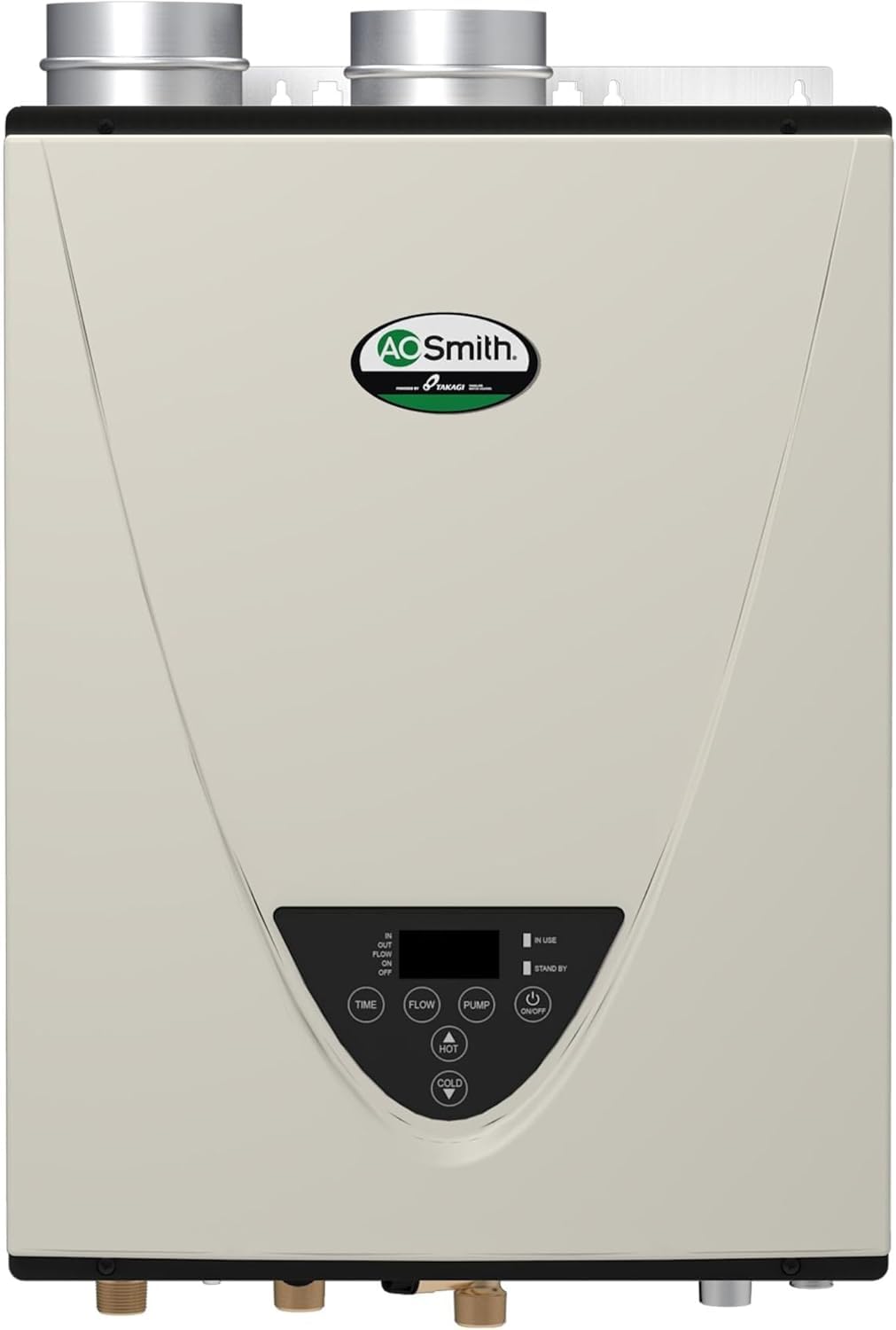
The instant-hot specialist with a recirculation pump built right in.
Most tankless heaters still make you wait for the hot water to travel through the pipes. This A. O. Smith solves that with an integrated hot water recirculation pump, delivering instant hot water at the tap with no warm-up wait. The recirculation system may need a bypass valve, which is not included, so factor that into the install. The 10 GPM continuous flow and 199,000 BTU condensing output suit homes with 3-4 bathrooms depending on climate.
Build durability is the deeper sell. Commercial-grade materials include marine-grade 316L stainless steel, and the limited warranty runs 15 years on the heat exchanger and 5 years on parts in residential use. The 0.93 UEF efficiency figure is strong for this class. Safety features include exhaust and water temperature safety control, an overheat cut-off fuse, and an air-fuel ratio (AFR) sensor.
The trade-off is scale and complexity. At 61 pounds it is the heaviest unit here, so plan a two-person install. It requires a licensed plumber, and for very large homes a common vent system can link up to 8 units, or an Easy-Link setup with a 540H to boost flow further — a feature none of the smaller picks offer. For a straightforward single-unit install, that up-scaling capability is unused overhead.
Instant hot water on tap: The integrated recirculation pump ends the wait for hot water at the fixture.
Built to link up: Common venting handles up to 8 units for large properties.
Pick it for instant taps: A large home that wants hot water the moment you turn the handle.
Mind the weight and valve: 61 pounds needs two installers, and the recirculation bypass valve is extra.
Know the Specs
Flow Rate (GPM)
GPM stands for gallons per minute — how much hot water the unit can push out while it is running. A 4.3 GPM model like the Ranein covers 3-4 water points, while an 11 GPM model like the Rinnai RX199iN can feed up to seven fixtures. Match this to how many showers, sinks, and appliances you expect to run at once.
BTU Output
BTU (British Thermal Units) measures heating power — how fast the unit can raise water temperature. Higher BTUs mean more capacity to heat more water at once, especially when incoming water is cold. The 199,000 BTU units here handle larger homes and colder climates than the 100,000 BTU Ranein.
UEF Efficiency
The Uniform Energy Factor is a standard score for how efficiently the heater uses gas. Condensing models like the Rinnai RX199iN reach.98, while non-condensing and tank units sit lower. A higher UEF generally means lower gas consumption for the same hot water output.
Freeze Protection
Built-in freeze protection keeps the unit heating when temperatures drop to avoid cracked pipes. The Ranein resists down to 14°F, and the APUS activates near 41°F. If you live in a cold climate, this is not optional.
Common Questions
How many GPM do I need for a family of four?
What is the difference between condensing and non-condensing tankless heaters?
Do I need a professional to install a gas tankless water heater?
Will a tankless gas water heater work in below-freezing weather?
How much venting does an indoor tankless heater need?
Can a tankless water heater run out of hot water?
Is a tankless gas heater cheaper to run than a tank heater?
What water pressure do these units need to activate?
How long does a gas tankless water heater last?
Can I install a tankless heater outdoors?
What size tankless heater fits a home with three bathrooms?
The Bottom Line
For most households, the best gas water heater is the Rinnai RX199iN — its 11 GPM flow feeds up to seven fixtures and its.98 UEF is the highest efficiency in this roundup, backed by a 15-year heat exchanger warranty. If you want big-house capacity without the premium tier, grab the GASLAND Gasmart E; its 199,000 BTU output matches the top pick at 7.6 GPM and a lighter 37.5-pound body. And for a well system or low-pressure plumbing where other heaters will not even trigger, the Westinghouse is the one to reach for, thanks to its 0.53 GPM activation flow and 15 PSI operating floor.
Whichever you pick, match the GPM and BTU rating to how many fixtures your household runs at once, then confirm venting and freeze protection against your climate. Size it correctly and have a licensed pro handle the gas line and venting, and a tankless heater delivers on-demand hot water for years.
How we choose
We do not accept paid placement. Every pick is matched to a real buyer and a real use-case; we do not hands-on test units.
Sources
Specifications: manufacturer listings and product documentation. Review insights: verified customer reviews, as of November 2026. Pricing: not shown on this page (it changes often); check the current price via the retailer link.
As an Amazon Associate, Tactical Gear Guy earns from qualifying purchases. This does not affect which products we feature.