Specs are compiled from manufacturer listings and verified buyer reviews and can change over time — please confirm the key details on the product page before buying.
If you ride carbon bars, a carbon seatpost or a modern alloy stem, the bolt you are about to turn has a torque limit printed right on it — and guessing past that limit can crack a component that costs more than every tool on this page. A bike torque tool does one job: it clicks at the exact Newton meter (Nm, the unit of twisting force) you dial in, so you stop before the part gives way. Below are eight wrenches that genuinely do that job, ranked by how well they cover real bicycle fasteners.
This guide is built by comparing the manufacturers’ published specifications and the patterns across verified customer reviews, so you get each pick’s real strengths and trade-offs instead of marketing spin.
Some of these sets click audibly and come with every bit you need; others are bare wrenches that assume you already own sockets. The top pick is the one that covers carbon bolts and drivetrain hardware in a single case, and each entry below notes which fasteners it handles.
Top Picks


How To Choose The Best Bike Torque Tool
You do not need a workshop full of wrenches. You need one that reads the numbers your bike actually uses, clicks when it gets there, and fits the bolts on your frame. Four specs decide whether a wrench earns its place in your pack.
Get the Newton meter range right first
Most bicycle fasteners live between 2 Nm and 14 Nm. A stem faceplate bolt often sits near 5–6 Nm, a seatpost clamp similar, and a carbon seatpost can be lower still. A wrench that starts at 1 Nm and tops out at 25 Nm covers nearly all of it with room to spare. One that starts at 10 Nm is too coarse — you cannot dial in a low-value carbon bolt accurately.
Check the accuracy figure, not just the word “accurate”
Look for a stated tolerance like ±3% or ±4%. That is the margin of error the maker publishes, and it tells you how close the click is to the number on the dial. A certificate of calibration or a traceable serial number is a bonus — it means your specific wrench was checked, not just the design.
Decide between a bare wrench and a full bit set
A bare torque wrench assumes you already own hex and Torx bits and a socket rail. A 20- or 27-piece set hands you hex bits, Torx bits, sockets and an extension bar in one case. If you are starting from nothing, the set saves a second purchase. If you already have a bit kit, a bare wrench is lighter and cheaper to own.
Ratchet tooth count and swing arc matter in tight spots
A 72-tooth ratchet turns in small steps, which helps when the bolt sits close to a frame tube or behind a brake caliper. Higher tooth counts generally mean a smaller swing arc — the angle you need to move the handle before it re-engages. On a bike with tight clearances, that is the difference between a clean turn and skinning your knuckles.
Side-by-Side Comparison
| Model | Best For | Torque Range | Ratchet / Drive | Pieces Included | Amazon |
|---|---|---|---|---|---|
| Wera Click-Torque A 6★ Best Overall | Carbon-safe precision work | 2.5–25 Nm | 45-tooth, 1/4″ drive | 20 pcs | Amazon |
| Matework 27-Piece SetBest Value | Complete starter kit | 1–25 Nm | 72-tooth, 1/4″ drive | 27 pcs | Amazon |
| LEXIVON LX-180Inch-Pound Specialist | Inch-pound fasteners | 1.1–16.9 Nm | 72-tooth, 1/4″ drive | 1 wrench | Amazon |
| LEXIVON LX-190 | Road and MTB portability | 2–26 Nm | 72-tooth, 1/4″ drive | 1 wrench | Amazon |
| TEKTON TRQ50402 | Certified calibration | 20–200 in-lb | 90-tooth, 1/4″ drive | 1 wrench | Amazon |
| Park Tool Ratcheting Click | Bicycle-specific shop use | 2–14 Nm | Ratcheting, 3/8″ drive | 1 wrench | Amazon |
| Feedback Sports Range | Compact travel kit | 2–14 Nm | 72-tooth, bit driver | 13 bits | Amazon |
| Topeak Torq Stick | Reach into tight bolts | 4–20 Nm | Reversible, bit driver | 9 bits | Amazon |
Detailed Reviews
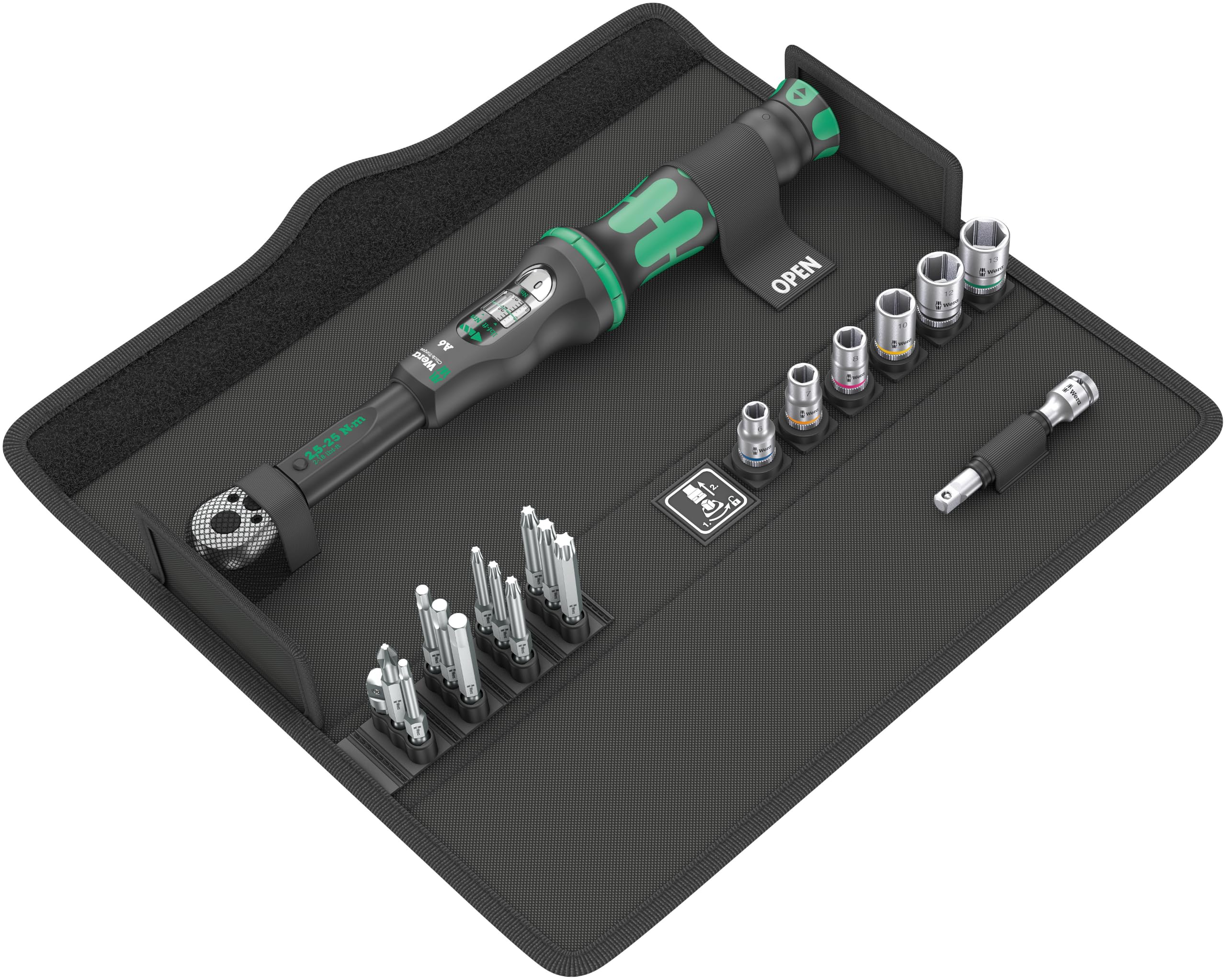
1. Wera Click-Torque A 6 Torque Wrench Set
Our pick — 4.5+★ from 600+ verified ratings; the strongest balance of quality and price.
Two separate clicks — one to set the dial, one to tell you the bolt is done.
On carbon bars and seatposts, the dial-set click and the target click take the guesswork out of both ends of the turn. It clicks once as you dial the target figure in, so you know the scale is locked, then clicks again the moment you reach that figure on the bolt itself. On a carbon seatpost or bar, that second click is what stops you before the clamp cracks.
The numbers behind it hold up. Wera publishes ±4% accuracy measured against DIN EN ISO 6789-1:2017-07, an international torque-tool calibration standard, which means the click is checked against a known reference rather than eyeballed. The range runs 2.5–25 Nm, so it reaches low-value carbon bolts and still covers brake and drivetrain hardware. And it is genuinely light — the comparison data puts it at 0.11 kg, against 0.39 kg for the LEXIVON LX-190, so it travels in a pack without pulling at your jersey.
What you get in the textile case is a full working kit: a 1/4″ socket adaptor, a free-turning extension, six sockets from 6mm to 13mm, plus Phillips, TORX and hex bits. Those sockets are rated for both hand and non-impact power tool use, so the same set keeps working if you add a driver later. The reversible 45-tooth ratchet handles clockwise tightening and flips for loosening without a second tool. One trade-off worth naming: 45 teeth gives a wider swing arc than the 72-tooth ratchets elsewhere on this list, so the tightest frame corners need a little more handle travel.
Where The Wera Pulls Ahead
- Double click — one at dial-set, one at target torque — removes doubt at both ends
- ±4% accuracy to DIN EN ISO 6789-1:2017-07, a published calibration standard
- 2.5–25 Nm covers carbon seatpost and stem bolts plus larger drivetrain hardware
- Six sockets (6–13mm) plus Phillips, TORX and hex bits arrive in one textile case
- At 0.11 kg it is the lightest full set here by a wide margin
The Honest Hangups
- 45-tooth ratchet needs more swing room than a 72-tooth head in tight frames
- Premium build carries a premium outlay — this is the costliest way to get torquing
Reach for this if: you work on carbon components and want every turn confirmed twice before the bolt is tight.
Look elsewhere for: packed frame triangles where a wider ratchet swing simply will not fit.
2. Matework 1/4 Inch Drive Click Torque Wrench
Twenty-seven pieces and a 1 Nm floor — the do-everything starter case.
If you own no bits or sockets yet, this case covers a stem swap without a second purchase. The count tells the story: 27 pieces against the single wrench you get with the LEXIVON LX-180, so you are not hunting down a Torx bit before you can touch a stem bolt. Hex bits run H2 through H10, Torx runs T10 through T30, and there are six-point sockets from 7mm to 15mm — that is most of what a modern bike throws at you.
The precision claim is specific rather than vague. Matework states accuracy within ±3% across a 1–25 Nm range, with 0.1 Nm micro-adjustment. That fine a step means you can set a 5.5 Nm faceplate bolt as easily as a 14 Nm pedal. The 72-tooth reversible head works clockwise and counter-clockwise through a paddle, and a quick-release button swaps sockets without them dropping. A 4″ extension bar is included for recessed bolts, and there is a universal joint for awkward angles.
The one thing to go in expecting: the bits are where this set shows its price point. Sockets and bits have been known to shear under harder use, so treat this as a careful torquing tool rather than a breaker bar. Set it, click it, move on — that is the job it does well.
Why it earns the value slot: a 1 Nm starting point, a ±3% tolerance, and a 27-piece kit with a 4″ extension and universal joint — there is nothing else to buy before your first stem swap.
The catch to know about: the included bits and sockets are the weak link under heavier force, so lean on the click and stop there.
Best fit: a newer rider building a first proper toolkit who wants torque control plus every bit in one purchase.
Think twice if: you plan to hammer seized bolts — this set is for measured tightening, not force.
3. LEXIVON LX-180 Inch Pound Torque Wrench, 1/4-Inch Drive
Built for the manual that prints inch-pounds instead of Newton meters.
Some component sheets — especially older or American-market ones — list bolt torque in inch-pounds (in-lb), and this wrench speaks that language natively rather than making you convert. The range is 10–150 in-lb, which the spec pairs with 1.1–16.9 Nm, so both scales are printed for you. The micro-adjustment dial lets you dial the smaller unit in steps instead of jumping between coarse values.
The build is a chromium-molybdenum steel body with an electro-black coating, and the 72-tooth dual-direction gear gives the fine swing arc you want near a caliper. It ships as a single wrench in a zippered protective case, so budget for bits separately if you do not already own them. At 8.7 inches long it fits in a saddlebag, and the comparison data puts it at 13.44 ounces against 11.68 ounces for the TEKTON TRQ50402 — noticeably heavier in the hand, though both are compact.
Here is the honest part, and it is the reason this list has two LEXIVON wrenches rather than one. The click and locking mechanism on this inch-pound model are the recurring weak points — the setting can fail to lock, or the click can be faint at the value you set. Contrast that with the LX-190 below, which is a different tool with its own slide-to-lock design. If your bike’s manual prints Nm, go for that one; come here only if inch-pounds are genuinely what you need.
What it does well: a native 10–150 in-lb scale with micro-adjustment, a 72-tooth head, and a chromium-molybdenum steel body with an electro-black finish — a clean tool for inch-pound manuals.
The real caveat: the locking mechanism and click strength let this down for some buyers, so verify the dial holds its setting before you lean on it.
Pick it when: your component documentation is written in inch-pounds and you want the number printed, not converted.
Better served elsewhere: anyone whose bolts are spec’d in Nm — the LX-190 below is the stronger LEXIVON for that job.
4. LEXIVON LX-190 Bike Torque Wrench, 1/4-Inch Drive, 2-26 Nm
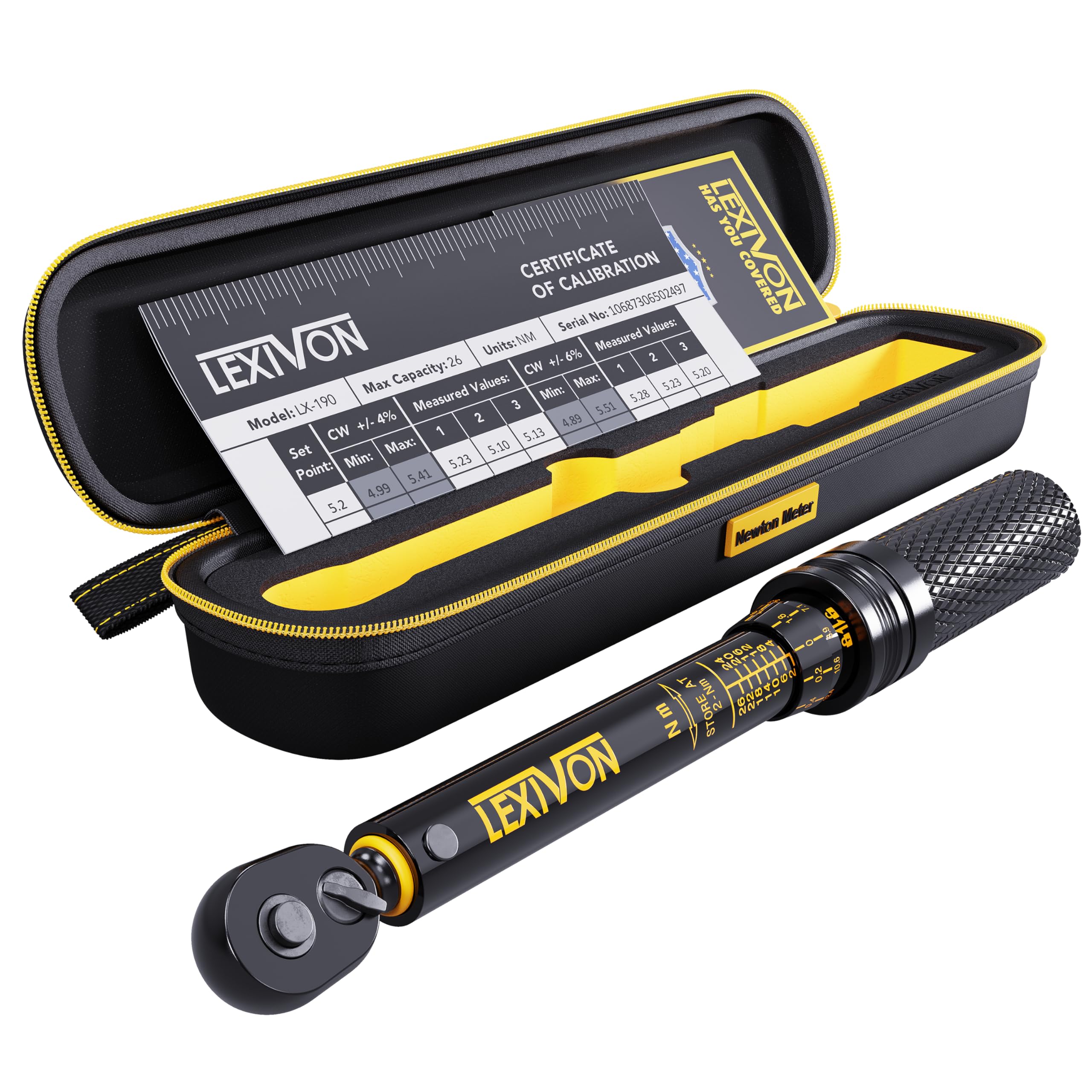
A dedicated bike wrench with a calibration certificate and a low-light scale.
This one was drawn up for bicycles specifically, and it shows in the details. The scale is printed yellow-on-black so you can read it in a dim garage, and the range runs 2–26 Nm, which brackets carbon seatposts at the low end and crank and pedal hardware at the top. Each wrench arrives with a calibration certificate and a traceable serial number — meaning the individual tool was checked, not just the model line.
Accuracy is quoted as ±4% clockwise and ±6% counter-clockwise, so tightening is the tighter of the two directions. The head is a heat-treated chrome-molybdenum ratchet with an electro-black finish to resist rust, and the 72-tooth gear gives a 5° swing arc — small enough to work beside a frame tube. A quick-release button swaps sockets fast. The handle is aerospace aluminium with a non-slip knurled grip, and LEXIVON claims its handle mechanism cuts hand fatigue by up to 62%.
Weight is the trade-off here. At 0.39 kg it is the heaviest wrench in this comparison, and the data shows it sitting well above the Wera set’s 0.11 kg. That heft comes with a padded hardshell pouch rather than a soft case, so it protects well in a tool bag but adds grams. It also ships as one wrench — no bits, no sockets — so it suits someone who already owns a bit kit. For everyone else, plan on a second purchase.
The standout spec: a 2 Nm floor, a 72-tooth head with a 5° swing arc, and a serialised calibration certificate — the combination that makes carbon work feel safe rather than approximate.
What to plan around: 0.39 kg is the heaviest in this group, and it arrives bare, so bits are a separate buy.
Suits you if: you want a bike-only wrench with a certificate in the pouch and already own the bits.
Not the one for: riders who want everything in one case and would rather travel light.
5. TEKTON 1/4 Inch Drive Micrometer Torque Wrench, TRQ50402
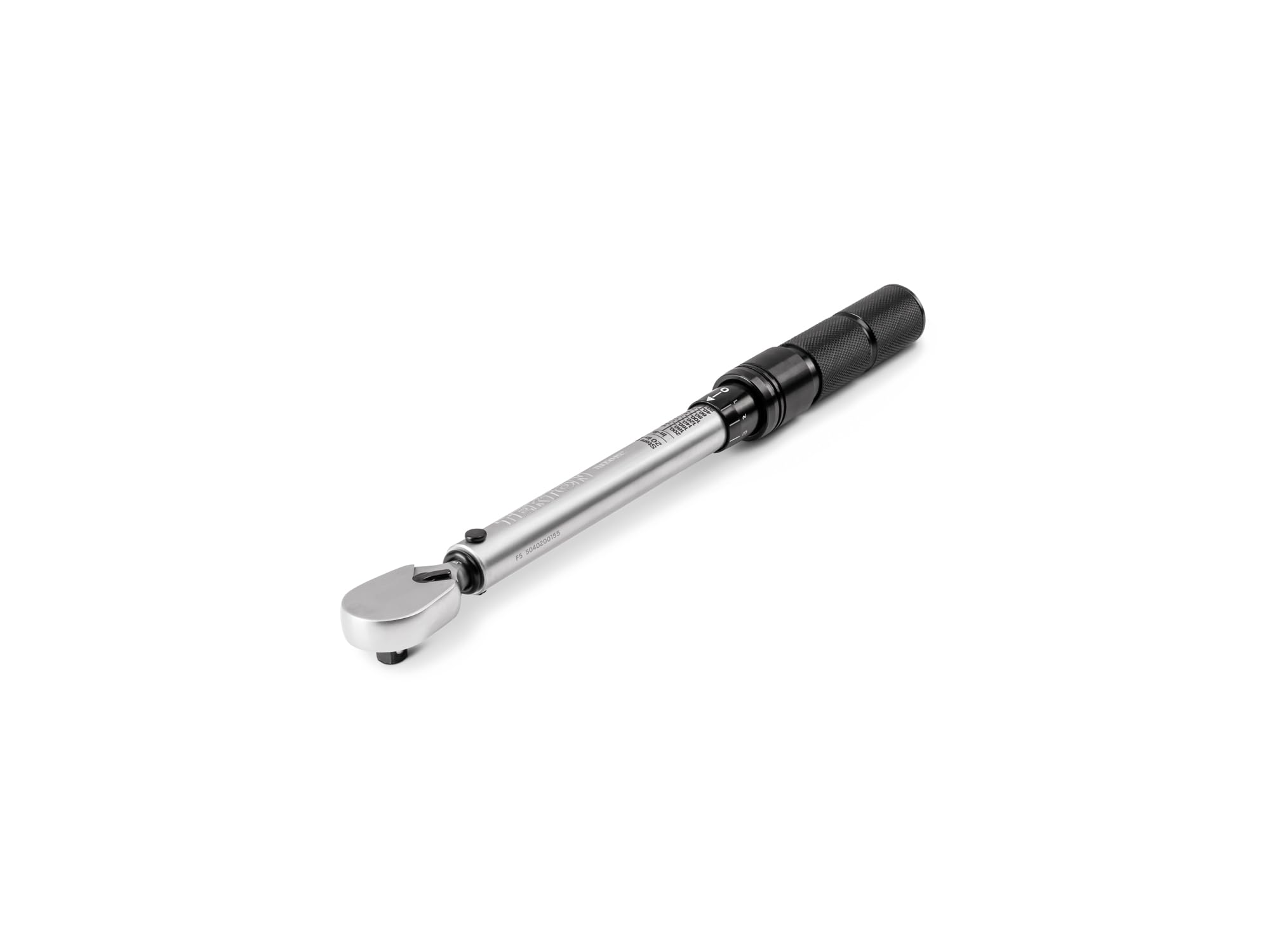
Ninety teeth, a four-degree swing, and a paper trail for your specific wrench.
The number that sets this apart is 90 — the tooth count on the fixed ratchet head. A single half-moon pawl keeps 9 teeth engaged with the gear at all times, so it will not skip under load, and the 4° swing arc shortens how far you must move the handle. In a tight bottom-bracket area, that is the difference between a clean turn and a re-seat.
Accuracy is stated at ±3% in both directions, and the actual figure for your wrench is printed on its certificate. TEKTON calibrates to the ISO standard and states that this also meets and exceeds the ASME standard. The certificate carries the serial number, the test results, and the equipment and conditions used. The scale is a single-unit micrometer design with high-contrast laser markings on a satin-finished body to cut glare — one unit, so no juggling two scales mid-adjust.
What you should know before you commit: this one is marked 20–200 in-lb, which is an inch-pound scale rather than an Nm dial, so it is not the tool for a bike manual that lists 5 Nm bolts. It is also the lightest bare wrench here at 11.68 ounces, against 13.44 ounces for the LEXIVON LX-180 — a real difference when it hangs in a pack all day. Think of it as the precision instrument for fasteners spec’d in inch-pounds.
Why The 90-Tooth Head Wins Fans
- 4° swing arc — the shortest of any ratchet here — for cramped frame access
- ±3% accuracy in both directions, with a serialised certificate of calibration
- 9 teeth engaged at all times so the pawl will not skip under stress
- Single-unit laser-marked scale on a satin body to reduce glare
What To Weigh Up
- 20–200 in-lb range — inch-pound only, so no direct Nm dial for metric manuals
- Ships as one wrench with no bits or sockets in the box
Go here for: the tightest swing arc on this list plus a certificate that documents your exact wrench.
Keep looking if: your bike’s torque values are printed in Nm and you want to set them without converting.
6. Park Tool Ratcheting Click Type Torque Wrench

The bike-specific 2–14 Nm range that matches seatpost and bar clamps exactly.
Park Tool built this around the values bicycles actually use. The 2–14 Nm range, printed alongside 18–124 inch-pounds, lines up with seatpost clamps, bar clamps and stem bolts rather than car lug nuts. Adjustment moves in 0.4 Nm increments through a dial system that lets you preset your target. It reads and registers for both left-hand and right-hand threading, and the conversion scale on the body saves a mental step.
It is a 3/8″ ratcheting drive at 9 inches long and 12.64 ounces, calibrated to be accurate to ±4%. That drive size is worth noting: it is larger than the 1/4″ drives that dominate this list, so check your socket set before assuming it will bolt straight onto your existing bits. Its 2–14 Nm range and 0.4 Nm adjustment steps are built around seatpost, bar and stem clamps rather than car hardware.
The mixed feedback centres on the click and the low end. Some find it easy to over-tighten at low settings, and a few report the indicator not clicking reliably at the set value or disengaging instead. Value is also debated, with some feeling the outlay is steep for what arrives. None of that makes it a poor tool — it is a well-regarded shop-style wrench — but if you regularly work below 5 Nm, pay attention to how it feels at the bottom of its range before trusting a carbon bolt to it.
The case for it: a 2–14 Nm bike-specific spread, 0.4 Nm adjustment steps, dual-thread reading and a ±4% calibration figure — a wrench shaped around bicycle work rather than adapted to it.
Where it asks patience: the low end of the range is where the click is least convincing, and the 3/8″ drive needs matching sockets.
Well matched to: riders who want a single bike-focused wrench in the classic shop format and mostly work above 5 Nm.
Second-guess it if: you spend your time on sub-5 Nm carbon bolts and want a stronger low-end click.
7. Feedback Sports Range Click Torque Wrench Set, 2-14Nm

A 144mm body that vanishes into a pack — with thirteen S2 steel bits inside.
Compact is the whole point here, and the figure proves it: the body measures 144mm, short enough to slip into a riding pack and stay there. The adjustable range runs 2–14 Nm in clear 1 Nm increments, so you can set a 5 Nm faceplate bolt as easily as a 14 Nm one. Each setting is calibrated for consistent application, which is how the tool guards against over-tightening on one bolt and under-tightening on the next.
The bit system is the other reason to pick it. Thirteen S2 steel hex and Torx bits arrive in standard and extension lengths, in a TPU protective carrying case. That covers a wide spread of fasteners without a second purchase. The drive is a 72-tooth ratchet with direction control and a magnetic bit interface, so changes are quick mid-adjustment. The handle is plastic-free, and the whole set weighs 0.28 kg.
It is the compact design that keeps coming up as the reason people like it, alongside the build quality. The trade-off is range: at 2–14 Nm it tops out below the 25 Nm and 26 Nm wrenches on this list, so it will not handle the higher-torque hardware those reach. Think of it as the travel kit for stems, bars, seatposts and brakes — the bolts you actually adjust on the roadside — and keep a wider-range wrench at home for the rest.
Why it travels well: a 144mm body, a 0.28 kg all-in weight, thirteen S2 steel bits in a TPU case, and a 72-tooth magnetic drive — a full kit that lives in a pack.
The range ceiling: 14 Nm at the top end means it stops short of the higher-torque hardware the 25 Nm and 26 Nm wrenches here can take.
Made for: riders who adjust their own cockpit and seatpost on the road and want a kit that packs small.
Not your only tool if: you also need high-torque work — this is the travel companion, not the whole box.
8. Topeak Torq Stick 4-20 Nm Bike Torque Wrench, 9 Bits

Thirty-millimetre bits that reach the bolts buried behind a rotor or frame tube.
Reach is the reason to pick this one. The nine included bits are extra-long at 30mm, so they get down into fasteners that sit below a surface or behind a component where a standard-length bit bottoms out on the surrounding metal. The set covers 3, 4, 5, 6, 8 and 10mm Allen plus T20, T25 and T30 Torx — most of what a modern cockpit and brake setup uses.
The working range runs 4–20 Nm with ±4% accuracy, so it handles carbon seatpost and stem values while reaching higher-torque fittings too. The ratchet and bits are hardened steel, the body is aluminium and engineering-grade polymer, and the reversible head works clockwise and counter-clockwise. Ergonomic bit storage keeps the set together, and a bit organiser comes in the box. It measures 8.9 inches and 6.6 oz, so it travels well in a toolkit.
One thing to map against your own bike: the floor sits at 4 Nm, higher than the 1 Nm and 2 Nm starting points on several wrenches here. If a component on your bike is specified below 4 Nm — some lightweight seatpost clamps are — this tool cannot set that value accurately. Everything above it is clean and precise. Buy it for the long reach and the 4–20 Nm band, and accept that the very lowest carbon values belong to a different wrench.
Its distinct angle: 30mm extra-long knurled bits in a nine-piece set, ±4% accuracy, and a 4–20 Nm range — the combination for fasteners other tools cannot reach.
The limit to know: a 4 Nm floor leaves out the lowest carbon clamps, so this cannot be your only wrench if any bolt is spec’d lower.
Ideal for: recessed and hard-to-reach bolts where standard-length bits will not seat.
Pair it with: a low-range wrench if your bike lists any bolt below 4 Nm.
Know the Specs
Torque range and the Nm unit
Newton meter (Nm) is the unit of twisting force a bolt receives. The range printed on a bike torque tool tells you the lowest and highest values it can set accurately. Bicycle fasteners often fall between 2 Nm and 14 Nm, so a tool starting at 2 Nm or lower and reaching 14 Nm or more covers most of the bike. If the tool’s floor sits above a value your manual lists, it cannot set that bolt correctly. Match the range to the numbers on your components before anything else.
Accuracy tolerance and calibration
The accuracy figure — ±3% or ±4%, for example — is the margin of error the maker publishes for the click. It tells you how close the trigger is to the dial number. A certificate of calibration with a traceable serial number means that individual wrench was checked against a reference, rather than only the design being validated. Both matter on carbon, where a small over-torque can damage a component. A stated tolerance on a certificate is worth more than a general claim of precision.
Click type versus micrometer adjustment
A click-type wrench triggers an audible and tactile snap when the set value is reached, so you stop applying force. A micrometer design uses a rotating sleeve to dial the value in fine steps, often with a single marked scale. Some wrenches combine both — a click at the target plus a micrometer-style adjuster for the setting. What you want is a clear trigger you can feel and hear, plus a scale that locks so your value does not drift while you work.
Ratchet teeth, swing arc and drive size
Tooth count sets how finely the head re-engages. A 72-tooth ratchet, or a 90-tooth head, turns in smaller steps than a 45-tooth one, which helps where clearance is tight. Swing arc is the angle you must move the handle before it bites again — a 4° or 5° arc works where a wider one does not. Drive size (1/4″ or 3/8″) decides which sockets and bits fit. Check that your existing set matches the drive before buying a bare wrench.
Common Questions
What torque range do I need for a carbon bike?
Is a click-type torque wrench accurate enough for bike bolts?
Do I need a certificate of calibration?
What is the difference between Nm and inch-pounds on a torque wrench?
Will a 1/4-inch drive torque wrench fit my existing sockets?
How many ratchet teeth do I need for tight bike frames?
Can I use a torque wrench to loosen bolts too?
Should I store my torque wrench at its lowest setting?
Are the included bits good enough, or should I buy separate ones?
The Bottom Line
The best-valued way into proper torque control is the Wera Click-Torque A 6. Its double click removes the two points where carbon work goes wrong — setting the dial and reaching the value — and its 2.5–25 Nm range plus 20-piece kit means it is the last torque purchase most riders need. If you want every bit in one box for the least outlay, the Matework 27-piece set starts at 1 Nm and hands you the whole kit. And for bolts buried out of reach, the 30mm bits on the Topeak Torq Stick get where shorter bits cannot.
Whichever you pick, check the two numbers that matter most: the low end of the range against your smallest bolt, and the accuracy tolerance the maker publishes. Get those right, and every bolt on your bike gets the number printed on it.
How we choose
We do not accept paid placement. Every pick is matched to a real buyer and a real use-case; we do not hands-on test units.
Sources
Specifications: manufacturer listings and product documentation. Review insights: verified customer reviews, as of November 2026. Pricing: not shown on this page (it changes often); check the current price via the retailer link.
As an Amazon Associate, Tactical Gear Guy earns from qualifying purchases. This does not affect which products we feature.