Specs are compiled from manufacturer listings and verified buyer reviews and can change over time — please confirm the key details on the product page before buying.
You want a board that keeps your knife sharp, catches the juices from a roast, and stays flat after washing. Those three things matter most for raw meat. Every board below is solid wood, not plastic or glass, and each one suits a different kind of meat cook.
This guide is built by comparing the manufacturers’ published specifications and the patterns across verified customer reviews, so you get each pick’s real strengths and trade-offs instead of marketing spin.
We start with density and thickness, then weigh end grain against edge grain, because that choice decides whether your knives stay sharp and whether the board survives years of Sunday roasts. Here is my full breakdown of the wooden chopping board for meat.
Top Picks

How To Choose The Best Wooden Chopping Board for Meat
Raw meat is the hardest job a board ever gets. You are pressing down with a real knife, you are chasing liquid, and you are scrubbing the board afterwards — so the wood you pick has to survive all three.
End grain versus edge grain
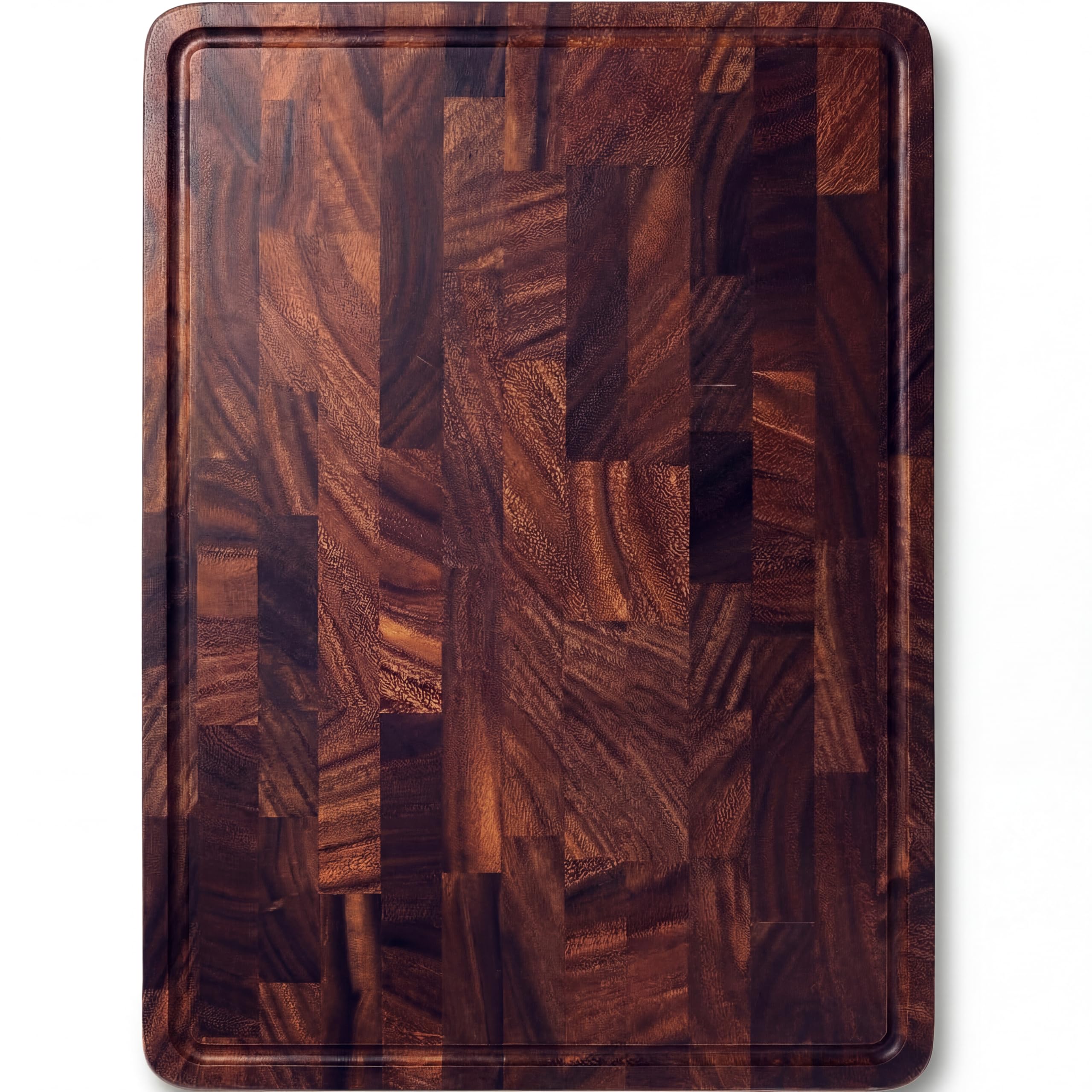
End grain means the wood is cut so its fibres face up like the bristles of a brush. The knife edge slides between those fibres instead of slicing across them, so it stays sharp longer and the surface can close up a little after oiling. Edge grain is cut along the side of the log, which gives a flatter, denser-looking surface that is usually easier on the wallet. Both work for meat; end grain is the gentler option for anyone who sharpens often.
The juice groove does real work
When you carve a roast or a whole chicken, liquid leaves the meat fast. A groove — a shallow channel carved around the edge — catches it before it reaches your counter. A deep groove on a large board is genuinely useful; a shallow groove on a small board fills up quickly.
Thickness, weight and stability
A thicker board resists warping and stays put while you press down. The trade-off is weight: a big board can be heavy enough that lifting it to the sink becomes a two-hand job. If you carve often and have the counter space, thicker is better; if you store the board upright in a cupboard, check the weight before you commit.
Care is part of the purchase
Every board in this list is hand wash only. No dishwasher, no soaking, and always dry it standing so air reaches both faces. A drop of food-grade oil now and then keeps the wood from drying and cracking.
Side-by-Side Comparison
| Model | Best For | Material | Size (L x W x Thick) | Weight | Amazon |
|---|---|---|---|---|---|
| Walnut End Grain by Babilonia★ Best Overall | Everyday meat prep and charcuterie | Walnut Wood | 17″ x 13″ x 1″ | 2.79 kg | Amazon |
| Acacia Butcher Block by BabiloniaMost Versatile | Slide-and-scrape prep with a plate | Acacia Wood | 15.7″ x 10.2″ x 1.6″ | 2.71 kg | Amazon |
| FANICHI XL Acacia End GrainTop Performer | Big-batch carving with two usable faces | Acacia Wood | 20″ x 15″ x 1.5″ | 6 pounds | Amazon |
| Yes4All Teak Edge Grain | Moisture resistance for wet meat prep | Teak Wood | 20″ x 15″ x 1.5″ | 9.1 pounds | Amazon |
| Winco WCB-1824 | Carving whole birds and bone-in ham | Natural Hardwood | 24″ x 18″ x 1.75″ | 17.8 pounds | Amazon |
| HexClad Rectangle Walnut | Reversible grooved and smooth sides | Walnut Wood | 19.5″ x 13.75″ x 1.25″ | 8 pounds | Amazon |
| American Walnut End Grain by Babilonia | Two-person households and gift giving | Black Walnut Wood | 15.7″ x 10.2″ x 1.7″ | 3.08 kg | Amazon |
| Teakhaus Extra Thick End Grain | Serious carving on a permanent counter spot | Teak Wood | 20″ x 14″ x 2.5″ | — | Amazon |
Detailed Reviews
1. Walnut Wood Cutting Board
Our pick — 4.5+★ from 300+ verified ratings; the strongest balance of quality and price.
End grain walnut that treats your knife edge like something worth keeping.
Buyers keep praising the build. This board is 100% walnut cut end grain (the wood fibres stand upright), so your blade slips between the fibres instead of slicing through them. That means fewer honing sessions between roasts.
At 17″ x 13″ x 1″ it is a mid-size board that leaves real room for a chicken or a couple of steaks without swallowing your counter. It weighs 2.79 kg, close to the Acacia board at 2.71 kg, so it stays put under pressure but you can still carry it one-handed to the sink. A build-in groove catches the juices and a built-in handle helps you lift it when it is wet.
It arrives seasoned and pre-oiled with a bottle of organic oil in the box, so you can carve the same day it lands. The honest caveat is wear: this is a wood surface, and a few cooks note that repeated cutting leaves deep scratches over time. That is a maintenance question, not a defect — a light sanding and a fresh coat of oil brings the surface back. It also undercuts comparable end grain walnut boards on price.
What earns it the crown
- End grain walnut construction that is gentle on knife edges
- Build-in juice groove and built-in handle for wet-hand lifting
- Arrives pre-oiled with a bottle of organic oil included
- 17″ x 13″ x 1″ gives real carving room without dominating the counter
Where it shows its age
- Hand wash only — it cannot go near a dishwasher
- Deep scratches can develop over time on the cutting face
- The 1″ thickness is slimmer than the heavy butcher blocks here
Go for it if: you carve meat a few times a week and want a board that protects your knives without taking over the kitchen.
Think again if: you want a thick slab you never have to refinish — the deeper blocks at the bottom of this list suit that better.
2. Acacia Wood Cutting Board
The board that slides chopped meat straight into the pan instead of making you lift it.
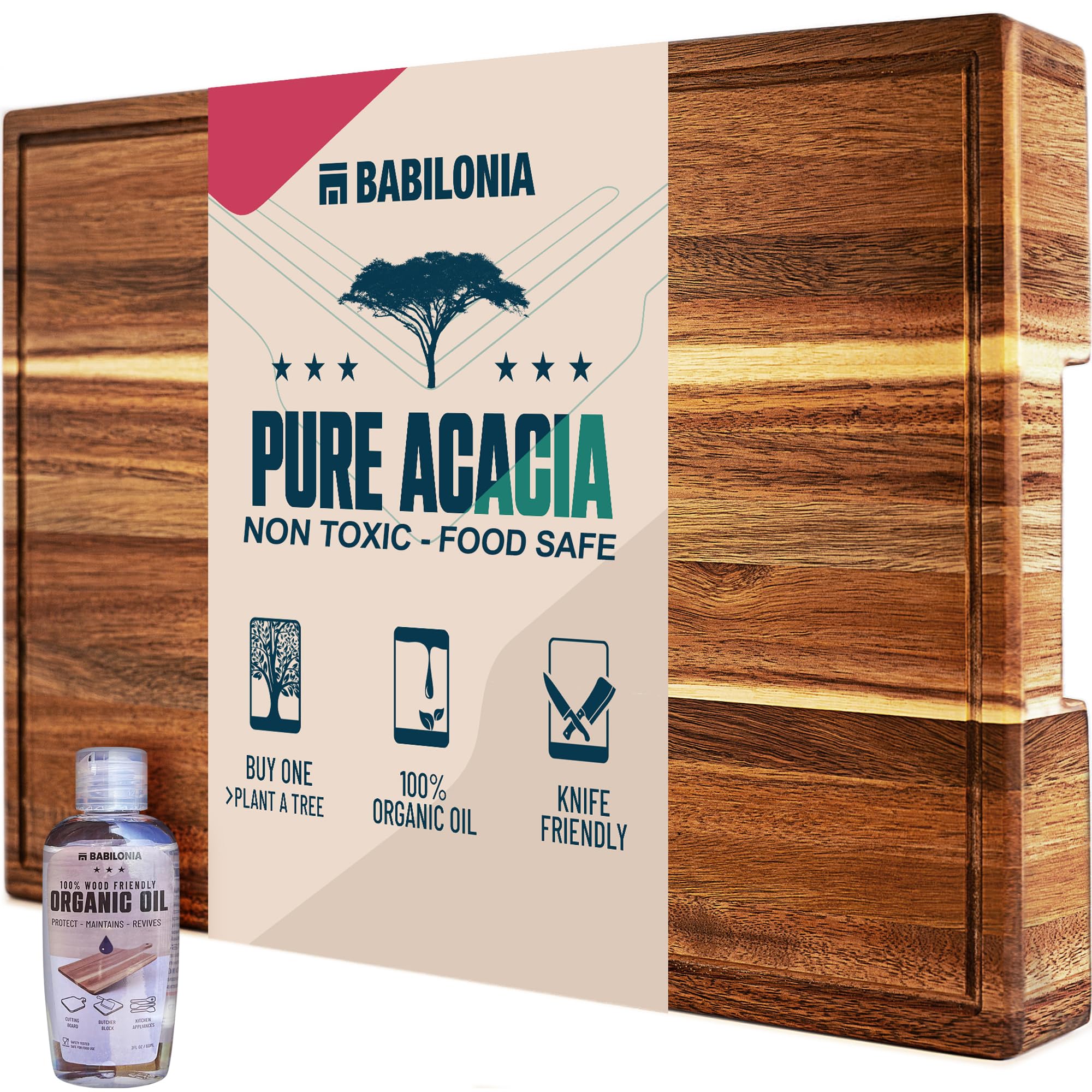
Most of the praise for this one lands on the wood itself — people keep coming back to how good the acacia looks on the counter. But the feature that actually earns its place in a meat kitchen is the notch-and-plate design. You chop, then tilt the board and slide the produce or diced meat off into your pot, which means no more scooping with a knife or carrying a loaded board across the kitchen.
The numbers back up the stability claim. It is 1.6″ thick in 100% acacia, cut edge grain, and it weighs 2.71 kg — slender enough next to the Walnut End Grain at 2.79 kg that you will not notice a difference in the hand. Its footprint is 15.7″ x 10.2″, which the manufacturer sizes as a medium board, and one thing buyers consistently agree on is that this size lands right for day-to-day cooking.
The build also tips over to the smooth side as a serving tray with a hidden handle, so a cheese and cured-meat spread is a genuine second job for it. It arrives pre-oiled with a bottle of organic oil and a plate in the box. Worth knowing before you buy: the compact footprint that owners love means a whole large bird will overhang the edges — that is what the 20″ boards are for.
The slide-off trick: the notch and plate let you transfer diced meat without lifting the board, which keeps juice off the counter and saves a second bowl.
Size reality check: at 15.7″ x 10.2″ it is a medium board, brilliant for steaks and chicken breasts but not the board for a holiday roast.
Reach for this if: you cook smaller cuts often and want one board that preps, slides and serves.
Look elsewhere if: your Sunday job is a whole turkey or a bone-in ham.
3. XL Acacia End Grain Wood Cutting Board (20x15x1.5in)
Two boards in one: a grooved carving face and a compartmented prep face.
Twenty by fifteen by one and a half inches is a serious footprint, and the 6-pound weight keeps it from skating while you press through a bone-in cut. That is 6 pounds versus the Yes4All teak board at 9.1 pounds, which matters if you wash your board after every meal rather than leaving it out.
Flip it and the design changes completely. The front face carries a carved juice groove around the edge to catch runaway liquid; the back face has three separated compartments for diced veg, mashed garlic or resting pieces. It is genuinely a second workspace, not just a marketing line. The inner handles are cut into the board itself, so there is nothing protruding to catch on a drawer.
End grain acacia gives it a friendly surface for knives, and the wood is 100% natural with each board showing its own colour and pattern. The trade-off worth naming: this is end grain, and a handful of cooks find the surface marks up more visibly than a dense edge-grain board — regular oiling keeps it looking right. If you have the counter space, its two faces make it the most flexible carving board of the mid-range group.
Carving plus prep, one board: a grooved face for roasts and a compartmented face for diced ingredients — that is two stations in 20″ x 15″ x 1.5″.
The care note: hand wash only, and expect to oil it more often than a tight-grain hardwood if you want it to keep its finish.
Best fit: cooks who want a carving board and a prep board without storing two of them.
The catch: at 6 pounds it is easy to move, but the end grain surface asks for oiling discipline.
4. Yes4All Teak Cutting Boards
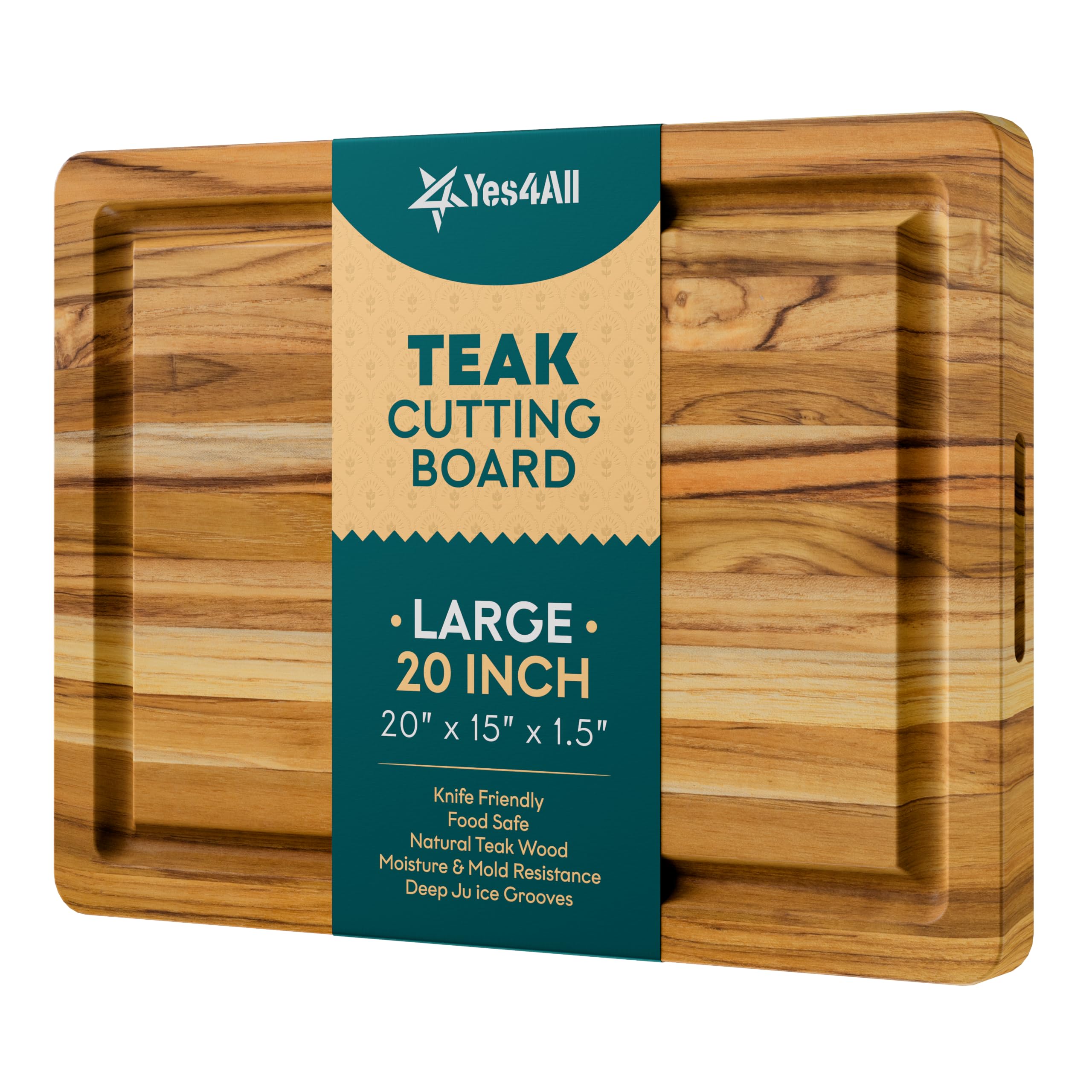
Moisture-resistant teak for the cook who rinses the board after every raw chicken.
Raw meat means water, and water is what kills most wood boards over time. This one is 100% natural teak with a tight grain structure the manufacturer says resists moisture absorption and surface wear. In practice, that tight grain is what keeps the board from cupping at the corners.
It is a big board — 20″ x 15″ x 1.5″ — and at 9.1 pounds it is the heaviest piece in this group bar the Winco. That weight is why it does not move when you bear down. It weighs 9.1 pounds versus the FANICHI XL above at 6 pounds, so plan where it lives; this is a leave-it-on-the-counter board, not a tuck-it-in-a-drawer board. A deep juice groove runs the perimeter and the reversible build gives you a fresh face when one side is in use.
Owners talk most about how it holds up: it resists showing cuts and does not warp, which is exactly what you want from a board that meets a knife several times a day. The scrubbed surface is designed to protect your knife’s edge. Teak’s natural colour and pattern vary from board to board, so no two look identical.
Why it earns the price
- Tight-grain teak that resists moisture absorption and surface wear
- Deep juice groove around the perimeter
- Reversible for a second clean cutting face
- Resists warping through daily prep
What you give up
- 9.1 pounds is heavy to lift for washing
- Thick and large — it needs dedicated counter space
- Edge grain, so a little firmer under the knife than end grain
This one wins if: moisture is your worry and you prep a lot of raw protein.
Not for you if: you wash and put the board away after every use — the weight makes that a chore.
5. Winco WCB-1824 Wooden Cutting Board

The restaurant-style slab that swallows a whole bird without arguing.
Eighteen by twenty-four inches. That is not a typo, and it is the entire reason this board exists. The manufacturer builds it for daily use in restaurants and hotels, and the size follows from that: a whole turkey, a bone-in ham, a full rack of ribs all sit comfortably with room to spare around the edge.
Natural hardwood at 1.75″ thick, and the manufacturer states the solid construction minimizes knife dulling. It weighs 17.8 pounds versus the Yes4All teak board’s 9.1 pounds — this board is a permanent fixture, not something you carry to the sink one-handed. Two recessed handles cut into the edges give you something to grip when you do move it.
The comments that stick with you are about solidity: it does not bend, warp or crack, and the smooth natural finish looks upscale whether it is on a home counter or a prep line. The wood has enough give that your knife lands cleanly. Hand wash only, and the 1 year warranty against defects in workmanship backs the build. Before you commit, check your sink — a board this size will not fit in every basin.
Size is the whole pitch: 24″ x 18″ x 1.75″ of solid hardwood — enough surface to carve the biggest joint you will cook all year.
The practical limit: 17.8 pounds and a wide footprint mean it lives on the counter and needs a sink that can actually fit it.
Take this one if: you host roasts and want the board to be the carving station, not a hand-held helper.
Hold off if: your kitchen is tight or your sink is narrow.
6. HexClad Rectangle Large Walnut Cutting Board
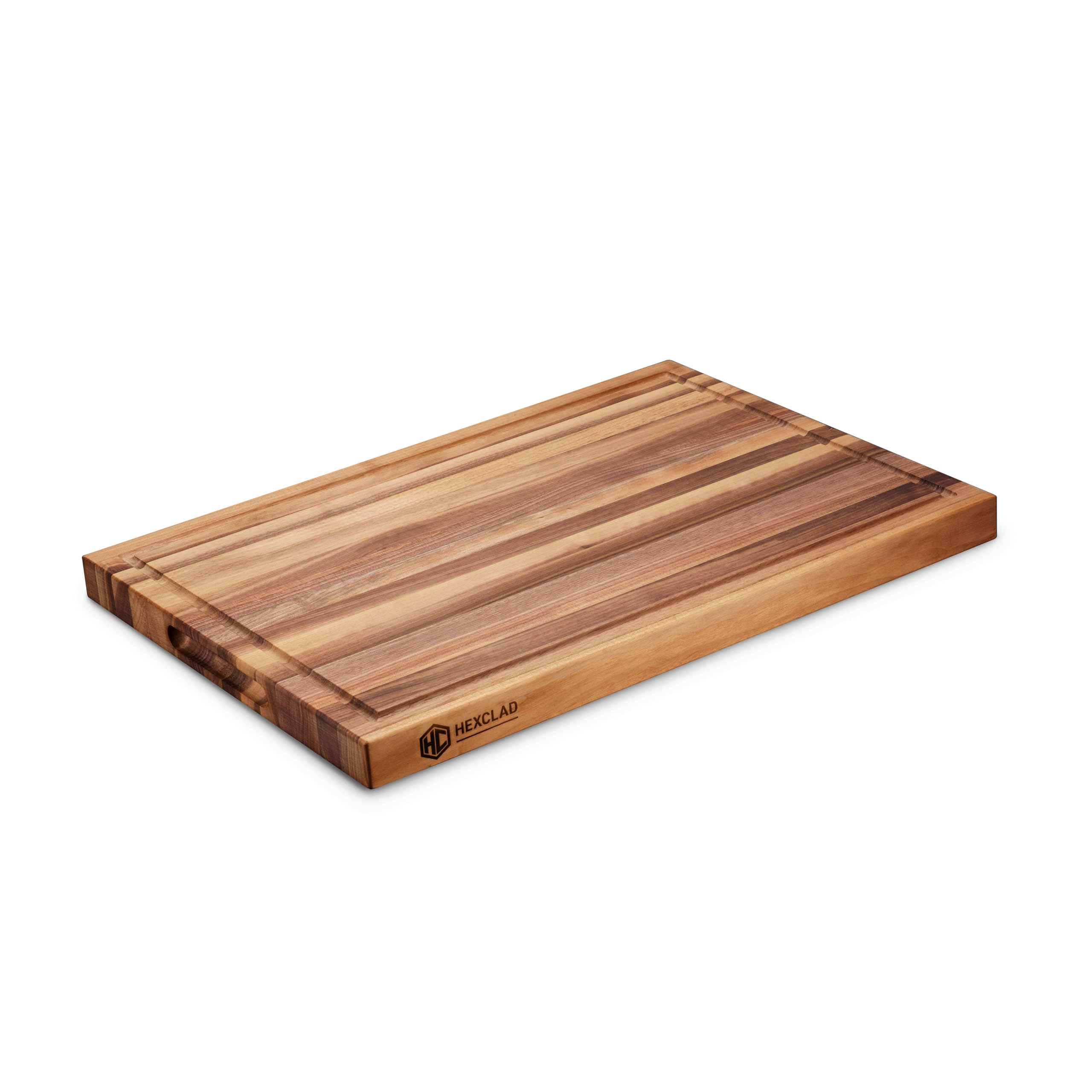
Walnut so dense it holds its surface, with a grooved side and a flat side.
Density is the reason to pay more for walnut here. HexClad builds this from high-end walnut, and the maker states that its tight grain resists deep knife marks, helps prevent staining, and keeps the surface from soaking up the smell of garlic, onions or raw protein. If a cheap board has ever held onto the scent of last week’s fish, that resistance is worth the extra.
The two-sided layout is practical in a way you notice on the first roast. The grooved side catches juices from a joint or a pile of fruit; flip it and you get a flat surface for slicing, dicing or plating a charcuterie spread. Recessed handles sit into the sides so flipping it wet stays manageable.
At 19.5″ x 13.75″ x 1.25″ it is wide enough for a large job without reaching the Winco’s slab proportion, and 8 pounds is light next to that 17.8-pound board. Two honest notes: the generous size surprises some buyers once it is on the counter, and walnut boards this dense still need oiling to keep the grain from drying. Hand wash only.
The density argument: tight-grain walnut is built to resist knife marks, staining and lingering odours — the three things that make a meat board feel worn out.
Measure before you buy: at 19.5″ x 13.75″ some cooks find it bigger than expected on the counter.
Suits you if: you want one good-looking walnut board that handles raw meat on one side and serving on the other.
Worth passing if: counter space is tight or you wanted end grain construction.
7. American Walnut Wood Cutting Board
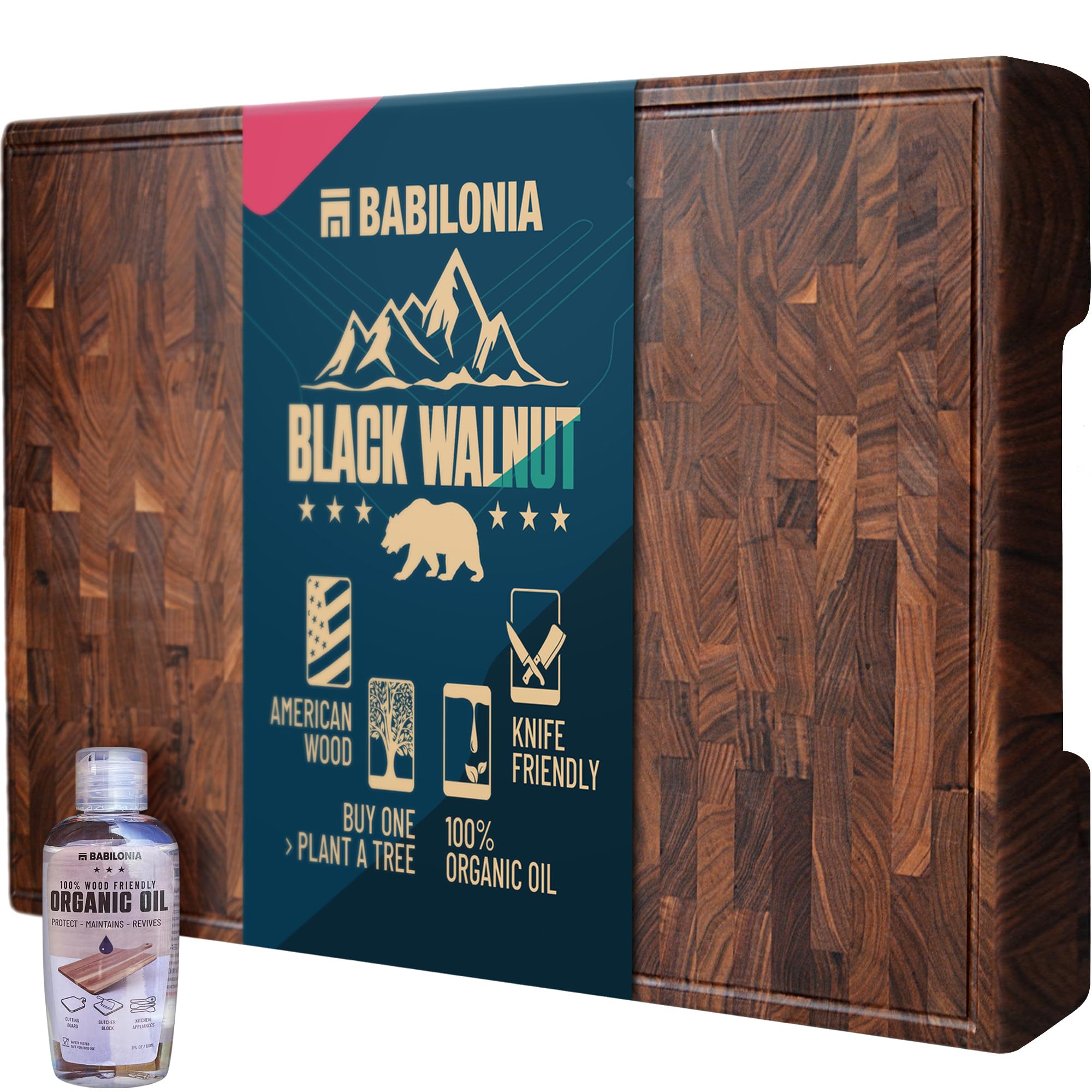
American-grown black walnut in end grain, at a thickness that will not flex.
Two numbers tell you what this board is: 1.7″ thick and 3.08 kg. That is a heavier build than the small Walnut End Grain at 2.79 kg, and the extra heft is exactly what keeps an end-grain board from bowing under a heavy cleaver. The wood is 100% sustainable black walnut grown in America, cut end grain so the knife edge slips in rather than across the fibres.
At 15.7″ x 10.2″, this is a compact board. That size is deliberate: it handles a couple of steaks or a chicken breast with room to move, and suits a two-person kitchen better than a slab. The 3 in 1 design adds a slide-off notch and plate (the same idea as on the Acacia board): tilt it and diced meat goes straight into the pan. It flips to a serving tray with a hidden handle.
Owners describe the surface as smooth and the construction as rock solid, and the black walnut grain is striking enough that several use it as a display board when no one is cooking. It ships pre-oiled with a bottle of organic oil included. The honest limit is footprint: this is not the board for a holiday bird, and the price climbs for what is a smaller working area.
What you are paying for
- 1.7″ end-grain American black walnut — dense and stable
- Slide-off notch and plate for moving chopped meat
- Ships pre-oiled with organic oil in the box
- Smooth surface that doubles as a display board
Know before ordering
- 15.7″ x 10.2″ is compact — too small for a whole bird
- Hand wash only, no dishwasher
- Premium walnut price for a smaller working surface
The right buy for: one- or two-person kitchens that want premium walnut at a workable size.
Not the right buy for: big-batch cooks who need the whole counter covered.
8. Teakhaus Extra Thick End Grain Butcher Block

Two and a half inches of end grain teak — a slab you plan your counter around.
No other board on this list comes close to 2.5″ thick. That dimension is the point: mass this heavy does not shift when you drive a cleaver through a rib rack, and it does not need rubber feet to stay flat, which owners specifically notice. The surface is end grain teak, gentle on knife edges by design.
It is 20″ x 14″ with a juice groove to catch liquid, and the build is reversible with grip handles. The teak is 100% FSC-certified, which means it comes from responsibly managed forests — a meaningful detail if you care where hardwood comes from. Teak also brings natural moisture resistance, a real advantage for a board that meets raw protein regularly.
What holds people back is the practical side rather than the build. This is a heavy board with a wide footprint, and some cooks find it takes more counter real estate than they planned for. It also sits at the top of the price range here, which is real money for a chopping board. Hand wash only, oil it now and then, and the 2.5″ teak slab is built to outlast most of the kitchen around it.
The case for the slab: 2.5″ of FSC-certified end grain teak gives you mass, stability and a knife-friendly surface in one piece.
What it asks of you: counter space and a hand-wash routine — it is not a board you tuck away.
Choose it when: you want a carving station built to last decades and have a permanent spot for it.
Choose otherwise when: you need something light enough to move or compact enough to store upright.
Know the Specs
End grain versus edge grain
End grain means the wood is cut across the log so the fibres point up, like the bristles of a brush. Your knife edge slides between those fibres, which is why end-grain boards are gentler on knives and can close up a little after oiling. Edge grain is cut along the length of the log, giving a flatter, denser-looking face that tends to be more affordable. Both handle meat well — end grain is the better long-term choice if you sharpen often.
Juice groove depth and layout
A juice groove is a shallow channel carved around part of the board, and its job is to catch liquid before it reaches your counter. Layout matters as much as depth: a groove that runs the full perimeter on a large board cups the liquid in place, while a groove along one edge only is fine for smaller cuts. If you regularly carve roasts, put more weight on a deep groove than on board colour.
Thickness and weight
Thickness is what keeps a board from warping, and weight is what keeps it from sliding while you press down. The trade-off is handling: a board at 1″ lifts easily, one at 2.5″ is a fixture on your counter. Match the thickness to how you cook — a lighter board for quick weeknight chicken, a heavier slab for whole roasts and bone-in cuts.
Wood species and moisture
Teak brings natural moisture resistance, which helps a board that sees a lot of raw protein. Walnut is dense and resists deep knife marks and lingering odours. Acacia is a middle ground with strong natural colour variation. All wood boards are hand wash only — never soak one, and always dry it standing so air gets to both faces.
Common Questions
Is end grain or edge grain better for cutting raw meat?
Can I put a wooden chopping board in the dishwasher?
How do I stop a wooden board from holding onto raw meat smells?
Does a juice groove actually catch liquid from a roast?
How heavy is too heavy for a chopping board?
How often should I oil a wooden chopping board used for meat?
Is a thick board better for carving a whole turkey?
Can I use one wooden board for both raw meat and vegetables?
What does FSC-certified teak mean on a cutting board?
The Bottom Line
For most kitchens, the wooden chopping board for meat winner is the Walnut End Grain by Babilonia. Its end grain walnut lets the blade slip between the fibres, a built-in groove catches roast juices, and a bottle of organic oil ships in the box. If raw-protein moisture is your main worry, the Yes4All Teak board brings tight-grain moisture resistance in a big 20″ x 15″ format. And for carving whole birds, the Winco WCB-1824 at 24″ x 18″ is the one to reach for, provided your sink can take it.
One nudge: the Walnut End Grain earns its top spot because buyers keep praising its craftsmanship. If you are torn between two boards, start with the one buyers praise for craftsmanship.
How we choose
We do not accept paid placement. Every pick is matched to a real buyer and a real use-case; we do not hands-on test units.
Sources
Specifications: manufacturer listings and product documentation. Review insights: verified customer reviews, as of November 2026. Pricing: not shown on this page (it changes often); check the current price via the retailer link.
As an Amazon Associate, Tactical Gear Guy earns from qualifying purchases. This does not affect which products we feature.