Specs are compiled from manufacturer listings and verified buyer reviews and can change over time — please confirm the key details on the product page before buying.
If your hands slide off a foam brick the moment you start to sweat, you already know the problem. A natural cork or wood brick keeps its grip when damp, stays firm under your palm instead of squashing, and gives you a stable base for balance poses. Below are nine natural blocks, sorted by what each one does best, so you can pick in minutes instead of an hour.
This guide is built by comparing the manufacturers’ published specifications and the patterns across verified customer reviews, so you get each pick’s real strengths and trade-offs instead of marketing spin.
Weight and thickness decide most of the experience here, so both are spelled out for every block. Read on for the plain-English breakdown of the best natural yoga bricks for your practice.
Top Picks


How To Choose The Best Natural Yoga Bricks
Three things decide whether a brick feels right in your hand: what it is made of, how thick it is, and how much it weighs. Get those three right and the rest is detail.
Cork versus wood
Cork comes from the bark of cork oak trees and has a slightly soft, textured surface that grips damp skin. Wood is harder and heavier, so it suits poses where you want a rigid ledge under your hand or heel. Neither is better in every case — cork is the friendlier everyday choice, wood is the choice for firm, unyielding support.
Thickness sets your reach
A 4-inch brick lifts your hand higher, which helps when your hamstrings or shoulders are tight and the floor feels too far away. A 3-inch brick is a smaller step up and suits you better once your flexibility improves or when you want the block tucked under your seat. Many regular practitioners end up wanting one of each height.
Weight is the stability-versus-portability trade
A heavier block sits still under your palm and does not skitter across the mat. A lighter block goes into a gym bag without dragging it down. If you mostly practice at home, weight is a bonus. If you carry your kit to a studio several times a week, pay attention to the numbers.
Side-by-Side Comparison
| Model | Best For | Material | Thickness | Weight / Count | Amazon |
|---|---|---|---|---|---|
| Cork Yoga Blocks 2 Pack Set (Volcano)★ Best Overall | Most people, everyday practice | Cork | 4″ | 2.04 kg / 2 pack | Amazon |
| Hatha Yoga Cork Yoga BlockSingle-Block Firmness | Single-block buyers who want firmness | Cork | 4″ | 2.2 pounds / 1 count | Amazon |
| Yogikuti Solid Wooden Yoga BlockBest Wood Option | Iyengar practice and rigid support | Pine Wood | 4.72″ | 1 kg / 1 count | Amazon |
| TSYPAIRS Cork Yoga Blocks 2 Pack | Firm support with a decorative finish | Cork | 3″ | 1.77 kg / 2 pack | Amazon |
| Yoga Design Lab The Cork Block | Style-led single block | Cork | — | — / 1 count | Amazon |
| Yoga Dood Premium Cork Blocks 2 Pack | Travel and small-carried kits | Cork | 3″ | 1.32 kg / 2 pack | Amazon |
| Hugger Mugger Cork Yoga Block | Sweaty hands and light carry | Cork | — | 16 ounces / 1 count | Amazon |
| Yoga-Mad Cork Yoga Block | A wider, lower platform | Cork | 5cm (1.9″) | 0.5 kg / 1 count | Amazon |
Detailed Reviews
1. Cork Yoga Blocks 2 Pack
Our pick — 4.5+★ from 750+ verified ratings; the strongest balance of quality and price.
The pair that does not budge under a sweaty palm, at the price of one mid-tier block.
You get two full-size bricks measuring 9″ x 6″ x 4″, both cut from Portuguese cork. That four-inch height is the taller of the two common sizes, so it puts your hand closer to the floor when tight hamstrings would otherwise stop the pose short. The pair weighs 2.04 kg together, which is heavy enough that the bricks sit still on the mat rather than skating away mid-balance.
What wins people over is the firmness. The cork is dense and does not give way under your weight the way a foam brick does, and the surface stays grippy once your hands get damp. Cork also resists odor and wipes clean with a damp cloth, which matters for a prop you press your face near in restorative work. The one honest catch is the weight — 2.04 kg for the pair is genuinely substantial to lug to a studio, so this is happiest living at home. A few owners also notice a faint cork smell at first.
Compare it against the single Hatha block below: this pair gives you two bricks for one purchase, while the Hatha is a single 2.2-pound block. For most home practitioners, two bricks are what you actually want, since many poses use one under each hand. The Volcano set is the crowd favorite here, and it holds the highest score of the group at 4.5+ stars.
What earns its keep
- Two 9″ x 6″ x 4″ cork blocks in one set
- Dense cork stays firm and does not squash under your palm
- Grippy surface holds when hands get damp
- Wipes clean with a damp cloth, resists odor
What to weigh up
- 2.04 kg for the pair is heavy to carry to class
- Some notice a faint cork smell out of the pack
Best for: Home practitioners who want two firm, grippy bricks and never want to think about them again.
Think twice if: You carry your kit to a studio several times a week and want something lighter in the bag.
2. Hatha Yoga Cork Yoga Block, Natural Cork from Portuguese
One solid block for the practitioner who only ever needs a single brick under a heel or hip.
Not everyone wants a pair. If your practice leans on one block at a time — under your seat in meditation, under a hip in a restorative pose — a single 9″ x 6″ x 4″ brick is all you need. This one is cut from 100% solid Portuguese cork and weighs 2.2 pounds, a weight the maker openly says is heavier than a foam block. That is the point: the extra mass is what keeps it planted.
The quality is what carries this one. It holds its shape under body weight, the surface wipes clean with a damp cloth, and it comes in a 3-inch or 4-inch thickness so you can pick your reach. The trade-off is the weight again — 2.2 pounds is thick enough that one owner described it as shockingly heavy, and the size reads as too big for a few users. Those are fit notes, not flaws: a smaller-framed practitioner may prefer a 3-inch block instead.
Set against the Volcano pair above, you are trading two bricks for one. Buy this if a single block is genuinely your practice. skip it if you already know you want one under each hand.
Where it shines: The density is the whole story — it does not compress, does not slide, and holds alignment in a deep lunge without flexing.
What you need to decide: one block or two. This is a strong single block, not a set.
Choose this if: Your practice uses one block at a time and you want the firmest cork you can get.
Pass if: You want a matched pair for two-hand poses.
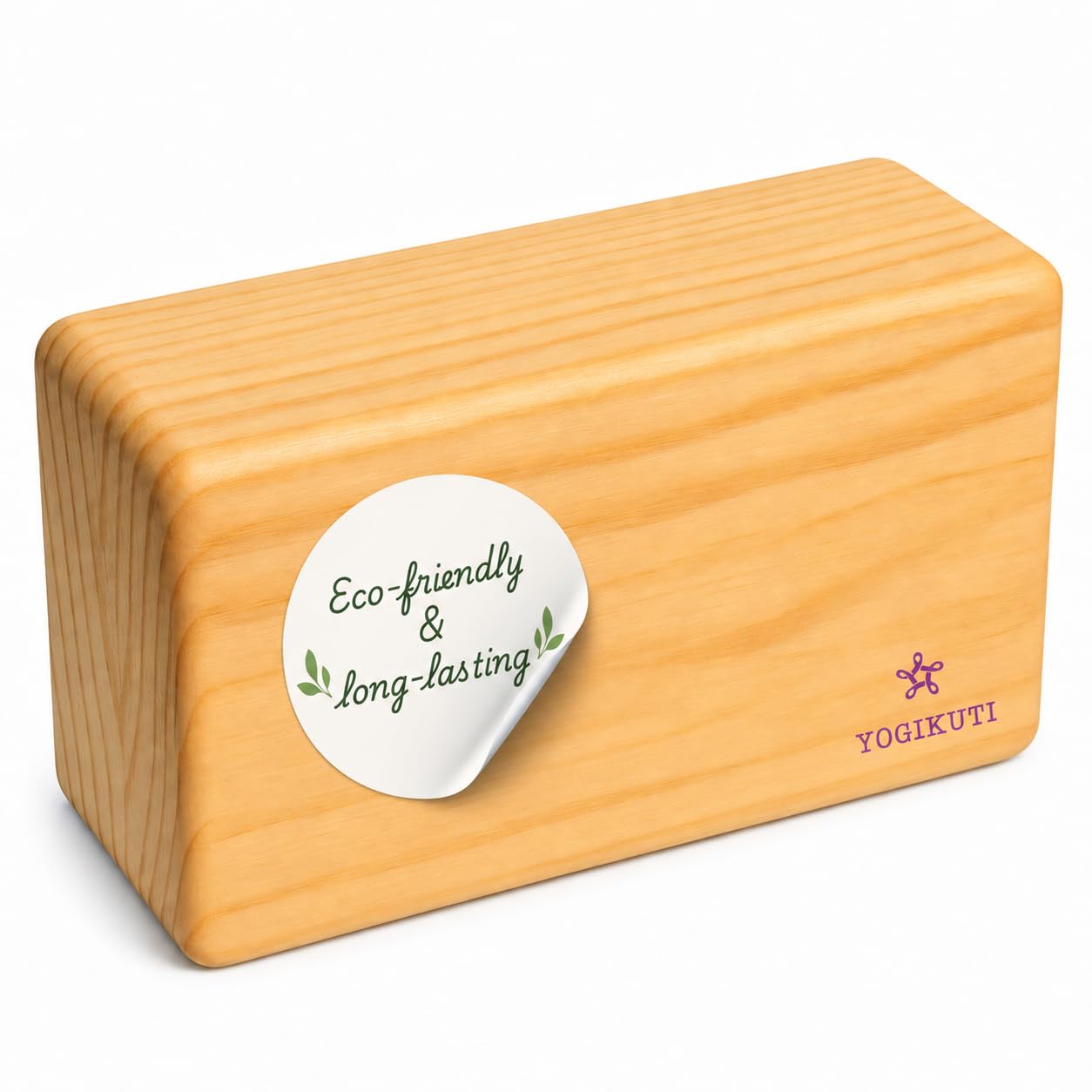
3. Yogikuti Solid Wooden Yoga Block, Premium Pine Wood
Pine instead of cork, for the Iyengar practitioner who wants a rigid ledge under the hand.
Cork has a little give. Wood does not. The edges are rounded and smooth, so the firmness does not bite into your hand during a long hold. For Iyengar work, where blocks are used as firm extensions of the floor, that rigid feel is exactly the point.
The honest warning is size. The listed dimensions run 8.46″ long by 2.76″ wide by 4.72″ thick, which is narrower than the standard 9″ x 6″ footprint most cork blocks use. Several owners mention it feels smaller than a standard block. If you have larger hands or want a broad platform under your seat, that narrow width is a real consideration. If you want a compact, rigid, light block, it fits the bill.
Compared with the Hatha cork block above, this pine block gives you a harder surface at roughly half the weight. Wood is the answer when you want the floor to feel like actual floor, not a cushion.
Why wood earns a place
- Solid pine gives rigid, unyielding support
- About 1 kg each, far lighter than the cork pairs
- Smooth rounded edges stay comfortable in long holds
The size question
- Narrower footprint than the standard 9″ x 6″ block
- Customers note it feels smaller than expected
Made for: Iyengar and alignment-focused practice where a hard, light block is the tool you want.
Not the one if: You need a wide platform for larger hands or seated support.
4. TSYPAIRS Cork Yoga Blocks 2 Pack Set, High Density

A double-compressed cork pair with a laser-etched tree on the side, firmer than the standard stuff.
The tree design is the first thing you notice, laser-printed into the cork surface. The second thing is the density. These blocks are made from double-compressed, high-density cork, which the listing says makes them heavier and firmer than standard cork blocks. They come in at 9″ x 6″ x 3″ each — the slimmer three-inch height — and weigh 1.77 kg for the pair.
What buyers respond to is how substantial they feel and how well the grip holds. The cork does not squish the way foam does, and the tree motif gives these a look you would not hide in a cupboard. Durability is the other thing that comes up, and it lands well. The honest note: the firmer, denser build is the very thing that some find a touch hard, so if you want a soft surface under a knee, this is on the firm end of the scale.
Against the Volcano pair, this one is slimmer at 3 inches versus 4, and lighter at 1.77 kg versus 2.04 kg. If you want a slightly lower step-up and a more decorative finish, this is the pick.
The standout: Double-compressed cork that feels denser and firmer than a standard brick, wrapped in a laser tree detail you will actually leave out.
One trade-off: The firmness that makes it stable is also why a few find it hard under a knee.
Suits you if: You want a slimmer 3-inch pair that feels firm and looks the part.
Skip if: You want a softer surface for knee or forehead support.
5. YOGA DESIGN LAB The Cork Block, Eco Friendly Luxury

A single cork block sold on the strength of its grip and a mandala finish.
This is one block, not a set, and it leans on two things the listing names outright: superior grip and strength. The colorway is called Mandala, which gives it a decorative face that stands apart from a plain cork brick. If you care how your props look when they sit out in a living room, that is the draw here.
The care instruction is hand wash, so treat it gently rather than tossing it in a machine. Beyond that, this is a straightforward single cork block aimed at someone who wants a quality one-off rather than a pair. The listing keeps the details lean, so measure your expectations against the grip-and-strength pitch rather than a long spec sheet. It is a premium single block for the buyer who values the finish.
Set that against the Yogikuti wood block above, which is a different material entirely, and this is the softer cork alternative for someone who wants cork’s give with a bit of pattern. Not the pick if you need two bricks.
Its appeal: Cork grip and a Mandala finish in one single block, for someone who wants their props to look considered.
Be aware: It is one block, and it is hand wash only — not a pair, not a machine-wash item.
The right call if: You want one good-looking cork block and do not need a matched set.
Not for you if: You want two bricks or a block you can clean quickly.
6. YOGA DOOD Premium Cork Yoga Blocks 2 Pack

The pair that slips into a gym bag without weighing it down, and grips when things get sweaty.
At 1.32 kg for the pair, this is one of the lighter two-block sets here, which is the whole reason to pick it. It comes in a 9″ x 6″ x 3″ size — the slimmer three-inch height — so it packs flatter than a 4-inch brick. The cork is described as sustainably sourced and biodegradable, and the listing makes a point of the non-toxic alternative to foam, including no chemical odor.
The textured surface is built to keep its grip through sweaty sessions, so your hands stay planted when you are slick with sweat. Reviewers point out using it for knee support, which makes sense for a firmer cork block that does not compress under a joint. One design point is worth flagging: the marketing leans hard on “for men” and “busy professionals,” but the block itself is a plain 3-inch cork brick — the size and firmness do the work, not the wording.
Against the TSYPAIRS pair above, this one is slightly heavier at 1.32 kg versus 1.77 kg — actually lighter — and also a 3-inch brick. Both are slim; this one is the more travel-minded of the two. If you move your kit around, start here.
Why it travels well
- 1.32 kg for the pair, light for a two-block set
- Slim 3″ height packs flatter than a 4″ brick
- Biodegradable cork, no foam chemical odor
- Textured surface holds through sweaty sessions
Keep in mind
- 3″ height gives a lower reach than a 4″ block
Pick this if: You carry your blocks between home, studio, and travel and want a pair that does not weigh you down.
Look at a 4″ pair instead if: You need the taller step-up under tight hamstrings.
7. Hugger Mugger Cork Yoga Block, Naturally Grippy

A single cork block that weighs 16 ounces, made from a finer grain for a lighter carry.
The number that defines this block is 16 ounces — about a pound — for one block. The listing says it uses a finer grain than the coarse cork typical in other blocks, and that is what keeps it light. The edges are contoured for comfort, so it sits kindly in the hand during a long hold, and the surface is built to be easy to grip and non-slip.
The grip and the texture are what people keep coming back to. Cork has a natural tack that holds once hands get damp, and this one adds a fine-grain feel that is softer than wood but not squishy like foam. Weight is the top thing that comes up, positively — a pound is genuinely easy to carry. The honest note: it is a single block. If you want two, you are buying twice.
Compare it with the Yogikuti wood block above: at 16 ounces this cork block is lighter still than the roughly 1 kg pine block, and it gives a little where wood does not. If you want a light, grippy single for sweaty hands, this is it.
What owners like most: It is light at 16 ounces and the fine-grain cork grips well once hands are damp.
Worth noting: One block per order, so a two-hand practice means buying two.
Ideal for: Sweaty-handed practitioners who want a light, grippy single cork block.
Think twice if: You want a pair from the start.
8. Yoga-Mad Cork Yoga Block, 30.5cm x 20.5cm x 5cm

A wide, low block at 30.5cm by 20.5cm by 5cm, for a broad platform under the hand.
Most blocks here sit at roughly 9 by 6 inches on the face. This one is bigger and flatter: 30.5cm long by 20.5cm wide by 5cm thick, which works out to a 12-inch by 8-inch face at about 1.9 inches of height. That wider footprint gives you more surface under a palm or a heel, and the low height makes it a gentler step up than a 4-inch brick. It weighs 0.5 kg — the lightest block of the whole group.
The cork is described as high-quality and sustainable, and the block is built to add balance, stability, and comfort in longer holds. Because it is low and wide, it suits you well for restorative work and for anyone who finds a tall block too much of a jump. The honest trade: at 1.9 inches thick, it will not lift you as high as a 4-inch brick, so if your hamstrings need real reach, this is the wrong height.
Set beside the 4-inch Volcano pair above, this is the low-and-wide alternative rather than the tall lift. Pick it when a broad, gentle platform matters more than height.
Where it wins
- Wide 12″ x 8″ face gives a broad platform
- 0.5 kg, the lightest block here
- Low 5cm height is a gentle step up
The height trade
- 1.9″ thickness will not lift you as high as a 4″ block
Go for it if: You want a wide, low, light platform for restorative and gentle work.
pass on it if: You need real height under tight hamstrings.
Know the Specs
Material: Cork versus Pine Wood
Cork comes from cork oak bark and has a natural tack that grips damp skin, plus a touch of give that cushions a knee or forehead. Pine wood is harder and gives a rigid, floor-like surface under the hand — the choice for Iyengar alignment work where you want no compression at all. Neither wears out quickly when wiped clean after use.
Thickness: 3 Inch, 4 Inch, or Lower
Thickness sets how high the block lifts your hand or seat. A 4-inch brick is the taller common size, useful when your hamstrings or shoulders are tight. A 3-inch block is a smaller step up for when flexibility improves. A low block like a 5cm option is a gentle platform for restorative poses rather than a big lift.
Weight and the Carry Trade
Heavier blocks sit still on the mat; lighter ones travel. Two blocks can weigh anywhere from 1.32 kg to over 2 kg for the pair, so a home-only set can afford the extra mass while a studio-goer will feel every ounce in the bag. Single blocks range from 16 ounces up to about 1 kg.
Dimensions and Footprint
Most blocks use a roughly 9″ x 6″ face, but some run wider (12″ x 8″) or narrower. A wider face gives more surface under a hand or heel; a narrower one suits smaller hands but feels small under a broad palm. Check the footprint if you have larger hands or do seated work.
Common Questions
Is cork better than foam for a yoga block?
Should I get a 3-inch or 4-inch yoga block?
Do I need one block or two?
Will a cork block hold up in a hot or sweaty practice?
How do I clean a natural cork yoga block?
Why does my new cork block smell?
Is a wooden yoga block better than cork?
How do I keep a block from sliding on my mat?
Can I use a yoga block for Pilates or stretching?
The Bottom Line
For most people, the natural yoga brick to buy is the Volcano Cork 2 Pack. One purchase gets you two firm, grippy 9″ x 6″ x 4″ cork blocks, and it holds the highest score of the group at 4.5+ stars. If you only ever use one block at a time, pick the single Hatha Cork Block. For a rigid, lightweight block for Iyengar alignment work, reach for the Yogikuti Pine Wood Block.
The pattern is simple: a heavier cork pair for home, a slimmer 3-inch set for the bag, and a pine single for rigid Iyengar support. Get material, height, and weight right, and your blocks will quietly do their job for years.
How we choose
We do not accept paid placement. Every pick is matched to a real buyer and a real use-case; we do not hands-on test units.
Sources
Specifications: manufacturer listings and product documentation. Review insights: verified customer reviews, as of November 2026. Pricing: not shown on this page (it changes often); check the current price via the retailer link.
As an Amazon Associate, Tactical Gear Guy earns from qualifying purchases. This does not affect which products we feature.