Specs are compiled from manufacturer listings and verified buyer reviews and can change over time — please confirm the key details on the product page before buying.
If your baby wakes the second a sliver of daylight hits the crib, the fix is a fabric shell that wraps the sleep space in near-darkness and airflow at the same time. That is the whole job of an infant sleep tent — a bottomless mesh-and-fabric cover that drops over a crib, pack n play, or travel bed so naps stop depending on the room. Below are the four models worth your attention, sorted by what each one actually does best: one is the safest bet for travel, one is the darkest, one is the cheapest way to stop a climber, and one is the premium pick parents pack for hotel rooms.
This guide is built by comparing the manufacturers’ published specifications and the patterns across verified customer reviews, so you get each pick’s real strengths and trade-offs instead of marketing spin.
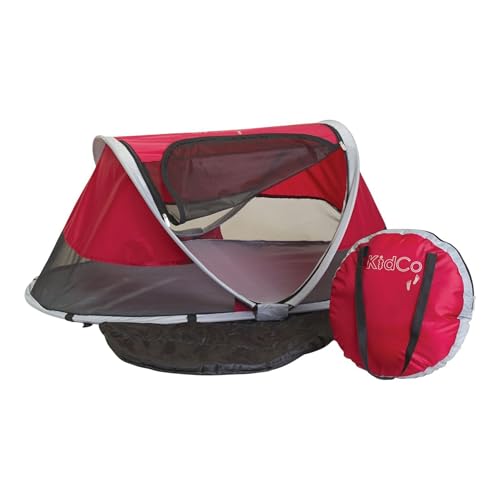
You will see where each tent is lightest, where the blackout really works, and where the zipper or the fold lets owners down. My pick for most families is the KidCo Peapod in Cranberry, the one children’s travel bed built to pass the CPSC (Consumer Product Safety Commission) testing protocols — best infant sleep tent.
Top Picks
How To Choose The Best Infant Sleep Tent
Start with the bed your baby already sleeps in. A sleep tent does not replace the crib or play yard — it covers it. That single fact decides most of your shopping, because a tent that does not fit your bed is useless no matter how dark the fabric is.
Fit first: bottomless covers vs. stand-alone beds
A bottomless tent has no floor, so it sits over an existing mattress and lets you lift your baby in and out through a zipper door. The SlumberPod and the Porayhut crib net both work this way. The KidCo Peapod is different — it is a complete travel bed with its own base, so you are buying the sleeping surface, not just a cover.
How dark do you actually need it
Blackout fabric is rated by how much light it stops, and the numbers vary widely. The SlumberPod states its fabric reduces 99% of light, while the Poray Pop Up lists an effective light blocking rate of 95%. For a midday nap in a bright hotel room, either is plenty. Pair the dark fabric with adjustable ventilation screens so the air still moves.
Ventilation, mesh, and bug protection
Mesh is the part of the tent your baby breathes through. The KidCo Peapod uses lightweight mesh for airflow and as an insect screen. The Poray Pop Up adds four adjustable ventilation and light-blocking screens on the front, back, left, and right. More vent panels mean less stale air on a warm night.
Weight and pack size for travel days
You will carry this through airports and up stairs, so pack weight is a real spec. The Porayhut crib net folds to a travel size of 21.6 x 21.6 x 1 inches at 3.3 pounds. The Poray Pop Up weighs 6.6 pounds and stores at 20 x 20 x 3 inches. Both fit in a suitcase; one is far easier to haul.
Climb-out protection and the zipper
If your toddler has learned to swing a leg over the crib rail, look at how the zipper closes. The Poray Pop Up uses a single outer zipper that your child cannot open from inside. An outer-only zipper is what keeps a climber contained instead of treating the tent as a game.
Side-by-Side Comparison
| Model | Best For | Weight | Fits | Light Blocking | Amazon |
|---|---|---|---|---|---|
| KidCo Peapod, Cranberry★ Best Overall | Travel bed with safety testing | — | Stand-alone travel bed | — | Amazon |
| Porayhut Portable Baby Safety Crib Mesh Tent | Stopping a crib climber | 3.3 pounds | 51 x 27.9 inch crib, bottomless | — | Amazon |
| Poray Pop Up Baby Privacy Bed Tent | Dark naps at home and on the road | 3.7 pounds | 52 x 28.3 inch full crib | 95% effective blocking rate | Amazon |
| SlumberPod The Original Blackout Sleep Tent | Room sharing and hotel travel | — | Play yards, pack n plays, mini cribs | Reduces 99% of light | Amazon |
Detailed Reviews
1. KidCo Peapod, Cranberry
Our pick — 4.5+★ from 350+ verified ratings; the strongest balance of quality and price.
The only pick here that is a complete travel bed rather than a cover, and the only one KidCo says passes CPSC testing.
Most of the tents in this list are covers. The Peapod is a bed. KidCo states it is the only children’s travel bed on the market that passes the Consumer Product Safety Commission (CPSC) testing protocols. It is the only pick here whose safety claim rests on a published test protocol instead of a fabric spec.
The body is lightweight mesh, which does two jobs at once: air moves through it on a warm night, and it works as an insect screen on an international trip. That combination is why parents drag it through airports. It folds into a large suitcase with room to spare, and children up to a 2.5-year-old fit comfortably inside, which is more space than the squarer travel beds give you.
What wins people over is how it looks and travels — the cranberry body reads as a proper little pod, and it carries lighter than you expect for a bed with its own base. Parents describe their kids settling into it on holiday and sleeping through the night. The trade-off is the fold. Folding it back down takes practice, and the directions leave some owners hunting for the right twist. Learn the fold once at home before you rely on it in a hotel lobby.
What earns it the top spot
- KidCo says it passes CPSC testing protocols, a published federal standard
- Mesh body works as both an airflow panel and a bug screen for overseas travel
- Fits inside a large suitcase with room left for clothes
- Room enough that a 2.5-year-old still sleeps comfortably
Where owners hit friction
- The fold takes practice and the printed directions are thin
- More involved to set up than a tent that simply pops open
Reach for this if: you want a travel bed with a real safety testing claim and mesh that doubles as bug protection.
Look elsewhere if: you want something that erects in one motion with no learning curve.
2. Porayhut Portable Baby Safety Crib Mesh Tent

A bottomless mesh lid for the crib your toddler has started treating as a climbing wall.
The size is genuinely generous. Unfolded it covers 51 x 27.9 inches, so it pairs with a same-size crib and mattress and gives your baby a full crib’s worth of space to roll around in. When the trip is over it collapses to 21.6 x 21.6 x 1 inches and weighs just 3.3 pounds. That is noticeably lighter than the 3.7-pound Poray Pop Up — the gap between them is stated as 12% here — so it wins the suitcase-packing contest between the two mesh options.
The honest catch is durability. The fabric is polyester, and the longevity is the dividing line in owner feedback: some families get years out of it, while others see a rip within a month. The zipper is the second soft spot, since it can collapse and stop closing cleanly. Treat this as a lightweight containment cover you handle carefully, not a heavy-duty piece of gear. Assembly itself is simple and fast, which is the part nearly everyone agrees on.
The packing advantage: at 3.3 pounds folding to 21.6 x 21.6 x 1 inches, this is the easiest tent on the list to slide into a bag beside the crib sheet — great if you travel between grandparents’ houses and need the net up in minutes.
The material reality: polyester mesh this thin trades toughness for lightness, so keep it away from sharp crib hardware and stow it flat rather than stuffing it in a corner.
Go here when: your toddler is escaping the crib and you need cheap, light containment that folds flat as a folder.
Not your pick if: you expect a fabric cover to survive rough handling for years.
3. Poray Pop Up Baby Privacy Bed Tent
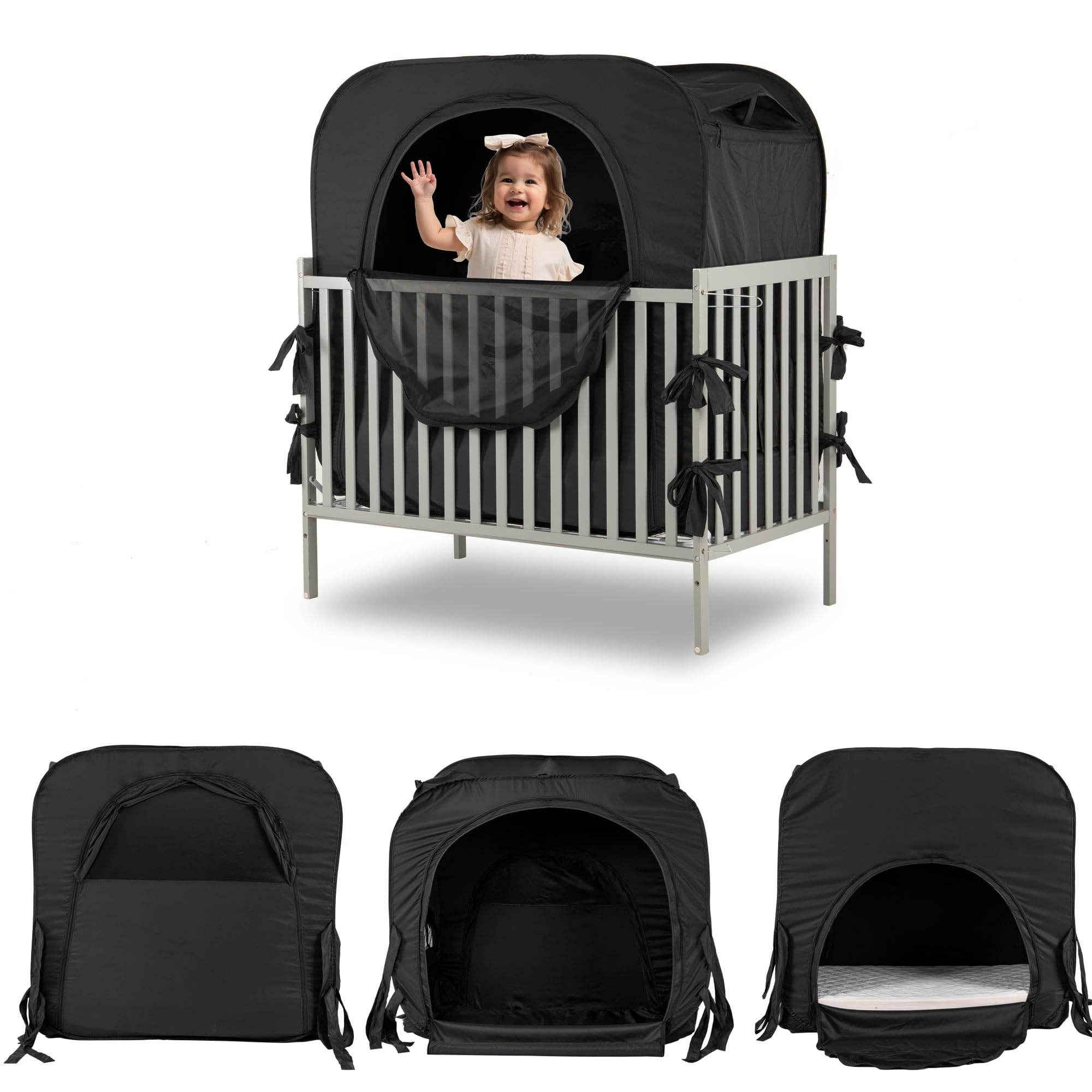
Pops open like an umbrella, then turns the crib into a cave with a 95% light-blocking shell.
Bedtime with a baby in your room usually fails on light, not on noise. Poray answers that with an advanced black fabric the maker lists at an effective light blocking rate of 95%, wrapped around a soft, breathable body. Set it over the crib and the lamp beside your bed and the phone screen in your hand stop landing on your baby’s face. The shell unfolds to 52 x 28.3 x 51 inches and covers a full crib, with a zipper along the bottom so you can slide the mattress in.
Then there is the thoughtfulness that separates it from a plain net. Four adjustable ventilation and light-blocking screens sit at the front, back, left and right, so you choose how much air and light get in on each side. Two mini fan pouches and two monitor pouches let you clip in a fan and a camera for watching a sleeping baby — neither is included. The zipper closes from outside only, so a toddler inside cannot reach it and let the whole thing fall open.
Weight is the price of that extra fabric. At 6.6 pounds and storing at 20 x 20 x 3 inches, it carries heavier than the 3.3-pound Porayhut net and takes more suitcase room, which is the cost of true blackout rather than sheer mesh. The recurring note in owner feedback is fit and safety on a crib: measure your own crib against 52 x 28.3 inches before ordering, because this is sized for a full crib and not a smaller bassinet.
Why the blackout crowd picks it
- 95% effective light blocking is the most specific darkness figure among the crib covers here
- Four adjustable vent-and-light screens give you side-by-side control
- Outer-only zipper keeps a climbing toddler inside
- Fan and monitor pouches built into the shell
What it asks of you
- 6.6 pounds is twice the pack weight of the lighter mesh net
- Sized for a full crib, so check your bed against 52 x 28.3 inches first
The right call for: room sharing with a baby who needs real darkness, not just a loose screen.
Think twice if: you are flying with hand luggage only and every ounce counts.
4. SlumberPod The Original Blackout Sleep Tent

The premium shell that drops over the pack n play and wins the darkness argument outright.
SlumberPod is the tent you see in hotel corners and grandparents’ spare rooms, and the reason is its fabric: the maker states it reduces 99% of light, the highest figure on this page. Because it is bottomless, it slips over most play yards, pack n plays, mini cribs, toddler cots, and inflatable toddler mattresses rather than replacing any of them. The tall interior gives you room to lean in and lay a sleeping baby down without folding yourself in half.
Airflow is handled deliberately. Four adjustable ventilation panels let you tune how much air moves through the shell, and two pockets fit the maker’s mini fan, sold separately. A monitor pocket lets you check on your little one through the fabric. The whole thing collapses into a travel tote that also fits in a carry-on suitcase, which is why it earns its place as the pick for flying families.
Quality and portability are what people talk about most, and the darkness delivers on the 99% claim — buyers report children sleeping past 6am in rooms that would otherwise wake them at dawn. The standing complaint is setup: threading the poles is a little cumbersome, particularly when you are kneeling beside a pack n play in a tight hotel room. Practice the assembly once at home before the trip. At this end of the range it is a considered purchase, and owners who like it rate it among their most-used baby purchases.
The darkness payoff: 99% light reduction over a pack n play blocks a 5am sunrise through thin hotel curtains.
The setup tax: poles and fabric take a few minutes and a bit of patience in a cramped room, so build it once at home and photograph the finished shape on your phone.
Worth it for: families who travel often and share rooms with a light-sensitive baby, and want the darkest tent in the group.
Pause if: you want a two-second pop-up and no pole threading at bedtime.
Know the Specs
Light-blocking percentage
The percentage tells you how much light the fabric stops before it reaches your baby. A 95% figure leaves a soft glow; 99% leaves near-total darkness. Use it as a starting point, not a guarantee — the way the tent sits over the bed and how well the bottom seals matters just as much as the number on the label.
Ventilation panels
Dark fabric holds air as well as light, so vent panels are what keep the space from going stale. Adjustable screens let you open one side and close another depending on where the sun or the draft comes from. Look for panels on multiple sides rather than a single window.
Bottomless vs. based design
A bottomless tent sits over an existing mattress and zips to the floor, which means you keep your baby’s usual sleep surface. A based bed like the KidCo Peapod gives your baby a complete stand-alone sleeping spot with its own floor. Bottomless is more flexible across beds; a based bed is simpler to set down anywhere.
Pack weight and folded size
Weight decides whether the tent comes with you or stays in the closet. A folded depth of about an inch slides into a suitcase flap; a folded cube takes real room. Weigh your tent against the rest of your luggage, because an infant sleep tent lives or dies on whether you actually pack it.
Common Questions
Does an infant sleep tent fit over a standard pack n play?
Will a sleep tent really keep a climbing toddler inside the crib?
How dark is 95% light blocking compared with 99%?
Are the mesh windows on an infant sleep tent safe for airflow?
Can I use a sleep tent while travelling by plane?
How do I fold a pop-up sleep tent back down?
Do sleep tents come with a fan or monitor included?
Is a bottomless sleep tent or a based travel bed better for a baby?
How long should an infant sleep tent last?
The Bottom Line
For most families, the infant sleep tent worth buying is the KidCo Peapod, because it is the only children’s travel bed here built to pass CPSC testing, with mesh that doubles as an airflow panel and bug screen. If you share a room with a light-sensitive baby and want the darkest shell available, reach for the SlumberPod, whose fabric reduces 99% of light. And if your toddler has started climbing out, the Porayhut crib net contains them with a bottomless 51 x 27.9 inch cover that folds to an inch flat. The one nudge that matters: once you know your bed’s size and your baby’s climbing habits, none of these is a gamble.
How we choose
We do not accept paid placement. Every pick is matched to a real buyer and a real use-case; we do not hands-on test units.
Sources
Specifications: manufacturer listings and product documentation. Review insights: verified customer reviews, as of November 2026. Pricing: not shown on this page (it changes often); check the current price via the retailer link.
As an Amazon Associate, Tactical Gear Guy earns from qualifying purchases. This does not affect which products we feature.