Specs are compiled from manufacturer listings and verified buyer reviews and can change over time — please confirm the key details on the product page before buying.
Most security cameras show you a car. Very few show you the plate. That single difference is what separates a real license plate security camera from a generic driveway cam, and it is the only thing worth spending your money on here. Below are four cameras that actually claim license plate recognition, sorted by who they genuinely suit.
This guide is built by comparing the manufacturers’ published specifications and the patterns across verified customer reviews, so you get each pick’s real strengths and trade-offs instead of marketing spin.
The trick is matching lens reach and low-light handling to your actual driveway distance. This breakdown of the license plate security camera market covers exactly that.
Top Picks

How To Choose The Best License Plate Security Camera
Reading a plate is a harder job than watching a driveway. The camera has to resolve small characters on a moving target, often at night, often against bright headlights. Get the lens reach and the low-light sensor right and the plate is legible; get them wrong and you own an expensive motion detector.
Lens reach beats megapixel count
A plate is small. To fill enough of the frame for its characters to be read, you need optical reach — a zoom lens you can dial in. That is why a motorized varifocal lens (a lens you can zoom and focus remotely from the app) shows up on nearly every serious plate camera. One pick here runs a 5 mm–60 mm motorized lens; another runs a 2.7–13.5 mm 5X motorized varifocal. Pick the reach that matches your distance to the road.
Night performance is the real test
Plates get read after dark more often than in daylight. Look at two things: the IR (infrared) illumination distance, which tells you how far the built-in invisible light throws, and the sensor’s low-light figure in Lux. A lower Lux number means the sensor needs less light to produce a usable picture, so shadows and unlit plates stay readable.
Glare and weather will fight you
Headlights at night create harsh hotspots that blow out a plate. A wide dynamic range figure — written as a dB number — is the camera’s ability to hold bright and dark areas in the same frame. Weather sealing matters just as much: an IP67 rating means the housing is protected against dust and water jets, and IK10 means it resists impact damage.
Check what it plugs into
Wired PoE (Power over Ethernet) cameras run data and power down one cable, which is clean and reliable. But not every camera talks to every recorder. Some units only work with their own brand’s NVR, and some need a specific recorder model to open up their plate features. Confirm the pairing before you buy, or budget for the matching recorder.
Side-by-Side Comparison
| Model | Best For | Resolution | Lens | Night Reach | Amazon |
|---|---|---|---|---|---|
| EmpireTech IPC-B52IR-Z12E S2★ Best Overall | Long-distance plate reads | 2MP (1920×1080) | 5–60 mm motorized | 150 m IR | Amazon |
| Ubiquiti AI Professional Bullet | Ubiquiti users wanting AI | 4K (8MP) | 3x optical zoom | 25 m (82 ft) IR | Amazon |
| Anpviz 4MP LPR POE Camera | Commercial lots and toll lanes | 4MP (2688×1520) @30fps | 2.7–13.5 mm varifocal | 132 ft (40 m) IR | Amazon |
| GW Security 8-Channel 4K System | Whole-property coverage | 4K (8MP) @25fps | Zoom | — | Amazon |
Detailed Reviews
1. EmpireTech IPC-B52IR-Z12E S2 IP Camera
Our pick — 4.0+★ from 60+ verified ratings; the strongest balance of quality and price.
The long-reach specialist that pulls a plate in from the far side of the road.
Reach is the whole reason this camera sits at the top. Its lens travels from 5 mm to 60 mm and is motorized, meaning you zoom and focus it from the app instead of climbing a ladder with a screwdriver. That range is what the maker points at for 50 ft–170 ft plate work or long-distance monitoring. If your plate capture happens across a wide street or a lot entrance, that is the number you care about — not the 2MP sensor.
At night it throws built-in IR (invisible infrared light) out to a stated 150 m, which is 492.13 ft. That is a genuinely long throw, and it is why this unit can work as a plate camera rather than just a shape detector after dark. It takes 12 VDC or PoE power, so a single Ethernet cable can carry both data and power. The housing is metal, which suits a long outdoor life.
The honest catch is focus. Autofocus is the weakest thread in the owner record here, with owners reporting it can drift or hunt — a real problem when a plate is only in frame for a second. Image quality and night vision also draw a split verdict, and a few found the picture soft. Buyers who do get it dialled in talk about it working well for reading plates and about the quality of the build. This camera rewards a careful install and a fixed focus setting rather than a set-and-run approach.
Where it earns the top spot
- A 5–60 mm motorized lens gives genuine long-distance reach for plate characters.
- 150 m (492.13 ft) IR throw keeps capture working well past the end of the driveway.
- Metal housing and PoE-or-12VDC power suit a permanent outdoor mount.
What to plan around
- Autofocus is the most-discussed soft spot — lock the focus once you are happy with it.
- Image quality and night vision split opinion, so test your exact angle before committing.
- You will need a recorder to store and review the footage.
Reach for this if: your plates appear at a distance and you want one camera built to zoom in on them.
Think twice if: you want plug-in-and-walk-away simplicity — the focus needs dialling in.
2. Ubiquiti Networks AI Professional Bullet Camera (UVC-AI-Pro)

The sharpest frame in the group — 8MP of detail behind an AI brain.
If picture detail is your measure, this is the one. It records at 4K, which is 8MP, and that 8MP effective still resolution is double the Anpviz’s 4MP. More pixels on a plate means more character definition to work with when the footage gets reviewed. The AI layer is built in for reading plates and detecting people, and a far-field microphone array handles two-way audio.
The trade-off is that detail comes with a shorter night reach. Its IR runs to 25 m, which is 82 ft — plenty for a driveway or a gate, less so for a long road approach. It is also a compact unit, weighing 1.5 lb, which makes mounting easy compared with a full system. PoE carries power and data down one cable, and the housing is rated weatherproof for exposed outdoor use.
Treat the ecosystem honestly: this is a Ubiquiti camera, built to pair with Ubiquiti’s own network and recorder gear. If you are not, you are buying into a whole system, not a standalone box. The camera is excellent, but it assumes a Ubiquiti household.
Detail-first thinking: 8MP at 4K gives you the most pixels per plate of any pick here, and the built-in AI does the plate reading rather than a third-party box.
The ecosystem caveat: it is designed for Ubiquiti’s network and recorder, so factor in whether you already run that gear before you fall for the specs.
Who it is for: anyone already inside the Ubiquiti world who wants AI plate reading with top-tier image detail.
The one snag: 25 m IR reach is a driveway figure, not a highway one.
3. Anpviz License Plate Recognition POE Camera, 4MP @30fps
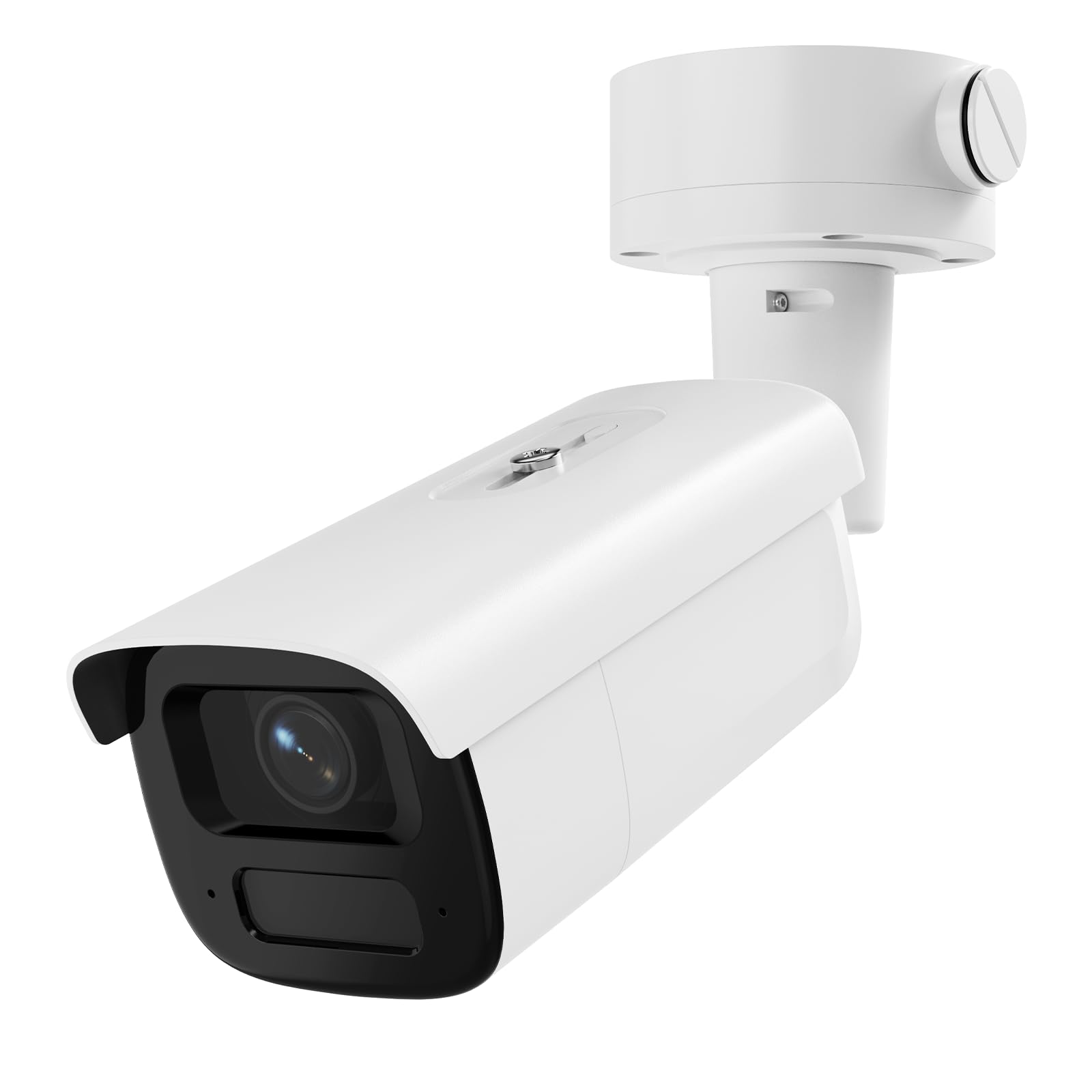
Built for a car park gate, not a cosy front porch — 120dB WDR and all-weather armour.
Here is the pick that handles bad lighting and bad weather without flinching. Its 120dB wide dynamic range (WDR) is the camera holding bright headlights and dark shadows in one frame without blowing out the plate — the exact condition that ruins plate reads at dusk. It shoots 4MP at 2688×1520 and 30fps, double the 15 fps of the GW Security system, so a moving car gets more frames to land a clean plate.
The low-light numbers are the other reason it earns its slot: 0.0003 Lux in colour and 0.0001 Lux in black-and-white, backed by a 1/1.3″ high-sensitivity sensor. Paired with 132 ft (40 m) of IR reach, it can deliver a usable image near total darkness. The 2.7–13.5 mm 5X motorized varifocal lens gives you the zoom to frame a plate properly, and H.265+ compression keeps storage and bandwidth in check.
Durability is where it pulls ahead of the rest. IP67 seals out dust and water jets, and IK10 means the housing shrugs off impact. Anpviz states it runs from -40°C to 60°C for harsh outdoor use. The one hard rule: it only works with Anpviz NVRs (B07T829M5V, B07Z9C1ZJQ, B0DBLDN195, B0DMP42V8K). If you own a different recorder, this camera is simply not an option without switching.
All-weather build: IP67 plus IK10 is the toughest housing on this list, and the -40°C to 60°C range is stated for real outdoor commercial use.
The lock-in to know: it is Anpviz-NVR-only, so a different recorder brand rules it out entirely.
Suits: car parks, toll-style lanes and exposed sites where glare and weather are the enemy.
Wrong pick if: you run a non-Anpviz recorder, because it will not pair.
4. GW Security 8-Channel 4K Smart AI PoE NVR Camera System
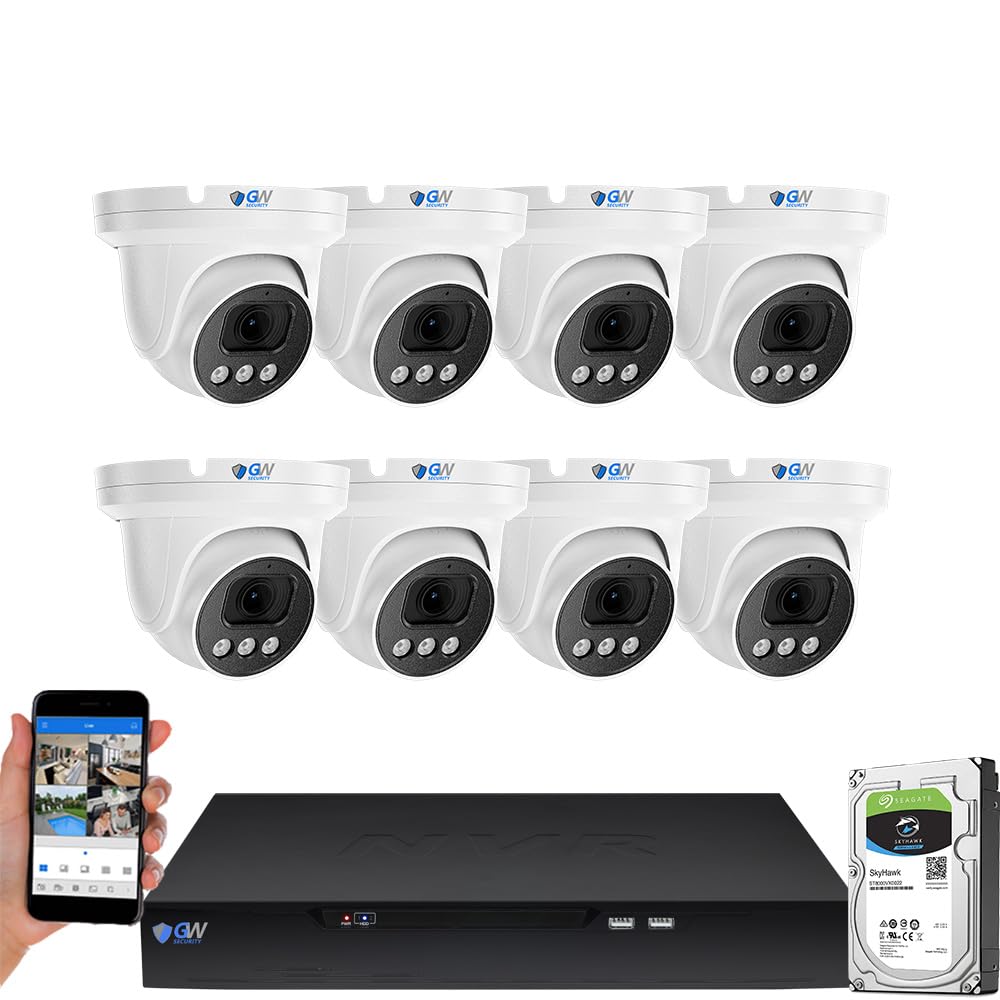
Not one camera — eight of them, an NVR, and enough storage to actually review the plates.
This is the answer for someone who wants the whole property covered in one purchase, plate detection included. The box ships with an 8-channel 12MP 6K NVR and eight 4K (8MP) cameras shooting at 25fps, each with a 135° wide angle and a built-in microphone. The AI handles Face Recognition, Human, Vehicle and License Plate detection, so it can flag a plate as well as a person. And crucially, a 2TB hard drive is already installed — you review footage the day it arrives.
The physical reality is worth stating plainly: at 25 lb with 20 × 15 × 20 inch dimensions, this is a whole system you mount piece by piece, not a single gadget. At 25 lb it is far heavier than the Ubiquiti’s 1.5 lb, because you are holding an NVR and eight cameras’ worth of hardware. It is NDAA and TAA compliant and made in Taiwan, which matters if you are buying for a site with federal requirements. H.265+ encoding cuts data use to help that 2TB go further.
Frame rate is the number that gives you pause. These cameras deliver 15 fps in the system’s own spec, against the Anpviz’s 30fps, so fast-moving plates get fewer frames to land on. For driveway and yard coverage it is fine; for a fast lane, the dedicated single cameras above will do the plate work better. This one wins on breadth — eight views, AI, and storage, all in a single box.
Why the whole-kit route works
- Eight 4K cameras, an 8-channel NVR and a pre-installed 2TB drive in one purchase.
- LICENSE PLATE detection sits alongside Face and Vehicle recognition in the AI suite.
- NDAA and TAA compliant — relevant for government or contract sites.
The honest limits
- 15 fps is slower than the dedicated plate cameras, so fast plates get fewer frames.
- At 25 lb it is a mounting project, not a quick one-camera add-on.
- You are covering a property, not optimising one single plate lane.
Choose this when: you want eight views, plate detection and storage bundled, and you are prepared to mount it all.
Pick something else if: a single fast-moving plate lane is your whole mission.
Know the Specs
Lens reach and varifocal zoom
A motorized varifocal lens is one you can zoom and focus from the app. The millimetre range tells you how far it can reach: a 5–60 mm lens stretches far across a road, while a 2.7–13.5 mm lens is more at home over a shorter field. Narrower, longer settings magnify the plate; wider settings watch more of the scene. Match the reach to the distance between camera and plate.
IR distance and Lux
IR (infrared) is the invisible light the camera throws so it can see at night. The metre or foot figure is how far that light reaches — 150 m on the EmpireTech, 25 m on the Ubiquiti. Lux is the opposite side of the coin: it measures how little light the sensor needs. Lower is better, and figures like 0.0003 Lux in colour point to a sensor built for near-darkness.
Wide dynamic range (WDR)
WDR is written as a dB figure and describes the camera’s ability to show bright and dark areas in one frame. Headlights and a shadowed plate are the classic problem. Higher dB keeps the plate from washing out. This matters most at dawn, dusk and whenever vehicle lights hit the lens.
IP and IK ratings
IP67 means the housing is sealed against dust and water jets — good for an exposed outdoor mount. IK10 refers to impact resistance, so the camera survives a knock. Together they say whether a camera belongs on a public car park post or a sheltered wall.
Frame rate in fps
Frames per second (fps) is how many still images the camera captures each second. A plate on a moving car is only in frame briefly, so a 30fps camera gives more chances to catch a clean read than a 15fps one. Resolution helps, but smooth motion capture helps more for fast traffic.
PoE and NVR pairing
PoE (Power over Ethernet) carries both data and power down one cable, which keeps outdoor wiring clean. But the recorder matters: some cameras only work with their own brand’s NVR. Always confirm whether your camera and recorder are compatible before buying, or buy the bundle that already matches.
Common Questions
Will the Anpviz LPR camera work with my existing NVR?
How far away can a camera read a license plate?
Does a wider megapixel count mean a better plate read?
Why does WDR matter for reading plates?
Can these cameras see plates at night without extra light?
Is PoE enough to power these cameras, or do I need a separate supply?
Does the GW Security system include storage for license plate footage?
Are these cameras built to survive rain and rough weather?
Will the EmpireTech’s autofocus stay locked on plates?
The Bottom Line
For most people, the license plate security camera winner is the EmpireTech IPC-B52IR-Z12E S2, because its 5–60 mm motorized lens and 150 m IR give you the reach to actually read a plate at distance. If image detail and built-in AI matter most and you live inside the Ubiquiti ecosystem, the Ubiquiti AI Professional delivers 8MP at 4K. And for a commercial lot fighting glare and harsh weather, the Anpviz 4MP LPR with its 120dB WDR and IP67/IK10 build is the one to reach for. Whichever you pick, match the lens reach to your plate distance and confirm the recorder pairing before you buy.
How we choose
We do not accept paid placement. Every pick is matched to a real buyer and a real use-case; we do not hands-on test units.
Sources
Specifications: manufacturer listings and product documentation. Review insights: verified customer reviews, as of November 2026. Pricing: not shown on this page (it changes often); check the current price via the retailer link.
As an Amazon Associate, Tactical Gear Guy earns from qualifying purchases. This does not affect which products we feature.