Specs are compiled from manufacturer listings and verified buyer reviews and can change over time — please confirm the key details on the product page before buying.
Dull corals leave you guessing whether light, flow, or chemistry is the problem. A PAR meter settles the lighting question in about thirty seconds. It measures photosynthetically active radiation (PAR — the slice of light your corals actually use to grow). Instead of guessing, you read a real PAR number at the exact spot where a frag sits. The four picks below do very different jobs: one splits light into blue, green, and red, one logs your tank around the clock, one reads UV alongside PAR, and one is built for growers rather than reef keepers. Each pick answers a different lighting question, so match the meter to yours.
This guide is built by comparing the manufacturers’ published specifications and the patterns across verified customer reviews, so you get each pick’s real strengths and trade-offs instead of marketing spin.
You will see how waterproofing, spectral range, and data logging change what a meter can tell you about a reef tank, plus where each instrument honestly falls short. Every pick here reads light underwater, and this breakdown of the par meter for reef tank work shows which one fits your setup best.
Top Picks

How To Choose The Best PAR Meter for Reef Tank
The single biggest mistake reef keepers make is buying a light meter that only reads lux. Lux tells you how bright a room looks to your eye, not how much usable light reaches a coral. You need a sensor tuned to PAR, which covers roughly 400-700 nm — the wavelengths chlorophyll responds to. If a listing never mentions PAR or PPFD, walk away.
Waterproofing beats cable length
Your sensor has to go underwater, so the housing rating is the first thing to check. An IP68 rating means the sensor is sealed against dust and survives continuous immersion — exactly what a saltwater tank demands. A waterproof sensor that only shrugs off splashes will eventually fail in a sump or at the bottom of a deep tank.
Blue light is the number that matters most
Reef LEDs pour out a lot of blue, and blue is the band your corals lean on hardest for growth and color. A meter that shows blue PAR separately — rather than one blended figure — tells you whether your fixture is genuinely strong in that band or just bright overall. That split reading shows whether your blue channel is strong enough to keep SPS colors from browning out.
Logging and reach decide daily usefulness
A one-off reading at one spot is a starting point, not a plan. Look at how many points a meter stores and whether it tracks DLI (daily light integral — the total light delivered over a full day). A telescopic rod also matters more than most buyers expect: it lets you lower the sensor toward the sandbed without dunking your shoulder in the water.
Know which tool you actually need
Some devices here are full aquarium monitors that happen to include a PAR sensor, and some are dedicated light meters. A monitor watches temperature, ammonia, and pH alongside light — useful if you want one dashboard. A dedicated meter goes deeper on light alone. Decide if you need a light-only meter or a full tank monitor before you buy.
Side-by-Side Comparison
| Model | Best For | Sensor Rating | Spectral Range | Logged Points | Amazon |
|---|---|---|---|---|---|
| VBR-Aqua IP68 PAR Meter★ Best Overall | Separate R/G/B readings on a budget | IP68 waterproof | — | 400 points | Amazon |
| SENEYE Reef Aquarium Monitor | Continuous tank monitoring plus PAR | In-water readings only | PAR, LUX, Kelvin | — | Amazon |
| Full Spectrum PAR + UVA Meter | UV and blue-light mapping | Waterproof sensor | 320-750 nm | 99 points | Amazon |
| MQ-500 Quantum PAR Meter | Growers wanting lab-grade PPFD | Potted aluminum, waterproof | 400-700 nm | Instant or logged | Amazon |
Detailed Reviews
1. VBR-Aqua IP68 PAR Meter
Our pick — 4.0+★ from 150+ verified ratings; the strongest balance of quality and price.
The reef-first meter that splits blue, green, and red apart — and actually survives the dunk.
For a reef keeper who wants to know what the blue channel is really doing, this is the instrument that answers the question directly. It shows PAR for blue, green, and red light separately rather than folding everything into one figure. Since blue is the band that drives coral growth, health, and coloration, seeing that number on its own tells you whether your fixture is strong where it counts. The sensor carries an IP68 rating — sealed against dust and built to stay under water — and it rides on a 3FT telescopic rod so you can reach toward the sandbed without submerging your whole arm.
Memory is where it pulls ahead of the Full Spectrum meter: it records 400 points of PAR against that meter’s 99. So you can walk the whole tank and build a real map of hot and dim zones instead of sampling a handful of spots. It also tracks DLI (daily light integral — the total light your corals get each day) for 28 days. That turns a single afternoon of testing into a running picture of daily light. Power comes from 3 AAA batteries (included) rated for 100 hours of use, and you can run it off an adapter for continuous testing. Value is its strongest draw: separate R/G/B PAR and 400-point logging without a premium-tier price.
The honest catch is twofold. Accuracy draws mixed reactions, with some readings landing around 50 PAR short of what owners expected, so treat any single number as a close guide rather than gospel. The extension pole also fills with water during use, which several owners flag. And the maker is explicit about method: for a stable reading, don’t let water flow while you test. Hold the sensor still, let the tank settle, and the numbers behave far better.
Where it earns its keep
- Separate blue, green, and red PAR readings show exactly what your blue channel delivers
- 400 logged points let you map the entire tank rather than spot-check it
- DLI tracking over 28 days builds a running light record
- IP68 sensor and 3FT rod reach deep without soaking your arm
- 100 hours from 3 AAA batteries, with adapter support for continuous runs
What to keep in mind
- Accuracy is mixed — some owners see readings roughly 50 PAR low
- The telescopic pole takes on water during use
- Requires still water for a stable reading
Reach for this if: you run a reef LED and want to see your blue PAR broken out without spending premium-tier money.
Look elsewhere if: you need UV readings or lab-grade certainty on every single point — the Full Spectrum and MQ-500 picks cover those jobs.
2. SENEYE Reef Aquarium Monitor and Par Meter

A tank watchdog that happens to read light — not a light meter that happens to watch your tank.
Most reef keepers buy this for the alerts, not the PAR. It sits in the water and watches temperature, free ammonia (NH3 — the highly toxic form that can wipe fish), and pH across a 6.4 to 9 range, then pings you before conditions turn dangerous. Water-level sensing means it only takes readings while submerged, so you are not chasing false alarms when the unit is out of the tank. At 4.6 ounces it is the lighter of the two handheld-style units here, sitting well under the MQ-500’s 6.4 ounces.
The PAR side is real but secondary. It reads PAR, LUX, and Kelvin, so you can confirm whether your lighting is in the right ballpark and watch how output fades as a fixture ages. Kelvin tracking is a nice touch for spotting color shift over months. If you want to know “is my light still where I set it,” this answers that — but it will not give you the per-channel blue breakdown or the point-by-point mapping the VBR-Aqua offers.
Weigh this carefully before you buy. pH accuracy draws the heaviest criticism, with buyers reporting readings off by 50-75 points. If pH precision is central to your routine, verify against a trusted test kit. Reliability, effectiveness, temperature monitoring, and even value all land in mixed territory across owner feedback. The device also uses a monthly replacement slide, and one month’s slide comes in the box. It is a genuinely useful sentinel for a keeper who wants confidence on ammonia and temperature. Just do not treat its pH figure as lab truth.
Best fit: a fish-and-softie keeper who wants early warning on ammonia and a rough light check in one small in-tank unit.
The monthly cost to know about: the slide needs replacing each month, which is an ongoing commitment rather than a one-time buy.
Worth it when: alerts on ammonia and temperature matter more to you than pinpoint light mapping.
Pass if: you want a dedicated reef PAR meter with per-channel depth — this is a monitor first.
3. Full Spectrum PAR Meter Aquarium
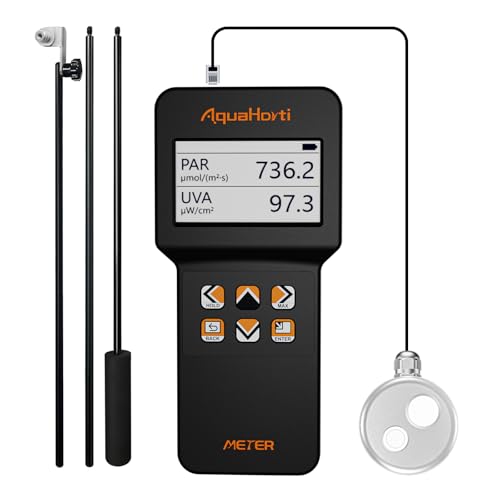
Reaches 25% further into the spectrum than the MQ-500, catching the UV band most meters skip.
This is the pick for the keeper who wonders what their UV channel is doing to the tank. Its sensor spans 320-750 nm — a wider window than the MQ-500’s 400-700 nm — so it reads PAR alongside UVA at 320-400 nm in irradiance units of w/m². Why bother? Excess UVA can harm aquarium organisms, while appropriate UVA is linked to color performance and simulating the natural environment. If you run a fixture with a UV diode and have no idea how strong it is, this meter gives you a number instead of a guess. It also isolates blue-light PAR, the band reef LEDs push hardest.
Memory is where it gives ground to the VBR-Aqua: it logs 99 points of PAR and UVA versus that meter’s 400, so your tank map is coarser. That said, those 99 points are plenty to sketch a PAR and UVA distribution map across a typical display. A 3FT telescopic rod handles the reach, and the sensor is waterproof for in-water testing. The PAR sensor IC comes from a Japanese maker, and the whole unit runs at 1.83 pounds. Its 4.5+ rating is the highest owner-satisfaction score here, though it rests on the smallest review base of the four.
Two operating notes decide whether readings come out clean. For stable PAR, keep the water still while you test — same rule the VBR-Aqua asks for. For an accurate UV figure, the water or ambient temperature must be above 25°C. In a cool room that second condition trips people up, so warm the space or the water before you trust the UVA number. Since this meter ships with the thinnest review history of the group, treat it as a strong specialist pick for UV-curious reefers rather than a crowd-proven default.
The UV angle: no other pick here reads 320-400 nm UVA in w/m², which is the entire reason to choose it.
Two rules for clean numbers: hold the water still, and keep the tank or room above 25°C for the UV reading to hold up.
Choose it if: your fixture has a UV channel and you want to map PAR and UVA together.
Think twice if: you want the biggest logged-point count — the VBR-Aqua holds 400 to this one’s 99.
4. MQ-500 Full-Spectrum Quantum PAR Meter — Digital PPFD Meter

Built for plant canopies and lab benches — not for the inside of your sump.
This one is a plant-science instrument wearing a rugged shell. It measures photosynthetic photons from 400-700 nm from any light source, taking either instantaneous or logged readings as you move across a canopy. The sensor head is machined aluminum and fully potted, which makes it waterproof and rugged, and the tangle-free cable lets you sweep a large growing area while still reading the high-contrast display. Crop physiologist Dr. Bruce Bugbee designed and refined it, and it is made in the USA with a four-year warranty and US-based support.
The case for its price tier is drift. The maker claims this meter resists the drift that can push budget PAR meter readings off by over 50%, though that is the company’s own positioning rather than an independent test. Its spectral window is the narrowest here: 400-700 nm against the Full Spectrum meter’s 320-750 nm. That narrower range is fine for plants and grow lights, but it means this meter skips the UV band the Full Spectrum unit reads. Weighing 6.4 ounces, it is the heavier of the two handheld-style meters compared with the SENEYE’s 4.6 ounces.
Here is the real consideration for a reef keeper: this meter was built for grow lights, sunlight, and plant monitoring, and its language is all canopy and crop. It will read a reef LED fine within its 400-700 nm window (the range of light wavelengths it senses). But you get no per-channel blue/green/red split and no UVA (ultraviolet A light), and it is not designed around in-tank use the way the VBR-Aqua and Full Spectrum units are. If you keep a planted tank, a frag grow-out system, or run lights over a greenhouse, this is the precise, drift-resistant tool. For a pure display reef, the reef-first picks above fit the job more naturally.
The precision pitch: a potted aluminum sensor, 400-700 nm coverage, and a maker claim of resistance to the drift budget meters see.
Whose tool this is not: a display-reef keeper wanting blue-channel depth or UV — those need the VBR-Aqua or Full Spectrum meter.
Made for: growers, plant scientists, and frag-system operators who want lab-leaning PPFD accuracy and a four-year warranty.
Not the pick for: a display reef where you need blue PAR broken out and UVA read — go reef-first instead.
Know the Specs
PAR and PPFD — the reading itself
PAR stands for photosynthetically active radiation, the light band (roughly 400-700 nm) that corals and plants use to grow. PPFD is the density of that light hitting a surface — the number you actually act on. A higher PPFD at a coral’s position means more usable light reaches it, so tracking where PPFD is strong versus dim is how you place frags. A meter that reads PAR or PPFD is the right tool; a lux-only meter measures what your eye sees and tells you nothing useful about coral growth.
Spectral range — how far the sensor looks
Spectral range is the span of wavelengths a sensor can read, written in nanometers (nm). The MQ-500 covers 400-700 nm, while the Full Spectrum meter reaches 320-750 nm — broader at both ends, which is what lets it read UVA at 320-400 nm. If you only care about the grow-light band, a 400-700 nm range is fine. If you run a UV diode and want to know its intensity in w/m², you need the wider window.
Waterproofing and the sensor housing
Your probe lives in saltwater, so the housing rating is not a marketing extra. An IP68 rating means the sensor resists dust and continuous immersion — the standard for dunking a probe at the bottom of a tank. A potted aluminum head, like the MQ-500’s, is a different route to the same goal: rugged, sealed, and waterproof. Always check that a sensor is rated for underwater use before you lower it into a display.
Point logging and DLI
Logging lets you store many readings so you can map light across the whole tank rather than sample two corners. Count the points the meter holds — the VBR-Aqua stores 400, the Full Spectrum meter 99. DLI (daily light integral) is the total light delivered over a full day; tracking it turns a moment-in-time reading into a picture of your corals’ daily light dose. More points and DLI tracking give a fuller map at the cost of more time spent testing.
Common Questions
Do I really need a PAR meter for a reef tank instead of just eyeballing my lights?
What does a PAR meter with separate blue, green, and red readings give me that a single number does not?
Is an IP68 waterproof sensor necessary if I only dip the probe near the surface?
Why do some owners see readings about 50 PAR short on the VBR-Aqua?
Can the SENEYE replace a dedicated reef PAR meter for light tuning?
When does it make sense to read UVA in a reef tank?
How many logged points do I need to map a full tank?
Is the MQ-500 the right meter for a saltwater reef display?
Why must the water stay still while I take a PAR reading?
How much battery runtime should I expect from a reef PAR meter?
The Bottom Line
For most reef keepers, the VBR-Aqua IP68 PAR Meter is the one to buy. It splits blue, green, and red PAR, stores 400 points for a full tank map, and reaches deep on a 3FT rod. All that comes at the budget-friendly tier with a real crowd behind it. If your fixture has a UV channel or you want the widest spectral window, reach for the Full Spectrum 320-750nm meter — it reads UVA the others skip. Want one device watching ammonia and temperature alongside a rough light check? The SENEYE fits that sentinel role. And if you run a planted or frag-grow system and want drift-resistant PPFD precision (PPFD — the light intensity plants use for growth), the MQ-500 is the tool for the bench.
How we choose
We do not accept paid placement. Every pick is matched to a real buyer and a real use-case; we do not hands-on test units.
Sources
Specifications: manufacturer listings and product documentation. Review insights: verified customer reviews, as of November 2026. Pricing: not shown on this page (it changes often); check the current price via the retailer link.
As an Amazon Associate, Tactical Gear Guy earns from qualifying purchases. This does not affect which products we feature.