Specs are compiled from manufacturer listings and verified buyer reviews and can change over time — please confirm the key details on the product page before buying.
Short answer: buy the Marker Griffon 13 if you ski hard and want one binding that accepts alpine, GripWalk, and touring boot soles. Buy the Marker Squire 11 instead if you are still building your skills and want an easier step-in at a lighter carry weight. Both are genuine MNC (multi-norm compatible) bindings, which means they release correctly with more than one boot sole type — so the boots you own now and the boots you buy next season will both clip in safely.
This guide is built by comparing the manufacturers’ published specifications and the patterns across verified customer reviews, so you get each pick’s real strengths and trade-offs instead of marketing spin.
Two bindings is a short list, but both are genuine MNC designs. Below you get the release settings side by side, the weight difference, the boot-sole question answered, and the plain reason to pick each. Read the comparison and you will know which mnc ski bindings belong on your skis before the next storm cycle lands.
Quick Picks
- Marker Griffon 13 Ski Bindings 2024 — Best Overall
- Marker Squire 11 All-Mountain Ski Bindings — Best for Progressing Skiers
How To Choose The Best MNC Ski Bindings
Your boots are the first thing to sort out, because a binding that only fits one sole standard can leave you re-mounting skis the moment you upgrade your footwear. An MNC binding — the letters stand for multi-norm compatible — is engineered to release consistently with more than one boot sole geometry. That is the whole reason this category exists, and it is the first spec to confirm before you look at anything else.
The boot sole question comes before everything
Alpine soles are the classic flat, hard plastic sole. GripWalk soles add a rockered rubber pad that feels much better walking to the lift. Touring soles are built for skinning uphill. A true MNC binding handles all three of those standards. The anti-friction device under the toe — the AFD, a sliding pad the boot sole rests on — is what keeps release smooth when that pad picks up dirt, snow, or ice. If the AFD is stainless steel gliding surface, it stays predictable in wet, gritty conditions.
Read the DIN range as a release scale
DIN (the release-force scale printed on every binding) is not a status symbol — it is a setting a certified technician sets for your weight, height, boot sole length, and skier type. A binding with a range of 4 to 13 covers a broad span of release forces. A binding with a maximum of 11 tops out earlier. If you are progressing, a wider range means you are not replacing the binding as your skiing gets more aggressive. If you are light or a newer skier, a binding that adjusts down to 4 keeps you inside the safe low end of the scale.
Match brake width to your ski waist
Brake width is the spread of the metal arms that fold down when you step out. It needs to sit slightly wider than the waist of your ski, not narrower. A 100 mm brake on a wide freeride ski will not clear the edges. A 110 mm brake on a narrow carving ski will drag. Check your ski’s waist measurement in millimeters against the brake size before you order, and remember that a shop mount is not optional on a safety-critical part like this.
Weight matters for spinning and hiking
Every gram on your foot is a gram you swing through a spin or lift uphill. A lighter binding takes less effort on park laps and short sidecountry walks. A heavier binding tends to carry more metal in the toe and heel for harder-charging retention. You cannot have both, so pick the weight that matches your skiing.
Side-by-Side Comparison
Detailed Reviews
1. Marker Griffon 13 Ski Bindings 2024
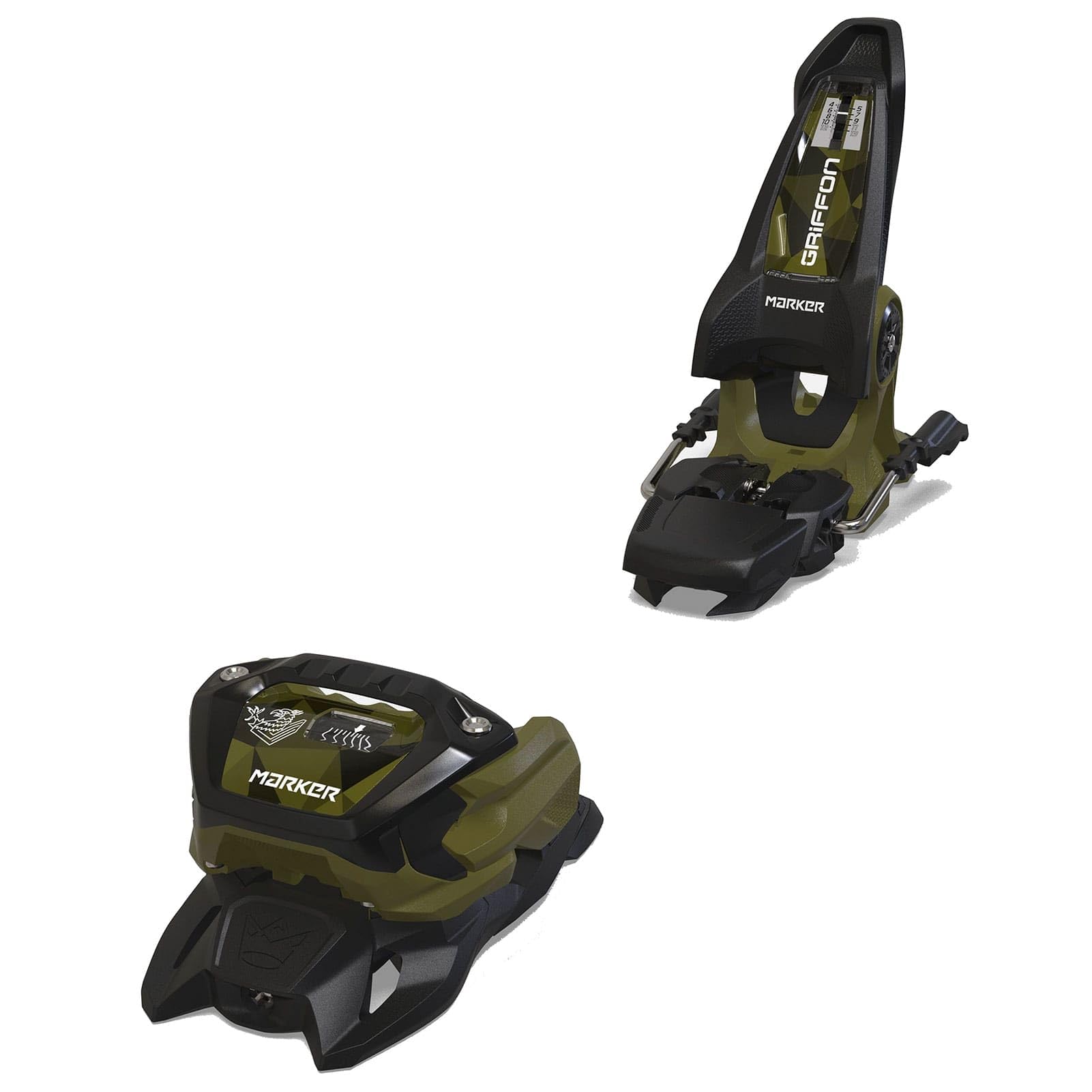
Three boot standards, one mount, and a 4-to-13 release window that follows you up the skill ladder.
Start with the number that decides whether these follow you up the ladder: a DIN range of 4.0 to 13.0. That is the release-force scale a technician sets for your weight, height, boot sole length, and skier type. A 4.0 floor keeps the binding usable for lighter skiers, and the 13.0 ceiling means it stays a match when your skiing gets more aggressive instead of sending you back to the shop. The Squire 11 above this one tops out at 11, so the Griffon’s headroom is the real difference between the two.
It is built for advanced to expert riders who want freeride power without dead weight on their feet. The spec’s swing-weight note backs it up: centralized mass makes spins, twists, and tricks feel smoother without giving up stability on landings. The Triple Pivot Elite toe is the other half of the story — a large support surface that soaks up energy, improves edge grip, and cuts down on early release. The Anti Ice Rail lets you scrape snow and ice off your boot sole for a clean step-in on a cold morning.
Boot compatibility is why this earns Best Overall. Multinorm (SOLE.ID) technology adapts to Alpine, GripWalk, and Touring soles — so your current boots and your next pair both release correctly. The stainless steel Gliding AFD keeps that release precise even with dirt, snow, and ice packed under the toe. The Inter Pivot 3 Freeride Heel handles the back end, with vertical elasticity and smoother step-in force. One honest caution sits in the spec sheet: this is a 6 pound binding, and it sits 2 pounds heavier than the Squire 11’s 4 pounds. All that retention has to live somewhere, and it lives on your ski.
Where the Griffon pulls ahead
- DIN 4.0 to 13.0 gives a wide release window that survives a skill jump
- Multinorm (SOLE.ID) accepts Alpine, GripWalk, and Touring soles
- Triple Pivot Elite toe absorbs energy and holds edge grip
- Centralized swing weight makes spins and tricks feel smoother
What you are trading away
- 6 pounds is 2 pounds more than the Squire 11’s 4 pounds
- 110 mm brake wants a wider ski waist — check yours before ordering
- Advanced-to-expert design is more binding than a cautious beginner needs
Reach for this if: you ski freeride, park, or pipe and want one binding that swallows three sole standards and a wide release range.
Look elsewhere if: your skis run a narrow waist, because the 110 mm brake needs room to clear the edges.
2. Marker Squire 11 All-Mountain Ski Bindings
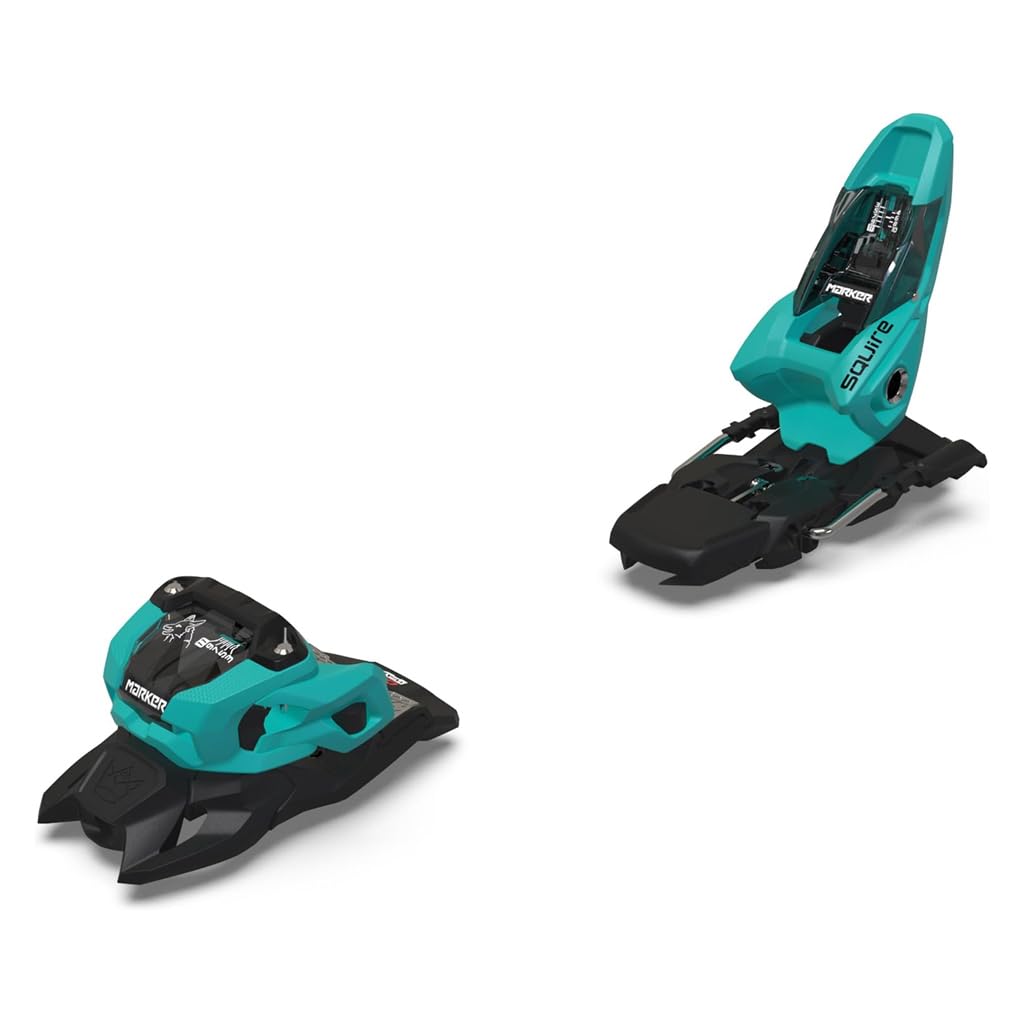
Half the carry weight of the Griffon, and a step-in that asks a lot less of your boot.
Four pounds on your foot instead of six changes how a whole ski day feels. The Squire 11 comes in at 4 pounds, and that is 2 pounds under the Griffon 13’s 6 pounds — you notice it on every park lap, every short hike, and every time you swing a ski around on the lift. The Hollow Linkage 2 heel is the part that makes getting back in easier, since the design calls for less force when you step in. On a cold, icy day when your boot is packed with snow, that is the difference between a clean click and a wrestle.
This binding is aimed at progressing skiers, and its 11 maximum DIN reflects that. Beginners and intermediates get a full all-mountain binding without paying for release-force headroom they will not touch yet. The Triple Pivot Light 2 Toe accepts both alpine and GripWalk soles, so your boot options stay open. The AFD (the sliding anti-friction pad under the toe) is built to release precisely even with dirt, snow, and ice buildup on it. The 100 mm brake sits 10 mm narrower than the Griffon’s 110 mm, which suits all-mountain skis rather than the wide freeride boards.
The trade-off is the ceiling. If your skiing moves toward hard-charging freeride, an 11 maximum will eventually feel like a limit and you will be shopping again. For everyone on the earlier part of the curve — and for anyone who would rather carry a lighter ski uphill — the Squire 11 is the smarter spend. It is an all-mountain binding built for skiers still earning their turns, not an entry-level compromise.
Light-footed advantage: 4 pounds versus the Griffon’s 6 pounds makes this the easier binding to swing through a spin or carry up a bootpack.
Ceiling to consider: the 11 maximum DIN is the honest limit — it fits beginners and intermediates, not expert freeride charging.
The straightforward buy if: you are a beginner or intermediate who wants alpine and GripWalk compatibility with an easier step-in.
Move up the range if: you already ski aggressively enough to want a release setting above 11.
Know the Specs
MNC and Multinorm (SOLE.ID)
MNC means multi-norm compatible — the binding is built to release correctly with more than one boot sole standard instead of just one. Alpine soles are flat and hard, GripWalk soles add a rockered rubber walking pad, and Touring soles are made for skinning uphill. Marker’s name for this is Multinorm (SOLE.ID), which is what the Griffon 13 carries. The Squire 11 handles alpine and GripWalk through its Triple Pivot Light 2 Toe. Both are MNC by the plain definition: neither is locked to a single sole standard.
DIN Range and the AFD
DIN is the release-force scale a certified technician sets from your weight, height, boot sole length, and skier type — it is not a dial you turn up for bragging rights. A wider range like the Griffon’s 4.0 to 13.0 simply covers more of that scale. The AFD (anti-friction device) is the sliding pad the boot toe rests on. It keeps the release smooth and predictable, and when it is a stainless steel gliding surface, it holds up against dirt, snow, and ice packed under the boot.
Common Questions
What does MNC mean on a ski binding?
Will the Marker Squire 11 work with my GripWalk boots?
Can I mount ski bindings myself at home?
What brake width do I need for my skis?
Is a higher DIN binding automatically safer?
What does the AFD do when snow packs under my boot?
Griffon 13 or Squire 11 for a first all-mountain setup?
How long should a pair of ski bindings last?
Does binding weight actually matter on the mountain?
The Bottom Line
For most skiers shopping this category, the winner is the Marker Griffon 13 — a DIN range of 4.0 to 13.0, Multinorm (SOLE.ID) compatibility across Alpine, GripWalk, and Touring soles, and a Triple Pivot Elite toe that holds edge grip under load. Its 13.0 DIN ceiling means it will not need replacing the moment your skiing turns aggressive. If you are still on the front half of the learning curve, the Marker Squire 11 is the honest pick: alpine and GripWalk compatibility, an easier step-in through the Hollow Linkage 2 heel, and 4 pounds on your foot instead of 6. Either way, budget for a professional mount and confirm your brake width against your ski’s waist before the box ships.
How we choose
We do not accept paid placement. Every pick is matched to a real buyer and a real use-case; we do not hands-on test units.
Sources
Specifications: manufacturer listings and product documentation. Review insights: verified customer reviews, as of November 2026. Pricing: not shown on this page (it changes often); check the current price via the retailer link.
As an Amazon Associate, Tactical Gear Guy earns from qualifying purchases. This does not affect which products we feature.