Specs are compiled from manufacturer listings and verified buyer reviews and can change over time — please confirm the key details on the product page before buying.
Most outdoor night vision cameras fail at exactly the moment you need them — the dark. A cheap IR (infrared) illuminator turns a face into a white blur at thirty feet, and colour footage vanishes the second the sun drops. The fix is checking which night vision type a camera uses and how far it actually reaches. This guide separates the cameras that genuinely see at midnight from the ones that only look good in a daylight demo.
This guide is built by comparing the manufacturers’ published specifications and the patterns across verified customer reviews, so you get each pick’s real strengths and trade-offs instead of marketing spin.
You will learn the difference between IR and colour night vision, how resolution and field of view trade off against each other, and which cameras hold a signal in bad weather. Below is a straight comparison of the best outdoor night vision cameras for real homes and yards.
Top Picks
How To Choose An Outdoor Night Vision Camera
Start with the one question that decides everything else: what do you need to see after dark? A camera pointed at a gate needs long reach. A camera watching a whole driveway needs width. Those two jobs pull in opposite directions, so no single lens does both perfectly. Decide your job first, then match the specs to it.
IR versus colour night vision
IR night vision (infrared LEDs that light up the dark invisibly) gives you a clear monochrome picture and is the workhorse of outdoor security. Colour night vision needs a built-in spotlight to switch on, so it delivers colour detail — clothing, car paint, a red hoodie — but that light is visible and draws attention. Many cameras here offer both and let you switch. If you want to identify a person rather than just spot movement, colour night vision helps; if you want to cover a big dark area quietly, IR is the better fit.
Resolution you can actually use
Higher resolution packs more pixels into the same frame, so detail survives when you zoom in later. 2K is the common baseline here, 4K steps up, and one pick goes to 16MP. But resolution only helps if the lens covers the area you care about — a sharp 4K clip of the wrong half of your yard is useless. Check field of view alongside the megapixel count.
Power source decides your mounting options
Battery cameras mount almost anywhere but need recharging or a solar panel to stay alive. Solar models trade a little placement freedom for near-continuous charging — eufy’s C37 uses separate 3W panels you can angle toward the sun, while WYZE says an hour of daily sunlight removes charging downtime entirely. Plug-in models never run out of power but must sit near an outlet.
Weather rating and storage
An IP rating (a two-digit score for dust and water resistance) tells you how much weather a camera shrugs off. IP65 handles rain and snow; IP66 and IP67 add more dust and water protection. Then decide on storage: a microSD card keeps footage local and subscription-free, while cloud plans add history and AI alerts. Several cameras here work fully without a paid plan.
Side-by-Side Comparison
| Model | Best For | Night Vision | Resolution | Power | Amazon |
|---|---|---|---|---|---|
| Ring Floodlight Cam 2K★ Best Overall | Replacing an old floodlight | Motion-activated floodlight | Retinal 2K | Hardwired | Amazon |
| eufy Security eufyCam C37Most Versatile | Zero-fee 360° coverage | 2K colour + spotlight | 2K | Solar + battery | Amazon |
| Arlo Essential 2K (3rd Gen)Best for Smart Homes | Smart-home integration | Colour night vision + spotlight | 2K | Rechargeable battery | Amazon |
| WYZE Solar Cam Pan 2K | Pan-and-track on a budget | Full-colour night vision | 2K | Solar + battery | Amazon |
| REOLINK Lumus Pro 4K | Sharpest detail per dollar | Colour night vision, F1.6 lens | 4K (8MP) | Plug-in | Amazon |
| Tapo C545D | Dual-lens wide plus zoom | Night vision to 99 ft | Dual 2K | DC plug-in | Amazon |
| Reolink Duo 3 WiFi | Wide 180° panorama | Full-colour + IR modes | 16MP | Plug-in | Amazon |
| Arlo Pro 2K HDR (6th Gen) | Multi-camera HDR coverage | Colour night vision + spotlight | 2K HDR | Rechargeable battery | Amazon |
| Hiseeu 8-Cam Solar System | Whole-property, no monthly fee | 4MP colour night vision | 4MP | Solar + 1TB HDD base | Amazon |
Detailed Reviews
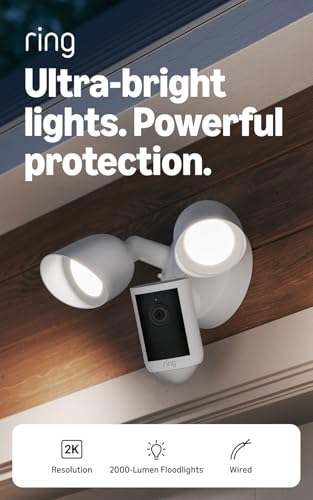
1. Ring Floodlight Cam 2K
Our pick — 4.5+★ from 600+ verified ratings; the strongest balance of quality and price.
The night camera that lights up your yard and catches the face behind the movement.
If you already have an outdoor floodlight by the door, this is the easiest upgrade in the whole list. It replaces that existing light fixture rather than asking you to run new wiring, and the motion-activated floodlight then doubles as your night illumination. That one-two of bright light plus a 2K camera is why it earns the top spot: the light comes on, the subject is lit, and the camera records a usable image instead of a grainy silhouette. The Ring Floodlight Cam 2K is the pick that turns an ordinary porch light into a working night watch.
Owners keep coming back to praise the video. It records in Retinal 2K (a sharp 2K-resolution picture) with a wide angle, so you see more of the porch in one frame. Up to 6x Enhanced Zoom pulls details into sharp focus — handy for reading a face mask, a hoodie logo, or a plate on a parked car. A built-in siren sounds straight from the Ring app with a tap, so you can scare off a loiterer before anyone steps outside. Live View and Two-Way Talk (live video plus a mic and speaker) let you speak to whoever is at the door from anywhere.
Here is the honest catch, sized to how most people actually get on with it: the WiFi link and the floodlight brightness draw the most disagreement. Some find the light plenty bright, others expect more reach from it, and the connection occasionally drops a signal. That is a fair trade-off for a device that installs in place of an existing light — but if your WiFi is weak at that corner of the house, plan for it. The rest of the package, from the replaceable-fixture install to the 2K detail, is exactly what a front-of-house night camera should be.
Where it earns its keep
- Swaps in for an existing floodlight — no new wiring run
- Retinal 2K video with up to 6x Enhanced Zoom for detail
- Motion-activated light plus a tap-to-sound siren in the Ring app
- Live View and Two-Way Talk for real-time conversation
What to plan around
- WiFi connectivity is the most-mixed point — a weak signal shows up here
- Floodlight brightness splits opinion; not everyone finds it as bright as hoped
- Advanced alerts and history need a compatible Ring Protect Plan, sold separately
Made for: anyone with an existing outdoor floodlight who wants night coverage without hiring an electrician.
Think twice if: the mounting spot has a shaky WiFi signal — that is where the complaints cluster.
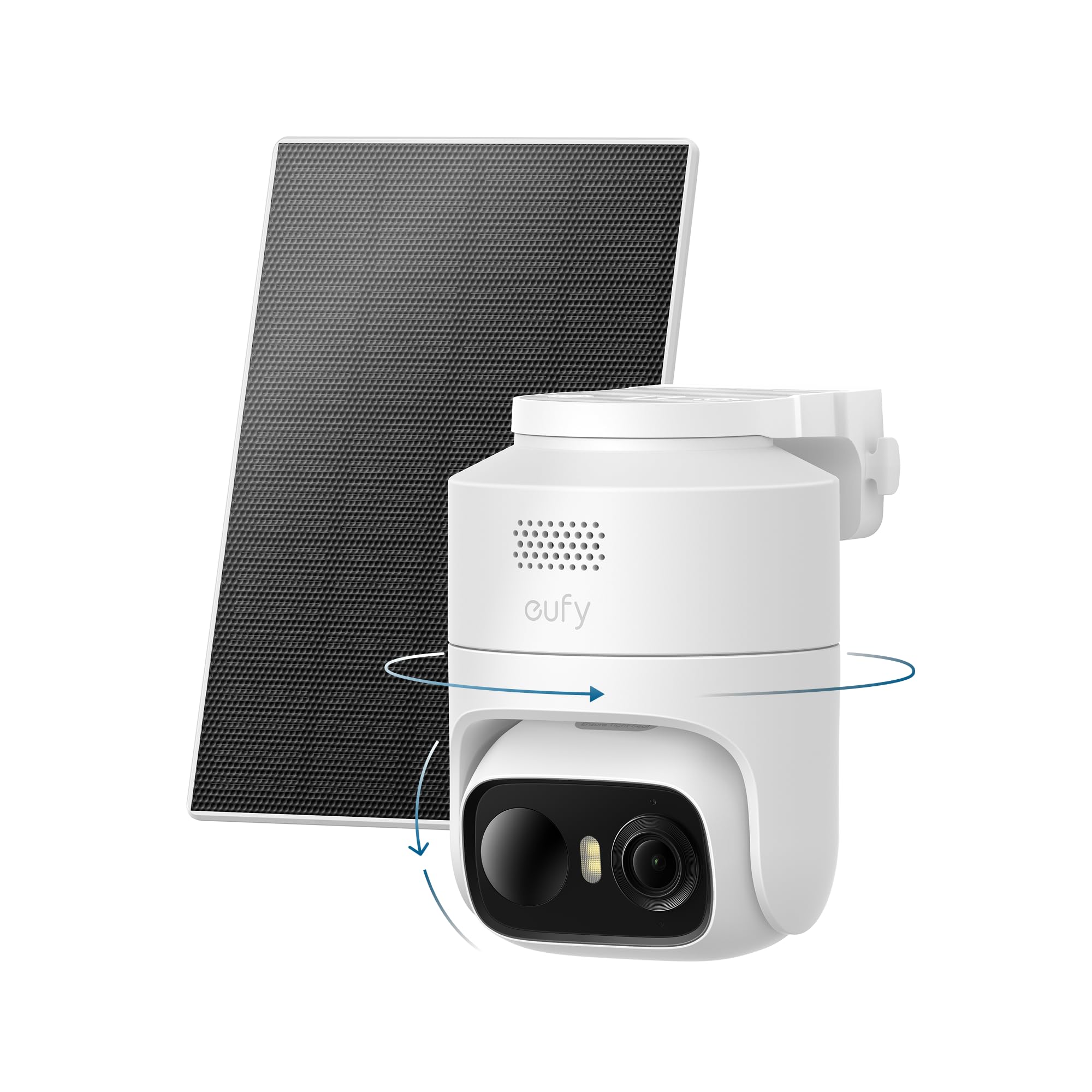
2. eufy Security eufyCam C37
One camera that pans a full circle, tracks a person, and never asks for a subscription.
A single fixed lens leaves blind spots on either side — this camera solves that with 360° AI tracking. Pan and tilt keep a subject centred as they move, so you capture the whole path, not just the moment they cross the frame. Pair that with detachable panels: each 3W solar panel can be angled toward the sun while the camera points exactly where you need it. That freedom is rare in a solar camera, where the panel usually dictates the angle. The eufyCam C37 is the most flexible setup here for covering a corner, a side gate, or a long garden.
The night vision is 2K colour, and eufy claims 2K captures 77% more pixels than 1080p. A built-in spotlight lights up faces, plates, and clothing in colour even in total darkness, so you get colour detail instead of monochrome. Smart detection picks out people, vehicles, and pets, then follows their movement. On the storage front you record to a microSD card up to 256GB (sold separately) or a HomeBase, with no cloud subscription supported — your footage stays local. Note that this camera stores up to 256GB, while the WYZE below handles cards up to 512GB.
What wins people over here is the build and ease of use — the setup is quick and the picture quality is sharp by day as well as at night. The trade-off worth knowing is reliability: the connection and long-term dependability draw the most split feedback, and the system needs the newer eufy app to run smoothly. It is also worth checking compatibility up front, since it works with HomeBase Mini, HomeBase 3, and later but not with HomeKit or HomeBase2. For most yards those caveats sit well inside a camera that covers a full circle on solar power alone.
Why the tracking matters: A fixed lens sees one slice of your property. The C37 pans and tilts to follow a subject across 360°, so a person walking from gate to door stays in frame the whole way.
Plan for: Verify your HomeBase or app version before you mount it — this is a system that wants current software and the right base station.
Pick this one if: you want one solar camera to sweep a wide area and track movement, with zero monthly bill.
Pass if: you rely on HomeKit or an older HomeBase — it is not built to talk to those.
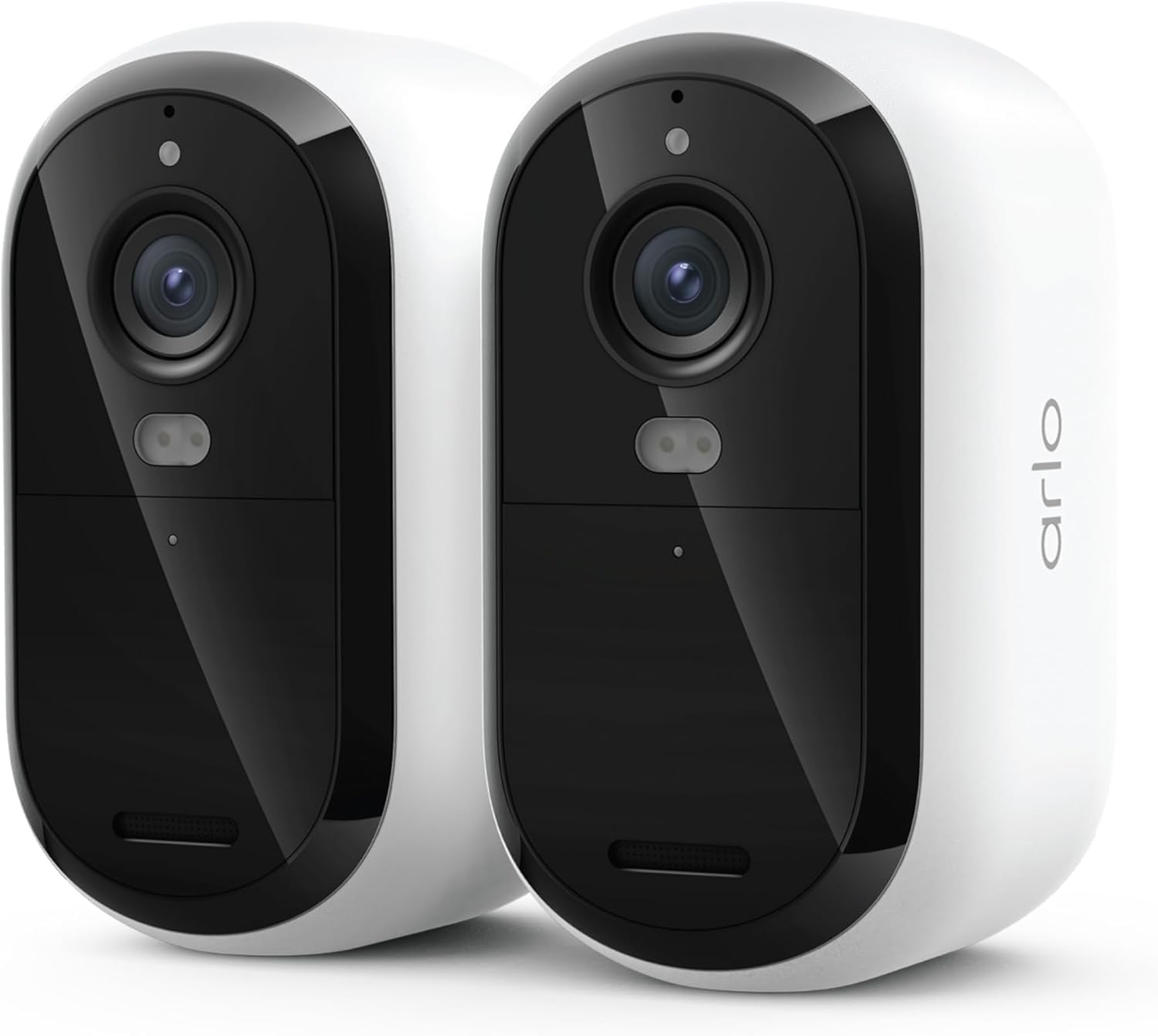
3. Arlo Essential Wireless Security Camera 2K (3rd Gen) – 2-Cam
Two cameras that slot into Alexa, Apple Home, and Google Home and share one app.
If your house already runs on a voice assistant, this two-camera kit fits straight in. It works with Alexa, Apple Home, Google Home, Samsung SmartThings, and IFTTT — so a motion alert can trigger lights or send a notification without extra kit. The pair covers a front door and a back yard, and each camera records 2K with colour night vision, a spotlight, and a 130° field of view. Buttons in the Arlo app fire the siren and pull in live view, and setup is wireless with no cabling to run.
Zoom is where this camera makes a clear stand against the Ring Floodlight Cam above. The Arlo offers 12x zoom versus the Ring’s 6x — a 2x step up in how far you can push in on a detail. That extra reach helps when the subject is across the street rather than on the doorstep. On video quality alone, the 2K footage reads as remarkably clean, and the app is genuinely easy to drive day to day.
The thing to weigh honestly is battery life. Some owners get weeks from a charge and some see the front-door camera drain fast — so if it sits where people pass constantly, plan on more frequent recharging or add a solar panel. Reliability also splits, and a paid Arlo Secure plan is needed for 60-day history and the advanced AI alerts after the one-month trial, though live streaming and basic alerts run without it. The two-camera value is strong; just keep an eye on charge if you mount one over a busy path.
The case for two cameras
- Two cameras cover a front and a back entry out of one box
- 12x zoom pulls more detail than the 6x on the Ring above
- Works with Alexa, Apple Home, Google Home, SmartThings, and IFTTT
- Wireless install — no cables to run per camera
Keep an eye on
- Battery life varies a lot — high-traffic spots drain a charge faster
- 60-day history and advanced AI alerts need a paid plan after the trial
- Long-term reliability draws mixed reports
Best matched to: a smart-home household that wants two night cameras running inside one app with voice control.
Be ready for: recharging the busier of the two cameras more often, or adding a panel.
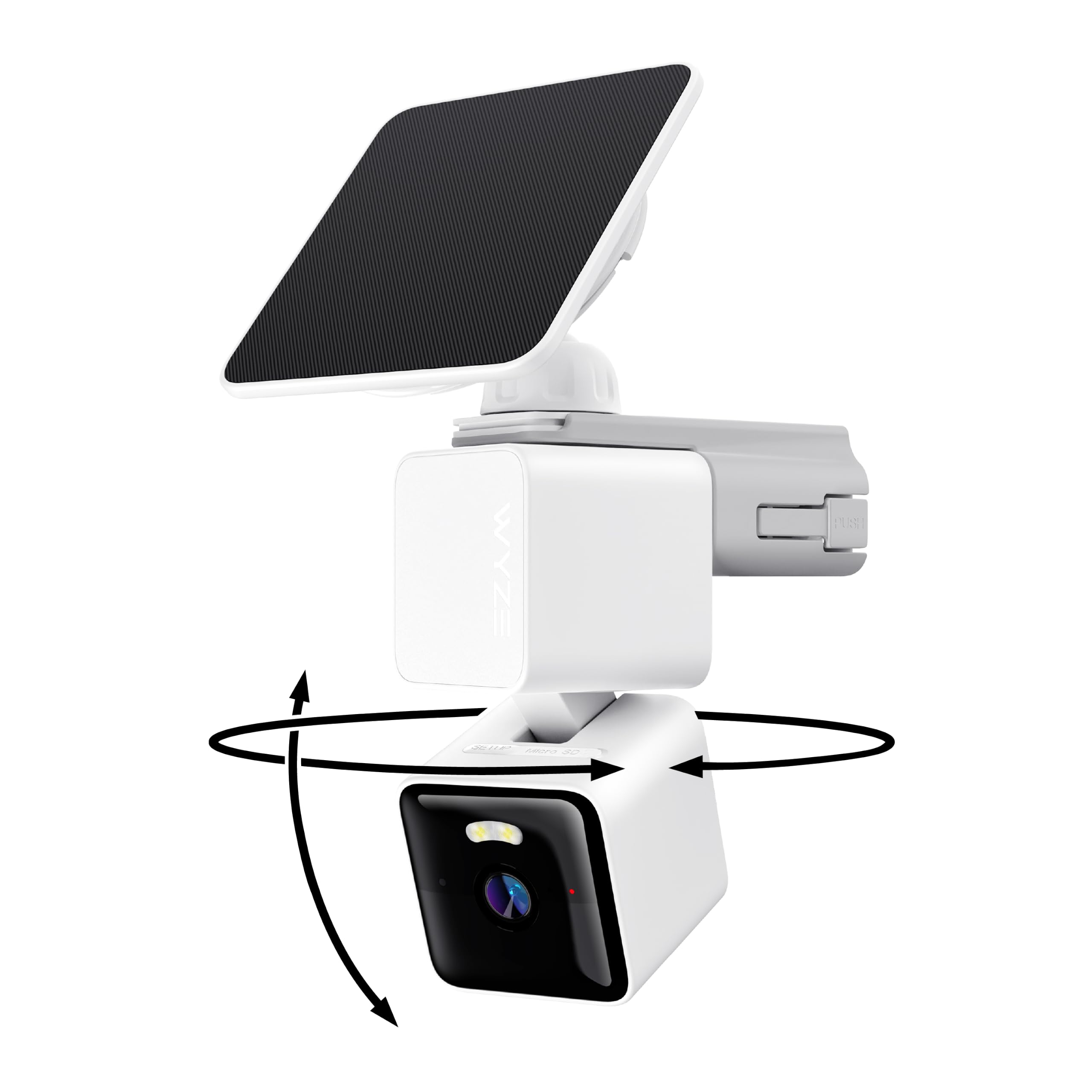
4. WYZE Solar Cam Pan
Solar power, a full pan of the yard, and a colour picture — without the premium tag.
This is the value pick that still covers the big jobs. It pans a full 360° and tilts 70°, so one camera sweeps your whole property on a mount that needs no wiring. WYZE claims one hour of daily sunlight eliminates charging downtime. Footage records locally to a microSD card up to 512GB (sold separately) — double the card capacity the eufy C37 above accepts. If you want a cheap way to cover a big area with no monthly fee, this does the core work well.
The night side is 2K with full-colour night vision, so low light still comes through in colour rather than grey. AI detection tracks people and reduces the false alerts from leaves and passing cats. A motion-triggered spotlight and a 105dB siren let you respond from the app, and two-way talk means you can speak to whoever is out there. It carries an IP65 rating — built to handle rain, heat, and snow — and runs on Wi-Fi 6 at 2.4GHz only, so check that your network handles that band.
The honest limit: this is a budget camera, and a few of its extras sit behind a paid plan. The smarter AI alerts for people, pets, packages, and vehicles need Cam Plus, and cloud recording is optional and sold separately. Battery life and motion-tracking accuracy also split, and the 5GHz band is not supported. None of that stops it being the cheapest route to pan-and-track colour night vision here — it just means the free experience is lighter than the premium cameras’ full package.
Reach for this if: you want wide pan coverage and colour at night on a tighter budget, with footage kept on a card.
Look elsewhere if: you want the full AI alert set without any paid plan, or need 5GHz WiFi.
5. REOLINK Lumus Pro 4K
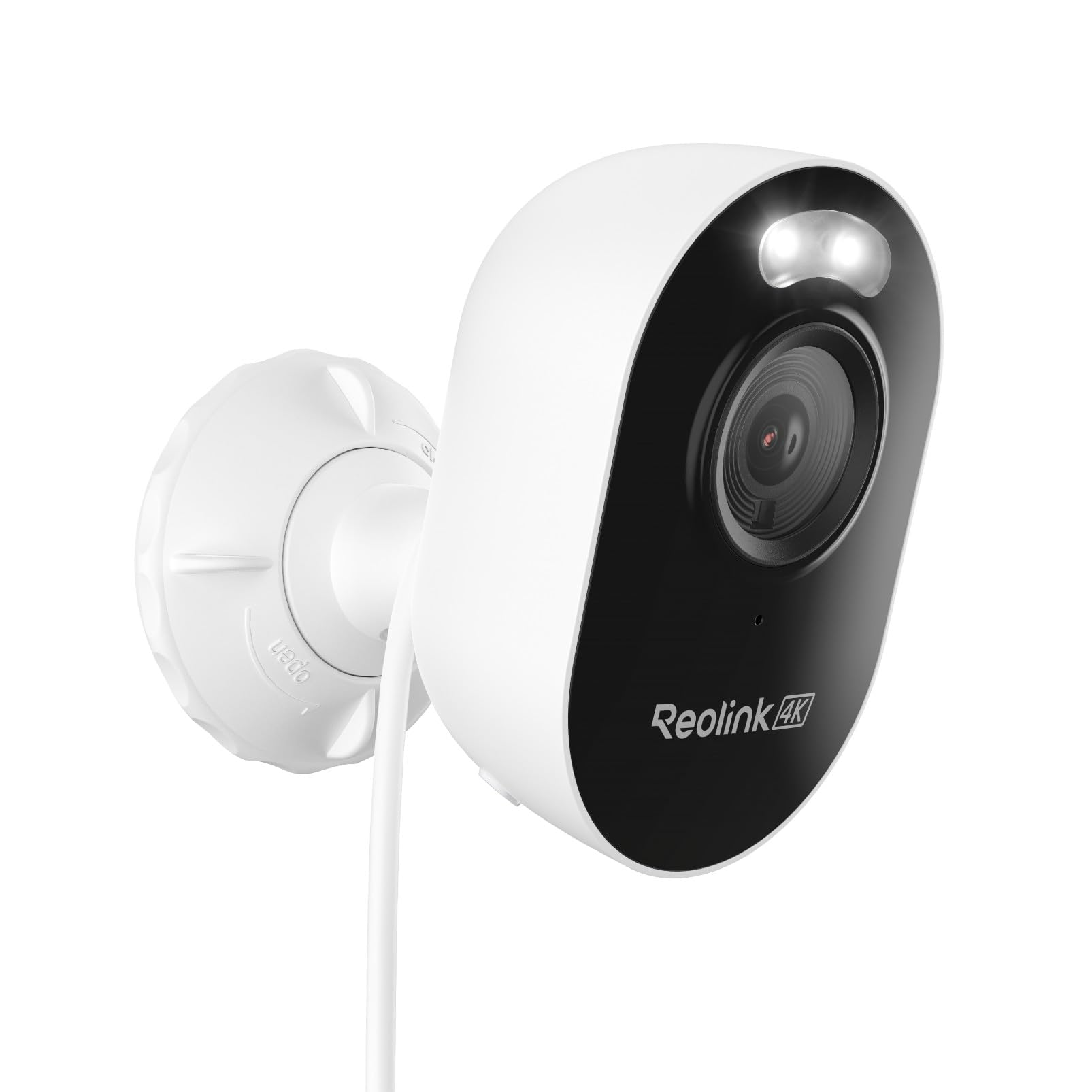
The detail champion — 4K footage that reads a licence plate after midnight.
When you need to identify rather than just detect, resolution is the whole game. This camera records 4K Ultra HD through an 8-megapixel lens, which is a clear step up from the 2K cameras filling this list. The F1.6 large aperture pulls in more light than a smaller F2.0 opening, so the colour night vision stays vivid even in low light. It is a plug-in model, so it needs to sit near an outlet, but in return it never runs out of power mid-night. The Lumus Pro 4K is the pick for a front driveway where you want a clean, zoomable face or plate.
Connectivity is strong too — dual-band Wi-Fi 6 on 2.4/5GHz plus Bluetooth pairing for setup, so it locks onto the stronger signal and the install is quick. AI detection picks out people, vehicles, and animals, with adjustable sensitivity and zones to cut false alarms, and none of that needs a monthly fee. Storage flexes: a microSD card up to 256GB (not included), a Reolink Home Hub Pro or NVR, or your own FTP or NAS for backup. Up to 19 other users can view live and playback alongside you.
The fair caveat is what draws the mixed feedback: the IR lights and overall functionality split reports, and the connection can drop and reconnect on some networks. Sound clarity is noted as strong close up, at around 10 feet. Those are real-world networking issues rather than the lens letting you down — the picture quality itself is the reason to buy. Give it a solid WiFi 6 signal and the 4K detail is hard to match in this group.
The picture is the pitch: True 4K from an 8MP sensor with an F1.6 lens means colour night footage that holds together when you zoom in to check a detail.
Set it up right: Feed it a strong dual-band WiFi 6 signal — the recurring grumbles are about connection drops, not image quality.
Built for: a driveway or front path with a nearby outlet, where you want the sharpest night detail per dollar.
Skip the plug if: you need battery or solar freedom far from power — this one stays tied to an outlet.
6. Tapo C545D
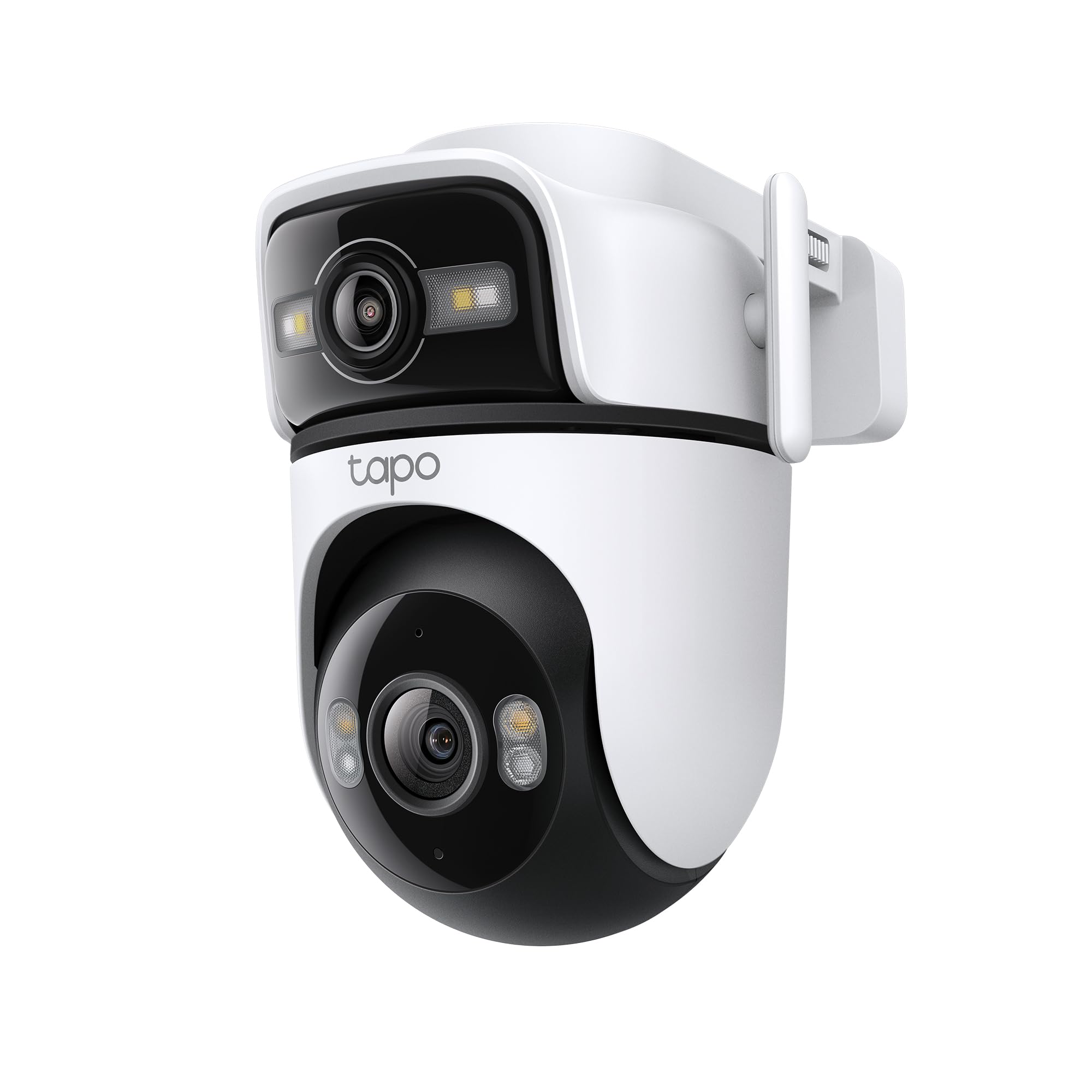
Two lenses on one camera — a wide sweep plus a zoom that locks on and follows.
Most cameras make you choose between seeing the whole yard and seeing a detail clearly. This one gives you both at once. Lens one is a 165° ultra-wide 2K view that covers a front yard or driveway in one sweep. Lens two is a 6mm telephoto that pans and tilts to track motion across a 360° range and zooms up to 10.8× digital. The clever part is One-Tap Smart Focus: tap anywhere on the wide view in the Tapo app and the telephoto lens snaps to that spot, so the far detail stays sharp.
Night reach is a standout here — the night vision reaches up to 99 ft, and the camera carries an IP66 weather rating to handle rain and dust. It is DC powered through the included adapter, then connects over 2.4GHz Wi-Fi 6 or Ethernet, drawing up to 11.5W. Free AI detection covers people, pets, vehicles, motion, line-crossing, and tampering without a monthly fee. Storage is flexible: a microSD card up to 512GB, optional Tapo Care cloud, or a compatible Tapo Hub (sold separately).
The thing to understand before buying is that this is a newer, less-reviewed model, so the field data is thinner than the veteran picks around it. It also needs 2.4GHz WiFi for wireless setup rather than 5GHz, and the zoom is digital rather than optical — sharp for detail, but not the same as a true optical zoom lens. For a plug-in camera that covers both the big picture and the tight detail, the dual-lens design is the reason to choose it.
Great fit for: a driveway or patio where you want wide coverage and a bit of zoom without mounting two cameras.
Worth knowing: setup wants 2.4GHz WiFi, and the zoom is digital — factor both in before you pick the mounting spot.
7. Reolink Duo 3 WiFi

The panoramic heavyweight — a 180° stitched view from two 4K sensors.
One camera can watch a long fence line, a broad driveway, or the front of a shop that would normally take two. Two 4K image sensors combine into 16MP of detail and stitch into a smooth 180° panorama (one wide, unbroken view) with minimal distortion. At night it switches between full-colour and IR (infrared, a black-and-white night mode) modes: 8 spotlights plus an F1.6 aperture (a wide lens opening that lets in more light) pull vivid colour out of the dark, so a face or a car colour still reads at midnight. A tap flips it to IR when you want a quieter monochrome picture. Motion Track shows a subject’s full path in one frame.
Smart detection picks out humans, vehicles, and animals, and you can set the siren, spotlights, and voice messages to warn off intruders. Wi-Fi 6 on 5GHz keeps the stream steady, storage takes a microSD card up to 512GB with no monthly fee, and the IP67 build shrugs off dust and rain. Setup is a little unusual: you connect by Ethernet to a router with the 12V/2A adapter, finish in the Reolink app, then unplug for WiFi use.
Be straight about the weak point: WiFi connection is the single loudest complaint on this camera — reports of failed connections and constant dropouts — so a strong, close signal is not optional here. Reliability also splits, with some units quitting after a couple of months. The 180° view is genuinely its own thing and worth it for the right property. Just wire it to a strong 5GHz signal, or plan on the Ethernet step for stability.
What it does better than the rest
- One camera covers a 180° panorama from dual 4K sensors at 16MP
- 8 spotlights and an F1.6 lens for vivid full-colour night detail
- IP67 weatherproofing and up to 512GB local storage, no monthly fee
- Motion Track captures the full path of movement in one frame
Where it will test you
- WiFi connectivity is its most-criticised feature — needs a strong 5GHz signal
- Setup needs an Ethernet step before it goes wireless
- Some units have been reported to quit after around two months
Choose it for: a wide, open run of property where a single panoramic night camera beats two narrow ones.
Pause if: your WiFi is weak where it must mount — the connection is this camera’s known soft spot.
8. Arlo Pro Wireless Security Camera 2K HDR (6th Gen) – 4-Cam

Four HDR cameras that see faces in harsh light and dark corners alike.
Covering a whole property means more than one angle, and this kit puts four cameras in play. Each records 2K High Dynamic Range (HDR) video — HDR keeps detail in both the bright and shadowed parts of a frame, so a face half-lit by a porch lamp still reads clearly. The 160° panoramic field of view catches a wide angle too, with a rechargeable, swappable battery feeding each camera. Auto zoom with motion tracking follows subjects, and colour night vision plus a spotlight handle the dark. The Arlo Pro 6th Gen is the pick for someone who wants all entry points watched at once.
The battery is 22 watt-hours, and because it swaps out you can keep one charged while another runs — no taking the whole camera down. Each unit carries 12x zoom and a 160° view, so pushing in on a detail matches the Arlo Essential above on zoom and goes wider on coverage. Setup is wireless with no cables, and the cameras work with Alexa, Apple Home, Google Home, SmartThings, and IFTTT. AI-generated event captions summarise activity, and keyword search helps you jump to the right clip.
The trade-offs are real but manageable. Battery life splits opinions — some get a good stretch, others recharge often — so a high-traffic camera will want more attention. A paid Arlo Secure plan open up 60-day history and full AI detection after the trial, though live streaming and basic alerts work without it. Treat it as a flexible four-camera night setup, and check you are happy with the recharge rhythm before committing to a busy doorway.
A strong match for: a larger home that needs four night cameras watching every entry at once.
One thing to accept: frequent recharging on the busiest camera — the swappable battery eases it but does not erase it.
9. Hiseeu 8 Cam-Kit
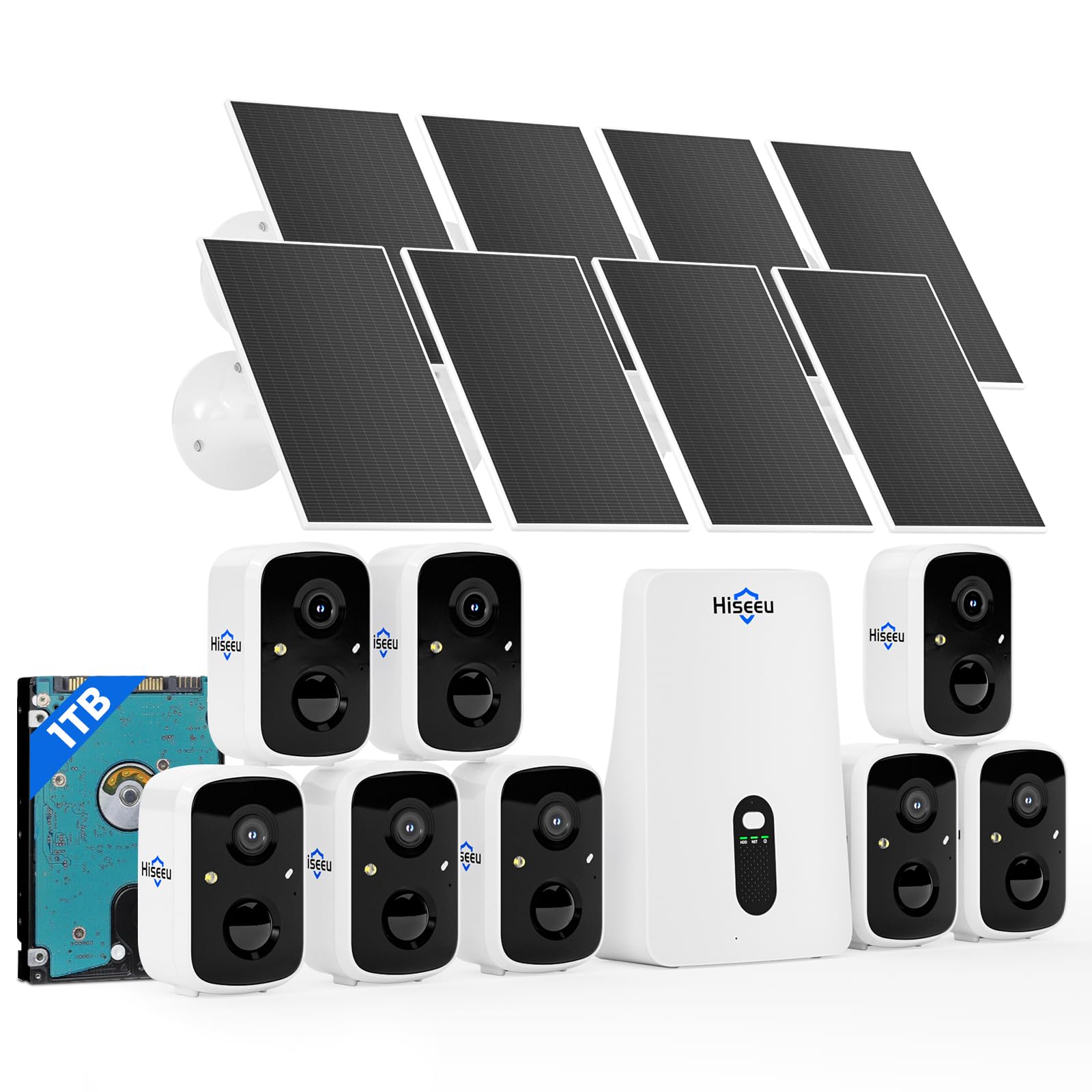
A whole-property solar system with its own hard drive — no cloud bill attached.
If one camera cannot cover your place, this kit starts you at eight. You get eight solar-powered cameras, a base station with a 1TB hard drive, and room to grow to 10 channels (10 camera feeds). Hiseeu rates the 1TB drive for 36+ months of recording, and the base accepts a 256GB card or an 8TB drive. It also runs fully without internet: connect the base to a TV or monitor over HDMI (the standard video cable) for offline viewing, which suits a cabin, barn, or rural plot. The 4MP cameras catch colour night vision, so porch pirates show up in full colour even at midnight.
Power is maintenance-light — Hiseeu claims four hours of daily direct sun keeps the cameras charged year-round, and each camera is IP66 waterproof. PIR motion detection (a sensor that reacts to body heat) cuts the false alerts, with AI detection for people, vehicles, and pets available on an upgraded cloud plan. The 135° wide lens catches corners, and two-way talk lets you speak to whoever is outside from the EseeCloud app. Remote viewing runs on 2.4GHz/5GHz dual-band for a steadier signal.
Size the caveat to the job: this is a full system, so the AI detection for people, vehicles, and pets sits behind the paid upgrade rather than in the box. Reliability and connectivity both split — some units ran flawlessly and others stumbled on pairing or staying connected — which is common in multi-camera kits where more devices means more places for a signal to fall short. For a large property that wants wide coverage without a monthly fee, the 1TB base and eight cameras do the heavy lifting.
The big-property answer: Eight solar cameras plus a 1TB base station record locally, so a farm, a workshop, or a rural cabin gets year-round coverage with no cloud bill in the loop.
Before you commit: Plan the network — with this many cameras, pairing and connection reliability is where the system needs the most attention.
Suits you if: you have a big site to watch and want a self-contained solar system that stores footage on its own drive.
Not ideal if: you want the person/vehicle AI detection without any upgrade — that piece needs the paid plan.
Know the Specs
IR versus colour night vision
IR night vision uses infrared LEDs to light the dark invisibly, giving a clear picture in greyscale that stays hidden from a passer-by. Colour night vision switches on a visible spotlight to keep colour in the footage — useful for clothing or car paint, but noticeable at night. Many cameras here carry both and let you flip between them, so you can match the mode to the job.
Resolution and megapixels
Resolution is the pixel detail in a frame. 2K is the common baseline, 4K (around 8-megapixel) packs in more, and dual-sensor cameras can reach 16MP. More pixels mean a crisper zoom-in, but resolution only helps where the lens actually points — always read it next to the field of view.
Field of view and zoom
Field of view is how wide the lens sees — 130°, 160°, or a stitched 180° panorama. A wider view covers more yard, while a longer zoom (up to 12x on some cameras here) pulls in a distant detail. Most buyers want enough width to cover the approach, with a little zoom to identify a face.
Power and weather rating
Battery cameras mount freely but need recharging or solar. Solar panels keep them topped up — some use separate panels you angle toward the sun. Plug-in models never lose power but must sit near an outlet. The IP rating (dust and water resistance) shows weather durability: IP65 handles rain and snow, IP66 and IP67 add more protection.
Common Questions
Do outdoor night vision cameras work in complete darkness?
What is the difference between IR and colour night vision?
Can I use these cameras without a monthly subscription?
How far can an outdoor security camera see at night?
Will a solar security camera stay charged in winter?
Is 4K better than 2K for night vision?
What does the IP rating mean on an outdoor camera?
Can outdoor cameras share footage with more than one person?
Do these cameras need WiFi to work?
What is HDR and does it help at night?
The Bottom Line
For most homes, the best outdoor night vision cameras pick is the Ring Floodlight Cam 2K, because it slides into an existing floodlight fixture and turns your porch light into a lit, zoomable night watch — no new wiring, no fuss. Want one solar camera to sweep and track a full circle with no monthly fee? Grab the eufy Security eufyCam C37. For a wide open property that needs a single panoramic eye, the Reolink Duo 3 WiFi covers 180° in one shot. Match the camera’s night vision type and reach to your mounting spot, and the dark stops being a blind spot.
How we choose
We do not accept paid placement. Every pick is matched to a real buyer and a real use-case; we do not hands-on test units.
Sources
Specifications: manufacturer listings and product documentation. Review insights: verified customer reviews, as of November 2026. Pricing: not shown on this page (it changes often); check the current price via the retailer link.
As an Amazon Associate, Tactical Gear Guy earns from qualifying purchases. This does not affect which products we feature.