Specs are compiled from manufacturer listings and verified buyer reviews and can change over time — please confirm the key details on the product page before buying.
Here is the plain truth about washing a car with a pressure washer: too much force strips paint, and too little leaves road film behind. The machines that actually work for car cleaning sit in a narrow band: enough pressure to blast brake dust off a wheel, a foam cannon that lays down thick soap, and a hose long enough to walk around the whole vehicle without dragging the unit. Below you will find nine electric washers that fit that description, sorted by what each one does best.
This guide is built by comparing the manufacturers’ published specifications and the patterns across verified customer reviews, so you get each pick’s real strengths and trade-offs instead of marketing spin.
A car-safe washer balances PSI, GPM, and nozzle control instead of chasing the biggest number on the box. That single idea shapes every pick in this best power washer for car cleaning line-up.
Top Picks


How To Choose The Best Power Washer for Car Cleaning
Buying a washer for your car is a different job from buying one for a driveway. You want controlled pressure on painted panels, a soap stage that clings long enough to lift grit, and reach that lets you circle the vehicle without unplugging.
Match the nozzle to the panel, not the mood
A 0° nozzle fires a pencil-thin jet — that is your wheel-arch and concrete tool, never your door panel. The 25° tip is the general-purpose car angle, and a 40° tip is the gentle rinse for paint and glass. A turbo nozzle spins a rotating jet for stubborn grime, and it deserves the same respect as the 0° around clear coat.
Pressure is only half of the cleaning equation
PSI (pounds per square inch) measures how hard the water hits. GPM (gallons per minute) measures how much water arrives. A high-PSI, low-GPM unit can feel punchy yet rinse slowly, because there simply is not much water moving the dirt away. Cars respond well to a balance — enough PSI to break the bond, enough GPM to carry grime off the surface.
Foam cannon or soap tank
A foam cannon mixes soap with air to throw thick, clinging foam that dwells on the panel and loosens dirt before you touch it. A soap tank draws detergent through the line at low pressure — simpler, thinner, and fine for a quick maintenance wash. If scratch-free contact washing matters to you, prioritize the foam cannon over the soap tank.
Hose length and cord length decide your route
You will walk a full loop around a car. A 20-foot hose plus a 35-foot GFCI cord (a plug with a built-in safety breaker) usually covers one side at a time; a 25-foot hose buys you a little more slack before you reposition the unit. Check both numbers together, because a long hose with a short cord still parks you in one spot.
Weight and storage for the non-car days
These machines double as patio and siding cleaners. A unit around 13 to 19 pounds lifts into a trunk or onto a shelf without a fight. Heavier units on never-flat wheels roll fine on flat ground but complain on stairs.
Side-by-Side Comparison
| Model | Best For | Max Pressure | Max Flow Rate | Hose Length | Amazon |
|---|---|---|---|---|---|
| Westinghouse ePX3500★ Best Overall | Heavy grime and big vehicles | 2500 psi | 1.76 gpm | 25 feet | Amazon |
| Kärcher K1700Tiny Titan | Light weekend rinses | 1700 psi | 1.2 gpm | 19 feet | Amazon |
| Westinghouse ePX3100vCar-Wash Specialist | Car washing on a budget | 2100 psi | 1.76 gpm | 25 feet | Amazon |
| Greenworks GPW2101A | Compact telescoping storage | 2100 psi | 1.2 gpm | 25 feet | Amazon |
| A-iPower E2800-FM | Peak pressure on a mid budget | 2800 psi | 1.7 gpm | 25 feet | Amazon |
| Greenworks GPW3002A | Volume washing and big panels | 3000 psi | 2.0 gpm | 25 feet | Amazon |
| Active 2.0 GPM Full Kit | Detailing-focused car care | 1500 psi | 2.0 gpm | — | Amazon |
Detailed Reviews
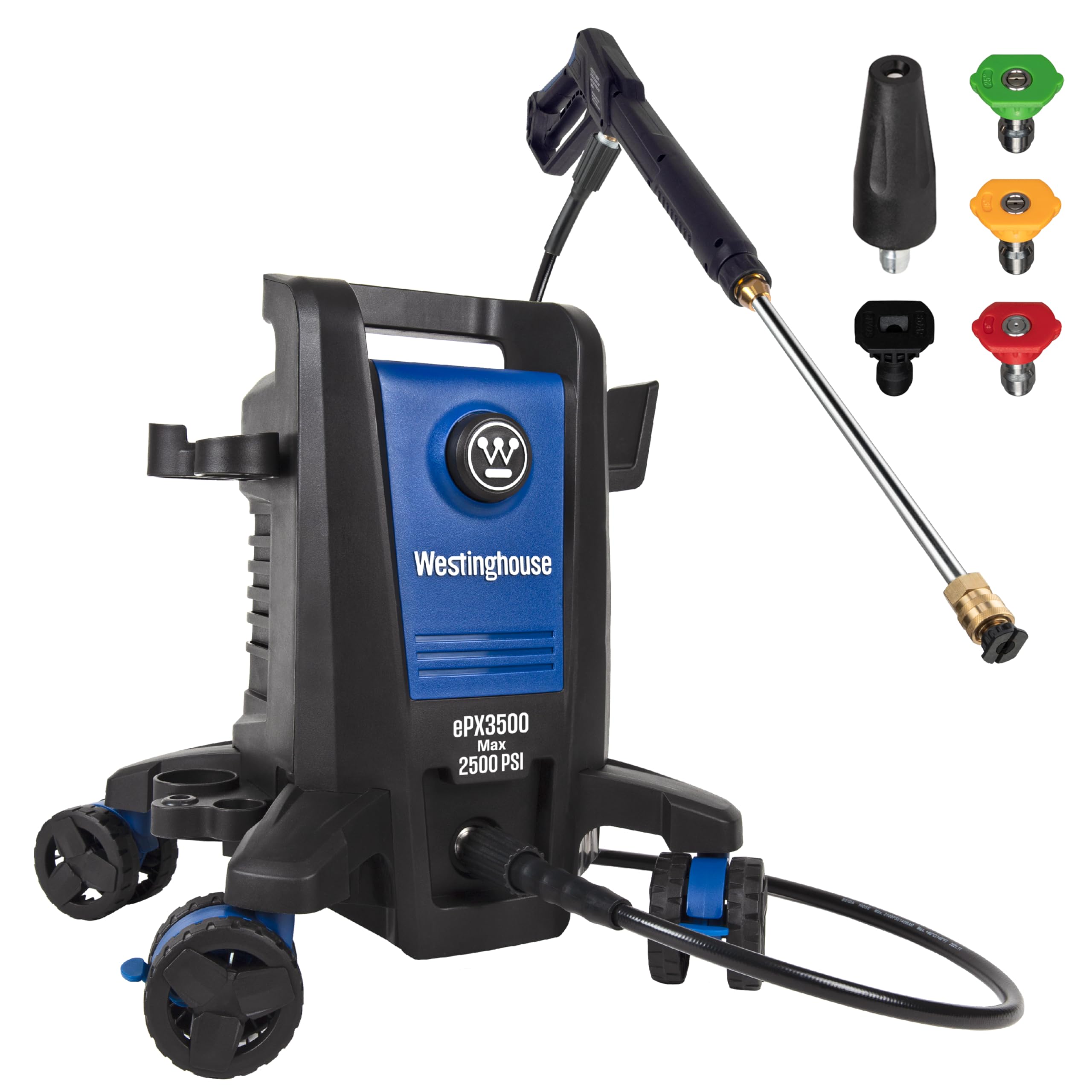
1. Westinghouse ePX3500 Electric Pressure Washer
Our pick — 4.5+★ from 8,000+ verified ratings; the strongest balance of quality and price.
The one that throws the hardest punch of the Westinghouse family without tipping over on a sloped driveway
The number that earns this the top slot is pressure: 2500 max PSI, the highest in this group apart from the two big Greenworks units. Compare that with the Kärcher K1700 at 1700 psi — that is 800 psi more working force for lifting dried bug splatter and brake dust. Flow sits at 1.76 max GPM, so rinsing a full sedan does not turn into a slow walk around the block. Rated figures are the honest ones to plan around: 2000 rated PSI and 1.2 rated GPM.
For car work specifically, the pro-style steel wand extends to 17.5 inches, which gets you over a roof panel without climbing onto the sill. Five nozzles ride along — 0°, 15°, 25°, a turbo, and a soap applicator — so wheels, paint, and glass each get their own tip. The 20-ounce onboard soap tank holds enough detergent for a full exterior wash, and the 25-foot nylon braided hose circles most of a mid-size car from one parking spot. At 19 pounds and just 16.5 inches tall, it stores on a garage shelf without rearranging anything else.
What wins people over here is raw capability: across 8,000+ owners it holds 4.5+ stars, and the performance and effectiveness feedback dominates to an unusual degree — clearing 2,800 and 2,300 mentions respectively, nearly all positive. Owners consistently describe assembly and maneuvering as painless, and the compact footprint gets called out as a genuine garage-space saver. The engineering detail that matters on uneven ground is the four quick-lock wheels with 360° steering and a deliberately low center of gravity — the anti-tipping design keeps a 2500 psi unit from walking away from you mid-pass.
What it earns its keep with
- 2500 max PSI out-muscles the Kärcher K1700’s 1700 psi for stubborn grime
- Five nozzles including a turbo and soap applicator cover every car-cleaning stage
- 20-ounce soap tank plus 25-foot hose means fewer refills and fewer repositioning walks
- Four quick-lock wheels with 360° steering and anti-tipping engineering
- 3-year limited service, labor and parts coverage
Where it asks for a little patience
- At 19 pounds it is heavier to lift into a trunk than the 10-pound ePX3100s
- 16.5 inches tall is compact, but the wand and hose still need a coiling routine
Reach for this if: you wash two cars on a weekend and want the pressure headroom to handle grime-heavy work as well.
Think twice if: your washer has to live in a hatchback — the lighter compact units below store more kindly.
2. Westinghouse ePX3100s Electric Pressure Washer
An independently CETA-certified unit with a back-saving foot switch for light-duty weekend rinses
Kärcher’s claim to serious attention is verification: this unit is CETA certified, meaning an independent body tested and confirmed the performance figures rather than leaving them to the marketing department. Those figures are 1700 PSI TruPressure and 1.2 GPM — the lowest pressure and lowest flow in this line-up, and the spec that defines where it belongs. Against the Westinghouse ePX3500 at 2500 max PSI and 1.76 max GPM, it is a gentler machine by a clear margin.
What it does well is ergonomics on a small job. The on/off foot switch means you start and stop it without stooping, and the pump auto-stops when you release the trigger. A 0.5-gallon detergent tank handles the soap stage, and the three nozzles (15°, turbo, 65°) cover a light wash and a rinse. Never-flat wheels roll across gravel and lawn, and the 19-foot hose keeps a compact loop around a small car. At 20.7 pounds it is the heaviest unit here by a wide gap — the ePX3100s is 13.5 pounds lighter.
Reliability is the trait owners come back to most, with ease of use and suitability for domestic jobs behind it. The honest picture is more textured on the pressure side: feedback splits between owners who find the force ample for their needs and those who want more bite, and build quality draws mixed reactions. A few report hose-connection or trigger-gun leaks over time. Treat this as a light-duty car rinser for a careful owner, and its 2-year limited warranty is the shortest in the group.
Certification is the selling point: an independent test body verified 1700 PSI and 1.2 GPM, so you know exactly what arrives.
The trade-off to weigh: at 1700 PSI and 1.2 GPM it is the softest washer here, so caked mud and heavy brake dust will take more passes than they would on a 2100 PSI unit.
Suits you if: you keep a garaged car lightly soiled and value a certified spec and a no-bend foot switch.
Look elsewhere if: your car sees winter salt or farm dust — the flow rate here is the lowest in this comparison.
3. Westinghouse ePX3100v Electric Pressure Washer
The washer owners specifically reach for when the job is the car sitting in the driveway
If you only read one number, read the hose: 25 feet. Set that beside the Kärcher K1700’s 19 feet and you get six extra feet of slack — enough to reach past the rear bumper without dragging the unit. Flow is 1.76 max GPM against the Kärcher’s 1.2 max GPM, so the rinse stage moves faster. The pressure band is 2100 max PSI with 1800 rated PSI and 1.2 rated GPM, which sits comfortably in the car-safe zone.
The detachable foam cannon is the detail that makes this a car washer rather than a general-purpose blaster. You take it off, fill it, dial the mix, and coat the panels in soap that clings long enough to lift road film. The pro-style steel wand and three-nozzle set ride on the frame, and the built-in carry handle means a 17.6-pound unit moves with one hand. At 11 inches tall it tucks on a shelf, and the auto-stop pump saves wear between trigger pulls.
Ask what people actually do with it and the pattern is car washing — that is the job owners single out first, with power for its size, compact storage, and the built-in handle close behind. Performance and functionality feedback sit at the top of the pile, both near-uniformly positive. Assembly is a quick job by most accounts, and the 3-year limited service, labor and parts coverage is the longest in this line-up alongside the ePX3500.
Where it differentiates: a detachable cannon plus 25 feet of hose and a 17.6-pound body is a deliberately car-first combination rather than a patio machine with a soap bottle bolted on.
The compromise: it carries less peak pressure than the ePX3500 at 2500 max PSI, so heavy concrete work takes longer even though car duty is its strength.
The match for: a weekly car washer who wants foam, reach, and one-hand portability without climbing to the top tier.
Not the one for: anyone whose main job is a stained concrete driveway — the 2500 PSI unit up top handles that better.
4. Greenworks 2100 PSI (1.2 GPM) Electric Pressure Washer

A pull-out handle and push-button start that make garage shelving and setup genuinely quick
The frame is the story here. A telescoping handle pulls out to wheel it to the car and collapses back so the whole thing stores compactly — a small mechanical detail that changes how often you actually use the machine. Pressure is 2100 PSI paired with 1.2 GPM, so it hits hard in the jet and rinses a bit more slowly than the 1.76 GPM Westinghouse units. For a compact car and normal road film, that trade is fine.
There is no gas, oil, spark plug, air filter, or pull cord to manage — push-button start, nothing else. The 35-foot GFCI cord auto-shuts the power if current goes astray, and the four accessories cover the full wash: a 25° nozzle for general cleaning, a 40° nozzle for gentle work on paint, a turbo nozzle for heavy spots, and a soap applicator for detergent. The 1/4-inch universal quick-connect system means any 1/4-inch accessory fits, and the 20-foot tangle-free hose keeps kinks out of your way.
Owners describe it as performing like a larger model than its footprint suggests, and the feedback clusters around functionality and quality with ease of use and pressure behind them. Assembly is a short job by most accounts. Durability feedback is the one place it splits, with a share of owners reporting long service and a smaller share reporting early nozzle or unit trouble — worth knowing, and well covered by the 3-year limited warranty against defects in materials, parts, or workmanship.
The storage win: a collapsible telescoping handle plus a 22-pound body means it disappears into a garage corner between washes.
The flow trade: 1.2 GPM rinses slower than 1.76 GPM, so budget an extra pass when you are sheeting water off a large panel.
Worth it for: a garage owner who wants fast setup, quick breakdown, and a frame that folds away.
Skip the temptation if: you wash a full-size SUV weekly — the lower flow rate makes the rinse stage feel slower than the Westinghouse units.
5. A-iPower Electric Pressure Washer 2800 Max PSI
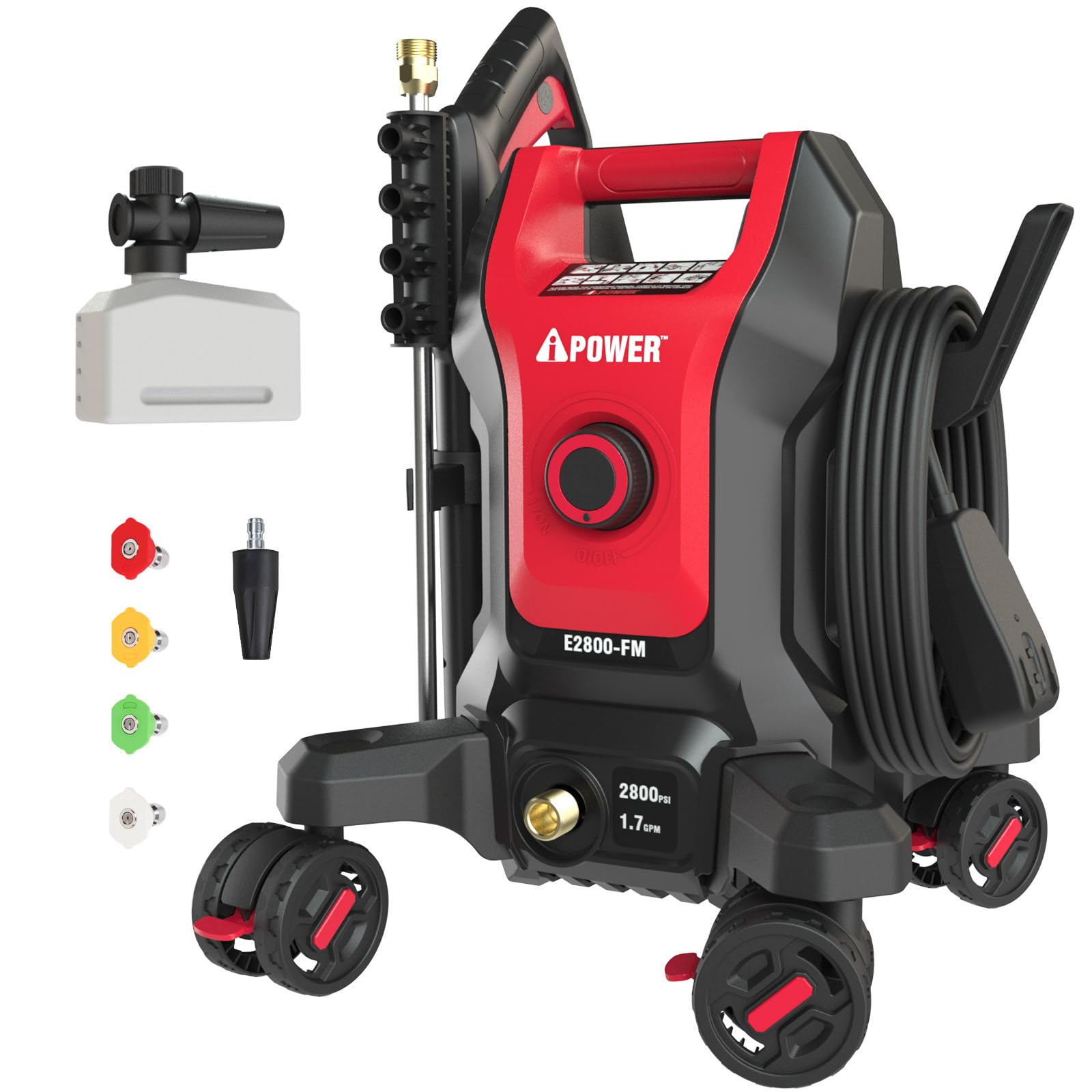
A 2800 PSI ceiling and five nozzle options for owners who want headroom beyond a basic car rinse
2800 max PSI is the headline, and it is the highest peak pressure in this group short of the two Greenworks machines up next. The honest planning figure is the rated one: 2000 rated PSI and 1.2 rated GPM, with a 1.7 max GPM ceiling. For car work, that rated pressure is plenty for wheels and lower panels — just keep the 0° and turbo tips off the paint and let the 25° and 40° do the bodywork.
Reach is generous: a 35-foot power cord plus a 25-foot pressure hose together let you circle a vehicle and cover a stretch of yard without hunting for a second outlet. Five nozzles ship in the box — 0°, 15°, 25°, 40°, and turbo — which is the widest tip selection here and means you never improvise an angle. Four quick-lock wheels with 360° steering and a low center of gravity carry the anti-tipping design, and the TSS system stops the pump the moment you release the trigger.
Performance is what owners talk about, and almost always in positive terms — sufficient power for the task at hand is the recurring note. Value and power follow, and ease of use gets called out, including how readily it starts. Build quality draws a split verdict, with some describing it as well-built and a smaller share reporting a failure after a few months. The 2-year manufacturer warranty is on the shorter side for this group.
What the extra PSI buys: 2800 max PSI gives you the reserve to step up from car duty to a stained patio without buying a second machine.
The caution to hold: the widest nozzle set includes a 0° tip, and at this pressure that jet is a paint-stripping tool — keep it to concrete and wheel wells.
A strong fit for: someone who wants one washer for cars and hard outdoor surfaces with pressure to spare.
Less suited to: buyers who want the longest warranty — this one covers 2 years versus 3 on several Westinghouse picks.
6. Greenworks Brushless Electric Pressure Washer, 3000 PSI Max

Two gallons a minute at 3000 max PSI — the fastest rinser in this entire line-up
This is the only unit here that reaches 2.0 max GPM and 3000 max PSI at once, and the combination is what separates it from everything above. Compare it with the Kärcher K1700’s 1.2 max GPM and you are moving a lot more water per minute, which is why sheeting a wet car down goes so much quicker. The 14 Amp TruBrushless motor drives those figures, and Greenworks states the PSI and GPM claims were tested by an independent lab — a claim note when so many listings round upward.
The accessories are detailer-grade: a rugged metal gun, a 25-foot Uberflex kink-resistant hose, and 15°, 25°, 40°, soap, and turbo nozzles — the widest working set here. JettFlow technology is the maker’s claim of up to 50% more flow for reaching higher areas and faster power rinsing. A 35-foot GFCI power cord and a detergent tank round out the package, and the maximum inlet water temperature is listed at 104°F (40°C), so warm water is fine but not hot.
Quality and reliability lead the owner feedback trail, with power and ease of use following — the phrase “like a gas-powered model” turns up around power more than once, and that tracks with 3000 PSI and 2.0 GPM. Durability draws a split read, with plenty reporting long service and a smaller group reporting a failure — again, this is the trade a high-output machine makes. Note the weight listing is unusually heavy for a portable unit, so plan it as a garage resident rather than a trunk regular.
The standout figure: 2.0 max GPM is the highest flow rate in this article, and it is what turns a rinse into a quick sheet rather than a slow soak.
What to plan around: this is a garage machine — treat it as a wheeled workhorse and be cautious with the 0° and turbo tips on clear coat.
Buy it for: high-volume washing where speed matters and the unit lives in a garage with room to roll.
Not for you if: you need to carry the washer to a coin-op bay or a friend’s driveway — the bulk works against that.
7. Active 2.0 GPM Electric High-Pressure Washer, 1800 PSI
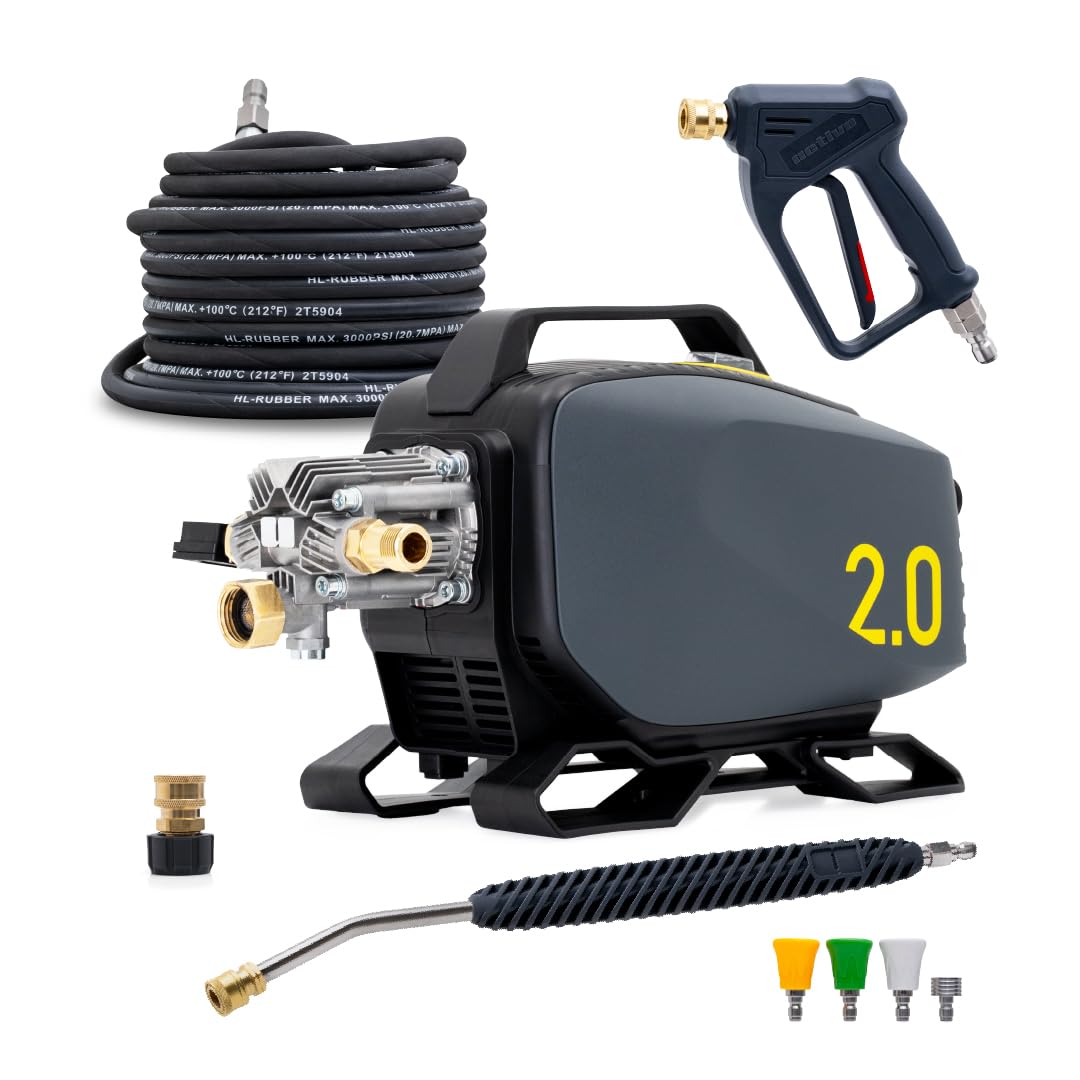
A car-care-first design that pairs gentle 1800 peak PSI with a beefy 2.0 GPM flow
Flip the usual priorities and this makes sense. Instead of chasing pressure, Active leans on flow: 2.0 GPM matches the Greenworks volume leader, while peak pressure sits at 1800 PSI and the spec table lists 1500 psi. For paint, that is the safer end of the spectrum — enough to move grit, little enough that the risk of marring drops. It arrives as a complete kit with hoses, nozzles, and accessories, so you are not ordering extras to start washing.
The pump is the longevity argument: a patented 5-piston design with premium internals built for years rather than one season, and it is engineered so parts can be swapped to keep it going. Connections stay open for upgrades — 3/4-inch GHA garden hose threads on the supply side and M22-14mm on the pressure side accept aftermarket hoses and tools. At 16 inches long by 9 inches wide by 8 inches tall, it is compact enough to keep on a detailing cart, and a 2-year residential warranty backs it.
Quality is the aspect owners praise first, then performance, then compact size and power — a small but consistent chorus behind an unusually focused design. Value is the one place opinions part, with some calling it worth every dollar and others noting you get what you pay for. This is a detailer’s tool, and the pricing reflects the specialty internals rather than raw output.
Flow over force: 2.0 GPM with a gentler 1800 peak PSI is deliberate — the volume carries the dirt, and the pressure stays kind to clear coat.
The honest limit: at 1500 psi in the spec table, this will not strip a stained driveway the way a 2800 or 3000 PSI unit will.
Made for: the home detailer who cares about paint safety, upgradeable fittings, and a pump that can be serviced.
Wrong tool for: anyone expecting to power-clean concrete — this one is tuned for panels, not pavement.
Know the Specs
PSI and GPM: pressure versus flow
PSI (pounds per square inch) is how hard the water pushes. GPM (gallons per minute) is how much water arrives each minute. For car work you want both in balance — a high-PSI, low-GPM machine hits hard but rinses slowly, while a low-PSI, high-GPM machine is gentle on paint but fast to sheet water off. Max figures are measured at the lowest pressure setting on many units, so look for the rated PSI and rated GPM numbers to plan real work.
Max versus rated figures
Max numbers are what the machine can spike to; rated numbers are the steady working output. That gap matters on a car, because the sustained pressure is what actually lifts road film. When a listing shows both, the rated figure is the one to compare across machines.
Nozzle angles explained
0° fires a thin high-power jet for concrete edges and wheel arches. 15° is a strong general tip. 25° is the standard car-cleaning angle. 40° is a gentle rinse for paint and glass. A turbo nozzle spins a rotating jet for stubborn grime but deserves respect near clear coat. A soap applicator draws detergent for a pre-wash stage.
Foam cannon versus soap tank
A foam cannon mixes soap and air to throw thick foam that clings and dwells, loosening grime before you touch the paint. A soap tank draws detergent through the line at low pressure — thinner coverage, quicker to set up. On a car, the cannon is the pre-wash step that reduces the chance of dragging grit across the surface.
Hose and cord length together
Hose length is pressure-side reach; cord length is your distance from the outlet. A 25-foot hose paired with a 35-foot cord is the working combination that lets you walk a full loop around a vehicle. Check both numbers as a pair, because a long hose tied to a short cord still leaves you stuck near the garage.
Quick-connect fittings and upgrades
M22-14mm and 1/4-inch quick-connect systems let you add surface cleaners, undercarriage cleaners, and aftermarket foam cannons later. If you plan to expand, look for standard threads rather than a proprietary connector — that keeps your accessories usable if you change machines.
Common Questions
Will a 2100 PSI pressure washer damage my car’s paint?
Is a higher GPM better than a higher PSI for washing a car?
Do I really need a foam cannon for car cleaning?
Can these electric washers pull water from a bucket instead of a hose?
What is the difference between max PSI and rated PSI?
Will a 20-foot hose reach around a full-size SUV?
Do I need warm water to wash a car with a pressure washer?
How much does a car-cleaning pressure washer weigh, and does it matter?
Can I use a surface cleaner attachment with these washers?
What should I do with the pressure washer between car washes?
The Bottom Line
The power washer for car cleaning that gets the most done for the most people is the Westinghouse ePX3500 — 2500 max PSI, 1.76 max GPM, five nozzles,a 20-ounce soap tank and 25 feet of hose, with 3-year coverage behind it. If storage and carry weight are your deciding factors, the Westinghouse ePX3100s drops to 10 pounds while keeping 2100 max PSI and an adjustable foam cannon. And for paint-safe detailing where flow matters more than force, the Active 2.0 GPM kit pairs its 2.0 GPM flow with a sub-2000 PSI ceiling and serviceable fittings. Whichever you pick, the nozzle in your hand decides whether the wash is paint-safe — the machine just supplies the water.
How we choose
We do not accept paid placement. Every pick is matched to a real buyer and a real use-case; we do not hands-on test units.
Sources
Specifications: manufacturer listings and product documentation. Review insights: verified customer reviews, as of November 2026. Pricing: not shown on this page (it changes often); check the current price via the retailer link.
As an Amazon Associate, Tactical Gear Guy earns from qualifying purchases. This does not affect which products we feature.