Specs are compiled from manufacturer listings and verified buyer reviews and can change over time — please confirm the key details on the product page before buying.
If your drinks come out half-frozen or barely cold, the thermostat is the culprit, not the drink. You want one that lets you dial in an exact number — say 37°F for a crisp lager or 55°F for a red wine — and then actually holds that number overnight. This guide separates the units with real temperature control from the ones with a vague cold-to-colder dial, and it explains in plain terms which size, door style, and cooling system fits a bedroom, office, or bar.
This guide is built by comparing the manufacturers’ published specifications and the patterns across verified customer reviews, so you get each pick’s real strengths and trade-offs instead of marketing spin.
Most buyers assume a glass door means a weak chill, and the picks below show that a compressor behind that glass changes everything. You will see which units give you a digital readout instead of a guessing-game knob, and which ones run quiet enough for a bedroom, all covered in this temperature control mini fridge breakdown.
Top Picks

How To Choose The Best Temperature Control Mini Fridge
The number that matters first is the low end of the thermostat range, not the can count. A fridge that bottoms out at 40°F is a drinks chiller; one that reaches 34°F can handle a colder pour. Everything else — door glass, shelf count, noise — is secondary to whether the unit can hold the temperature you set.
Digital thermostat versus a dial
A digital thermostat lets you punch in an exact number and see it on a display, so you know what you set. A dial moves in clicks with no readout, which means you tune it by feel and re-check with a thermometer. Digital panels also tend to offer a memory function that restores your setting after a power cut.
Compressor or thermoelectric cooling
A compressor works like a full-size fridge — it pushes refrigerant around and holds temperature even when the room is hot. A thermoelectric unit uses a plate that cools one side, and it struggles in a warm room. Compressors cool harder, and they usually run with a low hum rather than silence.
Sizing by cans and cubic feet
A 0.6 cubic foot cabinet holds around 24 standard cans, and a 3.2 cubic foot cabinet holds around 126 to 130. Measure the shelf or counter first, then pick the can count that fits your week — a party fridge and a bedside soda stash are different purchases.
Noise and placement
The spec to check is the decibel rating, written as dB. A 36 dB rating is about as loud as a quiet library, so it works beside a bed or desk. Units without a published dB number are a gamble in a small room, so treat the rating as a real filter.
Side-by-Side Comparison
| Model | Best For | Capacity | Temp Range | Cooling | Amazon |
|---|---|---|---|---|---|
| EUHOMY 130 Can Mini Fridge★ Best Overall | Whole-party drink storage | 3.2 cu. ft. / 130 cans | 37°F–61°F | Compressor | Amazon |
| Feelfunn 126 Can Beverage RefrigeratorBiggest Range | Big capacity in silver | 3.2 cu. ft. / 126 cans | 34°F–64°F | Compressor | Amazon |
| Erivess 126 Can Glass DoorBest Looking | Stainless-frame looks | 3.2 cu. ft. / 126 cans | cools to 37°F | Compressor + fan | Amazon |
| Icyglee 18L Wine Fridge | Wine-first chilling | 18 L | 40°F–61°F | Compressor | Amazon |
| Feelfunn 24 Can Countertop | Desk-side silence | 0.6 cu. ft. / 24 cans | 40°F–61°F | Compressor | Amazon |
| Antarctic Star 10L Small Drink Fridge | Bedroom countertop | 10 L | 40°F–61°F | Thermoelectric | Amazon |
| Tehanld 0.6 Cu.ft Beverage Cooler | Patio and outdoor spot | 0.6 cu. ft. | 40°F–61°F | Compressor | Amazon |
| Antarctic Star 18L 24 Can | Dorm and office shelf | 0.6 cu. ft. / 24 cans | 40°F–61°F | Compressor | Amazon |
| Erivess 60 Can 1.3 Cu.ft | Tight under-counter fit | 1.3 cu. ft. / 60 cans | cools to 40°F | Compressor | Amazon |
Detailed Reviews
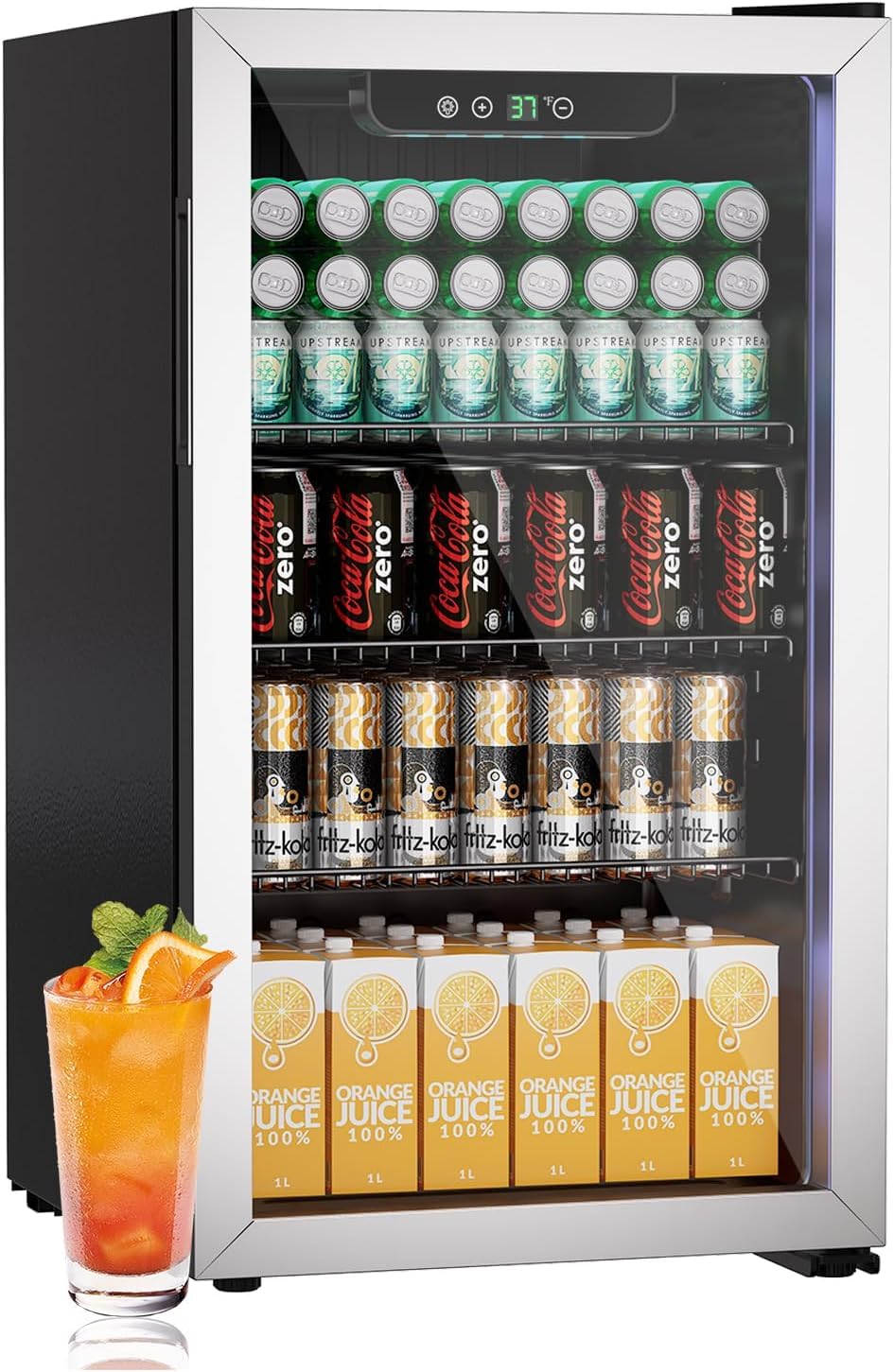
1. EUHOMY 130 Can Mini Fridge
Our pick — 4.0+★ from 3,500+ verified ratings; the strongest balance of quality and price.
A 130-can cabinet you tune by touchscreen, not by guesswork.
The headline is the range: you can set this cabinet anywhere from 37°F to 61°F on a touchscreen panel with an LED readout. That spread covers a cold lager at one end and a red wine at the other. You are not stuck with a knob that has three clicks and no numbers.
Then there is space. At 3.2 cubic feet it swallows up to 130 standard cans, split across 5 removable shelves that slot into 5 positions. Compare that with the Tehanld 0.6 Cu.ft Beverage Cooler below — 3.2 cubic feet against 0.6 cubic feet is a 5.3x gap in raw volume. The EUHOMY also gives you 5 door shelves to the Tehanld’s 1, a 5.0x difference, so smaller bottles and cans do not pile on top of each other.
Cooling is handled by a compressor with a circulation fan, which is what keeps the temperature even instead of pooling cold at the bottom. The double-layer UV-blocking glass door, tight seal, and high-density foam work together to hold both temperature and humidity. It runs at 36 dB, a level that sits comfortably in a bedroom or office, and the reversible door plus adjustable feet let you fit it into an awkward corner. Rated 4.0+ stars by 3,000+ owners, it covers a party stash, a wine bottle, and a bedside soda in one cabinet.
What earns it first place
- 37°F–61°F on a touchscreen — a real number you can dial in, not a mystery dial.
- 3.2 cu. ft. holding 130 cans across 5 removable shelves in 5 positions.
- 36 dB operation keeps it bedroom-friendly, and the door reverses for tight corners.
- Double-layer UV-blocking glass plus a high-tightness seal protects drink quality.
Before you plug it in
- It needs to stand upright for 24 hours before first use, so plan around that.
- At 3.2 cubic feet it eats real counter or floor space — measure before you buy.
Reach for this if: you want one fridge to cover a party stash, a wine bottle, and a bedside soda without a second unit.
Look elsewhere if: you only need a dozen cans — a smaller cabinet will fit far better.
2. Feelfunn 126 Can Beverage Refrigerator
The widest thermostat window here — 34°F at the bottom, 64°F at the top.
If you want the coldest setting on the list, this is the one. Its digital thermostat swings from 34°F to 64°F, which is a wider spread than the EUHOMY’s 37°F–61°F or the Antarctic Star 18L’s 40°F–61°F. A 34°F floor means a genuinely cold pour, and the 64°F ceiling suits a red wine that should not be served icy.
The cabinet matches the EUHOMY at 3.2 cubic feet and holds up to 126 cans on 4 adjustable shelves. Air circulation is handled by a compressor with 3D air flow, so cold is pushed through the whole cabinet rather than settling in one zone. The double-layer LOW-E glass keeps drinks visible while improving insulation, and the reversible door plus adjustable feet let it sit freestanding or slide under a counter.
Noise is published at 36 dB, which is why it works in a dorm or living room without dominating the room. What wins people over is the build — it is the aspect owners talk about most, with functionality close behind. The honest catch is the thermostat floor in real rooms: a few units struggle to reach the coldest end and run warm on the sides, so keep a little air gap around it. Dimensions are 17.5″W x 18.9″D x 31.2″H, so check your under-counter opening first.
Why it ranks here: the 34°F floor is the lowest setting in this group, and 3.2 cubic feet of glass-door storage at 36 dB is a strong pairing for a living room bar.
The coldest setpoint wins it: buy this if you want a proper 34°F chill and a digital readout to prove it.
Give it breathing room: leave clearance around the cabinet, since hot sides and a short-of-target chill are the recurring gripe.
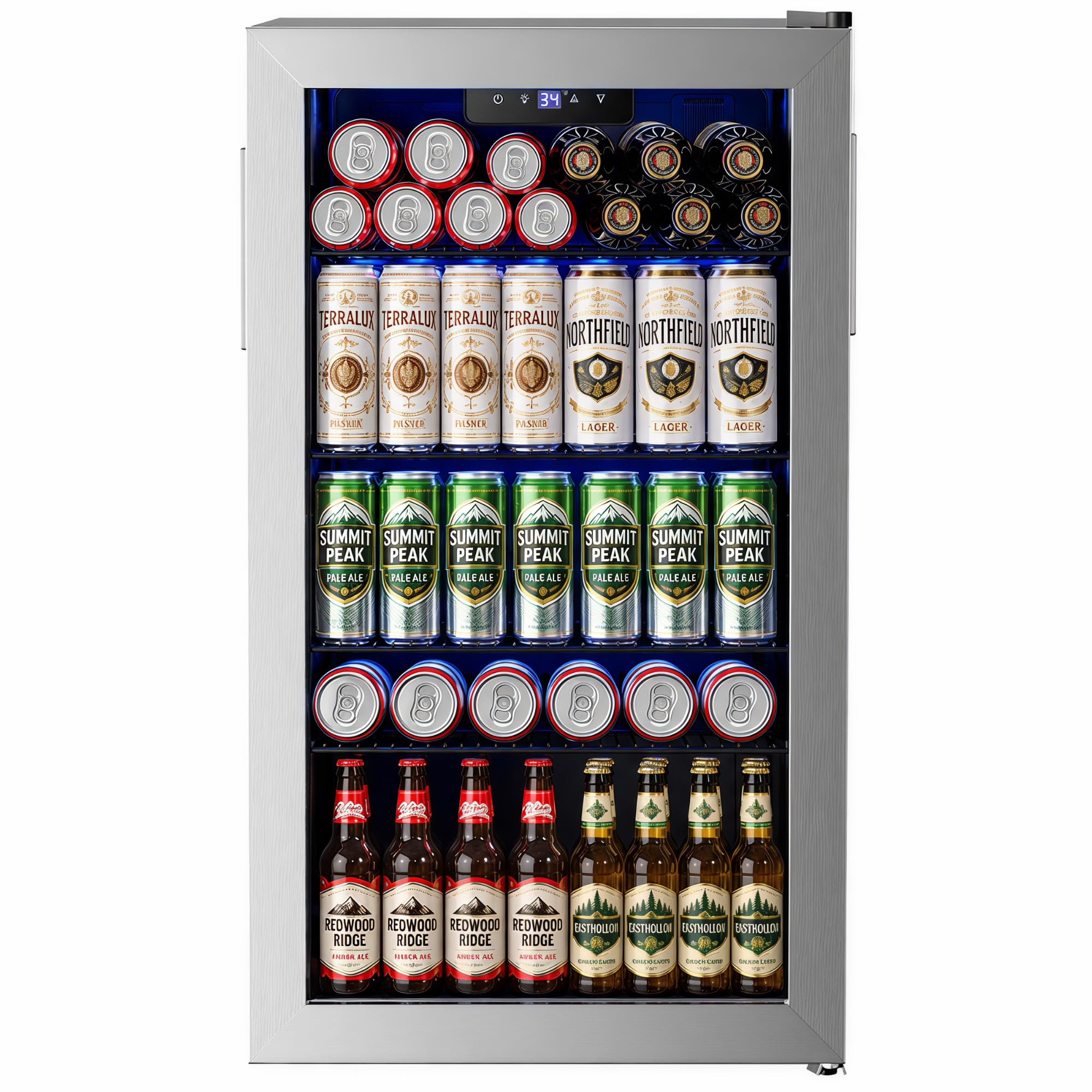
3. Erivess 126 Can Beverage Refrigerator, Glass Door for Soda
A stainless-framed glass door with the biggest shelf count in the group.
This is the one that looks like it belongs in a home bar rather than a dorm room. The glass front door is wrapped in a stainless steel frame, and it holds up to 126 cans across 4 adjustable and removable chrome shelves. Both the door and the shelves come out, so a wine bottle fits as easily as a row of soda.
The single-zone thermostat cools down to 37°F, and a large digital display makes it easy to set and monitor. A memory function restores your preset temperature after a power cut or unplugging. Cooling comes from a 120 V, 240 W compressor paired with a convection fan that circulates air for a uniform chill, and the unit also carries an additional temperature sensor that drives an auto-defrost mode.
Buyers rate the performance highly, and the appearance does the selling in a shared space. The caveat is temperature honesty: a handful of owners find it runs colder than room temperature rather than hitting a true setpoint, so verify with a thermometer in the first week. It is also drinks-only by design — the maker says not to store meats, vegetables, or fruit in it. At 3.2 cubic feet with 4 door shelves, it splits the difference between the EUHOMY’s 5 shelves and the Antarctic Star 18L’s single shelf.
The look-and-load pitch: a stainless frame, 126-can capacity, and 4 removable chrome shelves make this the display piece of the group.
Set your own baseline: check the actual temperature with a separate thermometer early, because a few units read colder than they chill.
Pick it for the finish: the stainless steel frame and blue LED make it the best-looking 126-can cabinet here.
Not a food fridge: it is built for drinks only, so keep groceries in the kitchen unit.
4. Icyglee 18L Wine Fridge
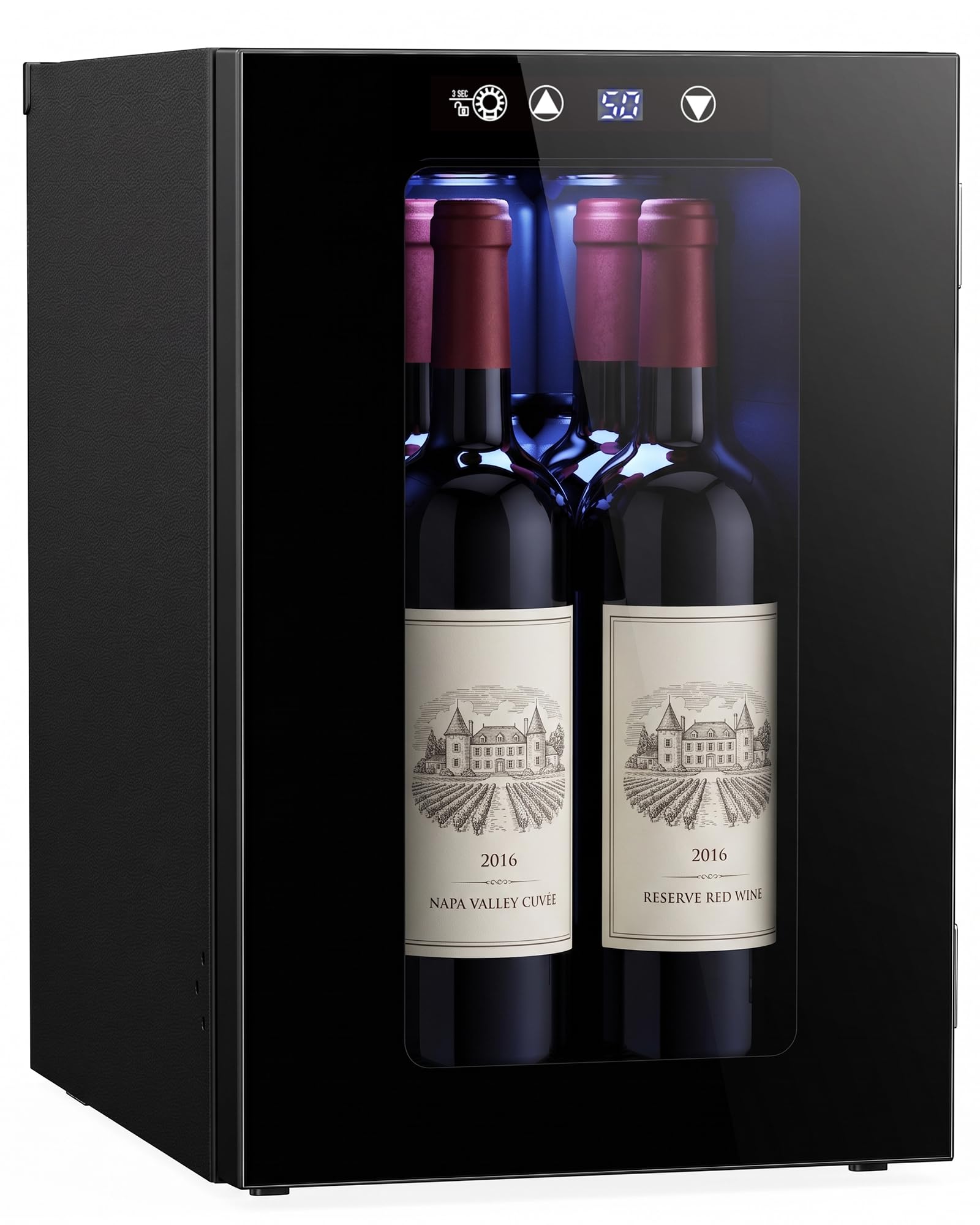
Six shelf heights and under 38 dB — built around bottles, not just cans.
Most mini fridges make you fight the shelf height. This one gives the removable shelf 6 positions, so a tall sparkling bottle and a short can both sit properly. In its standard setup the 18L cabinet holds up to 4 standard 750 mL wine bottles with 6 330 mL cans, and pull the shelf out and it takes up to 24 330 mL cans instead.
The touch panel runs from 40°F to 61°F, which covers red, white, and sparkling wine at their own settings. A double-layer tempered glass door cuts heat transfer and blocks UV exposure, so the light inside does not work against the wine. The soft interior LED lets you read labels without opening the door and letting the cold out.
At under 38 dB it is the quietest published number in this group, which is why it fits a bedroom or dining room. Build quality is what people praise most, and the temperature control draws steady approval. It is ETL certified and backed by 12 months of product support.
Where it shines
- 6 shelf positions adapt to bottles and cans without a fight.
- Under 38 dB — the lowest published noise figure on this list.
- Double-layer tempered glass cuts heat transfer and blocks UV.
- 40°F–61°F touch control suits red, white, and sparkling wine.
Know before you buy
- 18L is a small footprint — this is a wine cabinet, not a 100-can cooler.
- Some owners hear a loud buzz when the compressor kicks on.
Built for bottles: choose it if wine is the point and you want precise 40°F–61°F control in a quiet room.
Not a crowd cooler: if you need 100+ cans, step up to a 3.2 cubic foot cabinet.
5. Feelfunn 24 Can Beverage Refrigerator
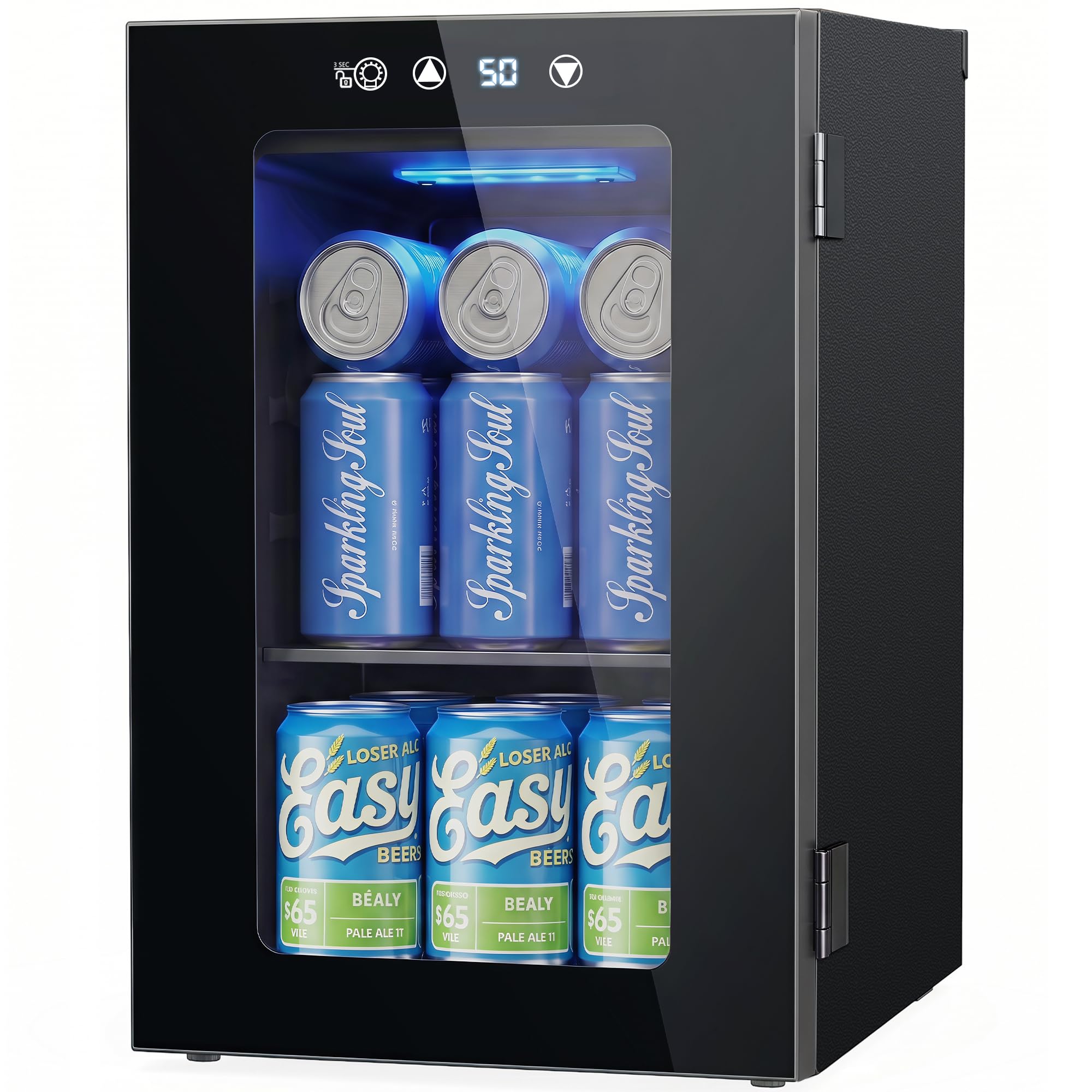
A 24-can counter unit with controls built into the door.
Here is a small fridge that respects a small desk. At 0.6 cubic feet it holds 24 cans and measures 11.2″W × 14.9″D × 16.8″H, so it fits on a countertop or under a desk without swallowing the space. A removable shelf lets you swap tall bottles for short cans as you like.
The thermostat runs from 40°F to 61°F, and the control panel sits on the door with an LED display. That means you adjust the temperature without opening the door and dumping the cold air. A 360° air circulation system backs up the compressor, so the chill stays even across the cabinet instead of pooling at the bottom.
What buyers respond to is the look — the appearance is the most-praised aspect, with temperature retention close behind. The double-pane glass door improves insulation while a blue LED shows off the contents. The fair warning is the noise: several owners find it louder than the “quiet” wording suggests, so if it is going beside your bed, weigh that. It carries 208 kilowatt hours per year on the spec sheet.
The desk-side case: door-mounted controls plus 24-can capacity make it the tidiest fit for an office or study corner.
For the work-from-home desk: 24 cans, a 40°F–61°F range, and controls on the door you do not have to open.
Check the sound first: if it sits within arm’s reach all day, expect more fan noise than the marketing implies.
6. Antarctic Star 10L Beverage Refrigerator
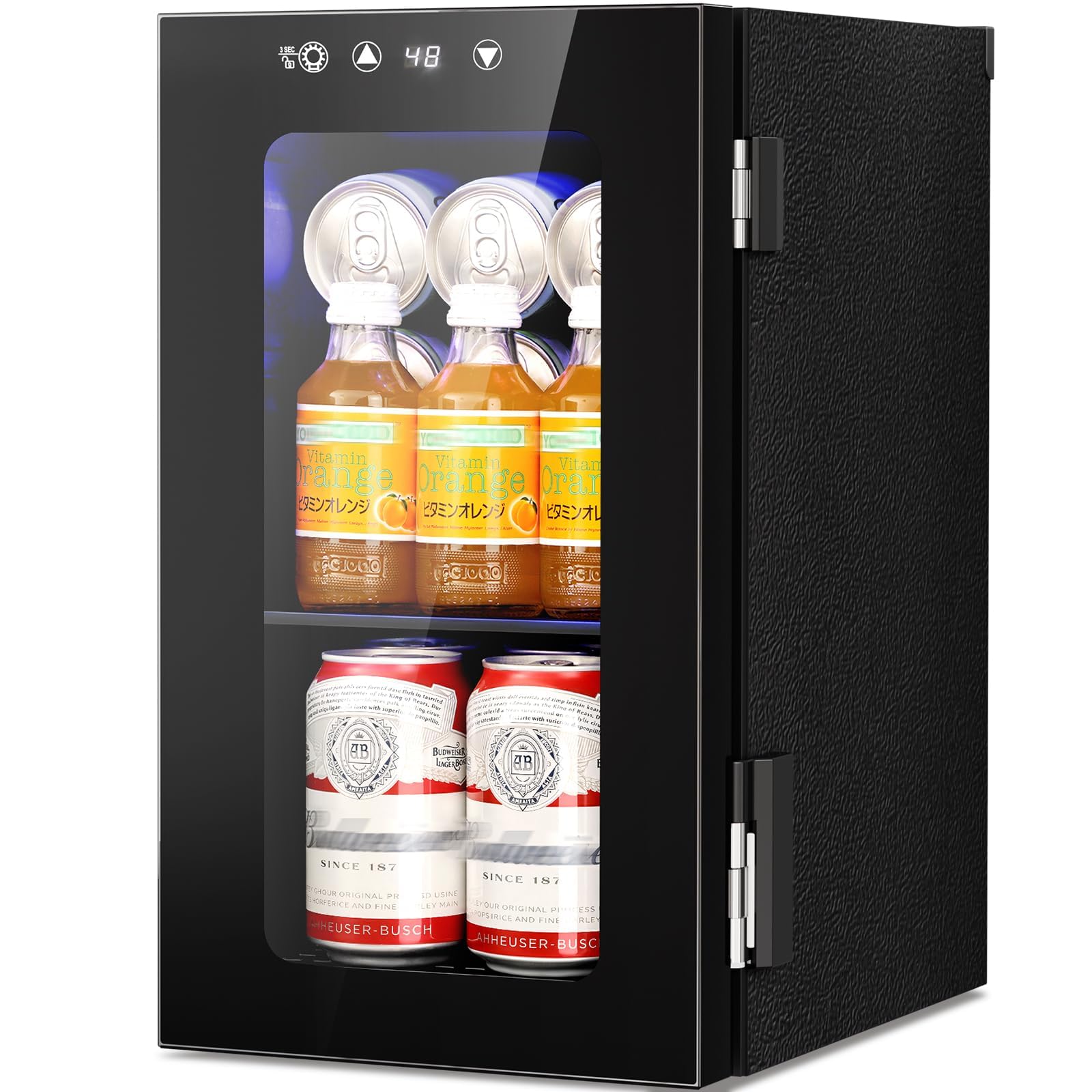
A 10-liter bedside cabinet that stores 12 cans in very little space.
This is the smallest unit here, and it makes the most of the room it takes. The 10L cabinet holds up to 12 aluminum cans, or 6 cans plus 2 wine bottles. The detachable shelf rearranges to fit tall or short drinks, so a juice bottle and a can do not compete for the same gap.
The digital thermostat spans 40°F to 61°F, with a display that shows the setting and a memory function that restores it after a power cut. A soft LED lights the interior so you can grab a drink in the dark. The manual defrost uses a backside drip tray where condensation evaporates on its own, which keeps upkeep to a quick wipe.
Cooling here is thermoelectric, not compressor — a plate that chills one side without the mechanical hum of a compressor. That is the dividing line against the Feelfunn 24 Can above, which uses a compressor. Thermoelectric units tend to be quieter up close, but they work best in a cool room rather than a hot garage. Reliability and cooling performance both draw steady praise, while noise remains the one area where opinions split.
Small-space logic: 10 liters, 12 cans, and a digital 40°F–61°F range in a cabinet that sits on a desk or nightstand.
The cooling caveat: thermoelectric cooling has less headroom than a compressor in a warm room, so keep it indoors.
The bedside size: pick it when 12 cans is your week and you want a dial-free digital setting.
Think twice in a hot room: the thermoelectric plate works best in a cool, climate-controlled space.
7. Tehanld 0.6 Cu.ft Beverage Cooler
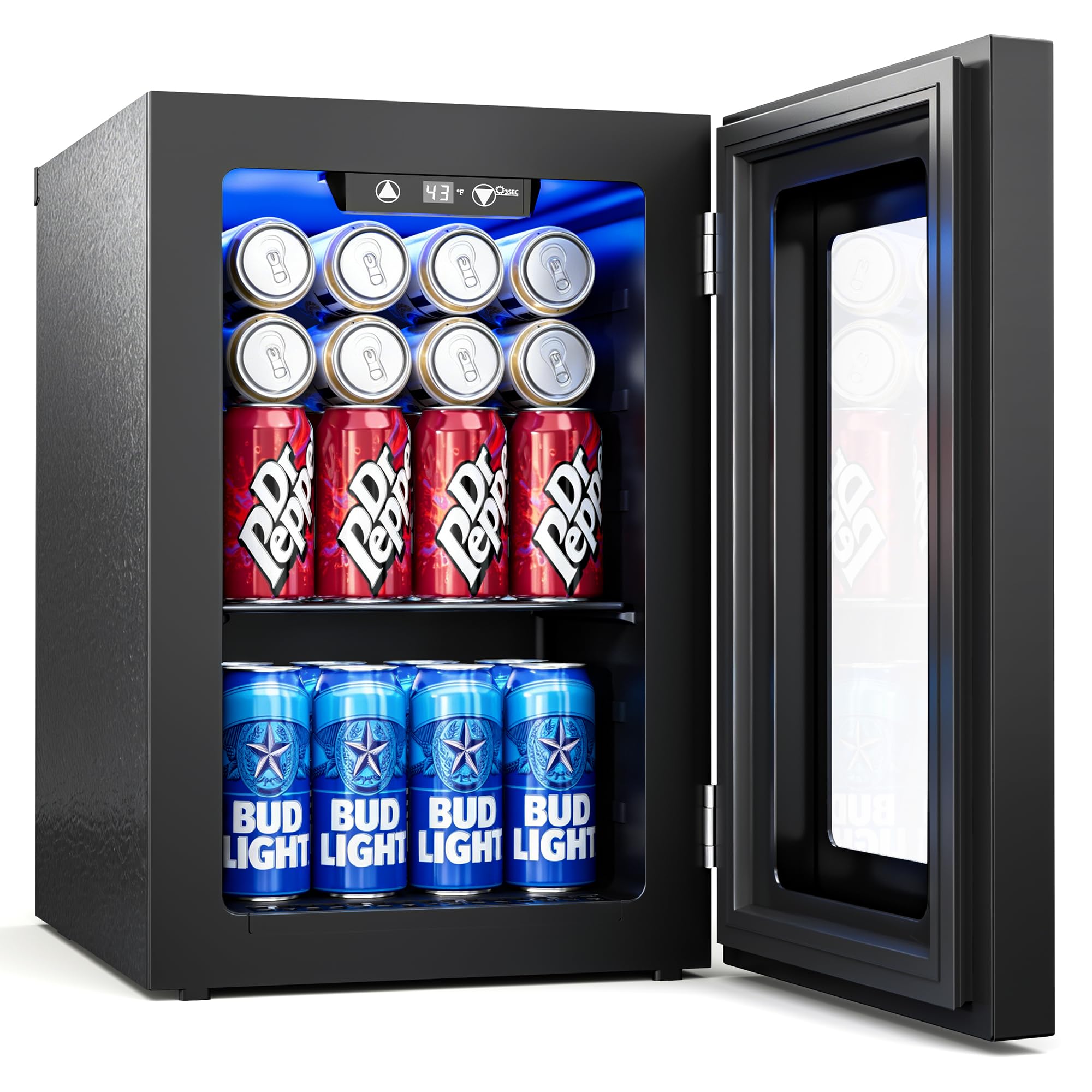
A tiny compressor cooler that holds steady even beside a hot tub.
Do not let the 0.6 cubic foot size fool you into the thermoelectric trap. This one is a real compressor unit, the same cooling method as a full-size fridge, so it keeps a stable temperature even when the room is warm. That is why it turns up beside outdoor hot tubs in owner reports.
The digital thermostat and touch buttons cover 40°F to 61°F, with a bright display and a memory function that restores your setting after an outage. One removable wire shelf tilts or slides out to fit different bottles and cans, and leveling legs keep it steady on a hard surface. A soft blue LED toggles on with a 3-second long press.
Maintenance is manual defrost with an integrated drip tray that channels and evaporates the water. The pricing-versus-performance question is the catch: it draws 226 kilowatt hours per year, which is the highest annual energy figure among the small cabinets here. Against the Antarctic Star 18L at 60 kilowatt hours per year, that is a 3.8x gap. If it lives outside for a couple of hours at a time, that matters less than if it hums all day in a bedroom.
Why it holds up outdoors
- Real compressor cooling stays stable in a warm room.
- 40°F–61°F touch control with a memory function after power loss.
- Tiltable wire shelf and leveling legs suit uneven patio floors.
What to weigh
- 226 kWh per year is heavy for a cabinet this small.
- A few units arrive with a dent or glass damage in transit — inspect on arrival.
For the patio corner: the compressor keeps the chill steady by a hot tub where thermoelectric units fade.
Mind the running cost: at 226 kWh per year, run it on a timer rather than all day indoors.
8. Antarctic Star 18L Mini Fridge
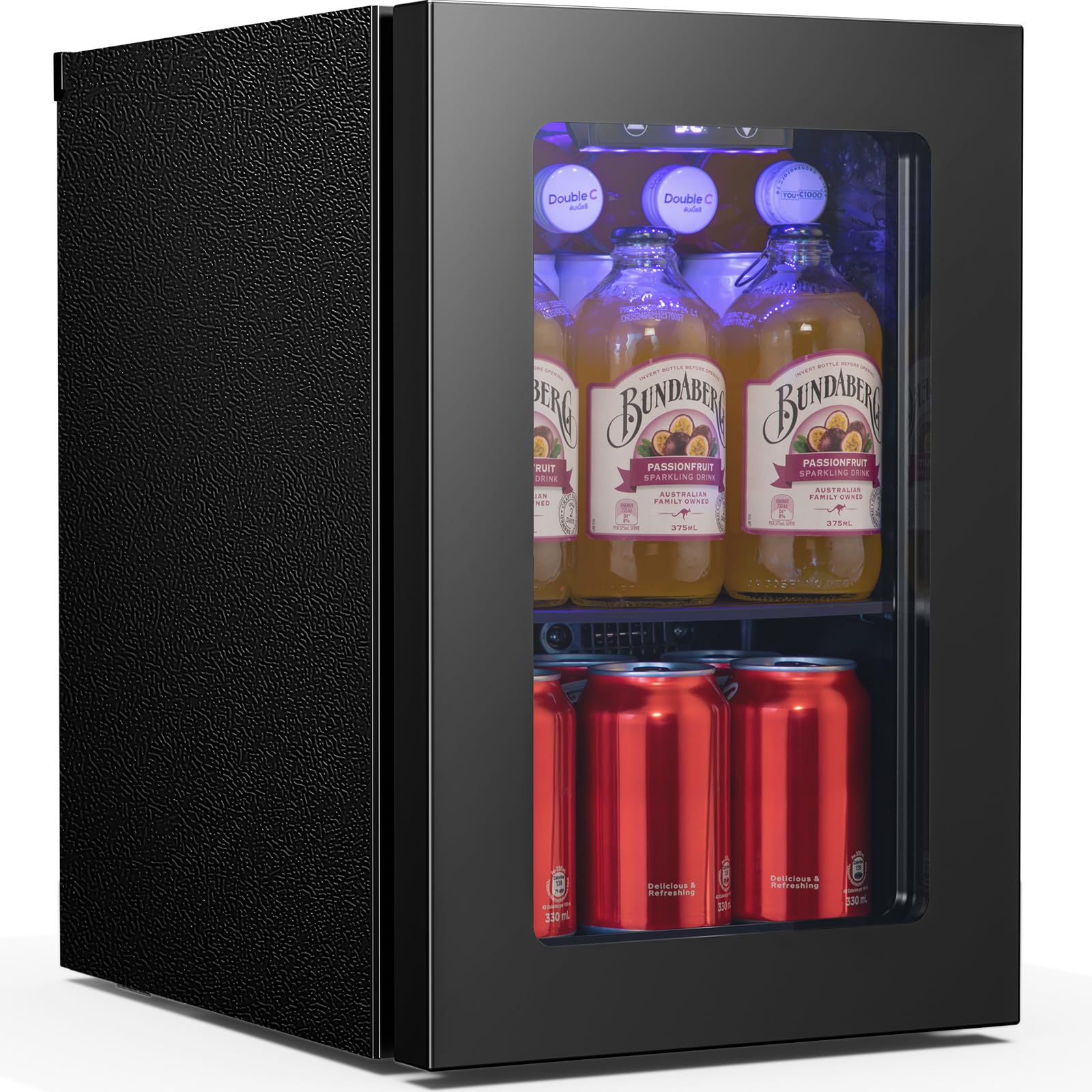
The efficiency pick — 60 kWh a year in a shelf-sized 24-can cabinet.
This is the unit for someone who wants a compressor chill without the running cost. Its annual energy consumption is 60 kilowatt hours per year, the lowest published figure among the small cabinets in this group. For a dorm room or office where it runs around the clock, that is the number to weigh first.
The working range is 40°F to 61°F, and because it uses a compressor rather than an electronic plate, it holds that temperature steady even on a hot summer day. It stores 24 standard cans in a compact 0.6 cubic foot body, with movable shelves that open up more space when you need it. A reinforced door with an airtight seal helps hold humidity, and the blue interior LED makes late-night grabbing easy.
The look earns high marks — appearance is a clean sweep among the aspects buyers discuss, with overall quality close behind. The honest catch is noise, where opinions split and some units emit a beeping sound, so test it the first night before it settles next to your pillow. It is a strong cheap-tier option, and the size keeps it out of the way.
The efficiency case: 60 kWh per year and a compressor that holds steady in summer heat make this the low-running-cost pick.
One thing to test: listen for beeping on the first run, since that is the recurring complaint.
For the tight shelf: 24 cans, 0.6 cubic feet, and the lowest annual energy draw here.
Listen before you commit: if a beep or fan hum would bother you overnight, give it a trial night first.
9. Erivess 60 Can Mini Fridge
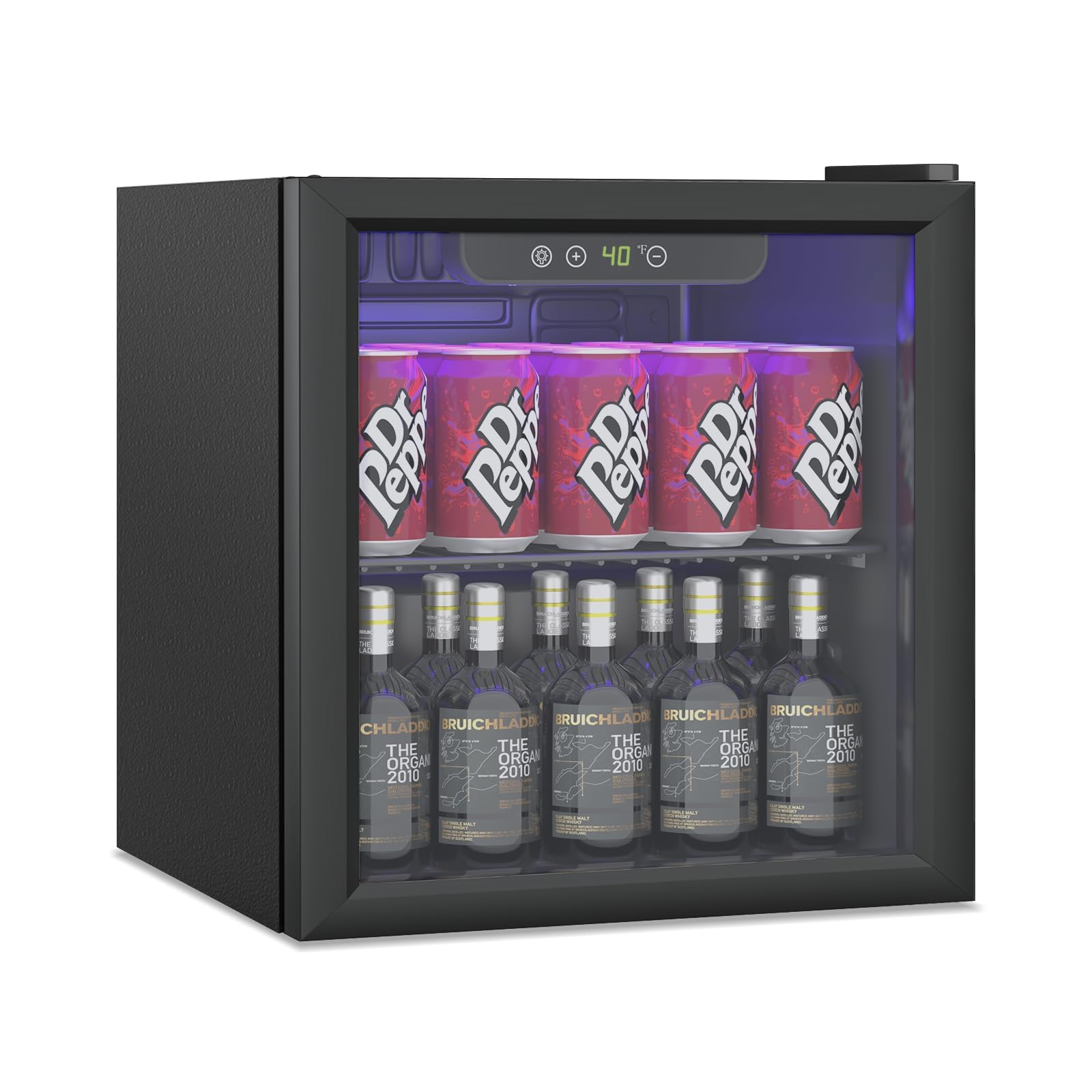
An under-counter 60-can chiller for a kitchen island gap.
This is the middle size — too small for a party, too big for a nightstand. At 1.3 cubic feet it holds up to 60 standard soda or beer cans, or several bottles of wine, on one removable shelf. The see-through acrylic front door is left-hinged, so it opens the way most kitchen runs want.
The single-zone thermostat cools down to 40°F, with a memory function that restores your preset temperature after an outage or unplugging. Cooling comes from a 120 V, 240 W compressor with a small convection fan that circulates air for an even chill. The manufacturer is clear that this is a drinks-only cooler — no meats, vegetables, or fruit.
What buyers rate highest is the overall quality, with the compact size close behind. The one recurring theme worth knowing is temperature consistency: most sessions run cold and quick, but some units overshoot and freeze up after a couple of days. That is the reason to leave a gap for airflow rather than boxing it into a tight cabinet. Its 1 door shelf against the EUHOMY’s 5 shows the storage difference between the two Erivess-sized ends of this list.
The mid-size balance: It holds 60 cans in 1.3 cubic feet (about 37 litres), so it slides into an under-counter kitchen gap that a 3.2 cubic foot unit cannot.
The trade-off to manage: keep airflow around the compressor, because a few units freeze up under tight conditions.
For the kitchen island: 60 cans in 1.3 cubic feet, a left-hinge door, and a clean acrylic front.
No food in here: it is built for beverages only, so plan the snacks elsewhere.
Know the Specs
Thermostat Range and Setpoint
The range is the coldest and warmest number the unit can hold, written in °F. A 34°F floor is a deep chill; a 40°F floor is a standard drinks chill. The number matters because a bottle of white wine and a red wine want different settings. A digital panel shows the exact number you set, while a dial moves in clicks with no readout.
Compressor versus Thermoelectric
A compressor is the same mechanism a kitchen fridge uses — it moves refrigerant and holds a temperature even when the room warms up. A thermoelectric unit uses a cooling plate and typically works best in a cool room. Compressor units often run with a low hum; thermoelectric units can be quieter up close but have less headroom in the heat.
Cubic Feet, Liters, and Can Count
Capacity gets published in three units and they describe the same box from different angles. Cubic feet measures the interior volume, liters measures it the metric way, and can count tells you how many standard cans fit. A 3.2 cubic foot cabinet usually holds around 126 to 130 cans; a 0.6 cubic foot box holds around 24.
Decibels and Annual Energy
Decibels (dB) measure running noise, and 36 dB is roughly a quiet library hum. Kilowatt hours per year measure how much electricity the unit uses over twelve months of running, so a lower number means a cheaper habit. Check both if the fridge will sit in a bedroom or office.
Common Questions
What temperature should I set a mini fridge for beer versus wine?
Will a glass door mini fridge keep drinks cold enough?
Is a compressor mini fridge louder than a thermoelectric one?
Can I put a mini fridge in a bedroom overnight?
How long should a mini fridge stand before I plug it in?
Can a beverage fridge store food as well as drinks?
What does the memory function do on a digital thermostat?
How many cans fit in a 3.2 cubic foot mini fridge?
Does a compressor mini fridge use a lot of electricity?
How often does a mini fridge need defrosting?
The Bottom Line
For most buyers, the temperature control mini fridge winner is the EUHOMY 130 Can Mini Fridge because it pairs a 37°F–61°F touchscreen thermostat with a 130 can, 3.2 cubic foot cabinet and 36 dB operation. If you want the coldest setpoint on the list, grab the Feelfunn 126 Can Beverage Refrigerator and its 34°F floor. And for a wine-first setup, the Icyglee 18L Wine Fridge is the one to reach for, with six shelf positions and under 38 dB.
Before you click, decide one thing: will this fridge run in a bedroom, or in a kitchen or patio? A bedroom calls for a low-decibel compressor; a kitchen or patio calls for a wide-range cabinet. Whichever you choose, stand it upright for 24 hours before plugging in and leave clearance at the back for airflow.
How we choose
We do not accept paid placement. Every pick is matched to a real buyer and a real use-case; we do not hands-on test units.
Sources
Specifications: manufacturer listings and product documentation. Review insights: verified customer reviews, as of November 2026. Pricing: not shown on this page (it changes often); check the current price via the retailer link.
As an Amazon Associate, Tactical Gear Guy earns from qualifying purchases. This does not affect which products we feature.