Specs are compiled from manufacturer listings and verified buyer reviews and can change over time — please confirm the key details on the product page before buying.
Your sharpest landscape shot is the one you actually got. A tripod that fights you on setup, wobbles in wind, or weighs down your pack is a tripod you will stop carrying — and that is the real reason most outdoor photographers miss the light. The picks below are chosen on what actually decides a shot in the field: how much weight they hold, how small they pack, how fast they lock, and how steady they stay when the wind picks up.
This guide is built by comparing the manufacturers’ published specifications and the patterns across verified customer reviews, so you get each pick’s real strengths and trade-offs instead of marketing spin.
You will see carbon fiber legs, ball heads, load ratings and packed lengths side by side, plus the honest trade-off each one carries. By the end you will know which load rating, packed length and leg lock match the way you actually shoot.
Top Picks


How To Choose The Best Outdoor Photography Tripod
Outdoor shooting punishes gear in ways a studio never does. You are carrying it uphill, setting it on rock and mud, and racing a sunset. The right tripod is light enough to carry all day and stiff enough to hold still in a gust.
Load capacity and leg diameter decide wind stability
Load capacity is how much camera weight the tripod is rated to hold — a full-frame body with a long telephoto lens gets heavy fast. A higher rating gives you headroom, and thicker legs resist flex in gusts. Check both together, because a tall tripod with thin legs is the one that shakes.
Packed length and weight decide whether it comes along
Packed length is how short the tripod folds — many designs reverse-fold the legs to save space. A shorter packed length slides into a daypack side pocket instead of strapping to the outside. On multi-mile approaches, a carbon leg set saves ounces that add up over hours of climbing.
Leg locks and ball heads decide setup speed
Twist-locks rotate to tighten, while flip buckles snap open and closed. Flip buckles are faster when your fingers are cold; twist-locks are simpler and less prone to snagging brush. A ball head with independent knobs lets you pan and tilt separately, which helps for panoramas and tracking wildlife.
Side-by-Side Comparison
| Model | Best For | Load Capacity | Max Height | Weight | Amazon |
|---|---|---|---|---|---|
| Peak Design Travel Tripod, Carbon Fiber★ Best Overall | Overall trail-and-travel carry | 20 lbs | 60 inches | 1.29 kg | Amazon |
| Sirui Compact Traveler 5CFastest Setup | Hiking and backpacking light | 8.8 lbs | 54.3 inches | 0.85 kg | Amazon |
| SIRUI Traveler 7CTwo Tools in One | Tripod-to-monopod flexibility | 17.6 lbs | 65.55 inches | 1.57 kg | Amazon |
| ULANZI JJ05 GlideGo | Tall reach and dual pan heads | 11.02 lbs | 72.44 inches | 1.56 kg | Amazon |
| NEEWER LITETRIP LT32 | Leveling head and spike feet | 22 lbs | 62 inches | 1.18 kg | Amazon |
| K&F Concept X-Series 68″ | Premium build and tall reach | 16 kg | 172.5 cm | 1.76 kg | Amazon |
| SLIK PRO CF-834 | Long-reach support for big lenses | 15.4 lbs | 65 inches | 3.4 lbs | Amazon |
Detailed Reviews
1. Peak Design Travel Tripod Carbon Fiber
Our pick — 4.5+★ from 650+ verified ratings; the strongest balance of quality and price.
The pack-flat original that holds a full-frame rig and still slips into a side pocket.
Here is the number that makes this tripod worth its spot at the top: 20 lbs of load capacity. That is real headroom for a full-frame DSLR with a telephoto lens bolted on, and it is the figure that separates this from every light-duty option on the list. The 3-inch leg diameter backs it up — one of the thickest leg sets here — so the stability holds when a gust rolls through an exposed ridge.
Then there is the packed shape. It collapses to roughly the diameter of a water bottle, which is the whole point of the design: it fits inside a backpack instead of dangling off the outside where it snags branches. Owners talk about the carry and the compact footprint more than anything else, and the build quality is what wins them over. The single-ring ball head lets you adjust with one hand, and a mobile mount pops straight out of the center column when you want to shoot with a phone instead.
The honest catch is value. Some owners find the cost hard to justify against cheaper carbon tripods that hold nearly as much. Its wider legs also mean a little more bulk in the pack than slimmer travel sticks. If you want the fastest setup and the smallest carried footprint in one package, this is the one. It is the crowd favorite with 4.5+ stars across 600+ ratings, and it earns that with setup speed and portability rather than raw height.
Why It Earns Top Spot
- 20 lbs load capacity handles a full-frame body plus a long telephoto
- Packs to water-bottle diameter so it disappears into a backpack
- Single-ring ball head with a built-in mobile mount for phone shooting
- 3-inch leg diameter gives it a stability edge over slim travel sticks
Where It Costs You
- Premium-tier pricing draws mixed feelings on value
- Thicker legs add bulk compared with featherweight hiking tripods
Reach for this if: you carry a serious camera body on trips and want the smallest packed footprint that still holds 20 lbs.
Think twice if: your kit is light and you want the absolute minimum grams on a long climb.
2. SIRUI Traveler X-III Carbon Fiber Tripod
Under two pounds and thirteen inches folded — the one hikers stop noticing in the pack.
At 1.87 lbs this is the lightest tripod on the list, and it folds to 13 inches thanks to legs that invert and fold back 180 degrees. At 1.87 lbs it disappears on a steep climb instead of dragging on your shoulders. The 22.00mm carbon legs keep it stiff enough for a compact kit, and the included carry bag makes it easy to lash down.
Height runs from 6.3 inches up to 54.3 inches across five twist-lock sections, with a three-position leg-angle system for uneven ground. The center column has a hook for hanging a bag as a counterweight, and it inverts for macro and ground-level shots. The aluminum ball head uses two independent knobs — one for the ball, one for the panning base — and accepts a standard Arca-style plate with a 1/4-inch screw. Its 8.8 lbs capacity is honest about its class: this is a light-kit tripod, not a heavy-telephoto rig.
Stability is the honest trade-off to size against your trips. The plastic leg holders are the fragile point, and a portion of owners find it needs care to stay steady in a stiff breeze. For backpacking and hiking where every ounce counts, those are acceptable costs — and the value here is genuinely strong, with owners calling the build quality better than they expected for the weight.
The hiking-first read: 1.87 lbs and a 13-inch folded length put this in a different carry class from every other pick here. For a light mirrorless body or a compact camera, that portability is the whole argument.
Size it to your camera: the 8.8 lbs ceiling and the light plastic leg holders mean this is not the tripod for a heavy telephoto setup or an exposed windy ledge.
Go with this if: you backpack or day-hike with a compact camera and want the lightest possible carry.
Pass if: you shoot a heavy lens and need maximum steadiness in wind.
3. SIRUI Traveler 7C Carbon Fiber Tripod
Converts to a full monopod when a stable base is overkill — one tool across two shooting styles.
The Traveler 7C solves a specific problem: some days you want three legs planted, other days one leg and a quick pan. Screw the center column and a removable leg together and it becomes a full-size monopod or even a walking stick — handy on a scramble where a planted tripod is the wrong tool. Its 65.55-inch working height reaches well above the 54.3-inch Traveler 5C, so you can shoot over tall grass and low fences without craning.
Capacity sits at 17.6 lbs, and at 1.57 kg it still carries comfortably on a hike. Four-section carbon legs with twist locks run from 18.9 inches up to 65.55 inches, and it folds back to 18.9 inches. The E-10 ball head pans 360 degrees with two independent knobs, and the reversible center column handles ultra-low and macro work. That load rating also runs past the 8.8 lbs Traveler 5C — a bigger step in capability than the 1.57 kg versus 0.85 kg weight gap suggests.
Owners consistently note it handles heavier loads than the weight implies, so a mid-size DSLR with a walkaround lens is well within its comfort zone. It is not an ultralight pack-flat option, though — at 18.9 inches folded it is longer than the 5C’s 13 inches. If you want one tripod that does double duty as a monopod for moving subjects, that flexibility justifies the extra length.
The dual-mode win: a 17.6 lbs tripod that screws into a monopod is rare at this weight, and owners say it carries more than its spec suggests. For wildlife, hiking poles, or scrambling, that reach changes the shot.
The length trade: 18.9 inches folded is the cost of that conversion and the taller 65.55-inch reach — it rides a pack but does not disappear into a side pocket like the shorter 5C.
Best for: shooters who want one tripod that doubles as a monopod and reaches tall heights.
Skip if: you need the shortest possible pack-flat carry for ultralight hiking.
4. ULANZI JJ05 GlideGo Carbon Fiber Tripod
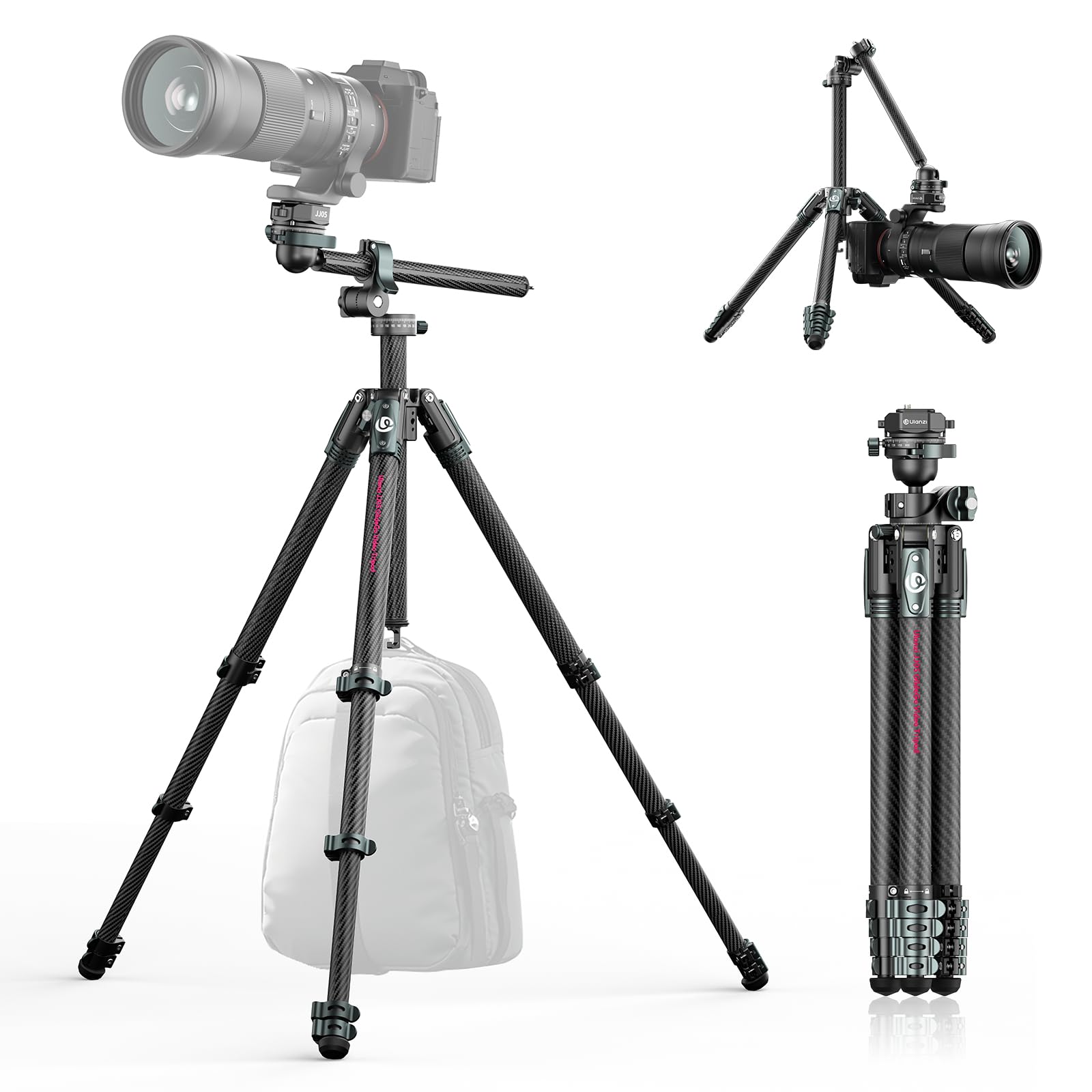
The tallest reach on the list, with pan heads that swivel at both the ball and the base.
Seventy-two inches is tall. The ULANZI GlideGo extends from 16.14 inches to 72.44 inches across a dual-section center column and five quick-lock legs — the most height of any tripod here. That reach helps when you need to shoot over a crowd, a fence, or tall foreground grass without crouching. It packs back down to 18.9 inches with legs that open up via quick-lock levers.
The build uses CNC-machined aluminum and 3K twill carbon fiber, supporting an 11.02 lbs load on the ball head. There are two 360-degree pan points — one at the ball, one at the center column — plus a 90-degree vertical switch for portrait orientation. The UKA quick-release plate has a safety lock to keep the camera from accidental drops, and a storage bag comes in the box. At 1.56 kg it stays portable enough for the height it delivers.
The mounting system is where opinions split. A few find the 1/3 screw can slide instead of locking firm, and the proprietary UKA plate system limits what other plates you can swap in. Steadiness itself gets strong notes from owners, though at 11.02 lbs it is not built for a heavy telephoto rig. If height and pan flexibility are your priorities, this delivers both in a compact carry — accept that the quick-release ecosystem is proprietary.
What Stands Out
- 72.44-inch max height is the tallest on this list
- Dual 360-degree pan points at the ball head and center column
- CNC-machined aluminum with 3K twill carbon fiber build
- Packs to 18.9 inches with a storage bag included
What to Weigh
- Proprietary UKA quick-release plate limits plate swaps
- 11.02 lbs load ceiling caps heavy telephoto use
Choose this if: tall reach and lots of pan range matter more to you than the maximum load rating.
Consider the trade: that proprietary plate system means committing to ULANZI’s quick-release ecosystem.
5. NEEWER LITETRIP LT32 Carbon Fiber Tripod

A leveling head and switchable spikes built for landscape, nature and muddy ground.
This is the tripod for the shooter who works landscape and wildlife in uneven country. The 22 lb load capacity is the second-highest here after the heavy-duty SIRUI, which means a full DSLR rig with a long lens sits comfortably. At 1.18 kg it is lighter than it looks on paper, and the 1-inch 26mm carbon tube gives it real stiffness for the class. Folded, it measures 17 inches by 2.6 inches and tucks into the carry bag.
The ball head is the standout feature. A 360-degree panoramic base with +/-15-degree quick leveling and dual U slots for 90-degree tilt makes it easy to correct a crooked horizon fast, and a flip buckle locks it down. Spring-loaded metal flip buckles pop open with a half motion for quick height changes, and the four-section legs adjust from 16 inches to 62 inches across three fixed opening angles. A center-axis hook takes counterweights, and the nonslip foot pads come off so you can fit spikes for sand, rock and mud.
The articulation is the part to be honest about. The quick-release lever is secure, but the ball head’s tilt is limited — some find you cannot aim the camera far enough up or down without working around the head, and a few find the spring lock sticky. It is still a quality-heavy package for the weight, and the Arca-type plate (compatible with PD) is a plus. This suits the landscape photographer who levels constantly and shoots on varied ground.
The ground-work advantage: a 22 lb capacity, a +/-15-degree leveling base, and removable feet for spikes make this the most terrain-ready tripod in the mid-range. For sandy or rocky ground, that spike option is a real differentiator.
The tilt caveat: the ball head’s limited tilt is the sticking point for shooters who need extreme upward or downward angles.
Best for: landscape and nature shooters working varied terrain who want fast leveling and spike feet.
Not ideal if: you frequently need to aim the camera far up or down and want an unlimited-tilt head.
6. K&F Concept X-Series 68″ Carbon Fiber Camera Tripod
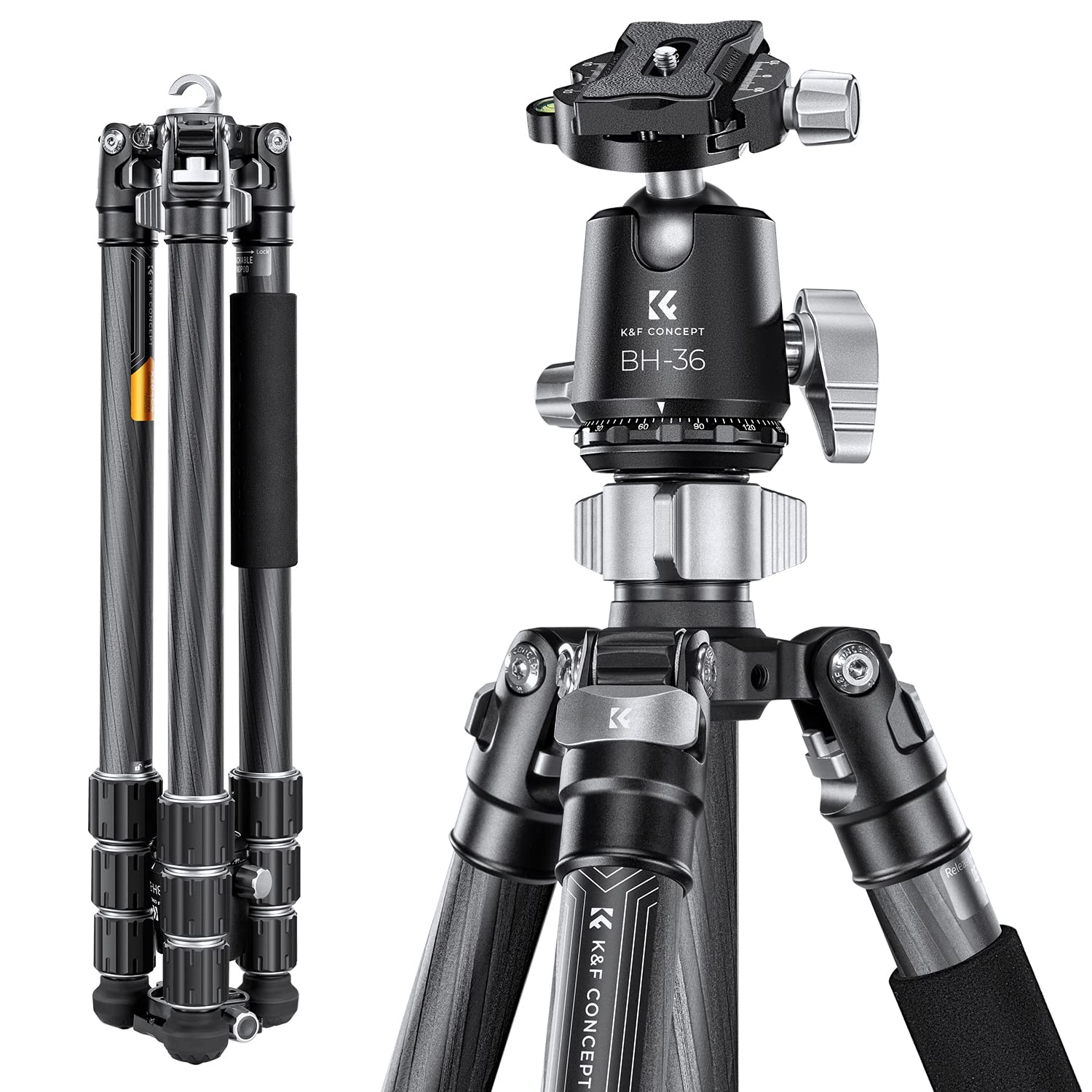
A machined metal head and a 28mm carbon tube built to take friction and rust over years.
The X-Series leans on build quality, and that is what buyers respond to most. The 28mm full carbon tube provides stiffness across its 172.5 cm top height, and the 36mm CNC metal ball head is machined to resist friction and rust, which matters if your trips run wet and salty. Its 16 kg load capacity covers a DSLR with a heavy lens, and the 360-degree swivel wheel lets you dial pan angles with precision.
At 1.55 kg with the head attached, it stays luggable for a tripod with this much reach. The standard 1/4-inch thread takes most Arca-Swiss quick-release plates and most cameras, DSLRs, projectors and telescopes. It also shoots as low as 58.5 cm for ground-level work. Build is where the praise concentrates — owners describe it as solid, well-built, and meeting every expectation they had.
Buyers report no surprises: the CNC head and 28mm carbon tubes simply hold up trip after trip. If you shoot in wet weather and want a machined ball head that shrugs off rust over a season, this delivers. Weigh the 1.76 kg carry against a featherweight like the Traveler 5C and decide whether that extra mass is worth the reliability.
The wet-weather argument: a rust-resistant CNC metal head and a 28mm carbon tube are the specs to buy for if you shoot near water or coastlines. A 16 kg rating keeps pace with the capacity of heavier rigs too.
The mass to accept: 1.76 kg is heavier than several mid-range picks, so this trades some trail comfort for build durability.
Right for you if: durability and a rust-resistant metal head matter as much as height.
Look elsewhere if: you prioritize the lightest possible carry over wet-weather resilience.
7. SLIK PRO CF-834 Carbon Fiber Tripod Legs
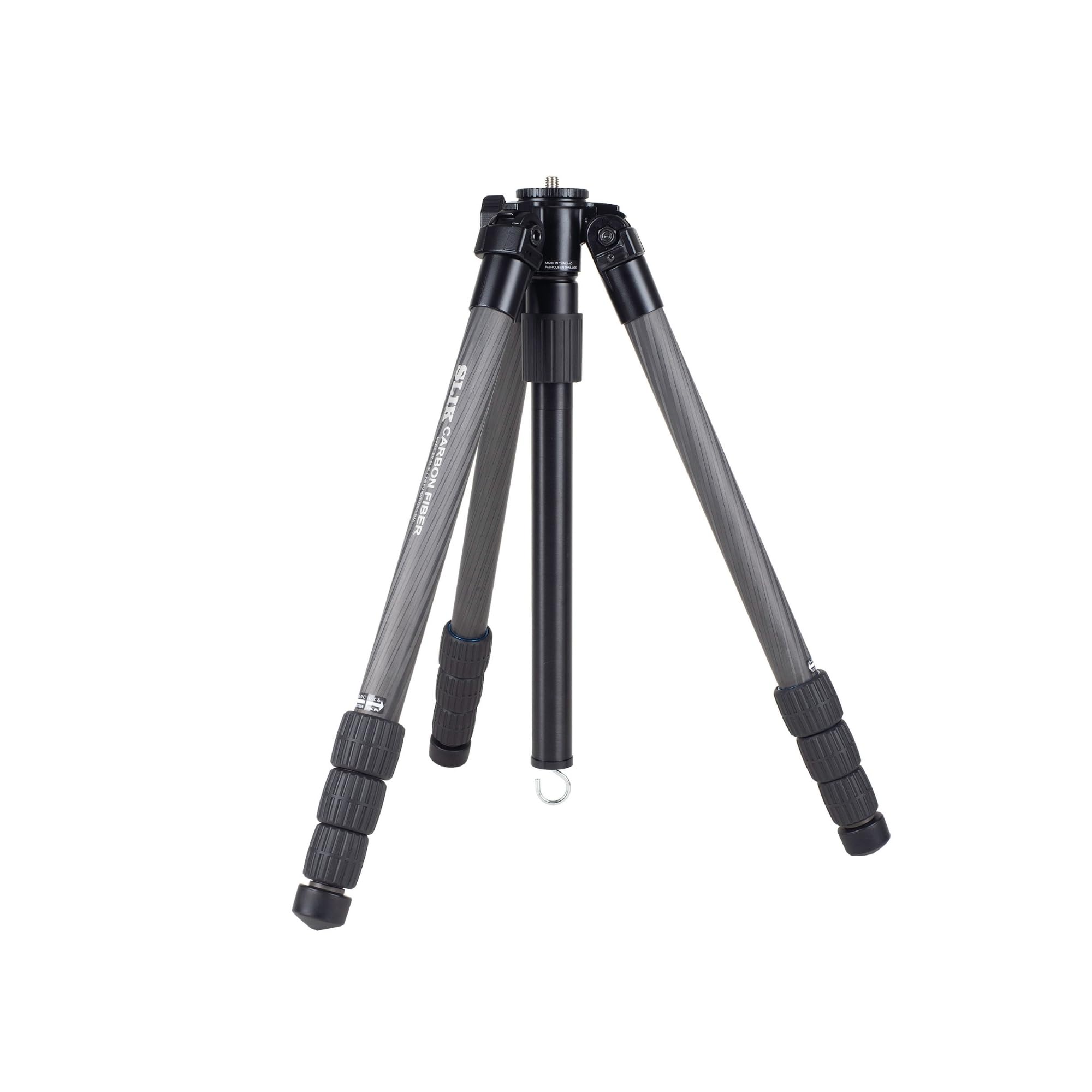
Sixty-five inches of support at 3.4 lbs, with legs that stop spinning inside each other.
The CF-834 is the tallest of the SLIK lineup here, reaching 65 inches while folding down to just 18.9 inches. That 65-inch max height lets you shoot improve landscape, wildlife, and glassing equipment angles well above the low picks. It supports 15.4 lbs while weighing 3.4 lbs, and the 28mm carbon legs are built to keep a stable stance under a long lens.
The ergonomics matter as much as the numbers. Each leg has an independent leg-angle lock that clicks into one of three angles, so you can plant it firmly on a slope or a narrow ledge without fighting. The center column is removable and reversible for ground-level or top-down shots, and it splits into two pieces for minimum height. A retractable hook lets you hang a pack against the wind, and an anti-rotational system keeps the leg sections from spinning inside each other while you twist-lock them. Rubber feet add grip, and the twist locks make takedown quick.
The CF-834 is honest about its job: it is a support column for long lenses and glassing, not a studio macro accessory. That 65-inch height and 15.4 lbs load make it a specialist rather than a general pack tripod. It is stable and light for its reach, but it lacks a head in the box, so budget for that separately. If you want the tallest steady support to glass distant game or landscapes without a ladder, this is it.
The glassing-tower use: 65 inches of height and a 15.4 lbs capacity, held on 28mm legs with independent angle locks, make this ideal for spotting-scope and landscape work on uneven ground.
The bare-legs note: it ships as legs only, so you add your own head, and it is a support specialist rather than an all-round pack tripod.
Best for: landscape and glassing shooters who want a tall, steady legs-only platform.
Plan for it: you supply the head, and this is a support-focused tripod rather than a do-everything pack tripod.
Know the Specs
Load Capacity
Load capacity is the total camera-and-lens weight a tripod is rated to hold — the number printed in pounds and kilograms on the spec sheet. Higher numbers give you headroom for a full-frame body with a long lens, while lower numbers tell you it is aimed at a compact kit. Standing capacity under load depends on leg diameter too, so read the two together rather than trusting the load number alone.
Leg Diameter and Material
Leg diameter is the thickness of the top leg tube in millimeters or inches — thicker tubes flex less in wind. Carbon fiber delivers stiffness at low weight, which is why outdoor photographers favor it. A 28mm or 32mm tube holds steadier with a heavy payload than a thinner travel tube, though it adds a little carry weight.
Max Height and Folded Length
Max height is how tall the tripod reaches with the center column (the sliding post in the middle) extended, which sets your shooting perspective. Folded length is how short it packs, often shortened by legs that reverse-fold 180 degrees (they flip up alongside the center column). A balance point is key: a tall tripod that packs short is the balance for hiking, while an ultralight tripod that folds small but tops out low suits compact kits.
Ball Head and Quick-Release Plates
A ball head lets you tilt the camera to any angle, while independent pan knobs let you rotate horizontally for panoramas. The quick-release plate is the mount that snaps your camera on and off — check it matches your Arca-Swiss or proprietary plate system. A bubble level helps you keep horizons straight, and leveling bases speed up corrections on uneven ground.
Common Questions
Will a heavy DSLR with a telephoto lens work on a travel tripod?
What does load capacity actually mean on a tripod?
Are twist-lock legs or flip-buckle legs better for outdoor shooting?
How tall should a tripod be for landscape photography?
Can I use a travel tripod on sand, mud, or rocky ground?
What is the difference between a ball head and a pan-and-tilt head?
How short does a tripod need to fold to fit inside a backpack?
Do I need spikes or rubber feet for outdoor tripod use?
Can a travel tripod convert into a monopod?
How much does tripod weight matter on a hike?
The Bottom Line
Start with your camera-and-lens weight and the ground you shoot on, then match load capacity and leg diameter. For most outdoor photographers, the Peak Design Travel Tripod wins because it pairs a 20 lb load capacity with a pack-flat water-bottle profile — real stability for a full-frame rig that still vanishes into a backpack. If you want the tripod to double as a monopod on moving-subject days, grab the SIRUI Traveler 7C with its 65.55-inch reach and 17.6 lb rating. And for glassing and long-lens landscape work where height and steady support come first, the SLIK PRO CF-834 is the one to reach for. With 4.5+ stars across hundreds of ratings, the Peak Design is the safest bet for the widest range of outdoor shooters.
How we choose
We do not accept paid placement. Every pick is matched to a real buyer and a real use-case; we do not hands-on test units.
Sources
Specifications: manufacturer listings and product documentation. Review insights: verified customer reviews, as of November 2026. Pricing: not shown on this page (it changes often); check the current price via the retailer link.
As an Amazon Associate, Tactical Gear Guy earns from qualifying purchases. This does not affect which products we feature.