Specs are compiled from manufacturer listings and verified buyer reviews and can change over time — please confirm the key details on the product page before buying.
Your window is wider than most AC units are built for. Standard air conditioners fit narrow single-hung windows, so if your sill measures 30 inches or more from side to side, you need a unit whose frame and side panels spread out to close that gap without a homemade filler board. For most buyers, the Frigidaire 10,000 BTU is the one to get: it cools up to 450 sq. ft. at just 53 dBA (decibels, a measure of sound) and has the strongest track record in this group. Below are the specs that matter, the fits that work, and honest trade-offs so you pick once and stop shopping.
This guide is built by comparing the manufacturers’ published specifications and the patterns across verified customer reviews, so you get each pick’s real strengths and trade-offs instead of marketing spin.
You will see cooling capacity, window width ranges, and sound figures compared side by side, and every pick is matched to the room size it genuinely handles. Choosing a wide window air conditioner starts with measuring your sash opening, and this breakdown makes that measurement the deciding factor.
Top Picks

How To Choose The Best Wide Window Air Conditioner
Start with a tape measure and the window itself, not the product listings. The width of your sash opening decides which units fit at all; the BTU rating decides whether the room feels cold or clammy. Get those two wrong and nothing else in the specs rescues the purchase.
Measure the opening first, then the room
Wide-window units publish an opening width range, not one fixed number. The GE 10,000 BTU model, for example, fits double-hung windows from 25 to 36.625 inches wide and needs 14.563 inches of clear vertical opening. Write your own width and height down before you shortlist anything. A unit that is a half inch too wide will not seat on the sill, no matter how good its cooling numbers are.
Match BTU to square footage, not to your impatience
A 10,000 BTU unit is generally sized for rooms up to 450 sq. ft., and a 14,000 BTU model for up to 700 sq. ft. Overshooting the room size sounds smart but tends to backfire: the compressor short-cycles, the room cools fast and turns off before the air dries out, and you are left with a cold, sticky feeling. Check the floor area figure in each listing and stay close to it.
Read the efficiency numbers that predict your summer bill
Two figures matter for running costs. Annual energy consumption, listed in kilowatt hours per year, estimates a year’s electricity use. The Midea 12,000 BTU U-Shaped model lists 6220 kilowatt hours per year while the Frigidaire 10,000 BTU lists 688. Inverter-driven units, which vary compressor speed rather than simply switching on and off, tend to post the more efficient numbers.
Side-by-Side Comparison
| Model | Best For | Cooling Power | Room Size | Sound Level | Amazon |
|---|---|---|---|---|---|
| Frigidaire 10,000 BTU★ Best Overall | Most wide window openings, medium rooms | 10000 BTU | 450 sq. ft. | 53 dBA | Amazon |
| LG 8,000 BTUBest Value | Smaller rooms, budget-minded cooling | 8000 BTU | 350 sq. ft. | 53 dB | Amazon |
| GE 10,000 BTU WiFiBest for Smart Homes | App control, 450 sq. ft. rooms | 10000 BTU | 450 sq. ft. | — | Amazon |
| Midea 12,000 BTU U-Shaped | Quiet operation, wide + tall openings | 12000 BTU | 550 sq. ft. | 32 dBA | Amazon |
| ROVSUN 8,000 BTU with Heat | Cooling plus supplemental heat | 8000 BTU | 350 sq. ft. | — | Amazon |
| Midea 8,000 BTU Smart Inverter | Year-round use, quiet bedrooms | 8000 BTU | 350 sq. ft. | 45 dBA | Amazon |
| BLACK+DECKER 14,300 BTU | Whole floors up to 700 sq. ft. | 14300 BTU | 700 sq. ft. | — | Amazon |
| GE 12,000 BTU Smart | Large rooms with app control | 12000 BTU | 550 sq. ft. | — | Amazon |
| Frigidaire 14,000 BTU Inverter | Big rooms, inverter efficiency | 14000 BTU | 700 sq. ft. | — | Amazon |
| LG 23,500 BTU Dual Inverter | Very large rooms up to 1,440 sq. ft. | 23500 BTU | 1,440 sq. ft. | 44 dB | Amazon |
| Keystone 23,200 BTU with Heat | Large spaces needing supplemental heat | 23200 BTU | 1,500 sq. ft. | — | Amazon |
Detailed Reviews
1. Frigidaire 10,000 BTU Window Air Conditioner
Our pick — 4.0+★ from 400+ verified ratings; the strongest balance of quality and price.
The balanced 10,000 BTU pick for a 450 sq. ft. room, rated 53 dBA.
This is the pick that does the boring things right. It moves a solid 10,000 BTU through a 450 sq. ft. room at 53 dBA, a level of noise that sits comfortably in the background rather than on top of your conversation. Six-way directional airflow at three fan speeds gets the cold air where your couch or bed actually is, instead of blasting one fixed direction all evening.
The running-cost figure is worth your attention: 688 kilowatt hours per year is among the leanest annual consumption numbers in this group. Compare that to the Midea 12,000 BTU U-Shaped at 6220 kilowatt hours per year — a difference you will feel in July and August. It runs Eco Mode to ease back the compressor once the room holds its temperature, Sleep Mode to creep the setpoint up through the night, and a Dry Mode that pulls excess moisture out of damp summer air.
The daily ownership side is refreshingly simple. A Clean Filter alert tells you when the washable pre-filter needs rinsing, a 24-hour timer lines the schedule up with your routine, and the remote covers every setting without getting off the couch. Cooling is the most-praised aspect in owner reviews, with buyers repeatedly noting it runs without quitting. The 4.0+ stars across 400+ ratings bear that out.
What works in its favor
- 53 dBA keeps it background-level in a living room
- 688 kilowatt hours per year is one of the lowest annual draws here
- Six-way directional airflow plus three fan speeds aim cold air precisely
- Washable filter with a Clean Filter reminder makes upkeep simple
Worth knowing before you buy
- Noise is the most-debated part of the experience — some find it low, others louder
- Long-term durability shows up as a weak point in a minority of cases
- No Wi-Fi or app control on this model
Reach for this if: you want the strongest all-round 450 sq. ft. window unit with modest running costs and no smart-home fuss.
Think twice if: app control is on your must-have list, since this one is remote-and-panel only.
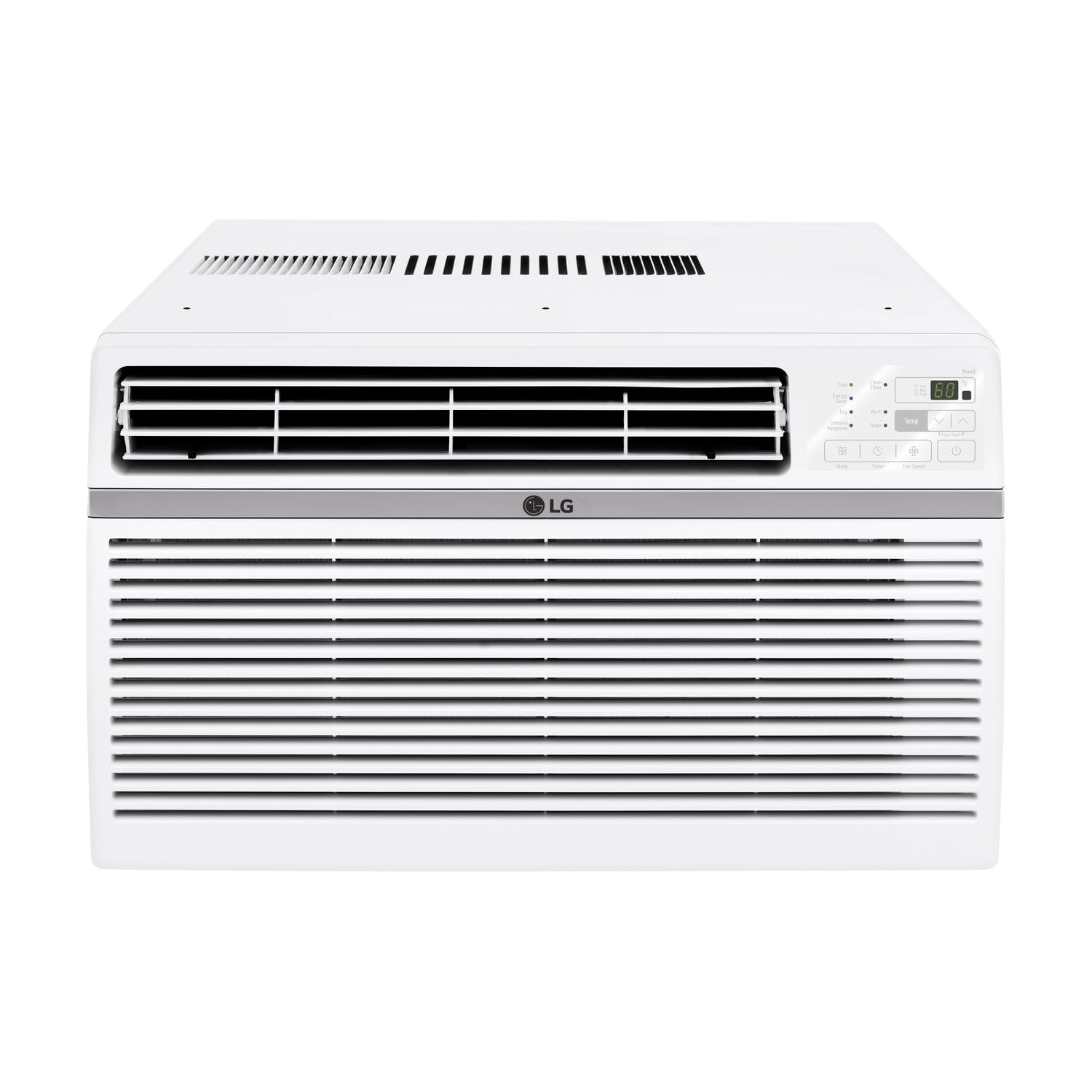
2. LG 8,000 BTU Window Air Conditioner, 115V, 350 Sq.Ft.
An 8,000 BTU workhorse sized for a bedroom at roughly 14 by 25 feet.
Fit this one to a room up to 350 sq. ft. — the maker sizes it around a 14′ x 25′ space, which is close to a standard bedroom. Its low-mode rating is 53 dB, so it drops into the background on the quiet setting and lets you sleep. Three cooling and fan speeds plus an Auto Cool mode give you a couple of gears between “off” and “blizzard.”
The practical detail owners tend to lean on is Auto Restart. If the power flickers during a storm, the unit returns to its last setting on its own instead of waiting for someone to walk over and press buttons. Set-and-forget control via the electronic panel and remote rounds it out. For the price tier, this is a dependable small-room machine with an energy-efficiency reputation behind it.
Quality is the aspect that gets praised most here, and the 4.0+ stars sitting on 400+ ratings fit that picture of a solid unit. What you should plan around is noise: the sound level is the single most-debated point, with the split falling between “barely there” and “noticeably loud” depending on which speed you run. And like any 8,000 BTU unit, it is a mismatch for a 500 sq. ft. open-plan space.
Where it lands: a good small-room buy that leans on trusted build quality and automatic restart rather than feature clutter.
Fair caveat: run it on a high fan speed all summer and you will hear it — the low setting is where the quieter experience lives.
Pick it if: you need a bedroom unit and appreciate auto-restart after power outages.
Pass if: your window opening is unusually wide or your room pushes past 350 sq. ft.
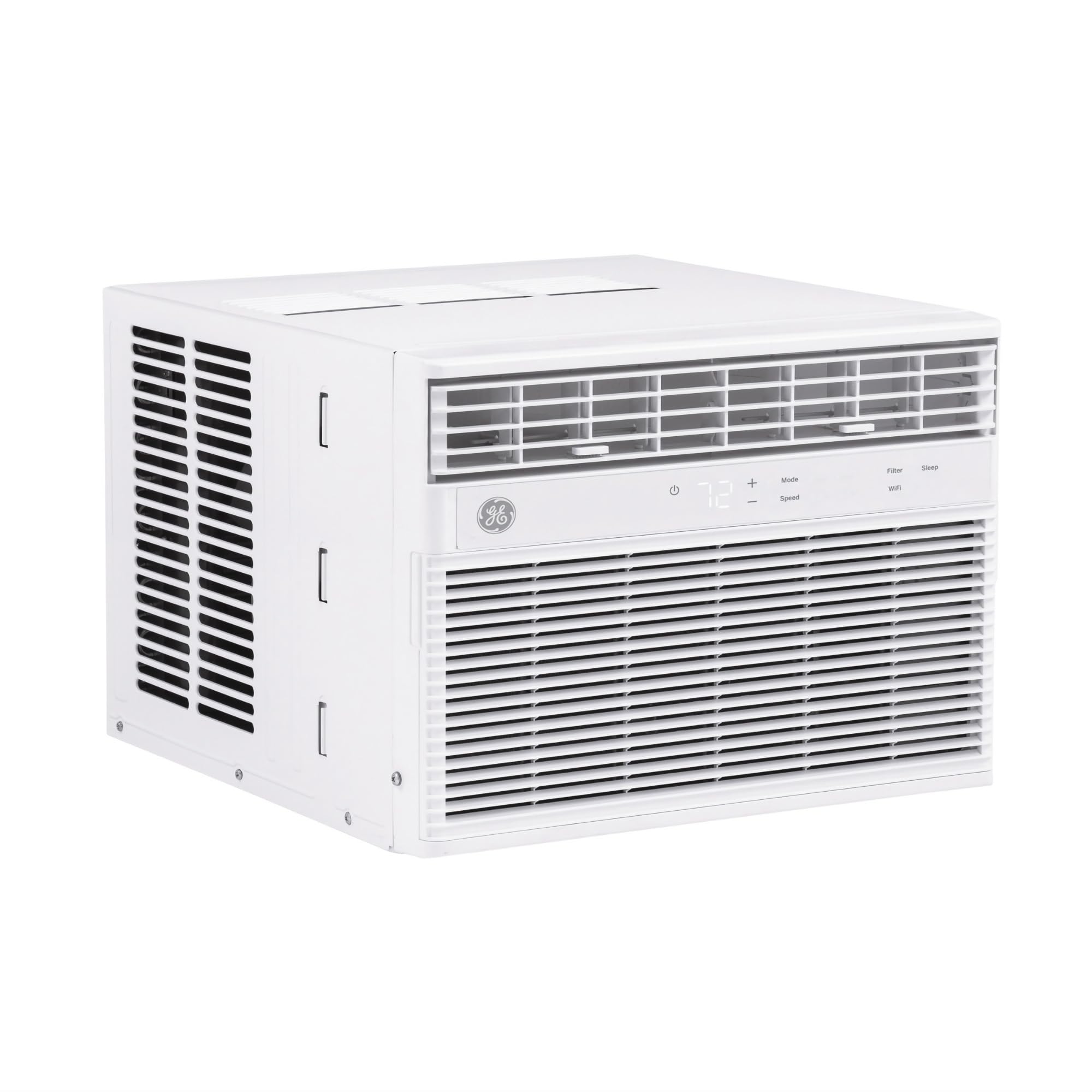
3. GE Window Air Conditioner 10000 BTU, Wi-Fi Enabled
The app-controlled 10,000 BTU unit that installs into a 25 to 36.625 inch opening.
This is the one to pick when you want to start the cold before you get home. The SmartHQ app lets you monitor, schedule, and control the unit from anywhere, and it works with Amazon Alexa and Google Assistant so a voice command can shift settings. That 10,000 BTU handles rooms up to 450 sq. ft., matching the Best Overall on capacity but adding a whole control layer.
Its window spec is the one serious buyers should lock onto: it slips into a double-hung opening from W 25 to 36.625″ and needs H 14.563″ of clear height. That is a genuinely wide range that catches most horizontal sash windows. An EZ Mount kit is included, and the slide-out washable filter is meant to be cleaned every 30 days to keep airflow strong.
Installation is the standout — it earns more positive sentiment than any other part of the experience, and the brand’s “easy install and cleaning” pitch holds up. The honest follow-up question is reliability, which comes up more than any other topic and splits close to even. A fair number of units run problem-free; a smaller share stop working after a month or two. Worth weighing if you want a long-term fixture rather than a stopgap.
Why it earns a place: full app and voice control plus Eco Mode that cuts the fan and compressor once the room is cool, all inside a broad 25 to 36.625 inch window range.
The trade-off to accept: some units arrive that never cool correctly or stop early, so check the return window and run it hard in the first week.
Best fit for: smart-home setups where you want to pre-cool a 450 sq. ft. room by voice or phone.
Look elsewhere if: you prefer a unit with a five-year no-drama reputation over the smart controls.
4. Midea 12,000 BTU U-Shaped Window Air Conditioner

The U-shape frame lets your window still open — and it runs as low as 32 dBA.
Here is the design that solves a problem most window units create. The U-shaped chassis lets your sash close over it while leaving part of the window able to open again, so you keep fresh air and more of your outdoor view. The maker states it runs as quietly as 32 dBA, and that number lands it as the quietest unit on this list by a wide margin. Its inverter system holds a steady low speed instead of kicking on and off.
Cooling is serious: 12,000 BTU serves up to 550 sq. ft., and the verified comparison block confirms this is 12000 british thermal units against the LG 8,000 BTU’s 8000 — a 50% more gap in cooling power. It carries 1 tons of capacity versus the GE 10,000 BTU’s 0.83 tons. If you have a large living space and a wide window, this is the heaviest lifter in the mid-tier.
The catch worth naming: this is a renewed unit, and durability surfaces as the weak spot — several arrive with visible dents or scratches. Installation is also a mixed experience; some describe it as genuinely easy, others find the instructions poor. Set expectations accordingly and inspect on arrival. The performance and quiet operation both land strongly, which is why it rates 4.4 across 300+ ratings.
The standout number: 32 dBA — meaning the unit can be almost inaudible in sleep mode.
What you accept: a renewed unit that may show cosmetic shipping damage, so give the box a careful look before you install.
Choose this if: quiet matters more than cosmetics and you have a wide window you still want to partly open.
Skip if: you need a factory-sealed unit with a spotless arrival.
5. ROVSUN 8000 BTU Window Air Conditioner with Heat

The do-two-jobs pick: 8,000 BTU of cooling and 4,000 BTU of heating in one chassis.
For a small room that needs something in shoulder season as well as July, this unit bundles cooling, heating, dehumidifying, and fan circulation. It moves 8,000 BTU of cooling and 4,000 BTU of heating across 350 sq. ft., which suits a bedroom or small office. Five modes (Heat, Auto, Cool, Dry, Fan) and three speeds give you reasonable flexibility, and the swing button redirects the louvers rather than blowing one fixed line.
Setup is friendlier than the big units: it fits windows 26 to 36 inches wide with a 16 inch height, and side panels plus a detailed manual are in the box. You get panel and remote control plus Wi-Fi with Alexa and Google Assistant for voice control, and a washable front-access filter for routine cleaning. The quiet reputation here is the strongest part — reduced noise comes up more positively than any other aspect, and the brand’s installation ease holds up too. A one-year warranty is included.
The real question is whether the heat lives up to the spec. Cooling and heating both draw mixed reactions: some find the cooling effective and welcome the heater function, while others report it barely produces warm air and the heat stops after about two hours. Reliability gets the same split. Treat the heating as a bonus rather than the reason you buy — a small space heater will heat faster if winter warmth is the goal.
Strong suit: compact two-way climate control at 350 sq. ft., with quiet operation and app control at a value tier.
Honest limit: the 4,000 BTU heating side is a supplement, and a share of units stop heating properly, so do not count on it as your winter primary.
Good call if: you want a quiet, app-connected 350 sq. ft. unit with optional heat for mild cool spells.
Look elsewhere if: the heating side is your main reason — performance there is uneven.
6. Midea 8,000 BTU Window Air Conditioner with Heat

A heat-pump 8,000 BTU unit that runs as quiet as 45 dBA, with an Energy Star badge.
This unit can heat and cool your bedroom all year. The inverter compressor (a motor that varies its speed to hold a steady temperature instead of switching hard on and off) runs as quietly as 45 dBA (decibels) and uses little electricity: the Energy Star badge is on the unit, and annual consumption is 407 kilowatt hours per year (kWh, the unit your power bill uses). Five modes cover Heat, Auto, Cool, Dry, and Fan, with three fan speeds and a 24-hour timer.
Its window spec is clearly stated: it fits double-hung windows with opening widths from 24 to 38.5 inches and needs 14.5 inches of clear vertical opening. The chassis is 19.41″W x 22.17″D x 13.9″H, so measure your sill depth before you commit. Control comes three ways — panel, remote, and the SmartHome app or voice through Alexa and Google Assistant.
Quiet operation is the second-most-praised aspect, with owners calling it barely audible at night. Energy efficiency is next, described as using about a third of the power of an older unit. The honest part is the heating — it works as a heat pump when the outside temperature is above 41°F, so deep winter calls on something else. And a share of buyers find it struggles to cool spaces past 250 sq. ft., so do not overreach past its rating.
Rated for real rooms: 350 sq. ft. of cooling plus supplemental heat, an Energy Star badge, and a front-access washable filter.
The catch: the heat pump cuts out below 41°F outside, and some units underperform their stated room size.
Worth it for: a bedroom you want to cool quietly and warm through fall, without a second appliance.
Not for: windows narrower than 24 inches or rooms much larger than 250 to 350 sq. ft.
7. BLACK+DECKER Window Air Conditioner 14300 BTU, BD145WT6

14,300 BTU of cooling that reaches a whole floor or a 700 sq. ft. open plan.
When one window has to cool more than one room, this is the unit built for it. At 14,300 BTU it covers rooms and whole floors up to 700 sq. ft., and it runs at four levels — auto, low, medium, and high — to dial the output. The accordion side panels are designed to spread and close over double-hung windows 23 to 36 inches wide with a 15.5 inch height, and installation is straightforward with those panels.
Running costs are worth reading: 915.75 kilowatt hours per year at an efficiency rating of 11.2. It uses R32 refrigerant, which the maker notes has zero impact on the ozone layer. A full-function remote covers sleep mode, energy saver, and a 24-hour timer, and the 3.52 cubic feet per minute per watt airflow efficiency is a reasonable figure for this class. Cooling is the most-praised aspect, with owners satisfied by how cold it gets even in large spaces.
The one number to plan around is noise: the sound level is the most-split point, with a real range between “not noisy” and “very noisy.” Durability also shows up as a minority weak spot. It rates 4.2 across 300+ ratings, so most buyers are happy, but pick your install spot with the sound in mind — not directly beside a headboard.
Why it earns: 700 sq. ft. of coverage and 14,300 BTU in a mid-tier package, with R32 refrigerant and full-function remote control.
Set expectations on: noise is the most-divisive part, and a small share report durability issues over the long haul.
Best for: a ranch floor or open living space that one window has to cool by itself.
Only if: you can tolerate the higher-speed fan noise and have a 23 to 36 inch window to spare.
8. GE 12,000 BTU Smart Window Air Conditioner
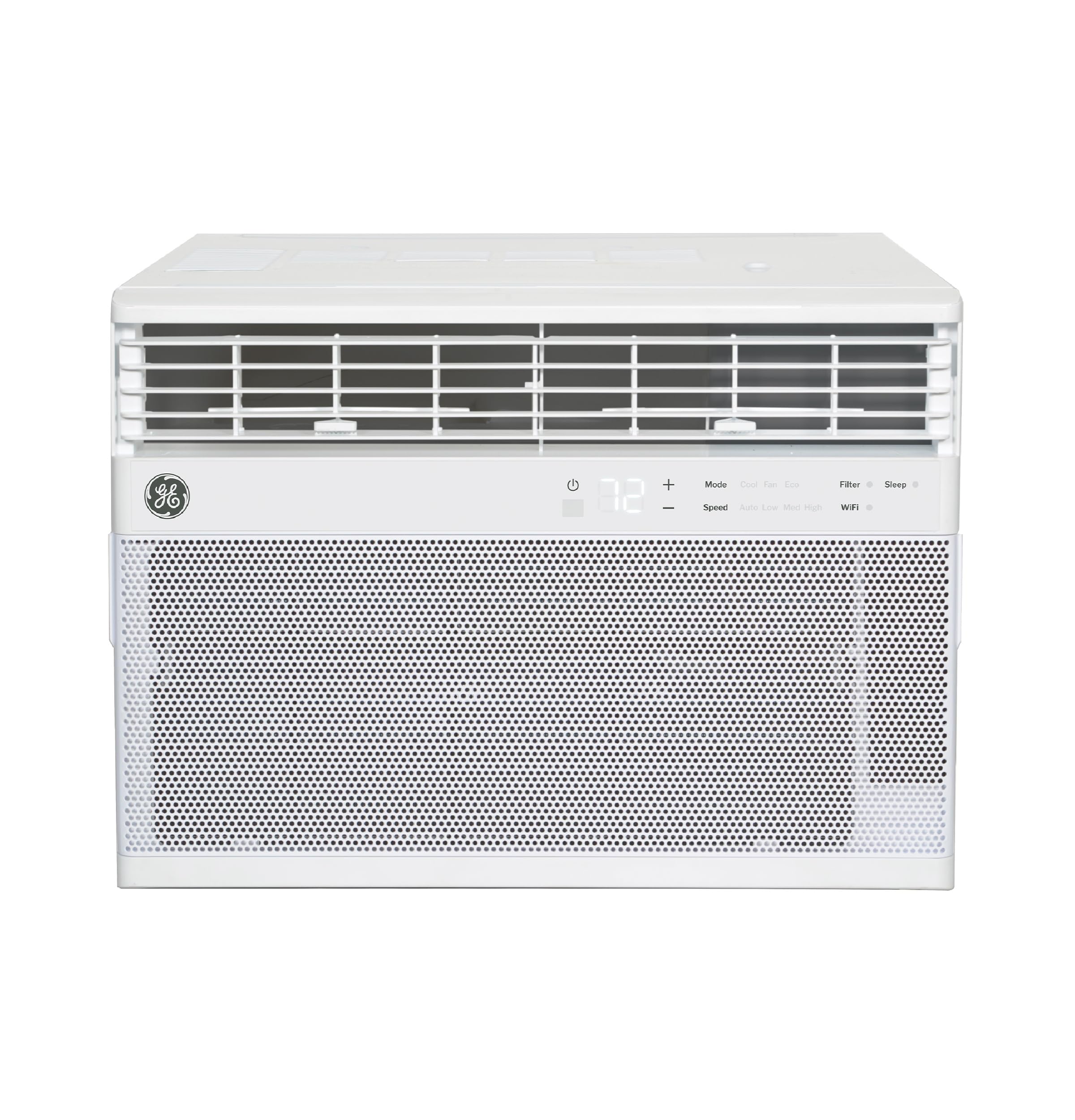
12,000 BTU of smart cooling for a 550 sq. ft. living room or family room.
Here is a unit that leans on reach and control. It moves 12,000 BTU to cool spaces up to 550 sq. ft., puts full app control in the SmartHQ app, and takes Alexa and Google Assistant commands plus a bundled remote. Eco Mode shuts down the fan and compressor once the room is cold, easing running costs and cutting the noise in one move. Three cooling modes and three fan speeds give you room to tune the output.
Installation is a genuine strength — it earns the most positive sentiment of any aspect here, and that is not faint praise. The fixed chassis fits a double-hung window from W 25 to 36.625″ and H 14.563″, with the EZ Mount kit in the box. A slide-out, washable filter makes the every-30-days cleaning routine straightforward.
Be clear-eyed about the scoreboard here: cooling performance, quality, and value all split close to even, and noise actually leans negative with a constant ringing or whistling reported by some. A subset of units blow warm air or fail outright. This is a decent smart option for a large room, but it does not carry the clean record of the top Frigidaire at 10,000 BTU. Buy it for the app and capacity, and test it hard on arrival.
The case for it: 550 sq. ft. capacity, SmartHQ app control, and Eco Mode that saves power and quiet at once.
The catch to weigh: noise is a recurring complaint and cooling is inconsistent between units, so this is a pick for buyers who want smart control over a spotless track record.
Pick it if: you have a 550 sq. ft. room and want voice plus app control in one unit that installs easily.
Consider the Frigidaire instead if: a consistent cooling record matters more than smart features.
9. Frigidaire 14,000 BTU Smart Inverter Window Air Conditioner
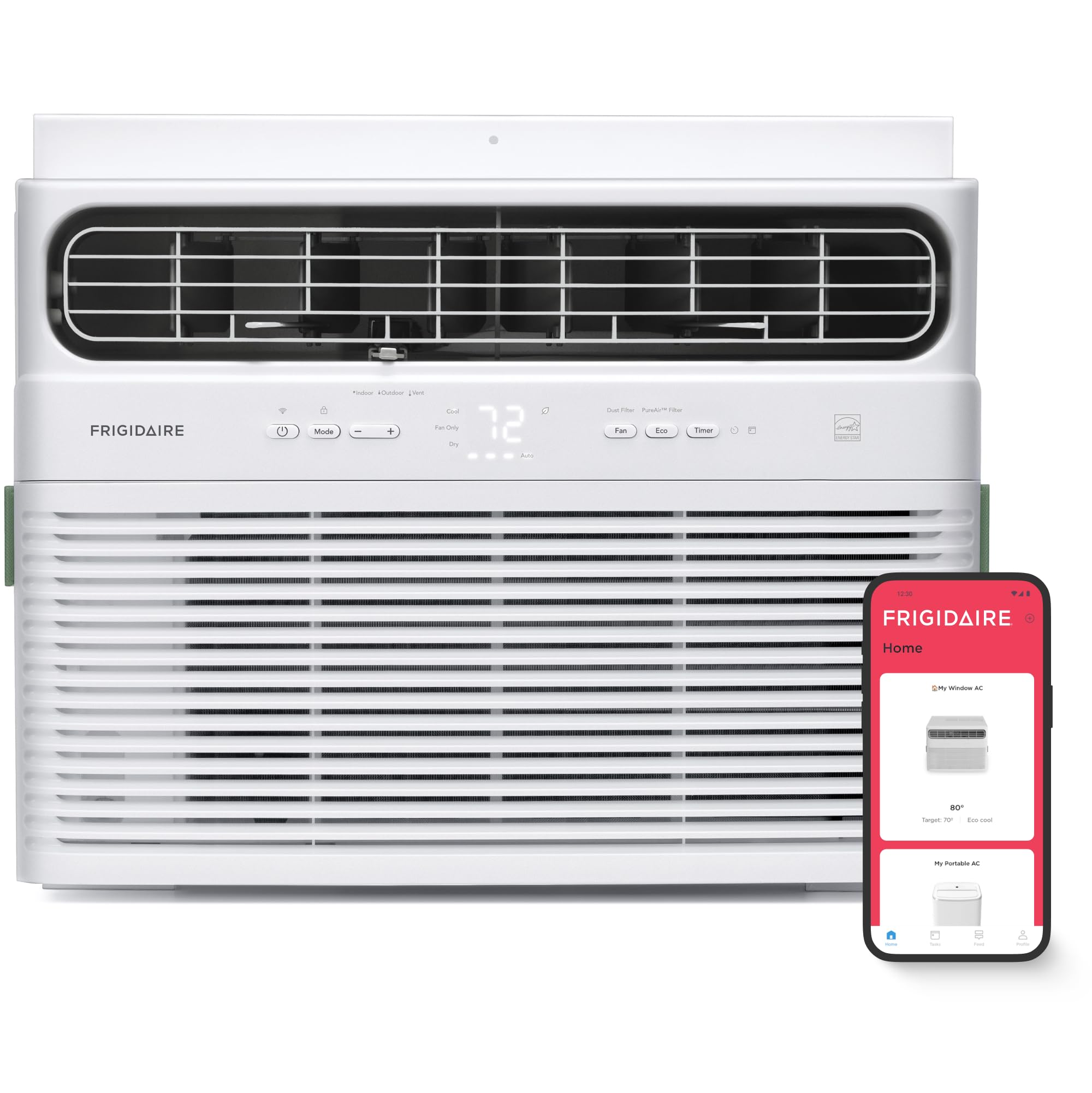
Inverter tech and an Energy Star badge across a 700 sq. ft. room.
For a big room where you want both power and modest running costs, this 14,000 BTU inverter unit is aimed straight at that job. It carries 1.25 tons of capacity for spaces up to 700 sq. ft., and the inverter compressor is designed to hold a steady temperature rather than switch hard on and off — which the listing frames as better regulation, more savings, and a quieter run. Energy Star certification backs that up, and the annual energy consumption figure is 525 kilowatt hours per year.
Control is a strength for smart-home buyers: the Frigidaire app works from anywhere, and it links to Amazon Alexa and Google Home for hands-free commands. Six-way directional airflow and three fan speeds let you aim the cold air, and a Clean Filter alert plus a 24-hour timer keep routine upkeep and scheduling simple. Dry Mode pulls moisture out of humid air when the cold is not the whole problem.
Owners are pleased with what it does: cooling performance, build quality, and quiet operation all land positive, which is why it holds a solid score on a compact number of reviews. For a 700 sq. ft. space, its combination of 14000 BTU and 525 kWh/year is a strong efficiency story.
Why it stands out: 14,000 BTU of inverter cooling over 700 sq. ft., Energy Star rated, with app and voice control.
Fair caveat: a smaller pool of owner feedback than the big-volume mid-tier picks, so rely on the return window to cover any early issue.
Worth a look if: you want an inverter-driven large-room unit with smart control and modest annual energy use.
Go with the Midea 12,000 BTU if: a bigger, more established owner base matters to you.
10. LG 23,500 BTU Dual Inverter Window Air Conditioner
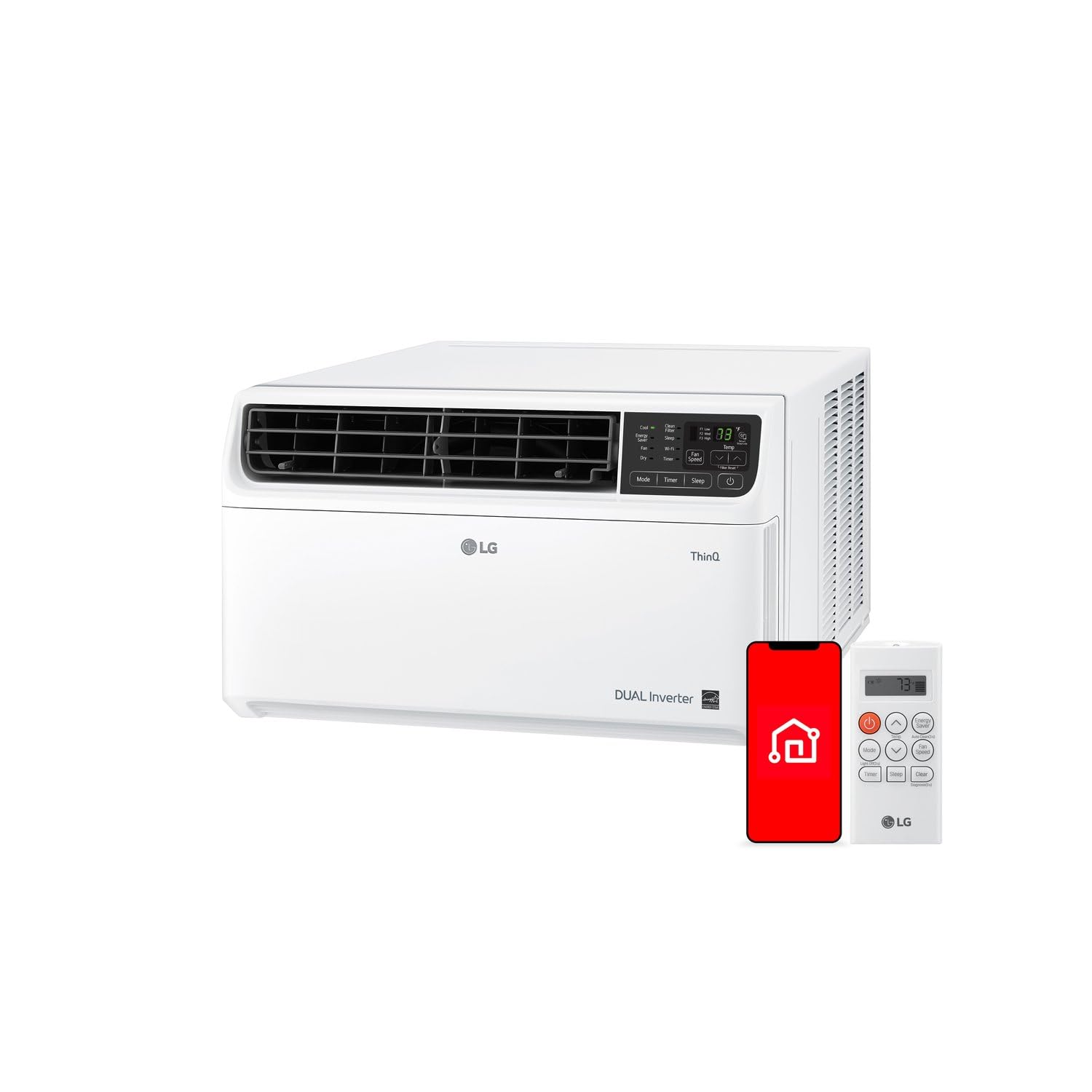
Dual Inverter output that chills up to 1,440 square feet down to 44 dB in sleep mode.
For a sprawling great room or a whole lower floor, this is the heavyweight of the list. At 23,500 BTU it cools spaces up to 1,440 sq. ft. — the maker sizes it around a 36′ x 40′ room — and its Dual Inverter compressor runs at sound levels as low as 44 dB in sleep mode. That is a meaningful number for a unit this powerful: you can be in the same room and hold a conversation.
The efficiency claim is baked into the hardware. Dual Inverter technology is described as up to 50% more energy efficient than the Energy Star certification requirement, and the unit holds a 5 Star energy rating. Control runs through the LG ThinQ app, the included LCD remote, or voice via Amazon Alexa and Hey Google, with four cooling and fan speeds plus Auto Cool. Every cooling comment is positive, and owners credit it with reaching multiple rooms.
Two things to know before you buy. First, this is a 230V unit, so it needs the right circuit and outlet — the plug type is the one negative flag owners raise. Second, durability splits: some units run for years, others stop in under three months, which is a coin-flip worth guarding against with the return window. Value for money also draws mixed feelings. Cooled correctly, it is a powerful large-room machine; the fit is narrower than the cooling number suggests.
The headline: 23,500 BTU, 1,440 sq. ft., 44 dB in sleep mode, and a 5 Star energy rating.
The two catches: 230V power means checking your outlet first, and durability outcomes vary — so open the box and run it immediately.
Made for: very large rooms where you have a 230V circuit ready and want quiet power.
Wrong pick if: you only have a standard 115V wall outlet — this needs 230V.
11. Keystone 23,200 BTU Window Air Conditioner
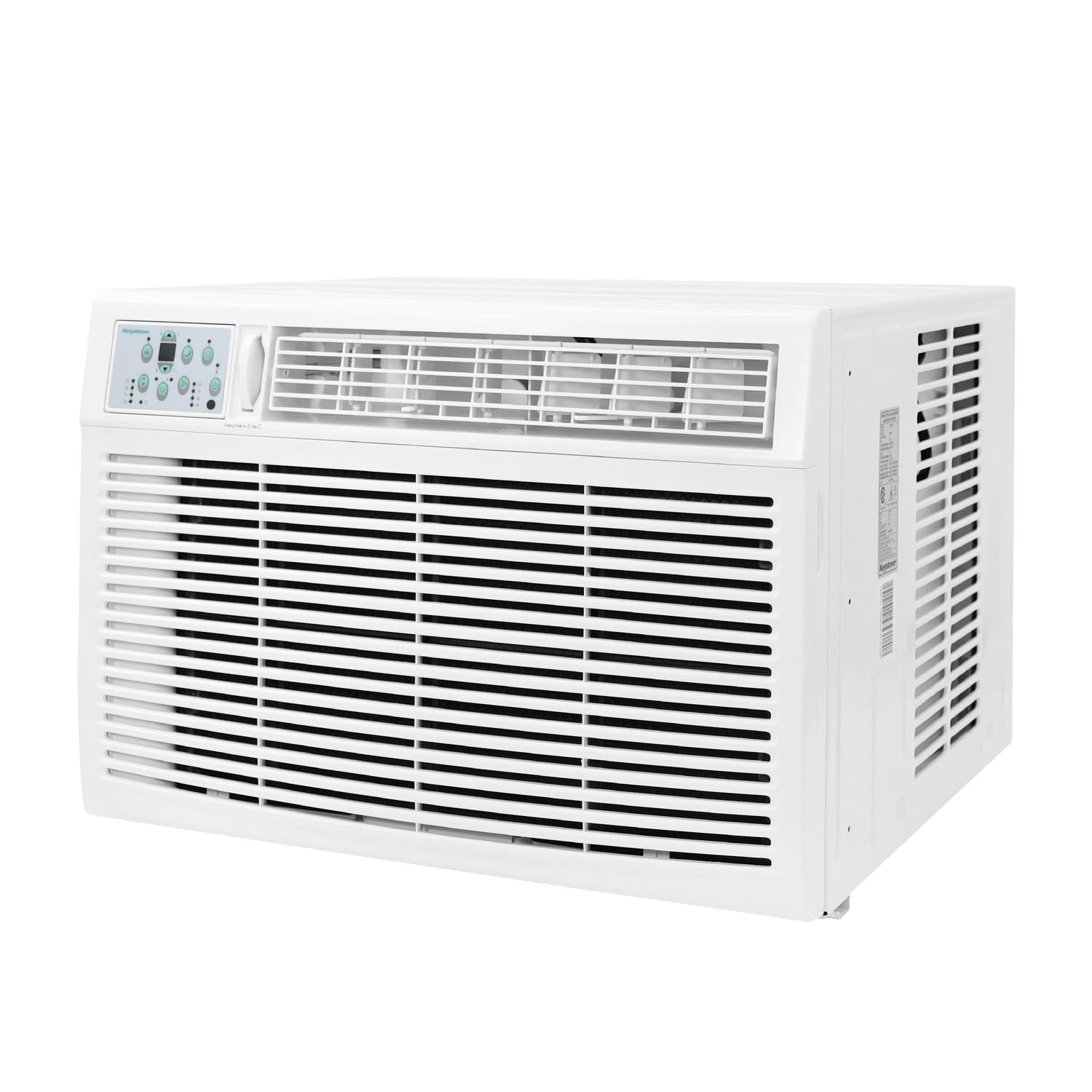
The biggest room on the list: 23,200 BTU cooling with 16,000 BTU of backup heat.
Tackle a 1,500 sq. ft. space with one window unit. This Keystone moves 23,200 BTU of cooling plus 16,000 BTU of supplemental heating, and it combines cooling, supplemental heat, dehumidification, and fan circulation in one chassis. The heating mode is rated for use when outside temperatures sit between 23 and 76 degrees — the maker is explicit that it is supplemental, not a primary heat source.
The smart remote is a nice touch: it reads the temperature of the room you are actually in and signals the unit every 3 minutes for accurate cooling, rather than relying on a sensor at the chassis. Energy Saver and Sleep modes ease the draw on your bill. The install kit is included, with a minimum window height of 19.5 inches, and the 19.5 inch figure is one you want to verify against your sash before ordering.
Cooling is the most-praised aspect, with owners consistently reporting strong, steady output. Quality also lands positive. The honest limit list is real, though: the 230V power means checking your outlet, the plug standard draws complaints, and durability shows up as a minority weak point. Plus that 19.5 inch minimum height rules out shallower window openings.
Where it wins: 1,500 sq. ft. of coverage with supplemental heat, accurate room-temp remote sensing, and a space-saving window install.
Before you order: confirm a 230V circuit and at least 19.5 inches of window height, and treat the heating as a supplement.
Right for: a very large space that needs strong cooling plus mild-season heating from a single window.
Not right if: your window is under 19.5 inches tall or you lack the 230V power it requires.
Know the Specs
BTU (how much heat it pulls out)
BTU stands for British thermal units, and it measures cooling power. A higher number moves more heat out of the room. Match it to square footage — a 10,000 BTU unit generally suits a 450 sq. ft. room, and a 23,500 BTU unit can cover 1,440 sq. ft. Going too big for the room tends to short-cycle the compressor and leave the air damp, so scale the BTU to the space.
Window width and sash height
Every wide-window unit publishes an opening width range plus a minimum vertical opening. The GE 10,000 BTU fits 25 to 36.625 inches wide and needs 14.563 inches of clear height; the Midea 8,000 BTU fits 24 to 38.5 inches wide with 14.5 inches of height. Measure your actual sash opening and note the height before you buy. A unit that is too wide will not seat, no matter how good it cools.
dBA (how loud it runs)
dBA is a decibel rating weighted to how the human ear perceives sound — lower is quieter. A unit at 32 dBA in sleep mode is close to inaudible; one at 53 dBA sits in the room’s background. The lower the number, the less the compressor interferes with sleep and conversation. Ratings are usually given for the quietest mode, so expect more sound on high fan.
Annual energy consumption (your summer bill)
This figure in kilowatt hours per year estimates a year of electricity use. The Frigidaire 10,000 BTU lists 688, while the Midea 12,000 BTU U-Shaped lists 6220 — a distinction that shows how inverter tech and sizing change running costs. A lower number suggests gentler bills. Inverter compressors, which vary speed rather than switching on and off, tend to post the more efficient figures.
Common Questions
How wide does my window need to be for a wide window air conditioner?
Will a wide window air conditioner fit a single-hung window or only double-hung?
What BTU do I need for my square footage?
How quiet is a window air conditioner in decibels?
best window air conditioner for wide windows?
Can I keep my window partly open with the Midea U-Shaped unit installed?
Do I need a special outlet for the large 23,000 BTU units?
Does the heating function on these units replace a space heater?
How often should I clean the filter on a window air conditioner?
Is an inverter window air conditioner worth it over a standard one?
What is the difference between supplemental heat and a heat pump on a window AC?
Can a window air conditioner cool more than one room?
The Bottom Line
For most rooms in a wide window, the wide window air conditioner winner is the Frigidaire 10,000 BTU because it balances 450 sq. ft. of cooling, 53 dBA (decibels) of quiet, and one of the lowest annual energy draws in the group at 688 kilowatt hours per year (kWh, the unit on your power bill). If quiet and a wide-to-tall window fit matter most, choose the Midea 12,000 BTU U-Shaped, which runs as low as 32 dBA and covers up to 550 sq. ft. And if you have a very large space with a 230V circuit (a high-voltage outlet) ready, the LG 23,500 BTU Dual Inverter cools up to 1,440 sq. ft. at 44 dB in sleep mode. Whichever fits your window and room, measure first, match the BTU (cooling capacity), and you will cool the space without the guesswork.
How we choose
We do not accept paid placement. Every pick is matched to a real buyer and a real use-case; we do not hands-on test units.
Sources
Specifications: manufacturer listings and product documentation. Review insights: verified customer reviews, as of November 2026. Pricing: not shown on this page (it changes often); check the current price via the retailer link.
As an Amazon Associate, Tactical Gear Guy earns from qualifying purchases. This does not affect which products we feature.