Specs are compiled from manufacturer listings and verified buyer reviews and can change over time — please confirm the key details on the product page before buying.
Your nose knows when pollen season starts before any calendar does. The fix is not a bigger box of tissues — it is a purifier whose fan moves enough air through a true HEPA filter to pull the pollen grains out of the room before they settle on your pillow. Below, every pick here has been checked for real HEPA filtration and enough airflow to be useful, not just a decorative hum in the corner.
This guide is built by comparing the manufacturers’ published specifications and the patterns across verified customer reviews, so you get each pick’s real strengths and trade-offs instead of marketing spin.
You will see how room coverage, fan noise, and filter grade trade against each other on every model, then find the unit that matches the room you actually sleep in with the best pollen air purifier.
Top Picks


How To Choose The Best Pollen Air Purifier
Pollen is a chunky particle compared with smoke, so any true HEPA filter catches it. The real question is whether the fan can push enough air through that filter to sweep the whole room. Buy on airflow and filter grade, not on the room-size number printed in the largest font.
Read the pollen CADR before anything else
CADR means clean air delivery rate — the volume of filtered air the unit pushes out each minute, measured in cubic feet (CFM). A higher pollen CADR means the machine can strip pollen out of a bigger room in less time. One pick here publishes a pollen CADR of 289 CFM alongside 254 CFM for dust and 250 CFM for smoke, which tells you it was independently tested on each particle type rather than given one vague efficiency claim.
Match coverage to how fast you want the room clean
Most listings quote an hour of cleaning, which is the slowest number in the set. Look at the shorter windows, because those describe what happens in a bedroom before you fall asleep. One unit cleans 470 sq ft in 15 minutes; another manages 795 sq ft in 12 minutes. If your bedroom is small, the short-window figure is the honest one.
Decide how much noise you will accept at night
Every purifier is quiet on its lowest setting. What separates them is how far the noise rises when the fan has to work. A low-speed figure of 23 dB to 27 dB will disappear under a fan or white-noise machine. If a listing only promises “quiet operation” with no number, treat the sleep-mode claim with suspicion.
Work out the long-run filter bill
The purchase is one cost; the filter is the other. A washable pre-filter saves you from replacing the expensive HEPA element as often, and one unit here runs its inner filter for up to two years between swaps. Check whether the seller names the genuine replacement filter and how often it needs changing before you commit.
Side-by-Side Comparison
This table lines up the three numbers that actually decide a pollen purifier: how much air it cleans per minute, how big a room it claims, and how quiet it runs at the bottom end of its fan range.
| Model | Best For | Pollen CARD | Coverage (1 hr) | Lowest Noise | Amazon |
|---|---|---|---|---|---|
| LEVOIT Vital 200S-P★ Best Overall | Bedrooms and allergy rooms | 289 CFM | 1,875 sq ft | 27 dB | Amazon |
| WINIX 5510Best Value | Large rooms on a budget | — | 1,882 sq ft | 23.5 dB | Amazon |
| COWAY Airmega 100Compact Pick | Small bedrooms and closets | — | 810 sq ft | — | Amazon |
| Honeywell Allergen Plus | Bedrooms and nurseries | — | 1,928 sq ft | — | Amazon |
| BLUEAIR Signature SP4i | Open-plan living spaces | — | 3,385 sq ft | 23 dB | Amazon |
| COWAY Airmega 350 | Whole-home open layouts | 450 CFM | 2,640 sq ft | 21.6 dB | Amazon |
| AirDoctor AD3500 | Serious allergy households | — | 2,520 sq ft | — | Amazon |
| CleanForce MEGA1000 | Extra-large and open rooms | — | 4,650 sq ft | — | Amazon |
| LEVOIT EverestAir-P | Big rooms with smart control | 354 CFM | 2,655 sq ft | — | Amazon |
| Air Oasis iAdaptAir 2.0 | Full-floor purification | 530 CADR | 3,975 sq ft | 25 dB | Amazon |
| AirDoctor AD5500 | Whole-home and open concept | — | 4,172 sq ft | — | Amazon |
Detailed Reviews
1. LEVOIT Vital 200S-P
Our pick — 4.5+★ from 15,000+ verified ratings; the strongest balance of quality and price.
The unit that pairs a published pollen rating with a bedroom-quiet 27 dB floor.
Here is the number that decides the pollen argument: this purifier carries a pollen CADR of 289 CFM, alongside 254 CFM for dust and 250 CFM for smoke. That means an independent lab tested how much filtered air it pushes out each minute when the target particle is pollen specifically — so the 289 figure is not a marketing estimate, it is a measured result. The AHAM VERIFIDE seal on the box is the same standard body’s stamp that confirms those figures were checked independently. That combination is exactly what you want when you are shopping for pollen first and everything else second.
For the space itself, it is rated for rooms up to 1,875 sq ft — a number that covers an open living room, a basement, or an oversized master suite. The dual-inlet design uses a traditional air inlet plus an additional U-shaped inlet, which is what lets it pull pet hair and odor into the filtration path rather than letting it clog at the grille. It runs at 27 dB at the low end, close to the level of a whisper-quiet refrigerator, and owners overwhelmingly report the high speed turns into a pleasant white noise rather than an intrusive whir. The performance figures are what owners talk about most, with the effectiveness and quiet-operation feedback all leaning the same way.
The room-size claim is where to set expectations honestly. A 1,875 sq ft figure reflects a single air exchange standard in a controlled room, not the speed at which a very large open floor plan clears after a pollen-heavy afternoon. In a truly wide open space you will want to run it continuously on a higher fan setting. The filter-change routine is straightforward, with the app handling scheduling, and the air quality monitor is what people lean on to see when the numbers actually start moving.
Why it wins the pollen argument
- Pollen CADR of 289 CFM — a lab-measured figure pinned to the pollen particle specifically
- AHAM VERIFIDE seal means performance was independently tested, not just claimed
- 27 dB low-speed noise keeps the bedroom usable while the fan still moves air
- Dual-inlet design handles pet hair and odor along with the pollen
Where to temper expectations
- The 1,875 sq ft figure assumes a controlled exchange rate, not a rapid clear of a huge open plan
- You will want a higher fan setting for continuous use in a wide open space
Built for allergy sleepers: A 289 CFM pollen measurement plus a 27 dB floor makes this an easy default for a bedroom where someone wakes up sneezing.
The honest limit: Treat the 1,875 sq ft figure as a steady-state ceiling, not a promise that a whole open floor plan clears the second pollen season arrives.
2. WINIX 5510
The fast-clearing workhorse that treats pollen as an hour-one problem, not an all-day one.
Read the coverage ladder and you understand what this machine is for: 470 sq ft in 15 minutes, 627 sq ft in 20 minutes, 941 sq ft in 30 minutes, and 1,882 sq ft over a full hour. Those short windows are the honest story for a bedroom you want clean before lights out — spray a pollen-heavy room with a fan this strong and the air turns over fast. The True HEPA filter is rated to capture 99.99% of airborne allergens as small as 0.3 microns, which covers pollen well past the level a HEPA standard is required to catch.
Filtration is layered in a way that saves you money over time. A washable fine mesh pre-filter catches the largest particles before they reach the expensive HEPA element, and the carbon layer is engineered to reduce odors from cooking, pets, and smoke — which in pollen season means the layer also does some work on the musty smell that comes with windows shut and air recirculating. The air quality indicator uses LED lights to display real-time conditions, and Auto Mode reads that sensor and adjusts fan speed without you touching anything. The Winix Smart App lets you monitor and change settings remotely. Sleep mode does something genuinely useful: it automatically activates when the room darkens and returns to Auto Mode when light returns, at 23.5 dB at its lowest speed.
The recurring thing to plan around is noise as the fan climbs. The lowest speeds are super quiet by consensus, but the higher the setting, the more the motor makes its presence felt. That is normal for a machine moving this much air, and it is why the auto mode is worth using — you let it run high only when the air actually needs it.
Where the value lands: A big hourly coverage number, a genuine True HEPA barrier, a washable pre-filter, and a low-speed figure of 23.5 dB. The combination puts most of the cleaning power of a premium purifier into a mid-range buy, and the sleep-mode automation is the sort of thing you appreciate without touching the controls again.
Reach for this if: You want a large room cleaned quickly and you will let Auto Mode handle the fan speed.
Look elsewhere if: You need the fan to stay whisper-quiet at its maximum setting — that is where the motor announces itself.
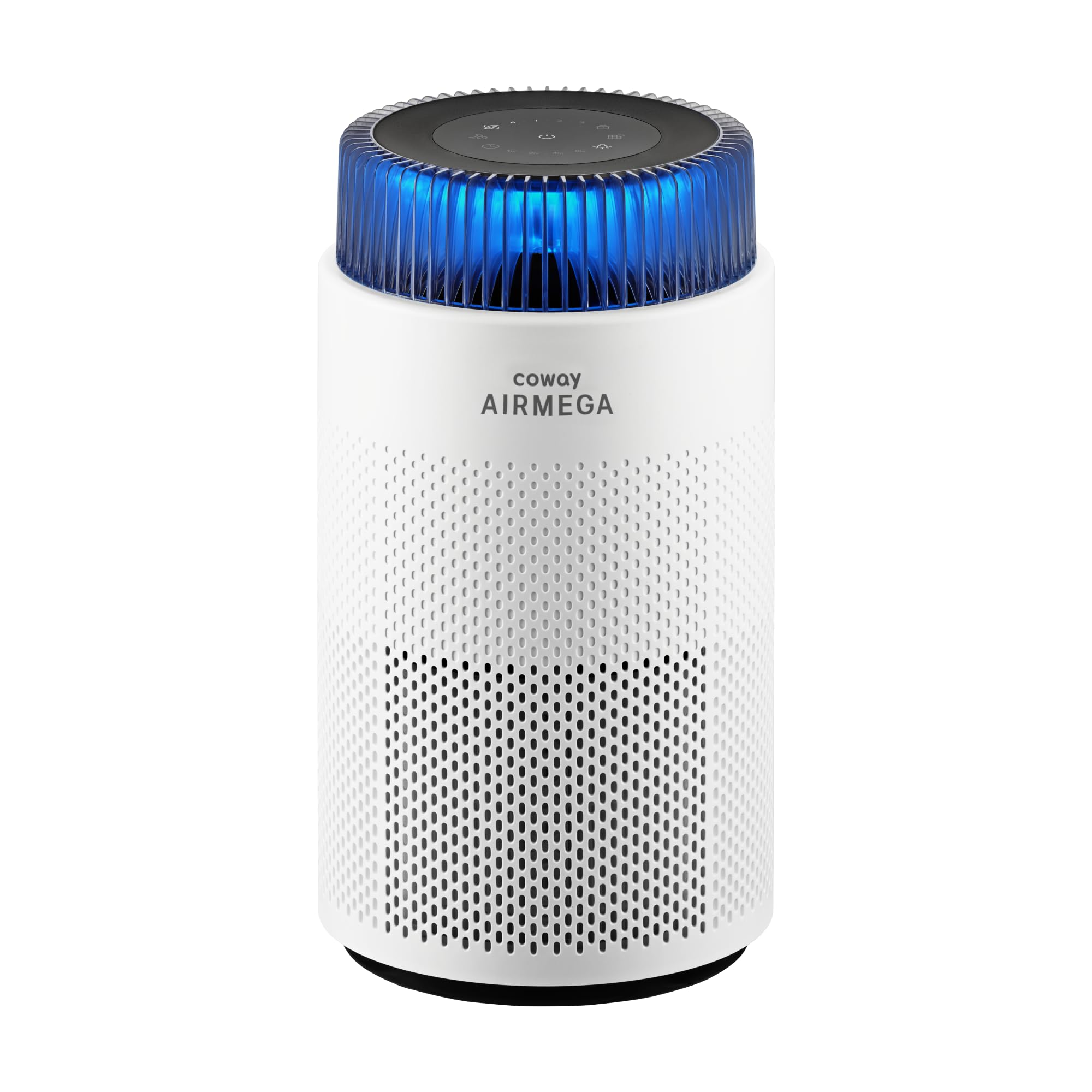
3. COWAY Airmega 100
A small-footprint filter for the bedroom or the walk-in closet — not the whole house.
At 7.5 pounds, this is the lightest unit on the list by a wide margin. Set that against the Honeywell Allergen Plus at 13.33 pounds and the difference is real: this is a purifier you can pick up with one hand and move from bedroom to closet without unplugging drama. The footprint is also the smallest here at 8.66 x 8.66 x 15.55 inches, which is why it consistently gets praised for fitting in a small bedroom or a walk-in closet where a larger unit would not.
The filtration is a three-part stack: pre-filter, deodorization filter, and HEPA. That HEPA layer is rated to reduce 99.97% of particles down to 0.3 microns — including pollen — and it also targets VOCs and odor. Auto Mode watches the air quality and adjusts the fan continuously, and Sleep Mode turns off the AQI and touch-button lights and drops the fan to its lowest speed so the bedroom stays dark. If you prefer manual control, there are three fan speeds — low, medium, and high — and a two-year manufacturer warranty on the unit itself.
Go in knowing this is a small-room machine. It is rated for 405 sq ft in 30 minutes and 810 sq ft in an hour. That is a bedroom or a home office, not an open-plan living room, and pushing it into a larger space asks more of a 7.5-pound unit than it was designed to give. Noise is also mixed in owner reports — some find it very quiet, while others describe a constant higher-pitched sound. In a closet or a guest room that is unlikely to matter; in a room you are sitting in for hours it might.
Suits the tight room: A bedroom, nursery, or walk-in closet of a few hundred square feet gets a real HEPA barrier without giving up floor space.
Skip it for the open plan: The 405 sq ft in 30 minutes rating is the ceiling of what this small unit is meant to do.
4. Honeywell Allergen Plus 3-in-1 HEPA Air Purifier
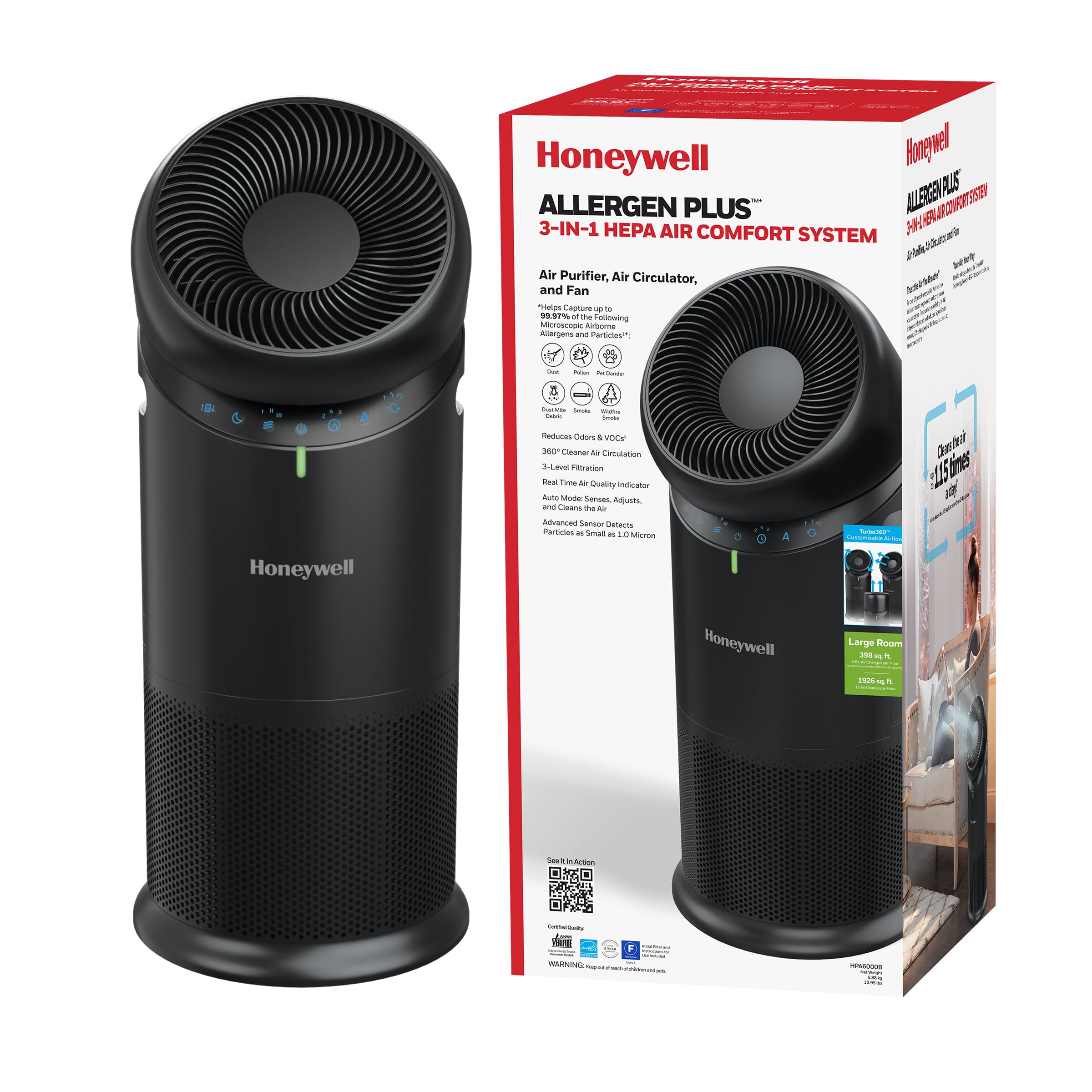
A swivel fan that spreads filtered air across the room instead of firing it at one wall.
The defining feature here is the Turbo360 fan — a swivel fan with a spin mode that distributes filtered air across a large room rather than blasting one direction. Coupled with the 360° airflow design, that is the reason it is rated for rooms up to 1,928 sq ft. The three-stage stack underneath is a cleanable pre-filter that grabs dust and pet hair, a certified HEPA layer that removes up to 99.97% of allergens, and a carbon layer for odors and VOCs.
Where this unit earns its keep is in the bedroom and nursery role. AHAM Verified coverage of 398 sq ft at 4.8 ACH means the room gets a real number of air changes per hour, not just a headline square footage. It runs quietly enough by consensus that owners routinely describe it as super quiet, and the sleep mode dims the lights and lets you set the timer at 2, 4, or 8 hours. There is also a built-in air quality sensor with a real-time color-coded display that adjusts the fan speed to match conditions, so you can glance at the color and know what the room is doing.
The recurring gripe is brightness. The lights read as too bright for some owners in a dark bedroom, which is a fair thing to know before you put it next to the bed. The sleep mode dims them, but the display is still there. If you need total darkness, plan around that. Beyond that, the filter quality is the thing people talk about most, and the cleaning performance sits right behind it — the machine does the job it is rated for.
The floor-space reality: At 13.33 pounds and 11.22 x 11.22 x 25.24 inches, this is a full-size floor unit — not a corner whisper. It earns that footprint with the swivel fan coverage.
Best for a nursery or bedroom: You want 360° coverage and a timer that lets you schedule the evening run without touching the unit again.
Not for a pitch-dark sleeper: The display brightness is a genuine compromise, even with sleep mode engaged.
5. BLUEAIR Signature SP4i
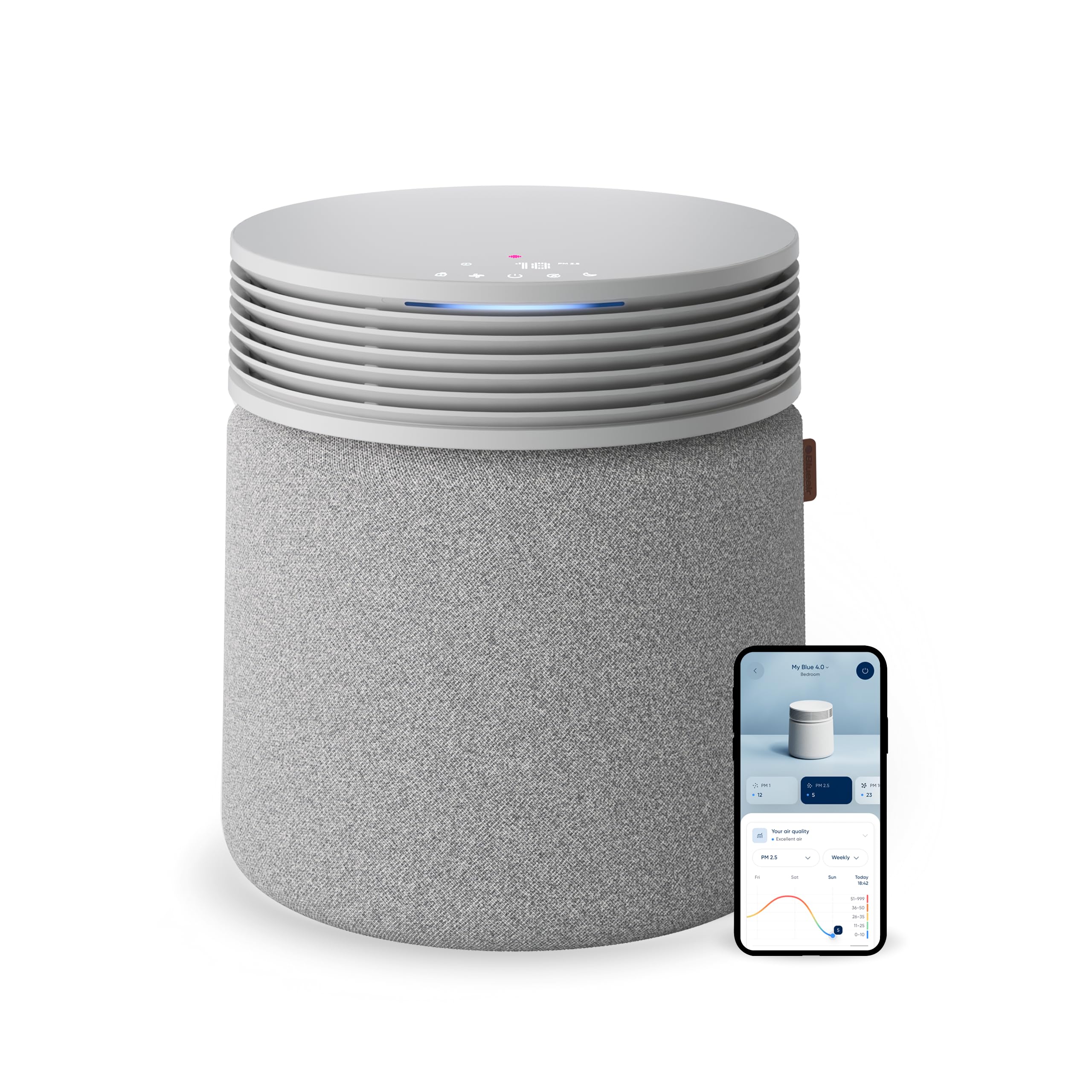
The machine that cleans a whole open floor plan in one hour — and hides as a side table.
Room coverage is where this one pulls ahead. It is rated for 3,385 sq ft per hour, and the fast figure is 705 sq ft in 12.5 minutes — better than any other pick on this list for raw area. That is the number to focus on if you have an open living-kitchen-dining layout, because it means the whole space gets an air exchange in the same window a smaller unit would need just for the living room. The Blueair Signature SP4i cleans 705 sq ft in 12.5 minutes versus 470 sq ft in 15 minutes for the WINIX 5510, so it clears a bigger footprint in a shorter window.
The filtration stack is a 7-stage HEPASilent system rated to capture 99.97% of airborne particles down to 0.3 microns, plus OdorFence to break down gases and VOCs. The quiet end runs as low as 23 dB, and the app lets you set fan speed and schedules remotely. Auto Mode adjusts based on the sensor readings, and the air quality indicator built into the air outlet shows five colors from excellent blue to poor red, plus a small animation when the unit is actively cleaning. The design is deliberate — it is styled to double as a side table, with interchangeable pre-filters in several colors so it can blend with your room rather than fight it.
Noise climbs on the higher settings, and the fan has been noted to rattle on some units — that is the honest ceiling on the quiet claim. The other thing to check before you buy is the price of the original replacement filters, which some find steep. Filter cost is the running bill, and for a unit rated for this much room it is worth knowing on the front end.
Where it leads the field
- 3,385 sq ft per hour coverage — the biggest room-clearing claim on the list
- 705 sq ft cleaned in 12.5 minutes beats the WINIX 5510’s 470 sq ft in 15 minutes
- 23 dB at the low end is genuinely library-quiet
- 7-stage HEPASilent captures 99.97% of particles down to 0.3 microns
What you should know
- Higher fan speeds get loud, and some units rattle — the quiet claim is a low-speed claim
- Original replacement filters are a steep ongoing cost
For the open-plan house: When you need one unit to cover the whole ground floor and you want it to look like furniture, this is the one.
Not for the filter-budget watcher: Factor the original filter cost into the decision before you commit.
6. COWAY Airmega 350
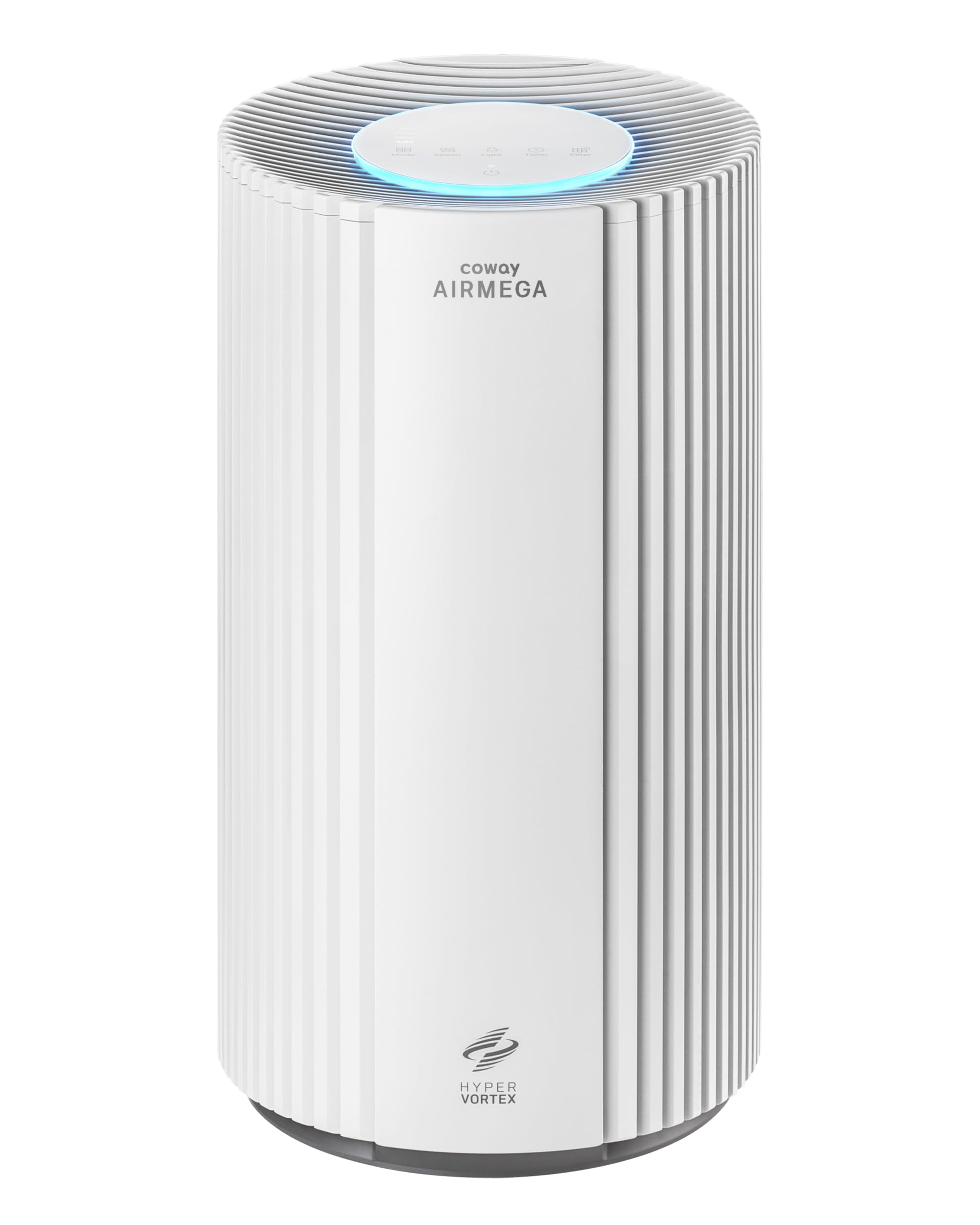
A 450 CFM pollen rating with the lowest noise floor on this entire list at 21.6 dB.
This is the pick where the spec sheet does the talking. The HyperVortex system carries a CADR of 450 for pollen, 376 for dust, and 352 for smoke — the highest pollen figure on this list. It is rated to clean 2,640 sq ft in one hour, and the noise floor drops as low as 21.6 dB. Set that against the LEVOIT Vital 200S-P at 27 dB and this one runs lower at its quietest setting, which matters if your bedroom is dead silent and any motor hum registers.
The filtration is a three-in-one stack: a vacuumable pre-filter, activated carbon, and a HEPA layer rated to reduce up to 99.97% of particles down to 0.3 microns, including pollen. The carbon layer reduces more than 99% of volatile organic compounds and also targets ammonia (NH3) and acetaldehyde (CH3CHO) fumes, which is useful if you also cook heavily or have pets. Real-time air quality monitoring tracks particles as small as PM 10, and Auto Mode adjusts fan speed to that reading. The light sensor turns off the display when the room darkens so it does not disturb bedtime, and Energy Star certification keeps the running wattage honest. A filter life indicator tells you when the HEPA element is due, and the unit carries a three-year manufacturer’s limited warranty.
At 17.2 pounds and 12 x 12 x 26.3 inches, this is a floor-standing unit that wants a corner or wall space. It is not a portable thing you move around; it is the household air machine. Owner opinion on value is split — some find it well worth it, some feel it sits high for what it is — so go in knowing you are paying for the 450 CFM pollen CADR and the three-year warranty, not for portability.
The whole-house answer: The 450 CFM pollen rating and 21.6 dB floor make this the strongest combination of cleaning power and quiet for a full home.
Not a portable: At 17.2 pounds it lives where you put it; plan the spot before it arrives.
7. AirDoctor AD3500

The purifier for the household that already knows pollen season by date.
For a household where pollen produces visible symptoms, the filtration quality is the reason this pick sits here. The UltraHEPA layer is rated to capture 99.99% of airborne particles at 0.003 microns — the finest particle size rating of any pick here — and it comes backed by third-party testing. The carbon layer is made with activated carbon and potassium permanganate to absorb and break down gases and airborne chemicals, not just the odors. Three stages — pre-filter, premium activated carbon, and UltraHEPA — cover dust, smoke, pet dander, pollen, and odors in one stack.
Coverage runs 630 sq ft in 15 minutes and up to 2,520 sq ft in one hour. The Halo display reads real-time PM2.5 with color-coded quality levels, and Auto Mode adjusts fan speed on that reading and activates Boost when needed. There are 4 fan speeds and a timer, plus a filter indicator so you know when the next change is due. AirDoctor recommends replacing the carbon filter every 6 months and the UltraHEPA every 12 months, and the unit is FSA and HSA eligible, so you can use pre-tax dollars if your plan allows it.
The trade-off is running cost. The carbon on a 6-month cycle and the UltraHEPA on an annual cycle means you are buying filter elements more often than a unit with a longer filter interval. The noise is also mixed — quiet by consensus on the lower speeds but a little loud at the top end when Boost kicks in. Neither is a deal-breaker for the allergy-first household, but both are real.
Built for the sensitive house: The UltraHEPA rating to 0.003 microns is the finest particle target on the list, and the carbon layer’s potassium permanganate is there for gases that ordinary carbon treats more slowly.
Made for allergy-first homes: If you have already tried a cheaper purifier and want the finest particle rating on the list, this is the step up.
Think about the filter calendar: Carbon every 6 months and UltraHEPA every 12 months — the maintenance is a scheduled habit, not a surprise.
8. CleanForce MEGA1000
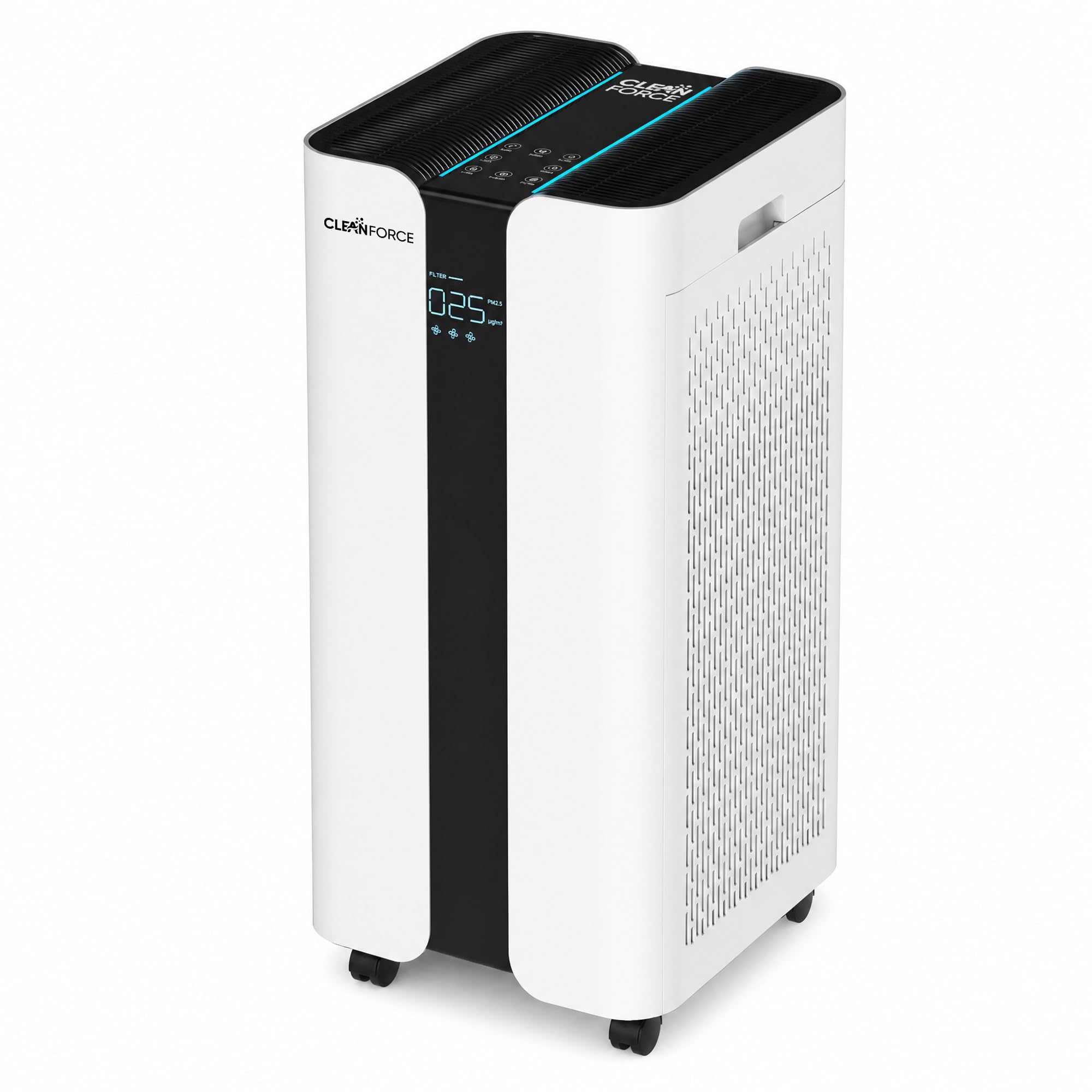
Twin-turbo fans for a room most purifiers would give up on.
If your pollen problem lives in a big open space, this is the answer. It is rated for 4,650 sq ft in one hour and 2,325 sq ft in 30 minutes — the largest short-window coverage on this list. The engine behind that is a dual air intake system with twin-turbo fans, which is why it can move that much air through a stack this large. The filtration is H13 True HEPA rated to capture 99.97% of airborne particles as small as 0.3 microns, and it runs two filter sets — meaning two pre-filters and two multi-integrated filter sets, each built from non-woven fabric, H13 HEPA, and activated carbon.
Controls are where this one gets practical. A touchscreen handles fan speed, timer, sleep mode, and a child lock, and there is a remote so you can change settings without getting up. Smart Auto Mode reads the real-time air quality and adjusts fan speed to match, so a pollen-heavy afternoon does not require you to babysit the dial. Setup is straightforward: unbox it, and owners say it only gets easier with use.
At 36.4 pounds and 14.57 x 15.55 x 31.5 inches, this is a piece of furniture in its own right. It is not the machine you move between rooms; it is the machine that handles the room it is in. The recurrent complaint in owner reports is the replacement filter cost — with two full filter sets in the unit, the running bill is higher than a single-filter design. Budget for that filter bill and the machine holds up.
What it gets right
- 4,650 sq ft in one hour and 2,325 sq ft in 30 minutes — the biggest fast-clear figure here
- H13 True HEPA with dual air intake and twin-turbo fans
- Child lock and remote control make it easier to live with in a family room
- Touchscreen puts fan speed, timer, and sleep mode in one place
What to weigh
- 36.4 pounds means it stays where it is placed — no moving it room to room
- Two filter sets means the ongoing replacement cost is higher than a single-filter design
For the biggest room: A great room, a classroom, or an open warehouse-style space that needs a genuine H13 barrier is where this belongs.
For somewhere smaller: If your room is a standard bedroom, this is more machine than you need — and the two filter sets make the upkeep heavier than necessary.
9. LEVOIT EverestAir-P

The purifier that tells you which pollutant triggered it, then does something about it automatically.
Most purifiers give you one air quality number. This one uses a 3-channel laser sensor that reads particles at PM10, PM2.5, and PM1.0 — three particle sizes, not one. In pollen terms that means you can see when the larger PM10 grains spike, which is exactly the tell-tale of a window left open during high pollen hours. The app lets you build smart scenes that trigger automatic action, so the unit can turn on when air quality drops or turn off when the house empties.
Coverage is 2,655 sq ft in one hour at a CADR of 354 CFM, and the unit carries 60% more carbon than the Vital 200S-P for tougher odors. The 3-stage original filter is pre-installed, and setup is a matter of pulling it out of the packaging and plugging it in. The app control is via Amazon Alexa, so voice control is in the picture if you already run an Alexa home. AN AHAM VERIFIDE seal means its performance figures were independently tested.
The recurring cost here is the replacement filter — it is the most expensive of the LEVOIT picks on this list. Use the sensor aggressively to schedule high-speed runs only when needed rather than leaving it on full time, and the filter life stretches. Buyers report the low speed is nearly silent, so overnight operation is realistic, but the filter bill is the thing to think about.
Pick for the data-driven home: The 3-channel sensor and app scenes are real advantages if you want to see and respond to what the air is doing.
Weigh the filter cost: The replacement filter is the pricey part of ownership — run it smart and it lasts longer.
10. Air Oasis iAdaptAir 2.0

A whole-floor purifier whose filters run up to two years between swaps.
The headline is the filter interval. The iAdaptAir 2.0 is rated to cover up to 3,975 sq ft and its filters last up to two years between replacements — the longest interval on the list. That changes the ownership math. Instead of buying HEPA elements every six or twelve months, you are buying them roughly half as often as the AirDoctor AD3500, which recommends an annual UltraHEPA change. For a big house where you intend to run a purifier year in and year out, that interval is the feature that matters most.
Power is a 530 CADR rating, which covers 3,975 sq ft in one hour or 795 sq ft in 12 minutes. The filter media is H13 True HEPA rated to stop particles as small as 0.05 microns, which is finer than the standard HEPA threshold. On top of that, the unit combines carbon filtration, an antimicrobial silver filter, bi-polar ionization, and UV light to capture mold, bacteria, viruses, and chemical odors. Real-time PM2.5 monitoring and Auto Mode adjust the fan speed based on air quality, and the app lets you check in remotely. One feature with no equivalent elsewhere: the WiFi chip is removable and can be disabled for EMF-sensitive users while keeping every other function working. Running noise is 25 dB at the quiet end.
At 20 pounds and 11.2 x 11.2 x 37 inches, this is a tall tower — 37 inches makes it a piece of furniture, not a tabletop unit. The value math is simple: the upfront price sits at the high end, but the two-year filter interval lowers your cost per square foot. If you plan to keep it for a decade, the number works out; if you want the cheapest entry, it is not this unit.
The two-year play: 530 CADR and up to two years between filter swaps is the combination that matters for anyone who wants to set a purifier up and leave it running for a decade.
For the long-haul household: If you are furnishing a floor or a whole home and want minimal filter fuss, the two-year interval plus the 530 CADR earns its place.
Not the cheapest entry: The upfront buy sits high; the return is in the two-year filter interval, not in the initial outlay.
11. AirDoctor AD5500
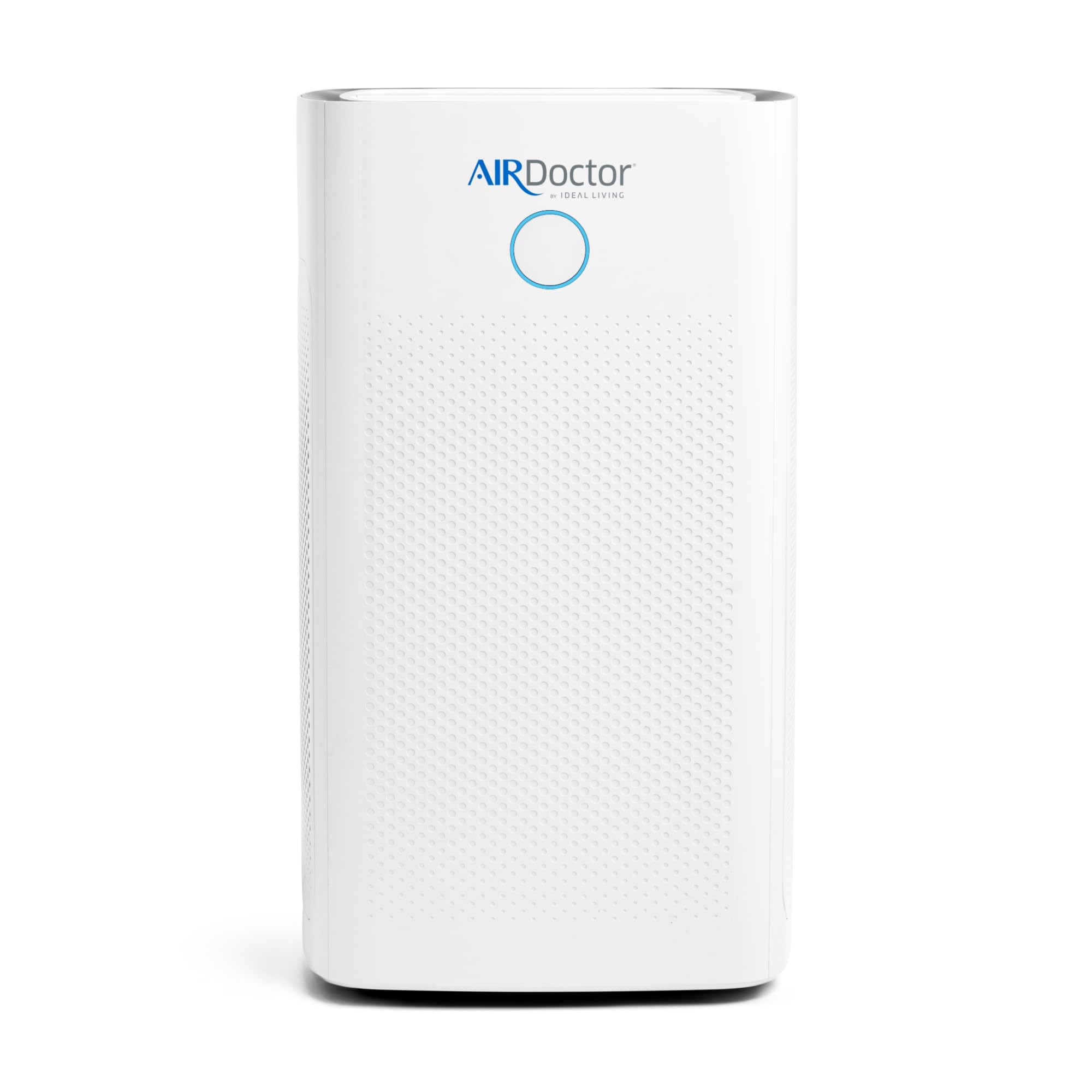
Four thousand square feet in an hour, from a purifier the size of an end table.
The AD5500 is the bigger sibling of the AD3500, and the gap is in the coverage. It is rated for 4,172 sq ft in one hour, or 1,043 sq ft in 15 minutes. That makes it the whole-home pick among the two AirDoctor units — the one you want if the space is an open floor plan rather than a couple of closed rooms. The filtration is the same UltraHEPA rated to capture 99.99% of airborne particles at 0.003 microns, backed by third-party testing, with a premium activated carbon layer made from activated carbon and potassium permanganate to absorb and break down gases, odors, and VOCs.
The control set matches the bigger capacity. The filter schedule is the same: carbon every 6 months, UltraHEPA every 12 months. It is FSA and HSA eligible. At 25.95 pounds and 16 x 16 x 28.75 inches it is a serious floor unit, and the fan set to a higher speed will make itself heard.
The trade-off is that you are buying the whole-home capacity and paying for it. The filter calendar stays the same as the smaller AD3500 while the room coverage is bigger, so the cost per square foot improves — but the filter bill on a six-month carbon cycle is still the running cost to account for. If your space is a normal single bedroom, the AD5500 is more machine than you need; the AD3500 above is the sensible choice.
Why the whole-home pick
- 4,172 sq ft in one hour — the biggest coverage among the AirDoctor pair
- UltraHEPA rated to 99.99% of particles at 0.003 microns
- 6 fan speeds plus timer and filter indicator give more granular control
- FSA and HSA eligible, so pre-tax dollars can be used if your plan allows it
What it costs you
- 25.95 pounds — a floor unit, not a room-to-room mover
- Higher fan speeds make themselves heard, so quiet is a low-speed claim
- Six-month carbon cycle is the maintenance rhythm
For the open floor plan: The 4,172 sq ft coverage and 6 fan speeds are designed for a single large volume of space rather than a set of separate rooms.
Skip for a single bedroom: A smaller AD3500 covers a bedroom well and keeps the same 0.003 micron rating — this one is only worth it for the bigger space.
Know the Specs
CADR (clean air delivery rate)
CADR is the number to hunt for on any pollen purifier box. It is measured inCFM (cubic feet per minute) and it tells you how much filtered air the machine pushes out each minute — for a specific particle type. A pollen CADR is the volume of pollen-free air the unit delivers per minute, so a higher pollen CADR means a bigger room gets cleaned in less time. Models here publish pollen figures of 289 CFM, 354 CFM, 450 CFM, and a 530 CADR rating. When a listing gives only one CADR and does not say which particle it applies to, ask — pollen, dust, and smoke are tested separately and the numbers differ.
True HEPA versus HEPA-type
A true HEPA filter is rated to capture 99.97% of particles at 0.3 microns — the hardest particle size to trap — and the grades climb from there. H13 is a European classification that sits at the same 99.97% threshold at 0.3 microns but is tested to a stricter standard overall. The picks here use true HEPA, H13, or in two cases an UltraHEPA rated down to 0.003 microns. What matters for pollen is that pollen grains are far larger than 0.3 microns, so any true HEPA filter catches them. The finer ratings buy you more on smoke, viruses, and ultrafine particles than they do on pollen.
Room coverage and the 15-minute window
Every purifier quotes an hourly coverage figure, but the short windows are the honest ones for a bedroom. One unit cleans 470 sq ft in 15 minutes; another handles 2,325 sq ft in 30 minutes. The difference is fan power and filter size, not marketing. Work out your room’s square footage — length times width — and read the shortest window in the listing to see whether the unit clears your bedroom before you fall asleep or only over an hour while you are out of the room.
Noise at the low end
Noise is measured in dB, and every 10 dB is roughly a doubling in perceived loudness. The lowest figure here is 21.6 dB, the highest low-end figure is 27 dB. A 23 dB unit is close to a quiet library; a unit that only goes quiet on a low setting but rises on high is a different experience for a bedroom. If a listing does not publish a dB number, that is a sign to check the reviews for sleep-mode commentary before you commit.
Washable pre-filter and filter cost
The pre-filter catches hair and large dust before it reaches the expensive HEPA element. A washable pre-filter means you rinse it instead of replacing it, and it extends the life of the HEPA layer behind it. Filter schedules on this list range from a washable pre-filter plus periodic HEPA swaps, to carbon every 6 months and a 12-month UltraHEPA, to a unit rated for up to two years between filter changes. Whatever the schedule, price the genuine replacement filter before you buy the machine — that is the number that recurs.
Air quality sensors and Auto Mode
A particle sensor reads the air and tells the purifier how hard to work. Sensors range from a single PM2.5 reading to a 3-channel sensor that reads PM10, PM2.5, and PM1.0 separately — the 3-channel version lets you pinpoint when the larger pollen-sized particles spike. Auto Mode takes that sensor reading and adjusts the fan speed without you touching the dial. That combination is what makes a purifier livable: high fan speed only when the air needs it, quiet when it does not.
Common Questions
Does a HEPA air purifier actually remove pollen from the air?
What size air purifier do I need for a bedroom?
How often do I have to replace a HEPA filter during pollen season?
Is it worth running the purifier all night for pollen?
Do I need a pollen-specific purifier or is any HEPA unit enough?
Can a purifier replace keeping the windows closed during pollen season?
Does a heavier purifier clean better than a lighter one?
Will a purifier on high speed keep me awake at night?
How long does it take a good purifier to clear pollen after the window has been open?
Are the replacement filters expensive and do I have to use the brand’s own?
The Bottom Line
The pollen air purifier winner is the LEVOIT Vital 200S-P, because it is the only pick here that pairs a lab-measured pollen CADR of 289 CFM with an AHAM VERIFIDE seal and a 27 dB bedroom-quiet floor — the exact combination a pollen-sensitive sleeper needs. If you have a larger room and want maximum air movement, the COWAY Airmega 350 carries the highest pollen CADR on this list at 450 CFM. And for a small bedroom, nursery, or walk-in closet, the compact COWAY Airmega 100 delivers a real HEPA barrier without eating floor space.
Before you buy, remember that pollen control is an airflow game, not a filter-grade game. Every unit here catches pollen with a true HEPA or finer filter, so the deciding factor is whether the fan can move enough filtered air through a room the size of yours before pollen settles back onto the sheets.
The Vital 200S-P earns the top spot on three things: a published pollen CADR, an AHAM VERIFIDE seal, and a 27 dB overnight run — not on being the biggest machine here.
How we choose
We do not accept paid placement. Every pick is matched to a real buyer and a real use-case; we do not hands-on test units.
Sources
Specifications: manufacturer listings and product documentation. Review insights: verified customer reviews, as of November 2026. Pricing: not shown on this page (it changes often); check the current price via the retailer link.
As an Amazon Associate, Tactical Gear Guy earns from qualifying purchases. This does not affect which products we feature.