Specs are compiled from manufacturer listings and verified buyer reviews and can change over time — please confirm the key details on the product page before buying.
Buying a riding mower is mostly a bet on how often it will quit on you mid-season. The short answer: electric zero-turn riders from EGO and gas machines with a proven Kawasaki or Briggs engine both top this list, and which one you pick depends on how much lawn you cut and how much maintenance you are willing to do yourself.
This guide is built by comparing the manufacturers’ published specifications and the patterns across verified customer reviews, so you get each pick’s real strengths and trade-offs instead of marketing spin.
Below you get deck widths, cutting-height ranges, runtime in acres, and which machines owners actually keep mowing with — so you can match a mower to your yard instead of guessing at the spec sheet. Here is the honest breakdown of the most reliable riding mowers you can buy for a yard that needs real work done.
Top Picks

How To Choose The Best Most Reliable Riding Mowers
Reliability on a riding mower means two things: it starts when you turn the key, and it finishes the lawn without something slipping, seizing, or dying on you. The specs that predict that are easier to read than the brochures make them sound.
Start with deck width, because it sets your mowing time
The cutting deck is the metal shell that holds the blades, and its width in inches is the single biggest lever on how long you spend mowing. A wider deck covers more grass per pass. The catch is clearance — a wide deck is harder to thread between a shed and a fence. A 42-inch deck is the practical middle ground for most suburban lots, while a 61-inch deck is built for open ground and larger acreage.
Read the cutting-height range, not just the number of settings
Cutting height is how far the blades sit above the dirt, and the adjustable range tells you how much grass you can handle. Ten positions between 1.5 and 4.5 inches lets you drop low for a scalped end-of-season cut or ride high when the rain has pushed the grass up. A narrow range limits your options when the lawn gets away from you.
Batteries versus gas: the reliability question in plain terms
Gas mowers ask you to manage fuel, oil, filters, and belts — more moving parts, more that can demand attention. Battery riders replace all of that with cells and motors. On the electric side, look at how many batteries the mower carries and what the maker rates runtime in acres on a single charge, because that number tells you whether you can finish before you run dry.
Weight and turning radius in the real world
A zero-turn mower steers with two independent drive wheels, so it pivots on the spot instead of following a front axle. That tight turn is why these machines save time around beds and trees. Heavier machines tend to stay planted on slopes, but they also need firm ground — expect to think about where you drive a machine that runs into the hundreds of pounds.
Side-by-Side Comparison
| Model | Best For | Cutting Width | Cutting Height Range | Item Weight | Amazon |
|---|---|---|---|---|---|
| EGO Power+ ZT5207L 52″ Zero Turn★ Best Overall | Big yards with no gas routine | 52 inches | 1.5 to 4.5 inches | 527.4 pounds | Amazon |
| CRAFTSMAN 42″ Gas Riding Lawn MowerBest Value | Budget-minded gas mowing | 42 inches | Up to 3.13 inches | 410 pounds | Amazon |
| Husqvarna MZ61 Zero Turn | Large acreage, commercial-grade parts | 61 inches | 38.1 to 114 millimeters | 844 pounds | Amazon |
Detailed Reviews
1. EGO Power+ ZT5207L Riding Lawn Mower
Our pick — 4.0+★ from 60+ verified ratings; the strongest balance of quality and price.
The widest deck on this list that still finishes a big yard on batteries alone.
If your lawn is measured in acres and you are done with oil changes, this is the machine the rest of the list is chasing. The 52-inch cutting deck covers a wide swath on every pass, and it rides on six included 56V 12.0Ah ARC Lithium batteries — EGO rates it for up to 4 acres on a single charge. That runtime figure is the honest headline here: it is the widest deck in this group paired with the longest rated coverage, so you spend less time circling and less time plugged in.
Steering is zero-turn, meaning two independent drive wheels pivot the machine on the spot instead of tracing a front axle, and speed runs 4 to 8 MPH. Cutting height moves through 10 positions so you can ride high over wet growth or drop low for the last cut of the season. The alloy steel deck and the absence of a fuel routine — no gas, no oil, no air filter, no drive belt — are what owners point to when they talk about why they switched.
What wins people over most is raw performance — it is the aspect that comes up far more than any other, and the ride comfort and low noise get steady mention too. The one thing to plan around is the batteries themselves: a slice of buyers report packs failing before the first mow, so check each pack the day the crate arrives rather than the day you need to cut. That is a fit-note, not a verdict — this machine holds 4.0+ stars and its owners overwhelmingly keep mowing with it.
Where it pulls ahead
- 52-inch deck paired with up to 4 acres of rated runtime — the widest-and-longest combo here
- 4 to 8 MPH speed range lets you dial down for detail work
- Six 56V 12.0Ah batteries included, and the platform is compatible with all EGO 56V ARC Lithium packs
- No gas, oil changes, air filters, or drive belts to babysit
Where to be careful
- Battery life draws the only mixed feedback — verify the packs on arrival
- At 527.4 pounds it wants firm ground, not soft turf after heavy rain
Reach for this if: you have an acre or more and want the widest deck with the longest rated runtime so one charge finishes the job.
Think twice if: you would rather not manage six battery packs — a smaller-deck machine with fewer cells is the easier routine.
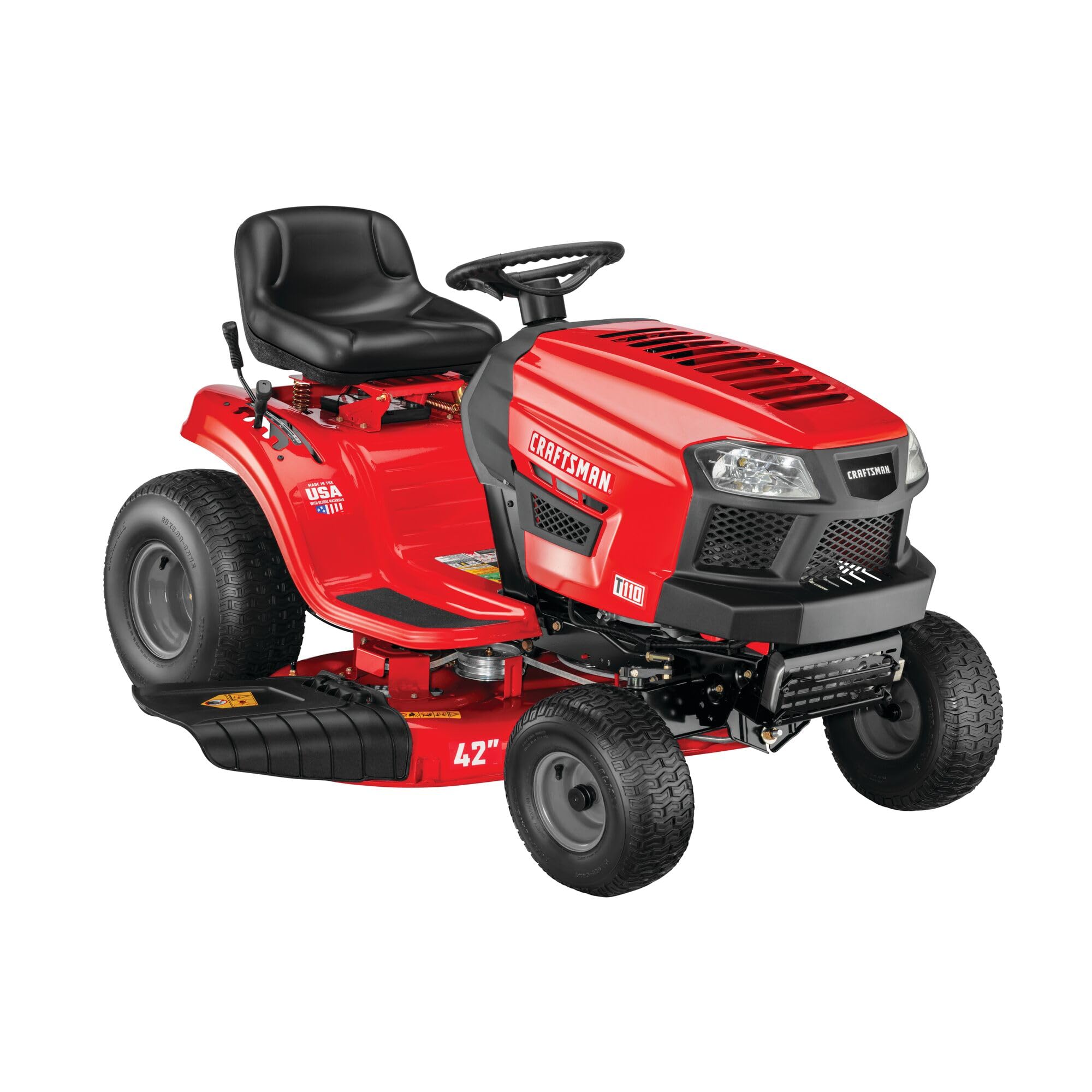
2. CRAFTSMAN 42″ Gas Riding Lawn Mower
The straightforward gas tractor for a smaller yard and a smaller budget.
Here is the pattern most riders start with: a 42-inch stamped steel deck rated to cut up to 2 acres, a 17.5 HP Briggs and Stratton single-cylinder engine, and an 18-inch turning radius that lets you dodge beds and mailboxes without a five-point turn. It is 410 pounds — the lightest machine on this list, and 230 pounds lighter than the EGO TR4204 at 640 pounds, which matters when you are rolling it over a soft spot or loading it on a trailer.
Power delivery is a 7-speed manual transmission, so you pick the gear for the task in front of you instead of letting a hydrostatic drive do it. Owners mention it starts readily and is genuinely easy to work on when you need to get underneath. Performance is what buyers praise most about it, and the contoured low-back seat gets credit for keeping the ride civil on a long cut.
The honest caveat lives in the deck belt — it coming off is the recurring gripe, and durability is the weakest of the aspect groups here. Assembly also divides people, with some machines arriving not fully put together, so budget an evening for setup or have it delivered assembled. Treat this as a light-duty gas tractor and it does the job; ask it to keep pace with a heavier commercial machine and you will feel the difference. Note that EGO’s 52-inch deck at 1.5 inches of minimum cut goes lower than the CRAFTSMAN’s stated minimum, which is worth knowing if you scalp your lawn at season’s end.
The value read: a 42-inch stamped steel deck, a 17.5 HP Briggs and Stratton engine, and a 7-speed transmission for a yard up to 2 acres — the entry point into gas riding without commercial-grade parts.
The honest limit: the deck belt working loose is the complaint that repeats, and the assembly is not always complete on arrival.
Best fit for: a homeowner with a yard under 2 acres who wants simple gas power and does not mind turning a wrench now and then.
Less ideal for: anyone expecting heavier-than-previous-model build — the durability notes here point to lighter construction than the older models it replaced.
3. EGO Power+ TR4204 Riding Lawn Mower

Four big packs, a two-hour turnaround, and 2 acres in a single pass.
The math buyers actually care about is runtime versus recharge, and this machine leans into both. Four included 56V 10.0Ah batteries carry it up to 2 acres on a single charge, and they refill in roughly two hours on the included Z6 wall charger. EGO also notes you can add more batteries to push the coverage to 3, 4, or 5 acres — which is the flexibility that makes this a smart platform buy rather than a fixed one.
Power is rated equivalent to 22 horsepower, and it hits up to 8 MPH in zero-turn steering. The 42-inch stamped steel deck handles 3-in-1 mowing — mulch, bag, or side discharge — across 10 cutting heights from 1.5 to 4.5 inches. Three driving modes (Standard, Control, Sport) let you tame the speed for detail work through a simple LCD interface.
Quality is the standout — owners describe the build as excellent and the machine as effective at the job. Battery life splits opinion, though, and handling draws the same kind of split verdict, with some finding it stable and others reporting it slides on slopes and tears turf. Pack and tyre condition matter on that front. It carries a 42-inch deck like the TR4204, but lands 2 acres of rated runtime against the TR4204’s 1.5 — the extra battery capacity is doing real work.
Fits you if: a two-acre lawn and a two-hour recharge window is a combo that works with your weekend schedule.
Snag to know: on slopes, some owners find it slides and rips the grass up — flat, firm ground is where it shines.
4. Husqvarna MZ61 Zero Turn Lawn Mower

The 61-inch gas zero turn built around commercial-grade parts and a Kawasaki twin.
Nothing on this list cuts as wide a swath. The 61-inch, 3-blade fabricated deck covers more ground per pass than any other pick here — the CRAFTSMAN manages 42 inches against this machine’s 61. Fabricated means the deck is welded from heavier plate rather than stamped from a single sheet, and that construction is what the price buys you.
The engine is a 24HP/726cc Kawasaki FR730V Series V-Twin, paired to a Hydro Gear ZT-3100 commercial-grade hydrostatic transmission — the kind of drivetrain rated for sustained duty rather than occasional Saturdays. Fuel capacity is 5 gallons, so refuel stops are infrequent on a big property, and the roll-over protection structure (ROPS) is a bar that shields you if the machine tips. Warranty runs 4 years for consumer use.
Cutting height adjusts across 3 positions, from 38.1 to 114 millimetres, and this machine weighs 844 pounds — far heavier than the CRAFTSMAN at 410, so it holds its line on slopes but wants solid, dry ground underfoot. It is also a gas engine, which brings back the oil and filter routine the electrics skip. Given the smaller owner base, the honest read is that this is a spec-forward pick for buyers who already know they want a wide fabricated deck and a Kawasaki twin.
Why it earns a spot: a 61-inch fabricated deck, a 24HP/726cc Kawasaki FR730V V-Twin, a Hydro Gear ZT-3100 transmission, and 5 gallons of fuel capacity — commercial-grade bones for the largest lawns.
Weight you feel: at 844 pounds it needs firm ground and a plan for storage.
Consider it if: you mow several open acres and want the widest cut and a Kawasaki twin doing the pulling.
Pass if: you are on a small suburban lot — a 61-inch deck is more mower than you can use, and the weight becomes a chore.
Know the Specs
Cutting width and what it does to your day
Cutting width is the span the deck covers in one pass, measured in inches. A wider deck means fewer passes over the same ground, so a 52-inch or 61-inch deck can trim real minutes off a large lawn compared with a 42-inch model. The cost is maneuverability — a wide deck is harder to thread around tight corners, which is why a smaller deck often wins on a cluttered lot.
Cutting-height range in inches and millimetres
Cutting height is how far the blades sit above the dirt, and the adjustable range shows how much grass you can handle. Some riders here span 1.5 to 4.5 inches across multiple positions; one gas zero turn lists its range in millimetres — 38.1 to 114. A wider range lets you ride high over wet growth or drop low for that last cut of the season.
Battery runtime in acres versus fuel capacity in gallons
Electric riders rate their coverage in acres per charge — the figure that tells you whether you can finish the lawn before you run dry. Gas machines get rated in fuel capacity, like a 5-gallon tank, which sets how far you go between fill-ups. Comparing the two honestly means asking how many acres your lawn is, then checking whether the machine’s rated coverage clears it.
Transmission type: hydrostatic versus manual
Hydrostatic transmissions use fluid to move the wheels and let you steer with two levers — that is zero-turn steering. Manual transmissions, like a 7-speed, make you shift for the task. Hydrostatic drives tend to ask less of the operator; a manual gearbox gives you direct control and fewer parts to service, but it is less forgiving on a stop-and-go lawn.
Common Questions
Is a zero turn mower more reliable than a lawn tractor?
How many acres can an electric riding mower cut on one charge?
Do EGO riding mowers work with other EGO 56V batteries?
What cutting height should I use for tall wet grass?
How much maintenance does a gas zero turn need versus electric?
Will a 61-inch deck fit through my gate?
How long does the warranty cover a riding mower?
Can I add more batteries to an electric riding mower to cut more acres?
What is a ROPS bar on a zero turn mower?
Should I keep grass cut higher or lower at the end of the season?
The Bottom Line
If you want one dependable pick, the most reliable riding mowers winner is the EGO Power+ ZT5207L because its 52-inch deck and up to 4 acres of rated runtime clear a large lawn on one charge with no gas, oil, or drive-belt routine to keep up with. If you want maximum cut width and a Kawasaki V-twin doing the pulling, grab the Husqvarna MZ61 with its 61-inch fabricated deck. And for a smaller lawn on the simplest gas budget, the CRAFTSMAN 42″ is the one to reach for — just verify the deck belt after setup. Match deck width and rated acres to your yard size and any of these will mow reliably for years.
How we choose
We do not accept paid placement. Every pick is matched to a real buyer and a real use-case; we do not hands-on test units.
Sources
Specifications: manufacturer listings and product documentation. Review insights: verified customer reviews, as of November 2026. Pricing: not shown on this page (it changes often); check the current price via the retailer link.
As an Amazon Associate, Tactical Gear Guy earns from qualifying purchases. This does not affect which products we feature.